Zillow Group, Inc. ZG
New risk paragraphs, branching off last year
Each branch is a paragraph in Risk Factors with nothing like it in the 10-K filed Feb 11, 2025. A box jumps to the paragraph as filed, below.
Paragraphs with nothing like them in last year's 10-K
21 paragraphs in Risk Factors of the 10-K filed Feb 11, 2026 with nothing like them in the 10-K filed Feb 11, 2025. Quoted exactly. Paragraphs that were only edited are under 10-K change.
•We may face costly intellectual property disputes, including claims that we infringe the rights of others.
•The Revolving Credit Facility contains restrictive and financial covenants that may limit our operational flexibility.
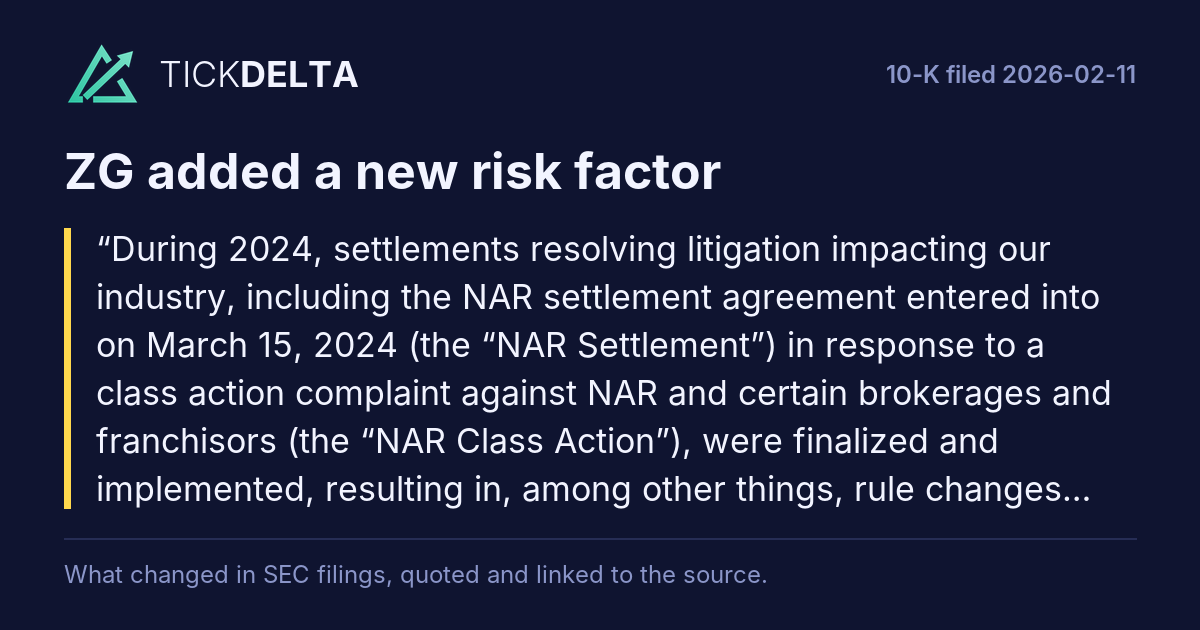
During 2024, settlements resolving litigation impacting our industry, including the NAR settlement agreement entered into on March 15, 2024 (the “NAR Settlement”) in response to a class action complaint against NAR and certain brokerages and franchisors (the “NAR Class Action”), were finalized and implemented, resulting in, among other things, rule changes affecting how commissions are offered and negotiated, and requiring written buyer-broker agreements before home tours. These changes have altered long-standing industry practices and may continue to impact how home buyers and sellers engage with real estate professionals in the course of buying and selling a home.
•effectively navigate the complex legal, regulatory, and industry landscape in which we operate; and
Our public statements, disclosures, targets, and product features relating to sustainability, including climate, diversity, or other socially or politically sensitive topics, may expose us to reputational harm, regulatory scrutiny, litigation, or commercial retaliation.
We have made, published, or released, and may continue to make, publish, or release, public statements, disclosures, targets, and product features relating to social impact and innovation, environmental sustainability, climate-related metrics (including science-based targets for reducing greenhouse gas emissions), workforce matters, responsible business practices, and other sustainability-related topics. These statements, disclosures, targets, and product features reflect plans, assumptions, methodologies, and third-party data sources available to us at the time they were made, published, or released, and are subject to evolving standards, interpretations, and data limitations. Our failure, or perceived failure, to accomplish or accurately track, measure, substantiate, or disclose information related to these statements, disclosures, targets, and product features, or to timely update them as circumstances change, could result in reputational harm, increased scrutiny from investors, regulators, and other stakeholders, enforcement actions under emerging “greenwashing” or consumer protection laws, or private litigation.
Expectations regarding sustainability-related practices, disclosures, and business decisions continue to evolve and are increasingly varied across investors, regulators, customers, employees, policymakers, and other stakeholders. As a result, actions or disclosures that are intended to address the expectations of certain stakeholders, may be viewed by others as insufficient, excessive, or misaligned with their views. This dynamic may expose us to reputational harm, political or regulatory scrutiny, consumer or partner boycotts, retaliatory legislative or regulatory actions, employee relations challenges, or reduced demand for our products or services, any of which could adversely affect our business, operating results, or financial condition.
In addition, the inclusion, exclusion, modification, or presentation of sustainability-related information within our products or services, including information derived from third-party sources, may give rise to similar reputational, legal, or commercial risks.
Show the other 8
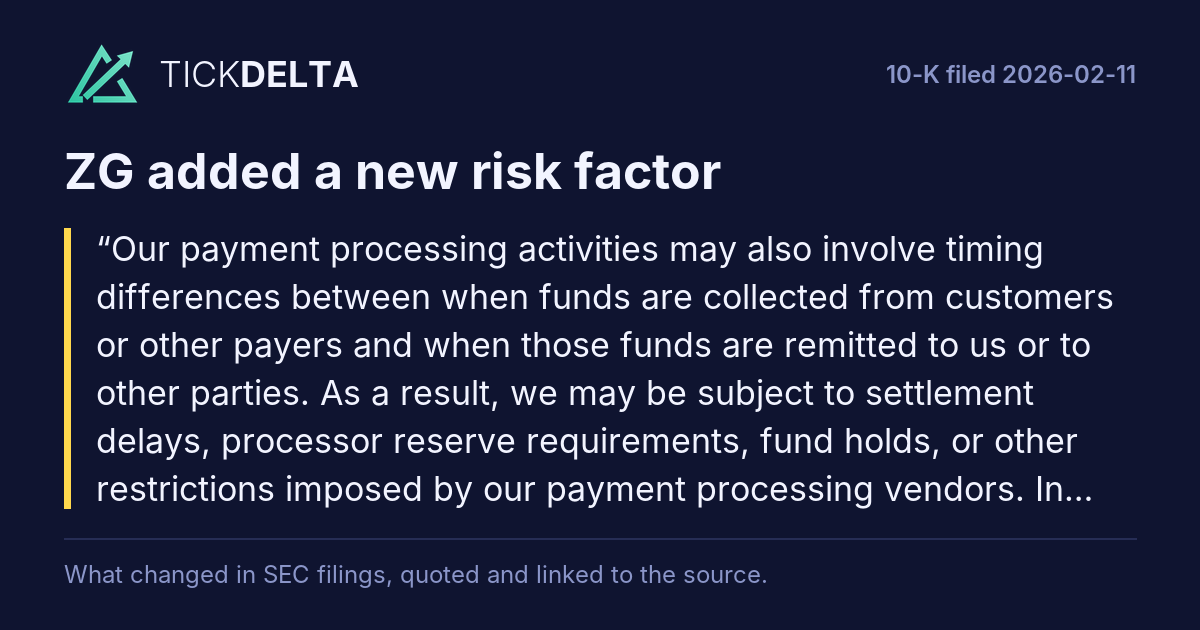
Our payment processing activities may also involve timing differences between when funds are collected from customers or other payers and when those funds are remitted to us or to other parties. As a result, we may be subject to settlement delays,
processor reserve requirements, fund holds, or other restrictions imposed by our payment processing vendors. In addition, we could incur losses if a customer or other counterparty fails to perform during applicable settlement windows. Any of these factors could adversely affect our liquidity, working capital, or cash flows.
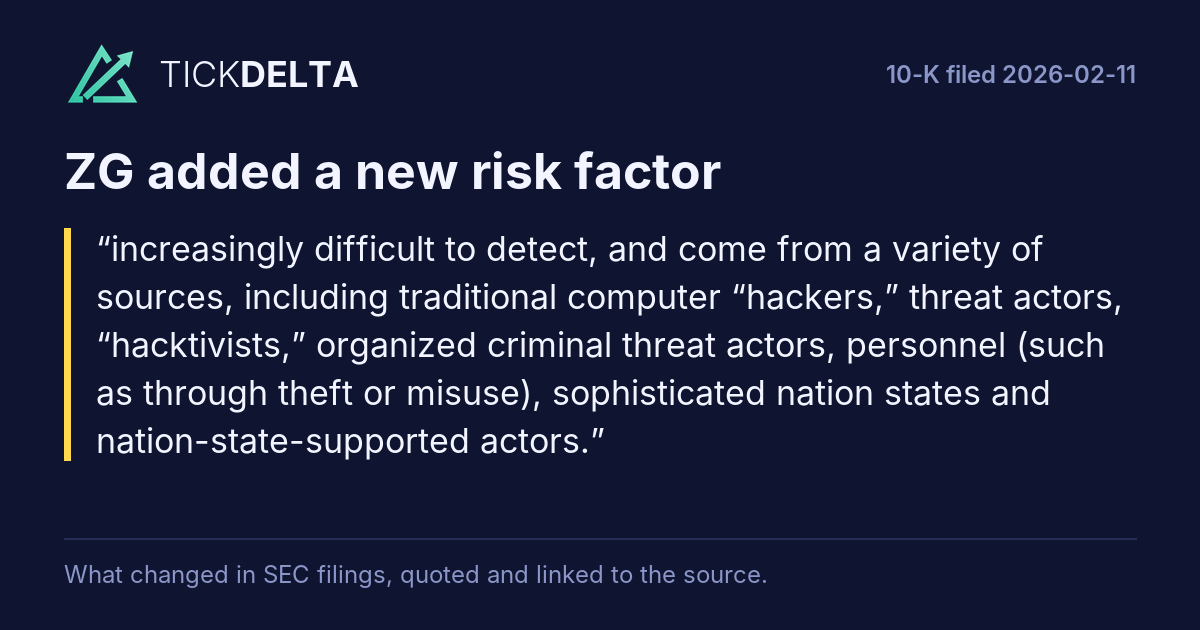
increasingly difficult to detect, and come from a variety of sources, including traditional computer “hackers,” threat actors, “hacktivists,” organized criminal threat actors, personnel (such as through theft or misuse), sophisticated nation states and nation-state-supported actors.
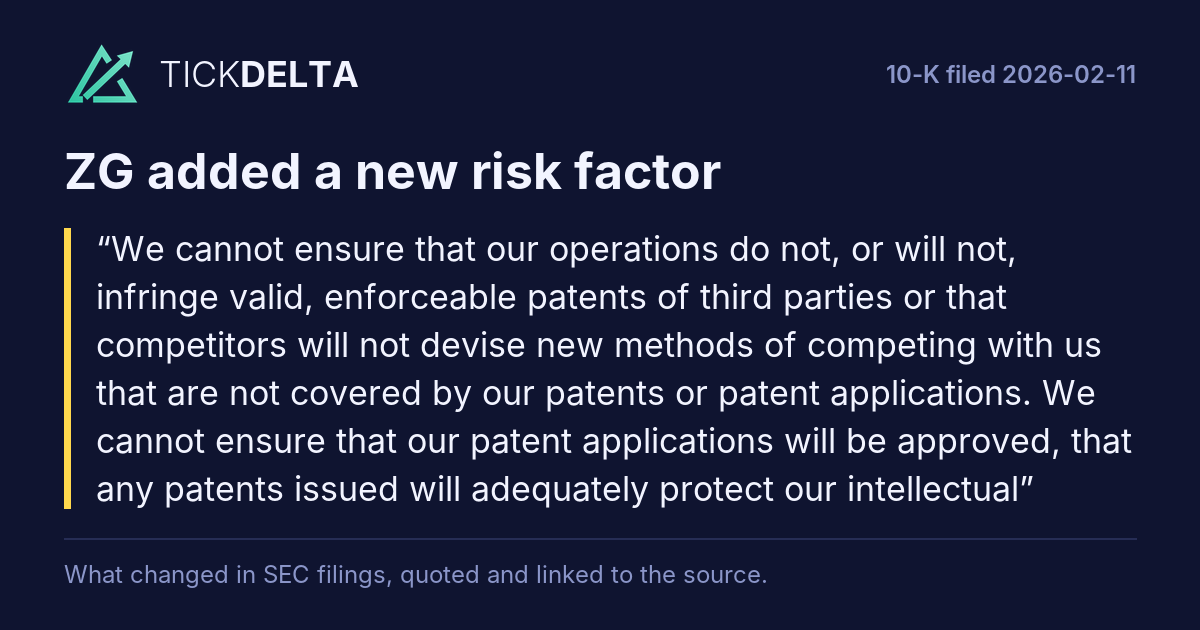
We cannot ensure that our operations do not, or will not, infringe valid, enforceable patents of third parties or that competitors will not devise new methods of competing with us that are not covered by our patents or patent applications. We cannot ensure that our patent applications will be approved, that any patents issued will adequately protect our intellectual
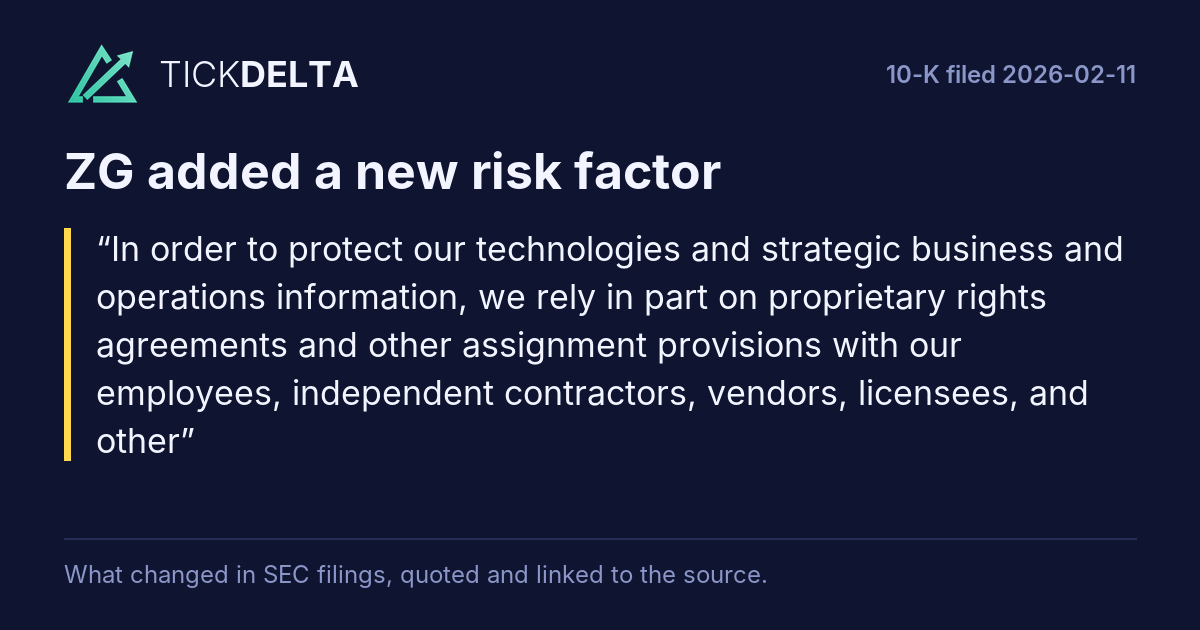
In order to protect our technologies and strategic business and operations information, we rely in part on proprietary rights agreements and other assignment provisions with our employees, independent contractors, vendors, licensees, and other
The number and scope of potential legal proceedings may increase as our business expands and our products and services evolve. For example, during 2025, among other claims, we were named in complaints filed by the Federal Trade Commission, certain state attorneys general, Compass, Inc., CoStar Group, Inc., and consumer plaintiffs in a purported class action, alleging antitrust, intellectual property, consumer protection, RESPA, and other claims. See Part II, Item 8 in Note 13 under the subsection titled “Legal Proceedings” in our Notes to Consolidated Financial Statements in this Annual Report on Form 10-K for additional information about certain of these and other legal proceedings.
The Revolving Credit Facility contains restrictive and financial covenants that may limit our operational flexibility. If we fail to meet our obligations under the Revolving Credit Facility, our operations may be interrupted and our business, results of operations, and financial condition could be adversely affected.
The Revolving Credit Facility contains customary conditions to borrowing, events of default, covenants, and other provisions that may limit our flexibility to take certain actions. The covenants include restrictions on our ability to incur indebtedness, grant liens, make investments, make distributions or other restricted payments, or engage in certain transactions, and under certain conditions require us to comply with a total net leverage ratio. The obligations under the Revolving Credit Facility are secured by a first lien on substantially all the assets of the Company and certain of its subsidiaries, with customary exceptions.
Various risks, uncertainties, and events beyond our control could affect our ability to comply with these covenants. Failure to comply with any of the covenants could result in a default under the Revolving Credit Facility. Such a default could reduce or suspend the availability of borrowings under the Revolving Credit Facility or could permit lenders to accelerate the maturity of outstanding amounts, if any, under the Revolving Credit Facility, which in turn could result in adverse
consequences that negatively impact our business, the market price for our stock, our other financing arrangements, or our ability to obtain other financing in the future. Further, upon an event of default, the lenders could exercise remedies against the collateral granted to secure the Revolving Credit Facility, which could limit our financial and operational flexibility and adversely affect our liquidity or financial condition.
indication of future performance. In addition, our results of operations may not meet the expectations of investors or public market analysts who follow us, which may adversely affect our stock price.
As our operations expand, a greater portion of our operating expenses may be denominated in foreign currencies, and fluctuations in foreign exchange rates could increase our operating costs or adversely affect our results of operations.
These provisions may also have the effect of delaying or preventing a change of control of our company, even if this change of control would benefit our shareholders.
Paragraphs in the 10-Q filed Nov 4, 2026 that were not in the one before
New in the latest 10-Q
18 paragraphs in the 10-Q filed Nov 4, 2026 with nothing like them in the 10-Q filed Aug 5, 2026 (at least half the words must differ; new numbers alone do not count). Quoted exactly, grouped by the item heading above them. This is text that changed, not a judgement of how serious it is.
Financial statements and notes
In August 2025, we settled the capped call transactions we entered into in connection with the issuance of the 2026 Notes, resulting in the receipt of approximately 3.1 million shares of Class C capital stock and $ 38 million in cash. Under applicable Washington State law, the acquisition of a corporation’s own shares is not disclosed separately as treasury stock in the financial statements and such shares are treated as authorized but unissued shares. We record acquisitions of our shares of capital stock as a reduction to capital stock at the par value of the shares reacquired, then to additional paid-in capital until it is depleted to a nominal amount, with any further excess recorded to retained earnings. We recorded an offsetting increase to additional paid-in capital for the settlement of the capped call transactions.
Read in the 10-Q
available information, that the outcomes of these proceedings will have a material effect on our financial position, results of operations or cash flow. Except for the ZO securities class action (defined below), we have not recorded any material accruals for the matters discussed below as of September 30, 2026 or December 31, 2025.
Read in the 10-Q
On September 30, 2025, the FTC filed a complaint in the U.S. District Court for the Eastern District of Virginia against Zillow Group, Inc., Zillow, Inc., and Redfin Corporation (“Redfin”). On October 1, 2025, the Attorneys General of the
Read in the 10-Q
(1) Net of expected insurance recoveries. (2) Other items include data acquisition costs, insurance costs, and taxes.
Read in the 10-Q
and nine months ended September 30, 2026, $ 20 million and $ 43 million, respectively, of the restructuring costs related to cash expenditures associated with severance payments, and the remainder related to accelerated share-based compensation expense. We do not expect to incur additional restructuring costs associated with this headcount reduction.
Read in the 10-Q
Show the other 13
As of June 30, 2026, we had accrued $ 23 million for future cash severance payments. During the three months ended September 30, 2026, we accrued an additional $ 20 million of future cash severance payments and paid $ 32 million of cash severance. As of September 30, 2026, we have $ 11 million accrued for future cash severance payments, which will primarily be paid out during the three months ending December 31, 2026.
Read in the 10-Q
Beginning with the three months ended September 30, 2026, we enhanced our methodology for identifying and excluding from visits any activity that we identify as generated by automated programs rather than consumers (“automated traffic”), such as programs that access our websites to index or collect content. Previously, we excluded self-identified automated traffic and estimated and excluded other automated traffic through monitoring of traffic patterns. Because the volume and sophistication of automated traffic have increased in recent periods, including traffic designed to resemble consumer activity, we now identify and exclude automated traffic at the individual visit level. Our methodology considers, among other factors, whether a user is signed in, the level of interaction during the visit, the traffic source and indicators of atypical network activity.
Read in the 10-Q
We believe excluding automated traffic at the individual visit level provides a more accurate indicator of consumers’ engagement with our mobile apps and websites and improves the comparability of visits across periods. We have recast prior period visits to conform with the current period methodology, which identifies and excludes automated traffic at the individual visit level, using the indicators of automated traffic available for each period. The change in methodology resulted in decreases of approximately 5% and 4% in previously reported visits for the three and nine months ended September 30, 2025, respectively.
Read in the 10-Q
Our methodology for identifying and excluding automated traffic from visits involves estimates and judgment and may not identify all automated traffic activity.
Read in the 10-Q
During the three and nine month periods ended September 30, 2026, visits to our mobile applications and websites decreased by 5% and 3%, respectively, compared to the three and nine month periods ended September 30, 2025. These decreases were primarily driven by housing market conditions, including low housing inventory, elevated and volatile mortgage interest rates and home price fluctuations.
Read in the 10-Q
Beginning with the three months ended September 30, 2026, we enhanced our methodology for identifying and excluding automated traffic from unique users, as identified using the methodology described under the “Visits” subsection above. We believe excluding automated traffic provides a more accurate indicator of consumer traffic to our mobile apps and websites and improves the comparability of unique users across periods. We have recast prior period average monthly unique users to conform with the current period methodology, which identifies and excludes automated traffic at each instance of access, using the indicators of automated traffic available for each period. The change in methodology resulted in decreases of approximately 11% and 10% in previously reported average monthly unique users for the three and nine months ended September 30, 2025, respectively.
Read in the 10-Q
Our methodology for identifying and excluding automated traffic from unique users involves estimates and judgment and may not identify all automated traffic activity.
Read in the 10-Q
During the three and nine month periods ended September 30, 2026, average monthly unique users decreased by 3% and 1%, respectively, compared to the three and nine month periods ended September 30, 2025. These decreases were primarily driven by housing market conditions, including low housing inventory, elevated and volatile mortgage interest rates and home price fluctuations.
Read in the 10-Q
(1) Estimate for the twelve months ended September 30, 2026 is as of October 2026.
Read in the 10-Q
• Adjusted EBITDA does not reflect the ZO securities class action settlement, net of expected insurance recoveries, which we do not believe is reflective of our ongoing operating performance. In making this determination, we considered together the size of the settlement charge and that the ZO securities class action settlement relates to our Zillow Offers operations, which were wound down; and
Read in the 10-Q
(2) Beginning with the three months ended September 30, 2026, we calculate and report Adjusted EBITDA excluding the ZO securities class action settlement, net of expected insurance recoveries, which we do not believe is reflective of our ongoing operating performance.
Read in the 10-Q
million of net borrowings on our master repurchase agreements related to Zillow Home Loans, and $38 million of proceeds from the settlement of capped call transactions.
Read in the 10-Q
Item 6
10.1* Employment Offer Letter, dated June 9, 2026, between Zillow Group, Inc. and Cassandra Knight.
Read in the 10-Q
The 10-Q's risk factors against the 10-K
Item 1A of the 10-Q filed Nov 4, 2026 against Item 1A of the 10-K filed Feb 11, 2026.
A 10-Q repeats only the risks that changed, so a 10-K paragraph that is missing from it is not counted as removed.
Added is a paragraph with nothing like it in the 10-K, Reworded a sentence that is in both with several words changed,
Quiet changes a sentence in both where one to four words changed and one is a hedge or a modal
(cut words struck through, new words highlighted).
Text on the page, not a score; each links to the filing at sec.gov.
Phrases used for the first time
Two-word phrases in Risk Factors of the 10-K filed Feb 11, 2026 that are in none of the 1 earlier 10-Ks stored, back to Feb 11, 2025
Where each one is used
- mobile apps: •We may not be able to establish or maintain relationships with listing and data providers, including MLSs, which could adversely affect traffic to our mobile apps and websites.
- revolving credit: •The Revolving Credit Facility contains restrictive and financial covenants that may limit our operational flexibility.
- credit facility: •The Revolving Credit Facility contains restrictive and financial covenants that may limit our operational flexibility.
- apps websites: Our ability to attract customers to our mobile apps, websites and other tools depends to some degree on providing timely access to comprehensive and accurate real estate listings, listing media, and information. To provide these listings and this information, we maintain relationships with real estate brokerages,...
- statements disclosures: •We are exposed to risks related to our sustainability-related public statements, disclosures, targets, and product features.
- disclosures targets: •We are exposed to risks related to our sustainability-related public statements, disclosures, targets, and product features.
- product features: •We are exposed to risks related to our sustainability-related public statements, disclosures, targets, and product features.
- regulatory scrutiny: Beyond the NAR Class Action and various similar private actions, the Department of Justice (“DOJ”) has sought to continue its investigation into NAR for violations of the federal antitrust laws, following a resolution in November 2020 pursuant to which NAR agreed to adopt certain rule changes, such as increased...
Used at least twice, small words left out. Counted, not picked: a phrase can be new because the company renamed something.
What was taken out
26 paragraphs of last year's Risk Factors with nothing like them now. The longest are quoted.
Sources
Item 1A of each 10-K and 10-Q on EDGAR, quoted exactly. Each paragraph links to the filing at sec.gov.
Also
10-K change: what was reworded or cut, section by section.
Work with it
Excel workbook · CSV. Google Sheet that stays up to date: paste =IMPORTDATA("https://tickdelta.com/company/ZG/export.csv") into a cell.