Added10-Q May 26, 2026 vs 10-K Sep 11, 2025
• the failure of our disaster recovery and business continuity arrangements; and
Each branch is a paragraph in Risk Factors with nothing like it in the 10-K filed Sep 11, 2025. A box jumps to the paragraph as filed, below.
17 paragraphs in Risk Factors of the 10-K filed Sep 3, 2026 with nothing like them in the 10-K filed Sep 11, 2025. Quoted exactly. Paragraphs that were only edited are under 10-K change.
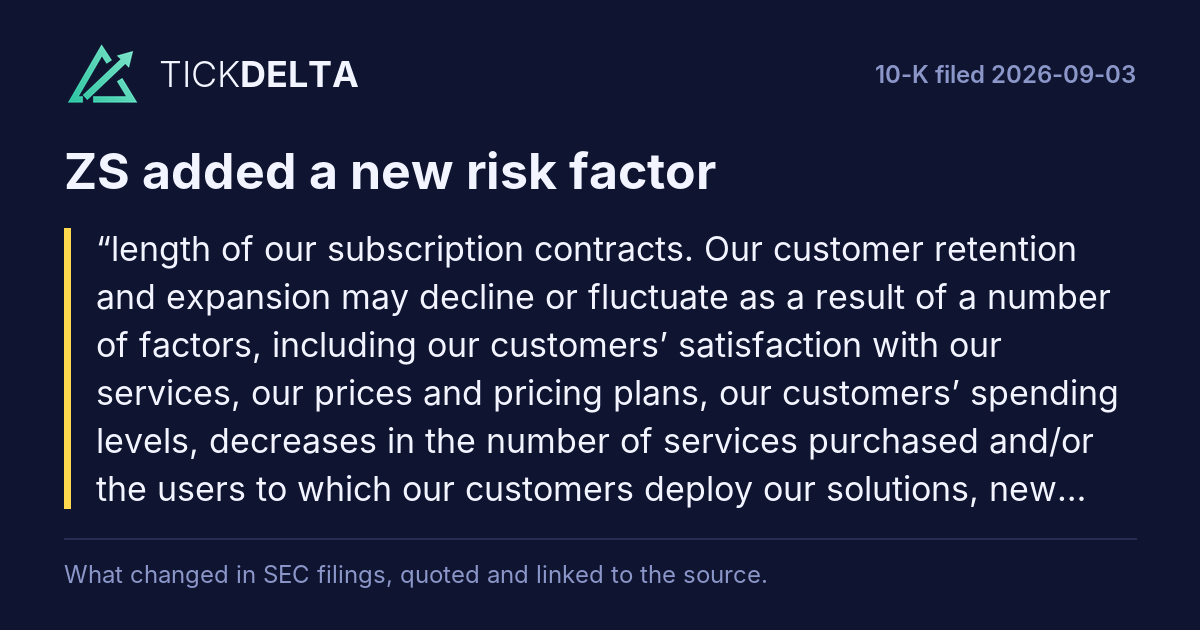
length of our subscription contracts. Our customer retention and expansion may decline or fluctuate as a result of a number of factors, including our customers’ satisfaction with our services, our prices and pricing plans, our customers’ spending levels, decreases in the number of services purchased and/or the users to which our customers deploy our solutions, new laws and regulations impacting service contract terms, mergers and acquisitions involving our customers, competition, our customers' increasing use of AI to automate tasks traditionally performed by human workers and deteriorating or uncertain general economic conditions. Any of these factors may result in our customers and potential customers reducing their IT budgets or lowering employee headcounts, which could negatively impact our business.
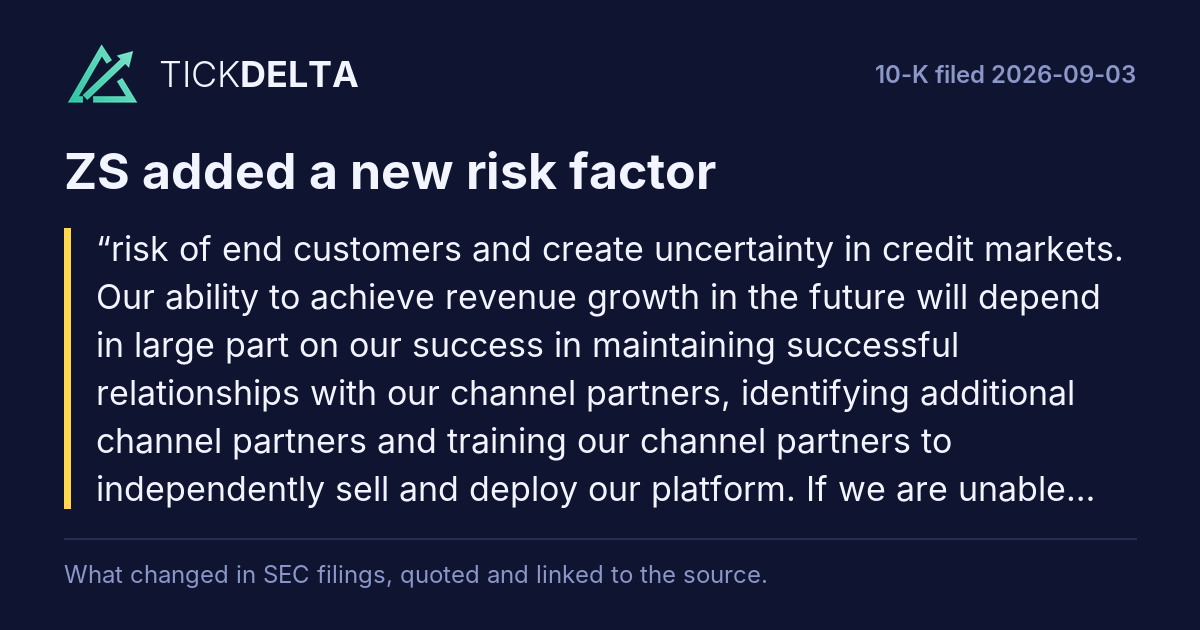
risk of end customers and create uncertainty in credit markets. Our ability to achieve revenue growth in the future will depend in large part on our success in maintaining successful relationships with our channel partners, identifying additional channel partners and training our channel partners to independently sell and deploy our platform. If we are unable to maintain our relationships with our existing channel partners or develop successful relationships with new channel partners or if our channel partners fail to perform, our business, financial position and results of operations could be materially and adversely affected.
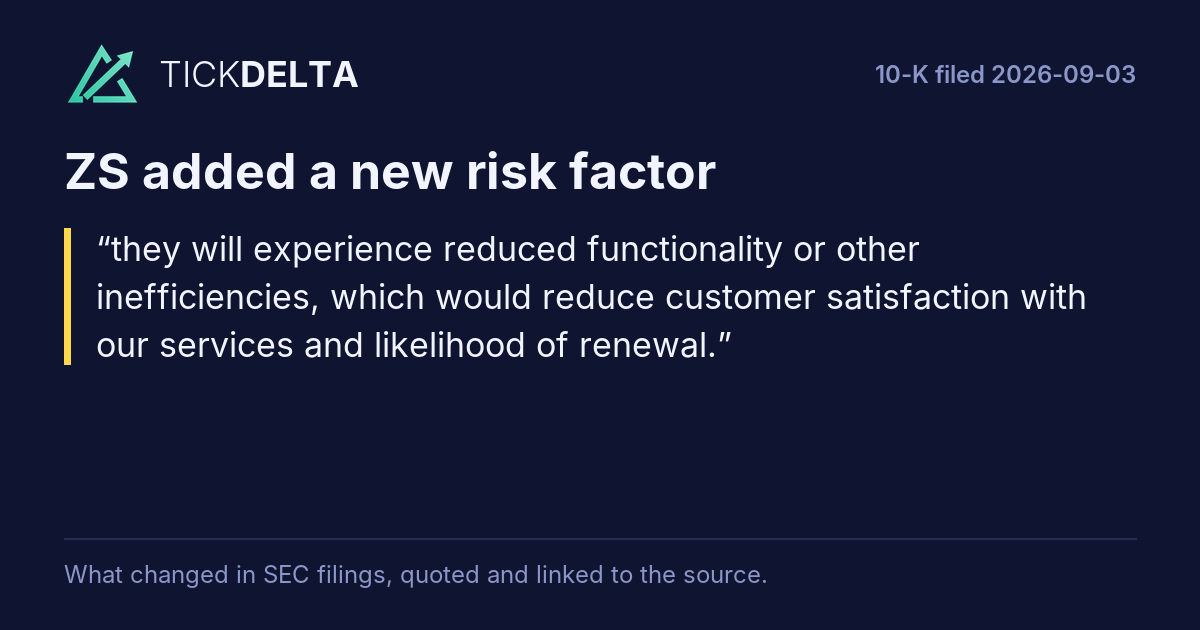
they will experience reduced functionality or other inefficiencies, which would reduce customer satisfaction with our services and likelihood of renewal.
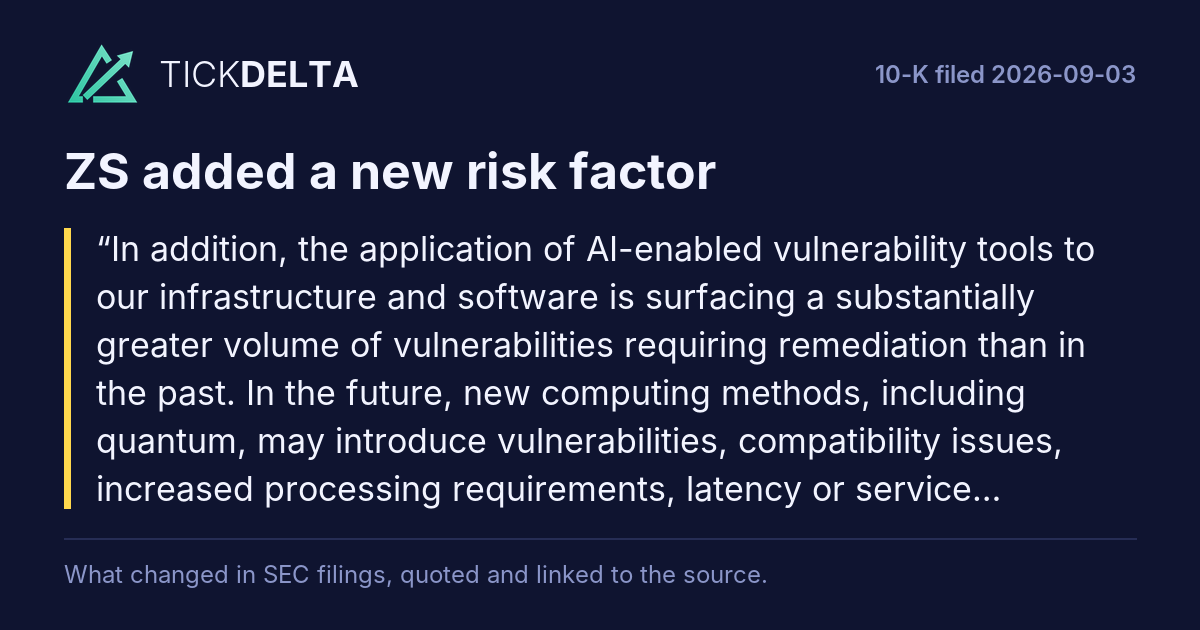
In addition, the application of AI-enabled vulnerability tools to our infrastructure and software is surfacing a substantially greater volume of vulnerabilities requiring remediation than in the past. In the future, new computing methods, including quantum, may introduce vulnerabilities, compatibility issues, increased processing requirements, latency or service disruptions, which may render key cryptographic methods used for encryption, authentication, digital signatures, certificates, software integrity, and key establishment ineffective. If quantum adoption materializes faster than expected, we may need to accelerate the refresh of our service delivery fleet, which could have a material impact on our costs. Additionally, we may need to make changes to our pricing and packaging in response to evolving customer needs, competitive dynamics or the costs associated with these technology transitions, which could adversely affect our revenue and margins. While timely remediation strengthens the security of our cloud platform, the engineering capacity required for patching, regression testing and re-validation may reduce the resources available for new feature development and the introduction of new solutions, which could adversely affect our ability to timely develop and release new product features and enhancements.
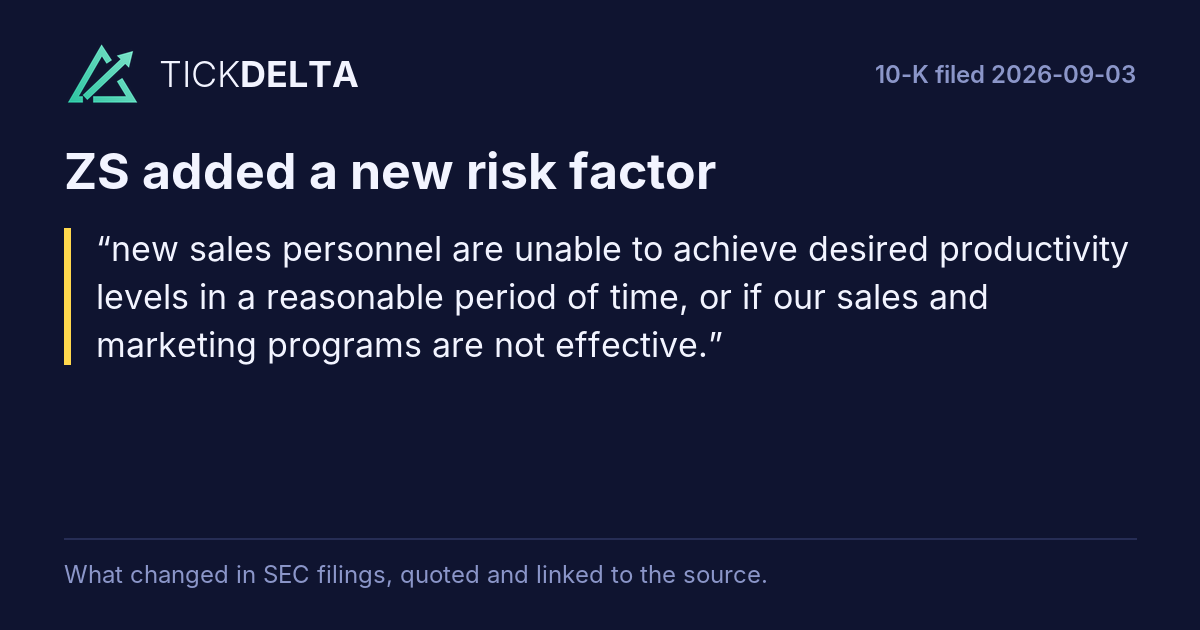
new sales personnel are unable to achieve desired productivity levels in a reasonable period of time, or if our sales and marketing programs are not effective.
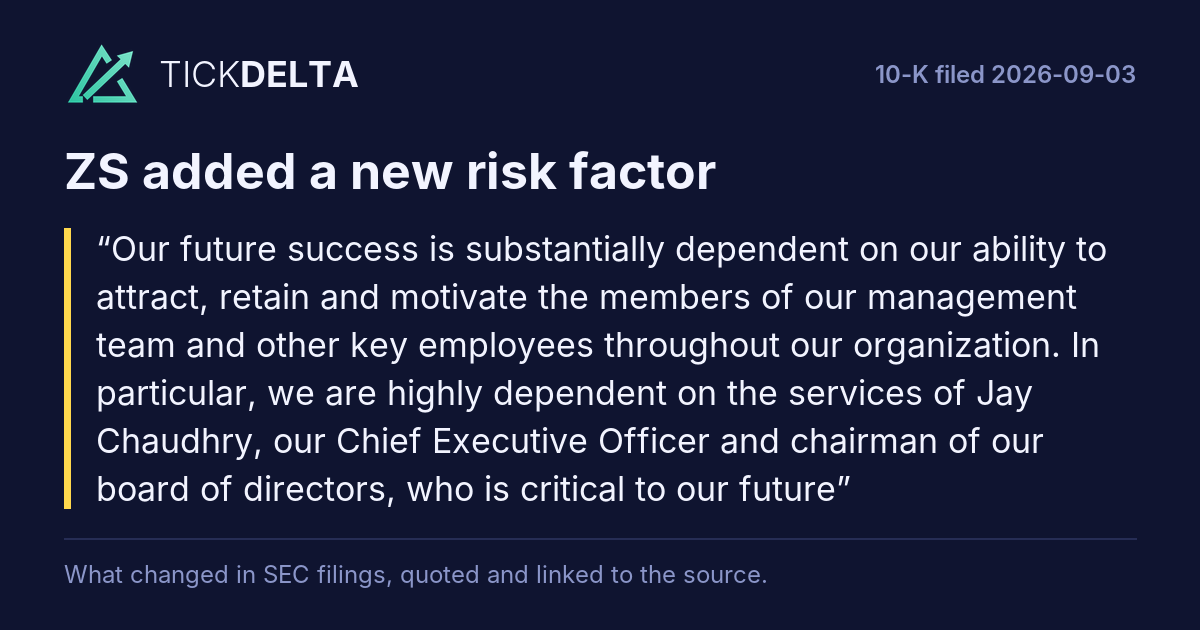
Our future success is substantially dependent on our ability to attract, retain and motivate the members of our management team and other key employees throughout our organization. In particular, we are highly dependent on the services of Jay Chaudhry, our Chief Executive Officer and chairman of our board of directors, who is critical to our future
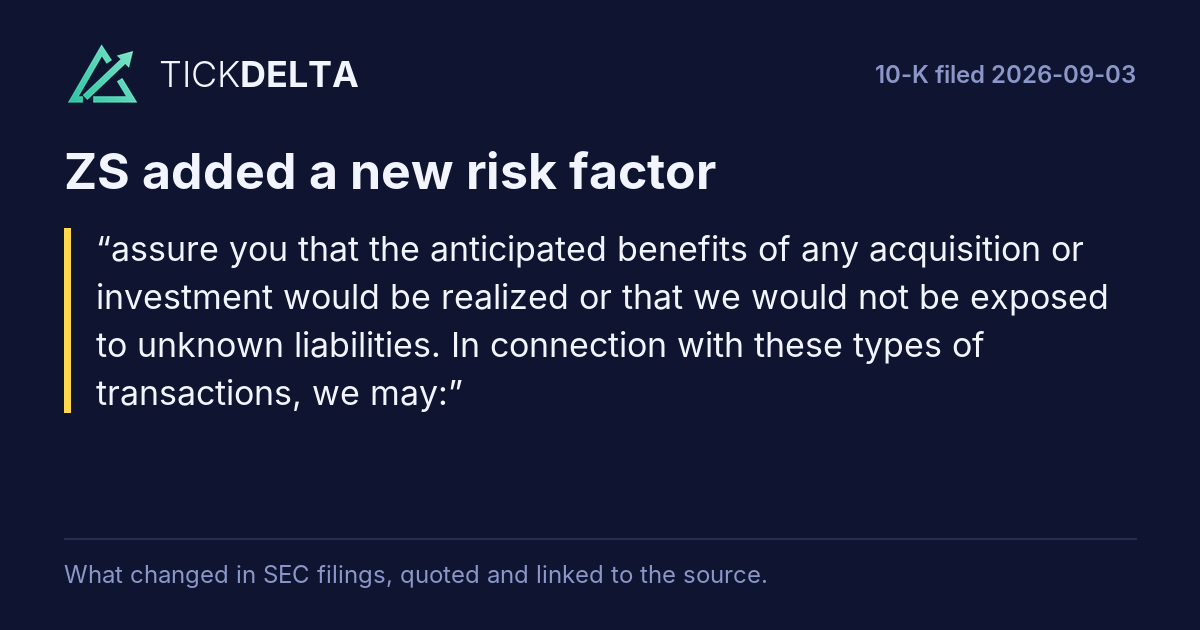
assure you that the anticipated benefits of any acquisition or investment would be realized or that we would not be exposed to unknown liabilities. In connection with these types of transactions, we may:
to use our services are the subject of a cyberattack that becomes publicized, our current or potential customers may look to our competitors for alternatives to our services.
We are increasingly utilizing AI and ML capabilities in our business operations and our product offerings. As with many developing technologies, AI and ML present risks and challenges, many of which may be unknown, which could affect their further development, adoption and use and our ability to realize their anticipated benefits. The rapid evolution of AI and ML requires the application of significant financial, operational and human resources to develop, test, maintain and monitor our products and services and our internal applications, systems and processes to help ensure that AI and ML are implemented effectively and responsibly. We may not accurately forecast the required resources or effectively deploy resources when and where needed to realize the benefits of AI and ML technologies. We are increasingly deploying AI agents, which may take actions that are erroneous, irreversible or misaligned with intended business outcomes, including interacting with unauthorized data sources and external tools. We are also enabling employees across our organization to design, build and deploy software applications. This decentralization of software development activity may increase the risk of security vulnerabilities, data exposure, regulatory non-compliance and operational failures that are difficult to detect or remediate through traditional oversight mechanisms.
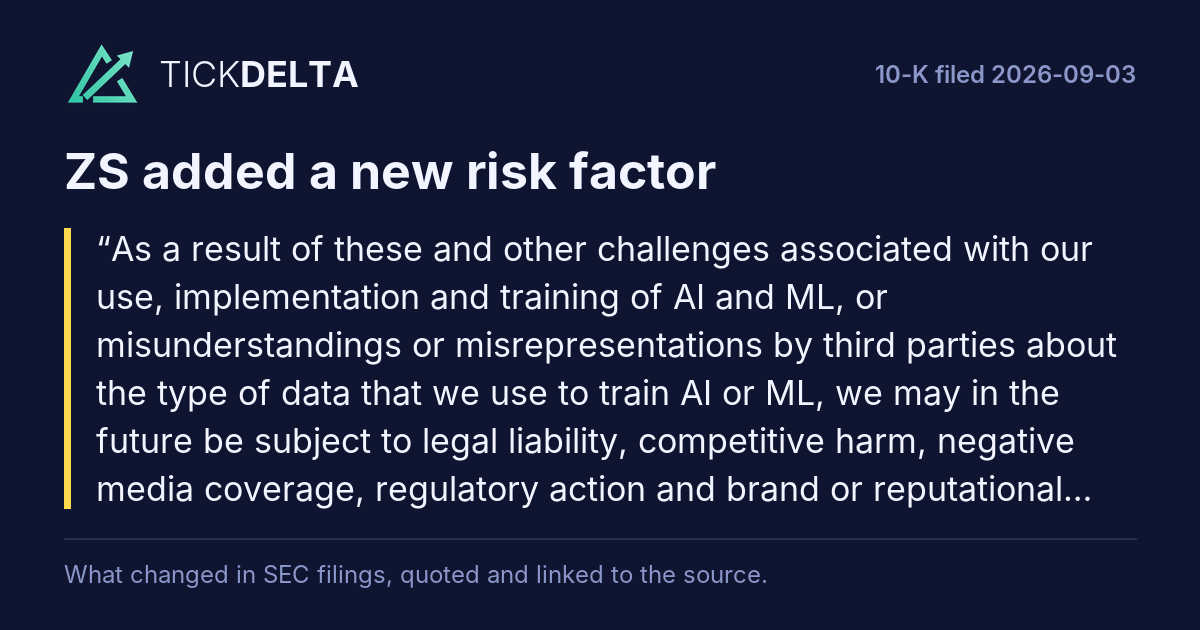
As a result of these and other challenges associated with our use, implementation and training of AI and ML, or misunderstandings or misrepresentations by third parties about the type of data that we use to train AI or ML, we may in the future be subject to legal liability, competitive harm, negative media coverage, regulatory action and brand or reputational harm.
AI laws and regulations, such as the European Union's AI Act, impose compliance obligations on AI systems that process personal data. Such laws and regulations may, among other things, require risk assessments specific to AI, changes to
data governance practices and enhancing transparency disclosures that supplement existing data protection requirements. The AI regulatory landscape is fragmented and uncertain, with various countries considering or enacting differing AI-specific laws and regulations to govern the emerging technology. This creates significant regulatory uncertainty about which compliance standards will ultimately govern our operations and solutions.
•price and volume fluctuations in the overall stock market or in the trading of our common stock from time to time;
•investor and market perceptions regarding AI-related disruption to software companies and the cybersecurity industry;
2028 Notes. Any anticipated future issuances of shares of our common stock upon conversion of the 2028 Notes could also depress the price of our common stock.
Although we maintain incident management and disaster response plans, in the event of a major disruption caused by a natural disaster or man-made problem, we may be unable to continue our operations and may endure system interruptions, reputational harm, delays in our development activities, lengthy interruptions in service, security breaches and incidents and loss of critical data.
criminal or civil sanctions, settlements, prosecution, loss of export privileges, suspension or debarment from U.S. government contracts, other enforcement actions, disgorgement of profits, significant fines, damages, other civil and criminal penalties or injunctions, whistleblower complaints, adverse media coverage and other consequences. Any investigations, actions or sanctions could materially harm our reputation, business, results of operations and financial condition.
New in the latest 10-Q
15 paragraphs in the 10-Q filed May 26, 2026 with nothing like them in the 10-Q filed Feb 26, 2026 (at least half the words must differ; new numbers alone do not count). Quoted exactly, grouped by the item heading above them. This is text that changed, not a judgement of how serious it is.
On February 5, 2026, we acquired all of the outstanding equity of SquareX, Inc. (“SquareX”), a browser security technology company, for total cash consideration of $ 112.8 million. The acquisition is expected to extend our browser capabilities, including on unmanaged devices.
Read in the 10-Q
The preliminary purchase price was allocated to $ 9.8 million of developed technology, valued using the replacement cost approach with an estimated useful life of five years.
Read in the 10-Q
The purchase price allocation is preliminary and subject to adjustment during a measurement period of up to one year from the acquisition date.
Read in the 10-Q
The purchase price allocation is preliminary and subject to adjustment during the measurement period of up to one year from the acquisition date.
Read in the 10-Q
The purchase price allocation is preliminary and subject to adjustment during the measurement period of up to one year from the acquisition date.
Read in the 10-Q
On May 19, 2026, we entered into a definitive agreement to acquire Symmetry Systems, Inc. ("Symmetry"), a cybersecurity company specializing in data and identity mapping for AI security. Under the terms of the purchase agreement, we will acquire Symmetry for total consideration of $ 175.0 million, consisting of cash and restricted shares subject to future employment services. We expect this acquisition to enhance our AI security offerings and our Zero Trust ExchangeTM platform. The transaction is expected to close in the fourth quarter of fiscal 2026, subject to the satisfaction of closing conditions.
Read in the 10-Q
In addition, the application of AI-enabled vulnerability tools to our infrastructure and software is surfacing a substantially greater volume of issues requiring remediation than in the past. While timely remediation strengthens the security of our cloud platform, the engineering capacity required for patching, regression testing and re-validation may reduce the resources available for new feature development and the introduction of new solutions, which could adversely affect our ability to timely develop and release new product features and enhancements.
Read in the 10-Q
infringement or noncompliance claim by an open source vendor, regardless of its validity, or discovering open source software code in our platform could harm our business, operating results and financial condition by, among other things:
Read in the 10-Q
• investor and market perceptions regarding AI-related disruption to software companies and the cybersecurity industry;
Read in the 10-Q
In addition, natural disasters, acts of war, international conflicts, such as the current conflicts between Russia and Ukraine and in the Middle East, including recent conflicts related to Iran, terrorism and other geopolitical unrest or health issues, such as an outbreak of a pandemic or epidemic disease, or fear of such events, could cause disruptions in our or our
Read in the 10-Q
Our current controls and any new controls we develop may become inadequate because of changes in conditions in our business. Further, weaknesses in our internal controls may be discovered in the future. Any failure to develop or maintain
Read in the 10-Q
On February 5, 2026, in connection with our acquisition of SquareX, we agreed to issue a total of 220,916 shares of our common stock as deferred consideration for a key employee. A portion of these awards is subject to either time-based vesting or performance conditions.
Read in the 10-Q
The foregoing transaction did not involve any underwriters, any underwriting discounts or commissions, or any public offering. We believe the offer, sale and issuance of the above securities was exempt from registration under the Securities Act by virtue of Section 4(a)(2) of the Securities Act, because the issuance of securities to the recipients did not involve a public offering. The recipients of the securities in this transaction represented their intentions to acquire the securities for investment only and not with a view to or for sale in connection with any distribution thereof, and appropriate legends were placed upon the securities issued in this transaction. All recipients had adequate access, through their relationships with us or otherwise, to information about us. The issuance of these securities was made without any general solicitation or advertising.
Read in the 10-Q
On March 20, 2026, Adam Geller, the Company's chief product officer, adopted a Rule 10b5-1 trading arrangement providing for the sale from time to time of an aggregate of up to 96,411 shares of our common stock. The trading arrangement is intended to satisfy the affirmative defense in Rule 10b5-1(c). The duration of the trading arrangement is until June 22, 2027, or earlier if all transactions under the trading arrangement are completed.
Read in the 10-Q
On March 24, 2026, Kevin Rubin, the Company's chief financial officer, adopted a Rule 10b5-1 trading arrangement providing for the sale from time to time of an aggregate of up to 14,754 shares of our common stock. The trading arrangement is intended to satisfy the affirmative defense in Rule 10b5-1(c). The duration of the trading arrangement is until June 25, 2027, or earlier if all transactions under the trading arrangement are completed.
Read in the 10-Q
Item 1A of the 10-Q filed May 26, 2026 against Item 1A of the 10-K filed Sep 11, 2025.
A 10-Q repeats only the risks that changed, so a 10-K paragraph that is missing from it is not counted as removed.
Added is a paragraph with nothing like it in the 10-K, Reworded a sentence that is in both with several words changed,
Quiet changes a sentence in both where one to four words changed and one is a hedge or a modal
(cut words struck through, new words highlighted).
Text on the page, not a score; each links to the filing at sec.gov.
The first 28 of 70 are shown (at most 12 of each type).
Two-word phrases in Risk Factors of the 10-K filed Sep 3, 2026 that are in none of the 1 earlier 10-Ks stored, back to Sep 11, 2025
Used at least twice, small words left out. Counted, not picked: a phrase can be new because the company renamed something.
18 paragraphs of last year's Risk Factors with nothing like them now. The longest are quoted.
Item 1A of each 10-K and 10-Q on EDGAR, quoted exactly. Each paragraph links to the filing at sec.gov.
10-K change: what was reworded or cut, section by section.
Excel workbook · CSV. Google Sheet that stays up to date: paste =IMPORTDATA("https://tickdelta.com/company/ZS/export.csv") into a cell.