Paragraph 26 · 50% changed
Every version of it
Screener
/
SEC EDGAR
/CIK 0001713683
/10-K filed Sep 3, 2026, compared with Sep 11, 2025
/Numbers from the XBRL of the 10-Ks
Nasdaq
Technology · IT Services
Zscaler, Inc. ZS
The 10-K against last year's
223 changes: 39 added, 46 removed, 129 reworded, 9 quiet changes
10-K Sep 3, 2026 vs Sep 11, 2025
Risk Factors
18.3%
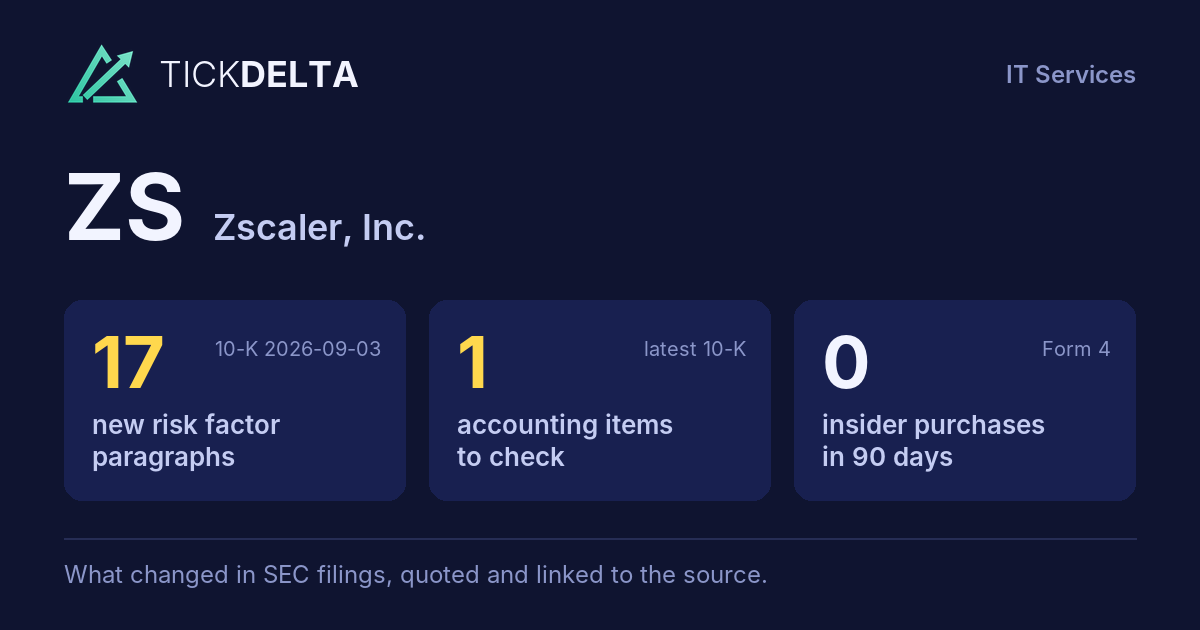
of the text changed · 23,589 words now · 17 new paragraphs, 18 gone
MD&A
39.5%
of the text changed · 7,361 words now · 22 new paragraphs, 28 gone
Legal Proceedings
48.6%
of the text changed · 396 words now
Accounting Policies
38.4%
of the text changed · 6,452 words now
10-K 0001713683-26-000157 (Sep 3, 2026) vs 10-K 0001713683-25-000158 (Sep 11, 2025)
Every paragraph, and how much of it changed
One bar per paragraph, in the order of the 10-K. Height and colour show the share of its words not in the closest paragraph a year earlier; the tallest bars are new paragraphs.
Risk Factors
317 paragraphs · 17 new · 114 reworded · 18 gone · 10-K Sep 3, 2026 against Sep 11, 2025
New paragraph
Reworded (5% of its words or more)
Same or nearly
Paragraph 303 · 48% changed
Every version of it
An extreme natural disaster, such as an earthquake, fire, flood or severe weather event; a man-made problem, such as an act of war or international conflict; or a public health emergency occurring where we have significant facilities, employees, customers, channel partners, component suppliers, vendors, data centers or other infrastructure could adversely affect our business, results of operations and financial condition. Our corporate headquarters are located in the San Francisco Bay Area, a region known for seismic activity. A significant natural disaster, such as an earthquake, fire, flood or public health emergency, occurring at our headquarters, in India, where and we have significant facilities, facilities in India. Both regions have heightened exposure to natural disasters including earthquakes, fires and floods. In addition to the natural disasters and man-made problems described above, cyberattacks have become more prevalent and damaging and may become more frequent and effective through the use of AI. Any of these potential natural or where a key channel partner, vendor or data center is located man-made problems could adversely affect impact our business, results of operations and financial condition. Further, if a natural disaster business or man-made problem were to affect cause widespread issues in national economies or the world economy, which could adversely impact our business.
Paragraph 179 · 46% changed
Every version of it
In addition, the techniques used by cyber threat actors, including state sponsored actors, to access or sabotage networks and other systems change frequently and frequently, generally are not recognized until launched against a target. target and are becoming faster, more sophisticated, more prevalent and more automated as a result of the availability and rapid commoditization of AI-enabled cyberattack toolkits. While advanced adversaries continue to gain capabilities, less-sophisticated actors are increasingly able to plan, develop and deliver attacks at a scale, speed and degree of customization that has historically required specialized expertise. As a result, we expect the volume, speed and the per-incident impact of cyberattacks to increase and dramatically expand the global threat landscape. Further, there is a risk that a cyber threat could emerge that our services are unable to detect or prevent until after some of our customers are impacted. The growth in state sponsored cyber activity showcases the increasing sophistication of cyber threats and dramatically expands the global threat landscape. Moreover, as our services are adopted by an increasing number of enterprises, it is possible that the individuals and organizations behind cyber threats will focus on finding ways to defeat our services or to target our systems. If this happens, our cloud platform could be targeted by attacks specifically designed to disrupt our business and create the perception that our cloud platform is not capable of providing superior security, which, in
Paragraph 202 · 46% changed
Every version of it
Paragraph 175 · 45% changed
Every version of it
Paragraph 97 · 44% changed
Every version of it
Paragraph 280 · 44% changed
Every version of it
Sales of a substantial number of shares of our common stock in the public market, particularly sales by our directors, executive officers and significant stockholders, or the perception that these sales could occur, could adversely affect the market price of our common stock and may make it more difficult for you to sell your common stock at a time and price that you deem appropriate. We may also issue our shares of common stock or securities convertible into shares of our common stock from time to time in connection with a financing, acquisition, investments or otherwise. Any such issuance could result in substantial dilution to our existing stockholders, cause the market price of our common stock to decline and dilute your voting power. For instance, prior to April 15, 2028, our 0.0% Convertible Senior Notes due 2028, or the 2028 Notes, are convertible at the option of the holders only under certain conditions or upon the occurrence of certain events. After April 15, 2028, holders may convert all or any portion of the 2028 Notes at their option at any time. If one or more holders elect to convert their 2028 Notes and we elect to settle all or any portion of such conversions in shares of our common stock, any sales in the public market of the common stock issuable upon such conversion could adversely affect prevailing market prices of our common stock. In addition, certain holders of the 2028 Notes may engage in short selling to hedge their position in the 2028 Notes. Any anticipated future issuances of shares of our common stock upon conversion of the 2028 Notes could also depress the price of our common stock.
Paragraph 192 · 44% changed
Every version of it
Paragraph 26 · 50% changed
Every version of it
10-K Sep 11, 2025To increase our revenue and achieve and maintain profitability, we must add new customers. To add new customers, we must successfully convince IT decision makers that security delivered through our cloud platform provides significant advantages over legacy on-premises appliance-based security products and competing cloud-based products. Additionally, many of our customers broadly deploy our products, which requires a significant commitment of resources from our customers. These factors significantly impact our ability to add new customers and increase the time, resources and sophistication required to do so.
10-K Sep 3, 2026
customers. These factors significantly impact our ability to add new customers and increase the time, resources and sophistication required to do so.
Paragraph 303 · 48% changed
Every version of it
10-K Sep 11, 2025
Our corporate headquarters are located in the San Francisco Bay Area, a region known for seismic activity. A significant natural disaster, such as an earthquake, fire, flood or public health emergency, occurring at our headquarters, in India, where we have significant facilities, or where a key channel partner, vendor or data center is located could adversely affect our business, results of operations and financial condition. Further, if a natural disaster or man-made problem were to affect our
10-K Sep 3, 2026
An extreme natural disaster, such as an earthquake, fire, flood or severe weather event; a man-made problem, such as an act of war or international conflict; or a public health emergency occurring where we have significant facilities, employees, customers, channel partners, component suppliers, vendors, data centers or other infrastructure could adversely affect our business, results of operations and financial condition. Our corporate headquarters are located in the San Francisco Bay Area, and we have significant facilities in India. Both regions have heightened exposure to natural disasters including earthquakes, fires and floods. In addition to the natural disasters and man-made problems described above, cyberattacks have become more prevalent and damaging and may become more frequent and effective through the use of AI. Any of these potential natural or man-made problems could adversely impact our business or cause widespread issues in national economies or the world economy, which could adversely impact our business.
Paragraph 179 · 46% changed
Every version of it
10-K Sep 11, 2025
In addition, the techniques used by cyber threat actors, including state sponsored actors, to access or sabotage networks and other systems change frequently and generally are not recognized until launched against a target. As a result, there is a risk that a cyber threat could emerge that our services are unable to detect or prevent until after some of our customers are impacted. The growth in state sponsored cyber activity showcases the increasing sophistication of cyber threats and dramatically expands the global threat landscape. Moreover, as our services are adopted by an increasing number of enterprises, it is possible that the individuals and organizations behind cyber threats will focus on finding ways to defeat our services or to target our systems. If this happens, our cloud platform could be targeted by attacks specifically designed to disrupt our business and create the perception that our cloud platform is not capable of providing superior security, which, in
10-K Sep 3, 2026
In addition, the techniques used by cyber threat actors, including state sponsored actors, to access or sabotage networks and other systems change frequently, generally are not recognized until launched against a target and are becoming faster, more sophisticated, more prevalent and more automated as a result of the availability and rapid commoditization of AI-enabled cyberattack toolkits. While advanced adversaries continue to gain capabilities, less-sophisticated actors are increasingly able to plan, develop and deliver attacks at a scale, speed and degree of customization that has historically required specialized expertise. As a result, we expect the volume, speed and the per-incident impact of cyberattacks to increase and dramatically expand the global threat landscape. Further, there is a risk that a cyber threat could emerge that our services are unable to detect or prevent until after some of our customers are impacted.
Paragraph 202 · 46% changed
Every version of it
10-K Sep 11, 2025to risks, including reduced control over production costs, constraints based on the then-current availability, terms and pricing of these components and potential loss of assets. For example, we generally purchase equipment or the components of equipment on a purchase order basis, and do not have long-term contracts guaranteeing supply. We also rely on sole or limited sourced SaaS vendors to provide critical services that we use to operate our business. In addition, the technology industry has experienced component shortages, delivery delays, price increases and service interruptions in the past, and we may experience shortages, delays, materially increased costs or service interruptions in the future, including as a result of natural disasters, acts of war or international conflicts, epidemics or global pandemics, increased demand in the industry or if our suppliers do not have sufficient rights to supply the components in all jurisdictions in which we may host our services. While global economic conditions have not yet had a material impact on our supply chain, these conditions have increased our costs in the past and could result in disruptions and delays for components in the future. Additionally, changes to existing international trade agreements, tariffs, export controls or other trade measures and regulations that impact our sourcing partners or us could lead to increased costs to operate our business and to disruptions in our supply chain, which could limit our ability to support our customers. For instance, there is a risk that current geopolitical, diplomatic and other developments affecting the relationship between China and Taiwan may materially and negatively impact the availability of certain critical components that we use in our data centers, which we source from overseas. If our supply of certain components is disrupted or delayed, there can be no assurance that available alternatives can serve as adequate replacements for the existing components or that alternatives will be available on terms that are favorable to us, if at all, as it may take several months or longer to identify, qualify and engage a new supplier or integrator. Any disruption or delay in access to components may delay opening new data centers, delay increasing capacity or replacing defective equipment at existing data centers, cause other constraints on our operations that could damage our channel partner or customer relationships or otherwise have a material adverse impact on our business.
10-K Sep 3, 2026
If our supply of certain components is disrupted, delayed or becomes significantly more expensive, there can be no assurance that available alternatives can serve as adequate replacements for the existing components or that alternatives will be available on terms that are favorable to us, if at all, as it may take several months or longer to identify, qualify and engage a new supplier or integrator. Any disruption or delay in access to components may materially increase our costs, require us to increase costs to our customers, delay establishing new data centers, delay increasing capacity or replacing defective equipment at existing data centers, cause other constraints on our operations that could damage our channel partner or customer relationships or otherwise have a material adverse impact on our business and operating results.
Paragraph 175 · 45% changed
Every version of it
10-K Sep 11, 2025These challenges related to acquisitions or investments could adversely affect our business, operating results, financial condition and prospects.
10-K Sep 3, 2026
to continue to support our business growth and to respond to business challenges could be significantly limited, and our business, operating results, financial condition and prospects could be materially and adversely affected.
Paragraph 97 · 44% changed
Every version of it
10-K Sep 11, 2025We currently host our cloud platform and serve our customers from a global network of over 160 public exchanges globally and thousands of private exchanges at the edge. While we have electronic access to the components and infrastructure of our cloud platform that are hosted by third parties, we do not control the operation of these facilities. Consequently, we may be subject to service disruptions as well as a lack of adequate support for our data center operations due to reasons that are outside of our control. Our data centers are vulnerable to damage and connections to our data centers may be interrupted by a variety of sources, including earthquakes, floods, fires, power loss, system or infrastructure failures, computer viruses, physical or electronic break-ins, human error or interference (including by disgruntled or negligent, current or former employees or contractors) and other catastrophic events. Our data centers may also be subject to national or local administrative actions, changes in government regulations, including, for example, the impact of global economic and other sanctions like those levied in response to the current conflict between Russia and Ukraine, changes to legal or permitting requirements and litigation to stop, limit or delay operations. Despite precautions taken at these facilities, a decision to close the facilities without adequate notice or other unanticipated problems at these facilities could result in interruptions or delays in our services, impede our ability to scale our operations or have other adverse impacts upon our business. In addition, if we do not accurately plan for our infrastructure capacity requirements or experience significant strains on our data center capacity, we may experience delays and additional expenses in arranging new data centers, and our customers could experience performance degradation or service outages that may subject us to financial liabilities, result in customer losses and materially harm our business.
10-K Sep 3, 2026
facilities, a decision to close the facilities without adequate notice or other unanticipated problems at these facilities could result in interruptions or delays in our services, impede our ability to scale our operations or have other adverse impacts upon our business. In addition, if we do not accurately plan for our infrastructure capacity requirements or experience significant strains on our data center resources, or if data center capacity is unavailable or unavailable at acceptable terms, we may experience delays and additional expenses in establishing new data centers, and our customers could experience performance degradation or service outages that may subject us to financial liabilities, result in customer losses and materially harm our business.
Paragraph 280 · 44% changed
Every version of it
10-K Sep 11, 2025
Sales of a substantial number of shares of our common stock in the public market, particularly sales by our directors, executive officers and significant stockholders, or the perception that these sales could occur, could adversely affect the market price of our common stock and may make it more difficult for you to sell your common stock at a time and price that you deem appropriate. We may also issue our shares of common stock or securities convertible into shares of our common stock from time to time in connection with a financing, acquisition, investments or otherwise. Any such issuance could result in substantial dilution to our existing stockholders, cause the market price of our common stock to decline and dilute your voting power. For instance, prior to April 15, 2028, our 0.0% Convertible Senior Notes due 2028, or the 2028 Notes, are convertible at the option of the holders only under certain conditions or upon the occurrence of certain events. After April 15, 2028, holders may convert all or any portion of the 2028 Notes at their option at any time. If one or more holders elect to convert their 2028 Notes and we elect to settle all or any portion of such conversions in shares of our common stock, any sales in the public market of the common stock issuable upon such conversion could adversely affect prevailing market prices of our common stock. In addition, certain holders of the 2028 Notes may engage in short selling to hedge their position in the 2028 Notes. Any anticipated future issuances of shares of our common stock upon conversion of the 2028 Notes could also depress the price of our common stock.
10-K Sep 3, 2026
Sales of a substantial number of shares of our common stock in the public market, particularly sales by our directors, executive officers and significant stockholders, or the perception that these sales could occur, could adversely affect the market price of our common stock and may make it more difficult for you to sell your common stock at a time and price that you deem appropriate.
Paragraph 192 · 44% changed
Every version of it
10-K Sep 11, 2025We are increasingly utilizing AI and ML capabilities, including, for example, those relating to generative AI and large language models, into our product offerings. The rapid evolution of AI and ML requires the application of resources to develop, test and maintain our products and services to help ensure that AI and ML are implemented responsibly to benefit our business, while also minimizing any unintended or harmful impact. As with many developing technologies, AI and ML present risks and challenges, many of which may be unknown, that could affect their further development, adoption and use. These risks and challenges could undermine public confidence in AI and ML, which could slow or even halt its adoption and negatively affect our business. Further, a quickly evolving legal and regulatory environment may cause us to incur increased research and development costs, or divert resources from other development efforts, to address social and ethical issues related to AI and ML. In addition, as the regulatory landscape for AI and ML evolves, we must develop and maintain robust internal policies and standards that clarify functional roles and responsibilities for the responsible and compliant development and deployment of AI technologies. The use of AI technologies presents emerging ethical issues that could become controversial and failure, or perceived failure, to establish or enforce such policies and clear lines of accountability could increase our risk of noncompliance, operational errors or reputational harm. As a result of these and other challenges associated with our use, implementation and training of AI and ML, or misunderstandings or misrepresentations by third parties about the type of data that we use to train AI or ML, we may in the future be subject to legal liability, competitive harm, negative media coverage or regulatory action, including new proposed, and in certain cases enacted, rules and legislation regulating AI in jurisdictions such as the European Union, new applications of existing data protection, privacy, cybersecurity, information security, intellectual property and other laws, and brand or reputational harm.
10-K Sep 3, 2026
Further, a quickly evolving legal and regulatory environment may cause us to incur increased research and development costs, or divert resources from other development efforts, to address social and ethical issues related to AI and ML. As the regulatory landscape for AI and ML evolves, including through new frameworks such as the EU AI Act, we must develop and maintain robust internal policies and standards that clarify functional roles and responsibilities for the responsible and compliant development, deployment and use of AI technologies in our internal operations and product offerings. Since the use of AI technologies presents ethical issues that could become controversial, failure, or perceived failure, to establish or enforce such policies and clear lines of accountability could increase our risk of noncompliance, operational errors, reputational harm and penalties.
MD&A
93 paragraphs · 22 new · 42 reworded · 28 gone · 10-K Sep 3, 2026 against Sep 11, 2025
New paragraph
Reworded (5% of its words or more)
Same or nearly
Paragraph 82 · 50% changed
Paragraph 84 · 48% changed
Paragraph 83 · 43% changed
Paragraph 34 · 40% changed
We generally experience seasonality in terms of when we enter into agreements with our customers. We typically enter into a higher percentage of agreements with new customers, as well as renewal agreements with existing customers, in our second half of our fiscal year. However, because we recognize revenue ratably over the terms of our subscription contracts, a substantial portion of the revenue that we report in each period is attributable to the recognition of deferred revenue relating to agreements that we entered into during previous periods. Consequently, increases or decreases in new sales or renewals in
Paragraph 74 · 40% changed
Paragraph 13 · 40% changed
We typically expand our relationship with our customers over time. While most of our new customers route all of their internet-bound web traffic through our cloud platform, some of our customers initially use our services for specific users or specific security functionality. We leverage our land-and-expand model with the goal of generating organic account expansion strategies to drive incremental revenue, often within the term of the initial subscription, by increasing sales to our existing customers in one of three the following ways:
Paragraph 6 · 39% changed
We operate our business as one reportable segment. Our revenue has experienced significant growth in recent periods. For fiscal 2025, 2026, fiscal 2024 2025 and fiscal 2023, 2024, our revenue was $3,352.5 million, $2,673.1 million, $2,167.8 million and $1,617.0 $2,167.8 million, respectively. We have incurred net losses in all annual periods since our inception. For fiscal 2025, 2026, fiscal 2024 2025 and fiscal 2023, 2024, our net loss was $63.2 million, $41.5 million, $57.7 million and $202.3 $57.7 million, respectively. We expect we will continue to incur net losses for the foreseeable future, as we continue to invest in our sales and marketing organization to maximize our market opportunity, to invest in research and development efforts to enhance the functionality of our cloud platform, and to address any legal matters and related accruals, as further described in Note 12, Commitments and Contingencies, of the consolidated financial statements included elsewhere in this Annual Report on Form 10-K.
Paragraph 15 · 38% changed
•selling a subscription to a new solution or product, such as selling Data security or Security for example AI solutions to an existing ZIA or ZPA customer, or selling a ZIA or ZPA subscription to a ZIA customer or a ZIA subscription to a ZPA an existing Zero Trust Branch customer.
Paragraph 82 · 50% changed
10-K Sep 11, 2025If the contract contains a single performance obligation, the entire transaction price is allocated to the single performance obligation. Contracts that contain multiple performance obligations require an allocation of the transaction price to each performance obligation based on a relative standalone selling price ("SSP").
10-K Sep 3, 2026
We recognize revenue in accordance with ASC Topic 606, Revenue From Contracts With Customers. Most of our contracts contain multiple performance obligations, which primarily include subscription and support services, along with professional and other services. When a contract contains multiple performance obligations, we allocate the transaction price to each performance obligation based on its relative standalone selling price ("SSP").
Paragraph 84 · 48% changed
10-K Sep 11, 2025Revenue from sales is recorded at the net sales price, which is the transaction price, and includes estimates of variable consideration. The amount of variable consideration that is included in the transaction price is constrained, and is included in the net sales price only to the extent that it is probable that a significant reversal in the amount of the cumulative revenue will not occur when the uncertainty is resolved.
10-K Sep 3, 2026
Certain contracts also include variable consideration in the form of service level credits and rebates. We include variable consideration in the transaction price only to the extent it is probable that a significant reversal of cumulative revenue will not occur. We have not experienced material incidents affecting our service level commitments, and rebates or estimated credits have not been material in the periods presented.
Paragraph 83 · 43% changed
10-K Sep 11, 2025Most of our contracts with customers contain multiple promised services consisting of (i) our subscription and support services and (ii) professional and other services that are distinct and accounted for separately. The transaction price is allocated to the separate performance obligations on a relative SSP basis. We determine SSP based on our overall pricing objectives, taking into consideration the type of subscription and support services and professional and other services, the geographical region of the customer and the number of users.
10-K Sep 3, 2026
We determine SSP based on our overall pricing objectives, taking into consideration the type of subscription and support services and professional and other services, the geographical region of the customer, and the number of users. For performance obligations where observable SSP data exists from standalone transactions, we use those prices directly. Where observable data is limited, we apply judgment using a market-based approach consistent with our pricing strategy. We periodically reassess our SSP determinations to reflect changes in our go-to-market approach and product offerings.
Paragraph 34 · 40% changed
10-K Sep 11, 2025
We generally experience seasonality in terms of when we enter into agreements with our customers. We typically enter into a higher percentage of agreements with new customers, as well as renewal agreements with existing customers, in our second half of our fiscal year. However, because we recognize revenue ratably over the terms of our subscription contracts, a substantial portion of the revenue that we report in each period is attributable to the recognition of deferred revenue relating to agreements that we entered into during previous periods. Consequently, increases or decreases in new sales or renewals in
10-K Sep 3, 2026
We generally experience seasonality in terms of when we enter into agreements with our customers. We typically enter into a higher percentage of agreements with new customers, as well as renewal agreements with existing customers, in the
Paragraph 74 · 40% changed
10-K Sep 11, 2025We generate revenue from contracts with typical durations ranging from one to three years. We typically invoice our customers annually in advance, and to a lesser extent quarterly in advance, monthly in advance or multi-year in advance. We recognize revenue ratably over the life of the contract. Amounts that have been invoiced are recorded in deferred revenue, or they are recorded in revenue if the revenue recognition criteria have been met. Subscriptions that are invoiced annually in advance or multi-year in advance represent a significant portion of our short-term and long-term deferred revenue in comparison to invoices issued quarterly in advance or monthly in advance. We cannot predict the mix of invoicing schedules in any given period.
10-K Sep 3, 2026
Subscriptions that are invoiced annually in advance or multi-year in advance contribute significantly to our short-term and long-term deferred revenue in comparison to our invoices issued quarterly in advance or monthly in advance. We strategically enter into agreements for multi-year in advance billings with our customers to achieve our and/or our customers’ business objectives. We cannot predict the mix of invoicing schedules in any given period.
Paragraph 13 · 40% changed
10-K Sep 11, 2025
We typically expand our relationship with our customers over time. While most of our new customers route all of their internet-bound web traffic through our cloud platform, some of our customers initially use our services for specific users or specific security functionality. We leverage our land-and-expand model with the goal of generating incremental revenue, often within the term of the initial subscription, by increasing sales to our existing customers in one of three ways:
10-K Sep 3, 2026
We typically expand our relationship with our customers over time. We leverage our organic account expansion strategies to drive incremental revenue, often within the term of the initial subscription, by increasing sales to existing customers in the following ways:
Paragraph 6 · 39% changed
10-K Sep 11, 2025
We operate our business as one reportable segment. Our revenue has experienced significant growth in recent periods. For fiscal 2025, fiscal 2024 and fiscal 2023, our revenue was $2,673.1 million, $2,167.8 million and $1,617.0 million, respectively. We have incurred net losses in all annual periods since our inception. For fiscal 2025, fiscal 2024 and fiscal 2023, our net loss was $41.5 million, $57.7 million and $202.3 million, respectively. We expect we will continue to incur net losses for the foreseeable future, as we continue to invest in our sales and marketing organization to maximize our market opportunity, to invest in research and development efforts to enhance the functionality of our cloud platform, and to address any legal matters and related accruals, as further described in Note 12, Commitments and Contingencies, of the consolidated financial statements included elsewhere in this Annual Report on Form 10-K.
10-K Sep 3, 2026
We operate our business as one reportable segment. Our revenue has experienced significant growth in recent periods. For fiscal 2026, fiscal 2025 and fiscal 2024, our revenue was $3,352.5 million, $2,673.1 million and $2,167.8 million, respectively. We have incurred net losses in all annual periods since our inception. For fiscal 2026, fiscal 2025 and fiscal 2024, our net loss was $63.2 million, $41.5 million and $57.7 million, respectively.
Paragraph 15 · 38% changed
10-K Sep 11, 2025
•selling a subscription to a new solution or product, for example selling a ZPA subscription to a ZIA customer or a ZIA subscription to a ZPA customer.
10-K Sep 3, 2026
•selling a new solution or product, such as selling Data security or Security for AI solutions to an existing ZIA or ZPA customer, or selling ZIA or ZPA to an existing Zero Trust Branch customer.
A paragraph is matched with the one last year that shares the most of its words; under half in common makes it new. The paragraphs shown are the 8 reworded the most in each section.
The paragraph that changed most in each section
The redline
Marked against last year's 10-K: cut words struck through, new words highlighted.
Risk Factors277 words changed in this paragraph; it is 50% similar to last year's version.
Source: Item 1A, 10-K 0001713683-26-000157 vs Item 1A, 10-K 0001713683-25-000158
MD&A238 words changed in this paragraph; it is 34% similar to last year's version.
We capitalize sales commissions and associated payroll taxes paid to sales personnel that are incremental to the acquisition of customer contracts. We determine whether costs should be deferred based on our sales compensation plans, if the commissions are in fact incremental and would not have occurred absent the customer contract. Sales commissions for renewal of a contract contracts are not considered commensurate with the commissions paid for the acquisition of the initial contract contracts, given the substantive difference in commission rates in proportion relative to their respective contract values. Commissions Accordingly, commissions paid upon the initial acquisition of a contract are amortized over an estimated period of benefit of five years years, while commissions paid for renewal contracts are amortized over the contractual term of the renewals. Amortization is recognized on a straight-line basis commensurate with the pattern of revenue recognition. We determine the period of benefit for commissions paid for the acquisition of the initial contract by taking into consideration the expected subscription term and expected renewals of our customer contracts, the duration of our relationships with customers, customer retention data, our technology development life cycle and other factors. Management exercises judgment to determine the period of benefit to amortize contract acquisition costs by considering factors such as expected renewals of customer contracts, duration of customer relationships and our technology development life cycle. Although we believe that the historical assumptions and estimates we have made are reasonable and appropriate, different assumptions and estimates could materially impact our reported financial results. Amortization of deferred contract acquisition costs is included in sales and marketing expense in the consolidated statements of operations. We periodically review these deferred costs to determine whether events or changes in circumstances have occurred that could impact the period of benefit of these deferred contract acquisition costs. renewal.
Source: Item 7, 10-K 0001713683-26-000157 vs Item 7, 10-K 0001713683-25-000158
Accounting Policies189 words changed in this paragraph; it is 36% similar to last year's version.
Basic net loss per share is computed by dividing net loss by the weighted-average number of shares of common stock outstanding during the period, less shares subject to restriction. Diluted earnings per share adjusts basic earnings per share for all potentially dilutive common stock equivalents outstanding during the period. period to the extent they are dilutive. Potentially dilutive securities consist primarily of stock options, share purchase rights under the ESPP, unvested RSUs, unvested PSAs, unvested common stock and shares related to issuable upon of our convertible senior notes. Since we have reported net losses for all periods presented, we have excluded all potentially The dilutive securities from effect of equity awards (stock options, restricted stock, RSUs, PSAs, and ESPP rights) is computed using the calculation treasury stock method. The dilutive effect of shares issuable upon conversion of our convertible senior notes is computed using the if-converted method, under which the convertible senior notes are assumed to be converted into shares of common stock at the beginning of the diluted reporting period and the related interest expense, net loss per share, as their effect of tax, is antidilutive. Accordingly, basic and diluted added back to net loss per share is loss. In connection with the same for all periods presented. issuance of the convertible senior notes, we entered into capped call transactions that are generally expected to reduce the potential dilution to our common stock upon any conversion of the convertible senior notes.
Source: Item 8, Note 1 – Business and Summary of Significant Accounting Policies, 10-K 0001713683-26-000157 vs Item 8, Note 1 – Business and Summary of Significant Accounting Policies, 10-K 0001713683-25-000158
Legal Proceedings97 words changed in this paragraph; it is 59% similar to last year's version.
We are a party to various litigation matters from time to time and subject to claims that arise in the ordinary course of business, including patent, commercial, product liability, employment, class action, whistleblower and other litigation and claims, as well as governmental and other regulatory investigations and proceedings. In addition, third parties may from time to time assert claims against us in the form of letters and other communications. There is no pending or threatened legal proceeding to which we are a party that, in our opinion, is likely to have a material adverse effect on our future financial results or operations; however, the results of litigation and claims are inherently unpredictable. Regardless of the outcome, litigation can have an adverse impact on us because of defense and settlement costs, diversion of management resources and other factors. The expense of litigation and the timing of this expense from period to period are difficult to estimate, subject to change and could adversely affect our results of operations.
Source: Item 3, via Note 12 – Commitments and Contingencies, 10-K 0001713683-26-000157 vs Item 3, via Note 12 – Commitments and Contingencies, 10-K 0001713683-25-000158
Sentences and paragraphs added, removed or reworded
Every change, by type
Sentences and paragraphs of ZS's Risk Factors and MD&A, 10-K Sep 3, 2026 against 10-K Sep 11, 2025. Each links to the text at sec.gov.
Quiet changes are sentences kept from last year with one to four words changed, at least one of them a hedge, a modal or a qualifier (may, could, will, not, significant, material…). A year or date rolling forward is not counted.
The full word list
adverse, adversely, all, although, anticipate, anticipates, any, approximately, believe, believes, can, cannot, certain, could, expect, expects, generally, however, if, intend, intends, largely, likely, many, material, materially, may, might, most, must, never, no, not, possible, primarily, probable, should, significant, significantly, some, substantial, substantially, unlikely, will, would
AddedRisk Factors
length of our subscription contracts. Our customer retention and expansion may decline or fluctuate as a result of a number of factors, including our customers’ satisfaction with our services, our prices and pricing plans, our customers’ spending levels, decreases in the number of services purchased and/or the users to which our customers deploy our solutions, new laws and regulations impacting service contract terms, mergers and acquisitions involving our customers, competition, our customers' increasing use of AI to automate tasks traditionally performed by human workers and deteriorating or uncertain general economic conditions. Any of these factors may result in our customers and potential customers reducing their IT budgets or lowering employee headcounts, which could negatively impact our business.
Read it in 10-K Sep 3, 2026 at sec.gov
AddedRisk Factors
risk of end customers and create uncertainty in credit markets. Our ability to achieve revenue growth in the future will depend in large part on our success in maintaining successful relationships with our channel partners, identifying additional channel partners and training our channel partners to independently sell and deploy our platform. If we are unable to maintain our relationships with our existing channel partners or develop successful relationships with new channel partners or if our channel partners fail to perform, our business, financial position and results of operations could be materially and adversely affected.
Read it in 10-K Sep 3, 2026 at sec.gov
AddedRisk Factors
they will experience reduced functionality or other inefficiencies, which would reduce customer satisfaction with our services and likelihood of renewal.
Read it in 10-K Sep 3, 2026 at sec.gov
AddedRisk Factors
In addition, the application of AI-enabled vulnerability tools to our infrastructure and software is surfacing a substantially greater volume of vulnerabilities requiring remediation than in the past. In the future, new computing methods, including quantum, may introduce vulnerabilities, compatibility issues, increased processing requirements, latency or service disruptions, which may render key cryptographic methods used for encryption, authentication, digital signatures, certificates, software integrity, and key establishment ineffective. If quantum adoption materializes faster than expected, we may need to accelerate the refresh of our service delivery fleet, which could have a material impact on our costs. Additionally, we may need to make changes to our pricing and packaging in response to evolving customer needs, competitive dynamics or the costs associated with these technology transitions, which could adversely affect our revenue and margins. While timely remediation strengthens the security of our cloud platform, the engineering capacity required for patching, regression testing and re-validation may reduce the resources available for new feature development and the introduction of new solutions, which could adversely affect our ability to timely develop and release new product features and enhancements.
Read it in 10-K Sep 3, 2026 at sec.gov
AddedRisk Factors
new sales personnel are unable to achieve desired productivity levels in a reasonable period of time, or if our sales and marketing programs are not effective.
Read it in 10-K Sep 3, 2026 at sec.gov
AddedRisk Factors
Our future success is substantially dependent on our ability to attract, retain and motivate the members of our management team and other key employees throughout our organization. In particular, we are highly dependent on the services of Jay Chaudhry, our Chief Executive Officer and chairman of our board of directors, who is critical to our future
Read it in 10-K Sep 3, 2026 at sec.gov
AddedRisk Factors
assure you that the anticipated benefits of any acquisition or investment would be realized or that we would not be exposed to unknown liabilities. In connection with these types of transactions, we may:
Read it in 10-K Sep 3, 2026 at sec.gov
AddedRisk Factors
to use our services are the subject of a cyberattack that becomes publicized, our current or potential customers may look to our competitors for alternatives to our services.
Read it in 10-K Sep 3, 2026 at sec.gov
Show the other 73
AddedRisk Factors
We are increasingly utilizing AI and ML capabilities in our business operations and our product offerings. As with many developing technologies, AI and ML present risks and challenges, many of which may be unknown, which could affect their further development, adoption and use and our ability to realize their anticipated benefits. The rapid evolution of AI and ML requires the application of significant financial, operational and human resources to develop, test, maintain and monitor our products and services and our internal applications, systems and processes to help ensure that AI and ML are implemented effectively and responsibly. We may not accurately forecast the required resources or effectively deploy resources when and where needed to realize the benefits of AI and ML technologies. We are increasingly deploying AI agents, which may take actions that are erroneous, irreversible or misaligned with intended business outcomes, including interacting with unauthorized data sources and external tools. We are also enabling employees across our organization to design, build and deploy software applications. This decentralization of software development activity may increase the risk of security vulnerabilities, data exposure, regulatory non-compliance and operational failures that are difficult to detect or remediate through traditional oversight mechanisms.
Read it in 10-K Sep 3, 2026 at sec.gov
AddedRisk Factors
As a result of these and other challenges associated with our use, implementation and training of AI and ML, or misunderstandings or misrepresentations by third parties about the type of data that we use to train AI or ML, we may in the future be subject to legal liability, competitive harm, negative media coverage, regulatory action and brand or reputational harm.
Read it in 10-K Sep 3, 2026 at sec.gov
AddedRisk Factors
AI laws and regulations, such as the European Union's AI Act, impose compliance obligations on AI systems that process personal data. Such laws and regulations may, among other things, require risk assessments specific to AI, changes to
Read it in 10-K Sep 3, 2026 at sec.gov
AddedRisk Factors
data governance practices and enhancing transparency disclosures that supplement existing data protection requirements. The AI regulatory landscape is fragmented and uncertain, with various countries considering or enacting differing AI-specific laws and regulations to govern the emerging technology. This creates significant regulatory uncertainty about which compliance standards will ultimately govern our operations and solutions.
Read it in 10-K Sep 3, 2026 at sec.gov
RemovedRisk Factors
RemovedRisk Factors
RemovedRisk Factors
RemovedRisk Factors
RemovedRisk Factors
RemovedRisk Factors
RemovedRisk Factors
RemovedRisk Factors
RemovedRisk Factors
RemovedRisk Factors
RemovedRisk Factors
RemovedRisk Factors
RewordedRisk Factors
RewordedRisk Factors
The Option Counterparties or their respective affiliates may modify their hedge positions by entering into or unwinding various derivatives with respect to our common stock and/or purchasing or selling our common stock or other securities of ours in secondary market transactions prior to the maturity of the 2028 Notes (and are likely to do so during the observation period related to a conversion of the 2028 Notes, in connection with any fundamental change repurchase of the 2028 Notes and, to the extent we unwind a corresponding portion of the capped call transactions, following any other repurchase of the 2028 Notes). Notes.
Read it in 10-K Sep 3, 2026 at sec.gov
RewordedRisk Factors
RewordedRisk Factors
RewordedRisk Factors
Any change or threatened change in export or import regulations, tariffs, economic sanctions or related laws, shift in the enforcement or scope of existing regulations or change in the countries, governments, persons or technologies targeted by such regulations could decrease our ability to sell subscriptions to our platform or provide software to existing customers or potential new customers with international operations.
Read it in 10-K Sep 3, 2026 at sec.gov
RewordedRisk Factors
The capped call transactions are generally expected generally to reduce the offset potential dilution to of our common stock upon stock, resulting from conversion of the 2028 Notes and/or Notes, or offset any cash payments we are required to make made in excess of the principal amount amounts of converted 2028 Notes, as the case may be, with such reduction and/or offset subject to a cap.
Read it in 10-K Sep 3, 2026 at sec.gov
RewordedRisk Factors
In addition, the number of customers, users users, services and internet traffic on our cloud platform has increased rapidly in recent years. years, and we anticipate that the increasing adoption and deployment of AI technologies by our customers will result in significant increases in traffic on and usage of our platform.
Read it in 10-K Sep 3, 2026 at sec.gov
RewordedRisk Factors
If we are unable to obtain adequate financing, or financing on terms satisfactory to us, when we require it, our ability to continue to support our business growth and to respond to business challenges could be significantly limited, and our business, operating results, financial condition and prospects could be materially and adversely affected.
Read it in 10-K Sep 3, 2026 at sec.gov
RewordedRisk Factors
In addition, the techniques used by cyber threat actors, including state sponsored actors, to access or sabotage networks and other systems change frequently and frequently, generally are not recognized until launched against a target. target and are becoming faster, more sophisticated, more prevalent and more automated as a result of the availability and rapid commoditization of AI-enabled cyberattack toolkits.
Read it in 10-K Sep 3, 2026 at sec.gov
RewordedRisk Factors
RewordedRisk Factors
We may not achieve anticipated revenue growth from expanding our sales force if we are unable to hire, develop and retain talented sales personnel, if our new sales personnel are unable to achieve desired productivity levels in a reasonable period of time, or if our sales and marketing programs are not effective.
Read it in 10-K Sep 3, 2026 at sec.gov
RewordedRisk Factors
Quiet changesRisk Factors
Quiet changesRisk Factors
In the event that portions of our proprietary software are determined to be subject to such requirements by an open source license, we could be required to publicly release the affected portions of our source code, re-engineer all or a portion of our platform or otherwise be limited in the licensing of our services, each of which could provide an advantage to our competitors or other entrants to the market, create security vulnerabilities in our solutions and could reduce or eliminate the value of our services.
Read it in 10-K Sep 3, 2026 at sec.gov
Quiet changesRisk Factors
Additionally, changes to existing international trade agreements, tariffs, export controls or other trade measures and regulations that impact our sourcing partners or us could may lead to increased costs to operate our business and to disruptions in our supply chain, which could limit our ability to support our customers.
Read it in 10-K Sep 3, 2026 at sec.gov
Quiet changesRisk Factors
The Option Counterparties are financial institutions, and we will be are subject to the risk that any or all of them might default under the capped call transactions.
Read it in 10-K Sep 3, 2026 at sec.gov
Quiet changesRisk Factors
Our exposure to the credit risk of the Option Counterparties will is not be secured by any collateral.
Read it in 10-K Sep 3, 2026 at sec.gov
Quiet changesRisk Factors
In addition, upon a default by an Option Counterparty, we may suffer adverse tax consequences and/or more dilution than we currently anticipate with respect to our common stock.
Read it in 10-K Sep 3, 2026 at sec.gov
Quiet changesRisk Factors
We can provide no assurance as to the financial stability or viability of any of the Option Counterparties.
Read it in 10-K Sep 3, 2026 at sec.gov
Quiet changesRisk Factors
The requirements of these rules and regulations will impose significant legal, accounting and financial compliance costs; make some activities more difficult, time-consuming and costly; and place significant strain on our personnel, systems and resources.
Read it in 10-K Sep 3, 2026 at sec.gov
AddedMD&A
We empower our customers with the cybersecurity solutions necessary to protect their enterprises, drive growth and outpace competitors where success depends on securely adopting the technologies required to operate and compete effectively in an AI world. We were founded in 2007, based on a vision that, with the broad adoption of SaaS applications, the internet would become the new corporate network, the cloud would become the new data center and perimeter-based security would fail to protect users, applications and data. As AI redefines how businesses operate and powerful AI-enabled cyberthreats proliferate, enterprises must now adopt a zero trust approach to security. We deliver a comprehensive, cloud-native zero trust platform that minimizes the attack surface of an enterprise and eliminates lateral threat movement, delivering security at the scale and speed of AI.
Read it in 10-K Sep 3, 2026 at sec.gov
AddedMD&A
Cloud adoption, workforce mobility and the rapid emergence of AI have fundamentally altered enterprise IT architectures and security requirements.
Read it in 10-K Sep 3, 2026 at sec.gov
AddedMD&A
As enterprise applications have migrated out of data centers and workforces have become increasingly distributed, conventional perimeter-based security, including firewalls and VPNs, are inadequate to address modern threats. These legacy tools can be expensive to maintain, may degrade user experience and were not designed to secure a borderless enterprise. AI adds further complexity as frontier models are accelerating the sophistication of cyberattacks and compressing the time
Read it in 10-K Sep 3, 2026 at sec.gov
AddedMD&A
between vulnerability discovery and exploitation, while AI-driven agentic workflows introduce data governance and access control demands that traditional architectures were not built to meet.
Read it in 10-K Sep 3, 2026 at sec.gov
AddedMD&A
We believe our cloud platform is well-positioned to address these dynamics. By performing inline inspection at scale, hiding applications from the internet and eliminating lateral threat movement our platform is designed to reduce the attack surface that legacy architectures expose. We connect users, devices, workloads, and AI agents to applications based on identity and context rather than network location, an approach we believe is increasingly aligned with how enterprises need to operate in the rapidly evolving AI and digital world.
Read it in 10-K Sep 3, 2026 at sec.gov
AddedMD&A
We believe the imperative for organizations to securely move to the cloud and safely realize the benefits of AI will increase demand for our cloud platform and broaden our customer base.
Read it in 10-K Sep 3, 2026 at sec.gov
AddedMD&A
•expanding deployment of our cloud platform to cover additional users and services;
Read it in 10-K Sep 3, 2026 at sec.gov
AddedMD&A
We also intend to continue investing in our research and development organization and our development efforts to offer new solutions on our cloud platform and dedicating resources to update and upgrade our existing solutions.
Read it in 10-K Sep 3, 2026 at sec.gov
AddedMD&A
In addition, we expect our general and administrative expenses to increase in absolute dollars for the foreseeable future, as we continue to operate as a public company and scale to support the needs of the business.
Read it in 10-K Sep 3, 2026 at sec.gov
AddedMD&A
(1) Includes acquisition-related stock-based compensation expense and related payroll taxes of $0.1 million, $0.2 million and nil for fiscal 2026, fiscal 2025 and fiscal 2024, respectively. Acquisition-related stock-based compensation includes deferred merger consideration subject to post-combination service vesting conditions, performance stock awards, and acquisition replacement awards.
Read it in 10-K Sep 3, 2026 at sec.gov
AddedMD&A
(1) Includes acquisition-related stock-based compensation expense and related payroll taxes of $57.4 million, $33.1 million and $17.7 million for fiscal 2026, fiscal 2025 and fiscal 2024, respectively. Acquisition-related stock-based compensation includes deferred merger consideration subject to post-combination service vesting conditions, performance stock awards, and acquisition replacement awards.
Read it in 10-K Sep 3, 2026 at sec.gov
AddedMD&A
Year Ended July 31, 2026 2025 2024 (in thousands) Net cash provided by operating activities $ 1,129,654 $ 972,453 $ 779,846 Less: Purchases of property, equipment and other assets (277,304) (164,252) (144,588) Capitalized internal-use software (73,207) (81,508) (50,308) Free cash flow $ 779,143 $ 726,693 $ 584,950 As a percentage of revenue: Net cash provided by operating activities 34 % 36 % 36 % Less: Purchases of property, equipment and other assets (8) % (6) % (7) % Capitalized internal-use software (3) % (3) % (2) % Free cash flow margin 23 % 27 % 27 %
Read it in 10-K Sep 3, 2026 at sec.gov
RemovedMD&A
RemovedMD&A
RemovedMD&A
RemovedMD&A
RemovedMD&A
RemovedMD&A
RemovedMD&A
RemovedMD&A
RemovedMD&A
RemovedMD&A
RemovedMD&A
RemovedMD&A
RewordedMD&A
RewordedMD&A
RewordedMD&A
Net cash inflows outflows from changes in operating assets and liabilities were partially offset by cash outflows resulting primarily the result from an increase of $230.5 $312.2 million in deferred contract acquisition costs, as our sales commission payments increased due to the addition of new customers and expansion of our existing customer subscriptions, an increase of $256.0 $140.0 million in accounts receivable primarily due to timing of billings and collections, a decrease of $62.0 $67.6 million in operating lease liabilities primarily due to lease payments, an increase of $41.6 $28.1 million in prepaid expenses, other current and noncurrent assets and an increase a decrease of $5.2 $10.6 million in accrued expenses, other current and noncurrent liabilities. accounts payable.
Read it in 10-K Sep 3, 2026 at sec.gov
RewordedMD&A
RewordedMD&A
Net cash outflows were partially offset by cash inflows resulting from changes in operating assets and liabilities were primarily the result of an increase of $573.1 $379.9 million in deferred revenue from advance invoicing in accordance with our subscription contracts, an increase of $21.0 $44.6 million in accrued compensation and an increase of $17.5 $36.4 million in accounts payable. accrued expenses, other current and noncurrent liabilities.
Read it in 10-K Sep 3, 2026 at sec.gov
RewordedMD&A
We believe that free cash flow and free cash flow margin are useful indicators of liquidity that provide information to management and investors about the amount of cash generated from our operations that, after the investments in property, equipment and other assets and capitalized internal-use software, can be used for strategic initiatives, including investing in our business, and strengthening our financial position. operations.
Read it in 10-K Sep 3, 2026 at sec.gov
RewordedMD&A
RewordedMD&A
RewordedMD&A
The remainder of the increase in research and development expenses was primarily attributable to increased expenses of $24.9 $62.3 million in facility, software and cloud hosting, software, equipment-related expenses to support our growth and $2.4 million in travel expenses. lower capitalization of internal-use software development costs.
Read it in 10-K Sep 3, 2026 at sec.gov
RewordedMD&A
Year Ended July 31, 2026 2025 2024 2023 Revenue 100% 100% 100% Cost of revenue 23 22 23 22 Gross margin 77 78 77 78 Operating expenses Sales and marketing 45 47 51 60 Research and development 27 25 23 22 General and administrative 9 10 10 11 Total operating expenses 81 82 84 93 Operating margin (4) (5) (6) (15) Interest income 4 5 6 4 Interest expense (1) (1) — (1) Other expense, net — — — Loss before income taxes (1) (1) (11) (1) Provision for income taxes 1 1 2 1 Net loss (2)% (2)% (3)% (12)%
Read it in 10-K Sep 3, 2026 at sec.gov
RewordedMD&A
The change was driven primarily driven by an increase of $116.4 $39.0 million in employee-related expenses, inclusive of an increase of $33.7 million in sales commissions expense, and an increase of $29.5 $20.6 million in stock-based compensation expense. expense, primarily due to an increase in headcount.
Read it in 10-K Sep 3, 2026 at sec.gov
RewordedMD&A
Net cash used in investing activities during fiscal 2024 2026 of $683.2 $2,652.7 million was primarily attributable to the purchases of short-term investments of $1,291.0 $2,254.3 million, business acquisitions, net of cash acquired, of $374.7 $918.1 million, capital expenditures of $194.9 $350.5 million to support the growth and expansion of our cloud platform, platform and $2.0 million for purchases purchase of strategic investments. investments of $10.4 million.
Read it in 10-K Sep 3, 2026 at sec.gov
Quiet changesMD&A
As of July 31, 2025, 2026, we had approximately over 40% of the Forbes Global 2000 as customers.
Read it in 10-K Sep 3, 2026 at sec.gov
Sources
The two latest 10-Ks on EDGAR, section by section. Each change links to the text at sec.gov.
Also
New risk factors: paragraphs with nothing like them last year, quoted in full.
Work with it
Excel workbook · CSV. Google Sheet that stays up to date: paste =IMPORTDATA("https://tickdelta.com/company/ZS/export.csv") into a cell.