Form 10-K for the Year Ended December 31, 2020
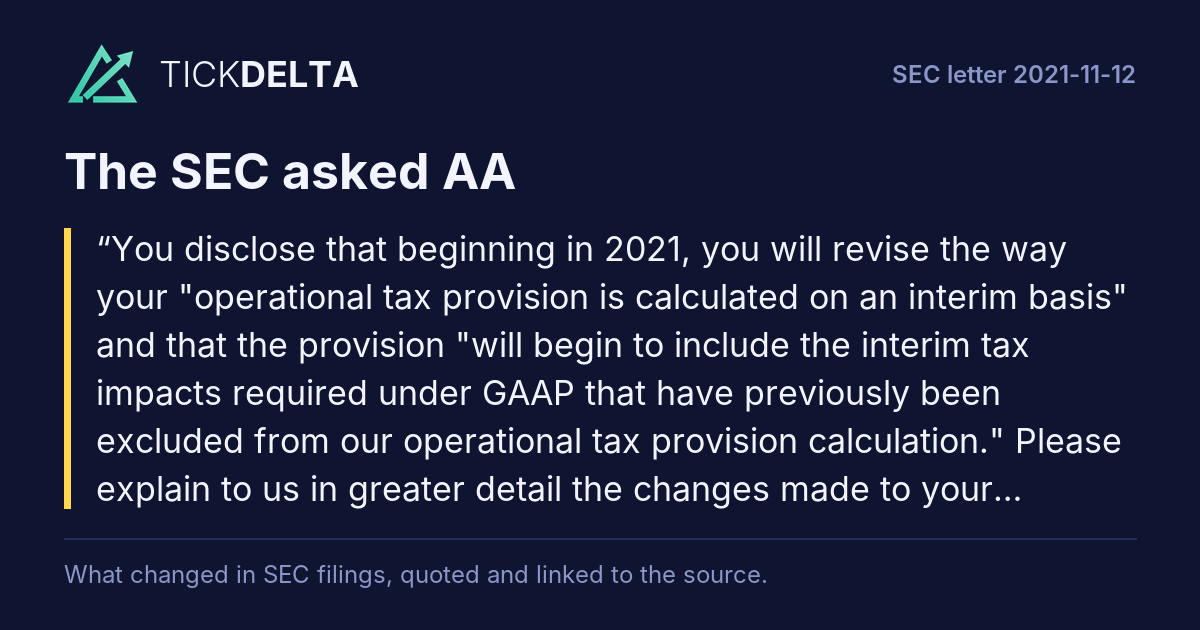
You disclose that beginning in 2021, you will revise the way your "operational tax provision is calculated on an interim basis" and that the provision "will begin to include the interim tax impacts required under GAAP that have previously been excluded from our operational tax provision calculation." Please explain to us in greater detail the changes made to your interim tax provision and whether it represents aRest of the question
change in accounting principle. In doing so, clarify the nature of the previously excluded items that will now be included, the accounting literature that supports the basis for your treatment, the reasons for the change, and why the change will have "no impact on the GAAP tax provision in any period."
The Company calculates its interim period GAAP tax provision in accordance with ASC 740-270 using an annual effective tax rate. There has been no change in the Company’s calculation of its interim period GAAP tax provision, and accordingly, the Company has made no change in accounting principle.Read in the reply
The Company did make a change to how it calculates its adjusted effective tax rate, which is its non-GAAP operational tax calculation. This measure is used by management to assess the tax on operations exclusive of special items and is presented and discussed in quarterly earnings presentations.Rest of the answer
This change has no impact on the Company’s GAAP tax provision for any period.
Beginning with the first quarter of 2021, the calculation of the
Company’s non-GAAP operational tax is calculated on a full year basis in a manner consistent with our GAAP tax provision except for exclusion of the following items:
•
Tax cost or benefit attributable to special items based on the applicable statutory rates in the jurisdictions where the special items occurred; and
Discrete tax items (generally unusual or infrequently occurring items, changes in law, items associated with uncertain tax positions, or effects of measurement-period adjustments).
Prior to 2021, our non-GAAP operational tax provision also excluded the interim impact of loss companies (entities with a full valuation allowance) for which no tax benefit was realized. On a full year basis, such impacts netted to zero.
We changed the non-GAAP operational tax provision to a methodology more closely aligned with the GAAP tax calculation to reduce interim period volatility in the non-GAAP operational tax provision as the GAAP tax provision includes the full year impact of loss companies for which no tax benefit was realized, which can fluctuate significantly between interim periods.
Financial Statements
Notes to the Consolidated Financial Statements
B.
First report after the company's reply of Nov 29, 2021: 10-K filed Feb 24, 2022 ↗, against the 10-K filed Feb 25, 2021 ↗.
Tickdelta does not hold the text of both reports, so they are not compared here.
Please tell us and disclose the nature of expenses that you include within the cost of goods sold line item and the nature of expenses that you include within the selling, general administrative, and other expenses line item.
The following is a description of the nature of expenses that the Company includes within the cost of goods sold line item and the nature of expenses that the Company includes within the selling, general administrative and other expenses line item:Read in the reply
Cost of goods sold. Alcoa includes the following in Cost of goods sold: operating costs of our three segments, excluding depreciation, depletion, amortization, but including all production related costs: raw materials consumed; purchases of metal for consumption or trade; conversion costs, such as labor, materials, and utilities; equity earningsRest of the answer
of certain investments integral to the Company’s supply chain; and plant administrative expenses. Also included in Cost of goods sold are: costs related to the Transformation function, which focuses on the management of expenses and obligations of previously closed operations;
pension and other postretirement benefit service cost for employees maintaining closed locations; and other costs not included in the operating costs of the segments.
Selling, general administrative, and other expenses. Alcoa includes the costs of corporate-wide functional support in Selling, general administrative, and other expenses. Such function costs include: executive; sales; marketing; strategy; operations administration; finance; information technology; legal; human resources; and government affairs and communications.
We will include these disclosures in the Company’s upcoming Annual Report on Form 10-K for the year ended December 31, 2021 (the “2021 Form 10-K”) under Note B. Summary of Significant Accounting Policies.
First report after the company's reply of Nov 29, 2021: 10-K filed Feb 24, 2022 ↗, against the 10-K filed Feb 25, 2021 ↗.
Tickdelta does not hold the text of both reports, so they are not compared here.
You disclose that inventories are stated at the lower of cost or market. Please clarify if you recognize inventory at the lower of cost or market or lower of cost or net realizable value and revise your disclosures accordingly. See ASC 330-10-35-1B. S. Contingencies and Commitments, page 108
The Company’s inventories are carried at the lower of cost or net realizable value in accordance with ASC 330-10-35-1B. The Company will update the following disclosure in its upcoming 2021 Form 10-K under Note B. Summary of Significant Accounting Policies as follows:Read in the reply
Inventory Valuation. Inventories are carried at the lower of cost or net realizable value, with the cost of inventories principally determined under the average cost method.
First report after the company's reply of Nov 29, 2021: 10-K filed Feb 24, 2022 ↗, against the 10-K filed Feb 25, 2021 ↗.
Tickdelta does not hold the text of both reports, so they are not compared here.
We note that Alcoa of Australia Limited ("AofA") is currently involved in a tax dispute with the Australian Taxation Office and that you are not recognizing any tax expense related to the matter since you believe it is more likely than not that AofA's tax position will be sustained.Rest of the question
Please tell us if you believe this matter falls within the scope of ASC 740 or other literature, such as ASC 450, and how you arrived at your determination. If applicable, tell us how you applied ASC 740-10-30-7 in determining that no additional tax expense was required.
The Company’s tax position on this matter was analyzed in accordance with ASC 740-10-25 as uncertain income tax positions are specifically excluded from ASC 450. The key questions in AofA’s dispute are whether, for the purposes ofRead in the reply
Australian tax legislation: (a) the parties to the relevant transactions dealt at arm’s length; and (b) AofA received arm’s length consideration in respect of the relevant supplies of alumina. If AofA can establish that at least one of these questions can be answered in the affirmative, the Australian Taxation Office’s (ATO) claims will fail.Rest of the answer
The Company performed a thorough legal and factual analysis based on the relevant facts and circumstances. The Company also received external counsel from legal and tax advisors in Australia. The Company has formed the view that it is more likely than not that it can establish that both questions can be answered in the affirmative. The Company does not agree with the
ATO’s positions and stands by its tax returns, and accordingly, will continue to defend its position. As the Company concluded, following the above process, that it is more likely than not that AofA’s tax position will be sustained, it has not recognized any tax expense in relation to this matter.
Form 10-Q for the Quarter Ended September 30,
First report after the company's reply of Nov 29, 2021: 10-K filed Feb 24, 2022 ↗, against the 10-K filed Feb 25, 2021 ↗.
Tickdelta does not hold the text of both reports, so they are not compared here.
Please tell us what the "Premium paid on early redemption of debt" line item represents and why you reflect it as an addition to operating cash flows. See ASC 230-10-45-15(g). In closing, we remind you that the company and its management are responsible for the accuracy and adequacy of their disclosures, notwithstanding any review, comments, action or absence of action by the staff.
The “Premium paid on early redemption of debt” line item is included in “Adjustments to reconcile net income to cash from operations” to remove the interest expense related to debt prepayments from operating cash flows and reclassify as cash outflows for financing activities. This is consistent with ASC 230-10-45-15 requiring cash payments for debt prepayment or debt extinguishment to be classified as cash outflows for financing activities.Read in the replyRest of the answer
The amount adjusted from operating cash flows is included in the “Payments on debt (original maturities greater than three months)” line item as a cash outflow for financing activities.
First report after the company's reply of Nov 29, 2021: 10-K filed Feb 24, 2022 ↗, against the 10-K filed Feb 25, 2021 ↗.
Tickdelta does not hold the text of both reports, so they are not compared here.
Your response to prior comment 5 indicates that the "Premium paid on early redemption of debt" line item is removing interest expense related to debt prepayments from operating cash flows and reclassifying them as financing cash flows in accordance with ASC 23010-45-15.Rest of the question
Considering ASC 230-10-45-15(g) specifically indicates that payments of accrued interest are excluded from financing activities, please clarify how your presentation complies with ASC 230-10-45-15(g) and ASC 230-10-45-17(c). A description of the related journal entries and how they are reflected on the statement of cash flows may facilitate our understanding.
The $43 million of redemption premiums included in the Statement ofRead in the reply
Consolidated Cash Flows caption “Premium paid on early redemption of debt” are cash payments for premiums associated with the early redemption of debt and exclude any accrued interest thereon. In the second quarter of 2021, the Company redeemed in full the $750 million aggregate principal amount of its outstanding 6.75% Senior Notes due 2024 at a redemption price equal to 103.375% of the principal amount, resulting in a premium payment of approximately $25 million.Rest of the answer
In the third quarter of 2021, the Company redeemed in full the $500 million aggregate principal amount of its outstanding 7.00% Senior Notes due 2026 at a redemption price equal to 103.5% of the principal amount, resulting in a premium payment of approximately $18 million. The redemption premiums totaling approximately $43 million are recorded in the “Interest expense” caption on the Statement of Consolidated Operations (debit), with a corresponding reduction of cash
(credit). As stated in ASC 230-10-45-15(g), premiums paid associated with debt repayment are to be presented as financing cash flows on the Statement of Consolidated Cash Flows. The Company’s Statement of Consolidated Cash Flows is prepared using the indirect method. The “Premium paid on early redemption of debt” caption in the cash from operations section is included to add-back the expense recorded associated with the redemption premiums to Net income (loss) and remove the cash flow impact from operating cash flows. The “Payments on debt (original maturities greater than three months)” caption includes the cash outflow associated with the redemption premiums to properly reflect the premiums paid as a financing outflow in accordance with ASC 230-10-45-15(g). Payments of accrued interest at the time of the redemptions were included in cash from operations in accordance with ASC
230-10-45-17(c).
A summary of the accounting entries recorded to reflect the redemption premiums in the Statement of Consolidated Operations and the Statement of Consolidated Cash Flows is included below:
Accounting for the cash payment of the redemption premiums (in millions):
D. Interest Expense
$
C. Cash
Cash flow impact of redemption premiums (in millions):
First report after the company's reply of Dec 14, 2021: 10-K filed Feb 24, 2022 ↗, against the 10-K filed Feb 25, 2021 ↗.
Tickdelta does not hold the text of both reports, so they are not compared here.
Also in this review: closing letter, 2021-12-17