Screener / SEC EDGAR /CIK 0000824142 /10-K filed Mar 2, 2026, compared with Feb 27, 2025 /Numbers from the XBRL of the 10-Ks
Nasdaq Industrials · HVAC Equipment

Aaon, Inc. AAON

Compare with peers Embed
SEC comment letters, last 20 years

4 reviews of AAON's filings by SEC staff

UPLOAD and CORRESP
Reviews 4 latest letter Sep 15, 2022
Questions asked 8 each answered in the company's own letter
No closing letter 0 reviews without a letter saying the staff completed it

When the SEC's staff reviews a filing, it writes to the company with numbered questions, and the company answers each one in a letter. SEC publishes the exchange once the review is over, at least 20 business days later. A question is not an accusation; most reviews end with the company adding detail to its next filing.

How the reviews went

Every review on EDGAR, from the first staff letter to the letter that closes it

  1. 1. Staff letters 5 UPLOAD
  2. 2. Questions in them 8 numbered comments
  3. 3. Company replies 5 CORRESP
  4. 4. Reviews closed 4 of 4 closing letter

Half the closed reviews took 21 days or less from the first letter to the closing letter.

Form 10-K for the year ended December 31, 2021

2022-09-15 to 2022-10-03 · 1 question · 1 letter from the SEC, 1 from the company
Review closed 2022-10-03
Acquisitions
Financial Statements
SEC asked
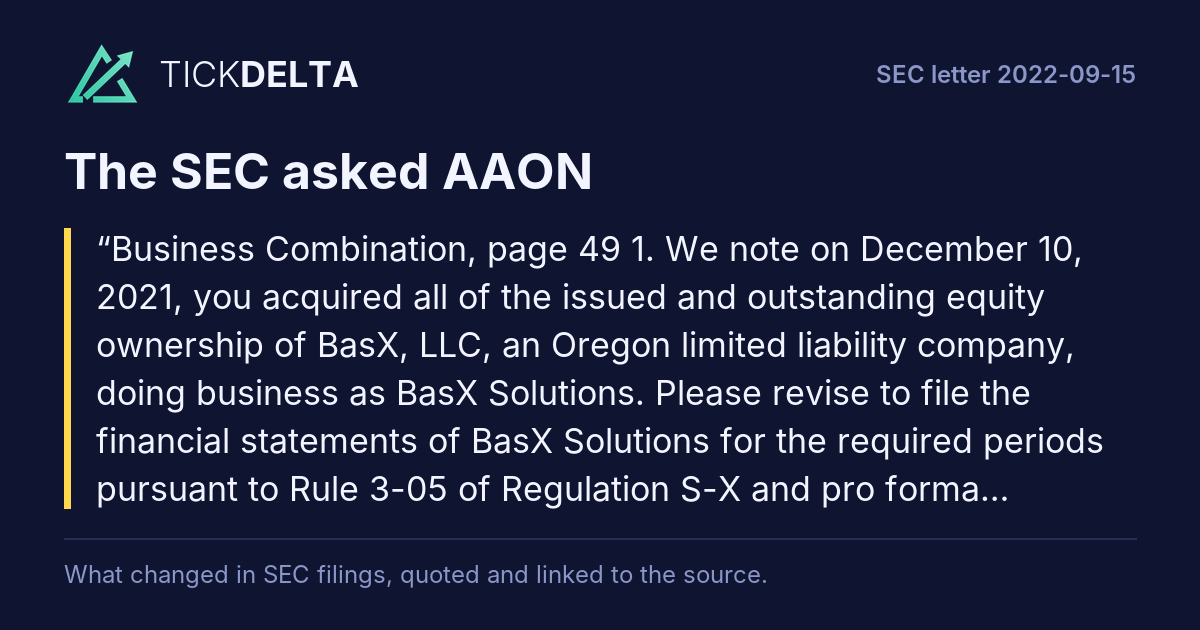
Business Combination, page 49 1. We note on December 10, 2021, you acquired all of the issued and outstanding equity ownership of BasX, LLC, an Oregon limited liability company, doing business as BasX Solutions. Please revise to file the financial statements of BasX Solutions for the required periods pursuant to Rule 3-05 of Regulation S-X and pro forma financial information as required by Article 11 of Regulation
Rest of the question

S-X or provide us with the significance test calculations of Rule 1-02(w) of Regulation S-X, supporting your conclusion that BasX Solutions' financial statements are not required to be presented.

AAON answered

No numbered answer found in the reply. Read the reply ↗

In its next report

First report after the company's reply of Sep 21, 2022: 10-Q filed Nov 7, 2022 ↗, against the 10-Q filed Aug 8, 2022 ↗.

Tickdelta does not hold the text of both reports, so they are not compared here.

Also in this review: closing letter, 2022-10-03

Form 10-K for the Year Ended December 31, 2019

2020-07-23 to 2020-08-13 · 2 questions · 2 letters from the SEC, 2 from the company
Review closed 2020-08-13
RevenueResults discussion (MD&A)Risk factors
Audited Financial Statements
SEC asked
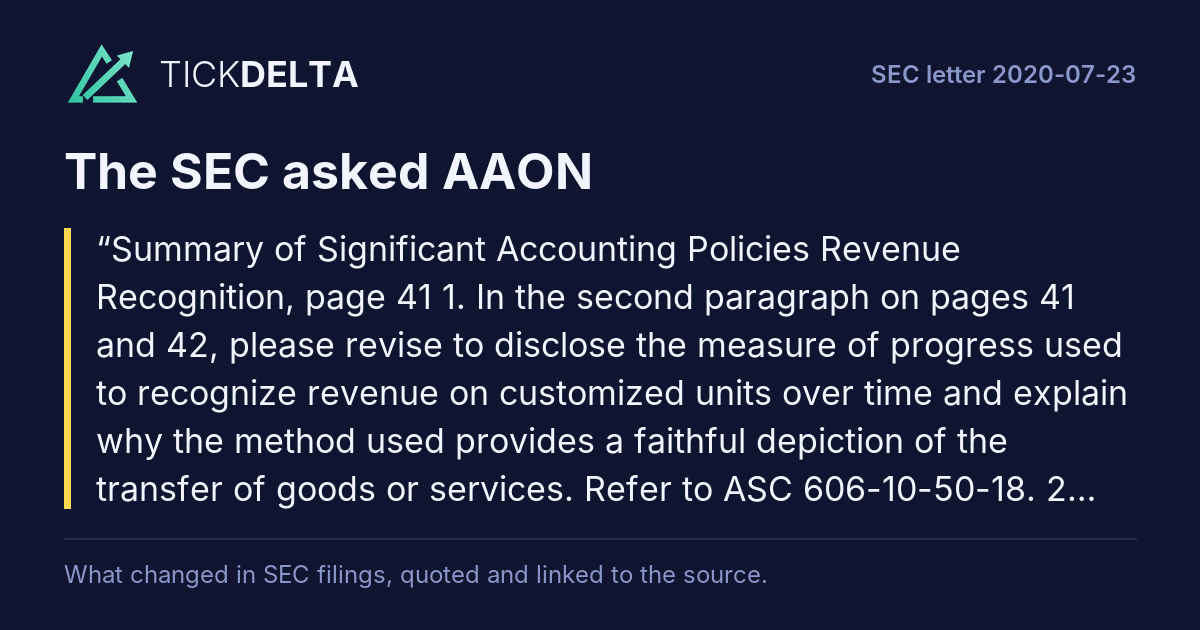
Summary of Significant Accounting Policies Revenue Recognition, page 41 1. In the second paragraph on pages 41 and 42, please revise to disclose the measure of progress used to recognize revenue on customized units over time and explain why the method used provides a faithful depiction of the transfer of goods or services. Refer to ASC 606-10-50-18. 2.
Rest of the question

We note your disclosure that revenue is presented net of certain payments to your independent manufacturer representatives. So that we may better understand your accounting for these transactions, please refer to ASC 606-10-50-12 and ASC 606-10-5536 through 55-40 and tell us the following: • Clarify if your contracts for the purchase of HVAC units, related products and services are between you and the end customer or you and the representative; • Describe the nature of your performance obligation(s) associated with these contracts; • Provide us with a comprehensive analysis explaining how you concluded you were the principal or agent in these arrangements; and • In the event you are unable to collect amounts due from the end user, please explain the financial obligations that you and representatives have to each other. Management's Discussion and Analysis, page 23 3. We note that the majority of your sales are in domestic markets and your most significant customer operates primarily in Texas. Given the continued rise in COVID-19 cases throughout the United States, including Texas, please ensure that your MD&A disclosures in your upcoming Form 10-Q for the period ended June 30, 2020 address the matters described in CF Disclosure Guidance Topic 9A. Please similarly revise your risk factor and financial statement disclosures as appropriate. Disclosures should address, but not be limited to, the following: • Known or expected impacts upon your backlog and peak selling season; • Any potential supply chain disruptions (particularly with respect to raw materials needed for assembly); • Any material changes to your manufacturing process (including measures taken to protect workers in your manufacturing facilities); • Any known or expected adjustments needed to ensure sufficient access to capital (e.g. plans to increase borrowings, reduce dividend payments, or curtail capital expenditures); and • Known or expected impacts on the timing of the Longview, Texas plant expansion. In closing, we remind you that the company and its management are responsible for the accuracy and adequacy of their disclosures, notwithstanding any review, comments, action or absence of action by the staff.

AAON answered
The Company's finished goods inventory turns very quickly. At any quarter end, the quantity and value of units for which the performance obligation has not been met is not material. Generally, almost all sales are 100% complete by the period end and we believe the additional disclosures noted above are not material and as a result have chosen to omit these disclosures.

2.We note your disclosure that revenue is presented net of certain payments to your independent manufacturer representatives.
Rest of the answer

So that we may better understand your accounting for these transactions, please refer to ASC 606-10-50-12 and ASC 606-10-55-

36 through 55-40 and tell us the following:

a.Clarify if your contracts for the purchase of HVAC units, related products and services are between you and the end customer or you and the representative;

a.Describe the nature of your performance obligation(s) associated with these contracts;

b.Provide us with a comprehensive analysis explaining how you concluded you were the principal or agent in these arrangements; and c.In the event you are unable to collect amounts due from the end user, please explain the financial obligations that you and representatives have to each other.

Response:

The Company's contracts for the purchase of HVAC units and "Third Party Products", as defined in our 10K, are with the end customer. The primary performance obligation listed in the contract is delivery of the requested manufactured equipment. Third Party Products provided by the Representative generally are shown as a lump sum included with the Representative's commission in the contract. Third Party Products are not detailed out or necessarily provided to the Company; the Representative simply includes a total amount for which the Company should bill relating to these items. Our contracts that include Third Party Products only note a total sum that include the cost of our equipment, Third Party Products and the Representative's commission.

It is clearly stated in the contract that delivery is FOB Factory and title transfers to the customer upon delivery of goods to the freight carrier. The shipping policy also notes that the customer is responsible for any damage caused by the freight carrier and for pursuing claims against the freight carrier. The contract also does note the Company’s limited warranty policy as a performance obligation. Delivery of said equipment/parts are distinct as the customer can use and install them on their own. Even large orders of units can be completed in partial shipments so that customers can start the installation process on units that have shipped while waiting for the remaining units on the order to be manufactured and shipped.

There are sometimes other items noted in an order that could also be considered performance obligations such as startup cost fees, cancellation fees, change fees, handling fees, and extended warranties. Generally, none of these items individually or in total would be material. Additionally, in most cases these items would be billed at the same time as shipments of the units—only in cases of very large jobs where there are potentially multiple shipments and partial billings where all items on an order would not all be billed at the same time. Extended warranties are considered a distinct service in the contract and the Company does track and break out that item separately for purposes of recognizing revenue. ASC 606-10-25-18A discusses shipping and handling activities related to goods in the contract. It notes that if the shipping and handling activities are performed before the customer obtains control of the good, then the shipping and handling activities are not a promised service to the customer but activities to fulfill the entity’s promise to transfer the good. As such, they would not be a distinct good or service in the contract.

As the principal, the Company controls the AAON equipment as it designs and manufactures the equipment based upon requested specifications and controls the goods prior to being transferred to the customer. The Company has inventory risk and control in establishing the price for the goods as AAON provides the minimum sales price to the Representatives.

AAON does not control the Third Party Products. The Representatives have primary responsibility for fulfilling the promise to provide Third Party Products to the end customer. The Company is neither obligated to provide the Third Party Products if the supplier fails to transfer the goods to the customer nor is responsible for the acceptability of the goods. The Company does not take inventory risk at any time before or after the goods are transferred to the customer. The Company does not commit to obtain the goods from the Representatives before the goods are purchased by the customer and does not accept responsibility for any damaged or returned goods. The Company does not have discretion in establishing prices for the Third Party Products which are set by the supplier.

As such, the Company would recognize revenue as gross for the products it manufactures and recognize revenue as net related to the Third Party Products.

The Company will only release the amount due to the Representative upon collection of the receivable from the end customer. Any amount not collected from the end customer typically will reduce the amount due to the Representative.

Management's Discussion and Analysis, page 23

3.We note that the majority of your sales are in domestic markets and your most significant customer operates primarily in Texas. Given the continued rise in COVID-19 cases throughout the United States, including Texas, please ensure that your MD&A disclosures in your upcoming Form 10-Q for the period ended June 30, 2020 address the matters described in CF Disclosure Guidance Topic 9A. Please similarly revise your risk factor and financial statement disclosures as appropriate. Disclosures should address, but not be limited to, the following:

a.Known or expected impacts upon your backlog and peak selling season;

b.Any potential supply chain disruptions (particularly with respect to raw materials needed for assembly);

c.Any material changes to your manufacturing process (including measures taken to protect workers in your manufacturing facilities);

d.Any known or expected adjustments needed to ensure sufficient access to capital (e.g. plans to increase borrowings, reduce dividend payments, or curtail capital expenditures); and e.Known or expected impacts on the timing of the Longview, Texas plant expansion.

Response:

In the June 30, 2020 10Q, the Company will insert the following three paragraphs in the "Overview" section of Item 2:

Our manufacturing operations are considered a critical infrastructure industry, as defined by the U.S. Department of Homeland Security, as such, the decrees issued by national, state, and local governments in response to the COVID-19 pandemic have had minimal impact on our operations except for higher employee absenteeism in our manufacturing facilities. We had almost no interruptions to our production during the six months ended June 30, 2020. For the most part, our workers are able to socially distance themselves during the manufacturing process. Additional precautions have been taken to social distance workers that work in close environments. The Company utilizes sanitation stations, requires the use of a facial covering, performs daily temperature scanning, and performs additional cleaning and sanitation throughout the day and deep cleaning overnight. The Company did see significant absenteeism in the month of June, but was still able to maintain reduced production at both plants.

While the Company's operations are primarily in Oklahoma and Texas, our domestic sales to customers cover almost all 50 states. Only the state of Texas has more than 10% of our revenues. For the six months ended June 30, 2020, we've experienced record sales. We have not seen a significant slow down or disruption in our customer jobs and have benefited from some of the new construction for temporary hospitals due to COVID-19. Our incoming order rate has recently softened slightly due to less than optimal lead times and turmoil in the market resulting from COVID-19. We expect to be back on schedule by the end of July and anticipate orders will increase as our lead times improve during our peak selling season. Uncertainty in the education sector could negatively impact our employee attendance levels as well as our bookings. The outlook for the remainder of the year is hard to predict during these uncertain times. Despite this uncertainty, we remain cautiously optimistic that the year will end with modest growth over 2019.

We had unrestricted cash and cash equivalents of $61.3 million as of June 30, 2020, which, along with improved free cash flow, enabled us to declare an 18.8% increase in our semi-annual cash dividend in May (from $0.16 to $0.19 per share) that was paid on July 1, 2020. Our capital expenditures during the first half of the year were $33.5 million, as compared to $16.8 million for the same period a year ago, and we anticipate our full-year 2020 capital expenditures will total approximately $73.2 million. Our expansion to our Longview, TX facility is on schedule and expected to be completed in the fourth quarter of 2020. The Company also has $28.3 million available under its line of credit. Should the Company experience an unexpected downturn due to COVID-19; spending on dividends and capital expenditures can be reduced and the line of credit can be utilized.
Read in the reply
In its next report

First report after the company's reply of Jul 27, 2020: 10-Q filed Aug 6, 2020 ↗, against the 10-Q filed May 7, 2020 ↗.

Tickdelta does not hold the text of both reports, so they are not compared here.

Form 10-K for the Fiscal Year Ended December 31, 2019 · Audited Financial Statements
SEC asked
Summary of Significant Accounting Policies Revenue Recognition, page 41 1. We note your response to prior comment two. Please revise your future filings to clearly explain, as you do in your response letter, the types of performance obligations that are contained within your contracts with end users. Please also revise your disclosures to clarify that you are principal with respect to HVAC units.
Rest of the question

Refer to ASC 606-10-50-12 and 50-17. 2. You indicate in your response to prior comment two that Third Party Products are not detailed out or perhaps not even provided to the Company by the Representative. As such, please supplementally clarify for us what your performance obligations are, if any, related to Third Party Products. Please explain to us what the Representative's fee represents and tell us what costs are netted against revenues with respect to Third Party Products. It may be helpful to provide us with an example to demonstrate how you account for the different components that are billed to customers.

AAON answered
We have updated our footnote in the June 30, 2020 10-Q filed on August 6, 2020 as shown below. We have underlined items that were added. Additionally, the footnote was rearranged to help make the disclosure clearer.

Revised Footnote:

The Company recognizes revenue, presented net of sales tax, when it satisfies the performance obligation in its contracts. The primary performance obligation in our contract is delivery of the requested manufactured equipment.
Rest of the answer

Most of the Company’s products are highly customized, cannot be resold to other customers and the cost of rework to be resold is not economical. The Company has a formal cancellation policy and generally does not accept returns on these units. As a result, many of the Company’s products do not have an alternative use and therefore, for these products we recognize revenue over the time it takes to produce the unit. For all other products that are part sales or standardized units, we satisfy the performance obligation when the control is passed to the customer, generally at time of shipment. Final sales prices are fixed based on purchase orders. Sales allowances and customer incentives are treated as reductions to sales and are provided for based on historical experiences and current estimates. Sales of our products are moderately seasonal with the peak period being July - November of each year.

We are responsible for billings and collections resulting from all sales transactions, including those initiated by our independent manufacturer representatives (“Representatives”). Representatives are national companies that are in the business of providing HVAC units and other related products and services to customers. The end user customer orders a bundled group of products and services from the Representative and expects the Representative to fulfill the order. These additional products and services may include controls purchased from another manufacturer to operate the unit, start-up services, and curbs for supporting the unit (“Third Party Products”). All are associated with the purchase of a HVAC unit but may be provided by the Representative or another third party. Only after the specifications are agreed to by the Representative and the customer, and the decision is made to use an AAON HVAC unit, will we receive notice of the order. We establish the amount we must receive for our HVAC unit (“minimum sales price”), but do not control the total order price that is negotiated by the Representative with the end user customer. The Representatives submit the total order price to us for invoicing and collection. The total order price includes our minimum sales price and an additional amount which may include both the Representatives’ fee and amounts due for additional products and services required by the customer. The Company is considered the principal for the equipment we design and manufacture and records that revenue gross. The Company has no control over the Third Party Products to the end customer and the Company is under no obligation related to the Third Party Products. Amounts related to Third Party Products are not recognized as revenue but are recorded as a liability and are included in accrued liabilities on the consolidated balance sheet.

2.You indicate in your response to prior comment two that Third Party Products are not detailed out or perhaps not even provided to the Company by the Representative. As such, please supplementally clarify for us what your performance obligations are, if any, related to Third Party Products. Please explain to us what the Representative's fee represents and tell us what costs are netted against revenues with respect to Third Party Products. It may be helpful to provide us with an example to demonstrate how you account for the different components that are billed to customers.

Response:

For clarification, the following summarizes the business activities conducted by the Company’s independent manufacturer representatives who are not employees of the Company, but are independent business entities (the “Representatives”). Our Representatives are not individuals. Rather, they are independent national companies that are in the business of providing HVAC units and other related services either to Customers who are replacing their HVAC unit or to Customers who are newly constructing commercial buildings. The Representatives operate under their own trade names and may sell multiple brands of HVAC units. Representatives are generally assigned a geographic territory and are used to generate sales of the Company’s HVAC equipment.

The Representatives are responsible for initiating sales orders with end users of the Company’s products (the “Customers”). When a Customer needs a HVAC unit installed at the construction site, they will contact their local HVAC business (our Representatives) to determine what HVAC product they need and any additional product or installation services required. Once the order specifications are agreed to between the Representatives and the Customer, and the decision is made by the Representative to use an AAON HVAC unit, the Company receives notice of the order. The order information includes information regarding the specifications of the actual HVAC unit the Company is expected to manufacture and deliver directly to the Customer’s construction site, as well as information regarding the total order price. The total order price represents the final negotiated price of the entire order, which includes the Company’s HVAC unit and generally includes Third Party Products. The Company determines the sales prices for its products only (“minimum sales price”).

The Company manufactures the HVAC unit, delivers the unit to the construction site and acts as the billing agent for the total order price. The total order price includes portions of the order for which the Company has no involvement with or responsibility for order fulfillment, such as installation, services and/or Third Party Products.

The somewhat unique aspect of our transactions is that our Representatives are not resellers of our products and we act as the billing agent for the entire order, including the portion of the order that relates to Third Party Products that we have no involvement with. The structure of our arrangements with our Representatives allows us to reduce our credit risk, which would increase if we allowed our Representatives to be responsible for collecting the sales proceeds from the Customer. We would then be exposed to credit risk at both the Customer level and at the Representative level. In addition, our structure allows us to be in a position of placing liens on the Customer’s project if payment is not received, which creates significant incentive for Customers to pay our invoices. Lastly, the Company’s HVAC unit is almost always the largest component of the entire order, and this allows us to be in a position to control the billings and collections from the Customer.

All billings and collections are the responsibility of the Company. The Company owes the excess of the final total order price over the minimum sales price to the Representative, which is a “pass through” amount, upon receipt of payment from the Customer. The final total order price may include Third Party Products that are associated with the purchase of a HVAC product but are provided by the Representative or another third party. The Company does not obtain a break-down of the Third Party Product amounts included in the excess of the final total order price over the minimum sales price. If the Company does not collect the final total order price from the Customer, payment is not owed to the Representative.

To illustrate using an example, if the Company established a minimum sales price for one of the Company’s HVAC products of $20,000 and a Representative negotiates a final total order price to the Customer of $30,000, the following transactions occur:

1.Once AAON is notified of the order, AAON manufactures the product and ships the product to the Customer.

2.AAON invoices the Customer for the final total order price of $30,000. This transaction is recorded as a debit to accounts receivable for $30,000; a credit to sales of $20,000 and a credit to Due to Representatives (a liability account) of $10,000.

3.AAON collects the $30,000 from the Customer.

Read in the reply
In its next report

First report after the company's reply of Aug 10, 2020: 10-Q filed Nov 5, 2020 ↗, against the 10-Q filed May 7, 2020 ↗.

Tickdelta does not hold the text of both reports, so they are not compared here.

Also in this review: closing letter, 2020-08-13

Form 10-K for the Fiscal Year Ended December 31, 2017

2018-12-04 to 2018-12-18 · 3 questions · 1 letter from the SEC, 1 from the company
Review closed 2018-12-18
Results discussion (MD&A)Liquidity and cashInventoryRevenue
Selling, General and Administrative Expenses, page 14
SEC asked (1)
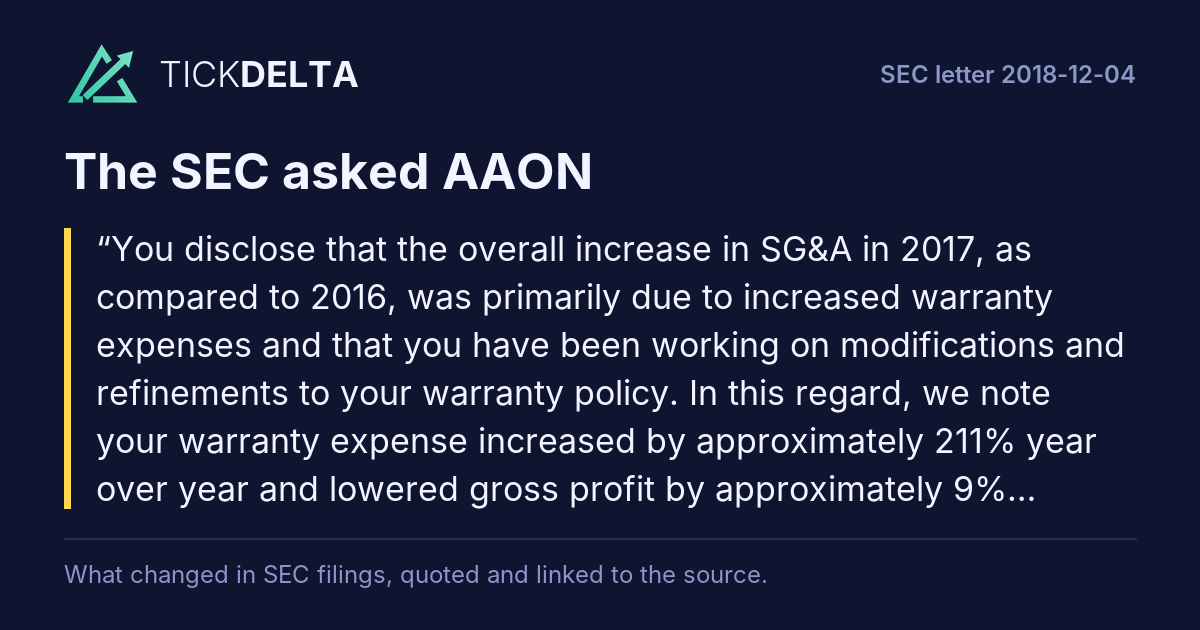
You disclose that the overall increase in SG&A in 2017, as compared to 2016, was primarily due to increased warranty expenses and that you have been working on modifications and refinements to your warranty policy. In this regard, we note your warranty expense increased by approximately 211% year over year and lowered gross profit by approximately 9%.
Rest of the question

Please revise to disclose the material factors negatively impacting your results so that investors can better understand the underlying issues driving your warranty payments and increased expense. To the extent management anticipates that warranty expense will continue to have a negative impact on your future results, please provide discussion of this trend to provide investors with more insight into your risks and future results of operations. Please refer to Sections 501.04 (Material Changes) and .12 (Overall Approach to MD&A) of the Financial Reporting Codification for further guidance.

AAON answered
The Company acknowledges the Staff's comment and will change our disclosure in future filings to the following:

The overall increase in SG&A was primarily due to increased warranty expenses. The Company's warranty expense increased due the increase in the failure rate used in calculating our accrual for warranty liability.
Rest of the answer

The failure rate increased due the approximately $4.5 million or 110% increase in warranty claims in 2017.

Factors affecting the increase in warranty claims were: (1) changes in personnel that resulted in a less stringent application of the warranty claim policy, (2) allowing our independent sales representatives to submit a one-time clean-up of old warranty claims not previously submitted to the Company increased claims by approximately $1.0 million, (3) two specific job failures, involving multiple units, increased claims by approximately $1.1 million, and (4) paint department failures which increased claims by approximately $0.8 million. Claims related to the specific job and paint department failures may continue throughout 2018.

Management's Discussion and Analysis of Financial Condition and Results of Operations Cash Flows from Operating Activities, page 18

Read in the reply
In its next report

First report after the company's reply of Dec 7, 2018: 10-K filed Feb 28, 2019 ↗, against the 10-K filed Feb 27, 2018 ↗.

Tickdelta does not hold the text of both reports, so they are not compared here.

Management's Discussion and Analysis of Financial Condition and Results of Operations · Cash Flows from Operating Activities, page 18
SEC asked (2)
We note the increase in inventory and it appears that your inventory turnover decreased from 6.19 for FY 2016 to 4.77 for FY 2017. You disclose that cash flows from operating activities decreased primarily due to increased purchases of inventory during the year.
Rest of the question

Please revise your filing to expand your disclosures regarding cash flows used in operating activities to provide more insight into the underlying drivers of the significant increases in inventory between the periods presented. Refer to Section 501.13.b.1 of the Financial Reporting Codification for guidance.

AAON answered
Cash flows from operating activities decreased primarily due to increased purchases of raw material during the year arising from stocking of parts needed for the water-source heat pump line. Additionally, the Company began stocking water-source heat pumps units which resulted in larger amounts of finished goods on hand at the end of the year.
Read in the reply
In its next report

First report after the company's reply of Dec 7, 2018: 10-K filed Feb 28, 2019 ↗, against the 10-K filed Feb 27, 2018 ↗.

Tickdelta does not hold the text of both reports, so they are not compared here.

Note 9. Warranties, page 11
SEC asked (3)
As it relates to your standard warranty with terms from 18 months to 25 years, which you disclose obligates the company to replace parts or services your products, tell us how you considered the factors in ASC 606-10-55-33 in determining your warranties do not also include a service component and these warranties should be accounted for as a separate performance obligation in accordance with ASC 606-10-55-34.
Rest of the question

Include in your response a comparison of the warranty periods to the average life spans of each product type.

AAON answered
In future filings, the Company will adjust its wording in Note 9 to remove the reference to "service" as this is not part of our standard limited warranty. Additionally, the Company will adjust the wording on page 3 of its Form 10-K under Warranties to read:

"Our product warranty policy is: the earlier of one year from the date of first use or 18 months from date of shipment for parts only; an additional four years for compressors (if applicable);

15 years on aluminized steel gas-fired heat exchangers (if applicable); 25 years on stainless steel heat exchangers (if applicable); and ten
Rest of the answer

years on gas-fired heat exchangers in RL products (if applicable). Our warranty policy for the RQ series covers parts for two years from date of unit shipment. Our warranty policy for the WH and WV Series geothermal/water-source heat pumps covers parts for five years from the date of manufacture."

The language in our 2017 Form 10-K referencing labor for one year from date of unit shipment on RQ units is not correct and was inadvertently included.

The Company's product warranty provides the customer with assurance that the related product will function as the parties intended because it complies with agreed-upon specifications and cannot be purchased separately. The Company's standard warranty does not include a service. The Company did consider the items discussed in ASC 606-10-55-33 in determining that no service is provided. The average life span our of products can vary significantly depending on features, maintenance and location. Below is a summary showing an estimated average life span by product type:

Product Type

Avg Life Span (years)

Rooftop Units

Rooftop Units with Heat Exchanger

Condensing Units

Air Handlers

Outdoor Mechanical Rooms

Water Source Heat Pumps

As noted in the description of our product warranty policy above, the primary warranty that relates to all products is the parts warranty of 12-18 months. The Company provides replacement parts for other specified components for a longer period of time as noted above. The product warranty policy notes that it does not cover labor or material charges. The Company does not provide any service beyond its product warranty that is in addition to the assurance that the product complies with agreed-upon specifications except for its extended warranties, which are purchased separately and accounted for separately.

As the Company concluded that it did not have a service component, the Company followed the guidance in ASC 606-10-55-32, "If a customer does not have the option to purchase a warranty separately, an entity should account for the warranty in accordance with the guidance on product warranties in Subtopic 460-10 on guarantees, unless the promised warranty, or part of the promised warranty, provides the customer with a service in addition to the assurance that the product complies with agreed-upon specifications."

Read in the reply
In its next report

First report after the company's reply of Dec 7, 2018: 10-K filed Feb 28, 2019 ↗, against the 10-K filed Feb 27, 2018 ↗.

Tickdelta does not hold the text of both reports, so they are not compared here.

Also in this review: closing letter, 2018-12-18

Form 10-K for the Fiscal Year Ended December 31, 2015

2016-12-05 to 2016-12-27 · 2 questions · 1 letter from the SEC, 1 from the company
Review closed 2016-12-27
Executive pay
Products and Markets, page 1 · Major Customers, page 2
SEC asked (1)
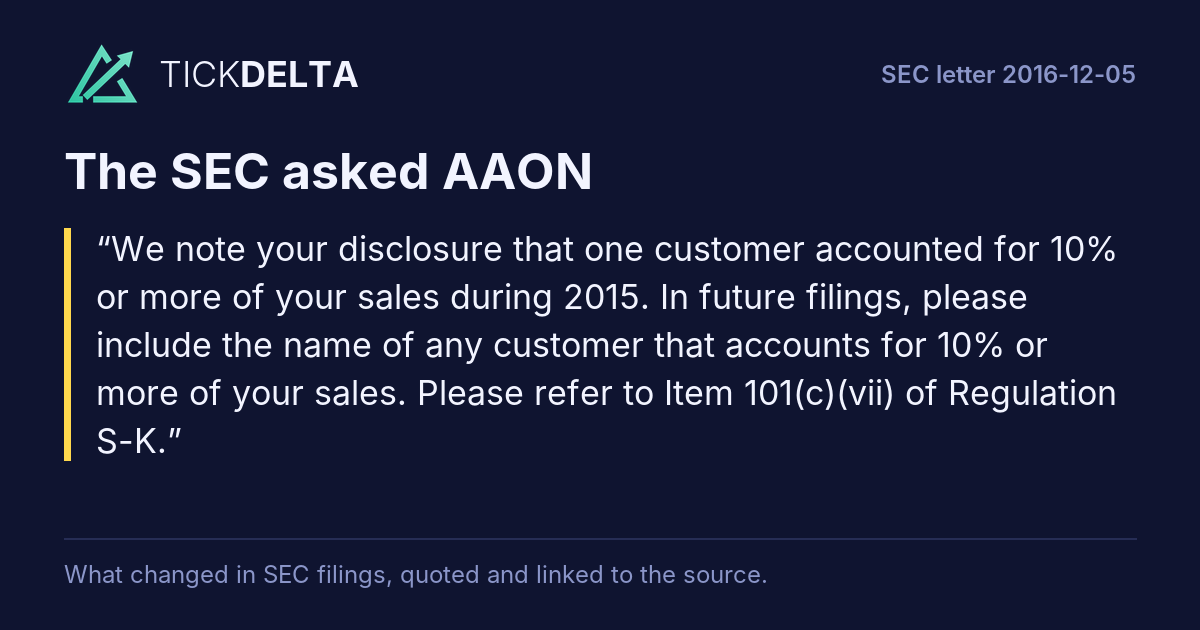
We note your disclosure that one customer accounted for 10% or more of your sales during 2015. In future filings, please include the name of any customer that accounts for 10% or more of your sales. Please refer to Item 101(c)(vii) of Regulation S-K.
AAON answered
The Company acknowledges the Staff's comment and will provide the requested information in future filings.
Read in the reply
In its next report

First report after the company's reply of Dec 8, 2016: 10-K filed Feb 23, 2017 ↗.

No earlier 10-K before the SEC's letter is in Tickdelta, so there is nothing to compare with.

Executive Compensation, page 14 · Summary Compensation Table, page 23
SEC asked (2)
It appears that the amounts which you have disclosed in the “Bonus” column of this table should have been disclosed under the “Non-Equity Incentive Compensation Plan” column because the amounts reflect the performance of your executives under your nonequity incentive plan, as defined in Item 402(a)(6)(iii) of Regulation S-K.
Rest of the question

If, in the exercise of discretion, an amount is paid over and above the amounts earned by meeting the performance measure in the non-equity incentive plan, that amount should be reported in the “Bonus” column. It appears that Mr. Asbjornson’s discretionary bonus increase in the amount of $51,065 should have been disclosed in the Bonus column. Please explain to us why the payments under the annual incentive bonus awards are being disclosed in the “Bonus” column. For guidance refer to Question 119.02 of Regulation S-K Compliance and Disclosure Interpretations. Please ensure that in future filings you disclose payments under your annual incentive bonus as earned under a non-equity incentive plan and provide appropriate disclosure in your Grant of Plan-Based Awards Table.

AAON answered
The Company acknowledges the Staff's comment and will change our disclosure in future filings to show the amounts paid under the Company's Annual Cash Incentive Bonus plan in the "Non-Equity Incentive Compensation Plan" column of this table. Any additional discretionary amounts paid over and above the amounts earned by meeting the performance measure in the non-equity incentive plan, will be reported in the "Bonus" column of this table.

The Company acknowledges the following:

• the Company and its management are responsible for the adequacy and accuracy of the disclosures in its
Rest of the answer

filings;

staff comments or changes to disclosure in response to staff comments do not foreclose the Commission from taking any action with respect to the filing; and the Company may not assert staff comments as a defense in any proceeding initiated by the Commission or any person under the federal securities laws of the United States.

Read in the reply
In its next report

First report after the company's reply of Dec 8, 2016: 10-K filed Feb 23, 2017 ↗.

No earlier 10-K before the SEC's letter is in Tickdelta, so there is nothing to compare with.

Also in this review: closing letter, 2016-12-27

From the SEC's correspondence on EDGAR: staff letters (form UPLOAD) and company letters (form CORRESP), 14 letters filed since 2016-12-05. Questions and answers are matched by their numbers; topics come from words in each question. The reports are compared word for word (same form, before the first SEC letter against the first report after the company's reply). No AI.

Sources

The SEC's correspondence on EDGAR: staff letters (form UPLOAD) and company letters (form CORRESP), matched question by question. No AI.

Also

Filings: the letters in the filing list.

Work with it

Excel workbook · CSV. Google Sheet that stays up to date: paste =IMPORTDATA("https://tickdelta.com/company/AAON/export.csv") into a cell.

Next in Owners and insiders:Insider trades
Esc

Type a ticker such as AAPL, a name, an investor such as Buffett, or a topic such as tariffs. ↑ ↓ to move, Enter to open.