Paragraph 60 · 49% changed
Every version of it
Screener
/
SEC EDGAR
/CIK 0001070494
/10-K filed Feb 26, 2026, compared with Feb 27, 2025
/Numbers from the XBRL of the 10-Ks
Nasdaq
Health care · Pharmaceuticals
Acadia Pharmaceuticals Inc ACAD
The 10-K against last year's
131 changes: 42 added, 12 removed, 76 reworded, 1 quiet changes
10-K Feb 26, 2026 vs Feb 27, 2025
Risk Factors
16.9%
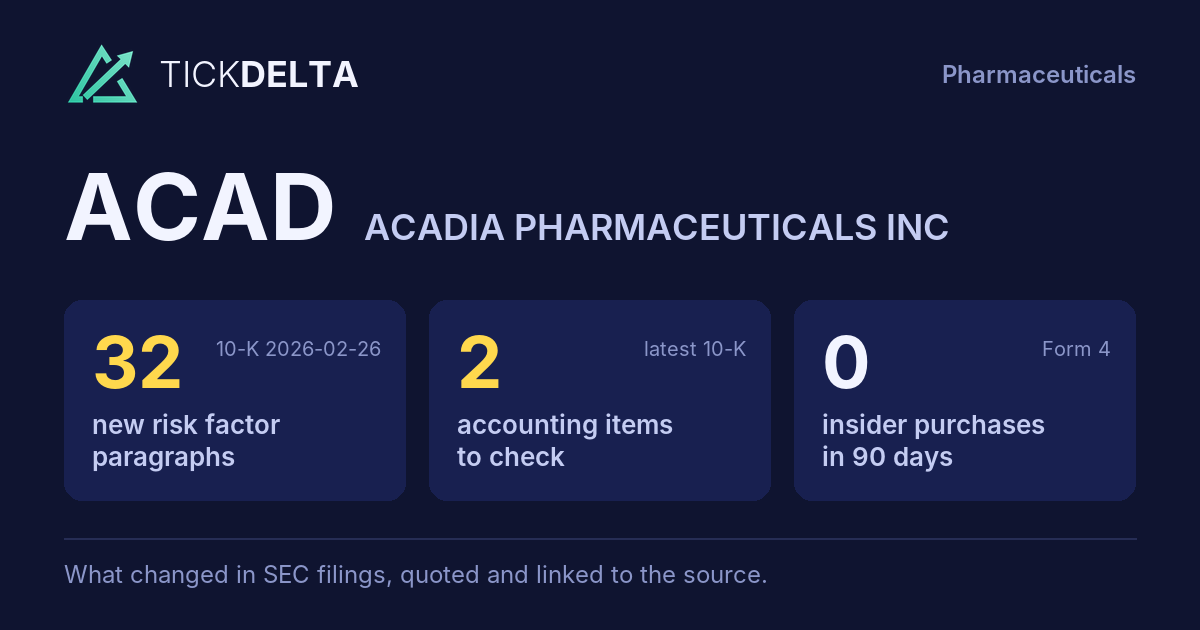
of the text changed · 28,838 words now · 32 new paragraphs, 10 gone
MD&A
14.4%
of the text changed · 7,815 words now · 10 new paragraphs, 2 gone
Legal Proceedings
11.2%
of the text changed · 1,357 words now
Accounting Policies
14.6%
of the text changed · 4,838 words now
10-K 0001193125-26-072519 (Feb 26, 2026) vs 10-K 0000950170-25-029253 (Feb 27, 2025)
Every paragraph, and how much of it changed
One bar per paragraph, in the order of the 10-K. Height and colour show the share of its words not in the closest paragraph a year earlier; the tallest bars are new paragraphs.
Risk Factors
346 paragraphs · 32 new · 79 reworded · 10 gone · 10-K Feb 26, 2026 against Feb 27, 2025
New paragraph
Reworded (5% of its words or more)
Same or nearly
Paragraph 259 · 48% changed
Every version of it
Paragraph 160 · 48% changed
Every version of it
Paragraph 62 · 47% changed
Every version of it
In the U.S., the EU and many foreign countries, we are not permitted to market our product candidates until we receive regulatory approval from the FDA, European Commission or comparable foreign regulatory authorities. DAYBUE was approved in 2023 in the U.S. by the FDA, and in October 2024 in Canada by Health Canada, for and in 2025 in Israel by the treatment Ministry of Rett syndrome in adult and pediatric patients two years of age and older. Health. In January 2025, we submitted a marketing authorization application MAA for the approval of trofinetide for the treatment of Rett syndrome in the EU. If we do not receive marketing approval for trofinetide in the EU or other jurisdictions outside of North America, including Japan, we will never be able to commercialize trofinetide in such jurisdictions. Even if we do receive additional regulatory approvals, we may not be successful in commercializing those opportunities.
Paragraph 104 · 43% changed
Every version of it
The process of integrating any acquired business, technology, service, or product may result in unforeseen operating difficulties and expenditures and may divert significant management attention from our ongoing business operations. As a result, we will incur a variety of costs in connection with an acquisition and may never realize its anticipated benefits. Moreover, any product candidate we identify, select and acquire or license may require additional, time-consuming development or regulatory efforts prior to commercial sale, including preclinical studies, if applicable, and extensive clinical testing and approval by the FDA and applicable foreign regulatory authorities. All product candidates are prone to the risk of failure that is inherent in pharmaceutical product development, including the possibility that the product candidate will not be shown to be sufficiently safe and/or effective for approval by regulatory authorities. In addition, any such products that are approved may not be manufactured or produced economically, successfully commercialized or widely accepted in the marketplace or be more effective or desired than other commercially available alternatives.
Paragraph 156 · 39% changed
Every version of it
We have incurred, and expect to continue to incur, significant costs as a result of laws laws, regulations and regulations standards relating to various aspects of our business, including corporate governance governance, work force initiatives and other matters. matters, and failure to comply with such laws, regulations and standards could adversely affect our business.
Paragraph 198 · 39% changed
Every version of it
Paragraph 140 · 38% changed
Every version of it
The amount of taxes we pay in different jurisdictions depends on the application of the tax laws of various jurisdictions, including the United States, to our international business activities, tax rates, new or revised tax laws, or interpretations of tax laws and policies, and our ability to operate our business in a manner consistent with our corporate structure and intercompany arrangements. In 2015, we licensed worldwide intellectual property rights related to pimavanserin in certain indications to Acadia Pharmaceuticals GmbH, our wholly owned Swiss subsidiary (Acadia GmbH), and in July 2020 we licensed additional related rights to Acadia GmbH. Our goals for the establishment of Acadia GmbH, and the licensing of worldwide intellectual property rights for pimavanserin, include building a platform for long-term operational and financial efficiencies, including tax-related efficiencies. The taxing authorities of the jurisdictions in which we operate may challenge our methodologies for pricing intercompany transactions pursuant to our intercompany arrangements or disagree with our determinations as to the income and expenses attributable to specific jurisdictions. In addition, future changes in U.S. and non-U.S. tax laws, including implementation of international tax reform relating to the tax treatment of multinational corporations, if enacted, may reduce or eliminate any potential financial efficiencies that we hoped to achieve by establishing this operational structure. Additionally, taxing authorities, such as the U.S. Internal Revenue Service, may audit and otherwise challenge these types of arrangements, and have done so with other companies in the pharmaceutical industry. If any such challenge or disagreement were to occur or change in tax law were enacted, we could be required to pay additional taxes, interest and penalties, which could result in one-time tax charges, higher effective tax rates, reduced cash flows and lower overall profitability of our operations. Our financial statements could fail to reflect adequate reserves to cover such a contingency. Similarly, a taxing authority could assert that we are subject to tax in a jurisdiction where we believe we have not established a taxable connection, often referred to as a “permanent establishment” under international tax treaties, and such an assertion, if successful, could increase our expected tax liability in one or more jurisdictions.
Paragraph 60 · 49% changed
Every version of it
10-K Feb 27, 2025Drug development is a long, expensive and unpredictable process. Even if we do successfully complete clinical trials, those results are not necessarily predictive of results of additional trials that may be needed before a marketing application may be submitted to regulatory authorities. If we are unable to develop, or obtain marketing approval for, or, if approved, successfully commercialize our product candidates, we may not be able to generate sufficient revenue and our business operations and financial performance may be materially and adversely affected.
10-K Feb 26, 2026
We are currently conducting studies with our product candidates. Even if we complete all planned clinical trials for our product candidates on schedule, such completion does not guarantee that we will obtain regulatory approval from the regulatory authorities. The results of our clinical trials may not meet the requirements for approval, or regulatory authorities may interpret the data differently than we do. In addition, completion of clinical trials does not ensure that regulatory authorities will view the results as sufficient to demonstrate safety, efficacy, or clinical benefit. For example, regulators may disagree with the design or implementation of our clinical trials, the appropriateness or relevance of endpoints of our clinical trials, duration of our clinical trials, whether the patient population is sufficiently representative of the desired indication in their geography or at all, the nature or existence of comparative data, size and duration of safety database, and our interpretation of meaningfulness and/or generalizability of findings. Consequently, the successful completion of clinical trials may not be predictive of a positive outcome with any or all regulatory authorities. If we are unable to develop, or obtain marketing approval for, or, if approved, successfully commercialize our product candidates, we may not be able to generate sufficient revenue and our business operations and financial performance may be materially and adversely affected.
Paragraph 259 · 48% changed
Every version of it
10-K Feb 27, 2025Ensuring that our internal operations and future business arrangements with third parties comply with applicable healthcare laws and regulations could involve substantial costs. It is possible that governmental authorities will conclude that our business practices do not comply with current or future statutes, regulations or case law interpreting applicable fraud and abuse or other healthcare laws and regulations. For example, contributions to third-party charitable foundations are a current area of significant governmental and congressional scrutiny, and we could face action if a federal or state governmental authority were to conclude that our charitable contributions to foundations that support Parkinson’s disease patients generally are not compliant. If our operations are found to be in violation of any of the laws described above or any other governmental laws and regulations that may apply to us, we may be subject to significant penalties, including civil, criminal and administrative penalties, damages, fines, exclusion from U.S. government-funded healthcare programs, such as Medicare and Medicaid, disgorgement, imprisonment, contractual damages, reputational harm, diminished profits, additional reporting requirements and/or oversight, and the curtailment or restructuring of our operations. Moreover, while we do not bill third-party payors directly and our customers make the ultimate decision on how to submit claims, from time-to-time, for our products, we may provide reimbursement guidance to patients and healthcare providers. If a government authority were to conclude that we provided improper advice and/or encouraged the submission of a false claim for reimbursement, we could face action against us by government authorities. If any of the physicians, healthcare professions, or other providers or entities with whom we expect to do business is found to be not in compliance with applicable laws, they may be subject to criminal, civil or administrative sanctions, including exclusions from government-funded healthcare programs and imprisonment. If any of the above occur, it could adversely affect our ability to operate our business and our results of operations.
10-K Feb 26, 2026
face action against us by government authorities. If any of the physicians, healthcare professions, or other providers or entities with whom we expect to do business is found to be not in compliance with applicable laws, they may be subject to criminal, civil or administrative sanctions, including exclusions from government-funded healthcare programs and imprisonment. If any of the above occur, it could adversely affect our ability to operate our business and our results of operations.
Paragraph 160 · 48% changed
Every version of it
10-K Feb 27, 2025Our research and development activities and our third-party manufacturers’ and suppliers’ activities involve the generation, storage, use and disposal of hazardous materials, including the components of our products and product candidates and other hazardous compounds and wastes. We and our manufacturers and suppliers are subject to environmental, health and safety laws and regulations governing, among other matters, the use, manufacture, generation, storage, handling, transportation, discharge and disposal of these hazardous materials and wastes and worker health and safety. In some cases, these hazardous materials and various wastes resulting from their use are stored at our and our manufacturers’ facilities pending their use and disposal. We cannot eliminate the risk of contamination or injury, which could result in an interruption of our commercialization efforts, research and development efforts and business operations, damages and significant cleanup costs and liabilities under applicable environmental, health and safety laws and regulations. We also cannot guarantee that the safety procedures utilized by our third-party manufacturers for handling and disposing of these materials and wastes generally comply with the standards prescribed by these laws and regulations. We may be held liable for any resulting damages costs or liabilities, which could exceed our resources, and state or federal or other applicable authorities may curtail our use of certain materials and/or interrupt our business operations. Furthermore, environmental, health and safety laws and regulations are complex, change frequently and have tended to become more stringent. We cannot predict the impact of such changes and cannot be certain of our future compliance. Failure to comply with these environmental, health and safety laws and regulations may result in substantial fines, penalties or other sanctions. We do not currently carry hazardous waste insurance coverage.
10-K Feb 26, 2026
health and safety laws and regulations are complex, change frequently and have tended to become more stringent. We cannot predict the impact of such changes and cannot be certain of our future compliance. Failure to comply with these environmental, health and safety laws and regulations may result in substantial fines, penalties or other sanctions. We do not currently carry hazardous waste insurance coverage.
Paragraph 62 · 47% changed
Every version of it
10-K Feb 27, 2025
DAYBUE was approved in 2023 in the U.S. by the FDA, and in October 2024 in Canada by Health Canada, for the treatment of Rett syndrome in adult and pediatric patients two years of age and older. In January 2025, we submitted a marketing authorization application for the approval of trofinetide for the treatment of Rett syndrome in the EU. If we do not receive marketing approval for trofinetide in the EU or other jurisdictions outside of North America, including Japan, we will never be able to commercialize trofinetide in such jurisdictions. Even if we do receive additional regulatory approvals, we may not be successful in commercializing those opportunities.
10-K Feb 26, 2026
In the U.S., the EU and many foreign countries, we are not permitted to market our product candidates until we receive regulatory approval from the FDA, European Commission or comparable foreign regulatory authorities. DAYBUE was approved in 2023 in the U.S. by the FDA, in 2024 in Canada by Health Canada, and in 2025 in Israel by the Ministry of Health. In January 2025, we submitted a MAA for the approval of trofinetide for the treatment of Rett syndrome in the EU.
Paragraph 104 · 43% changed
Every version of it
10-K Feb 27, 2025
The process of integrating any acquired business, technology, service, or product may result in unforeseen operating difficulties and expenditures and may divert significant management attention from our ongoing business operations. As a result, we will incur a variety of costs in connection with an acquisition and may never realize its anticipated benefits. Moreover, any product candidate we identify, select and acquire or license may require additional, time-consuming development or regulatory efforts prior to commercial sale, including preclinical studies, if applicable, and extensive clinical testing and approval by the FDA and applicable foreign regulatory authorities. All product candidates are prone to the risk of failure that is inherent in pharmaceutical product development, including the possibility that the product candidate will not be shown to be sufficiently safe and/or effective for approval by regulatory authorities. In addition, any such products that are approved may not be manufactured or produced economically, successfully commercialized or widely accepted in the marketplace or be more effective or desired than other commercially available alternatives.
10-K Feb 26, 2026
The process of integrating any acquired business, technology, service, or product may result in unforeseen operating difficulties and expenditures and may divert significant management attention from our ongoing business operations. As a result, we will incur a variety of costs in connection with an acquisition and may never realize its anticipated benefits.
Paragraph 156 · 39% changed
Every version of it
10-K Feb 27, 2025
We have incurred, and expect to continue to incur, significant costs as a result of laws and regulations relating to corporate governance and other matters.
10-K Feb 26, 2026
We have incurred, and expect to continue to incur, significant costs as a result of laws, regulations and standards relating to various aspects of our business, including corporate governance, work force initiatives and other matters, and failure to comply with such laws, regulations and standards could adversely affect our business.
Paragraph 198 · 39% changed
Every version of it
10-K Feb 27, 2025The manufacturers of our products and product candidates, including Patheon, Siegfried, Corden, FIS and CoreRx, are obliged to operate in accordance with FDA-mandated current good manufacturing practices (cGMPs), and we have limited control over the ability of third-party manufacturers to maintain adequate quality control, quality assurance and qualified personnel to ensure compliance with cGMPs. In addition, the facilities used by our third-party manufacturers to manufacture our products and product candidates must be approved by the FDA pursuant to inspections that will be conducted prior to any grant of regulatory approval by the FDA. If any of our third-party manufacturers are unable to successfully manufacture material that conforms to our specifications and the FDA’s strict regulatory requirements, or pass regulatory inspection, they will not be able to secure or maintain approval for the manufacturing facilities. Additionally, a failure by any of our third-party manufacturers to establish and follow cGMPs or to document their adherence to such practices may lead to significant delays in clinical trials or in obtaining regulatory approval of product candidates, or result in issues maintaining regulatory approval of our products and any product candidate that receives regulatory approval, negatively impact our commercialization of our products, or lead to significant delays in the launch and commercialization of any other products we may have in the future. Failure by our third-party manufacturers or us to comply with applicable regulations could result in sanctions being imposed on us, including fines, injunctions, civil penalties, failure of regulatory authorities to grant
10-K Feb 26, 2026
pass regulatory inspection, they will not be able to secure or maintain approval for the manufacturing facilities. We, or our contract manufacturers, any future collaborators and their contract manufacturers could be subject to periodic unannounced inspections by the FDA, competent authorities of EU Member States or other comparable foreign regulatory authorities, to monitor and ensure compliance with cGMP. Despite our efforts to audit and verify regulatory compliance, one or more of our third-party manufacturing vendors may be found on regulatory inspection by the FDA, competent authorities of EU Member States or other comparable foreign regulatory authorities to be noncompliant with cGMP regulations. Additionally, a failure by any of our third-party manufacturers to establish and follow cGMPs or to document their adherence to such practices may lead to significant delays in clinical trials or in obtaining regulatory approval of product candidates, or result in issues maintaining regulatory approval of our products and any product candidate that receives regulatory approval, negatively impact our commercialization of our products, or lead to significant delays in the launch and commercialization of any other products we may have in the future. Failure by our third-party manufacturers or us to comply with applicable regulations could result in sanctions being imposed on us, including shutdown of the third-party vendor or invalidation of drug product lots or processes, fines, injunctions, civil penalties, failure of regulatory authorities to grant pre-market approval of drugs, delays, suspension, variation or withdrawal of approvals, seizures or recalls of products, operating restrictions, and criminal prosecutions, any of which could significantly and adversely affect supplies of our products, if approved, and significantly harm our business, financial condition, results of operations and prospects.
Paragraph 140 · 38% changed
Every version of it
10-K Feb 27, 2025
The amount of taxes we pay in different jurisdictions depends on the application of the tax laws of various jurisdictions, including the United States, to our international business activities, tax rates, new or revised tax laws, or interpretations of tax laws and policies, and our ability to operate our business in a manner consistent with our corporate structure and intercompany arrangements. In 2015, we licensed worldwide intellectual property rights related to pimavanserin in certain indications to Acadia Pharmaceuticals GmbH, our wholly owned Swiss subsidiary (Acadia GmbH), and in July 2020 we licensed additional related rights to Acadia GmbH. Our goals for the establishment of Acadia GmbH, and the licensing of worldwide intellectual property rights for pimavanserin, include building a platform for long-term operational and financial efficiencies, including tax-related efficiencies. The taxing authorities of the jurisdictions in which we operate may challenge our methodologies for pricing intercompany transactions pursuant to our intercompany arrangements or disagree with our determinations as to the income and expenses attributable to specific jurisdictions. In addition, future changes in U.S. and non-U.S. tax laws, including implementation of international tax reform relating to the tax treatment of multinational corporations, if enacted, may reduce or eliminate any potential financial efficiencies that we hoped to achieve by establishing this operational structure. Additionally, taxing authorities, such as the U.S. Internal Revenue Service, may audit and otherwise challenge these types of arrangements, and have done so with other companies in the pharmaceutical industry. If any such challenge or disagreement were to occur or change in tax law were enacted, we could be required to pay additional taxes, interest and penalties, which could result in one-time tax charges, higher effective tax rates, reduced cash flows and lower overall profitability of our operations. Our financial statements could fail to reflect adequate reserves to cover such a contingency. Similarly, a taxing authority could assert that we are subject to tax in a jurisdiction where we believe we have not established a taxable connection, often referred to as a “permanent establishment” under international tax treaties, and such an assertion, if successful, could increase our expected tax liability in one or more jurisdictions.
10-K Feb 26, 2026
The amount of taxes we pay in different jurisdictions depends on the application of the tax laws of various jurisdictions, including the United States, to our international business activities, tax rates, new or revised tax laws, or interpretations of tax laws and policies, and our ability to operate our business in a manner consistent with our corporate structure and intercompany arrangements. In 2015, we licensed worldwide intellectual property rights related to pimavanserin in certain indications to Acadia Pharmaceuticals GmbH, our wholly owned Swiss subsidiary (Acadia GmbH), and in July 2020 we licensed additional related rights to Acadia GmbH. Our goals for the establishment of Acadia GmbH, and the licensing of worldwide intellectual property rights for pimavanserin, include building a platform for long-term operational and financial efficiencies, including tax-related efficiencies. The taxing authorities of the jurisdictions in which we operate may challenge our methodologies for pricing intercompany transactions pursuant to our intercompany arrangements or
MD&A
89 paragraphs · 10 new · 30 reworded · 2 gone · 10-K Feb 26, 2026 against Feb 27, 2025
New paragraph
Reworded (5% of its words or more)
Same or nearly
Paragraph 48 · 37% changed
Cost of product sales was $89.0 million and $81.8 million for the years ended December 31, 2025 and $41.6 million in 2024 and 2023, 2024, respectively, or approximately 8% and 9% and 6% of net product sales, respectively. Cost of product sales as a percentage of net product sales for both NUPLAZID and DAYBUE remained relatively flat in 2024 2025 as compared to 2023. 2024. The increase in cost of product sales was primarily due to the $51.8 million in license fees and royalties expensed during 2024 increased standard per unit manufacturing cost for DAYBUE as compared to $21.8 million in we substantially finished the same period of 2023 for DAYBUE, including royalties due to Neuren based on net sales of DAYBUE and the amortization of the milestone payments capitalized under our 2018 license agreement with Neuren. zero cost inventories.
Paragraph 46 · 36% changed
Net product sales of NUPLAZID were $549.2 $680.1 million and $517.2 $609.4 million in 2023 2025 and 2022, 2024, respectively. The increase in net product sales of NUPLAZID of $32.0 $70.7 million was due to the growth in NUPLAZID unit sales as well as a higher average net selling price in of NUPLAZID in 2023 2025 compared to 2022. 2024, partially offset by an unfavorable gross-to-net adjustments of approximately $11.8 million related to Medicare inflation cap rebates for the sales related to October 1, 2022 to December 31, 2024. This adjustment does not impact underlying demand trends, which continue to be demonstrated by strong volume growth. Net product sales of DAYBUE were $177.2 $391.4 million for 2023. There were no and $348.4 million in 2025 and 2024, respectively. The increase in net product sales of DAYBUE during 2022. of $43.0 million was due to the growth in DAYBUE unit sales as well as a higher average net selling price of DAYBUE in 2025 compared to 2024.
Paragraph 16 · 35% changed
Net product sales consist of sales of our products. The FDA approved NUPLAZID in April 2016 for the treatment of hallucinations and delusions associated with PDP and we launched the product in the United States in May 2016. The FDA approved DAYBUE in March 2023 for the treatment of Rett syndrome and we launched the product in the United States in April 2023. Health Canada granted marketing authorization of DAYBUE for the treatment of Rett syndrome in adult and pediatric patients 2 years of age and older in October 2024. The FDA approved DAYBUE STIX in December 2025 for the treatment of Rett syndrome and we made the product available on a limited basis in the first quarter of 2026, with a broader launch planned for Q2 2026. The Ministry of Health in Israel recently approved DAYBUE for the treatment of Rett syndrome in adults and pediatric patients 2 years of age and older and weighing at least 9 kg in December 2025.
Paragraph 14 · 33% changed
We have several product candidates in earlier stages of development for the treatment of CNS disorders neurological and rare diseases, including diseases. These include ACP-711 for the treatment of essential tremor, for which we expect to initiate with a Phase 2 study expected to begin in 2026; and ACP-271, a GPR88 agonist, with a first-in-human study in healthy volunteers planned for the first quarter of 2026.
Paragraph 52 · 33% changed
Selling, general and administrative expenses increased to $548.9 million for the year ended December 31, 2025 from $488.4 million in 2024, including $51.6 million in stock-based compensation expense, from $406.6 million in 2023, including $48.0 million in stock-based compensation expense. for the year ended December 31, 2024. The increase in selling, general and administrative expenses was primarily driven by increased marketing costs related to our consumer activation program to support the NUPLAZID and the planned expansion of the DAYBUE franchises in the U.S. and investments to support commercialization of DAYBUE outside the U.S. team.
Paragraph 36 · 27% changed
Paragraph 86 · 27% changed
Net cash used in investing activities totaled $302.6 million in 2025 compared to net cash used in investing activities of $30.5 million in 2024 compared to and net cash provided by investing activities of $32.0 million in 2023 and 2023. The increase in net cash provided by used in investing activities in 2025 compared to 2024 was primarily due to no proceeds from sale of $73.2 million in 2022. a non-financial asset and increased net payments made to Neuren for our sale of the PRV and an annual net sales milestone. The increase in net cash used in investing activities in 2024 compared to 2023 was primarily due to increased net purchases of investment securities. The decrease in net cash provided by investing activities in 2023 compared to 2022 was primarily due to milestone payment of $40 million to Neuren and decreased net sale and maturities of investment securities.
Paragraph 72 · 25% changed
•our ability to obtain regulatory approval for, and subsequently generate product sales from, NUPLAZID for the negative symptoms of schizophrenia, or from DAYBUE, and our product candidates;
Paragraph 48 · 37% changed
10-K Feb 27, 2025
Cost of product sales was $81.8 million and $41.6 million in 2024 and 2023, respectively, or approximately 9% and 6% of net product sales, respectively. Cost of product sales as a percentage of net product sales for NUPLAZID remained flat in 2024 as compared to 2023. The increase in cost of product sales was primarily due to the $51.8 million in license fees and royalties expensed during 2024 as compared to $21.8 million in the same period of 2023 for DAYBUE, including royalties due to Neuren based on net sales of DAYBUE and the amortization of the milestone payments capitalized under our 2018 license agreement with Neuren.
10-K Feb 26, 2026
Cost of product sales was $89.0 million and $81.8 million for the years ended December 31, 2025 and 2024, respectively, or approximately 8% and 9% of net product sales, respectively. Cost of product sales as a percentage of net product sales for both NUPLAZID and DAYBUE remained relatively flat in 2025 as compared to 2024. The increase in cost of product sales was primarily due to the increased standard per unit manufacturing cost for DAYBUE as we substantially finished the zero cost inventories.
Paragraph 46 · 36% changed
10-K Feb 27, 2025
Net product sales of NUPLAZID were $549.2 million and $517.2 million in 2023 and 2022, respectively. The increase in net product sales of NUPLAZID of $32.0 million was due to the growth in NUPLAZID unit sales as well as a higher average net selling price in NUPLAZID in 2023 compared to 2022. Net product sales of DAYBUE were $177.2 million for 2023. There were no net product sales of DAYBUE during 2022.
10-K Feb 26, 2026
Net product sales of NUPLAZID were $680.1 million and $609.4 million in 2025 and 2024, respectively. The increase in net product sales of NUPLAZID of $70.7 million was due to the growth in NUPLAZID unit sales as well as a higher average net selling price of NUPLAZID in 2025 compared to 2024, partially offset by an unfavorable gross-to-net adjustments of approximately $11.8 million related to Medicare inflation cap rebates for the sales related to October 1, 2022 to December 31, 2024. This adjustment does not impact underlying demand trends, which continue to be demonstrated by strong volume growth. Net product sales of DAYBUE were $391.4 million and $348.4 million in 2025 and 2024, respectively. The increase in net product sales of DAYBUE of $43.0 million was due to the growth in DAYBUE unit sales as well as a higher average net selling price of DAYBUE in 2025 compared to 2024.
Paragraph 16 · 35% changed
10-K Feb 27, 2025
Net product sales consist of sales of our products. The FDA approved NUPLAZID in April 2016 for the treatment of hallucinations and delusions associated with PDP and we launched the product in the United States in May 2016. The FDA approved DAYBUE in March 2023 for the treatment of Rett syndrome and we launched the product in the United States in April 2023.
10-K Feb 26, 2026
Net product sales consist of sales of our products. The FDA approved NUPLAZID in April 2016 for the treatment of hallucinations and delusions associated with PDP and we launched the product in the United States in May 2016. The FDA approved DAYBUE in March 2023 for the treatment of Rett syndrome and we launched the product in the United States in April 2023. Health Canada granted marketing authorization of DAYBUE for the treatment of Rett syndrome in adult and pediatric patients 2 years of age and older in October 2024. The FDA approved DAYBUE STIX in December 2025 for the treatment of Rett syndrome and we made the product available on a limited basis in the first quarter of 2026, with a broader launch planned for Q2 2026. The Ministry of Health in Israel recently approved DAYBUE for the treatment of Rett syndrome in adults and pediatric patients 2 years of age and older and weighing at least 9 kg in December 2025.
Paragraph 14 · 33% changed
10-K Feb 27, 2025
We have several product candidates in earlier stages of development for the treatment of CNS disorders and rare diseases, including ACP-711 for the treatment of essential tremor, for which we expect to initiate a Phase 2 study in 2026.
10-K Feb 26, 2026
We have several product candidates in earlier stages of development for the treatment of neurological and rare diseases. These include ACP-711 for the treatment of essential tremor, with a Phase 2 study expected to begin in 2026; and ACP-271, a GPR88 agonist, with a first-in-human study in healthy volunteers planned for the first quarter of 2026.
Paragraph 52 · 33% changed
10-K Feb 27, 2025
Selling, general and administrative expenses increased to $488.4 million in 2024, including $51.6 million in stock-based compensation expense, from $406.6 million in 2023, including $48.0 million in stock-based compensation expense. The increase in selling, general and administrative expenses was primarily driven by increased marketing costs to support the NUPLAZID and DAYBUE franchises in the U.S. and investments to support commercialization of DAYBUE outside the U.S.
10-K Feb 26, 2026
Selling, general and administrative expenses increased to $548.9 million for the year ended December 31, 2025 from $488.4 million for the year ended December 31, 2024. The increase in selling, general and administrative expenses was primarily driven by costs related to our consumer activation program to support NUPLAZID and the planned expansion of the DAYBUE team.
Paragraph 36 · 27% changed
10-K Feb 27, 2025Rebates: Allowances for rebates include mandated discounts under the Medicaid Drug Rebate Program and the Medicare Part D prescription drug benefit. Rebates are amounts owed after the final dispensing of the product to a benefit plan participant and are based upon contractual agreements with, or statutory requirements pertaining to, Medicaid and Medicare benefit providers. The allowance for rebates is based on statutory discount rates and expected utilization. Our estimates for expected utilization of rebates is based on historical data received from the SPs, SDs and the single wholesale distributor since product launch. Rebates are generally invoiced and paid in arrears so that the accrual balance consists of an estimate of the amount expected to be incurred for the current quarter’s activity, plus an accrual balance for prior quarters’ unpaid rebates still estimated to be incurred. Allowances for rebates also include amounts due under the Inflation Reduction act of 2022 for Medicare Part D unit sales with applicable period AMP increases that outpace inflation over the benchmark period. The applicable period will be twelve months on October 1 of each year, with the initial applicable period beginning on October 1, 2022. The benchmark period AMP price is January 1, 2021 through September 30, 2021. Our estimates are based Medicare Part D sales as a percentage of gross sales and the rate AMP for the current period will be in excess the benchmark period. We regularly monitor our estimates and record adjustments when rebate trends, rebate programs and contract terms, legislative changes, or other significant events indicate that a change in the estimates is appropriate. To date, our estimates have not differed materially from actual rebates. However, subsequent changes in estimates may result in a material change in our accruals, which could also materially affect our balance sheet and results of operations.
10-K Feb 26, 2026
Medicare benefit providers. The allowance for rebates is based on statutory discount rates and expected utilization. Our estimates for expected utilization of rebates is based on historical data received from the SPs, SDs and the single wholesale distributor since product launch. Rebates are generally invoiced and paid in arrears so that the accrual balance consists of an estimate of the amount expected to be incurred for the current quarter’s activity, plus an accrual balance for prior quarters’ unpaid rebates still estimated to be incurred. Allowances for rebates also include amounts due under the Inflation Reduction Act of 2022 (IRA) for Medicare Part D unit sales with applicable period AMP increases that outpace inflation over the benchmark period. The applicable period will be twelve months on October 1 of each year, with the initial applicable period beginning on October 1, 2022. The benchmark period AMP price is January 1, 2021 through September 30, 2021 for NUPLAZID and January 1, 2024 through December 31, 2024 for DAYBUE. Our estimates are based Medicare Part D sales as a percentage of gross sales and the rate AMP for the current period will be in excess the benchmark period. We regularly monitor our estimates and record adjustments when rebate trends, rebate programs and contract terms, legislative changes, or other significant events indicate that a change in the estimates is appropriate. Prior to 2025, our estimates had not differed materially from actual rebates. However, in December 2025, we received our first invoices for Medicare inflation cap rebates from CMS for the applicable periods beginning on October 1, 2022 through September 30, 2024, which were higher than expected and material to our product revenue. The variances between the actual invoices received and our accruals were from the higher units billed. While we have been accruing for Medicare inflation cap rebates since the implementation of the IRA, the historical data we had from the federal government and our customers indicated that our Medicare volume mix for NUPLAZID was lower than the ultimate Medicare volume we received from CMS in our IRA invoices. We adjusted our Medicare rebate accruals to reflect actual invoices received and updated expectations. This unfavorable change of approximately $20.1 million related to the sales from October 1, 2022 to December 31, 2025, which increased our gross-to-net adjustments and reduced our net product sales of NUPLAZID. The adjustment does not impact underlying demand trends, which demonstrated strong volume growth in 2025. Of the $20.1 million, $11.8 million was classified as a change in estimate for the impact through December 31, 2024, and $8.3 million was captured within the current financial statements for the period ending December 31, 2025.
Paragraph 86 · 27% changed
10-K Feb 27, 2025
Net cash used in investing activities totaled $30.5 million in 2024 compared to net cash provided by investing activities of $32.0 million in 2023 and net cash provided by investing activities of $73.2 million in 2022. The increase in net cash used in investing activities in 2024 compared to 2023 was primarily due to increased net purchases of investment securities. The decrease in net cash provided by investing activities in 2023 compared to 2022 was primarily due to milestone payment of $40 million to Neuren and decreased net sale and maturities of investment securities.
10-K Feb 26, 2026
Net cash used in investing activities totaled $302.6 million in 2025 compared to net cash used in investing activities of $30.5 million in 2024 and net cash provided by investing activities of $32.0 million in 2023. The increase in net cash used in investing activities in 2025 compared to 2024 was primarily due to no proceeds from sale of a non-financial asset and increased net payments made to Neuren for our sale of the PRV and an annual net sales milestone. The increase in net cash used in investing activities in 2024 compared to 2023 was primarily due to increased net purchases of investment securities.
Paragraph 72 · 25% changed
10-K Feb 27, 2025
•our ability to obtain regulatory approval for, and subsequently generate product sales from, NUPLAZID for the negative symptoms of schizophrenia, or from DAYBUE, and our product candidates;
10-K Feb 26, 2026
•our ability to obtain regulatory approval for, and subsequently generate product sales from, our product candidates;
A paragraph is matched with the one last year that shares the most of its words; under half in common makes it new. The paragraphs shown are the 8 reworded the most in each section.
The paragraph that changed most in each section
The redline
Marked against last year's 10-K: cut words struck through, new words highlighted.
Risk Factors364 words changed in this paragraph; it is 48% similar to last year's version.
Third-party payors, whether governmental or commercial, whether in the U.S. or globally, are developing increasingly sophisticated methods of controlling healthcare costs. The current environment is putting pressure on companies to price products below what they may feel is appropriate. For example, the HHS imposes rebates on many Medicare Part B and Medicare Part D products to penalize price increases that outpace inflation on an annual basis. In addition, HHS has been empowered to negotiate the price of certain single-source drugs that have been on the market for at least 7 years covered under Medicare as part of the Medicare Drug Price Negotiation Program. Each year up to 20 products will be selected by HHS for the Medicare Drug Price Negotiation Program. Based upon the current law, we believe that 2029 is the earliest year NUPLAZID could be subject to a negotiated price, as we expect to apply and qualify for the small biotech exception, which provides an exemption from selection until 2027 (for initial price negotiation in 2029). In 2029, if selected, we expect that the price negotiation for NUPLAZID would be limited as we qualify as a “specified small manufacturer” and will receive the discount phase-in for NUPLAZID in years 2029 and 2030. Products subject to the Medicare Drug Price Negotiation Program are expected to experience a significant reduction in reimbursement from the Medicare program on a per unit basis. If coverage and adequate reimbursement are not available, or are available only to limited levels, we may not be able to successfully commercialize our current and any future product candidates that we develop, which could have an adverse effect on our operating results and our overall financial condition. Selling our products at less than an optimized price would impact our revenues and could impact our overall success as a company. We have changed, and may continue to change, the price of our products from time to time, however, we do not know if the price we have selected, or may select in the future, for our products is or will be the optimized price. Additionally, we do not know whether and to what extent third-party payors will react to any possible future changes in the price of our products. In the U.S., no uniform policy of coverage and reimbursement for drug products exists among third-party payors. Outside the U.S., reimbursement and healthcare payment systems vary significantly by country, and many countries have instituted price ceilings on specific products and therapies. Further, one payor’s determination to provide coverage and reimbursement for a product does not ensure that other payors will also provide coverage and reimbursement for the product. Therefore, coverage and reimbursement for our products both in the U.S. and outside may differ significantly from payor to payor. As a result, the coverage determination process is often a time-consuming and costly process that will require us to provide scientific and clinical support for the use of our products to each payor separately, with no assurance that coverage will be obtained. Coverage policies and third-party payor reimbursement rates may change at any time. Therefore, even if favorable coverage and reimbursement status is attained, less favorable coverage policies and reimbursement rates may be implemented in the future.
Source: Item 1A, 10-K 0001193125-26-072519 vs Item 1A, 10-K 0000950170-25-029253
MD&A286 words changed in this paragraph; it is 62% similar to last year's version.
Source: Item 7, 10-K 0001193125-26-072519 vs Item 7, 10-K 0000950170-25-029253
Accounting Policies204 words changed in this paragraph; it is 85% similar to last year's version.
The fair value of RSUs is estimated based on the closing market price of the Company’s common stock on the date of grant. RSUs generally vest over a four-year period. Certain RSUs also have an accelerated vesting clause based on specified market condition target and continued employment through a minimum vesting period. The fair value of RSUs expected to vest are recognized and amortized on a straight-line basis over the requisite service period, which is generally the vesting period. For those RSUs requiring satisfaction of both market and service conditions, the requisite service period is the longest of the explicit, implicit and derived service periods. Through 2023, the Company granted PSUs that vest upon the achievement of certain pre-defined company-specific performance-based criteria. Expense related to these PSUs is recognized ratably over the expected performance period once the pre-defined performance-based criteria for vesting becomes probable and can vest up to 200 percent of the target number of shares granted. The fair value of these PSUs is estimated based on the closing market price of the Company’s common stock on the date of grant. Beginning in 2024, the structure of the PSU design was revised with a rTSR approach such that awards are earned for the Company’s rTSR performance over three-year measurement periods relative to a peer group of companies and the actual numbers of PSUs that will vest at the end of the performance period may be anywhere from zero to 150 percent of the target number of shares granted. The fair value of these PSUs is estimated using a Monte Carlo model because the performance target is based on a market condition. Expense related to these PSUs is recognized ratably over the three-year measurement period. In connection with the departure of the former CEO, in September 2024 the Company incurred approximately $10.7 million in stock-based compensation expense as a result of accelerated equity award vesting and stock modifications under the former CEO’s severance plan. The table below summarizes the total stock-based compensation expense included in the Company’s consolidated statements of operations for the periods presented (in thousands): Years Ended December 31, 2025 2024 2023 2022 ─────────────────────────────────────────────────────────────────────────────────────────────────────────────────────────── Cost of product sales $ 858 $ 1,319 $ 1,007 $ 1,106 Research and development 16,436 14,100 17,408 22,580 Sales, general and administrative 34,841 51,630 48,006 44,515 $ 52,135 $ 67,049 $ 66,421 $ 68,201 Segment Reporting The Company uses “the management approach” in determining reportable operating segments. The management approach considers the internal organization and reporting used by the Company’s Chief Operating Decision Maker (CODM) for making operating decisions and assessing performance as the source for determining the Company’s reportable segments. The Company determines and presents operating segments based on the information that is internally provided to the CEO who is considered the Company’s CODM, in accordance with ASC 280, Segment Reporting. The Company has determined that it operates as a single business segment, which is the development and commercialization of innovative medicines. Refer to Note 11 - Segment Reporting for further information related to the segment. Income Taxes Current income tax expense or benefit represents the amount of income taxes expected to be payable or refundable for the current year. A deferred income tax asset or liability is computed for the expected future impact of differences between the financial reporting and income tax bases of assets and liabilities and for the expected future tax benefit to be derived from tax credits and loss carryforwards. Deferred income tax expense or benefit represents the net change during the year in the deferred income tax asset or liability. Deferred tax assets are reduced by a valuation allowance when, in the opinion of management, it is more likely than not that some portion or all of the deferred tax assets will not be realized. The Company recognizes the impact of a tax position in the financial statements only if that position is more likely than not to be sustained upon examination by taxing authorities, based on the technical merits of the position. Any interest and penalties related to uncertain tax positions will be reflected in income tax expense. Earning (Net Loss) Per Share Basic earnings (net loss) per share is calculated by dividing the net income (loss) by the weighted average number of common shares outstanding for the period, without consideration for common stock equivalents. Diluted net income (loss) per share is computed by dividing the net income (loss) by the weighted average number of common shares and common stock equivalents outstanding for the period determined using the treasury stock method. For purposes of diluted earnings (net loss) per share calculation, equity awards and employee stock purchase plan rights are considered to be common stock equivalents.
Source: 10-K text, Note 2 – Summary of Significant Accounting Policies, 10-K 0001193125-26-072519 vs 10-K text, Note 2 – Summary of Significant Accounting Policies, 10-K 0000950170-25-029253
Legal Proceedings85 words changed in this paragraph; it is 49% similar to last year's version.
In connection with the Pimavanserin II cases, MSN and Aurobindo are the remaining defendants. A bench trial was conducted from December 3, 2024 to December 6, 2024 in the matter. Post-trial briefing was completed on February 12, 2025 2025. On June 9, 2025, the District Court issued a final judgement in our favor that Aurobindo’s ANDA infringes the asserted NUPLAZID patent and we are awaiting that the defendants failed to demonstrate such patent is invalid. On June 16, 2025, MSN and Aurobindo filed a Notice of Appeal to the United States Court of Appeals for the Federal Circuit from the final decision of the Court. judgment entered on June 9, 2025. Briefing was completed on December 19, 2025. An oral argument has not been scheduled as yet.
Source: Item 3, 10-K 0001193125-26-072519 vs Item 3, 10-K 0000950170-25-029253
Sentences and paragraphs added, removed or reworded
Every change, by type
Sentences and paragraphs of ACAD's Risk Factors and MD&A, 10-K Feb 26, 2026 against 10-K Feb 27, 2025. Each links to the text at sec.gov.
Quiet changes are sentences kept from last year with one to four words changed, at least one of them a hedge, a modal or a qualifier (may, could, will, not, significant, material…). A year or date rolling forward is not counted.
The full word list
adverse, adversely, all, although, anticipate, anticipates, any, approximately, believe, believes, can, cannot, certain, could, expect, expects, generally, however, if, intend, intends, largely, likely, many, material, materially, may, might, most, must, never, no, not, possible, primarily, probable, should, significant, significantly, some, substantial, substantially, unlikely, will, would
AddedRisk Factors
The process of obtaining regulatory approval of medicinal products in the EU and elsewhere, is expensive, often takes many years following the commencement of clinical trials and can vary substantially based upon the type, complexity and novelty of the product candidates involved, as well as the target indications and patient population. Approval policies or regulations may change, and regulatory authorities have substantial discretion in the drug approval process, including the ability to delay, limit or deny approval of a product candidate for many reasons. Despite the time and expense invested in clinical development of product candidates, regulatory approval is never guaranteed.
Read it in 10-K Feb 26, 2026 at sec.gov
AddedRisk Factors
Prior to obtaining approval to commercialize trofinetide in the EU or internationally, we must demonstrate with substantial evidence from adequate and well-controlled clinical trials, and to the satisfaction of the EMA, the European Commission or comparable foreign regulatory authorities, that trofinetide is safe and effective for its intended uses. Results from non-clinical studies and clinical trials can be interpreted in different ways. Even if we believe the non-clinical or clinical data for trofinetide are promising, such data may not be sufficient to support approval by the European Commission or comparable foreign regulatory authorities. For example, in January 2026 we were informed by the EMA’s CHMP of a negative trend vote on our MAA for trofinetide for the treatment of Rett syndrome, following a CHMP oral explanation. While we announced our intent to request a re-examination once the CHMP opinion is adopted, the results of the re-examination may not be favorable to us and our ability to ultimately obtain approval for trofinetide for the treatment of Rett syndrome may be negatively impacted.
Read it in 10-K Feb 26, 2026 at sec.gov
AddedRisk Factors
The EMA or comparable foreign regulatory authorities may also require us to conduct additional preclinical studies or clinical trials for trofinetide either prior to or post-approval or may object to elements of our clinical development program. If we were required to conduct such additional preclinical studies or clinical trials, the EMA or comparable foreign regulatory authorities may not agree with our interpretation of the results and we may not receive approval for trofinetide for the desired indication, or marketing of trofinetide, if approved, may be subject to additional requirements.
Read it in 10-K Feb 26, 2026 at sec.gov
AddedRisk Factors
Trofinetide could fail to receive regulatory approval for many reasons, including the following:
Read it in 10-K Feb 26, 2026 at sec.gov
AddedRisk Factors
•the EMA or comparable foreign regulatory authorities may disagree with the design or implementation of our clinical trials, the appropriateness or relevance of endpoints of our clinical trials, duration of our clinical trials, whether the patient population is sufficiently representative of the desired indication, the nature or existence of comparative data, size and duration of safety database, and our interpretation of meaningfulness and/or generalizability of findings;
Read it in 10-K Feb 26, 2026 at sec.gov
AddedRisk Factors
•the EMA or comparable foreign regulatory authorities may not accept clinical data from trials which are conducted at clinical facilities or in countries where the standard of care is potentially different from that of the EU or the applicable foreign jurisdiction;
Read it in 10-K Feb 26, 2026 at sec.gov
AddedRisk Factors
•we may be unable to demonstrate to the satisfaction of the EMA or comparable foreign regulatory authorities that trofinetide is safe and effective for its proposed indication;
Read it in 10-K Feb 26, 2026 at sec.gov
AddedRisk Factors
•we may be unable to demonstrate that trofinetide’s clinical and other benefits outweigh its safety risks to the satisfaction of the EMA or comparable foreign regulatory authorities;
Read it in 10-K Feb 26, 2026 at sec.gov
Show the other 51
AddedRisk Factors
•the EMA or comparable foreign regulatory authorities may disagree with our interpretation of data from preclinical studies or clinical trials;
Read it in 10-K Feb 26, 2026 at sec.gov
AddedRisk Factors
•the data collected from clinical trials of our product candidates may not be sufficient to obtain regulatory approval in the EU or elsewhere for the proposed indication in the proposed population; and
Read it in 10-K Feb 26, 2026 at sec.gov
AddedRisk Factors
•the approval policies or regulations of the EMA, the European Commission or comparable foreign regulatory authorities may significantly change in a manner rendering our clinical data insufficient for approval.
Read it in 10-K Feb 26, 2026 at sec.gov
AddedRisk Factors
Any of the above events could prevent us from achieving market approval of trofinetide and could substantially increase the costs of commercializing trofinetide.
Read it in 10-K Feb 26, 2026 at sec.gov
RemovedRisk Factors
RemovedRisk Factors
RemovedRisk Factors
RemovedRisk Factors
RemovedRisk Factors
RemovedRisk Factors
RemovedRisk Factors
RemovedRisk Factors
RemovedRisk Factors
RemovedRisk Factors
RewordedRisk Factors
Failure by our third-party manufacturers or us to comply with applicable regulations could result in sanctions being imposed on us, including shutdown of the third-party vendor or invalidation of drug product lots or processes, fines, injunctions, civil penalties, failure of regulatory authorities to grant pre-market approval of drugs, delays, suspension, variation or withdrawal of approvals, seizures or recalls of products, operating restrictions, and criminal prosecutions, any of which could significantly and adversely affect supplies of our products, if approved, and significantly harm our business, financial condition, results of operations and prospects.
Read it in 10-K Feb 26, 2026 at sec.gov
RewordedRisk Factors
RewordedRisk Factors
RewordedRisk Factors
We have incurred, and expect to continue to incur, significant costs as a result of laws laws, regulations and regulations standards relating to various aspects of our business, including corporate governance governance, work force initiatives and other matters. matters, and failure to comply with such laws, regulations and standards could adversely affect our business.
Read it in 10-K Feb 26, 2026 at sec.gov
RewordedRisk Factors
These patients generally have life-threatening or severe illnesses for which there are no alternative therapies or they have exhausted all other available therapies. therapies, and unapproved products or product candidates may be provided to eligible patients based upon the request of healthcare professionals as allowed by country specific laws and regulations.
Read it in 10-K Feb 26, 2026 at sec.gov
RewordedRisk Factors
We have had several clinical studies evaluating pimavanserin that did not achieve statistical significance on certain endpoints, including the unsuccessful Phase 3 ADVANCE-2 study of pimavanserin for the treatment of the negative symptoms of schizophrenia in March 2024 and 2024, the unsuccessful Phase 2 study of pimavanserin for the treatment of irritability associated with autism spectrum disorder in pediatric populations (Pediatric Phase 2 Trial) in October 2024. 2024 and the unsuccessful Phase 3 COMPASS PWS study of intranasal carbetocin for the treatment of hyperphagia in Prader-Willi Syndrome in September 2025.
Read it in 10-K Feb 26, 2026 at sec.gov
RewordedRisk Factors
During times of war and other major conflicts, we and the third parties with whom we work may be vulnerable to a heightened risk of these attacks, including retaliatory cyber-attacks, that could materially disrupt our systems and operations, supply chain, and ability to produce, sell and distribute our goods and services.
Read it in 10-K Feb 26, 2026 at sec.gov
RewordedRisk Factors
Our registration obligations under this registration rights agreement, the 2026 Registration Rights Agreement, which cover all shares securities now held or later acquired by the Baker Entities, will be in effect for up to 10 years, and include our obligation to facilitate certain underwritten public offerings and block trades of our securities by the Baker Entities in the future.
Read it in 10-K Feb 26, 2026 at sec.gov
RewordedRisk Factors
RewordedRisk Factors
On May 25, 2022, we filed 23, 2025, the SEC declared effective a registration statement that we filed on May 9, 2025 covering the sale of up to 42,393,855 43,576,075 shares of our common stock, which includes 489,269 492,407 shares of our common stock issuable upon the exercise of warrants that were owned by the Baker Entities as of May 16, 2022, April 30, 2025, and which represented approximately 26 percent of our outstanding shares at the time.
Read it in 10-K Feb 26, 2026 at sec.gov
RewordedRisk Factors
Additionally, we have contracted with Siegfried AG to manufacture API to be used in the manufacture of NUPLAZID drug product for commercial use, Corden Pharma Bergamo S.p.A. and Corden, FIS and Flamma to manufacture API to be used in the manufacture of DAYBUE drug product for commercial use.
Read it in 10-K Feb 26, 2026 at sec.gov
RewordedRisk Factors
If any third party in our supply or distribution chain for materials or finished product is adversely impacted by geopolitical and macroeconomic developments, including rapid changes in U.S. trade policy, such as the imposition of tariffs and trade barriers as well as potential retaliatory measures taken by other governments, our supply chain may be disrupted, limiting our ability to manufacture, test and distribute our products for commercial sales and our product candidates for our clinical trials and research and development operations.
Read it in 10-K Feb 26, 2026 at sec.gov
Quiet changesRisk Factors
Our ability to generate product revenues will be diminished if coverage for our products from commercial or government payors is not provided, is decreased or if patients have unacceptably high out-of-pocket requirements.
Read it in 10-K Feb 26, 2026 at sec.gov
AddedMD&A
We are a biopharmaceutical company focused on turning scientific promise into meaningful innovation that makes the difference for underserved neurological and rare disease communities around the world.
Read it in 10-K Feb 26, 2026 at sec.gov
AddedMD&A
Until September 2025 we had been developing the product candidate ACP-101 (intranasal carbetocin) for the treatment of hyperphagia in PWS, a neuro rare disease. In September 2025, we announced top-line results from our COMPASS PWS study, a Phase 3 study evaluating the efficacy and safety of ACP-101 for the treatment of hyperphagia in PWS. In the study, ACP-101 did not demonstrate a statistically significant improvement over placebo on the study’s primary endpoint, change from baseline to Week 12 on the Hyperphagia Questionnaire for Clinical Trials (HQ-CT), nor was there separation from placebo on any secondary endpoint. As a result, we do not intend to investigate ACP-101 any further.
Read it in 10-K Feb 26, 2026 at sec.gov
AddedMD&A
Our provision for income taxes, deferred tax assets and liabilities, and reserves for unrecognized tax benefits reflect our best assessment of estimated future taxes to be paid. Judgments and estimates based on interpretations of existing tax laws or regulations are required in determining our provision for income taxes. Changes in tax laws, regulations, or statutory tax rates, and estimates of our future taxable income could impact the deferred tax assets and liabilities provided for in the consolidated financial statements and would require an adjustment to the provision for income taxes. Prior to fiscal year 2025, we maintained a full valuation allowance against our net deferred tax assets (DTAs) due to a history of cumulative losses. However, during the fiscal year ended December 31, 2025, we achieved cumulative three-year profitability. Management determined there is sufficient positive evidence to conclude it is “more likely than not” that deferred taxes are realizable. We therefore reduced the valuation allowance accordingly.
Read it in 10-K Feb 26, 2026 at sec.gov
AddedMD&A
On July 4, 2025, President Trump signed into law the OBBBA. The OBBBA made permanent key elements of the Tax Cuts and Jobs Act, including domestic research cost expensing, the business interest limitation, and 100% bonus depreciation. We evaluated the enacted effects of the legislation on our estimated annual effective tax rate and cash tax position. We expect to realize significant cash tax savings in tax year 2025 as we are no longer required to capitalize our domestic research and experimental costs under Section 174 of the Internal Revenue Code beginning with the tax year ending December 31, 2025.
Read it in 10-K Feb 26, 2026 at sec.gov
AddedMD&A
Rebates: Allowances for rebates include mandated discounts under the Medicaid Drug Rebate Program and the Medicare Part D prescription drug benefit. Rebates are amounts owed after the final dispensing of the product to a benefit plan participant and are based upon contractual agreements with, or statutory requirements pertaining to, Medicaid and
Read it in 10-K Feb 26, 2026 at sec.gov
AddedMD&A
Our provision for income taxes, deferred tax assets and liabilities, and reserves for unrecognized tax benefits reflect our best assessment of estimated future taxes to be paid. Judgments and estimates based on interpretations of existing tax laws or regulations in the United States and the numerous foreign jurisdictions where we are subject to income tax are required in determining our provision for income taxes. Changes in tax laws, regulations, or statutory tax rates, and estimates of our future taxable income could impact the deferred tax assets and liabilities provided for in the consolidated financial statements and would require an adjustment to the provision for income taxes.
Read it in 10-K Feb 26, 2026 at sec.gov
AddedMD&A
The company evaluates the realizability of DTAs on a quarterly basis, weighing positive and negative evidence to determine if it is “more likely than not” that all or some portion of the DTAs will be realized. The weight given to evidence is based on the extent to which it can be objectively verified.
Read it in 10-K Feb 26, 2026 at sec.gov
AddedMD&A
Prior to fiscal year 2025, we maintained a full valuation allowance against our net DTAs due to a history of cumulative losses. However, during the fiscal year ended December 31, 2025, we achieved cumulative three-year profitability. Management determined there is sufficient positive evidence to conclude it is “more likely than not” that deferred taxes of $249.9 million are realizable. We therefore reduced the valuation allowance accordingly.
Read it in 10-K Feb 26, 2026 at sec.gov
AddedMD&A
The Company recognizes the impact of a tax position in the financial statements only if that position is more likely than not to be sustained upon examination by taxing authorities, based on the technical merits of the position. Any interest and penalties related to uncertain tax positions will be reflected in income tax expense.
Read it in 10-K Feb 26, 2026 at sec.gov
AddedMD&A
Research and development expenses increased to $328.8 million for the year ended December 31, 2025 from $303.2 million for the year ended December 31, 2024. The increase in research and development expenses during 2025 was primarily related to increased expenditures for remlifanserin and other early-stage product candidates as well as increased personnel expenses, offset by reduced expenditures for ending studies that took place in 2025.
Read it in 10-K Feb 26, 2026 at sec.gov
RemovedMD&A
RemovedMD&A
RewordedMD&A
The increase in net product sales of NUPLAZID of $32.0 $70.7 million was due to the growth in NUPLAZID unit sales as well as a higher average net selling price in of NUPLAZID in 2023 2025 compared to 2022. 2024, partially offset by an unfavorable gross-to-net adjustments of approximately $11.8 million related to Medicare inflation cap rebates for the sales related to October 1, 2022 to December 31, 2024.
Read it in 10-K Feb 26, 2026 at sec.gov
RewordedMD&A
RewordedMD&A
The increase decrease in net cash provided by operating activities in 2023 2025 relative to 2022 2024 was primarily due to increased research and development costs and sales and marketing costs, partially offset by an increase in our net revenues and decreased research and development costs, partially offset by increased sales and marketing costs. revenues.
Read it in 10-K Feb 26, 2026 at sec.gov
RewordedMD&A
Net cash provided by operating activities was $109.8 million in 2025 compared to $157.7 million in 2024 compared to net cash provided by operating activities of and $16.7 million in 2023 and net cash used in operating activities of $114.0 million in 2022. 2023.
Read it in 10-K Feb 26, 2026 at sec.gov
RewordedMD&A
Net cash used in investing activities totaled $302.6 million in 2025 compared to net cash used in investing activities of $30.5 million in 2024 compared to and net cash provided by investing activities of $32.0 million in 2023 and net cash provided by investing activities of $73.2 million in 2022. 2023.
Read it in 10-K Feb 26, 2026 at sec.gov
RewordedMD&A
The increase in selling, general and administrative expenses was primarily driven by increased marketing costs related to our consumer activation program to support the NUPLAZID and the planned expansion of the DAYBUE franchises in the U.S. and investments to support commercialization of DAYBUE outside the U.S. team.
Read it in 10-K Feb 26, 2026 at sec.gov
RewordedMD&A
We have several product candidates in earlier stages of development for the treatment of CNS disorders neurological and rare diseases, including ACP-711 for the treatment of essential tremor, for which we expect to initiate a Phase 2 study in 2026. diseases.
Read it in 10-K Feb 26, 2026 at sec.gov
RewordedMD&A
In November 2023, the fourth quarter of 2025, we initiated a Phase 2 study evaluating the efficacy and safety of ACP-204 ACP-211 for the treatment of hallucinations and delusions associated with ADP. major depressive disorder.
Read it in 10-K Feb 26, 2026 at sec.gov
RewordedMD&A
Cost of product sales was $89.0 million and $81.8 million for the years ended December 31, 2025 and $41.6 million in 2024 and 2023, 2024, respectively, or approximately 8% and 9% and 6% of net product sales, respectively.
Read it in 10-K Feb 26, 2026 at sec.gov
RewordedMD&A
We anticipate that the level of cash used in our operations will fluctuate in future periods depending on the levels of spending required for our ongoing and planned commercial activities for our products, our ongoing and planned development activities for pimavanserin for the negative symptoms of schizophrenia, ACP-101 remlifanserin as a treatment for PWS ADP and ACP-204 as a treatment for ADP, LBDP, studies to be conducted pursuant to our PMRs, our ongoing and planned development activities for other early- and late-stage product candidates and strategic business development to further expand our portfolio.
Read it in 10-K Feb 26, 2026 at sec.gov
RewordedMD&A
We expect to receive our first an invoice for rebates under the IRA from Medicare Part D unit sales for applicable period of October 1, 2024 to September 30, 2025 in 2025. June 2026.
Read it in 10-K Feb 26, 2026 at sec.gov
RewordedMD&A
Net cash provided by financing activities decreased was $49.9 million in 2025 compared to $6.8 million in 2024 compared to and $25.1 million in 2023 and $8.2 million in 2022. 2023.
Read it in 10-K Feb 26, 2026 at sec.gov
Sources
The two latest 10-Ks on EDGAR, section by section. Each change links to the text at sec.gov.
Also
New risk factors: paragraphs with nothing like them last year, quoted in full.
Work with it
Excel workbook · CSV. Google Sheet that stays up to date: paste =IMPORTDATA("https://tickdelta.com/company/ACAD/export.csv") into a cell.