Added10-Q Nov 5, 2026 vs 10-K Feb 26, 2026
We face risks and uncertainties related to our business, many of which are beyond our control. In particular, risks associated with our business include:
Each branch is a paragraph in Risk Factors with nothing like it in the 10-K filed Feb 27, 2025. A box jumps to the paragraph as filed, below.
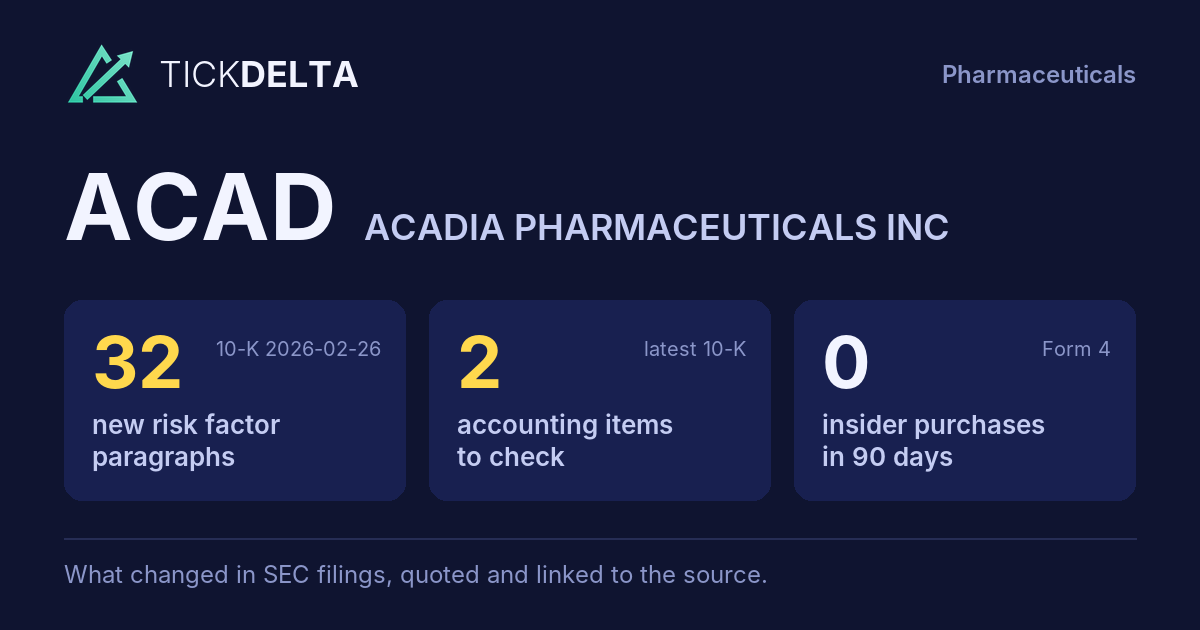
32 paragraphs in Risk Factors of the 10-K filed Feb 26, 2026 with nothing like them in the 10-K filed Feb 27, 2025. Quoted exactly. Paragraphs that were only edited are under 10-K change.
The process of obtaining regulatory approval of medicinal products in the EU and elsewhere, is expensive, often takes many years following the commencement of clinical trials and can vary substantially based upon the type, complexity and novelty of the product candidates involved, as well as the target indications and patient population. Approval policies or regulations may change, and regulatory authorities have substantial discretion in the drug approval process, including the ability to delay, limit or deny approval of a product candidate for many reasons. Despite the time and expense invested in clinical development of product candidates, regulatory approval is never guaranteed.
Prior to obtaining approval to commercialize trofinetide in the EU or internationally, we must demonstrate with substantial evidence from adequate and well-controlled clinical trials, and to the satisfaction of the EMA, the European Commission or comparable foreign regulatory authorities, that trofinetide is safe and effective for its intended uses. Results from non-clinical studies and clinical trials can be interpreted in different ways. Even if we believe the non-clinical or clinical data for trofinetide are promising, such data may not be sufficient to support approval by the European Commission or comparable foreign regulatory authorities. For example, in January 2026 we were informed by the EMA’s CHMP of a negative trend vote on our MAA for trofinetide for the treatment of Rett syndrome, following a CHMP oral explanation. While we announced our intent to request a re-examination once the CHMP opinion is adopted, the results of the re-examination may not be favorable to us and our ability to ultimately obtain approval for trofinetide for the treatment of Rett syndrome may be negatively impacted.
The EMA or comparable foreign regulatory authorities may also require us to conduct additional preclinical studies or clinical trials for trofinetide either prior to or post-approval or may object to elements of our clinical development program. If we were required to conduct such additional preclinical studies or clinical trials, the EMA or comparable foreign regulatory authorities may not agree with our interpretation of the results and we may not receive approval for trofinetide for the desired indication, or marketing of trofinetide, if approved, may be subject to additional requirements.
Trofinetide could fail to receive regulatory approval for many reasons, including the following:
•the EMA or comparable foreign regulatory authorities may disagree with the design or implementation of our clinical trials, the appropriateness or relevance of endpoints of our clinical trials, duration of our clinical trials, whether the patient population is sufficiently representative of the desired indication, the nature or existence of comparative data, size and duration of safety database, and our interpretation of meaningfulness and/or generalizability of findings;
•the EMA or comparable foreign regulatory authorities may not accept clinical data from trials which are conducted at clinical facilities or in countries where the standard of care is potentially different from that of the EU or the applicable foreign jurisdiction;
•we may be unable to demonstrate to the satisfaction of the EMA or comparable foreign regulatory authorities that trofinetide is safe and effective for its proposed indication;
•we may be unable to demonstrate that trofinetide’s clinical and other benefits outweigh its safety risks to the satisfaction of the EMA or comparable foreign regulatory authorities;
•the EMA or comparable foreign regulatory authorities may disagree with our interpretation of data from preclinical studies or clinical trials;
•the data collected from clinical trials of our product candidates may not be sufficient to obtain regulatory approval in the EU or elsewhere for the proposed indication in the proposed population; and
•the approval policies or regulations of the EMA, the European Commission or comparable foreign regulatory authorities may significantly change in a manner rendering our clinical data insufficient for approval.
Any of the above events could prevent us from achieving market approval of trofinetide and could substantially increase the costs of commercializing trofinetide.
Of the large number of drugs in development, only a small percentage successfully complete European Commission or comparable foreign regulatory approval processes and are commercialized. Even if we receive approval for trofinetide, the European Commission or comparable foreign regulatory authorities may grant approval contingent on the performance of costly additional clinical trials, including post-approval clinical trials, and/or the implementation of risk management strategies, which may be required to ensure safe use of the drug after approval. The European Commission or comparable foreign regulatory authorities also may approve trofinetide for a more limited indication or patient population than we originally requested, and the European Commission or comparable foreign regulatory authorities may not approve the labeling that we believe is necessary or desirable for the successful commercialization of trofinetide. As a result, any approval may fail to create the value we were expecting trofinetide to generate. Further, if we do not receive marketing approval for trofinetide in the EU or other jurisdictions outside of North America, including Japan, we will not be able to commercialize trofinetide in such jurisdictions at all.
•failure to conduct clinical trials in accordance with regulatory requirements or other irregularities in clinical trial conduct;
International trade policies, including tariffs, sanctions and trade barriers may adversely affect our business, financial condition, results of operations and prospects.
We operate in a global economy, and our business depends on a global supply chain for the development, manufacturing, and distribution of our pharmaceutical products, and for the advancement of our preclinical and clinical development programs. There is inherent risk, based on the complex relationships among the U.S. and the countries in which we conduct our business, that political, diplomatic, and national security factors can lead to global trade restrictions and changes in trade policies and export regulations that may adversely affect our business and operations. The current international trade and regulatory environment is subject to significant ongoing uncertainty.
We source significant quantities of active pharmaceutical ingredients (APIs), precursor chemicals, and specialized equipment from international suppliers, with substantial reliance on foreign manufacturers, including China. Tariff policies, particularly those affecting China and pharmaceutical products, could materially increase our costs and reduce our profitability, including as a result of our inability to adjust pricing in formulary-based markets. Recent and potential future changes in international trade policies, including U.S.-China trade relations and pharmaceutical-specific tariffs, present material risks to our operations and financial performance.
Recent policy discussions have included potential targeted tariffs or other trade measures specifically aimed at pharmaceutical products and ingredients as part of broader healthcare cost control or national security initiatives. For example, the Bureau of Industry and Security, U.S. Department of Commerce, has initiated an investigation to determine whether pharmaceutical ingredients, including finished drug product, manufactured outside the United States pose a national security risk and should be subject to additional tariffs. Unlike consumer goods, pharmaceuticals face unique regulatory, technology and capacity constraints that make rapid supply chain adjustments particularly difficult and costly. Should the current tariffs hold or additional tariffs be imposed specifically targeting pharmaceutical imports, our production costs could
rise significantly, and it would be difficult and costly to qualify alternative sources within another country with a lower tariff rate or within the United States, as developing and qualifying alternative sources typically requires substantial lead time and substantial investment and regulatory approvals. Moreover, the dynamic and unpredictable tariff and trade landscape creates substantial uncertainty and significant planning challenges for our operations and to our CMOs’ long term capital investment plans. Changes in tariff classifications, country-of-origin requirements, or customs procedures can occur with limited notice. This uncertainty complicates our long-term investment decisions regarding manufacturing facilities, supply chain optimization, and research and development locations.
Unlike many industries, our ability to pass increased costs to customers is limited by the structure of pharmaceutical pricing and reimbursement systems. Many of our products are included in formularies with pricing established through annual or multi-year contracts with commercial, third-party payors and pharmacy benefit managers, and reimbursement methodologies established by government programs, such as Medicare and Medicaid. These arrangements typically include fixed pricing terms that were determined prior to the implementation of the recently announced tariffs and well ahead of payors’ fiscal cycles (typically 12-18 months ahead of a calendar year). As a result, and depending on their timing and scope, tariff-induced cost increases may be difficult or impossible to pass through to customers until the 2027 calendar year at the earliest, perhaps even a year later.
Current or future tariffs will also result in increased research and development expenses, including with respect to increased costs associated with APIs, raw materials, laboratory equipment and research materials and components. Trade restrictions affecting the import of materials necessary for clinical trials could result in delays to our development timelines. Increased development costs and extended development timelines could place us at a competitive disadvantage compared to companies operating in regions with more favorable trade relationships and could reduce investor confidence and negatively impact our business, results of operations, financial condition and growth prospects.
The complexity of announced or future tariffs may also increase the risk that we or our suppliers may be subject to civil or criminal enforcement actions in the United States or foreign jurisdictions related to compliance with trade regulations. Foreign governments may also adopt non-tariff measures, such as procurement preferences or informal disincentives to engage with, purchase from or invest in U.S. entities, which may limit our ability to compete internationally and attract non-U.S. investment, employees, customers and suppliers. Foreign governments may also take other retaliatory actions against U.S. entities, such as decreased intellectual property protection, increased enforcement actions, or delays in regulatory approvals, which may result in heightened international legal and operational risks. In addition, the United States and other governments have imposed and may continue to impose additional sanctions, such as trade restrictions or trade barriers, which could restrict us from doing business directly or indirectly in or with certain countries or parties and may impose additional costs and complexity to our business.
Trade disputes, tariffs, restrictions and other political tensions between the United States and other countries may also exacerbate unfavorable macroeconomic conditions including inflationary pressures, foreign exchange volatility, financial market instability, and economic recessions or downturns. The ultimate impact of current or future tariffs and trade restrictions remains uncertain and could materially and adversely affect our business, financial condition, and prospects. While we actively monitor these risks, any prolonged economic downturn, escalation in trade tensions, or deterioration in international perception of U.S.-based companies could materially and adversely affect our business, ability to access the capital markets or other financing sources, results of operations, financial condition and prospects. In addition, tariffs and other trade developments have and may continue to heighten the risks related to the other risk factors described elsewhere in this report.
For example, on July 4, 2025, the OBBBA was signed into law, which narrowed access to ACA marketplace exchange enrollment and declined to extend the ACA enhanced advanced premium tax credits that expired at the end of 2025, which, among other provisions in the law, are anticipated to reduce the number of Americans with health insurance. The OBBBA also is expected to reduce Medicaid spending and enrollment by implementing work requirements for some beneficiaries, capping state-directed payments, reducing federal funding, and limiting provider taxes used to fund the program. Congress is considering proposed legislation intended to further reduce healthcare costs with alternatives to replace the expired ACA subsidies. It is unclear how any healthcare reform measures of the current administration will impact the ACA and our business.
An expansion in the government’s role in the U.S. healthcare industry may increase existing congressional or governmental agency scrutiny on price increases, such as the ones we have implemented for NUPLAZID, cause general downward pressure on the prices of prescription drug products, lower reimbursements for providers using our products, reduce product utilization and adversely affect our business and results of operations.
The current administration is pursuing policies to reduce regulations and expenditures across government including at HHS, the FDA, the Centers for Medicare & Medicaid Services (CMS) and related agencies. These actions, presently directed by executive orders or memoranda from the Office of Management and Budget, may propose policy changes that create additional uncertainty for our business. For example, the current administration has announced agreements with several pharmaceutical companies that require the drug manufacturers to offer, through a direct to consumer platform, U.S. patients and Medicaid programs prescription drug Most-Favored Nation pricing equal to or lower than those paid in other developed nations, with additional mandates for direct-to-patient discounts and repatriation of foreign revenues. Other recent actions include, for example: (1) directives to reduce agency workforce and program cuts; (2) directing HHS and other agencies to lower prescription drug costs for Medicare through a variety of initiatives, including by improving upon the Medicare Drug Price Negotiation Program and establishing Most-Favored-Nation pricing for pharmaceutical products; (3) imposing tariffs on imported pharmaceutical products; and (4) as part of the Make America Healthy Again (MAHA) Commission’s recent Strategy Report, working across government agencies to increase enforcement on direct-to-consumer pharmaceutical advertising. Additionally, the current administration recently called on Congress to enact “The Great Healthcare Plan,” to codify and expand Most-Favored Nation pricing, lower government subsidies to private insurance companies, increase healthcare price transparency, expand pharmaceutical drugs available for over-the-counter purchase, and enact restrictions on PBM payment methodologies, among other things. These actions and policies may significantly reduce U.S. drug prices, potentially impacting manufacturers’ global pricing strategies and profitability, while increasing their operational costs and compliance risks. In the event Most-Favored-Nation pricing for pharmaceutical products is implemented and applicable to the products that we commercialize outside of the U.S., our revenue opportunities may be adversely affected, as our U.S. pricing would have to be reduced to the lowest price paid for the applicable product outside of the U.S. In such event, we may choose to forgo the ex-U.S. market to preserve more favorable U.S. pricing. In June 2024, the U.S. Supreme Court’s Loper Bright decision greatly reduced judicial deference to regulatory agencies, which could increase successful legal challenges to federal regulations affecting our operations. Congress may introduce and ultimately pass healthcare related legislation that could impact the drug approval process and make changes to the Medicare Drug Price Negotiation Program.
In the EU, on January 12, 2025, Regulation (EU) 2021/2282 on HTA entered into application through a phased implementation. It is intended to increase cooperation among EU Member States in assessing clinical aspects of health technologies, including new medicinal products, by establishing a framework for joint clinical assessments, joint scientific consultations, and the early identification of emerging health technologies. The HTA Regulation permits EU Member States to use common tools, methodologies, and procedures and requires them to rely on EU‑level joint clinical assessment reports for the clinical components of their national HTA evaluations. EU Member States, however, remain responsible for assessing non‑clinical aspects, such as economic, ethical, and social considerations, and for making pricing and reimbursement decisions at the national level. As implementation of the HTA Regulation is phased in and key methodological and procedural guidance continues to evolve, there remains uncertainty regarding the evidence requirements, timing, and impact of joint clinical assessments on national reimbursement processes. The new framework may result in additional or differently structured evidentiary expectations, misalignment between assessment and regulatory timelines, or delays in national decisions. Any adverse or delayed HTA outcomes, or divergent national reimbursement decisions, could negatively affect our ability to obtain or maintain favorable pricing and reimbursement status for any product candidates, if approved. If we are unable to maintain favorable pricing and reimbursement status in EU Member States for product candidates that we may successfully develop and for which we may obtain regulatory approval, any anticipated revenue from and growth prospects for those products in the EU could be negatively affected.
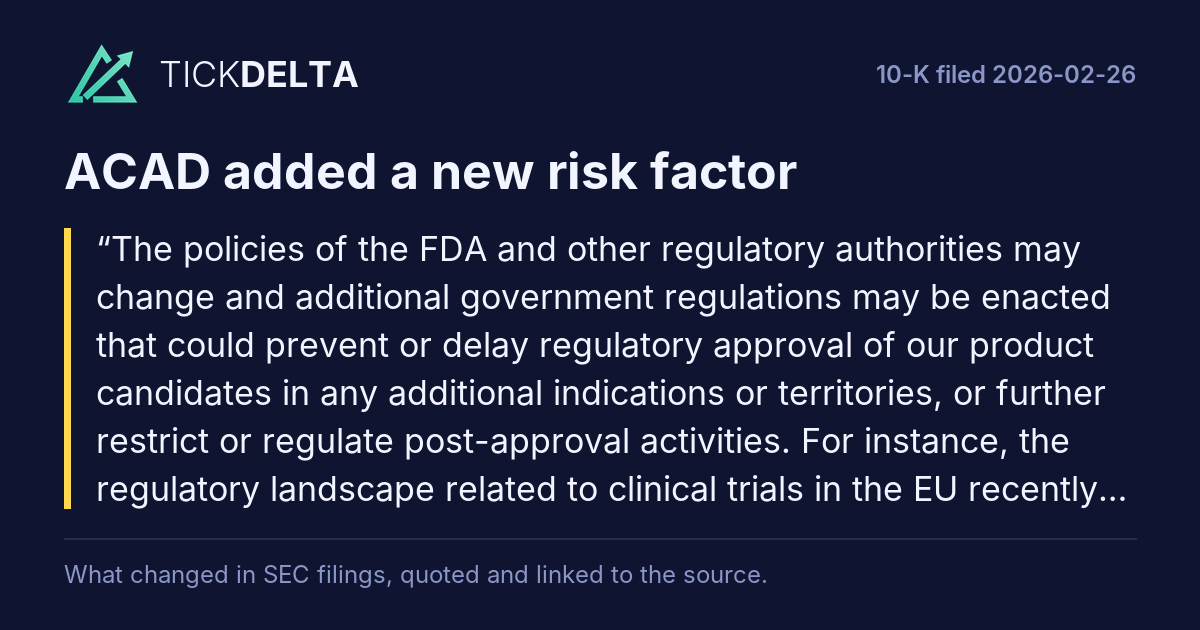
The policies of the FDA and other regulatory authorities may change and additional government regulations may be enacted that could prevent or delay regulatory approval of our product candidates in any additional indications or territories, or further restrict or regulate post-approval activities. For instance, the regulatory landscape related to clinical trials in the EU recently evolved. The EU CTR, which was adopted in April 2014 and repeals the EU Clinical Trials Directive, became applicable on January 31, 2022. The CTR introduces, among other changes, a centralized application system, coordinated review procedures, expanded reporting and increased transparency obligations. The new requirements, together with evolving guidance from EU authorities, may impose additional operational burdens on us and our CROs and could result in delays in trial initiation, increased compliance costs, or other disruptions to our development programs.
In addition, on December 11, 2025, the European Commission, the Parliament and the European Council reached a political agreement on a comprehensive overhaul of EU pharmaceutical legislation (the Pharma Package). The reform has been under negotiation since the European Commission submitted its proposal in April 2023. This package, comprised of a new directive and regulation to replace existing legislation, aims to modernize the EU framework. The political agreement is still subject to formal approval by the European Parliament and Council. If approved in the form proposed, the Pharma Package will, among other changes, reduce the baseline market protection period by one year, with limited opportunities for extensions, capped at a maximum of eleven years; reshape the incentives regime for orphan medicinal products, by introducing “breakthrough” orphan medicinal products (those addressing diseases with no available medicinal treatment), which will benefit from 11 years of market exclusivity; and expand the “Bolar” exemption to permit generic and biosimilar manufacturers to conduct preparatory activities for regulatory submissions, including pricing and reimbursement, and participate in procurement tenders while patent protection remains in force. A decrease in market exclusivity opportunities for our product candidates in the EU, combined with the expanded Bolar exemption, could open them to generic or biosimilar competition earlier than under the current regime, potentially impacting reimbursement status and the commercial prospects of our product candidates
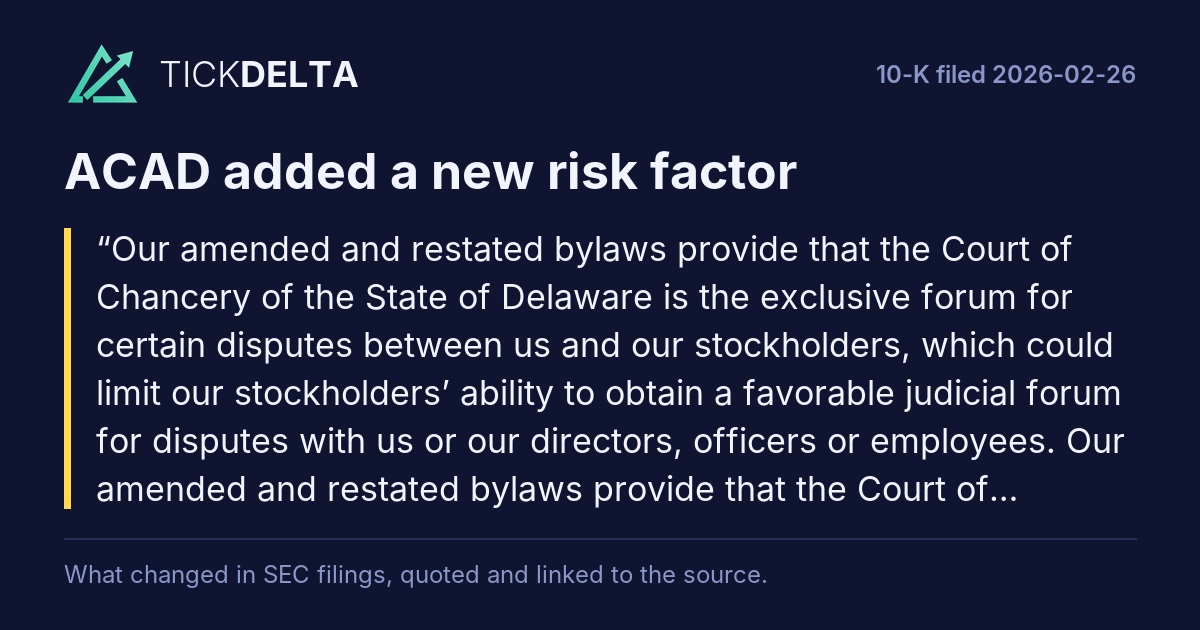
Our amended and restated bylaws provide that the Court of Chancery of the State of Delaware is the exclusive forum for certain disputes between us and our stockholders, which could limit our stockholders’ ability to obtain a favorable judicial forum for disputes with us or our directors, officers or employees.
Our amended and restated bylaws provide that the Court of Chancery of the State of Delaware will be the sole and exclusive forum for (i) any derivative action or proceeding brought on our behalf, (ii) any action asserting a claim of breach of a fiduciary duty owed by any of our directors, officers or employees to our company or our stockholders, (iii) any action asserting a claim against our company or any director, officer or other employee arising pursuant to any provision of the General Corporation Law of the State of Delaware or our amended and restated certificate of incorporation or bylaws, (iv) any action to interpret, apply, enforce or determine the validity of our amended and restated certificate of incorporation or bylaws; (v) any action as to which the General Corporation Law of the State of Delaware confers jurisdiction on the Court of Chancery of the State of Delaware; and (vi) any action asserting a claim against our company governed by the internal affairs doctrine. This choice of forum provision does not apply to suits brought to enforce a duty or liability created by the Securities Act.
This choice of forum provision may limit a stockholder’s ability to bring certain claims in a judicial forum that it finds favorable for disputes with us or any of our directors, officers, other employees or stockholders, which may discourage lawsuits with respect to such claims, although our stockholders will not be deemed to have waived our compliance with federal securities laws and the rules and regulations thereunder. If a court were to find this choice of forum provision to be inapplicable or unenforceable in an action, we may incur additional costs associated with resolving such action in other jurisdictions, which could adversely affect our business and financial condition.
New in the latest 10-Q
7 paragraphs in the 10-Q filed Nov 5, 2026 with nothing like them in the 10-Q filed Aug 5, 2026 (at least half the words must differ; new numbers alone do not count). Quoted exactly, grouped by the item heading above them. This is text that changed, not a judgement of how serious it is.
and December 31, 2025; no shares issued and outstanding at September 30, 2026 and
Read in the 10-Q
December 31, 2025 Common stock, $0.0001 par value; 225,000,000 shares authorized at September 30, 2026 17 16
Read in the 10-Q
The Company expenses amounts paid to acquire licenses associated with products under development when the ultimate recoverability of the amounts paid is uncertain and the technology has no alternative future use when acquired. Acquisitions of technology licenses are charged to expense or capitalized based upon management’s assessment regarding the ultimate recoverability of the amounts paid and the potential for alternative future use. The Company has determined that technological feasibility for its product candidates is reached when the requisite regulatory approvals are obtained to make the product available for sale.
Read in the 10-Q
Unless the context requires otherwise, we refer to DAYBUE, DAYBUE STIX and DAYBU collectively as DAYBUE products.
Read in the 10-Q
Following the EC’s grant of marketing authorization for DAYBU in August 2026, DAYBU is also subject to generally applicable ongoing post-authorization requirements in the EU, including pharmacovigilance and risk management, safety reporting, manufacturing and quality requirements and requirements relating to updates to the marketing authorization and product information. Failure to comply with these requirements could result in regulatory action, including restrictions, suspension, variation or withdrawal of the marketing authorization.
Read in the 10-Q
10.1a Joint Venture and License Agreement, dated July 13, 2023, by and between the Registrant and Neuren Pharmaceuticals Limited.
Read in the 10-Q
a Pursuant to Item 601(b)(10) of Regulation S-K, certain portions of this exhibit have been omitted (indicated by “[…***…]”) because the Company has determined that the information is both not material and is the type that the Company treats as private or confidential.
Read in the 10-Q
Item 1A of the 10-Q filed Nov 5, 2026 against Item 1A of the 10-K filed Feb 26, 2026.
A 10-Q repeats only the risks that changed, so a 10-K paragraph that is missing from it is not counted as removed.
Added is a paragraph with nothing like it in the 10-K, Reworded a sentence that is in both with several words changed,
Quiet changes a sentence in both where one to four words changed and one is a hedge or a modal
(cut words struck through, new words highlighted).
Text on the page, not a score; each links to the filing at sec.gov.
The first 19 of 37 are shown (at most 12 of each type).
Two-word phrases in Risk Factors of the 10-K filed Feb 26, 2026 that are in none of the 1 earlier 10-Ks stored, back to Feb 27, 2025
Used at least twice, small words left out. Counted, not picked: a phrase can be new because the company renamed something.
10 paragraphs of last year's Risk Factors with nothing like them now. The longest are quoted.
Item 1A of each 10-K and 10-Q on EDGAR, quoted exactly. Each paragraph links to the filing at sec.gov.
10-K change: what was reworded or cut, section by section.
Excel workbook · CSV. Google Sheet that stays up to date: paste =IMPORTDATA("https://tickdelta.com/company/ACAD/export.csv") into a cell.