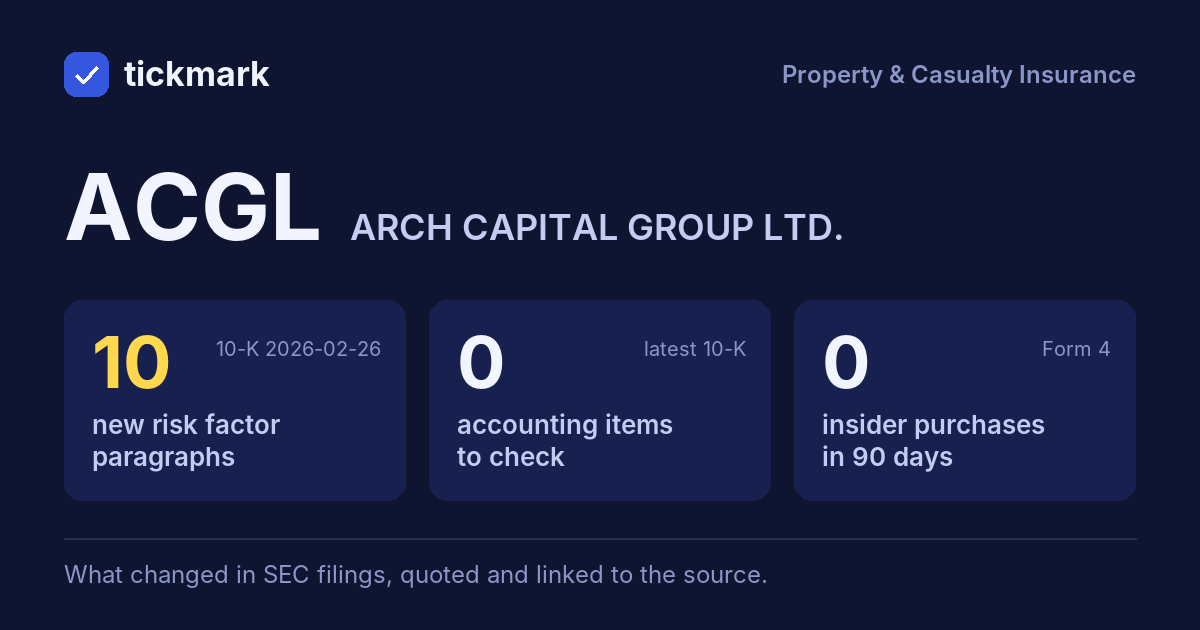
Marked against last year's 10-K:
cut words struck through, new words highlighted and underlined.
Risk Factors 200 words changed in this paragraph; it is 49% similar to last year's version.
On July 27, In 2023, the Federal banking agencies released a proposed rule to implement the Basel III Endgame in the United States. States, which would apply to banks with assets greater than $100 billion. The proposal would increase the capital charges for mortgages held in portfolio and eliminate the capital relief currently afforded mortgage loans protected by private mortgage insurance. Instead, the capital treatment would be based on the mortgage’s loan to value ratio without consideration of mortgage insurance. The comment period for this proposal closed on January 16, 2024. If the U.S. regulators decide to adopt the proposed Basel III Endgame approach to mortgage assets, the capital treatment of mortgages held in portfolio will increase and the capital relief benefits of mortgage insurance would be eliminated, insurance, which could adversely affect the volume of mortgages originated by banks subject to the rule and the demand for mortgage insurance. With the change in the Presidential administration, administration in 2025, and based on feedback received in response to the proposed rule, the Federal Banking banking agencies have indicated an intent to repropose the Basel III Rules, Rules. In September 2025, Federal Reserve Vice Chair for Supervision, Michelle Bowman, stated that the U.S. bank regulators are working toward unveiling a revised Basel III Endgame by early 2026. She indicated that the revised proposal would be more “industry friendly” than prior versions, though the timing, requirements, and implementation of the reproposed rule remain uncertain. In January 2025, the European Commission stated that it is considering what steps to take in light of possible delay or changes to the Basel III implementation in the United States, and the Bank of England announced a one-year delay in implementation in order to get clarity on what the United States plans to do.
Source: Item 1A, 10-K 0000947484-26-000017 vs Item 1A, 10-K 0000947484-25-000017
Accounting Policies 149 words changed in this paragraph; it is 67% similar to last year's version.
The Company applies a fair value based measurement method in accounting for its share-based payment arrangements with eligible employees and directors. Compensation expense is estimated based on the fair value of the award at the grant date and is recognized in net income over the requisite service period with a corresponding increase in shareholders’ equity. No value is attributed to awards that employees forfeit because they fail to satisfy vesting conditions. The Company’s (i) time-based awards generally vest over a three year period with one-third vesting on the first, second and third anniversaries of the grant date and (ii) performance-based awards cliff vest after each three year performance period based on achievement of the specified performance criteria. The share-based compensation expense associated with awards that have graded vesting features and vest based on service conditions only is calculated on a straight-line basis over the requisite service period for the entire award. Compensation expense recognized in connection with performance awards is based on the achievement of the specified performance and service conditions. The final measure of compensation expense recognized over the requisite service period reflects the final performance outcome. During the recognition period compensation expense is accrued based on the performance condition that is probable of achievement. For awards granted to retirement-eligible employees where no service is required for the employee to retain the award, the grant date fair value is immediately recognized as compensation expense at the grant date because the employee is able to retain the award without continuing to provide service. For employees near retirement eligibility, attribution of compensation cost is over the period from the grant date to the retirement eligibility date. These charges had no impact on the Company’s cash flows or total shareholders’ equity. See note 22, for information relating to the Company’s share-based payment awards.
Source: Item 8, Note 3 – Significant Accounting Policies, 10-K 0000947484-26-000017 vs Item 8, Note 3 – Significant Accounting Policies, 10-K 0000947484-25-000017
MD&A 146 words changed in this paragraph; it is 37% similar to last year's version.
If we are not able to obtain adequate capital, our business, results of operations and financial condition could be adversely affected, which could include, among other things, the following possible outcomes: (1) potential downgrades in the financial strength ratings assigned by ratings agencies to our operating subsidiaries, which could place those operating subsidiaries at a competitive disadvantage compared to higher-rated competitors; (2) reductions in the amount of business that our operating subsidiaries are able to write in order to meet capital adequacy-based tests enforced by statutory agencies; and (3) any resultant ratings downgrades could, among other things, affect our ability to write business and increase the cost of bank credit and letters of credit. In addition, under certain of the reinsurance agreements assumed by our reinsurance operations, upon the occurrence of a ratings downgrade or other specified triggering event with respect to our reinsurance operations, such as a reduction in surplus by specified amounts during specified periods, our ceding company clients may be provided with certain rights, including, among other things, the right to terminate the subject reinsurance agreement and/or to require that our reinsurance operations post additional collateral.
Source: Item 7, 10-K 0000947484-26-000017 vs Item 7, 10-K 0000947484-25-000017
Legal Proceedings 5 words changed in this paragraph; it is 99% similar to last year's version.
The areas where significant concentrations of credit risk may exist include unpaid losses and loss adjustment expenses recoverable, contractholder receivables, ceded unearned premiums, paid losses and loss adjustment expenses recoverable net of reinsurance balances payable, investments and cash and cash equivalent balances. A credit exposure exists with respect to reinsurance recoverables as they may become uncollectible. The Company manages its credit risk in its reinsurance relationships by transacting with reinsurers that it considers financially sound and, if necessary, the Company may hold collateral in the form of funds, trust accounts and/or irrevocable letters of credit. This collateral can be drawn on for amounts that remain unpaid beyond specified time periods on an individual reinsurer basis. In addition, certain insurance policies written by the Company’s insurance operations feature large deductibles, primarily in its construction and national accounts lines of business. Under such contracts, the Company is obligated to pay the claimant for the full amount of the claim. The Company is subsequently reimbursed by the policyholder for the deductible amount. These amounts are included on a gross basis in the consolidated balance sheet in contractholder payables and contractholder receivables, respectively. In the event that the Company is unable to collect from the policyholder, the Company would be liable for such defaulted amounts. Collateral, primarily in
Source: Item 3, via Note 18 – Commitments and Contingencies, 10-K 0000947484-26-000017 vs Item 3, via Note 18 – Commitments and Contingencies, 10-K 0000947484-25-000017