Paragraph 215 · 48% changed
Every version of it
Screener
/
SEC EDGAR
/CIK 0001520697
/10-K filed Feb 27, 2026, compared with Feb 27, 2025
/Numbers from the XBRL of the 10-Ks
Nasdaq
Health care · Specialty Outpatient Facilities
Acadia Healthcare Company, Inc. ACHC
The 10-K against last year's
107 changes: 25 added, 8 removed, 73 reworded, 1 quiet changes
10-K Feb 27, 2026 vs Feb 27, 2025
Risk Factors
6.8%
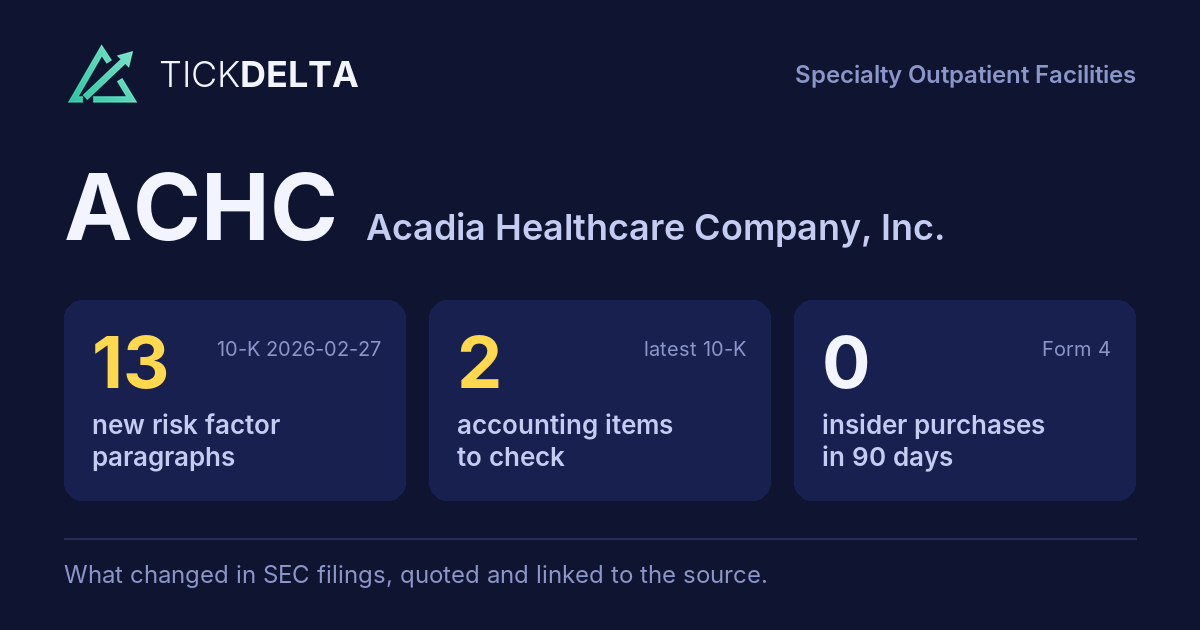
of the text changed · 17,387 words now · 13 new paragraphs, 2 gone
MD&A
22.7%
of the text changed · 9,879 words now · 12 new paragraphs, 6 gone
Legal Proceedings
16.3%
of the text changed · 2,266 words now
Accounting Policies
29.3%
of the text changed · 2,535 words now
10-K 0001193125-26-078266 (Feb 27, 2026) vs 10-K 0000950170-25-029095 (Feb 27, 2025)
Every paragraph, and how much of it changed
One bar per paragraph, in the order of the 10-K. Height and colour show the share of its words not in the closest paragraph a year earlier; the tallest bars are new paragraphs.
Risk Factors
230 paragraphs · 13 new · 43 reworded · 2 gone · 10-K Feb 27, 2026 against Feb 27, 2025
New paragraph
Reworded (5% of its words or more)
Same or nearly
Paragraph 91 · 41% changed
Every version of it
Paragraph 100 · 38% changed
Every version of it
•require us to dedicate a substantial portion of our cash flow from operations to payments on our debt (including scheduled repayments on our outstanding term loan borrowings under the Credit Facility), thereby reducing the availability of our cash flow to fund working capital, capital expenditures and other general corporate purposes;
Paragraph 125 · 37% changed
Every version of it
Paragraph 64 · 35% changed
Every version of it
mental health and/or substance abuse treatment that are more stringent than the rules that apply to healthcare information generally. Part 2 regulations mandate strict confidentiality for SUD Records, permitting disclosure only as expressly authorized under the regulations. As public attention is drawn to the issues of the privacy and security of medical information, states may revise or expand their laws concerning the use and disclosure of health information, or may adopt new laws addressing these subjects.
Paragraph 136 · 32% changed
Every version of it
Paragraph 88 · 29% changed
Every version of it
Changes in these government programs in recent years have resulted in limitations on reimbursement and, in some cases, reduced levels of reimbursement for healthcare services. Payments from federal and state government healthcare programs are subject to statutory and regulatory changes, administrative rulings, interpretations and determinations, requirements for utilization review, and federal and state funding restrictions, all of which could materially increase or decrease program payments, as well as affect the cost of providing service to patients and the timing of payments to facilities. We are unable to predict the effect of recent and future policy changes on our operations. In addition, since most states operate with balanced budgets and since the Medicaid program is often a state’s largest program, some states can be expected to enact or consider enacting legislation formulated to reduce their Medicaid expenditures. If the rates paid or the scope of services covered by government payors are reduced, there could be a material adverse effect on our business, financial condition and results of operations.
Paragraph 13 · 28% changed
Every version of it
•We are subject to volatility in the global capital and credit markets as well as significant developments in macroeconomic and political conditions that are out of our control. control, including any effects that a U.S. government shutdown, tariffs or trade disputes may have on financial markets and macroeconomic conditions.
Paragraph 215 · 48% changed
Every version of it
10-K Feb 27, 2025Fluctuations in our operating results, quarter to quarter earnings and other factors, including factors outside our control, may result in significant decreases in the price of our common stock.
10-K Feb 27, 2026
The market price of our common stock has been, and may continue to be, volatile and could be subject to wide fluctuations in response to our operating results, quarter to quarter earnings, the risk factors described in this Annual Report on Form 10-K and other factors outside of our control.
Paragraph 91 · 41% changed
Every version of it
10-K Feb 27, 2025Changes in these government programs in recent years have resulted in limitations on reimbursement and, in some cases, reduced levels of reimbursement for healthcare services. Payments from federal and state government healthcare programs are subject to statutory and regulatory changes, administrative rulings, interpretations and determinations, requirements for utilization review, and federal and state funding restrictions, all of which could materially increase or decrease program payments, as well as affect the cost of providing service to patients and the timing of payments to facilities. We are unable to predict the effect of recent and future policy changes on our operations. In addition, since most states operate with balanced budgets and since the Medicaid program is often a state’s largest program, some states can be expected to enact or consider enacting legislation formulated to reduce their Medicaid expenditures. If the rates paid or the scope of services covered by government payors are reduced, there could be a material adverse effect on our business, financial condition and results of operations.
10-K Feb 27, 2026
We are unable to predict the effect of recent and future policy changes on our operations. In addition, since most states operate with balanced budgets and since the Medicaid program is often a state’s largest program, some states can be expected to enact or consider enacting legislation formulated to reduce their Medicaid expenditures.
Paragraph 100 · 38% changed
Every version of it
10-K Feb 27, 2025
•require us to dedicate a substantial portion of our cash flow from operations to payments on our debt (including scheduled repayments on our outstanding term loan borrowings under the Credit Facility), thereby reducing the availability of our cash flow to fund working capital, capital expenditures and other general corporate purposes;
10-K Feb 27, 2026
•require us to dedicate a substantial portion of our cash flow from operations to payments on our debt (including scheduled
Paragraph 125 · 37% changed
Every version of it
10-K Feb 27, 2025We also have a number of recurring costs including insurance, utilities and rental costs, and may face increases to other recurring costs such as regulatory compliance costs. There can be no assurance that any of our recurring costs will not grow at a faster rate than our revenue. As a result, any increase in our operating costs could have a material adverse effect on our business, results of operations and financial condition.
10-K Feb 27, 2026
rate than our revenue. As a result, any increase in our operating costs could have a material adverse effect on our business, results of operations and financial condition.
Paragraph 64 · 35% changed
Every version of it
10-K Feb 27, 2025
public attention is drawn to the issues of the privacy and security of medical information, states may revise or expand their laws concerning the use and disclosure of health information, or may adopt new laws addressing these subjects.
10-K Feb 27, 2026
mental health and/or substance abuse treatment that are more stringent than the rules that apply to healthcare information generally. Part 2 regulations mandate strict confidentiality for SUD Records, permitting disclosure only as expressly authorized under the regulations. As public attention is drawn to the issues of the privacy and security of medical information, states may revise or expand their laws concerning the use and disclosure of health information, or may adopt new laws addressing these subjects.
Paragraph 136 · 32% changed
Every version of it
10-K Feb 27, 2025We expect value-based purchasing programs, including programs that condition reimbursement on patient outcome measures, to become more common and to involve a higher percentage of reimbursement amounts. We are unable at this time to predict how this trend will affect our results of operations, but it could negatively impact our revenue if we are unable to meet quality standards established by both governmental and private payers.
10-K Feb 27, 2026
trend will affect our results of operations, but it could negatively impact our revenue if we are unable to meet quality standards established by both governmental and private payers.
Paragraph 88 · 29% changed
Every version of it
10-K Feb 27, 2025
Changes in these government programs in recent years have resulted in limitations on reimbursement and, in some cases, reduced levels of reimbursement for healthcare services. Payments from federal and state government healthcare programs are subject to statutory and regulatory changes, administrative rulings, interpretations and determinations, requirements for utilization review, and federal and state funding restrictions, all of which could materially increase or decrease program payments, as well as affect the cost of providing service to patients and the timing of payments to facilities. We are unable to predict the effect of recent and future policy changes on our operations. In addition, since most states operate with balanced budgets and since the Medicaid program is often a state’s largest program, some states can be expected to enact or consider enacting legislation formulated to reduce their Medicaid expenditures. If the rates paid or the scope of services covered by government payors are reduced, there could be a material adverse effect on our business, financial condition and results of operations.
10-K Feb 27, 2026
Changes in these government programs in recent years have resulted in limitations on reimbursement and, in some cases, reduced levels of reimbursement for healthcare services. Payments from federal and state government healthcare programs are subject to statutory and regulatory changes, administrative rulings, interpretations and determinations, requirements for utilization review, and federal and state funding restrictions, all of which could materially increase or decrease program payments, as well as affect the cost of providing service to patients and the timing of payments to facilities.
Paragraph 13 · 28% changed
Every version of it
10-K Feb 27, 2025
•We are subject to volatility in the global capital and credit markets as well as significant developments in macroeconomic and political conditions that are out of our control.
10-K Feb 27, 2026
•We are subject to volatility in the global capital and credit markets as well as significant developments in macroeconomic and political conditions that are out of our control, including any effects that a U.S. government shutdown, tariffs or trade disputes may have on financial markets and macroeconomic conditions.
MD&A
138 paragraphs · 12 new · 52 reworded · 6 gone · 10-K Feb 27, 2026 against Feb 27, 2025
New paragraph
Reworded (5% of its words or more)
Same or nearly
Paragraph 64 · 49% changed
Provision for (benefit from) income taxes. For the year ended December 31, 2024, 2025, the provision for income taxes was $26.0 million, reflecting an effective tax rate of (2.4)%, compared to the provision for taxes of $77.4 million, reflecting an effective tax rate of 22.6%, compared to the benefit from taxes of $(9.7) million, reflecting an effective tax rate of 38.2%, for the year ended December 31, 2023. Our higher 2024. The Company’s pre-tax results loss for the year ended December 31, 2024 yields lower volatility 2025 included $996.2 million of goodwill impairment expense, which is nondeductible for income tax purposes and results in a decrease to the items impacting effective tax rate given the Company’s pre-tax loss position. Similarly, the Company recorded additional tax expense for the year ended December 31, 2025 in connection with a valuation allowance recorded on certain state deferred tax assets, which also resulted in a decrease to the Company’s effective tax rate for the year ended December 31, 2024 when compared to prior periods. 2025.
Paragraph 57 · 46% changed
Paragraph 83 · 42% changed
Cash provided by operating activities for the year ended December 31, 2024 2025 was $129.7 $131.9 million compared to $462.3 $129.7 million for the year ended December 31, 2023. The decline in 2024. Operating cash provided by operating activities was primarily due to the Desert Hills Litigation payments made during flows for the year ended December 31, 2025 were impacted by a decrease in earnings, an increase in cash paid for transaction, legal and other costs and $147.5 million of legal settlements expense for the 2019 Securities Litigation. Operating cash flows for the year ended December 31, 2024 were impacted by Desert Hills Litigation payments of $400.0 million in January 2024. Days sales outstanding at December 31, 2024 2025 was 43 49 compared to 45 43 at December 31, 2023. 2024 due primarily to new facilities that continue to ramp up during the start up period, as well as identifiable payor delays, with targeted actions underway to accelerate collections.
Paragraph 95 · 41% changed
Paragraph 119 · 40% changed
Paragraph 94 · 40% changed
We have the ability to increase the amount of the Credit Facility, which may take the form of increases to the Revolving Facility or the Term Loan Facility or the issuance of one or more incremental term loan facilities (collectively, the “Incremental Facilities”), Incremental Facilities, upon obtaining additional commitments from new or existing lenders and the satisfaction of certain customary conditions precedent for such Incremental Facilities. Such Incremental Facilities may not exceed the sum of (i) the greater of $480.0 million and an amount equal to 100% of the Consolidated EBITDA (as defined in the Credit Facility) at the time of determination (the “Incremental Fixed Basket”), and (ii) the additional amounts that would not cause our Consolidated Senior Secured Net Leverage Ratio (as defined in the Credit Facility) to exceed 3.5 to 1.0 (the “Incremental Ratio Basket”). The Incremental Term Loans were incurred in reliance on the Incremental Ratio Basket, leaving the full amount of the Incremental Fixed Basket available for any future Incremental Facilities.
Paragraph 101 · 37% changed
Paragraph 98 · 37% changed
Paragraph 64 · 49% changed
10-K Feb 27, 2025
Provision for (benefit from) income taxes. For the year ended December 31, 2024, the provision for income taxes was $77.4 million, reflecting an effective tax rate of 22.6%, compared to the benefit from taxes of $(9.7) million, reflecting an effective tax rate of 38.2%, for the year ended December 31, 2023. Our higher pre-tax results for the year ended December 31, 2024 yields lower volatility in the items impacting the effective tax rate for the year ended December 31, 2024 when compared to prior periods.
10-K Feb 27, 2026
Provision for income taxes. For the year ended December 31, 2025, the provision for income taxes was $26.0 million, reflecting an effective tax rate of (2.4)%, compared to the provision for taxes of $77.4 million, reflecting an effective tax rate of 22.6%, for the year ended December 31, 2024. The Company’s pre-tax loss for the year ended December 31, 2025 included $996.2 million of goodwill impairment expense, which is nondeductible for income tax purposes and results in a decrease to the effective tax rate given the Company’s pre-tax loss position. Similarly, the Company recorded additional tax expense for the year ended December 31, 2025 in connection with a valuation allowance recorded on certain state deferred tax assets, which also resulted in a decrease to the Company’s effective tax rate for the year ended December 31, 2025.
Paragraph 57 · 46% changed
10-K Feb 27, 2025Professional fees. Professional fees were $189.7 million for the year ended December 31, 2024, or 6.0% of revenue, compared to $176.0 million for the year ended December 31, 2023, or 6.0% of revenue. Same facility professional fees were $166.0 million for
10-K Feb 27, 2026
Debt extinguishment costs. Debt extinguishment costs were $1.3 million for the year ended December 31, 2025 related to the refinancing of the Prior Credit Facility.
Paragraph 83 · 42% changed
10-K Feb 27, 2025
Cash provided by operating activities for the year ended December 31, 2024 was $129.7 million compared to $462.3 million for the year ended December 31, 2023. The decline in cash provided by operating activities was primarily due to the Desert Hills Litigation payments made during the year ended December 31, 2024. Days sales outstanding at December 31, 2024 was 43 compared to 45 at December 31, 2023.
10-K Feb 27, 2026
Cash provided by operating activities for the year ended December 31, 2025 was $131.9 million compared to $129.7 million for the year ended December 31, 2024. Operating cash flows for the year ended December 31, 2025 were impacted by a decrease in earnings, an increase in cash paid for transaction, legal and other costs and $147.5 million of legal settlements expense for the 2019 Securities Litigation. Operating cash flows for the year ended December 31, 2024 were impacted by Desert Hills Litigation payments of $400.0 million in January 2024. Days sales outstanding at December 31, 2025 was 49 compared to 43 at December 31, 2024 due primarily to new facilities that continue to ramp up during the start up period, as well as identifiable payor delays, with targeted actions underway to accelerate collections.
Paragraph 95 · 41% changed
10-K Feb 27, 2025We have the ability to increase the amount of the Credit Facility, which may take the form of increases to the Revolving Facility or the Term Loan Facility or the issuance of one or more incremental term loan facilities (collectively, the “Incremental Facilities”), upon obtaining additional commitments from new or existing lenders and the satisfaction of customary conditions precedent for such Incremental Facilities. Such Incremental Facilities may not exceed the sum of (i) the greater of $480.0 million and an amount equal to 100% of the Consolidated EBITDA (as defined in the Credit Facility) at the time of determination (the “Incremental Fixed Basket”), and (ii) the additional amounts that would not cause our Consolidated Senior Secured Net Leverage Ratio (as defined in the Credit Facility) to exceed 3.5 to 1.0 (the “Incremental Ratio Basket”). The Incremental Term Loans were incurred in reliance on the Incremental Ratio Basket, leaving the full amount of the Incremental Fixed Basket available for any future Incremental Facilities.
10-K Feb 27, 2026
Facilities may not exceed the sum of (i) the greater of $710.0 million and an amount equal to 100% of our LTM Consolidated EBITDA (as defined in the Credit Agreement) at the time of determination and (ii) additional amounts that would not cause our Consolidated Senior Secured Net Leverage Ratio (as defined in the Credit Agreement) to exceed 4.0 to 1.0.
Paragraph 119 · 40% changed
10-K Feb 27, 2025Settlements under cost reimbursement agreements with third-party payors are estimated and recorded in the period in which the related services are rendered and are adjusted in future periods as final settlements are determined. Final determination of amounts earned under the Medicare and Medicaid programs often occurs in subsequent years because of audits by such programs, rights of appeal and the application of numerous technical provisions. In the opinion of management, adequate provision has been made for any adjustments and final settlements. However, there can be no assurance that any such adjustments and final settlements will not have a material effect on our financial condition or results of operations. Our cost report payables were $0.8 million and $9.3 million as of December 31, 2024 and 2023, respectively, and were included in other current liabilities on the consolidated balance sheet. The net adjustments to estimated cost report settlements resulted in an increase to revenue of $0.2 million, $1.8 million and $0.1 million for the years ended December 31, 2024, 2023 and 2022, respectively.
10-K Feb 27, 2026
material effect on our financial condition or results of operations. We had cost report receivables of $8.4 million as of December 31, 2025 which are included in other current assets on the consolidated balance sheet. Our cost report payables were $0.8 million as of December 31, 2024, and are included in other current liabilities on the consolidated balance sheet. The net adjustments to estimated cost report settlements resulted in a decrease to revenue of $0.7 million for the year ended December 31,2025 and an increase to revenue of $0.2 million and $1.8 million, respectively, for the years ended December 31, 2024 and 2023.
Paragraph 94 · 40% changed
10-K Feb 27, 2025
We have the ability to increase the amount of the Credit Facility, which may take the form of increases to the Revolving Facility or the Term Loan Facility or the issuance of one or more incremental term loan facilities (collectively, the “Incremental Facilities”), upon obtaining additional commitments from new or existing lenders and the satisfaction of customary conditions precedent for such Incremental Facilities. Such Incremental Facilities may not exceed the sum of (i) the greater of $480.0 million and an amount equal to 100% of the Consolidated EBITDA (as defined in the Credit Facility) at the time of determination (the “Incremental Fixed Basket”), and (ii) the additional amounts that would not cause our Consolidated Senior Secured Net Leverage Ratio (as defined in the Credit Facility) to exceed 3.5 to 1.0 (the “Incremental Ratio Basket”). The Incremental Term Loans were incurred in reliance on the Incremental Ratio Basket, leaving the full amount of the Incremental Fixed Basket available for any future Incremental Facilities.
10-K Feb 27, 2026
We have the ability to increase the amount of the Credit Facility, which may take the form of increases to the Revolving Facility or the Term Loan Facility or the issuance of one or more Incremental Facilities, upon obtaining additional commitments from new or existing lenders and the satisfaction of certain customary conditions precedent for such Incremental Facilities. Such Incremental
Paragraph 101 · 37% changed
10-K Feb 27, 2025During the year ended December 31, 2024, we borrowed $305.0 million on the Revolving Facility and repaid $15.0 million of the balance outstanding. During the year ended December 31, 2023, we borrowed $40.0 million on the Revolving Facility and repaid $35.0 million of the balance outstanding. We had $226.5 million of availability under the Revolving Facility and had standby letters of credit outstanding of $3.5 million related to security for the payment of claims required by our workers’ compensation insurance program at December 31, 2024.
10-K Feb 27, 2026
For the year ended December 31, 2025, we borrowed $115.0 million on the Prior Revolving Facility and repaid $485.0 million of the balance outstanding prior to February 28, 2025, when the Prior Credit Facility was refinanced with the Credit Facility. For the year ended December 31, 2024, we borrowed $305.0 million on the Prior Revolving Facility and repaid $15.0 million of the balance outstanding.
Paragraph 98 · 37% changed
10-K Feb 27, 2025During the year ended December 31, 2024, we borrowed $305.0 million on the Revolving Facility and repaid $15.0 million of the balance outstanding. During the year ended December 31, 2023, we borrowed $40.0 million on the Revolving Facility and repaid $35.0 million of the balance outstanding. We had $226.5 million of availability under the Revolving Facility and had standby letters of credit outstanding of $3.5 million related to security for the payment of claims required by our workers’ compensation insurance program at December 31, 2024.
10-K Feb 27, 2026
For the year ended December 31, 2025, we borrowed $954.0 million on the Revolving Facility and repaid $550.0 million of the balance outstanding.
A paragraph is matched with the one last year that shares the most of its words; under half in common makes it new. The paragraphs shown are the 8 reworded the most in each section.
The paragraph that changed most in each section
The redline
Marked against last year's 10-K: cut words struck through, new words highlighted.
Legal Proceedings307 words changed in this paragraph; it is 43% similar to last year's version.
On October 16, 2024, July 10, 2025, a putative consolidated class action complaint was filed against the Company and certain former and current officers in the consolidated lawsuit styled Kachrodia v. Acadia Healthcare Company, Inc., et al., Case No. 3:24-cv-01238, which is pending in the United States District Court for the Middle District of Tennessee. The complaint is brought on behalf of a putative class consisting of all persons (other than defendants) who purchased or otherwise acquired publicly traded securities of the Company between February 28, 8, 2020 and September 26, 2024, and February 27, 2025. The complaint alleges that defendants violated Sections 10(b) and 20(a) of the Exchange Act and Rule 10b-5 promulgated thereunder. On October 21, 2024, an amended putative class action Defendants filed a motion to dismiss the consolidated complaint was filed, asserting on September 8, 2025. The motion has been fully briefed as of December 22, 2025. The court has not yet ruled on the same claims but expanding the proposed class period to October 18, 2024. On October 29, 2024, a putative class action complaint was filed against motion. At this time, the Company and certain former and current officers in is not able to reasonably estimate the lawsuit styled Dyar v. Acadia Healthcare Company, Inc., et al., Case No. 3:24-cv-01300, which is pending in the United States District Court for the Middle District of Tennessee. The complaint is brought on behalf of a putative class consisting of all persons (other than defendants) who purchased amount or otherwise acquired publicly traded securities range of the Company between February 28, 2020 and October 18, 2024, and alleges that defendants violated Sections 10(b) and 20(a) of the Exchange Act and Rule 10b-5 promulgated thereunder. On December 3, 2024, the Kachrodia and Dyar cases were consolidated. On December 10, 2024, a putative class action complaint was filed against the Company and certain former and current officers ultimate liability, if any, in the lawsuit styled City of Fort Lauderdale Police and Firefighters Retirement System v. Acadia Healthcare Company, Inc. et al., Case No. 3:24-cv-01447, which is pending in the United States District Court for the Middle District of Tennessee. The complaint is brought on behalf of a putative class consisting of all persons (other than defendants) who purchased or otherwise acquired publicly traded securities of the Company between February 8, 2020 and October 30, 2024, and alleges that defendants violated Sections 10(b) and 20(a) of the Exchange Act and Rule 10b-5 promulgated thereunder. A joint motion is pending to consolidate the City of Fort Lauderdale case connection with the Kachrodia and Dyar cases. this action.
Source: Item 3, via Note 11 – Commitments and Contingencies, 10-K 0001193125-26-078266 vs Item 3, via Note 11 – Commitments and Contingencies, 10-K 0000950170-25-029095
MD&A185 words changed in this paragraph; it is 77% similar to last year's version.
We are subject to medical malpractice and other lawsuits due to the nature of the services we provide. A portion of our professional liability risks are insured through a wholly-owned insurance subsidiary providing coverage for up to $7.0 million per claim and $10.0 million for certain other claims through August 31, 2024 and $10.0 million per claim, $15.0 million per claim for certain other claims and $25.0 million for certain batched claims through August 31, 2025 and $15.0 million per claim and $25.0 million for certain batched claims thereafter. We have obtained reinsurance coverage from a third-party to cover claims in excess of those limits. The reinsurance policy has a coverage limit of $78.0 $80.0 million or $75.0 million in the aggregate for certain other claims through August 31, 2024 2025 and $80.0 million or $75.0 million in the aggregate for claims thereafter, with exclusions for certain other claims thereafter. types of incidents. Our reinsurance receivables are recognized consistent with the related liabilities and include known claims and any incurred but not reported claims that are covered by current insurance policies in place. The reserve for professional and general liability risks was estimated based on historical claims, prior settlements and judgments, industry trends, severity factors, and other actuarial assumptions. The estimated accrual for professional and general liabilities could be significantly affected should current and future occurrences differ from historical claim trends and expectations. While claims are monitored closely when estimating professional and general liability accruals, the complexity of the claims and wide range of potential outcomes often hampers timely adjustments to the assumptions used in these estimates. We recorded unfavorable adjustments of $10.1 $52.7 million and $5.3 $10.1 million to our estimated liability for self-insured professional and general liability claims during the years ended December 31, 2024 2025 and 2023, 2024, respectively, relating to the settlement or expected settlement of certain prior year claims. In particular, the unfavorable adjustment recorded during the year ended December 31, 2025, was driven by higher expected settlement costs for claims related to policy years prior to September 1, 2024; a significant increase in claim frequency during the policy year ended August 31, 2025, compared to the prior policy year; and less favorable insurance coverage terms compared to prior years. The professional and general liability reserve was $181.8 million at December 31, 2025, of which $31.4 million was included in other accrued liabilities and $150.4 million was included in other long-term liabilities. The professional and general liability reserve was $87.5 million at December 31, 2024, of which $12.5 million was included in other accrued liabilities and $75.0 million was included in other long-term liabilities. The professional and general liability reserve was $109.4 million at December 31, 2023, of which $12.5 million was included in other accrued liabilities and $96.9 million was included in other long-term liabilities. We estimate receivables for the portion of professional and general liability reserves that are recoverable under our insurance policies. Such receivable was $9.3 million at December 31, 2024, of which $0.5 million was included in other current assets and $8.8 million was included in other assets, and such receivable was $62.3 million at December 31, 2023, of which $33.6 million was included in other current assets and $28.7 million was included in other assets.
Source: Item 7, 10-K 0001193125-26-078266 vs Item 7, 10-K 0000950170-25-029095
Accounting Policies122 words changed in this paragraph; it is 85% similar to last year's version.
2. Summary of Significant Accounting Policies Cash and Cash Equivalents The Company considers all highly liquid investments with original maturities of three months or less to be cash equivalents. At times, cash and cash equivalent balances may exceed federally insured limits. Management believes that the Company mitigates any risks by depositing cash and investing in cash equivalents with major financial institutions. Insurance The Company is subject to medical malpractice and other lawsuits due to the nature of the services the Company provides. A portion of the Company’s professional liability risks are insured through a wholly-owned insurance subsidiary providing coverage for up to $7.0 million per claim and $10.0 million for certain other claims through August 31, 2024 and $10.0 million per claim, $15.0 million per claim for certain other claims and $25.0 million for certain batched claims through August 31, 2025 and $15.0 million per claim and $25.0 million for certain batched claims thereafter. The Company has obtained reinsurance coverage from a third-party to cover claims in excess of those limits. The reinsurance policy has a coverage limit of $78.0 $80.0 million or $75.0 million in the aggregate for certain other claims through August 31, 2024 2025 and $80.0 million or $75.0 million in the aggregate for claims thereafter, with exclusions for certain other claims thereafter. types of incidents. The Company’s reinsurance receivables are recognized consistent with the related liabilities and include known claims and any incurred but not reported claims that are covered by current insurance policies in place. The reserve for professional and general liability risks was estimated based on historical claims, prior settlements and judgments, industry trends, severity factors, and other actuarial assumptions. The estimated accrual for professional and general liabilities could be significantly affected should current and future occurrences differ from historical claim trends and expectations. While claims are monitored closely when estimating professional and general liability accruals, the complexity of the claims and wide range of potential outcomes often hampers timely adjustments to the assumptions used in these estimates. The Company recorded unfavorable adjustments of $10.1 $52.7 million and $5.3 $10.1 million to its estimated liability for self-insured professional and general liability claims during the years ended December 31, 2024 2025 and 2023, 2024, respectively, relating to the settlement or expected settlement of certain prior year claims. The professional and general liability reserve was $87.5 million at In particular, the unfavorable adjustment recorded during the year ended December 31, 2024, of which $12.5 million 2025 was included driven by higher expected settlement costs for claims related to policy years prior to September 1, 2024; a significant increase in other accrued liabilities claim frequency during the policy year ended August 31, 2025, compared to the prior policy year; and $75.0 million was included in other long-term liabilities. The professional and general liability reserve was $109.4 million at December 31, 2023, of which $12.5 million was included in other less favorable insurance
Source: 10-K text, Note 2 – Summary of Significant Accounting Policies, 10-K 0001193125-26-078266 vs 10-K text, Note 2 – Summary of Significant Accounting Policies, 10-K 0000950170-25-029095
Risk Factors84 words changed in this paragraph; it is 66% similar to last year's version.
Changes in these government programs in recent years have resulted in limitations on reimbursement and, in some cases, reduced levels of reimbursement for healthcare services. Payments from federal and state government healthcare programs are subject to statutory and regulatory changes, administrative rulings, interpretations and determinations, requirements for utilization review, and federal and state funding restrictions, all of which could materially increase or decrease program payments, as well as affect the cost of providing service to patients and the timing of payments to facilities. We are unable to predict the effect of recent and future policy changes on our operations. In addition, since most states operate with balanced budgets and since the Medicaid program is often a state’s largest program, some states can be expected to enact or consider enacting legislation formulated to reduce their Medicaid expenditures. If the rates paid or the scope of services covered by government payors are reduced, there could be a material adverse effect on our business, financial condition and results of operations.
Source: Item 1A, 10-K 0001193125-26-078266 vs Item 1A, 10-K 0000950170-25-029095
Sentences and paragraphs added, removed or reworded
Every change, by type
Sentences and paragraphs of ACHC's Risk Factors and MD&A, 10-K Feb 27, 2026 against 10-K Feb 27, 2025. Each links to the text at sec.gov.
Quiet changes are sentences kept from last year with one to four words changed, at least one of them a hedge, a modal or a qualifier (may, could, will, not, significant, material…). A year or date rolling forward is not counted.
The full word list
adverse, adversely, all, although, anticipate, anticipates, any, approximately, believe, believes, can, cannot, certain, could, expect, expects, generally, however, if, intend, intends, largely, likely, many, material, materially, may, might, most, must, never, no, not, possible, primarily, probable, should, significant, significantly, some, substantial, substantially, unlikely, will, would
AddedRisk Factors
•Activist investors and their actions threatened or commenced against us could cause us to incur substantial costs, divert management’s attention and resources, cause uncertainty about the strategic direction of our business and adversely impact our business, financial condition, results of operations and stock price.
Read it in 10-K Feb 27, 2026 at sec.gov
AddedRisk Factors
Activist investors and their actions threatened or commenced against us could cause us to incur substantial costs, divert management’s attention and resources, cause uncertainty about the strategic direction of our business and adversely impact our business, financial condition, results of operations and stock price.
Read it in 10-K Feb 27, 2026 at sec.gov
AddedRisk Factors
Activist investors have sought and may from time to time seek to effect changes and assert influence on our board of directors and management, including by threatening or commencing a proxy contest or “vote no” campaign, engaging in proxy solicitations or advancing stockholder proposals. These actions could have a material adverse effect on us for the following reasons:
Read it in 10-K Feb 27, 2026 at sec.gov
AddedRisk Factors
•Activist investors may attempt to effect changes in how we are governed and our strategic direction, or to acquire control over the Company. In particular, activist investors may suggest changes to our strategy, operations, board of directors and management that conflict with our strategic direction and could cause uncertainty amongst employees, patients and our investors about the strategic direction of our business.
Read it in 10-K Feb 27, 2026 at sec.gov
AddedRisk Factors
•Responding to these actions is costly and time-consuming, and could disrupt our operations and divert the attention of our board of directors, management and employees away from their regular duties and the pursuit of business strategies. In addition, we may choose to initiate, or may become subject to, litigation as a result of a proxy contest or matters arising from a proxy contest or other activist investor actions, which may serve as a distraction to our board of directors, management and employees and could require us to incur significant additional costs.
Read it in 10-K Feb 27, 2026 at sec.gov
AddedRisk Factors
•Any perceived uncertainties as to our future direction as a result of potential changes to management or the composition of the board of directors may lead to the perception of a change in the direction of the business, instability or lack of continuity, which may be exploited by our competitors, may cause concern to our current or potential patients and employees, may result in the loss of potential business opportunities and may make it more difficult to attract and retain qualified personnel and business partners.
Read it in 10-K Feb 27, 2026 at sec.gov
AddedRisk Factors
•Such actions could cause significant fluctuations in our stock price based on temporary or speculative market perceptions or other factors that do not necessarily reflect the underlying fundamentals and prospects of our business.
Read it in 10-K Feb 27, 2026 at sec.gov
AddedRisk Factors
A recent example of legislative changes impacting government program funding is the OBBBA, passed by Congress on July 4, 2025, which contains provisions that may impact our financial performance. The OBBBA includes provisions that have varying effective dates, and we cannot predict how future legislation, rulemaking, or judicial action will impact its implementation. The OBBBA reduces federal Medicaid expenditures and tightens beneficiary eligibility requirements, including imposing work requirements for adults in Medicaid expansion states and requiring states to conduct eligibility redeterminations at least every six months by December 31, 2026. These changes increase the likelihood of patients losing coverage mid-year, which may disrupt treatment continuity, complicate coverage verification, and result in higher levels of uncompensated care and uncollected patient balances. Pursuant to the OBBBA, the HHS has also revised regulations governing state directed payment programs to cap total payment rates for certain services at Medicare payment rates and implemented policy changes that have decreased enrollment in ACA marketplace plans, including ending automatic renewals by requiring pre-enrollment verification requirements.
Read it in 10-K Feb 27, 2026 at sec.gov
Show the other 49
AddedRisk Factors
In addition to the federal healthcare program changes under the OBBBA, the enhanced premium tax credits, originally enacted under the American Rescue Plan Act of 2021, expired on December 31, 2025. Consequently, marketplace premiums have increased substantially, and enrollment for the 2026 plan year declined significantly. This increases the likelihood that more patients are uninsured, underinsured, or may become uninsured or underinsured. An increase in uninsured or underinsured patients or a deterioration in the collectability of patient accounts receivable could have a material adverse effect on our business, financial condition and results of operations.
Read it in 10-K Feb 27, 2026 at sec.gov
AddedRisk Factors
If the rates paid or the scope of services covered by government payors are reduced, there could be a material adverse effect on our business, financial condition and results of operations.
Read it in 10-K Feb 27, 2026 at sec.gov
AddedRisk Factors
Healthcare policy changes that increase the number of uninsured patients may adversely affect our results of operations. For example, the OBBBA reduces federal Medicaid expenditures and imposes more stringent Medicaid eligibility requirements. By December 31, 2026, Medicaid expansion states will also be required to conduct eligibility redeterminations at least every six months. These changes increase the likelihood of coverage loss, including mid‑year loss of eligibility, which may disrupt treatment continuity, complicate coverage verification processes, and result in higher levels of uncompensated care and uncollected patient balances. In addition, the enhanced premium tax credits for ACA marketplace health plans, enacted under the American Rescue Plan Act of 2021, expired on December 31, 2025. Following the expiration of these subsidies, marketplace premiums increased substantially and enrollment for the 2026 plan year declined significantly, increasing the likelihood that patients who previously maintained coverage may no longer be insured.
Read it in 10-K Feb 27, 2026 at sec.gov
AddedRisk Factors
Some companies that have experienced volatility in the market price of their stock, including us, have been subject to securities class action litigation. We have been the target of this type of litigation and may continue to be a target in the future. Securities litigation against us has, and could in the future, result in substantial costs and divert our management’s attention from other business concerns, which could materially adversely affect our business, results of operations, and financial condition. For example, during the year ended December 31, 2025, we incurred $147.5 million of settlement expense for the 2019 Securities Litigation (as described in more detail in Note 11 — Commitments and Contingencies in the accompanying notes to our consolidated financial statements).
Read it in 10-K Feb 27, 2026 at sec.gov
RemovedRisk Factors
RemovedRisk Factors
RewordedRisk Factors
For example, as on July 7, 2023, in connection with one of the lawsuits in our Desert Hills Litigation (as described in more detail in Note 11 — Commitments and Contingencies in the accompanying notes to our consolidated financial statements, on July 7, 2023, in connection with one of the lawsuits in our Desert Hills Litigation, statements), a jury awarded the plaintiff compensatory damages of $80.0 million and punitive damages of $405.0 million.
Read it in 10-K Feb 27, 2026 at sec.gov
RewordedRisk Factors
We are subject to volatility in the global capital and credit markets as well as significant developments in macroeconomic and political conditions that are out of our control. control, including any effects that a U.S. government shutdown, tariffs or trade disputes may have on financial markets and macroeconomic conditions.
Read it in 10-K Feb 27, 2026 at sec.gov
RewordedRisk Factors
At December 31, 2024, 2025, we had approximately $2.0 $2.5 billion of total debt (net of debt issuance costs, discounts and premiums of $8.9 $16.8 million), which included approximately $1.0 billion of debt under the Credit Facility, $450.0 million of debt under the 5.500% Senior Notes (as defined below) and below), $475.0 million of debt under the 5.000% Senior Notes (as defined below). below), and $550.0 million of debt under the 7.375% Senior Notes.
Read it in 10-K Feb 27, 2026 at sec.gov
RewordedRisk Factors
In addition, certain of our facilities are required to maintain specified staffing levels. levels, including minimum staff- or nurse-to-patient staffing ratios applicable to our facilities located in California, which increases our labor costs.
Read it in 10-K Feb 27, 2026 at sec.gov
RewordedRisk Factors
For example, the federal government and some states impose laws governing the use and disclosure of health information pertaining to mental health and/or substance abuse treatment that are more stringent than the rules that apply to healthcare information generally.
Read it in 10-K Feb 27, 2026 at sec.gov
RewordedRisk Factors
For the year ended December 31, 2024, 2025, we recorded non-cash impairment charges of $17.3 million related to the closure of certain facilities, $1,007.9 million, which is recorded in loss on impairment in our consolidated statement of operations.
Read it in 10-K Feb 27, 2026 at sec.gov
RewordedRisk Factors
The expertise and efforts of our senior executives executives, including our Chief Executive Officer and the chief executive officer, chief financial officer, Chief Financial Officer, medical directors, physicians and other key members of our facility management personnel are important to the success of our business.
Read it in 10-K Feb 27, 2026 at sec.gov
RewordedRisk Factors
Our business has in the past been, and may continue to be, affected by a number of factors that are beyond our control, such as general macroeconomic conditions, conditions in the financial services markets, geopolitical conditions and other general political and economic developments, developments (including a U.S. government shutdown or the imposition of tariffs or trade disputes), and can continue to be affected by such factors in the future.
Read it in 10-K Feb 27, 2026 at sec.gov
RewordedRisk Factors
Current and future inflationary effects may be driven by, among other things, supply chain disruptions and governmental stimulus or fiscal policies, and geopolitical instability, including the ongoing conflicts between Ukraine and Russia and in Israel and Gaza. instability.
Read it in 10-K Feb 27, 2026 at sec.gov
RewordedRisk Factors
We depend on key management personnel, and the departure of failure to attract and retain one or more of our key executives executives, including our Chief Executive Officer, or a significant portion of our local facility management personnel could harm our business.
Read it in 10-K Feb 27, 2026 at sec.gov
RewordedRisk Factors
Failure to comply with the hospital price transparency regulations may result in corrective action or civil monetary penalties.
Read it in 10-K Feb 27, 2026 at sec.gov
RewordedRisk Factors
Continuing inflationary pressure, has in the past, and could in the future, impact our costs of labor and services and the margins we are able to realize on the operation of our facilities and services, all of which could have an adverse impact on our business, financial position, results of operations and cash flows.
Read it in 10-K Feb 27, 2026 at sec.gov
Quiet changesRisk Factors
AddedMD&A
•our dependence on key management personnel, key executive and local facility management personnel, the failure to attract and retain such personnel, including our Chief Executive Officer, and the impact of any disruptions from the recent transition of various executives;
Read it in 10-K Feb 27, 2026 at sec.gov
AddedMD&A
•the impact from changes in expectations resulting from actuarial and other reviews of our liability reserves and other aspects of our business;
Read it in 10-K Feb 27, 2026 at sec.gov
AddedMD&A
•the impact of the restructuring, consolidation, and elimination of federal agencies that regulate the healthcare industry, which could result in changes to federal agency reviews and enforcement activities, priorities, and guidance, and has the potential to cause delays in obtaining necessary or desired reviews and approvals for our facilities;
Read it in 10-K Feb 27, 2026 at sec.gov
AddedMD&A
•the impact of various executive orders affecting the broader healthcare industry; and
Read it in 10-K Feb 27, 2026 at sec.gov
AddedMD&A
On the Credit Facility Closing Date, the full $650.0 million amount of the Term Loan Facility was funded, and $550.0 million was funded under the Revolving Facility, which amounts were used, among other things, to refinance the outstanding obligations under the Prior Credit Facility.
Read it in 10-K Feb 27, 2026 at sec.gov
AddedMD&A
On February 28, 2025, we refinanced the Prior Credit Facility by using the proceeds of the Credit Facility to repay the outstanding balances of the Prior Term Loan Facility and the Prior Revolving Facility, which totaled $670.9 million and $485.0 million, respectively. In connection therewith, we recorded a loss on extinguishment of $1.3 million, which is included in debt extinguishment costs in the consolidated statements of operations.
Read it in 10-K Feb 27, 2026 at sec.gov
AddedMD&A
which $12.5 million was included in other accrued liabilities and $75.0 million was included in other long-term liabilities. We estimate receivables for the portion of professional and general liability reserves that are recoverable under our insurance policies. Such receivable was $28.8 million at December 31, 2025, of which $7.2 million was included in other current assets and $21.6 million was included in other assets, and such receivable was $9.3 million at December 31, 2024, of which $0.5 million was included in other current assets and $8.8 million was included in other assets.
Read it in 10-K Feb 27, 2026 at sec.gov
AddedMD&A
As of our annual impairment test on October 1, 2025, we had one reporting unit, behavioral healthcare services. In performing the goodwill impairment test, we used a combination of the income and market approaches to estimate the fair value of our reporting unit. Determining fair value requires substantial judgment and use of significant unobservable inputs, which are categorized as Level 3 fair value measurements. For the income approach, we used a discounted cash flow model in which cash flows are projected using internal forecasts over future periods, plus a terminal value, and are discounted to present value using a risk-adjusted rate of return. Our internal forecasts include estimates of growth rates and profitability based on our current views of the long-term outlook of the reporting unit and may materially differ from actual results. Discount rate assumptions are based on an assessment of the risk inherent in the projected future cash flows. For the market approach, we compared our reporting unit to guideline companies actively traded in public markets and included a control premium, which was based on acquisition premiums of selected companies similar to our reporting unit. These estimates and assumptions were determined in connection with support from a third-party valuation specialist. As of our annual impairment test on October 1, 2025, the fair value of our behavioral healthcare services reporting unit exceeded its carrying value, and therefore no impairment was recorded.
Read it in 10-K Feb 27, 2026 at sec.gov
AddedMD&A
During the fourth quarter of 2025, we revised our 2025 earnings forecast to reflect the impact of higher professional and general liability (“PLGL”) expenses associated primarily with patient-related litigation; lowered our internal revenue projections for future years to reflect changes in Medicaid reimbursement, primarily related to New York State exclusion of Medicaid referrals to our facilities in Pennsylvania; and experienced a sustained decline in our stock price and overall market capitalization. We concluded the combination of these factors constituted a triggering event which warranted a quantitative impairment test of our goodwill at December 31, 2025. We estimated the implied fair value of our goodwill using a combination of the income and market approaches,
Read it in 10-K Feb 27, 2026 at sec.gov
AddedMD&A
as described above. The discounted cash flow model used in the income approach reflected our expectation of higher PLGL expenses and lower revenues and used a higher discount rate to correspond to the risks inherent in the reporting unit. The results of this analysis determined the fair value of our behavioral healthcare services reporting unit was less than its carrying value. Accordingly, we recorded a non-cash goodwill impairment charge of $996.2 million, representing the amount by which the Company’s book value exceeds its fair value, which is included in loss on impairment in the consolidated statement of operations.
Read it in 10-K Feb 27, 2026 at sec.gov
AddedMD&A
No goodwill impairment charges were recorded during the years ended December 31, 2024 or 2023.
Read it in 10-K Feb 27, 2026 at sec.gov
AddedMD&A
Assessment of the potential impairment of goodwill and intangible assets is an integral part of our normal ongoing review of operations. Testing for potential impairment of these assets is significantly dependent on numerous assumptions and reflects management’s best estimates at a particular point in time. In particular, estimating the fair value of our reporting unit includes substantial judgment and significant estimates and may materially differ from actual results. Changes in assumptions, industry or peer groups could negatively impact estimated fair value and impact the existence and magnitude of impairments, as well as the period in which such impairments are recognized. Impairment charges have no effect on liquidity or capital resources; however, they are a non-cash charge and could adversely affect our financial results in the period recognized.
Read it in 10-K Feb 27, 2026 at sec.gov
RemovedMD&A
RemovedMD&A
RemovedMD&A
RemovedMD&A
RemovedMD&A
RemovedMD&A
RewordedMD&A
Cash provided by financing activities for the year ended December 31, 2024 2025 primarily consisted of borrowings on long-term debt of $350.0 $1,200.0 million, borrowings on revolving credit facility of $305.0 $1,069.0 million and contributions from noncontrolling partners in joint ventures of $5.2 $8.6 million, offset by principal payments on long-term debt of $56.3 $12.2 million, principal payments on revolving credit facility of $15.0 $1,035.0 million, distributions to noncontrolling partners in joint ventures of $3.0 $3.9 million, repayment of long-term debt of $670.9 million, payment of debt issuance costs of $1.5 million and $18.6 million, repurchase of common stock of $50.0 million, repurchase of shares for payroll tax withholdings, net of proceeds from stock option exercises exercises, of $1.3 $4.2 million, and cash consideration paid of $1.5 million.
Read it in 10-K Feb 27, 2026 at sec.gov
RewordedMD&A
In addition, the Credit Facility Agreement contains financial covenants requiring us to maintain, on a consolidated basis to maintain, as of the last day of any consecutive four fiscal quarter each quarterly period, a Consolidated Total Net Leverage Ratio of not more than 4.5 5.0 to 1.0 (which may be increased in connection with a material acquisition to 5.0 5.5 to 1.0 for a four quarter period of up to four consecutive fiscal quarters following three times during the consummation term of certain material acquisitions) the Credit Agreement) and a Consolidated Interest Coverage Ratio (as defined in the Credit Facility) Agreement) of at least 3.0 to 1.0.
Read it in 10-K Feb 27, 2026 at sec.gov
RewordedMD&A
RewordedMD&A
For the year ended December 31, 2024, 2025, the provision for income taxes was $26.0 million, reflecting an effective tax rate of (2.4)%, compared to the provision for taxes of $77.4 million, reflecting an effective tax rate of 22.6%, compared to the benefit from taxes of $(9.7) million, reflecting an effective tax rate of 38.2%, for the year ended December 31, 2023. 2024.
Read it in 10-K Feb 27, 2026 at sec.gov
RewordedMD&A
Same facility other operating expenses were $408.3 $500.9 million for the year ended December 31, 2025, or 15.5% of revenue, compared to $410.6 million for the year ended December 31, 2024, or 13.2% of revenue, compared to $361.8 million for the year ended December 31, 2023, or 12.6% 13.3% of revenue.
Read it in 10-K Feb 27, 2026 at sec.gov
RewordedMD&A
A portion of our professional liability risks are insured through a wholly-owned insurance subsidiary providing coverage for up to $7.0 million per claim and $10.0 million for certain other claims through August 31, 2024 and $10.0 million per claim, $15.0 million per claim for certain other claims and $25.0 million for certain batched claims through August 31, 2025 and $15.0 million per claim and $25.0 million for certain batched claims thereafter.
Read it in 10-K Feb 27, 2026 at sec.gov
RewordedMD&A
Excluding equity-based compensation expense, SWB expense was $1,789.0 million, or 54.0% of revenue, for the year ended December 31, 2025, compared to $1,653.9 million, or 52.4% of revenue, for the year ended December 31, 2024, compared to $1,540.0 million, or 52.6% of revenue, for the year ended December 31, 2023. 2024.
Read it in 10-K Feb 27, 2026 at sec.gov
RewordedMD&A
Other operating expenses were $553.3 million for the year ended December 31, 2025, or 16.7% of revenue, compared to $440.8 million for the year ended December 31, 2024, or 14.0% of revenue, compared to $388.9 million for the year ended December 31, 2023, or 13.3% of revenue.
Read it in 10-K Feb 27, 2026 at sec.gov
RewordedMD&A
Depreciation and amortization expense was $189.2 million for the year ended December 31, 2025, or 5.7% of revenue, compared to $149.6 million for the year ended December 31, 2024, or 4.7% of revenue, compared to $132.3 million for the year ended December 31, 2023, or 4.5% of revenue.
Read it in 10-K Feb 27, 2026 at sec.gov
RewordedMD&A
RewordedMD&A
RewordedMD&A
The net adjustments to estimated cost report settlements resulted in a decrease to revenue of $0.7 million for the year ended December 31,2025 and an increase to revenue of $0.2 million, $1.8 million and $0.1 million $1.8 million, respectively, for the years ended December 31, 2024, 2023 2024 and 2022, respectively. 2023.
Read it in 10-K Feb 27, 2026 at sec.gov
Sources
The two latest 10-Ks on EDGAR, section by section. Each change links to the text at sec.gov.
Also
New risk factors: paragraphs with nothing like them last year, quoted in full.
Work with it
Excel workbook · CSV. Google Sheet that stays up to date: paste =IMPORTDATA("https://tickdelta.com/company/ACHC/export.csv") into a cell.