Paragraphs with nothing like them in last year's 10-K
Quoted exactly
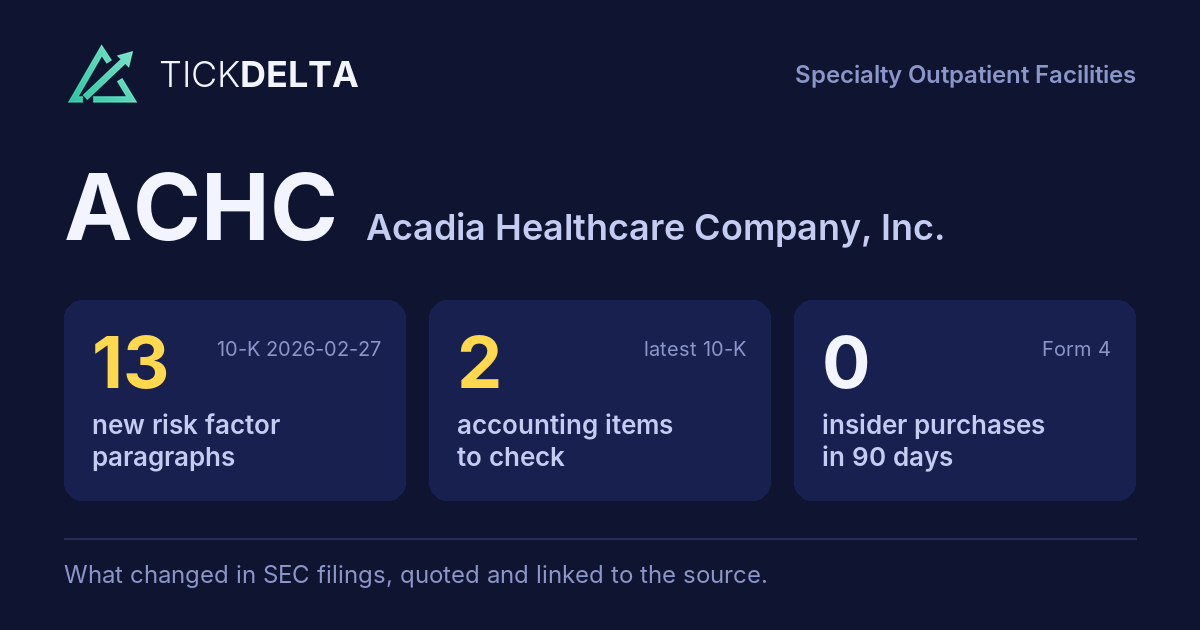
13 paragraphs in Risk Factors of the 10-K filed Feb 27, 2026
with nothing like them in the 10-K filed Feb 27, 2025. Quoted exactly.
Paragraphs that were only edited are under 10-K change.
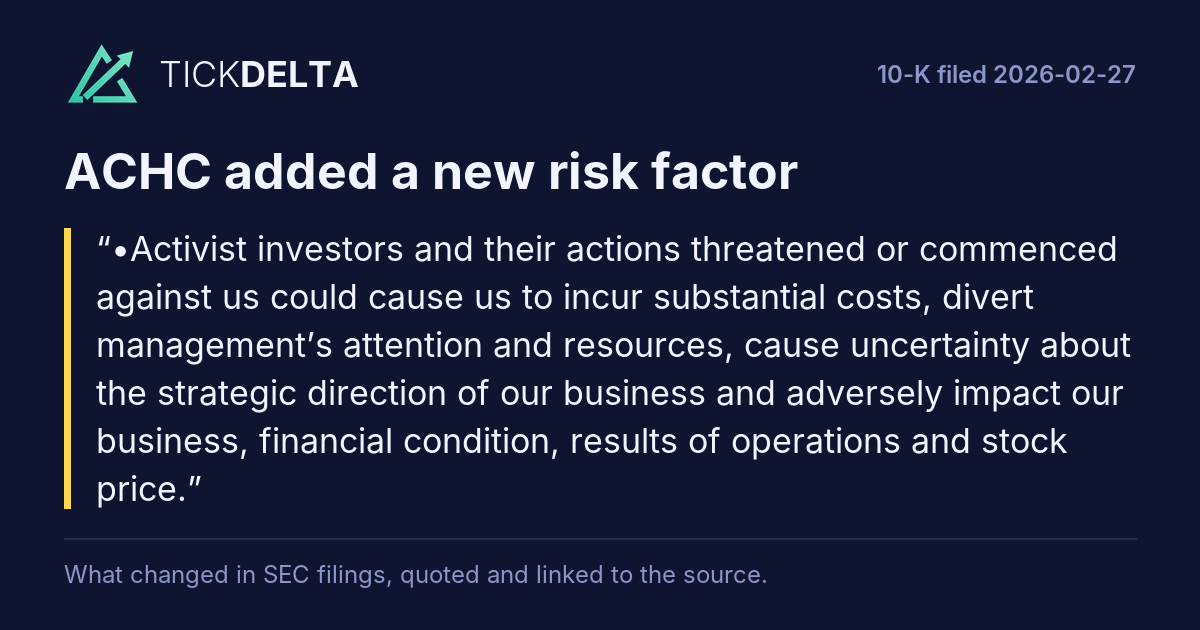
•Activist investors and their actions threatened or commenced against us could cause us to incur substantial costs, divert management’s attention and resources, cause uncertainty about the strategic direction of our business and adversely impact our business, financial condition, results of operations and stock price.
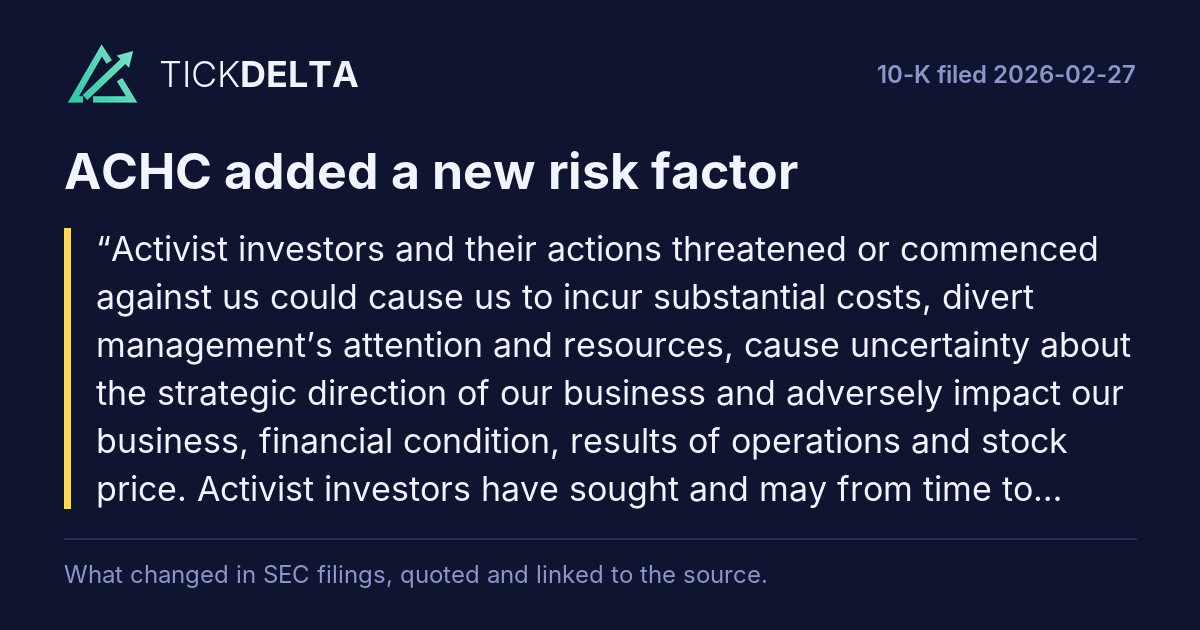
Activist investors and their actions threatened or commenced against us could cause us to incur substantial costs, divert management’s attention and resources, cause uncertainty about the strategic direction of our business and adversely impact our business, financial condition, results of operations and stock price.
Activist investors have sought and may from time to time seek to effect changes and assert influence on our board of directors and management, including by threatening or commencing a proxy contest or “vote no” campaign, engaging in proxy solicitations or advancing stockholder proposals. These actions could have a material adverse effect on us for the following reasons:
•Activist investors may attempt to effect changes in how we are governed and our strategic direction, or to acquire control over the Company. In particular, activist investors may suggest changes to our strategy, operations, board of directors and management that conflict with our strategic direction and could cause uncertainty amongst employees, patients and our investors about the strategic direction of our business.
•Responding to these actions is costly and time-consuming, and could disrupt our operations and divert the attention of our board of directors, management and employees away from their regular duties and the pursuit of business strategies. In addition, we may choose to initiate, or may become subject to, litigation as a result of a proxy contest or matters arising from a proxy contest or other activist investor actions, which may serve as a distraction to our board of directors, management and employees and could require us to incur significant additional costs.
•Any perceived uncertainties as to our future direction as a result of potential changes to management or the composition of the board of directors may lead to the perception of a change in the direction of the business, instability or lack of continuity, which may be exploited by our competitors, may cause concern to our current or potential patients and employees, may result in the loss of potential business opportunities and may make it more difficult to attract and retain qualified personnel and business partners.
•Such actions could cause significant fluctuations in our stock price based on temporary or speculative market perceptions or other factors that do not necessarily reflect the underlying fundamentals and prospects of our business.
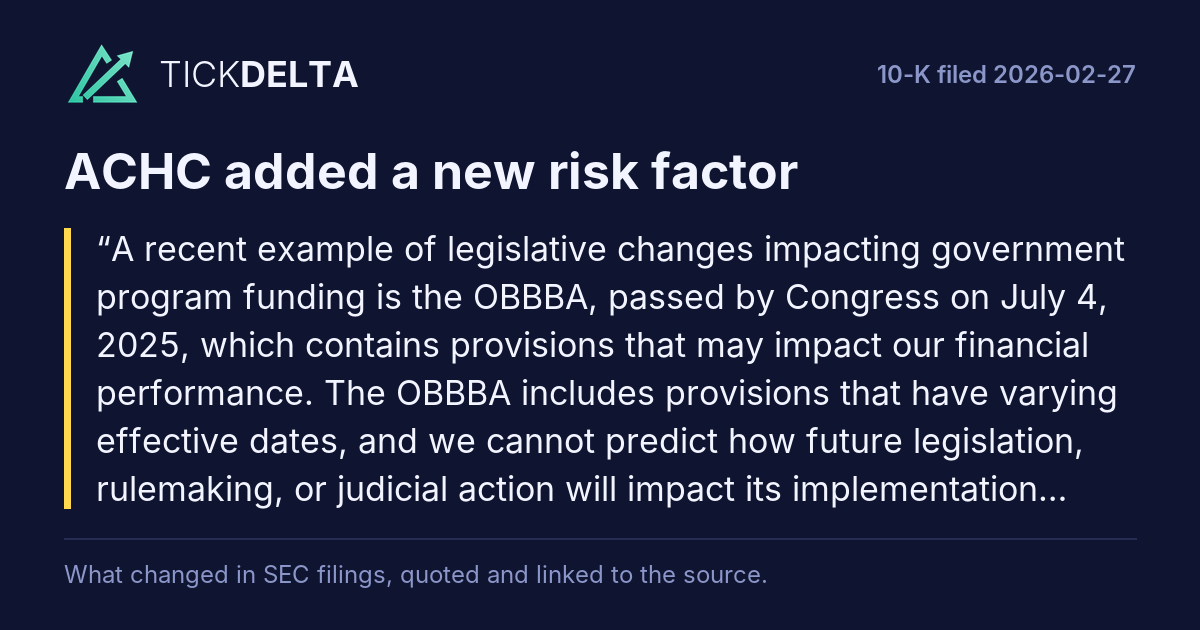
A recent example of legislative changes impacting government program funding is the OBBBA, passed by Congress on July 4, 2025, which contains provisions that may impact our financial performance. The OBBBA includes provisions that have varying effective dates, and we cannot predict how future legislation, rulemaking, or judicial action will impact its implementation. The OBBBA reduces federal Medicaid expenditures and tightens beneficiary eligibility requirements, including imposing work requirements for adults in Medicaid expansion states and requiring states to conduct eligibility redeterminations at least every six months by December 31, 2026. These changes increase the likelihood of patients losing coverage mid-year, which may disrupt treatment continuity, complicate coverage verification, and result in higher levels of uncompensated care and uncollected patient balances. Pursuant to the OBBBA, the HHS has also revised regulations governing state directed payment programs to cap total payment rates for certain services at Medicare payment rates and implemented policy changes that have decreased enrollment in ACA marketplace plans, including ending automatic renewals by requiring pre-enrollment verification requirements.
In addition to the federal healthcare program changes under the OBBBA, the enhanced premium tax credits, originally enacted under the American Rescue Plan Act of 2021, expired on December 31, 2025. Consequently, marketplace premiums have increased substantially, and enrollment for the 2026 plan year declined significantly. This increases the likelihood that more patients are uninsured, underinsured, or may become uninsured or underinsured. An increase in uninsured or underinsured patients or a deterioration in the collectability of patient accounts receivable could have a material adverse effect on our business, financial condition and results of operations.
If the rates paid or the scope of services covered by government payors are reduced, there could be a material adverse effect on our business, financial condition and results of operations.
Healthcare policy changes that increase the number of uninsured patients may adversely affect our results of operations. For example, the OBBBA reduces federal Medicaid expenditures and imposes more stringent Medicaid eligibility requirements. By December 31, 2026, Medicaid expansion states will also be required to conduct eligibility redeterminations at least every six months. These changes increase the likelihood of coverage loss, including mid‑year loss of eligibility, which may disrupt treatment continuity, complicate coverage verification processes, and result in higher levels of uncompensated care and uncollected patient balances. In addition, the enhanced premium tax credits for ACA marketplace health plans, enacted under the American Rescue Plan Act of 2021, expired on December 31, 2025. Following the expiration of these subsidies, marketplace premiums increased substantially and enrollment for the 2026 plan year declined significantly, increasing the likelihood that patients who previously maintained coverage may no longer be insured.
Show the other 1
Some companies that have experienced volatility in the market price of their stock, including us, have been subject to securities class action litigation. We have been the target of this type of litigation and may continue to be a target in the future. Securities litigation against us has, and could in the future, result in substantial costs and divert our management’s attention from other business concerns, which could materially adversely affect our business, results of operations, and financial condition. For example, during the year ended December 31, 2025, we incurred $147.5 million of settlement expense for the 2019 Securities Litigation (as described in more detail in Note 11 — Commitments and Contingencies in the accompanying notes to our consolidated financial statements).
Our stock could be the target of short sellers who may seek to drive down the price of shares by disseminating negative reports or information about us. Such negative publicity may lead to additional public scrutiny or may cause further volatility in our stock price, a decline in the value of a stockholder’s investment in us or reputational harm. Volatility in our stock price also impacts the value of our equity compensation, which affects our ability to recruit and retain employees. Accordingly, substantial or sustained stock price declines could have a material adverse impact on stockholder confidence and employee recruiting and retention.
Paragraphs in the 10-Q filed Nov 4, 2026 that were not in the one before
New in the latest 10-Q
5 paragraphs in the 10-Q filed Nov 4, 2026 with nothing like
them in the 10-Q filed Jul 28, 2026 (at least half the words must differ; new numbers alone do not count).
Quoted exactly, grouped by the item heading above them. This is text that changed, not a judgement of how serious it is.
Financial statements and notes
Weighted average shares outstanding for basic earnings 90,888 90,414 90,747 90,794
Read in the 10-Qopen_in_new
per share Effects of dilutive instruments 858 170 705 461 Shares used in computing diluted earnings per common 91,746 90,584 91,452 91,255
Read in the 10-Qopen_in_new
The case went to trial in April 2026. On May 12, 2026, a jury found in favor of the plaintiff and awarded $35.0 million in compensatory damages and $70.0 million in punitive damages. That award far exceeds the damages awarded in other single-plaintiff retaliation cases involving comparable conduct. In October 2026, Fashion Valley filed a motion for a new trial and a motion for judgment notwithstanding the verdict arguing, among other things, that juror misconduct infected the proceedings, that the compensatory damages award is grossly excessive, and that the punitive damages award violates due process. Fashion Valley expects to pursue an appeal if those motions are unsuccessful. Fashion Valley is also pursuing a separate appeal from the trial court’s order denying Fashion Valley’s motion to compel arbitration, which is currently being briefed. At this time, the Company cannot reasonably predict or provide any assurance regarding the ultimate outcome of the proceedings or whether the damages awarded by the jury will be reduced or otherwise modified.
Read in the 10-Qopen_in_new
Legal settlements (gain) expense. Legal settlements gain was $7.2 million for the three months ended September 30, 2026 and primarily related to the receipt of insurance proceeds in excess of payments of attorneys’ fees and expenses to plaintiffs’ counsel in connection with the settlement of derivative cases against the Company.
Read in the 10-Qopen_in_new
Our ability to negotiate favorable payment rates and other terms for our services impacts our revenue and results of operations. We actively engage with payors to negotiate such terms and, from time to time, we have had and may continue to have disagreements with payors regarding the interpretation or application of contractual terms, including with respect to claims for payment, which could result in reimbursement for certain of our services at rates lower than those we believe are required under our existing contractual arrangements or delays in payment.
Read in the 10-Qopen_in_new
The 10-Q's risk factors against the 10-K
Item 1A of the 10-Q filed Nov 4, 2026 against Item 1A of the 10-K filed Feb 27, 2026.
A 10-Q repeats only the risks that changed, so a 10-K paragraph that is missing from it is not counted as removed.
Added is a paragraph with nothing like it in the 10-K, Reworded a sentence that is in both with several words changed,
Quiet changes a sentence in both where one to four words changed and one is a hedge or a modal
(cut words struck through, new words highlighted).
Text on the page, not a score; each links to the filing at sec.gov.
Added10-Q Nov 4, 2026 vs 10-K Feb 27, 2026
In addition to the other information set forth in this report, an investor should carefully consider the factors discussed in Part I, “Item 1A. Risk Factors” in the Company’s Annual Report on Form 10-K for the year ended December 31, 2025, which are incorporated herein by reference. There have been no material changes to the risk factors previously disclosed in the Company’s Annual Report on Form 10-K for the year ended December 31, 2025. However, the risks described in the Company’s Annual Report on Form 10-K for the year ended December 31, 2025, are not the only risks facing the Company. Additional risks and uncertainties not currently known to management or that management currently deems immaterial also may materially, adversely affect the Company’s business, financial condition, operating results or cash flows.
Read it in the 10-Q at sec.govopen_in_new
Sources
Item 1A of each 10-K and 10-Q on EDGAR, quoted exactly. Each paragraph links to the filing at sec.gov.
Also
10-K change: what was reworded or cut, section by section.
Work with it
Excel workbook · CSV. Google Sheet that stays up to date: paste =IMPORTDATA("https://tickdelta.com/company/ACHC/export.csv") into a cell.