Paragraph 12 · 50% changed
Every version of it
Screener
/
SEC EDGAR
/CIK 0000935036
/10-K filed Feb 26, 2026, compared with Feb 27, 2025
/Numbers from the XBRL of the 10-Ks
Nasdaq
Technology · Software
ACI Worldwide, Inc. ACIW
The 10-K against last year's
72 changes: 19 added, 23 removed, 30 reworded
10-K Feb 26, 2026 vs Feb 27, 2025
Risk Factors
13.2%
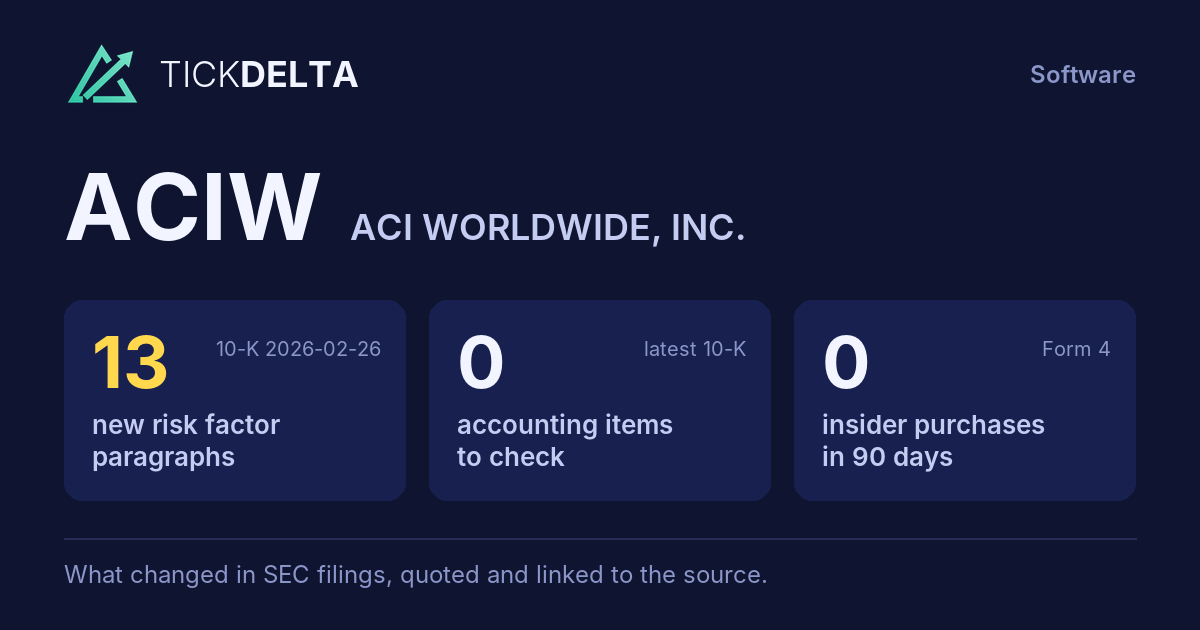
of the text changed · 12,413 words now · 13 new paragraphs, 12 gone
MD&A
17.4%
of the text changed · 8,260 words now · 6 new paragraphs, 11 gone
Legal Proceedings
33.3%
of the text changed · 491 words now
Accounting Policies
12.9%
of the text changed · 3,108 words now
10-K 0000935036-26-000011 (Feb 26, 2026) vs 10-K 0000935036-25-000006 (Feb 27, 2025)
Every paragraph, and how much of it changed
One bar per paragraph, in the order of the 10-K. Height and colour show the share of its words not in the closest paragraph a year earlier; the tallest bars are new paragraphs.
Risk Factors
140 paragraphs · 13 new · 20 reworded · 12 gone · 10-K Feb 26, 2026 against Feb 27, 2025
New paragraph
Reworded (5% of its words or more)
Same or nearly
Paragraph 60 · 43% changed
Every version of it
Paragraph 92 · 38% changed
Every version of it
Paragraph 62 · 37% changed
Every version of it
Paragraph 23 · 26% changed
Every version of it
From time to time, we may divest of all or a portion of certain businesses. Divestitures involve risk, including, potential increased expense associated with the divestitures, and potential issues with the acquirers, customers or suppliers of the divested business, or products. Occasionally, we may wind down certain business activities and perform other organizational restructuring projects in an effort to reduce costs and streamline operations. For example, we divested our corporate online banking solutions related assets and liabilities to One Equity Partners on September 1, 2022. Divestiture activities involve risks as they may divert management's attention from our core businesses, increase expenses on a short‑term basis and lead to potential issues with employees or customers. If we do not complete these activities in a timely manner, or do not realize anticipated cost savings, synergies and efficiencies, business disruption occurs during or following such activities, or we incur unanticipated charges, this may negatively impact our business, financial condition, operating results, and cash flows.
Paragraph 10 · 23% changed
Every version of it
As part of our business, we electronically receive, process, store, and transmit information, including personal information and sensitive business information of our customers. Cybersecurity incidents vary in their form and can include the deployment of harmful malware or ransomware, denial-of-services attacks, and other attacks, which may affect business continuity and threaten the availability, confidentiality and integrity of our systems and information. Cybersecurity incidents can also include employee or personnel failures, fraud, phishing or other social engineering attempts, AI deep fakes, zero-day sophistication, supply chain threats, AI created malware or ransomware, or other methods to cause confidential information, payments, account access or access credentials, or other data to be transmitted to an unintended recipient. Cybersecurity threat actors also may attempt to exploit vulnerabilities in both ACI and cloud provider infrastructure along with vulnerabilities in software including software commonly used by companies in cloud-based services and bundled software. Like many other companies, we detect attempts by threat actors to gain access to our systems and networks on a frequent basis, and the frequency of such attempts could increase in the future. Unauthorized access, use, or disruptions to our data, computer systems or databases or other cybersecurity incidents or similar attacks could result in the theft or publication of confidential information, including intellectual property and consumer information, or the deletion or modification of records or could otherwise cause interruptions in our operations. These concerns about security are increased when we transmit information over the Internet. Security breaches and cybersecurity incidents in connection with the delivery of our products and services, including products and services utilizing the Internet, or well-publicized security breaches, and the trend toward broad consumer and general public notification of such incidents, could significantly harm our business, financial condition, cash flows and/or results of operations. We cannot be certain that advances in criminal capabilities, discovery of new vulnerabilities, attempts to exploit vulnerabilities in our systems, data thefts, physical system or network break-ins or inappropriate access, or other developments will not compromise or breach the technology protecting our networks and confidential information. Computer viruses have also been distributed and have rapidly spread over the Internet. Computer viruses could infiltrate our systems, disrupting our delivery of services and making our applications unavailable. Any inability to prevent security breaches or computer viruses could also cause existing customers to lose confidence in our systems and terminate their agreements with us, and could inhibit our ability to attract new customers. A cybersecurity incident or failure or disruption relating to our information or systems or that of our third-party business partners, or any failure by us or our third-party business partners to effectively address, enforce and maintain our information technology infrastructure, systems, or security measures may result in substantial harm to our business strategy, results of operations and financial condition, including major disruptions to business operations, loss of intellectual property, release of confidential information, alteration or corruption of data or systems, costs related to remediation or the payment of ransom, and litigation including individual claims or consumer class actions, commercial litigation, administrative, and civil or criminal investigations or actions, regulatory intervention and sanctions or fines, investigation and remediation costs and possible prolonged negative publicity. The shift to a remote/hybrid work model has expanded our attack surface, increasing the complexity of securing our information systems and data.
Paragraph 3 · 22% changed
Every version of it
The markets in which we compete are characterized by rapid change, frequent introduction of new products and services, evolving technologies and industry standards, intense competition, and increasing client expectations. We may not be successful in developing, marketing, or selling new products and services that meet these demands or achieve market acceptance. We must anticipate and respond to these changes in order to remain competitive within our relevant markets. There is no assurance that we will be able to maintain our current market share or customer base. We face intense competition in our businesses and we expect competition to remain intense in the future. We have many competitors that are significantly larger than us and have significantly greater financial, technical and marketing resources, have well-established relationships with our current or potential customers, advertise aggressively or beat us to the market with new products and services. Mergers and acquisitions by, and collaborations between, the companies we compete against may lead to even larger competitors with more resources. In addition, some of our clients have chosen to develop key products in-house, and others may choose to do so in the future. As a result, we may compete against our existing and potential clients’ in-house capabilities. Additionally, we expect that the markets in which we compete will continue to attract new competitors and new technologies. Increased competition in our markets could lead to price reductions, reduced profits, or loss of market share.
Paragraph 91 · 18% changed
Every version of it
U.S. and other banking agencies have adopted or proposed enhanced cyber risk management standards that would apply to us and our financial institution clients and that would address cyber risk governance and management, management of internal and external dependencies, and incident response, cyber resilience, and situational awareness. Several states in the U.S. have adopted or proposed new privacy and cybersecurity laws targeting these issues. Legislation and regulations on cybersecurity, data privacy, data protection and data localization may compel us to need to modify our systems, invest in new systems or alter our business practices or our policies on data governance and privacy. These actions could significantly increase our operational costs.
Paragraph 12 · 50% changed
Every version of it
10-K Feb 27, 2025Failure to obtain renewals of customer contracts or obtain such renewals on favorable terms could adversely affect our results of operations and financial condition.
10-K Feb 26, 2026
We rely on third-party cloud infrastructure and related services to deliver and operate our platform and deliver our solutions, and any disruption, limitation, or change in these cloud services could adversely affect our business, results of operations and financial condition.
Paragraph 60 · 43% changed
Every version of it
10-K Feb 27, 2025Failure to obtain renewals of customer contracts or obtain such renewals on favorable terms could adversely affect our results of operations and financial condition.
10-K Feb 26, 2026
Macroeconomic and geopolitical conditions could adversely affect our business, results of operations and financial condition.
Paragraph 92 · 38% changed
Every version of it
10-K Feb 27, 2025U.S. and other banking agencies have adopted or proposed enhanced cyber risk management standards that would apply to us and our financial institution clients and that would address cyber risk governance and management, management of internal and external dependencies, and incident response, cyber resilience, and situational awareness. Several states in the U.S. have adopted or proposed new privacy and cybersecurity laws targeting these issues. Legislation and regulations on cybersecurity, data privacy, data protection and data localization may compel us to need to modify our systems, invest in new systems or alter our business practices or our policies on data governance and privacy. These actions could significantly increase our operational costs.
10-K Feb 26, 2026
data privacy, data protection and data localization may compel us to need to modify our systems, invest in new systems or alter our business practices or our policies on data governance and privacy. These actions could significantly increase our operational costs.
Paragraph 62 · 37% changed
Every version of it
10-K Feb 27, 2025The crises in eastern Europe and the Middle East continue to be a challenge to global companies, including us. We currently have one employee in Russia, a dormant customer in Russia, and customers located in the Middle East. The U.S. and other global governments have placed restrictions on how companies may transact with, and provide services or solutions to, parties in these regions, particularly Russia, Belarus and restricted areas in Ukraine. No assurances can be given that additional developments in the impacted regions, and responses thereto from the U.S. and other global governments, would not have a material adverse effect on our business, results of operations and financial condition.
10-K Feb 26, 2026
Current and potential conflicts continue to challenge global companies, including us. We currently have one employee in Russia, a dormant customer in Russia, and customers located in the Middle East. The U.S. and other global governments have placed restrictions on how companies may transact with, and provide services or solutions to certain countries, including Russia.
Paragraph 23 · 26% changed
Every version of it
10-K Feb 27, 2025
From time to time, we may divest of all or a portion of certain businesses. Divestitures involve risk, including, potential increased expense associated with the divestitures, and potential issues with the acquirers, customers or suppliers of the divested business, or products. Occasionally, we may wind down certain business activities and perform other organizational restructuring projects in an effort to reduce costs and streamline operations. For example, we divested our corporate online banking solutions related assets and liabilities to One Equity Partners on September 1, 2022. Divestiture activities involve risks as they may divert management's attention from our core businesses, increase expenses on a short‑term basis and lead to
10-K Feb 26, 2026
From time to time, we may divest of all or a portion of certain businesses. Divestitures involve risk, including, potential increased expense associated with the divestitures, and potential issues with the acquirers, customers or suppliers of the divested business, or products. Occasionally, we may wind down certain business activities and perform other organizational restructuring projects in an effort to reduce costs and streamline operations. Divestiture activities involve risks as they may divert management's attention from our core businesses, increase expenses on a short‑term basis and lead to potential issues with employees or customers. If we do not complete these activities in a timely manner, or do not realize anticipated cost savings, synergies and efficiencies, business disruption occurs during or following such activities, or we incur unanticipated charges, this may negatively impact our business, financial condition, operating results, and cash flows.
Paragraph 10 · 23% changed
Every version of it
10-K Feb 27, 2025
otherwise cause interruptions in our operations. These concerns about security are increased when we transmit information over the Internet. Security breaches and cybersecurity incidents in connection with the delivery of our products and services, including products and services utilizing the Internet, or well-publicized security breaches, and the trend toward broad consumer and general public notification of such incidents, could significantly harm our business, financial condition, cash flows and/or results of operations. We cannot be certain that advances in criminal capabilities, discovery of new vulnerabilities, attempts to exploit vulnerabilities in our systems, data thefts, physical system or network break-ins or inappropriate access, or other developments will not compromise or breach the technology protecting our networks and confidential information. Computer viruses have also been distributed and have rapidly spread over the Internet. Computer viruses could infiltrate our systems, disrupting our delivery of services and making our applications unavailable. Any inability to prevent security breaches or computer viruses could also cause existing customers to lose confidence in our systems and terminate their agreements with us, and could inhibit our ability to attract new customers. A cybersecurity incident or failure or disruption relating to our information or systems or that of our third-party business partners, or any failure by us or our third-party business partners to effectively address, enforce and maintain our information technology infrastructure, systems, or security measures may result in substantial harm to our business strategy, results of operations and financial condition, including major disruptions to business operations, loss of intellectual property, release of confidential information, alteration or corruption of data or systems, costs related to remediation or the payment of ransom, and litigation including individual claims or consumer class actions, commercial litigation, administrative, and civil or criminal investigations or actions, regulatory intervention and sanctions or fines, investigation and remediation costs and possible prolonged negative publicity.
10-K Feb 26, 2026
As part of our business, we electronically receive, process, store, and transmit information, including personal information and sensitive business information of our customers. Cybersecurity incidents vary in their form and can include the deployment of harmful malware or ransomware, denial-of-services attacks, and other attacks, which may affect business continuity and threaten the availability, confidentiality and integrity of our systems and information. Cybersecurity incidents can also include employee or personnel failures, fraud, phishing or other social engineering attempts, AI deep fakes, zero-day sophistication, supply chain threats, AI created malware or ransomware, or other methods to cause confidential information, payments, account access or access credentials, or other data to be transmitted to an unintended recipient. Cybersecurity threat actors also may attempt to exploit vulnerabilities in both ACI and cloud provider infrastructure along with vulnerabilities in software including software commonly used by companies in cloud-based services and bundled software. Like many other companies, we detect attempts by threat actors to gain access to our systems and networks on a frequent basis, and the frequency of such attempts could increase in the future. Unauthorized access, use, or disruptions to our data, computer systems or databases or other cybersecurity incidents or similar attacks could result in the theft or publication of confidential information, including intellectual property and consumer information, or the deletion or modification of records or could otherwise cause interruptions in our operations. These concerns about security are increased when we transmit information over the Internet. Security breaches and cybersecurity incidents in connection with the delivery of our products and services, including products and services utilizing the Internet, or well-publicized security breaches, and the trend toward broad consumer and general public notification of such incidents, could significantly harm our business, financial condition, cash flows and/or results of operations. We cannot be certain that advances in criminal capabilities, discovery of new vulnerabilities, attempts to exploit vulnerabilities in our systems, data thefts, physical system or network break-ins or inappropriate access, or other developments will not compromise or breach the technology protecting our networks and confidential information. Computer viruses have also been distributed and have rapidly spread over the Internet. Computer viruses could infiltrate our systems, disrupting our delivery of services and making our applications unavailable. Any inability to prevent security breaches or computer viruses could also cause existing customers to lose confidence in our systems and terminate their agreements with us, and could inhibit our ability to attract new customers. A cybersecurity incident or failure or disruption relating to our information or systems or that of our third-party business partners, or any failure by us or our third-party business partners to effectively address, enforce and maintain our information technology infrastructure, systems, or security measures may result in substantial harm to our business strategy, results of operations and financial condition, including major disruptions to business operations, loss of intellectual property, release of confidential information, alteration or corruption of data or systems, costs related to remediation or the payment of ransom, and litigation including individual claims or consumer class actions, commercial litigation, administrative, and civil or criminal investigations or actions, regulatory intervention and sanctions or fines, investigation and remediation costs and possible prolonged negative publicity. The shift to a remote/hybrid work model has expanded our attack surface, increasing the complexity of securing our information systems and data.
Paragraph 3 · 22% changed
Every version of it
10-K Feb 27, 2025
The markets in which we compete are characterized by rapid change, frequent introduction of new products and services, evolving technologies and industry standards, intense competition, and increasing client expectations. We may not be successful in developing, marketing, or selling new products and services that meet these demands or achieve market acceptance. We must anticipate and respond to these changes in order to remain competitive within our relevant markets. There is no assurance that we will be able to maintain our current market share or customer base. We face intense competition in our businesses and we expect competition to remain intense in the future. We have many competitors that are significantly larger than us and have significantly greater financial, technical and marketing resources, have well-established relationships with our
10-K Feb 26, 2026
The markets in which we compete are characterized by rapid change, frequent introduction of new products and services, evolving technologies and industry standards, intense competition, and increasing client expectations. We may not be successful in developing, marketing, or selling new products and services that meet these demands or achieve market acceptance. We must anticipate and respond to these changes in order to remain competitive within our relevant markets. There is no assurance that we will be able to maintain our current market share or customer base. We face intense competition in our businesses and we expect competition to remain intense in the future. We have many competitors that are significantly larger than us and have significantly greater financial, technical and marketing resources, have well-established relationships with our current or potential customers, advertise aggressively or beat us to the market with new products and services. Mergers and acquisitions by, and collaborations between, the companies we compete against may lead to even larger competitors with more resources. In addition, some of our clients have chosen to develop key products in-house, and others may choose to do so in the future. As a result, we may compete against our existing and potential clients’ in-house capabilities. Additionally, we expect that the markets in which we compete will continue to attract new competitors and new technologies. Increased competition in our markets could lead to price reductions, reduced profits, or loss of market share.
Paragraph 91 · 18% changed
Every version of it
10-K Feb 27, 2025
U.S. and other banking agencies have adopted or proposed enhanced cyber risk management standards that would apply to us and our financial institution clients and that would address cyber risk governance and management, management of internal and external dependencies, and incident response, cyber resilience, and situational awareness. Several states in the U.S. have adopted or proposed new privacy and cybersecurity laws targeting these issues. Legislation and regulations on cybersecurity, data privacy, data protection and data localization may compel us to need to modify our systems, invest in new systems or alter our business practices or our policies on data governance and privacy. These actions could significantly increase our operational costs.
10-K Feb 26, 2026
U.S. and other banking agencies have adopted or proposed enhanced cyber risk management standards that would apply to us and our financial institution clients and that would address cyber risk governance and management, management of internal and external dependencies, and incident response, cyber resilience, and situational awareness. Several states in the U.S. have adopted or proposed new privacy and cybersecurity laws targeting these issues. Legislation and regulations on cybersecurity,
MD&A
142 paragraphs · 6 new · 48 reworded · 11 gone · 10-K Feb 26, 2026 against Feb 27, 2025
New paragraph
Reworded (5% of its words or more)
Same or nearly
Paragraph 9 · 47% changed
Payments intelligence, fraud, Intelligence and compliance. Artificial Intelligence. The accelerated adoption of real-time payments, fraudsters leveraging artificial intelligence, payments and the ramping up of mandates increase new risks associated with AI agents driving new exploits increases the urgency for industry-wide collaboration to mitigate fraud with precision and achieve operational excellence. against fraud. As the threat of sophisticated fraud scams becomes a greater concern for remitting and receiving institutions, consumers are challenged with increased friction to prevent illegitimate access account take-over and criminals successfully persuading consumers to push transactions themselves, inadvertently, to mule accounts they have full control of, created with fake or synthetic identity, or simply "borrowed" with or without consent of genuine accounts or funds the legit account holders. While AI will be used to protect the consumer trust accelerate vulnerabilities, it can also be used to automate financial protection, including but not limited to recognition of synthetic identities and confidence, while achieving their strategic objectives. Regulators are beginning to litigate between consumers and financial institutions on the losses, and between remitting and receiving banks on the accountability. automated remediation. Banks and intermediaries, merchants, and billers are pursuing solutions to mitigate their risks while improving their customer experience, protecting their margins, and securing their revenue streams, especially with their new products and offerings. We continue to evolve our see opportunities for AI and other advanced machine learning and network intelligence analytics capabilities to stop criminals fraudulent behavior and enable frictionless, legitimate business. Meanwhile, with payments intelligence, organizations can integrate intelligent services to enhance consumer relationships while achieving precise, real-time fraud and risk mitigation capabilities. frictionless customer experiences.
Paragraph 95 · 38% changed
Cash and cash equivalents consist of highly liquid investments with original maturities of three months or less. As of December 31, 2024, 2025, we had $216.4 $196.5 million of cash and cash equivalents, of which $116.1 $96.8 million was held by our foreign subsidiaries. If these funds were needed for our operations in the United States, we may potentially be required to accrue and pay foreign and U.S. state The Company has recognized deferred income taxes to repatriate these funds. As for local country income and withholding taxes that could be incurred on distributions of December 31, 2024, only the certain non-U.S. earnings from our Indian foreign subsidiaries are indefinitely reinvested. We are also permanently reinvested in the outside book/tax basis differences related to foreign subsidiaries. These outside basis differences could reverse through the sale of foreign subsidiaries, as well as various other events, none of which these earnings are considered probable as of December 31, 2024. not intended to be indefinitely reinvested.
Paragraph 106 · 34% changed
Cash flows provided by operating activities was $358.7 were $322.8 million for the year ended December 31, 2024, an increase of 113% 2025, compared to $168.5 $358.7 million for the same period in 2023. This increase is attributed to improved profitability and corresponding 2024. Operating cash flows for the current year decreased primarily from due to lower customer receipt collections as a result of lower invoiced amounts at the prior year-end and lower higher income tax payments, taxes paid, partially offset by working capital use. improved profitability.
Paragraph 93 · 33% changed
For discussion of 2023 2024 compared to 2022, 2023, see Segment Results in Part II, Item 7 of our annual report on Form 10-K for the year ended December 31, 2023. 2024. Beginning in the first quarter of 2025, the Company reported financial performance based on its new operating segments, Payment Software, which merged the previously reported operating segments Banks and Merchants, and maintained Biller.
Paragraph 66 · 25% changed
•The increase was primarily due to higher personnel and related expenses of $22.2 million, expenses, including a $11.1 $3.2 million increase in stock-based compensation expense. The remaining increase was due to an increase in professional and other legal fees of $2.2 million.
Paragraph 71 · 25% changed
•The increase was primarily due to higher personnel and related expenses of $22.2 million, expenses, including a $11.1 $3.4 million increase in stock-based compensation expense. The remaining increase was due to an increase in professional and other legal fees of $2.2 million.
Paragraph 85 · 25% changed
Other, net is primarily comprised of foreign currency transaction gains and losses. During the year ended December 31, 2025, other, net also included the $25.9 million gain on the sale of the Company's equity method investment and the $1.1 million loss on extinguishment of debt. Other, net was $19.7 million of income and $1.2 million and $8.5 million of expense for the years ended December 31, 2024 2025 and 2023, 2024, respectively.
Paragraph 82 · 24% changed
•The decrease was primarily due to a $10.0 million decrease in depreciation due to prior facilities cost reduction activities and a $5.8 million decrease in amortization for fully amortized software and intangibles acquired through acquisitions.
Paragraph 9 · 47% changed
10-K Feb 27, 2025
Payments intelligence, fraud, and compliance. The accelerated adoption of real-time payments, fraudsters leveraging artificial intelligence, and the ramping up of mandates increase the urgency for industry-wide collaboration to mitigate fraud with precision and achieve operational excellence. As the threat of sophisticated fraud becomes a greater concern for remitting and receiving institutions, consumers are challenged with increased friction to prevent illegitimate access of genuine accounts or funds to protect the consumer trust and confidence, while achieving their strategic objectives. Regulators are beginning to litigate between consumers and financial institutions on the losses, and between remitting and receiving banks on the accountability. Banks and intermediaries, merchants, and billers are pursuing solutions to mitigate their risks while improving their customer experience, protecting their margins, and securing their revenue streams, especially with their new products and offerings. We continue to evolve our advanced machine learning and network intelligence capabilities to stop criminals and enable frictionless, legitimate business. Meanwhile, with payments intelligence, organizations can integrate intelligent services to enhance consumer relationships while achieving precise, real-time fraud and risk mitigation capabilities.
10-K Feb 26, 2026
Payments Intelligence and Artificial Intelligence. The accelerated adoption of real-time payments and new risks associated with AI agents driving new exploits increases the urgency for industry-wide collaboration against fraud. As the threat of scams becomes a greater concern for remitting and receiving institutions, consumers are challenged with increased friction to prevent account take-over and criminals successfully persuading consumers to push transactions themselves, inadvertently, to mule accounts they have full control of, created with fake or synthetic identity, or simply "borrowed" with or without consent of the legit account holders. While AI will be used to accelerate vulnerabilities, it can also be used to automate financial protection, including but not limited to recognition of synthetic identities and automated remediation. Banks and intermediaries, merchants, and billers are pursuing solutions to mitigate their risks while improving their customer experience, protecting their margins, and securing their revenue streams, especially with their new products and offerings. We continue to see opportunities for AI and other advanced analytics capabilities to stop fraudulent behavior and enable frictionless customer experiences.
Paragraph 95 · 38% changed
10-K Feb 27, 2025
Cash and cash equivalents consist of highly liquid investments with original maturities of three months or less. As of December 31, 2024, we had $216.4 million of cash and cash equivalents, of which $116.1 million was held by our foreign subsidiaries. If these funds were needed for our operations in the United States, we may potentially be required to accrue and pay foreign and U.S. state income taxes to repatriate these funds. As of December 31, 2024, only the earnings from our Indian foreign subsidiaries are indefinitely reinvested. We are also permanently reinvested in the outside book/tax basis differences related to foreign subsidiaries. These outside basis differences could reverse through the sale of foreign subsidiaries, as well as various other events, none of which are considered probable as of December 31, 2024.
10-K Feb 26, 2026
Cash and cash equivalents consist of highly liquid investments with original maturities of three months or less. As of December 31, 2025, we had $196.5 million of cash and cash equivalents, of which $96.8 million was held by our foreign subsidiaries. The Company has recognized deferred income taxes for local country income and withholding taxes that could be incurred on distributions of certain non-U.S. earnings in foreign subsidiaries, as these earnings are not intended to be indefinitely reinvested.
Paragraph 106 · 34% changed
10-K Feb 27, 2025
Cash flows provided by operating activities was $358.7 million for the year ended December 31, 2024, an increase of 113% compared to $168.5 million for the same period in 2023. This increase is attributed to improved profitability and corresponding cash flows primarily from customer receipt collections and lower income tax payments, partially offset by working capital use.
10-K Feb 26, 2026
Cash flows provided by operating activities were $322.8 million for the year ended December 31, 2025, compared to $358.7 million for the same period in 2024. Operating cash flows for the current year decreased primarily due to lower customer receipt collections as a result of lower invoiced amounts at the prior year-end and higher income taxes paid, partially offset by improved profitability.
Paragraph 93 · 33% changed
10-K Feb 27, 2025
For discussion of 2023 compared to 2022, see Segment Results in Part II, Item 7 of our annual report on Form 10-K for the year ended December 31, 2023.
10-K Feb 26, 2026
For discussion of 2024 compared to 2023, see Segment Results in Part II, Item 7 of our annual report on Form 10-K for the year ended December 31, 2024. Beginning in the first quarter of 2025, the Company reported financial performance based on its new operating segments, Payment Software, which merged the previously reported operating segments Banks and Merchants, and maintained Biller.
Paragraph 66 · 25% changed
10-K Feb 27, 2025
•The increase was primarily due to higher personnel and related expenses of $22.2 million, including a $11.1 million increase in stock-based compensation expense. The remaining increase was due to an increase in professional and other legal fees of $2.2 million.
10-K Feb 26, 2026
•The increase was primarily due to higher personnel and related expenses, including a $3.2 million increase in stock-based compensation expense.
Paragraph 71 · 25% changed
10-K Feb 27, 2025
•The increase was primarily due to higher personnel and related expenses of $22.2 million, including a $11.1 million increase in stock-based compensation expense. The remaining increase was due to an increase in professional and other legal fees of $2.2 million.
10-K Feb 26, 2026
•The increase was primarily due to higher personnel and related expenses, including a $3.4 million increase in stock-based compensation expense.
Paragraph 85 · 25% changed
10-K Feb 27, 2025
Other, net is primarily comprised of foreign currency transaction gains and losses. Other, net was $1.2 million and $8.5 million of expense for the years ended December 31, 2024 and 2023, respectively.
10-K Feb 26, 2026
Other, net is primarily comprised of foreign currency transaction gains and losses. During the year ended December 31, 2025, other, net also included the $25.9 million gain on the sale of the Company's equity method investment and the $1.1 million loss on extinguishment of debt. Other, net was $19.7 million of income and $1.2 million of expense for the years ended December 31, 2025 and 2024, respectively.
Paragraph 82 · 24% changed
10-K Feb 27, 2025
•The decrease was primarily due to a $10.0 million decrease in depreciation due to prior facilities cost reduction activities and a $5.8 million decrease in amortization for fully amortized software and intangibles acquired through acquisitions.
10-K Feb 26, 2026
•The decrease was primarily due to a decrease in amortization for fully amortized intangibles acquired through acquisitions.
A paragraph is matched with the one last year that shares the most of its words; under half in common makes it new. The paragraphs shown are the 8 reworded the most in each section.
The paragraph that changed most in each section
The redline
Marked against last year's 10-K: cut words struck through, new words highlighted.
Risk Factors245 words changed in this paragraph; it is 71% similar to last year's version.
As part of our business, we electronically receive, process, store, and transmit information, including personal information and sensitive business information of our customers. Cybersecurity incidents vary in their form and can include the deployment of harmful malware or ransomware, denial-of-services attacks, and other attacks, which may affect business continuity and threaten the availability, confidentiality and integrity of our systems and information. Cybersecurity incidents can also include employee or personnel failures, fraud, phishing or other social engineering attempts, AI deep fakes, zero-day sophistication, supply chain threats, AI created malware or ransomware, or other methods to cause confidential information, payments, account access or access credentials, or other data to be transmitted to an unintended recipient. Cybersecurity threat actors also may attempt to exploit vulnerabilities in both ACI and cloud provider infrastructure along with vulnerabilities in software including software commonly used by companies in cloud-based services and bundled software. Like many other companies, we detect attempts by threat actors to gain access to our systems and networks on a frequent basis, and the frequency of such attempts could increase in the future. Unauthorized access, use, or disruptions to our data, computer systems or databases or other cybersecurity incidents or similar attacks could result in the theft or publication of confidential information, including intellectual property and consumer information, or the deletion or modification of records or could otherwise cause interruptions in our operations. These concerns about security are increased when we transmit information over the Internet. Security breaches and cybersecurity incidents in connection with the delivery of our products and services, including products and services utilizing the Internet, or well-publicized security breaches, and the trend toward broad consumer and general public notification of such incidents, could significantly harm our business, financial condition, cash flows and/or results of operations. We cannot be certain that advances in criminal capabilities, discovery of new vulnerabilities, attempts to exploit vulnerabilities in our systems, data thefts, physical system or network break-ins or inappropriate access, or other developments will not compromise or breach the technology protecting our networks and confidential information. Computer viruses have also been distributed and have rapidly spread over the Internet. Computer viruses could infiltrate our systems, disrupting our delivery of services and making our applications unavailable. Any inability to prevent security breaches or computer viruses could also cause existing customers to lose confidence in our systems and terminate their agreements with us, and could inhibit our ability to attract new customers. A cybersecurity incident or failure or disruption relating to our information or systems or that of our third-party business partners, or any failure by us or our third-party business partners to effectively address, enforce and maintain our information technology infrastructure, systems, or security measures may result in substantial harm to our business strategy, results of operations and financial condition, including major disruptions to business operations, loss of intellectual property, release of confidential information, alteration or corruption of data or systems, costs related to remediation or the payment of ransom, and litigation including individual claims or consumer class actions, commercial litigation, administrative, and civil or criminal investigations or actions, regulatory intervention and sanctions or fines, investigation and remediation costs and possible prolonged negative publicity. The shift to a remote/hybrid work model has expanded our attack surface, increasing the complexity of securing our information systems and data.
Source: Item 1A, 10-K 0000935036-26-000011 vs Item 1A, 10-K 0000935036-25-000006
MD&A208 words changed in this paragraph; it is 31% similar to last year's version.
Adoption of cloud technology. ACI has recognized the industry's industry’s technical inflection point in the as financial institutions transition from traditional on-premises on‑premises infrastructure to the private and public cloud, cloud environments, and we are actively supporting our customers' customers’ cloud strategies. Cloud technology innovations allow enables the financial services ecosystem to remove reduce technical risk from their operations, risk, accelerate innovation and time to market innovation, improve time‑to‑market for new revenue-generating solutions for their customers, solutions, and accelerate innovation enhance scalability, resiliency, and ensure scalability and resiliency while improving long‑term operating economics over time. economics. As banks and banks, intermediaries, merchants, and billers modernize their systems to take advantage of these capabilities, our ongoing investments and partnerships allow us to deliver cloud benefits today while maintaining ACI’s core strengths in performance, resiliency, and scalability. In addition, cloud‑native, multi‑tenant SaaS solutions expand our reach to smaller institutions by providing scalable, easy‑to‑integrate offerings at accessible price points. Building on these foundations, ACI Connetic—our fully cloud‑native banking platform launched in 2025—advances this strategy by conforming fully to Cloud Native Computing Foundation principles and by being deployable across public cloud environments such as Microsoft Azure and Amazon Web Services, as well as customers’ private clouds. Working closely with key hardware and software partners including IBM and Red Hat, we ensure ACI Connetic can operate at scale in public, private, and multi‑cloud deployments, supporting the needs of the largest global banks and processors, particularly in highly regulated markets where concentration risk and data sovereignty considerations drive deployment strategy.
Source: Item 7, 10-K 0000935036-26-000011 vs Item 7, 10-K 0000935036-25-000006
Accounting Policies80 words changed in this paragraph; it is 73% similar to last year's version.
In accordance with ASC 350, Intangibles - Goodwill and Other, the Company assesses goodwill for impairment annually during the fourth quarter of its fiscal year using October 1 balances or when there is evidence that events or changes in circumstances indicate that the carrying amount of the asset may not be recovered. The Company evaluates goodwill at the reporting unit level using the discounted cash flow valuation model and allocates goodwill to these reporting units using a relative fair value approach. During this assessment, management relies on a number of factors, including operating results, business plans, and anticipated future cash flows. The As discussed in Note 9, Segment Information, in 2025, the Company has identified its reportable segments, Banks, Merchants, realigned Banks and Billers, as the Merchants under a single general manager leading Payment Software. This change also resulted in a change in reporting units. As of December 31, 2024, the Company's goodwill balance of $ 1.2 billion was allocated $ 671.7 million to Banks, $ 137.3 million to Merchants, units - combining Banks and $ 417.0 million to Billers. Merchants into Payment Software, while maintaining Biller.
Source: 10-K text, Note 1 – Nature of Business and Summary of Significant Accounting Policies, 10-K 0000935036-26-000011 vs 10-K text, Note 1 – Nature of Business and Summary of Significant Accounting Policies, 10-K 0000935036-25-000006
Legal Proceedings76 words changed in this paragraph; it is 73% similar to last year's version.
Other guarantees include promises to indemnify, defend, and hold harmless the Company’s executive officers, directors, and certain other key officers. The Company’s certificate of incorporation provides that it will indemnify and advance expenses to its directors and officers to the maximum extent permitted by Delaware law. The indemnification covers any expenses and liabilities reasonably incurred by a person, by reason of the fact that such person is, was, or has agreed to be a director or officer, in connection with the investigation, defense, and settlement of any threatened, pending, or completed action, suit, proceeding, or claim. The Company’s certificate of incorporation authorizes the use of indemnification agreements, and the Company enters into such agreements with its directors and certain officers from time to time. These indemnification agreements typically provide for a broader scope of the Company’s obligation to indemnify the directors and officers than set forth in the certificate of incorporation. The Company’s contractual indemnification obligations under these agreements are in addition to the respective directors’ and officers’ rights under the certificate of incorporation or under Delaware law.
Source: Item 3, via Note 12 – Commitments and Contingencies, 10-K 0000935036-26-000011 vs Item 3, via Note 13 – Commitments and Contingencies, 10-K 0000935036-25-000006
Sentences and paragraphs added, removed or reworded
Every change, by type
Sentences and paragraphs of ACIW's Risk Factors and MD&A, 10-K Feb 26, 2026 against 10-K Feb 27, 2025. Each links to the text at sec.gov.
Quiet changes are sentences kept from last year with one to four words changed, at least one of them a hedge, a modal or a qualifier (may, could, will, not, significant, material…). A year or date rolling forward is not counted.
The full word list
adverse, adversely, all, although, anticipate, anticipates, any, approximately, believe, believes, can, cannot, certain, could, expect, expects, generally, however, if, intend, intends, largely, likely, many, material, materially, may, might, most, must, never, no, not, possible, primarily, probable, should, significant, significantly, some, substantial, substantially, unlikely, will, would
AddedRisk Factors
Our ability to provide reliable service in a number of our businesses depends on the efficient and uninterrupted operation of our data centers, information technology and communication systems, and those of our external service providers or business
Read it in 10-K Feb 26, 2026 at sec.gov
AddedRisk Factors
Our platform and solutions depend on third-party cloud service providers for computing, storage, networking, and data management infrastructure. We currently use Microsoft Azure and Amazon Web Services and may also utilize other cloud providers for hosting, content delivery, analytics, and AI services. These cloud environments are critical to operating our platform and delivering our solutions. If any of these third-party providers experience interruptions, capacity constraints, cybersecurity incidents, or performance degradation, or if we or our clients encounter technical issues in connecting to their platforms, our platform and solutions could become slow, unreliable, or unavailable. Even temporary outages could harm our reputation, trigger service-level penalties under client contracts, and cause clients to delay renewals or choose our competitors. Because many of the services we use are proprietary to our cloud providers, we may have limited ability to quickly migrate workloads to alternative vendors without incurring substantial costs or service disruption. Our dependence on a small number of cloud vendors also exposes us to risks of pricing increases, changes in service terms, data egress or storage costs, and regional availability limitations. Additionally, cloud service failures can originate not only from the primary vendor but from underlying networks, software updates, or third-party subprocessors integrated into those environments. If our providers fail to maintain adequate security, availability, or compliance certifications, or if regulatory changes restrict cross-border data transfers or cloud usage for certain types of data, we may need to re-architect or relocate infrastructure, resulting in additional expense and operational complexity. Any material disruption, data loss, increase in cost, or limitation in the performance, features, or availability of third-party cloud services could adversely affect our business, results of operations, and reputation.
Read it in 10-K Feb 26, 2026 at sec.gov
AddedRisk Factors
Our reliance on third parties could adversely affect our operations, compliance, security and reputation.
Read it in 10-K Feb 26, 2026 at sec.gov
AddedRisk Factors
We rely on third parties to operate our business, including with respect to software development and integration, intermediaries and agents that support international sales, external information technology and cloud service providers, and outsourced customer support providers. These relationships introduce performance, financial, compliance, information security, continuity, and concentration risks that are often outside our control. Our oversight, audit rights, and contractual remedies may be limited, and service level commitments or indemnities may not fully compensate for losses. Failures by our third party partners to perform as expected, maintain adequate internal controls, protect data, meet quality or timeliness standards, or comply with applicable laws and regulations could result in interruptions to critical operations, delays in product delivery, security and privacy incidents, investigations, fines or penalties, adverse contract outcomes, and reputational harm. Replacing or migrating away from a third party can be costly, complex, and time-consuming, and viable alternatives may not be available on acceptable terms or timelines.
Read it in 10-K Feb 26, 2026 at sec.gov
AddedRisk Factors
Some third parties may also use or integrate AI tools in their development, support, or operational processes. Such use can heighten risks of data leakage or misuse of confidential information, introduce biased or inaccurate outputs, or inadvertently incorporate third-party intellectual property. Limited visibility into a partner’s AI governance, training data, and control frameworks may increase our exposure to compliance, IP, privacy, and reputational risks.
Read it in 10-K Feb 26, 2026 at sec.gov
AddedRisk Factors
If any key third party were to fail to perform, cease operations, suffer a material disruption, or otherwise not provide services on acceptable terms, we could experience business interruptions, degraded platform or solution performance, increased costs to replace or duplicate services, customer dissatisfaction and churn, and litigation, any of which could materially and adversely affect our business, results of operations and financial condition.
Read it in 10-K Feb 26, 2026 at sec.gov
AddedRisk Factors
Adverse or uncertain macroeconomic conditions, including inflation, interest rate volatility, recessionary pressures, reduced consumer spending, banking stress, and foreign currency fluctuations, may lead customers to delay or reduce spending, extend sales and implementation cycles, pressure pricing and renewals, impair collections, increase our operating costs, and limit access to capital. Our global operations also expose us to differing local conditions and exchange‑rate movements that can affect reported results.
Read it in 10-K Feb 26, 2026 at sec.gov
AddedRisk Factors
Geopolitical instability and related government actions (such as sanctions and export controls), can disrupt financial markets and payment networks, depress transaction volumes, restrict cross‑border activity, and increase operational risks. We may be required to suspend or modify services, incur additional compliance and resiliency costs, or experience outages or vendor disruptions. Any of these developments could materially adversely affect our business, results of operations and financial condition.
Read it in 10-K Feb 26, 2026 at sec.gov
Show the other 55
AddedRisk Factors
If customers do not adopt our new payment solution, ACI Connetic, as anticipated, our business, results of operations and financial condition could be adversely affected.
Read it in 10-K Feb 26, 2026 at sec.gov
AddedRisk Factors
We have invested significant resources to design, develop, launch and commercialize ACI Connetic, which is our comprehensive cloud-native payments hub solution. Customer adoption of ACI Connetic depends on our ability to provide compelling functionality and predictable implementation and migration paths from our existing products and solutions. Introducing a new platform presents numerous operational, technical, financial and commercial risks. Unanticipated defects, outages, latency, or other performance shortfalls could harm our reputation for reliability, trigger service credits or other remedies under customer agreements, increase our support and remediation costs, delay sales cycles, and reduce renewals or expansions. Customers may delay or decline adoption if they perceive operational risk, insufficient incremental value, heightened or unnecessary switching costs, or a disruption to their existing user experience. Even where customers elect to adopt ACI Connetic, implementation at a customer may prove to be more difficult, costly or time consuming than originally anticipated. In addition, our competitors may offer their own solutions with features that our customers prefer. Larger or better-capitalized competitors may replicate or outpace our innovations in ACI Connetic, bundle offerings, leverage broader ecosystems, or use pricing and contract terms that make it more difficult for us to retain our current customers or win new business. If a material number of our customers choose not to adopt ACI Connetic or if we are unable to attract sufficient new customers to fuel our growth, our revenue could be adversely affected.
Read it in 10-K Feb 26, 2026 at sec.gov
AddedRisk Factors
The introduction of ACI Connetic also creates risks of cannibalization and pricing pressure if our current customers migrate from higher‑priced legacy arrangements to ACI Connetic with different pricing or consumption models. Any shift toward usage‑based or cloud‑delivered services could introduce revenue variability, require new go‑to‑market motions, or necessitate changes to partner programs and channel economics. Additionally, to the extent ACI Connetic incorporates third‑party
Read it in 10-K Feb 26, 2026 at sec.gov
AddedRisk Factors
technologies, cloud infrastructure, data residency options, artificial intelligence or machine learning features, or new compliance tooling, we may be exposed to supplier performance, intellectual property, regulatory, model governance, explainability, and data privacy risks, as well as evolving security standards and threat vectors. Meeting financial services regulatory expectations across multiple jurisdictions is complex and may require incremental investment, controls, certifications, and audits, and any failure or delay could impede adoption or result in penalties or contractual remedies.
Read it in 10-K Feb 26, 2026 at sec.gov
RemovedRisk Factors
RemovedRisk Factors
RemovedRisk Factors
RemovedRisk Factors
RemovedRisk Factors
RemovedRisk Factors
RemovedRisk Factors
RemovedRisk Factors
RemovedRisk Factors
RemovedRisk Factors
RemovedRisk Factors
RemovedRisk Factors
RewordedRisk Factors
(vi) there are significant maturities on our debt that we may not be able to fulfill or that may be refinanced at higher rates; and (vii) if we fail to satisfy our obligations under our outstanding debt or fail to comply with the financial or other restrictive covenants required under our credit facility, an event of default could cause all of our debt to become due and payable and could permit the lenders under our credit facility to foreclose on the assets securing such debt.
Read it in 10-K Feb 26, 2026 at sec.gov
RewordedRisk Factors
RewordedRisk Factors
The U.S. and other global governments have placed restrictions on how companies may transact with, and provide services or solutions to, parties in these regions, particularly Russia, Belarus and restricted areas in Ukraine. to certain countries, including Russia.
Read it in 10-K Feb 26, 2026 at sec.gov
RewordedRisk Factors
We have many competitors that are significantly larger than us and have significantly greater financial, technical and marketing resources, have well-established relationships with our current or potential customers, advertise aggressively or beat us to the market with new products and services.
Read it in 10-K Feb 26, 2026 at sec.gov
RewordedRisk Factors
RewordedRisk Factors
Our credit facility and the indenture governing our 5.750% Senior Notes due 2026 (“2026 Notes”) contain contains customary affirmative and negative covenants for debt of these types that limit our ability to engage in specified types of transactions.
Read it in 10-K Feb 26, 2026 at sec.gov
RewordedRisk Factors
If an event of default occurs, the lenders, trustee, lenders or holders of the 2026 Notes trustees will be entitled to take various actions, including, but not limited to, demanding payment for all amounts outstanding.
Read it in 10-K Feb 26, 2026 at sec.gov
RewordedRisk Factors
A negative or unpredictable economic climate could create uncertainty or financial pressures that impact the ability or willingness of our customers to make capital expenditures, thereby affecting their decision to purchase or roll out our products or services or to pay accounts receivable owed to us.
Read it in 10-K Feb 26, 2026 at sec.gov
RewordedRisk Factors
Divestiture activities involve risks as they may divert management's attention from our core businesses, increase expenses on a short‑term basis and lead to potential issues with employees or customers.
Read it in 10-K Feb 26, 2026 at sec.gov
RewordedRisk Factors
(iii) we use a large portion of our operating cash flow to pay principal and interest on our credit facility and the 2026 Notes, facility, which reduces the amount of money available to finance operations, acquisitions and other business activities;
Read it in 10-K Feb 26, 2026 at sec.gov
AddedMD&A
Increasing digital payment transaction volumes. The adoption of digital payments continues to accelerate, driven by the increased adoption of instant payments and other financial inclusion efforts of countries throughout the world, with countries such as India, Brazil, Indonesia, Malaysia, and most recently Colombia, growing dramatically. Contactless payments adoption for in-person payments was thrust forward in response to the COVID-19 pandemic, and that usage has not abated. ACI leverages growth in transaction volumes through the licensing of payment technologies to banks and intermediaries seeking to take advantage of that growth, supporting 44 global payment schemes and providing the central infrastructure to 11 central banks directly operating the scheme using ACI software. With the launch of ACI Connetic, our comprehensive cloud-native payments hub solution available as a SaaS solution, participating in this growth is now accessible to banks of all sizes, significantly increasing ACI’s addressable market for software solutions.
Read it in 10-K Feb 26, 2026 at sec.gov
AddedMD&A
ISO 20022 and enhanced payment standards. In 2024 and 2025, banks and processors across the globe achieved major milestones with the certification and go-live of ISO 20022 compliance across the major wires networks, including Fedwire, Swift, CHAPS, and CHIPS. ACI solutions were instrumental in this new initiative, regularly processing more than two-thirds of Fedwire payments traffic and approximately 15% of Swift payments traffic globally. These go-live events were highly consequential in financial services globally, and with the enhanced data standards described, the financial system stands to be easier to secure and provide much richer analytics.
Read it in 10-K Feb 26, 2026 at sec.gov
AddedMD&A
Adoption of cloud technology. ACI has recognized the industry’s technical inflection point as financial institutions transition from traditional on‑premises infrastructure to private and public cloud environments, and we are actively supporting our customers’ cloud strategies. Cloud technology enables the financial services ecosystem to reduce technical risk, accelerate innovation, improve time‑to‑market for new revenue-generating solutions, and enhance scalability, resiliency, and long‑term operating economics. As banks, intermediaries, merchants, and billers modernize their systems to take advantage of these capabilities, our ongoing investments and partnerships allow us to deliver cloud benefits today while maintaining ACI’s core strengths in performance, resiliency, and scalability. In addition, cloud‑native, multi‑tenant SaaS solutions expand our reach to smaller institutions by providing scalable, easy‑to‑integrate offerings at accessible price points. Building on these foundations, ACI Connetic—our fully cloud‑native banking platform launched in 2025—advances this strategy by conforming fully to Cloud Native Computing Foundation principles and by being deployable across public cloud environments such as Microsoft Azure and Amazon Web Services, as well as customers’ private clouds. Working closely with key hardware and software partners including IBM and Red Hat, we ensure ACI Connetic can operate at scale in public, private, and multi‑cloud deployments, supporting the needs of the largest global banks and processors, particularly in highly regulated markets where concentration risk and data sovereignty considerations drive deployment strategy.
Read it in 10-K Feb 26, 2026 at sec.gov
AddedMD&A
The GENIUS Act and stablecoins. With the passage of the 2025 GENIUS Act in the United States, stablecoins gained international attention and prominence. As a leading software provider of solutions to move value around the world, ACI already plays a significant role in enabling stablecoin workflows as fiat currency funds are transferred to and from issuers and stablecoins are minted and burned. We recognize the importance of stablecoins to global value transfer, especially cross-border transfers, and ACI Connetic at its core design is the ideal platform for initiating, managing, and receiving those transfers. As customers are evaluating payment hubs, we expect that ACI Connetic and our strategy for stablecoin support will be well-received in the market.
Read it in 10-K Feb 26, 2026 at sec.gov
AddedMD&A
•The increase was primarily driven by consumer price index uplifts on contracted maintenance.
Read it in 10-K Feb 26, 2026 at sec.gov
AddedMD&A
The decrease in total liquidity is primarily due to increased borrowings on the revolving credit facility used to redeem the Company's outstanding 2026 Notes.
Read it in 10-K Feb 26, 2026 at sec.gov
RemovedMD&A
RemovedMD&A
RemovedMD&A
RemovedMD&A
RemovedMD&A
RemovedMD&A
RemovedMD&A
RemovedMD&A
RemovedMD&A
RemovedMD&A
RemovedMD&A
RewordedMD&A
RewordedMD&A
Interest expense for the year ended December 31, 2024, 2025, decreased $6.0 $14.6 million, or 8%, 20%, as compared to the same period in 2023, 2024, primarily due to repayments on the Term Loan. lower comparative debt balances during 2025 as well as a decrease in interest rates.
Read it in 10-K Feb 26, 2026 at sec.gov
RewordedMD&A
Of the foreign jurisdictions in which we operate, our December 31, 2024 and 2023 effective tax rates as of December 31, 2025 and 2024 were most primarily impacted by our operations in Ireland and the United Kingdom. India for 2025, and Ireland for 2024.
Read it in 10-K Feb 26, 2026 at sec.gov
RewordedMD&A
RewordedMD&A
Cash flows provided by operating activities was $358.7 were $322.8 million for the year ended December 31, 2024, an increase of 113% 2025, compared to $168.5 $358.7 million for the same period in 2023. 2024.
Read it in 10-K Feb 26, 2026 at sec.gov
RewordedMD&A
RewordedMD&A
Other, net was $19.7 million of income and $1.2 million and $8.5 million of expense for the years ended December 31, 2024 2025 and 2023, 2024, respectively.
Read it in 10-K Feb 26, 2026 at sec.gov
RewordedMD&A
RewordedMD&A
RewordedMD&A
RewordedMD&A
Selling and marketing expense decreased $14.3 increased $6.7 million, or 11%, 6%, during the year ended December 31, 2024, 2025, as compared to the same period in 2023. 2024.
Read it in 10-K Feb 26, 2026 at sec.gov
RewordedMD&A
Interest income for the year ended December 31, 2024, increased $1.7 2025, decreased $1.1 million, or 12%, 7%, as compared to the same period in 2023. 2024.
Read it in 10-K Feb 26, 2026 at sec.gov
Sources
The two latest 10-Ks on EDGAR, section by section. Each change links to the text at sec.gov.
Also
New risk factors: paragraphs with nothing like them last year, quoted in full.
Work with it
Excel workbook · CSV. Google Sheet that stays up to date: paste =IMPORTDATA("https://tickdelta.com/company/ACIW/export.csv") into a cell.