ACI Worldwide, Inc. ACIW
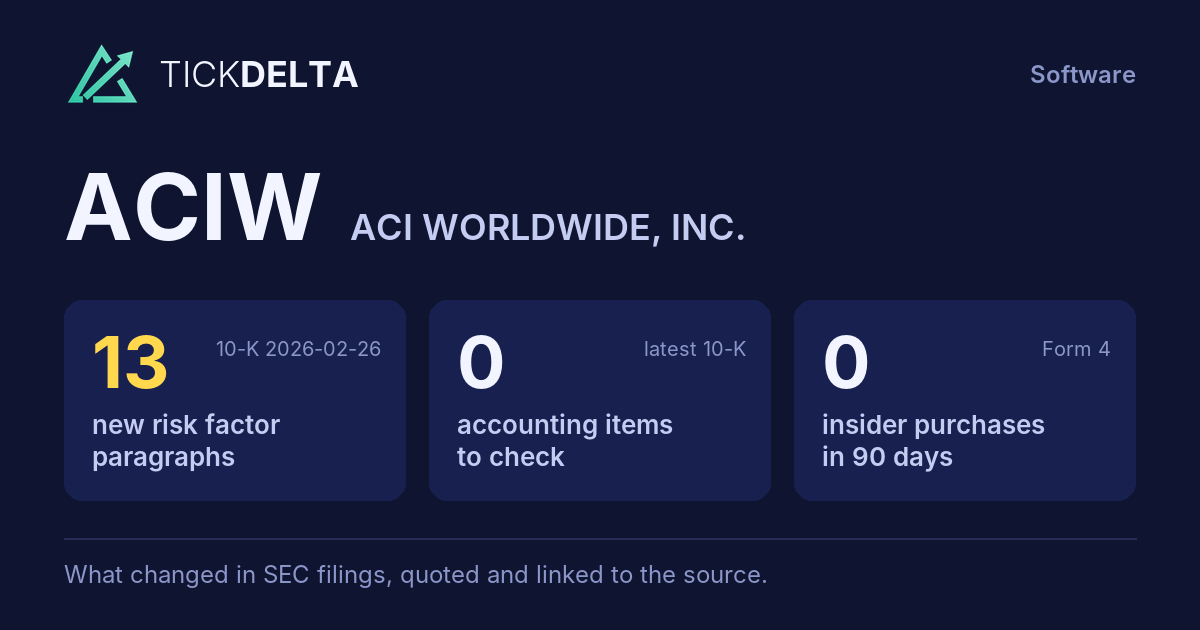
New risk paragraphs, branching off last year
Each branch is a paragraph in Risk Factors with nothing like it in the 10-K filed Feb 27, 2025. A box jumps to the paragraph as filed, below.
Paragraphs with nothing like them in last year's 10-K
13 paragraphs in Risk Factors of the 10-K filed Feb 26, 2026 with nothing like them in the 10-K filed Feb 27, 2025. Quoted exactly. Paragraphs that were only edited are under 10-K change.
Our ability to provide reliable service in a number of our businesses depends on the efficient and uninterrupted operation of our data centers, information technology and communication systems, and those of our external service providers or business
Our platform and solutions depend on third-party cloud service providers for computing, storage, networking, and data management infrastructure. We currently use Microsoft Azure and Amazon Web Services and may also utilize other cloud providers for hosting, content delivery, analytics, and AI services. These cloud environments are critical to operating our platform and delivering our solutions. If any of these third-party providers experience interruptions, capacity constraints, cybersecurity incidents, or performance degradation, or if we or our clients encounter technical issues in connecting to their platforms, our platform and solutions could become slow, unreliable, or unavailable. Even temporary outages could harm our reputation, trigger service-level penalties under client contracts, and cause clients to delay renewals or choose our competitors. Because many of the services we use are proprietary to our cloud providers, we may have limited ability to quickly migrate workloads to alternative vendors without incurring substantial costs or service disruption. Our dependence on a small number of cloud vendors also exposes us to risks of pricing increases, changes in service terms, data egress or storage costs, and regional availability limitations. Additionally, cloud service failures can originate not only from the primary vendor but from underlying networks, software updates, or third-party subprocessors integrated into those environments. If our providers fail to maintain adequate security, availability, or compliance certifications, or if regulatory changes restrict cross-border data transfers or cloud usage for certain types of data, we may need to re-architect or relocate infrastructure, resulting in additional expense and operational complexity. Any material disruption, data loss, increase in cost, or limitation in the performance, features, or availability of third-party cloud services could adversely affect our business, results of operations, and reputation.
Our reliance on third parties could adversely affect our operations, compliance, security and reputation.
We rely on third parties to operate our business, including with respect to software development and integration, intermediaries and agents that support international sales, external information technology and cloud service providers, and outsourced customer support providers. These relationships introduce performance, financial, compliance, information security, continuity, and concentration risks that are often outside our control. Our oversight, audit rights, and contractual remedies may be limited, and service level commitments or indemnities may not fully compensate for losses. Failures by our third party partners to perform as expected, maintain adequate internal controls, protect data, meet quality or timeliness standards, or comply with applicable laws and regulations could result in interruptions to critical operations, delays in product delivery, security and privacy incidents, investigations, fines or penalties, adverse contract outcomes, and reputational harm. Replacing or migrating away from a third party can be costly, complex, and time-consuming, and viable alternatives may not be available on acceptable terms or timelines.
Some third parties may also use or integrate AI tools in their development, support, or operational processes. Such use can heighten risks of data leakage or misuse of confidential information, introduce biased or inaccurate outputs, or inadvertently incorporate third-party intellectual property. Limited visibility into a partner’s AI governance, training data, and control frameworks may increase our exposure to compliance, IP, privacy, and reputational risks.
If any key third party were to fail to perform, cease operations, suffer a material disruption, or otherwise not provide services on acceptable terms, we could experience business interruptions, degraded platform or solution performance, increased costs to replace or duplicate services, customer dissatisfaction and churn, and litigation, any of which could materially and adversely affect our business, results of operations and financial condition.
Adverse or uncertain macroeconomic conditions, including inflation, interest rate volatility, recessionary pressures, reduced consumer spending, banking stress, and foreign currency fluctuations, may lead customers to delay or reduce spending, extend sales and implementation cycles, pressure pricing and renewals, impair collections, increase our operating costs, and limit access to capital. Our global operations also expose us to differing local conditions and exchange‑rate movements that can affect reported results.
Geopolitical instability and related government actions (such as sanctions and export controls), can disrupt financial markets and payment networks, depress transaction volumes, restrict cross‑border activity, and increase operational risks. We may be required to suspend or modify services, incur additional compliance and resiliency costs, or experience outages or vendor disruptions. Any of these developments could materially adversely affect our business, results of operations and financial condition.
If customers do not adopt our new payment solution, ACI Connetic, as anticipated, our business, results of operations and financial condition could be adversely affected.
We have invested significant resources to design, develop, launch and commercialize ACI Connetic, which is our comprehensive cloud-native payments hub solution. Customer adoption of ACI Connetic depends on our ability to provide compelling functionality and predictable implementation and migration paths from our existing products and solutions. Introducing a new platform presents numerous operational, technical, financial and commercial risks. Unanticipated defects, outages, latency, or other performance shortfalls could harm our reputation for reliability, trigger service credits or other remedies under customer agreements, increase our support and remediation costs, delay sales cycles, and reduce renewals or expansions. Customers may delay or decline adoption if they perceive operational risk, insufficient incremental value, heightened or unnecessary switching costs, or a disruption to their existing user experience. Even where customers elect to adopt ACI Connetic, implementation at a customer may prove to be more difficult, costly or time consuming than originally anticipated. In addition, our competitors may offer their own solutions with features that our customers prefer. Larger or better-capitalized competitors may replicate or outpace our innovations in ACI Connetic, bundle offerings, leverage broader ecosystems, or use pricing and contract terms that make it more difficult for us to retain our current customers or win new business. If a material number of our customers choose not to adopt ACI Connetic or if we are unable to attract sufficient new customers to fuel our growth, our revenue could be adversely affected.
The introduction of ACI Connetic also creates risks of cannibalization and pricing pressure if our current customers migrate from higher‑priced legacy arrangements to ACI Connetic with different pricing or consumption models. Any shift toward usage‑based or cloud‑delivered services could introduce revenue variability, require new go‑to‑market motions, or necessitate changes to partner programs and channel economics. Additionally, to the extent ACI Connetic incorporates third‑party
technologies, cloud infrastructure, data residency options, artificial intelligence or machine learning features, or new compliance tooling, we may be exposed to supplier performance, intellectual property, regulatory, model governance, explainability, and data privacy risks, as well as evolving security standards and threat vectors. Meeting financial services regulatory expectations across multiple jurisdictions is complex and may require incremental investment, controls, certifications, and audits, and any failure or delay could impede adoption or result in penalties or contractual remedies.
If we fail to execute on our ACI Connetic roadmap or if we do not gain a threshold level of market acceptance, we may experience slower than expected growth, lower retention rates, reduced revenue and margins and reputational harm. The timing and magnitude of these effects are subject to uncertainty given the rapid pace of technological change and competition in the payments industry. Even if market adoption of ACI Connetic occurs, it may take longer or cost more than we anticipate and may not generate the revenues we expect, which could materially adversely affect our business, results of operations and financial condition.
Paragraphs in the 10-Q filed Nov 5, 2026 that were not in the one before
New in the latest 10-Q
3 paragraphs in the 10-Q filed Nov 5, 2026 with nothing like them in the 10-Q filed Aug 6, 2026 (at least half the words must differ; new numbers alone do not count). Quoted exactly, grouped by the item heading above them. This is text that changed, not a judgement of how serious it is.
Financial statements and notes
On October 1, 2026, the Company completed the acquisition of certain assets of Cranium Ventures Pte. Ltd. and Cranium Services Sdn. Bhd. (collectively "Cranium") for $ 24.0 million in cash consideration, plus potential contingent consideration of up to $ 20.0 million based on specific transaction volume thresholds. Cranium was a privately held developer of cloud-native card payment switching technology. The acquisition is expected to accelerate the Company’s ACI Connetic for Cards strategy.
Read in the 10-Q
The initial accounting for the acquisition is incomplete, including the valuation of contingent consideration and the Company has not yet determined the fair values of the assets acquired and liabilities assumed or the resulting goodwill, if any.
Read in the 10-Q
On October 1, 2026, the Company completed the acquisition of certain assets of Cranium Ventures Pte. Ltd. and Cranium Services Sdn. Bhd. (collectively "Cranium") for $24.0 million in cash consideration, plus potential contingent consideration of up to $20.0 million. See Note 1, Condensed Consolidated Financial Statements, for additional information.
Read in the 10-Q
The 10-Q's risk factors against the 10-K
Item 1A of the 10-Q filed Nov 5, 2026 against Item 1A of the 10-K filed Feb 26, 2026.
A 10-Q repeats only the risks that changed, so a 10-K paragraph that is missing from it is not counted as removed.
Added is a paragraph with nothing like it in the 10-K, Reworded a sentence that is in both with several words changed,
Quiet changes a sentence in both where one to four words changed and one is a hedge or a modal
(cut words struck through, new words highlighted).
Text on the page, not a score; each links to the filing at sec.gov.
What the 10-Q itself says about its risk factors:There have been no material changes to the risk factors disclosed in Item 1A of our Form 10-K for the fiscal year ended December 31, 2025. Additional risks and uncertainties, including risks and uncertainties not presently known to us, or that we currently deem immaterial, could also have an adverse effect on our business, financial condition and/or results of operations.
Read in the 10-Q
1 paragraph in the 10-Q's Item 1A, and none of them adds, rewords or quietly edits a paragraph of the 10-K's.
Phrases used for the first time
Two-word phrases in Risk Factors of the 10-K filed Feb 26, 2026 that are in none of the 1 earlier 10-Ks stored, back to Feb 27, 2025
Where each one is used
- aci connetic: If customers do not adopt our new payment solution, ACI Connetic, as anticipated, our business, results of operations and financial condition could be adversely affected.
- third party: We rely on third parties to operate our business, including with respect to software development and integration, intermediaries and agents that support international sales, external information technology and cloud service providers, and outsourced customer support providers. These relationships introduce...
- third-party cloud: We rely on third-party cloud infrastructure and related services to deliver and operate our platform and deliver our solutions, and any disruption, limitation, or change in these cloud services could adversely affect our business, results of operations and financial condition.
- cloud service: We rely on third-party cloud infrastructure and related services to deliver and operate our platform and deliver our solutions, and any disruption, limitation, or change in these cloud services could adversely affect our business, results of operations and financial condition.
- cloud infrastructure: We rely on third-party cloud infrastructure and related services to deliver and operate our platform and deliver our solutions, and any disruption, limitation, or change in these cloud services could adversely affect our business, results of operations and financial condition.
- cloud services: We rely on third-party cloud infrastructure and related services to deliver and operate our platform and deliver our solutions, and any disruption, limitation, or change in these cloud services could adversely affect our business, results of operations and financial condition.
- cloud providers: Our platform and solutions depend on third-party cloud service providers for computing, storage, networking, and data management infrastructure. We currently use Microsoft Azure and Amazon Web Services and may also utilize other cloud providers for hosting, content delivery, analytics, and AI services. These cloud...
- maintain adequate: Our platform and solutions depend on third-party cloud service providers for computing, storage, networking, and data management infrastructure. We currently use Microsoft Azure and Amazon Web Services and may also utilize other cloud providers for hosting, content delivery, analytics, and AI services. These cloud...
Used at least twice, small words left out. Counted, not picked: a phrase can be new because the company renamed something.
What was taken out
12 paragraphs of last year's Risk Factors with nothing like them now. The longest are quoted.
Sources
Item 1A of each 10-K and 10-Q on EDGAR, quoted exactly. Each paragraph links to the filing at sec.gov.
Also
10-K change: what was reworded or cut, section by section.
Work with it
Excel workbook · CSV. Google Sheet that stays up to date: paste =IMPORTDATA("https://tickdelta.com/company/ACIW/export.csv") into a cell.