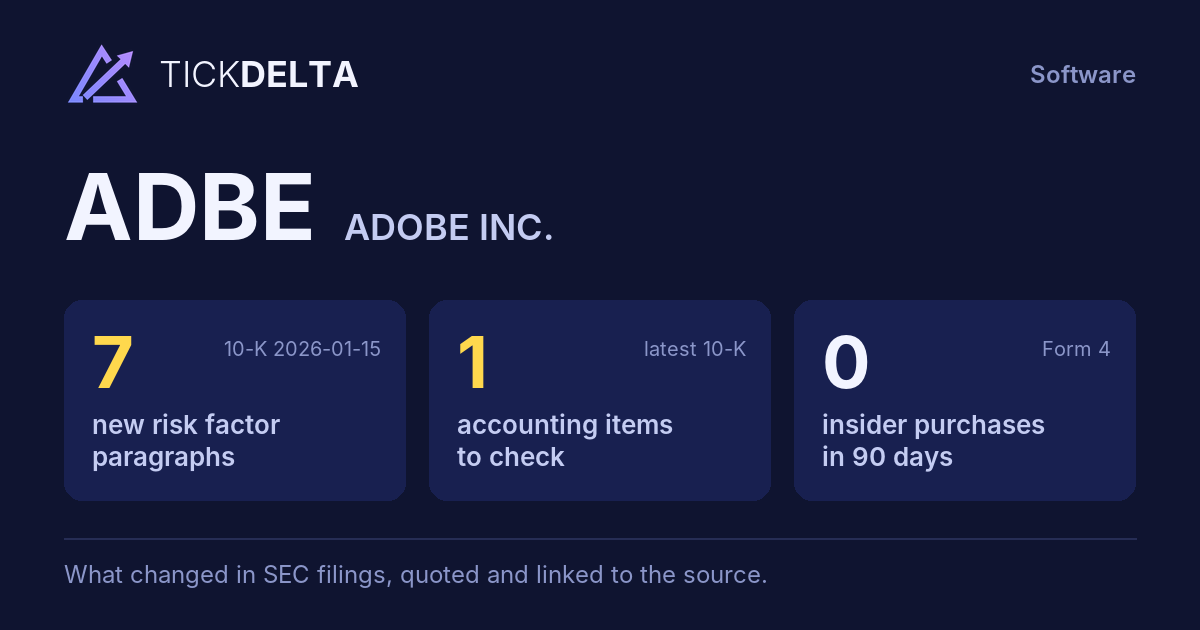
Marked against last year's 10-K:
cut words struck through, new words highlighted and underlined.
Risk Factors 280 words changed in this paragraph; it is 65% similar to last year's version.
The markets for our products, services and solutions are rapidly evolving and intensely competitive. We expect competition to continue to intensify. Our numerous competitors range in size from diversified include companies of various sizes and both public and private companies, including large, global companies and smaller companies with more specialized focuses, new entrants, and AI or cloud-native companies. Our competitors include companies with significant sales and research and development resources, broad brand awareness, long operating histories or access to large customer bases to small companies whose specialized focuses bases. Our competitors may allow them to more easily and effectively deploy technical, marketing and financial resources. resources more easily and effectively. Our competitors may develop or acquire additional products, services or solutions that are similar to ours or that achieve greater or faster acceptance, acceptance. Our competitors may undertake faster and more far-reaching and successful product development efforts or marketing campaigns or campaigns, may adopt more aggressive pricing policies. policies or may more effectively appeal to customers. As a result, current and potential customers may select the products, services or solutions of our competitors. Further, our future success depends on our continued ability to effectively appeal to businesses and consumers. New industry standards, evolving distribution and sales models, limited barriers to entry, short product life cycles, customer price sensitivity, global market economic conditions and the frequent entry of new products solutions or competitors may increase downward pressure on pricing and gross margins and adversely affect our renewal, upsell and cross-sell rates as well as our ability to attract new customers. In addition, we expect to face more competition as AI continues to advance and be integrated into the markets in which we compete. compete and to change the software industry. Our competitors or other third parties may incorporate develop AI into their offerings solutions more successfully and efficiently than we do and rapidly or successfully, including but not limited to different data training strategies or proprietary access to data and, as a result, other AI solutions may achieve greater and faster adoption, which could impair our ability to compete effectively and adversely affect our business and financial results. Other companies have, or in the future may obtain, proprietary rights that would prevent, limit or interfere with our ability to make, use or sell our AI offerings. Further, we expect AI offerings to be highly competitive and rapidly evolving. adoption. For example, we face increasing competition from companies offering generative and agentic AI capabilities, solutions, including text-to-image, text-to-video but not limited to prompt-based and multi-modal offerings that compete directly creation and editing, document productivity and understanding, ad distribution and creation, and purpose-built AI agents. Other companies have in the past, and may in the future prevent, limit or interfere with our creative offerings. ability to use third-party models in our solutions. If we are not able to provide products, services and solutions that compete effectively, we could experience reduced sales sales, which could materially and adversely impact our business could be adversely affected. and financial results. For additional information regarding our competition and the risks arising out of the competitive environment in which we operate, see the section titled “Competition” contained in Part I, Item 1 of this report.
Source: Item 1A, 10-K 0000796343-26-000003 vs Item 1A, 10-K 0000796343-25-000004
Accounting Policies 195 words changed in this paragraph; it is 32% similar to last year's version.
Our contracts with customers may include promises to transfer multiple goods products and services. For example, some Determining whether products and services are distinct performance obligations to be accounted for separately or combined as part of a single performance obligation may require significant judgment, primarily for our offerings solutions that include both on-premise and/or on-device software licenses and cloud services. Determining whether the software licenses and the cloud services are distinct from each other, and therefore performance obligations to be accounted for separately, or not distinct from each other, and therefore part of a single performance obligation, may require significant judgment. We have concluded that the certain subscription offerings, which include both on-premise/on-device software licenses and cloud services provided in our Creative Cloud services, represent a single, highly integrated performance obligation. This conclusion reflects the high degree of integration, interdependency and Document Cloud subscription offerings are not distinct from each other interrelation between the software and the cloud services, such that customers receive the intended benefit only when these components operate together. The nature of our promise to customers is to deliver a complete end-to-end solution, and the intended functionality and workflow efficiencies cannot be obtained from either the software or the cloud services on a standalone basis. Accordingly, revenue from each offering should be for these offerings is recognized ratably over the subscription period for during which the cloud services are provided. In reaching this conclusion, we considered the nature of our
Source: Item 8, Note 1 – BASIS OF PRESENTATION AND SIGNIFICANT ACCOUNTING POLICIES, 10-K 0000796343-26-000003 vs Item 8, Note 1 – BASIS OF PRESENTATION AND SIGNIFICANT ACCOUNTING POLICIES, 10-K 0000796343-25-000004
MD&A 109 words changed in this paragraph; it is 33% similar to last year's version.
The provision from On July 4, 2025, the One Big Beautiful Bill Act (“2025 U.S. Tax Act”) was enacted in the United States. Among the changes, the 2025 U.S. Tax Act which requires us to capitalize and amortize restores immediate expensing of domestic research and development costs became and modifies certain international provisions effective for us starting in fiscal 2023. This requirement continues to 2026 and 2027, respectively. The 2025 U.S. Tax Act did not have an adverse a material impact on our fiscal 2025 effective rates for income taxes paid, which is partially offset by or for cash taxes paid. While we continue to evaluate the impact for future years, we anticipate a benefit reduction to our effective tax rates from the increase for cash taxes paid in the foreign-derived intangible income deduction. years after fiscal 2025.
Source: Item 7, 10-K 0000796343-26-000003 vs Item 7, 10-K 0000796343-25-000004
Legal Proceedings 71 words changed in this paragraph; it is 88% similar to last year's version.
Since June 2022, we have been cooperating with the Federal Trade Commission (the “FTC”) staff in response to a Civil Investigative Demand seeking information regarding our disclosure and subscription cancellation practices relative to the Restore Online Shoppers’ Confidence Act (“ROSCA”). In November 2023, the FTC staff asserted that they had the authority to enter into consent negotiations to determine if a settlement regarding their investigation of these issues could be reached. On March 20, 2024, we were informed that the FTC had voted to authorize a filing of the case. The FTC then referred the case to the Department of Justice (the “DOJ”), and on June 17, 2024, the DOJ filed a civil complaint in the United States District Court for the Northern District of California, naming Adobe and certain of our employees as defendants. The complaint alleges that Adobe failed to clearly and conspicuously disclose material terms, failed to obtain express informed consent and failed to provide a simple cancellation mechanism regarding our disclosure and subscription cancellation practices in violation of ROSCA and the FTC Act. The DOJ is seeking injunctive relief, civil penalties, equitable monetary relief and other relief. On October 7, 2024, we filed a motion to dismiss the DOJ’s civil complaint, and that motion was fully briefed as of December 23, 2024. On May 2, 2025, the Court denied our motion to dismiss the complaint. The discovery phase is ongoing. The defense or resolution of this matter could involve significant monetary costs or penalties and have a significant impact on our financial results and operations. There can be no assurance that we will be successful in negotiating a favorable settlement or in litigation. Any remedies or compliance requirements could adversely affect our ability to operate our business or have a materially adverse impact on our financial results. At this stage, we are unable to estimate a reasonably possible financial loss or range of any potential financial loss, if any, as a result of this litigation.
Source: Item 3, via Note 16 – COMMITMENTS AND CONTINGENCIES, 10-K 0000796343-26-000003 vs Item 3, via Note 16 – COMMITMENTS AND CONTINGENCIES, 10-K 0000796343-25-000004