Screener / SEC EDGAR /CIK 0000917251 /10-K filed Feb 10, 2026, compared with Feb 11, 2025 /Numbers from the XBRL of the 10-Ks
NYSE Real estate · REIT

Agree Realty Corp ADC

Compare with peers Embed
SEC comment letters, last 20 years

5 reviews of ADC's filings by SEC staff

UPLOAD and CORRESP
Reviews 5 latest letter Apr 14, 2025
Questions asked 24 each answered in the company's own letter
No closing letter 1 reviews without a letter saying the staff completed it

When the SEC's staff reviews a filing, it writes to the company with numbered questions, and the company answers each one in a letter. SEC publishes the exchange once the review is over, at least 20 business days later. A question is not an accusation; most reviews end with the company adding detail to its next filing.

How the reviews went

Every review on EDGAR, from the first staff letter to the letter that closes it

  1. 1. Staff letters 7 UPLOAD
  2. 2. Questions in them 24 numbered comments
  3. 3. Company replies 7 CORRESP
  4. 4. Reviews closed 4 of 5 closing letter

Half the closed reviews took 70 days or less from the first letter to the closing letter.

Form 10-K for the year ended December 31, 2024

2025-04-14 to 2025-07-01 · 2 questions · 2 letters from the SEC, 2 from the company
Review closed 2025-07-01
Segments
Note 2. Summary of Significant Accounting Policies · Segment Reporting, page F-15
SEC asked
Please tell us how you determined that your disclosure is compliant with the requirements of ASC 280-10-50-20. Reference is also made to ASU 2023-07. In closing, we remind you that the company and its management are responsible for the accuracy and adequacy of their disclosures, notwithstanding any review, comments, action or absence of action by the staff.
ADC answered
The Company determined our disclosure is compliant with ASC 280-10-50-20 by first reviewing ASU 2023-07 and the guidance contained in ASC Topic 280. Important to our analysis of how we disclose the information required by ASC 280-10-50-20 is how management organizes and operates our business. Our management organizes and operates the business with a focus on the long-term, fee simple ownership of properties net leased to industry-leading, omni-channel retail tenants. We believe that a diversified portfolio of such properties provides for stable and predictable cash flow.
Rest of the answer

We organize and operate our business as a single operating segment, with consistent processes and technology applied across our portfolio, and we discuss our portfolio composition in terms of retail sectors, tenants, retailer credit ratings, retailer footprints (national, regional, or franchise), ownership structure

(fee simple or leasehold), and geography.

Consistent with how we organize and operate our business on a consolidated basis as a single operating segment, we likewise assess our operations in the same manner. As part of our disclosure review process, we evaluate information regularly provided to our chief operating decision maker (the “CODM”), which includes consolidated financial results through net income compared to budgeted amounts and prior comparative periods. The information regularly provided to the CODM is produced in the same manner and with the same accounting policies as our consolidated financial statements. The CODM does not regularly receive information related to asset balances or detailed expenses incurred at a lower level than what is included in our consolidated financial statements. The CODM does not review profit or loss measures by any grouping of properties, including by those categories in which we describe our portfolio composition, such as retail sector, tenant, or geography.

Our evaluation of compliance with the disclosure requirements of ASC

280-10-50-20, considering the background above, was based on the following areas:

I. General and Entity-Wide Information

We disclosed the following general information for each period presented on page F-15, which summarizes our business and how performance is assessed and how resources are allocated:

· The factors used in identifying our operating segment, specifically that we are in the business of acquiring, developing, and managing real estate and that our chief operating decision maker does not distinguish or group operations on a geographic, tenant sector, tenant or other basis when assessing performance and allocating resources;

· The types of products and services from which our operating segment derives its revenue, specifically that revenues are generated through leasing long-lived assets to external customers;

· The title and position of the chief operating decision maker, which is our Chief Executive Officer; and

· The fact that no single tenant comprises more than 10 percent of the company’s revenue.

II. Information about Profit or Loss and Assets

We disclose on page F-15 that consolidated net income is our measure of profit or loss that our CODM regularly reviews to assess performance and allocate resources, and that this measure is calculated and presented as reported on the consolidated statement of operations and comprehensive income. Guided by the background information above and the goal to allow readers of the Company’s consolidated financial statements to see through the eyes of management and to understand how management views the operating results and financial position of our business, particularly that the CODM does not receive incremental detailed revenue or expense information at a more disaggregated level, we concluded that duplicating the information found elsewhere throughout the consolidated financial statements would be unnecessary and the reference to the consolidated statement of operations and comprehensive income was appropriate and consistent with the basis of conclusions in ASU 2023-07. Each of the specific amounts required to be disclosed in accordance with ASC 280-10-50-20, if they are included in the measure of profit or loss, including revenue from external customers, depreciation and amortization, and interest expense, are disclosed on the consolidated statement of operations and comprehensive income while non-cash items are disclosed on the statement of cash flows.

As the Company is focused on growth of the portfolio, our disclosure references that expenditures for long-lived assets are reported on the consolidated statement of cash flows. After property acquisition, the CODM does not regularly receive information related to asset balances and we disclose that segment assets are not regularly reviewed by the CODM to evaluate performance as our reason for not including asset information in the disclosure, but we would highlight that the relevant asset amount is disclosed as total assets on the consolidated balance sheet. The company has no equity-method investments.

III. Information about the Measurement of Segment Profit or Loss and Assets & Reconciliations

As the items presented on the consolidated statement of operations and comprehensive income are the same items reported to the CODM for purposes of making decisions about allocating resources and assessing performance, no adjustments, eliminations, or allocations are necessary. We disclosed on page F-15 that the accounting policies of the reportable segment are the same as those described in “Note 2 – Summary of Significant Accounting Policies” and explicitly disclose that no intercompany revenues exist.

The Company acknowledges that it and its management are responsible for the accuracy and adequacy of their disclosures, notwithstanding any review, comments, action or absence of action by the Staff.

Read in the reply
In its next report

First report after the company's reply of Jun 2, 2025: 10-Q filed Jul 31, 2025 ↗, against the 10-Q filed Oct 22, 2024 ↗.

Tickdelta does not hold the text of both reports, so they are not compared here.
Note 2. Summary of Significant Accounting Policies · Segment Reporting, page F-15
SEC asked
We note your response to our prior comment. Please clarify whether significant segment expenses and other segment items are identical to what is presented on the face of your Consolidated Statements of Operations and Comprehensive Income. If so, include disclosure to this effect in future filings.
ADC answered
The Company confirms significant segment expenses and other segment items are identical to the information presented on the face of our Consolidated Statements of Operations and Comprehensive Income. The

Company will provide disclosure to this effect in our future periodic filings with the Commission.

The Company acknowledges that it and its management are responsible for the accuracy and adequacy of their disclosures, notwithstanding any review, comments, action or absence of action by the Staff.
Read in the reply
In its next report

First report after the company's reply of Jun 20, 2025: 10-Q filed Jul 31, 2025 ↗, against the 10-Q filed Oct 22, 2024 ↗.

Tickdelta does not hold the text of both reports, so they are not compared here.

Also in this review: closing letter, 2025-07-01
Form 10-K

2016-12-16 to 2017-01-27 · 1 question · 1 letter from the SEC, 1 from the company
Review closed 2017-01-27
Properties, page 16
SEC asked
We note your press release dated October 24, 2016 discussing your development projects. In future Exchange Act periodic reports, please clarify the amount of property you hold for development and disclose anticipated completion dates, costs incurred to date and budgeted costs.
Rest of the question

For completed developments, please disclose development and redevelopment expenditures per square foot and clarify whether you have included leasing costs. For material amounts of land, please discuss the amount of development the land could support.

ADC answered
The Company currently discloses the costs incurred to-date of the properties being developed in the line item titled Property Under Development on its balance sheet. This line item includes all costs related to the land acquisition, planning, development and construction of properties, including interest and real estate taxes during the construction period, prior to the date the properties become operational. These costs are capitalized for financial purposes.
Rest of the answer

Leasing costs associated with the lease up of development properties are included in Property Under Development prior to the date the development properties become operational. Once operational, the leasing costs are reclassified into Unamortized

Deferred Expenses. See Note 2 to the Company’s Consolidated Financial Statements for additional details regarding the Company’s significant accounting policies.

In the Company’s appropriate future

Exchange Act periodic filings with the Commission, the Company will include disclosure substantially similar to the following example regarding its development and redevelopment projects:

“During the third quarter and subsequent thereto, the Company commenced seven new development and Partner Capital Solutions (“PCS”) projects with total project costs of $24.8 million. These projects include the Company’s first Texas Roadhouse in Mount Pleasant, Michigan; three new

Burger King developments in Hamilton, Montana, West Fargo, North Dakota and Heber, Utah; two new Camping World projects in Tyler,

Texas and Georgetown, Kentucky; and the redevelopment and expansion of an existing asset for Orchard Supply Hardware in Boynton

Beach, Florida.

Year-to-date, the Company has 14 development or PCS projects completed or currently under construction on behalf of a number of industry-leading retail tenants. Total project costs for those developments are approximately $38.0 million and include the following completed or commenced projects:

Tenant

Location

Lease Structure

Lease Term

Actual or Anticipated Rent Commencement

Status

Hobby Lobby

Springfield, OH

Build-to-Suit

15 Years

Q1 2016

Completed

Burger King

Farr West, UT

20 Years

Q2 2016

Family Fare Quick Stop

Marshall, MI

Ground Lease

10 Years

Devils Lake, ND

Q3 2016

Wawa

Orlando, FL

Chick-fil-A

Frankfort, KY

Starbucks

North Lakeland, FL

Q4 2016

Under Construction

Hamilton, MT

West Fargo, ND

Q1 2017

Heber, UT

Texas Roadhouse

Mount Pleasant, MI

Q2 2017

Camping World

Tyler, TX

Georgetown, KY

Q3 2017

Orchard Supply Hardware

Boynton Beach, FL

Under Construction”

The Company’s development and redevelopment activities are a minority piece of its overall investment activity, representing less than 10% of the Company’s investment activity from 2014 through 2016. Management of the Company believes the project costs of any one individual development or redevelopment project are immaterial to the Company’s overall investment activities. For these reasons, the Company intends to disclose aggregate project costs for its entire pipeline of development and redevelopment projects on a quarterly and year-to-date basis.

The Company’s completion timelines for its development and redevelopment projects are highly variable due to a number of different factors outlined in Item 1a Risk

Factors in the Company’s Annual Report on Form 10-K. As a result of this variability, and in an effort to provide investors with a reasonable estimate of a development or redevelopment project’s completion, the Company intends to utilize quarterly rent commencement timelines to indicate when a project is expected to be completed.

projects include ground lease and traditional lease structures, of which the terms, cost structures and rental rates vary greatly in material respects from one project to another. The scope of the Company’s development and redevelopment efforts also differ materially depending on a number of factors specific to the project, including but not limited to the size of the parcel, topography of the site, size of the building, preferences and needs of the occupying tenant and requirements of the municipality in which the property is located. In consideration of these factors, the Company does not believe development and redevelopment expenditures per square foot is a relevant metric when evaluating the cost of its development and redevelopment projects, nor does it believe development and redevelopment expenditures per square foot provides a useful comparison between periods.

The Company has not historically held material amounts of land. The Company will continue to monitor and comply with U.S. GAAP requirements and, in the Company’s future

Exchange Act periodic reports, commencing with its Annual Report on Form 10-K for the year ending December 31, 2016, will disclose, to the extent it has material land holdings, the amount of development the land could support.

The Company acknowledges that:

§ the Company is responsible for the adequacy and accuracy of the disclosure in the filing;

§ Staff comments or changes to disclosure in response to Staff comments do not foreclose the Commission from taking any action with respect to the filing; and

§ the Company may not assert Staff comments as a defense in any proceeding initiated by the Commission or any person under the federal securities laws of the United States.

Read in the reply

Also in this review: closing letter, 2017-01-27

Form 10-K for the year ended December 31, 2010

2011-06-02 to 2011-08-11 · 11 questions · 2 letters from the SEC, 2 from the company
Review closed 2011-08-11
AcquisitionsLeasesRevenueResults discussion (MD&A)Risk factors
Form 10-K for the Fiscal Year Ended December 31, 2010
SEC asked (1)
In future periodic filings, please expand your disclosure of your leasing activities for the most recent period, including a discussion of the volume of new or renewed leases, average rents or yields, and, where applicable, average tenant improvement costs, leasing commissions and tenant concessions.
Rest of the question

To the extent you have material lease expirations in the next year, please include disclosure regarding the relationship of rents on expiring leases to market rents. Properties, page 18

ADC answered
We will include in our appropriate periodic filings with the Commission disclosure substantially similar to the following:

“During the year ended December 31, 2011, we leased or re-leased XX square feet of space, with a weighted average term of XX years for total annualized base rent of approximately $X million. During that period, total tenant improvements for such leases were $XX and total lease commissions were $XX.
Rest of the answer

Annualized base rent under such leases were $X.XX per square foot, or X.X% higher/lower than under the previous leases.”

Historically, rent concessions on our properties have been immaterial. If our rent concessions become material in the future, we will disclose the amount of our rent concessions in our appropriate periodic filings with the Commission.

We include detailed disclosure about our lease expirations in the table under “Properties—Lease Expirations” in our Annual Report on Form 10-K. We believe the disclosure above, which provides information on previous annualized base rents compared to annualized base rents under leases signed in the reported period, would enable readers to better assess the relationship of rents on expiring leases to market rents. We will also include disclosure regarding the relationship of rents on expiring leases to market rents to the extent we believe such relationship would be materially different than the leasing activity disclosed above with respect to the most recent reported period.

Read in the reply
Form 10-K for the Fiscal Year Ended December 31, 2010
SEC asked (2)
We note that during 2010 you acquired or developed 13 total properties. In future periodic filings please include capitalization rates for material acquisitions and/or dispositions of properties. Please disclose how you calculate capitalization rates for these purposes.
ADC answered
If and when our aggregate acquisitions or dispositions during any reporting period are material, we will disclose in appropriate periodic filings with the Commission the weighted average capitalization rate for such acquisitions or dispositions and explain how the rate was calculated. For these purposes, we intend to calculate the capitalization rate on aggregate acquisitions or dispositions by dividing the property net operating income by the purchase or sale prices.
Read in the reply
Development and Acquisition Summary, page 18
SEC asked (3)
In future periodic filings, please also include development and redevelopment expenditures on a per square foot basis. In addition, please provide a brief description of how you calculate the amount, including whether leasing costs are included.
ADC answered
In our appropriate periodic filings with the Commission, we will include substantially the following disclosure about development and redevelopment expenditures:

“During 2010, we completed the following developments and redevelopments:

Tenant(s)

Location

Cost (1)

Cost Per Square Foot

Walgreen (drug store) (2)

Ann Arbor, Michigan

$3.1 million

$227.11

Walgreen (drug store)

Atlantic Beach, Florida

$3.6 million

$248.65

St.
Rest of the answer

Augustine Shores, Florida

$3.7 million

$249.66

Dick’s Sporting Goods (retail store)

Boynton Beach, Florida

$84.49

___________

(1)

All costs related to planning, development and construction of buildings prior to the date they become operational, including interest and real estate taxes during the construction period, are capitalized for financial purposes. Leasing costs associated with the lease up of development properties are not included in development costs. See Note 2 to our Consolidated Financial Statements.

(2)

Property subject to long-term ground lease where a third-party owns the underlying land and has leased the property to us to construct a building for lease.

Read in the reply
In its next report

First report after the company's reply of Jun 16, 2011: 10-Q filed Aug 5, 2011 ↗, against the 10-Q filed May 10, 2011 ↗.

Tickdelta does not hold the text of both reports, so they are not compared here.

Development and Acquisition Summary, page 18
SEC asked (4)
On page 21, you have disclosed total annualized base rental revenue for your properties. In future filings, please also provide the average effective annual rental per square foot and clarify how your rental disclosures take into accounts tenant concessions and abatements.
ADC answered
In our appropriate periodic filings with the Commission, we will include information in the table under “Properties—Lease Expirations” regarding base rental revenue on a per square foot basis for our properties, which includes the effect of straight-line rent. Tenant concession and abatement amounts are immaterial to our financial statements.
Read in the reply
In its next report

First report after the company's reply of Jun 16, 2011: 10-Q filed Aug 5, 2011 ↗, against the 10-Q filed May 10, 2011 ↗.

Tickdelta does not hold the text of both reports, so they are not compared here.

Annualized Base Rent of Our Properties, page 21 · Management’s Discussion and Analysis of Financial Condition and Results of Operations
SEC asked (5)
We note your disclosure on page 35 that your total dividend paid for 2010 was $2.04 per share. We have also calculated your FFO in 2010 to be roughly $1.76 per diluted share. Given that your dividend payout exceeded your funds from operations, in future periodic reports please describe whether your current level of dividend is sustainable.
Rest of the question

To the extent that there is a material risk of your dividend changing, in future periodic reports please provide appropriate disclosure in the risk factors and in the MD&A.

ADC answered
In connection with the preparation of our financial statements for the year ended December 31, 2010, we recorded an $8.14 million non-cash impairment charge. The impairment charge pertained to the bankruptcy filing by our tenant, Borders Group, Inc. in February 2011 and related to six Borders properties. This non-cash impairment charge reduced our Funds from Operations by approximately $.85 per share and caused the deficiency between our dividends paid per share of $2.04 and reported Funds from Operations per share of $1.76.
Rest of the answer

If such a deficiency occurs in the future, we will disclose in our future periodic filings with the Commission the circumstances surrounding the sustainability of our dividend.

In addition, in future periodic reports we will disclose any material risk that our dividend rate will change. In addition, we will direct the reader of our periodic reports to the appropriate risk factors and MD&A disclosures surrounding our dividend policies.

Read in the reply
In its next report

First report after the company's reply of Jun 16, 2011: 10-Q filed Aug 5, 2011 ↗, against the 10-Q filed May 10, 2011 ↗.

Tickdelta does not hold the text of both reports, so they are not compared here.

Financial Statements · Consolidated Balance Sheets, page F-3
SEC asked (6)
Please explain to us the circumstances that lead you to record $8.2 million in lease intangible costs during 2010. To the extent these assets were acquired as part of a business combination, explain to us how you have met the disclosure requirements of ASC Topic 805-10-50 Notes to Consolidated Financial Statements 2. Summary of Significant Accounting Policies
ADC answered
We recorded $8.2 million in lease intangibles during 2010 due to the purchase of nine single-tenant properties with an “in-place” lease. The fair value of these “in-place” leases were accounted for in accordance with FASB ASC Topic 805-20-25-12, which requires that if the acquirer is a lessor, that they recognize an asset or liability if the terms of an acquired operating leases are favorable or unfavorable compared with the market terms of leases of the same or similar items at the acquisition date.
Rest of the answer

In addition, this lease intangible represents the value of the economic benefit associated with the building being leased because the acquirer would avoid costs necessary to obtain lessees (e.g., sales commissions or other lease incentive costs).

The disclosure requirements of FASB ASC Topic 805-10-50-2 (a) through (g) are not relevant to the purchase of a single-tenant real estate property and is not presented by other filers within our industry peer group.

We concluded that the amounts to be disclosed under FASB ASC Topic 805-10-50-2(h) (1) through (3) were not material to the financial statements. However, we will include in our appropriate future periodic filings with the Commission disclosure for material transactions substantially similar to the following:

“Total revenues of $XX and income before discontinued operations of $XX are included in the 2011 consolidated income statement for the aggregate 2011 acquisitions.

The following pro forma total revenue and income from continuing operations including 2011 acquisitions in aggregate, assumes the acquisitions had taken place on January 1, 2011 for the 2011 pro forma information, and on January 1, 2010 for the 2010 pro forma information:

Total Revenue

Income before Discontinued Operations

Supplemental pro forma for the year ended December 31, 2011 (1)

$

XX

Supplemental pro forma for the year ended December 31, 2010 (1)

(1) This unaudited pro forma supplemental information does not purport to be indicative of what our operating results would have been had the acquisitions occurred on January 1, 2011 or January 1, 2010, and may not be indicative of future operating results. Certain assets acquired were placed in service during 2011 and 2010, thus the pro forma information includes only results from the date the assets were placed in service.”

Notes to Consolidated Financial Statements

2. Summary of Significant Accounting Policies

Read in the reply
In its next report

First report after the company's reply of Jun 16, 2011: 10-Q filed Aug 5, 2011 ↗, against the 10-Q filed May 10, 2011 ↗.

Tickdelta does not hold the text of both reports, so they are not compared here.

Investments in Real Estate – Carrying Value of Assets, page F-10
SEC asked (7)
We note that you capitalize direct and indirect costs such as interest and property taxes incurred to ready the assets for their intended use. Please clarify what other types of direct and indirect costs are capitalized beyond interest and property taxes.
Rest of the question

In regards to indirect costs, if you capitalize soft costs such as payroll and other G&A costs, please tell us the methodology utilized to determine the amounts to be allocated to each specific asset. In addition please tell us the amount of payroll that was either capitalized or deferred in the past three years.

ADC answered
We confirm that in addition to interest and property taxes, other direct costs include: municipal fees, permits, architecture and engineering costs, and other professional fees incurred as a result of the specific development projects. Indirect costs include payroll for those individuals directly responsible for development and construction activities.
Rest of the answer

Payroll is allocated to development projects based on development and construction personnel time allocations.

We capitalize development personnel salaries in accordance with FASB ASC 970-360-25-2 and FASB ASC 970-360-25-3, which state the following:

“Project costs clearly associated with the acquisition, development, and construction of a real estate project shall be capitalized as a cost of that project. Indirect project costs that relate to several projects shall be capitalized and allocated to the projects to which the costs relate. Indirect costs that do not clearly relate to projects under development or construction, including general and administrative expenses, shall be charged to expense as incurred.”

For the years ended December 31, 2010, 2009 and 2008, we capitalized $124,500, $85,750 and $126,000, respectively, of development personnel salaries and related costs, which amounts are immaterial to our financial statements.

Read in the reply
In its next report

First report after the company's reply of Jun 16, 2011: 10-Q filed Aug 5, 2011 ↗, against the 10-Q filed May 10, 2011 ↗.

Tickdelta does not hold the text of both reports, so they are not compared here.

Purchase Accounting for Acquisitions of Real Estate, page F-11
SEC asked (8)
Please tell us and disclose your accounting policy regarding below market lease intangibles, including whether you have included below market lease renewals within your estimated amortization period. Within your response, please tell us management’s process for determining whether a lease includes a below market renewal option and how management determines the likelihood of the tenant exercising this option.
ADC answered
We analyzed all “in-place” leases for the nine acquired properties under ASC Topic 805-20-25-12 and concluded that there were no acquired operating leases that were unfavorable compared with the market terms of leases of the same or similar items at the acquisition date. As a result of this conclusion, and since base rent increased for each of these leases during the lease term, we do not believe that any of these leases contained below market lease renewal options.
Read in the reply
In its next report

First report after the company's reply of Jun 16, 2011: 10-Q filed Aug 5, 2011 ↗, against the 10-Q filed May 10, 2011 ↗.

Tickdelta does not hold the text of both reports, so they are not compared here.

Proxy Statement on Schedule 14A filed March 25, 2011
SEC asked (9)
We note that in 2010 your compensation committee used the 2010 NAREIT Compensation and Benefits Survey to provide it with relevant market data regarding compensation. Please tell us whether you engaged in benchmarking your compensation against other peer companies using market data.
Rest of the question

To the extent that you benchmarked your compensation, in future filings please disclose the target ranges for each element of your compensation in comparison to your peer group and whether the actual amounts paid fell within those ranges.

ADC answered
We do not engage in benchmarking compensation. Our Compensation Committee compares our overall executive compensation programs and total executive compensation for each individual with the compensation practices of other companies in our sector as disclosed in the NAREIT Annual Compensation Survey. To ensure that total compensation is competitive, our Compensation Committee uses the results of the comparison to establish general compensation guidelines. However, our Compensation Committee does not apply a formula or assign the survey data relative weight.
Rest of the answer

Instead it makes a determination for that individual after considering such results collectively.

Please note that the Company acknowledges the following:

· the Company is responsible for the adequacy and accuracy of the disclosure in the filings;

staff comments or changes to disclosure in response to staff comments do not foreclose the Commission from taking any action with respect to the filings; and the Company may not assert staff comments as a defense in any proceeding initiated by the Commission or any person under the federal securities laws of the United States.

We further understand that the Division of Enforcement has access to all information we provide to the staff of the Division of Corporation Finance in its review of our filing or in response to its comments on our filing.

If you need any additional information of if we can be of any further assistance, please call me at (248) 737-4190.

Read in the reply
In its next report

First report after the company's reply of Jun 16, 2011: 10-Q filed Aug 5, 2011 ↗, against the 10-Q filed May 10, 2011 ↗.

Tickdelta does not hold the text of both reports, so they are not compared here.

Form 10-K for the Fiscal Year Ended December 31, 2010 · Development and Acquisition Summary, page 18
SEC asked (1)
We note your response to comment 2 in our letter dated June 2, 2011. Please revise future periodic filings to disclose how you calculate NOI for the purposes of arriving at your weighted average capitalization rate for your acquisitions and dispositions, in particular, the basis for which you make any assumptions on future occupancy, rents or property expenses.
ADC answered
If and when the Company discloses capitalization rates for material acquisitions and/or dispositions in future periodic filings, it will also describe how it calculated NOI for such purposes, including how it makes assumptions on future occupancy, rents or property expenses, if any.
Read in the reply
In its next report

First report after the company's reply of Jul 21, 2011: 10-Q filed Aug 5, 2011 ↗, against the 10-Q filed May 10, 2011 ↗.

Tickdelta does not hold the text of both reports, so they are not compared here.

Financial Statements · Consolidated Balance Sheets, page F-3
SEC asked (2)
We have considered your response to our prior comment 6. We are unclear how you determined that none of the disclosure requirements discussed in ASC Topic 805-10-50-2 (a) through (g) are relevant to the acquisition of single tenant properties.
Rest of the question

Additionally, please tell us the total acquisition cost of properties acquired during 2010 and provide us with a analysis that reconciles the assets and liabilities recorded as part of the acquisitions to the purchase price.

ADC answered
ASC Topic 805-10-50-2 (a) through (g), states, “… acquirer shall disclose the following information for each business combination that occurs during the reporting period:

(a) The name and a description of the acquiree.

(b) The acquisition date.

(c) The percentage of voting equity interests acquired.

(d)

The primary reasons for the business combination and a description of how the acquirer obtained control of the acquiree.

(e)

For transactions that are recognized separately from the acquisition of assets and assumptions of liabilities in the business combination (see paragraph
Rest of the answer

805-10-25-20)...

(f)

The disclosure of separately recognized transactions required in (e) shall include the amount of acquisition-related costs, the amount recognized as an expense, and the line item or items in the income statement in which those expenses are recognized. The amount of any issuance costs not recognized as an expense and how they were recognized also shall be disclosed.

(g) In a business combination achieved in stages…”

Below is an analysis of sections (a) through (g) and their relevance to the acquisition of single tenant properties.

(a) The Company concluded that since acquisitions were unnamed single-tenant properties, the name and description were not considered relevant.

(b) The Company concluded that since the acquisitions were not individually material and none individually exceeded the threshold for reporting pursuant to Item 2.01 of Form 8-K, that the acquisition date of each individual acquisition was not considered relevant.

(c) The Company purchased real property assets and obtained 100% control. No voting equity interests were acquired therefore the percentage of voting equity interests were not considered relevant.

(d) The Company acquired each single-tenant property to expand the Company’s real estate portfolio while simultaneously achieving accretive returns in excess of the Company’s cost of capital. However, this reason is implicit in any real estate acquisition by any real estate investor, and therefore, was not considered relevant.

(e) There were no transactions recognized separately, therefore these disclosures were not considered relevant.

(f) There were no transactions recognized separately, therefore these disclosures were not considered relevant.

(g) None of the business combinations were achieved in stages, therefore these disclosures were not considered relevant.

The total purchase price for properties acquired during 2010 was approximately $37.0 million. Below is a breakdown of the allocation of the purchase price, including an allocation of approximately $8.2 million to lease intangibles due to the purchase of nine single-tenant properties with an “in-place” lease:

Land

Building

Lease Intangible

Total

$16,300,000

$12,526,000

$8,203,000

$37,029,000

Please note that the Company acknowledges the following:

· the Company is responsible for the adequacy and accuracy of the disclosure in the filings;

staff comments or changes to disclosure in response to staff comments do not foreclose the Commission from taking any action with respect to the filings; and the Company may not assert staff comments as a defense in any proceeding initiated by the Commission or any person under the federal securities laws of the United States.

We further understand that the Division of Enforcement has access to all information we provide to the staff of the Division of Corporation Finance in its review of our filing or in response to its comments on our filing.

If you need any additional information of if we can be of any further assistance, please call me at (248) 737-4190.

Read in the reply
In its next report

First report after the company's reply of Jul 21, 2011: 10-Q filed Aug 5, 2011 ↗, against the 10-Q filed May 10, 2011 ↗.

Tickdelta does not hold the text of both reports, so they are not compared here.

Also in this review: closing letter, 2011-08-11

Form S-3

2009-09-23 to 2009-11-10 · 1 question · 1 letter from the SEC, 1 from the company
Review closed 2009-11-10
General
SEC asked
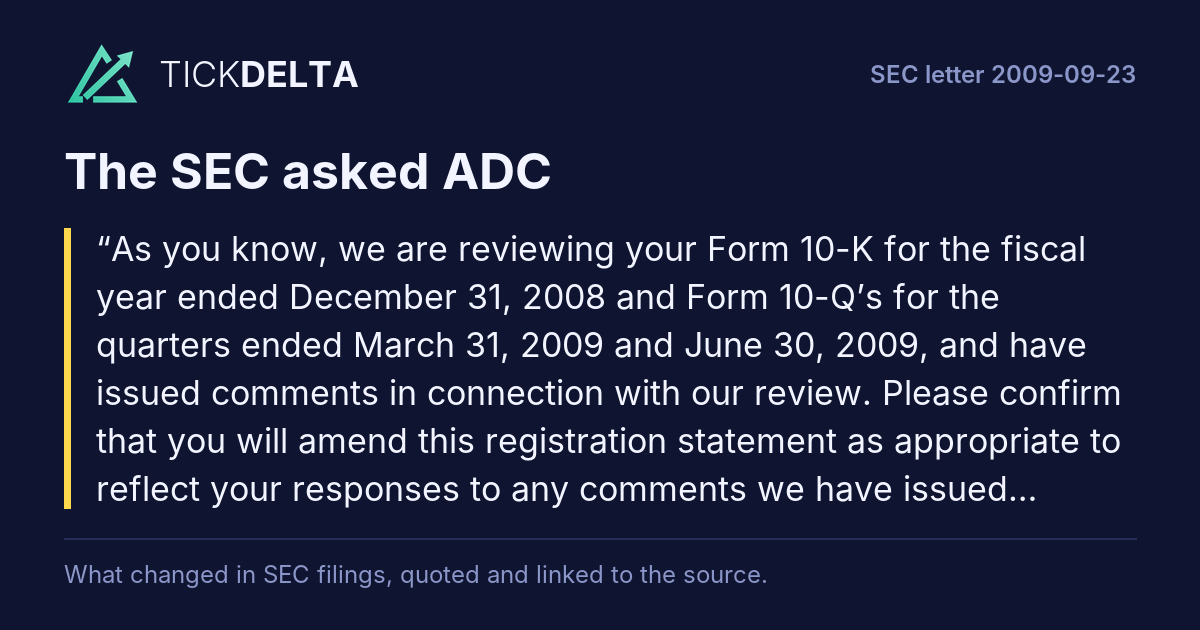
As you know, we are reviewing your Form 10-K for the fiscal year ended December 31, 2008 and Form 10-Q’s for the quarters ended March 31, 2009 and June 30, 2009, and have issued comments in connection with our review. Please confirm that you will amend this registration statement as appropriate to reflect your responses to any comments we have issued related to the periodic reports.
Rest of the question

In addition, please note that we will not be in a position to declare this registration statement effective until we have resolved all comments on your periodic reports. ***** As appropriate, please amend your registration statement in response to these comments. You may wish to provide us with marked copies of the amendment to expedite our review. Please furnish a cover letter with your amendment that keys your responses to our comments and provides any requested information. Detailed cover letters greatly facilitate our review. Please understand that we may have additional comments after reviewing your amendment and responses to our comments. We urge all persons who are responsible for the accuracy and adequacy of the disclosure in the filing to be certain that the filings include all information required under the Securities Act of 1933 and that they have provided all information investors require for an informed investment decision. Since the company and its management are in possession of all facts relating to a company’s disclosure, they are responsible for the accuracy and adequacy of the disclosures they have made. Notwithstanding our comments, in the event the company requests acceleration of the effective date of the pending registration statement, it should furnish a letter, at the time of such request, acknowledging that: ‚ should the Commission or the staff, acting pursuant to delegated authority, declare the filing effective, it does not foreclose the Commission from taking any action with respect to the filing; ‚ the action of the Commission or the staff, acting pursuant to delegated authority, in declaring the filing effective, does not relieve the company from its full responsibility for the adequacy and accuracy of the disclosure in the filing; and ‚ the company may not assert staff comments and the declaration of effectiveness as a defense in any proceeding initiated by the Commission or any person under the federal securities laws of the United States. In addition, please be advi sed that the Division of Enforcement has access to all information you provide to the staff of the Division of Corporation Finance in connection with our review of your filing or in response to our comments on your filing. We will consider a written request for acceleration of the effective date of the registration statement as confirmation of the fact that those requesting acceleration are aware of their respective responsibilities under the Securities Act of 1933 and the Securities Exchange Act of 1934 as they relate to the proposed public offering of the securities specified in the above registration statement. We will act on the request and, pursuant to delegated authority, grant acceleration of the effective date. We direct your attention to Rules 460 and 461 regarding requesting acceleration of a registration statement. Please allow adequate time after the filing of any amendment for further review before submitting a request for acceleration. Please provide this request at least two business days in advance of the requested effective date.

ADC answered
The

Company utilized only cash from operating activities to pay all 2008 dividends. Cash provided from operating activities was $21,930,372 for 2008. Dividends and limited partner distributions for 2008 were

$16,918,952. In the future, should funds other than those from operations be used to pay dividends, the Company will disclose that fact in its

Commission filings.
Read in the reply

Also in this review: closing letter, 2009-11-10

Form 10-K for the year ended December 31, 2008

2009-09-22 to 2009-11-13 · 9 questions · 1 letter from the SEC, 1 from the company
No closing letter
ControlsLiquidity and cash
FORM 10-K FOR THE YEAR ENDED DECEMBER 31, 2008 · Item 5 - Market for Registrant’s Common Equity, Related Stockholder Matters, page 17
SEC asked (1)
We note that net income was less than dividends per share in fiscal 2008. Please tell us the source of all funds used to pay distributions during the fiscal year. To the extent that you use funds other than cash from operating activities to fund distributions, please disclose the amounts and the sources in your future filings.
ADC answered
The Company hereby requests that the effective date for the Registration Statement referred to above be accelerated so that it will be declared effective at 3:00 p.m. on November 16, 2009, or as soon as practicable thereafter, pursuant to Rule 461 of the Securities Act of

1933, as amended.

The

Company confirms that no revisions were needed to be made to the Registration

Statement to reflect responses to the Commission’s comments issued related to the Company’s periodic reports.

The Company acknowledges that (i) should the Commission or the staff of the Commission, acting pursuant to
Rest of the answer

delegated authority, declare the filing effective, such declaration does not foreclose the Commission from taking any action with respect to the filing; (ii) the action of the Commission or the staff of the Commission, acting pursuant to delegated authority, in declaring the filing effective, does not relieve the

Company from its full responsibility for the adequacy and accuracy of the disclosure in the filing; and (iii) the Company may not assert staff comments and the declaration of effectiveness as a defense in any proceeding initiated by the Commission or any person under the federal securities laws of the United

States.

Read in the reply
In its next report

First report after the company's reply of Nov 13, 2009: 10-K filed Mar 12, 2010 ↗, against the 10-K filed Mar 13, 2009 ↗.

Tickdelta does not hold the text of both reports, so they are not compared here.

Item 9A - Controls and Procedures, page 27
SEC asked (2)
We note that management identified a material weakness in your internal control over financial reporting. Please tell us why there were no changes in your internal control over financial reporting during the fiscal year to address the material weakness.
Rest of the question

We also note disclosure in your 10-Q for the quarter ended June 30, 2009, which indicates that there have been no changes in your internal control over financial reporting.

ADC answered

No numbered answer found in the reply. Read the reply ↗

In its next report

First report after the company's reply of Nov 13, 2009: 10-K filed Mar 12, 2010 ↗, against the 10-K filed Mar 13, 2009 ↗.

Tickdelta does not hold the text of both reports, so they are not compared here.

Report of Independent Registered Public Accounting Firm on Agree Realty · Corporation’s Internal Control over Financial Reporting, page 28
SEC asked (3)
We note that your auditors’ report includes the definition of Material Weakness that is consistent with PCAOB Auditing Standard No. 2 rather than PCAOB Auditing Standard No. 5 (AS 5) which was effective pursuant to SEC Release No. 34-56152. Please confirm that the conclusions reached by you and your auditors were based upon AS 5 and that you will revise your disclosure in future filings to be consistent with AS 5.
ADC answered

No numbered answer found in the reply. Read the reply ↗

In its next report

First report after the company's reply of Nov 13, 2009: 10-K filed Mar 12, 2010 ↗, against the 10-K filed Mar 13, 2009 ↗.

Tickdelta does not hold the text of both reports, so they are not compared here.

Financial Statements and Notes
SEC asked (4)
We note on page 25 of the Definitive Proxy Statement dated March 26, 2009 that it appears you disclosed a related party transaction with Bodman LLP. Please tell us what consideration you gave to disclosing the transaction in this Form 10-K as required by SFAS 57.
ADC answered

No numbered answer found in the reply. Read the reply ↗

In its next report

First report after the company's reply of Nov 13, 2009: 10-K filed Mar 12, 2010 ↗, against the 10-K filed Mar 13, 2009 ↗.

Tickdelta does not hold the text of both reports, so they are not compared here.

Note 2 – Summary of Significant Accounting Policies · Minority Interest, page F-12
SEC asked (5)
Please describe the conversion features of the OP units, and clarify whether these securities are redeemable at the option of the holder or upon the occurrence of an event that is not solely within your control. Also tell us how you considered EITF Topic D-98.
ADC answered

No numbered answer found in the reply. Read the reply ↗

In its next report

First report after the company's reply of Nov 13, 2009: 10-K filed Mar 12, 2010 ↗, against the 10-K filed Mar 13, 2009 ↗.

Tickdelta does not hold the text of both reports, so they are not compared here.

Exhibit 4.4
SEC asked (6)
The front cover page of the third amended and restated line of credit indicates that the line of credit is in the amount of $50 million. Your disclosure on page 24 discloses the credit line as $55 million. Please tell us the reason for the $5 million difference.
ADC answered

No numbered answer found in the reply. Read the reply ↗

In its next report

First report after the company's reply of Nov 13, 2009: 10-K filed Mar 12, 2010 ↗, against the 10-K filed Mar 13, 2009 ↗.

Tickdelta does not hold the text of both reports, so they are not compared here.

DEFINITIVE PROXY STATEMENT ON SCHEDULE 14A FILED MAY 11, 2009 · Long Term Incentive Compensation, page 14
SEC asked (7)
We note that the committee considers several factors, including company performance, individual responsibilities and performance, stock performance, and market factors. Please elaborate on the factors considered, as disclosed on page 14 and provide us with a discussion of each named officer’s achievement within the consideration parameters that lead to his/her award.
ADC answered

No numbered answer found in the reply. Read the reply ↗

In its next report

First report after the company's reply of Nov 13, 2009: 10-K filed Mar 12, 2010 ↗, against the 10-K filed Mar 13, 2009 ↗.

Tickdelta does not hold the text of both reports, so they are not compared here.

FORM 10-Q FOR THE SIX MONTHS ENDED JUNE 30, 2009 · Consolidated Statements of Cash Flows, page 6
SEC asked (8)
Please tell us how your reconciliation of Net Income Attributable to Agree Realty Corporation to cash flows provided by operating activities complies with paragraph 28 of SFAS 95 which requires companies to reconcile from net income.
ADC answered

No numbered answer found in the reply. Read the reply ↗

In its next report

First report after the company's reply of Nov 13, 2009: 10-K filed Mar 12, 2010 ↗, against the 10-K filed Mar 13, 2009 ↗.

Tickdelta does not hold the text of both reports, so they are not compared here.

Operations · Funds from Operations, page 20
SEC asked (9)
We note that you calculate Funds from Operations (FFO) based on the NAREIT definition which begins with net income in accordance with GAAP. However, it appears that net income as presented in your reconciliation is equal to net income attributable to Agree Realty Corporation. Please tell us how your presentation complies with the NAREIT definition.
Rest of the question

As appropriate, please amend your filing and respond to these comments within 10 business days or tell us when you will provide us with a response. Detailed responses greatly facilitate our review. Please understand that we may have additional comments after reviewing your amendment and responses to our comments.

ADC answered

No numbered answer found in the reply. Read the reply ↗

In its next report

First report after the company's reply of Nov 13, 2009: 10-K filed Mar 12, 2010 ↗, against the 10-K filed Mar 13, 2009 ↗.

Tickdelta does not hold the text of both reports, so they are not compared here.

From the SEC's correspondence on EDGAR: staff letters (form UPLOAD) and company letters (form CORRESP), 18 letters filed since 2009-09-22. Questions and answers are matched by their numbers; topics come from words in each question. The reports are compared word for word (same form, before the first SEC letter against the first report after the company's reply). No AI.

Sources

The SEC's correspondence on EDGAR: staff letters (form UPLOAD) and company letters (form CORRESP), matched question by question. No AI.

Also

Filings: the letters in the filing list.

Work with it

Excel workbook · CSV. Google Sheet that stays up to date: paste =IMPORTDATA("https://tickdelta.com/company/ADC/export.csv") into a cell.

Next in Owners and insiders:Insider trades
Esc

Type a ticker such as AAPL, a name, an investor such as Buffett, or a topic such as tariffs. ↑ ↓ to move, Enter to open.