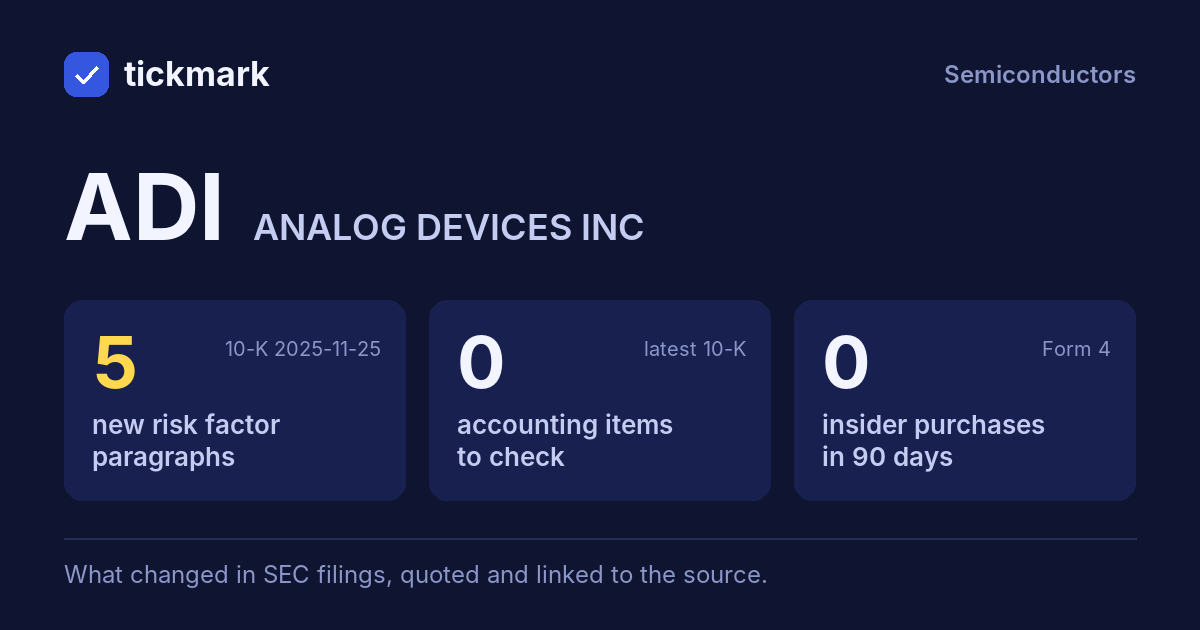
Marked against last year's 10-K:
cut words struck through, new words highlighted and underlined.
Risk Factors 233 words changed in this paragraph; it is 75% similar to last year's version.
We rely on information technology systems throughout our company to keep financial records and customer data, process orders, manage inventory, coordinate shipments to customers, maintain confidential and proprietary information, assist in semiconductor engineering and other technical activities and operate other critical functions such as internet connectivity, network communications and email. In addition, we provide our confidential and proprietary information to our strategic partners in certain cases, who may maintain such information on their information technology systems. While in the past we have experienced cybersecurity attacks and incidents, we believe that they have not had a material impact on our business. Our security measures or those of our third-party service providers or strategic partners may not detect or prevent security breaches, cyberattacks, defects, bugs or errors. Further, geopolitical tensions and conflicts have escalated the volume and sophistication of cyberattacks. Because the tactics and techniques used by threat actors to obtain unauthorized access to or sabotage systems change frequently and, in some cases, are not recognized until they are launched or even later, we may be unable to anticipate these techniques or to implement adequate preventative measures in advance, and security breaches may remain undetected for an extended period of time. Our use of AI may also increase vulnerability to cybersecurity risks, including through unauthorized use or misuse of AI tools and bad inputs or logic or the introduction of malicious code incorporated into AI generated code. AI and machine learning also may be used for certain cybersecurity attacks, improving or expanding the existing capabilities of threat actors in manners we cannot predict at this time, resulting in greater risks of security incidents and breaches. We and our third-party service providers or strategic partners are susceptible to security breaches of information technology systems or certain products and other incidents such as unauthorized access, supply-chain attacks, exfiltration or destruction of data, disruption of service, viruses or other malicious code, illegal break-ins or hacking, sabotage, phishing attempts and other forms of social engineering, malware, ransomware and other forms of cyber extortion and similar events. These threats may come from cybercriminals, cyberterrorists and hacktivists, nation-state and nation-state-supported actors (including advanced persistent threat intrusions) and computer hackers. They also may result from the malicious or accidental acts of our employees, contractors or third-party providers. In the event of unauthorized access to, or a security breach of, our systems or those of our third-party service providers or strategic partners, our operations may be disrupted and our proprietary information or that of our employees, contractors, partners, customers, suppliers or other third parties may be misappropriated. In the event of a cybersecurity attack or incident, we could be exposed to potential liability, litigation, and regulatory action, as well as the loss of existing or potential customers, damage to our reputation and other financial loss. In addition, the cost and operational consequences of responding to breaches and implementing remediation measures could be significant. Furthermore, the continuing and evolving threat of cyberattacks has resulted in increased regulatory focus and we may be required to invest significant additional resources to comply with evolving cybersecurity regulations. For example, the SEC adopted rules requiring the disclosure of cybersecurity incidents that we determine to be “material,” to be made within four business days of such determination, which can be complex, requiring a number of assumptions based on several factors. It is possible that the SEC may not agree with our determinations, which could result in fines, civil litigation or damage to our reputation.
Source: Item 1A, 10-K 0000006281-25-000153 vs Item 1A, 10-K 0000006281-24-000204
MD&A 229 words changed in this paragraph; it is 37% similar to last year's version.
If we elect not to use this option, or we determine that it is more likely than not that the fair value of a our reporting unit is less than its net book value, then we perform the quantitative goodwill impairment test. The quantitative goodwill impairment test requires an entity us to compare the fair value of a our reporting unit with its carrying amount. If fair value is determined to be less than carrying value, an impairment loss is recognized for the amount of the carrying value that exceeds the amount of the reporting unit’s fair value, not to exceed the total amount of goodwill allocated to the reporting unit. Additionally, we consider income tax effects from any tax deductible goodwill on the carrying amount of the reporting unit when measuring the goodwill impairment loss, if applicable. We determine the fair value of our reporting units using a weighting of the income and market approaches. Under the income approach, we use a discounted cash flow methodology which requires management to make significant estimates and assumptions related to forecasted revenues, gross profit margins, operating income margins, working capital cash flow, perpetual growth rates, and long-term discount rates, among others. For the market approach, we use the guideline public company method. Under this method we utilize information from comparable publicly traded companies with similar operating and investment characteristics as the reporting units, to create valuation multiples that are applied to the operating performance of the reporting unit being tested, in order to obtain their respective fair values. In order to assess the reasonableness of the calculated reporting unit fair values, we reconcile the aggregate fair values of our reporting units determined, as described above, to our total company market capitalization, allowing for a reasonable control premium.
Source: Item 7, 10-K 0000006281-25-000153 vs Item 7, 10-K 0000006281-24-000204
Accounting Policies 68 words changed in this paragraph; it is 70% similar to last year's version.
In August 2022, the U.S. government enacted the CHIPS and Science Act of 2022 (CHIPS Act), which provides funding for manufacturing grants and research investments and establishes a 25% an investment tax credit for certain investments in U.S. semiconductor manufacturing. As of November 1, 2025, the Company recorded $96.3 million and $167.2 million as offsets within current income taxes payable and in other assets, respectively, with corresponding reductions to the carrying amounts of the qualifying manufacturing assets on the Consolidated Balance Sheet. As of November 2, 2024, the Company recorded $106.3 million and $174.5 million as offsets within current income taxes payable and in other assets, respectively, with a corresponding reduction to the carrying amounts of the qualifying manufacturing assets on the Consolidated Balance Sheet. As of October 28, 2023, the Company recognized $174.3 million in other assets with a corresponding reduction to these fixed asset carrying amounts.
Source: Item 8, Note 2 – Summary of Significant Accounting Policies, 10-K 0000006281-25-000153 vs Item 8, Note 2 – Summary of Significant Accounting Policies, 10-K 0000006281-24-000204