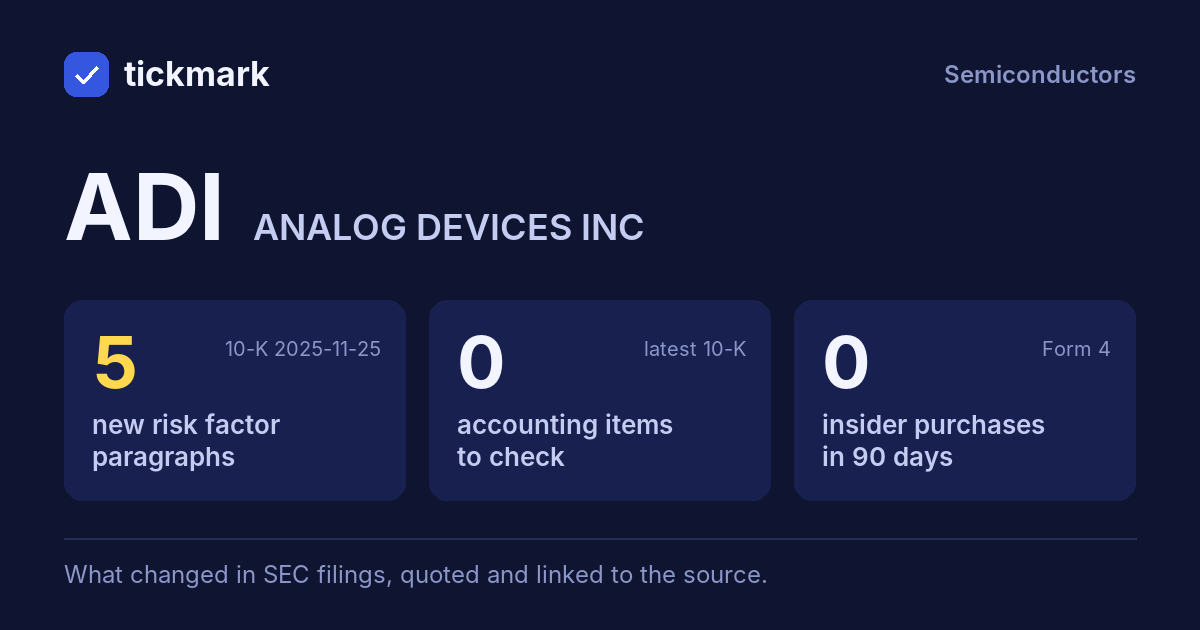
10-K 0000006281-25-000153 (2025-11-25) vs 10-K 0000006281-24-000204 (2024-11-26)
| Section | Compared text | Words now | Changed |
|---|
| Risk Factors | Item 1A | 11,591 |
12.9% |
| MD&A | Item 7 | 5,461 |
16.7% |
| Legal Proceedings | Item 3, via Note 8 – Commitments and Contingencies | 63 |
not compared |
| Accounting Policies | Item 8, Note 2 – Summary of Significant Accounting Policies | 8,105 |
8.0% |
The redline: what was cut and what was added
In each section, the paragraph that changed most, marked against last year's 10-K:
cut words struck through, new words highlighted and underlined.
Risk Factors 233 words changed in this paragraph; it is 75% similar to last year's version.
We rely on information technology systems throughout our company to keep financial records and customer data, process orders, manage inventory, coordinate shipments to customers, maintain confidential and proprietary information, assist in semiconductor engineering and other technical activities and operate other critical functions such as internet connectivity, network communications and email. In addition, we provide our confidential and proprietary information to our strategic partners in certain cases, who may maintain such information on their information technology systems. While in the past we have experienced cybersecurity attacks and incidents, we believe that they have not had a material impact on our business. Our security measures or those of our third-party service providers or strategic partners may not detect or prevent security breaches, cyberattacks, defects, bugs or errors. Further, geopolitical tensions and conflicts have escalated the volume and sophistication of cyberattacks. Because the tactics and techniques used by threat actors to obtain unauthorized access to or sabotage systems change frequently and, in some cases, are not recognized until they are launched or even later, we may be unable to anticipate these techniques or to implement adequate preventative measures in advance, and security breaches may remain undetected for an extended period of time. Our use of AI may also increase vulnerability to cybersecurity risks, including through unauthorized use or misuse of AI tools and bad inputs or logic or the introduction of malicious code incorporated into AI generated code. AI and machine learning also may be used for certain cybersecurity attacks, improving or expanding the existing capabilities of threat actors in manners we cannot predict at this time, resulting in greater risks of security incidents and breaches. We and our third-party service providers or strategic partners are susceptible to security breaches of information technology systems or certain products and other incidents such as unauthorized access, supply-chain attacks, exfiltration or destruction of data, disruption of service, viruses or other malicious code, illegal break-ins or hacking, sabotage, phishing attempts and other forms of social engineering, malware, ransomware and other forms of cyber extortion and similar events. These threats may come from cybercriminals, cyberterrorists and hacktivists, nation-state and nation-state-supported actors (including advanced persistent threat intrusions) and computer hackers. They also may result from the malicious or accidental acts of our employees, contractors or third-party providers. In the event of unauthorized access to, or a security breach of, our systems or those of our third-party service providers or strategic partners, our operations may be disrupted and our proprietary information or that of our employees, contractors, partners, customers, suppliers or other third parties may be misappropriated. In the event of a cybersecurity attack or incident, we could be exposed to potential liability, litigation, and regulatory action, as well as the loss of existing or potential customers, damage to our reputation and other financial loss. In addition, the cost and operational consequences of responding to breaches and implementing remediation measures could be significant. Furthermore, the continuing and evolving threat of cyberattacks has resulted in increased regulatory focus and we may be required to invest significant additional resources to comply with evolving cybersecurity regulations. For example, the SEC adopted rules requiring the disclosure of cybersecurity incidents that we determine to be “material,” to be made within four business days of such determination, which can be complex, requiring a number of assumptions based on several factors. It is possible that the SEC may not agree with our determinations, which could result in fines, civil litigation or damage to our reputation.
Source: Item 1A, 10-K 0000006281-25-000153 vs Item 1A, 10-K 0000006281-24-000204
MD&A 229 words changed in this paragraph; it is 37% similar to last year's version.
If we elect not to use this option, or we determine that it is more likely than not that the fair value of a our reporting unit is less than its net book value, then we perform the quantitative goodwill impairment test. The quantitative goodwill impairment test requires an entity us to compare the fair value of a our reporting unit with its carrying amount. If fair value is determined to be less than carrying value, an impairment loss is recognized for the amount of the carrying value that exceeds the amount of the reporting unit’s fair value, not to exceed the total amount of goodwill allocated to the reporting unit. Additionally, we consider income tax effects from any tax deductible goodwill on the carrying amount of the reporting unit when measuring the goodwill impairment loss, if applicable. We determine the fair value of our reporting units using a weighting of the income and market approaches. Under the income approach, we use a discounted cash flow methodology which requires management to make significant estimates and assumptions related to forecasted revenues, gross profit margins, operating income margins, working capital cash flow, perpetual growth rates, and long-term discount rates, among others. For the market approach, we use the guideline public company method. Under this method we utilize information from comparable publicly traded companies with similar operating and investment characteristics as the reporting units, to create valuation multiples that are applied to the operating performance of the reporting unit being tested, in order to obtain their respective fair values. In order to assess the reasonableness of the calculated reporting unit fair values, we reconcile the aggregate fair values of our reporting units determined, as described above, to our total company market capitalization, allowing for a reasonable control premium.
Source: Item 7, 10-K 0000006281-25-000153 vs Item 7, 10-K 0000006281-24-000204
Accounting Policies 68 words changed in this paragraph; it is 70% similar to last year's version.
In August 2022, the U.S. government enacted the CHIPS and Science Act of 2022 (CHIPS Act), which provides funding for manufacturing grants and research investments and establishes a 25% an investment tax credit for certain investments in U.S. semiconductor manufacturing. As of November 1, 2025, the Company recorded $96.3 million and $167.2 million as offsets within current income taxes payable and in other assets, respectively, with corresponding reductions to the carrying amounts of the qualifying manufacturing assets on the Consolidated Balance Sheet. As of November 2, 2024, the Company recorded $106.3 million and $174.5 million as offsets within current income taxes payable and in other assets, respectively, with a corresponding reduction to the carrying amounts of the qualifying manufacturing assets on the Consolidated Balance Sheet. As of October 28, 2023, the Company recognized $174.3 million in other assets with a corresponding reduction to these fixed asset carrying amounts.
Source: Item 8, Note 2 – Summary of Significant Accounting Policies, 10-K 0000006281-25-000153 vs Item 8, Note 2 – Summary of Significant Accounting Policies, 10-K 0000006281-24-000204
Every change, by type
Sentences and paragraphs of ADI's Risk Factors and MD&A, 10-K 2025-11-25 against 10-K 2024-11-26.
Each links to the text at sec.gov.
Quiet changes are sentences kept from last year with one to four words changed, at least one of them a hedge, a modal or a qualifier
(may, could, will, not, significant, material…). A year or date rolling forward is not counted.
The full word list
adverse, adversely, all, although, anticipate, anticipates, any, approximately, believe, believes, can, cannot, certain, could, expect, expects, generally, however, if, intend, intends, largely, likely, many, material, materially, may, might, most, must, never, no, not, possible, primarily, probable, should, significant, significantly, some, substantial, substantially, unlikely, will, would
AddedRisk Factors
•sanctions imposed by the U.S. government or by the governments in countries in which we do business, which could adversely impact our business by preventing us from performing existing contracts, recognizing revenue, pursuing new business opportunities or receiving payment for products already supplied to customers;
Read it in 10-K 2025-11-25 at sec.gov ↗
AddedRisk Factors
In 2025, the U.S. government announced a series of tariffs, including tariffs targeting a broad range of imports and targeted tariffs on goods from specific countries and industries. In response, many countries imposed reciprocal tariffs and other trade restrictions on the United States. Although many of these tariffs, countermeasures and other trade restrictions have since been eased or paused, their initial announcements triggered considerable volatility in global markets and heightened economic uncertainty, and the global trade situation, particularly between the United States and China, continues to be highly dynamic. Further, throughout 2025 the U.S. government has initiated numerous investigations into products and industries under Section 232 of the Trade Expansion Act of 1962. For example, in April 2025, the Department of Commerce launched an investigation into the national security impacts of imported semiconductors and semiconductor manufacturing equipment. While the results of this investigation remain unknown, it is expected to result in additional tariffs and trade restrictions that may adversely impact our business. Similar investigations on other industries or products, including automotive, copper, steel, aluminum, critical minerals and aircraft, may also adversely impact the semiconductor industry and our business. These changes have, and similar changes in the future may continue to, increase the cost or reduce the availability of raw materials and supplies we need to operate, cause customers to advance, delay, reduce, or cancel orders, shift buying patterns, impact demand in our end markets, complicate demand forecasting for us and our customers, increase supply chain complexity and contribute to volatility, a broader economic slowdown or recession. Any of these impacts or changes could materially and adversely affect our business, financial condition and results of operations.
Read it in 10-K 2025-11-25 at sec.gov ↗
AddedRisk Factors
Sales to third-party distributors accounted for approximately 56% of our revenue in the year ended November 1, 2025. These independent distributors generally represent product lines offered by several companies and thus could reduce their sales
Read it in 10-K 2025-11-25 at sec.gov ↗
AddedRisk Factors
property indemnity claims. Our customers have on occasion been sued, and may be sued in the future, by third parties alleging infringement of intellectual property rights, or damages resulting from use of our products. Those customers may seek indemnification from us under the terms and conditions of our sales contracts with them. In certain cases, our potential indemnification liability may be significant.
Read it in 10-K 2025-11-25 at sec.gov ↗
AddedRisk Factors
AI technology may also give rise to significant legal and regulatory compliance risk. Evolving rules, regulations and industry standards governing AI may require us to incur greater compliance costs and restrict the use of AI in our products or
Read it in 10-K 2025-11-25 at sec.gov ↗
RemovedRisk Factors
•natural disasters, public health emergencies, such as the COVID-19 pandemic, or other catastrophic events;
Read it in 10-K 2024-11-26 at sec.gov ↗
RemovedRisk Factors
We do not maintain any key person life insurance policy on any of our officers or other employees. The loss of one or more of our key employees, and any failure to have in place and execute an effective succession plan for key executives, could seriously harm our business and results of operations.
Read it in 10-K 2024-11-26 at sec.gov ↗
RemovedRisk Factors
facilities. The long-term effects of climate change on the global economy and the semiconductor industry in particular are unclear, but could be severe.
Read it in 10-K 2024-11-26 at sec.gov ↗
RewordedRisk Factors
A prolonged disruption at, disruption, shut-down or inability to utilize, utilize one or more of our or our third parties’ manufacturing facilities, facilities due to natural or man-made disasters, cybersecurity incidents, civil unrest or other events outside of our control, such as loss of raw materials or damage to our or our third parties’ manufacturing equipment for any reason, including due to natural or man-made disasters, civil unrest or other events outside of our control, such as equipment, widespread outbreaks of illness, or the failure to maintain our labor force at one or more of these facilities, may disrupt our operations, delay production, shipments and revenue and result in us being unable to timely satisfy customer demand.
Read it in 10-K 2025-11-25 at sec.gov ↗
RewordedRisk Factors
There is an increasing focus from regulators, investors, customers, employees and potential talent, as well as other stakeholders, concerning ESG matters, including climate change and sustainability, human rights, support for local communities, Board of Directors’ and employee workforce diversity, human capital management, employee health and safety practices, product quality, worker workers’ rights, supply chain management and corporate governance and transparency. transparency, continue to receive significant attention from a wide range of stakeholders, including regulators, investors, customers, employees and potential talent.
Read it in 10-K 2025-11-25 at sec.gov ↗
RewordedRisk Factors
Governments around the world have adopted, and may continue to adopt, laws and regulations related to AI, including the European Union’s AI Act, and several U.S. government agencies have increased investigations Investigations and enforcement efforts related to the use of AI technology, which technology could increase our compliance costs and limit restrict our ability to use AI in the development of our products and services.
Read it in 10-K 2025-11-25 at sec.gov ↗
RewordedRisk Factors
For example, changes in U.S.-China relations, the political environment or international trade policies could result in further revisions to laws or regulations or their interpretation and enforcement, increased taxation, trade sanctions, the imposition of import or export duties and tariffs, restrictions on imports or exports, currency revaluations or retaliatory actions, which have had and may continue to have an adverse effect on our business plans and operating results.
Read it in 10-K 2025-11-25 at sec.gov ↗
RewordedRisk Factors
Termination of a significant distributor or a group of distributors, whether at our initiative or the distributor’s initiative or through consolidation in the distribution industry, could disrupt our business, and Further, if we are unable to find suitable replacements with the appropriate scale and resources, our operating results could be adversely affected.
Read it in 10-K 2025-11-25 at sec.gov ↗
RewordedRisk Factors
Government incentives, including any that may be offered in connection with the CHIPS Act, may not be available to us on acceptable terms or at all, and to the extent that the incoming administration modifies or repeals the CHIPS Act, the availability of any such incentives may be even less certain. all.
Read it in 10-K 2025-11-25 at sec.gov ↗
RewordedRisk Factors
This will may require us to align our programs to such expectations and disclose an increasing amount of specific qualitative and quantitative information and data to illustrate demonstrate our position and progress and to support our customers to comply with regulations and other requirements. customers’ regulatory compliance.
Read it in 10-K 2025-11-25 at sec.gov ↗
RewordedRisk Factors
We are continuing continue to evaluate the impact of these restrictions on our business, but these actions business as they are updated and expanded, and we expect that they may continue to have direct and indirect adverse impacts on our revenues and results of operations in China and elsewhere.
Read it in 10-K 2025-11-25 at sec.gov ↗
RewordedRisk Factors
The loss of key personnel or the inability to attract, timely hire and retain key employees with critical technical skills to achieve our strategy, including as a result of changes to immigration policies, and the increased uncertainty surrounding such policies in light of the incoming administration’s expected immigration agenda, could cause business disruptions, increased expenses to comply with such policies and address any disruptions and could have a material adverse effect on our business.
Read it in 10-K 2025-11-25 at sec.gov ↗
RewordedRisk Factors
Purchasers that acquire our products via the gray market or through other unauthorized channels may resell or otherwise use our products for purposes for which they were not intended or that may be contrary to our ethical, legal and regulatory obligations.
Read it in 10-K 2025-11-25 at sec.gov ↗
RewordedRisk Factors
Global political Recently announced and economic uncertainty future tariffs and adverse conditions related to our international operations other trade restrictions could materially and adversely affect our business, financial condition and results of operations.
Read it in 10-K 2025-11-25 at sec.gov ↗
RewordedRisk Factors
Additionally, public interest and legislative and regulatory pressure related to companies’ ESG practices, including those related to sourcing practices, carbon emissions and human rights protections, practices continue to grow. evolve.
Read it in 10-K 2025-11-25 at sec.gov ↗
Quiet changesRisk Factors
Further, certain customers utilize ESG data to inform their purchasing decisions.
Read it in 10-K 2025-11-25 at sec.gov ↗
Quiet changesRisk Factors
For example, the Organization for Economic Cooperation and Development’s (OECD) Base Erosion and Profit Sharing Plans, which implement a minimum global effective tax rate of 15%, will apply applied to us beginning in fiscal year 2025.
Read it in 10-K 2025-11-25 at sec.gov ↗
AddedMD&A
published specifications, and that we will repair or replace defective products, for one year from the date title passes from us to the customer. Specific accruals are recorded for known product warranty issues.
Read it in 10-K 2025-11-25 at sec.gov ↗
RemovedMD&A
have passed to the customer. Shipping costs are charged to selling, marketing, general and administrative expense as incurred. Sales taxes are excluded from revenue.
Read it in 10-K 2024-11-26 at sec.gov ↗
RemovedMD&A
result in the recognition of an increase or decrease to our income tax provision, which could materially impact our consolidated financial position and results of operations.
Read it in 10-K 2024-11-26 at sec.gov ↗
RewordedMD&A
This may differ from the geographic location of the end customers particularly in cases where a third-party contract manufacturer purchases the Company’s products through distributors.2024 2023 distributors.Fiscal Year 2025 2024 $ Change % Change (1) Fiscal Year 2024 over 2023 United States $ 3,238,145 $ 2,840,426 $ 4,165,296 $ (1,324,870) (32)% 397,719 14% Rest of North and South America 162,470 62,318 88,579 (26,261) (30)% 100,152 161% Europe 2,285,598 2,109,529 3,001,871 (892,342) (30)% 176,069 8% Japan 989,916 1,085,631 1,397,119 (311,488) (22)% (95,715) (9)% China 2,858,286 2,128,840 2,229,631 (100,791) (5)% 729,446 34% Rest of Asia 1,485,292 1,200,413 1,423,043 (222,630) (16)% 284,879 24% Total Revenue $ 11,019,707 $ 9,427,157 $ 12,305,539 $ (2,878,382) (23)% 1,592,550 17%
Read it in 10-K 2025-11-25 at sec.gov ↗
RewordedMD&A
The year-over-year increase decrease in nonoperating expense in fiscal 2024 2025 as compared to fiscal 2023 2024 was primarily the result of higher interest expense related to our debt obligations income from higher cash, cash equivalents and lower net gains from other investments, partially offset by higher interest income. short-term investments balances during fiscal 2025.
Read it in 10-K 2025-11-25 at sec.gov ↗
RewordedMD&A
We test goodwill for impairment at the reporting unit level, which we determined is consistent with our identified operating segments, on an annual basis on the first day of the fourth quarter (on or about August 4th) (August 3, 2025 in fiscal 2025) or more frequently if we believe indicators of impairment exist or we reorganize our operating segments or reporting units. business.
Read it in 10-K 2025-11-25 at sec.gov ↗
RewordedMD&A
The decrease change in cash used for investing activities during fiscal 2024 2025 as compared to fiscal 2023 2024 was primarily the result of a decrease in cash used for capital expenditures, partially offset by the net impact of purchases and maturities of short-term investments during fiscal 2024. available-for-sale investments, partially offset by a decrease in cash used for capital expenditures.
Read it in 10-K 2025-11-25 at sec.gov ↗
RewordedMD&A
We have the option If we elect not to first assess qualitative factors to use this option, or we determine whether that it is more likely than not that the fair value of a our reporting unit is less than its net book value. value, then we perform the quantitative goodwill impairment test.
Read it in 10-K 2025-11-25 at sec.gov ↗
RewordedMD&A
Gross margin percentage in fiscal 2024 decreased 2025 increased by 690 440 basis points compared to fiscal 2023, 2024, primarily due to lower higher utilization of our factories due to decreased increased customer demand and unfavorable product mix. as well as a decrease in amortization expense related to acquired intangible assets.
Read it in 10-K 2025-11-25 at sec.gov ↗
RewordedMD&A
Our Third Fourth Amended and Restated Revolving Credit Agreement, dated as of June 23, 2021, April 11, 2025, with Bank of America N.A. as administrative agent and the other banks identified therein as lenders, which was subsequently amended on December 20, 2022 and July 24, 2023 (as amended, the lenders (the Revolving Credit Agreement) provides for a five year unsecured revolving credit facility in an aggregate principal amount not to exceed $2.5 $3.0 billion (subject to certain terms and conditions).
Read it in 10-K 2025-11-25 at sec.gov ↗
RewordedMD&A
In addition, the Revolving Credit Agreement contains a consolidated leverage an interest coverage covenant which requires the ratio covenant of total consolidated funded debt to consolidated earnings before interest, taxes, depreciation, depreciation and amortization (EBITDA) of not to consolidated interest charges to be greater than 3.5 3.0 to 1.0.
Read it in 10-K 2025-11-25 at sec.gov ↗
RewordedMD&A
Current liabilities decreased increased to $3.0 $3.2 billion at November 2, 2024 1, 2025 from $3.2 $3.0 billion recorded at the end of fiscal 2023, 2024, primarily due to decreases increases in accrued liabilities and current debt, income taxes payable, partially offset by increases a decrease in income taxes payable. current debt.
Read it in 10-K 2025-11-25 at sec.gov ↗
RewordedMD&A
The decrease increase in cash used for financing activities during fiscal 2024 2025 as compared to fiscal 2023 2024 was primarily the result of lower increased common stock repurchases. repurchases and dividend payments to shareholders, partially offset by the net proceeds from our debt obligations.
Read it in 10-K 2025-11-25 at sec.gov ↗
RewordedMD&A
The following discussion includes results of operations and financial condition for the fiscal year ended November 1, 2025 (fiscal 2025) and the fiscal year ended November 2, 2024 (fiscal 2024) and the fiscal year ended October 28, 2023 (fiscal 2023) and year-over-year comparisons between fiscal 2024 2025 and fiscal 2023. 2024.
Read it in 10-K 2025-11-25 at sec.gov ↗
RewordedMD&A
Provision for Income Taxes2024 2023 TaxesFiscal Year 2025 2024 $ Change % Change Fiscal Year 2024 over 2023 Provision for income taxes $ 444,770 $ 142,067 $ 293,424 $ (151,357) (52)% $302,703 213% Effective income tax rate 16.4 % 8.0 % 8.1 %
Read it in 10-K 2025-11-25 at sec.gov ↗