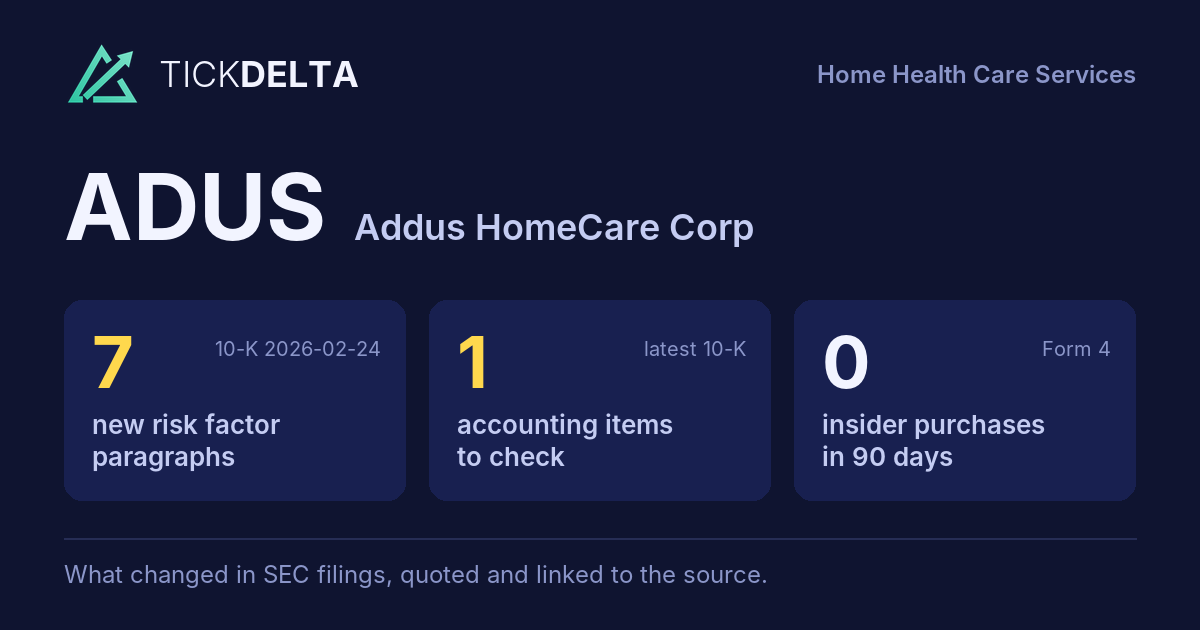
Paragraph 80 · 46% changed
Every version of it
Screener
/
SEC EDGAR
/CIK 0001468328
/10-K filed Feb 24, 2026, compared with Feb 25, 2025
/Numbers from the XBRL of the 10-Ks
Nasdaq
Health care · Home Health Care Services
Addus HomeCare Corp ADUS
The 10-K against last year's
125 changes: 8 added, 6 removed, 107 reworded, 4 quiet changes
10-K Feb 24, 2026 vs Feb 25, 2025
Risk Factors
16.0%
of the text changed · 12,780 words now · 7 new paragraphs, 4 gone
MD&A
10.3%
of the text changed · 10,815 words now · 1 new paragraphs, 2 gone
Legal Proceedings
18.5%
of the text changed · 937 words now
Accounting Policies
35.8%
of the text changed · 5,143 words now
10-K 0001437749-26-005352 (Feb 24, 2026) vs 10-K 0000950170-25-026747 (Feb 25, 2025)
Every paragraph, and how much of it changed
One bar per paragraph, in the order of the 10-K. Height and colour show the share of its words not in the closest paragraph a year earlier; the tallest bars are new paragraphs.
Risk Factors
120 paragraphs · 7 new · 54 reworded · 4 gone · 10-K Feb 24, 2026 against Feb 25, 2025
New paragraph
Reworded (5% of its words or more)
Same or nearly
Paragraph 48 · 37% changed
Every version of it
Paragraph 19 · 37% changed
Every version of it
Our revenues are particularly sensitive to regulatory and economic changes in states in which we generate a significant portion of our revenues including Illinois, New Mexico and Texas. In 2024, 2025, we derived approximately 43.7% 37.0% of our net service revenues from services provided in Illinois and 15.3% of our net service revenues Illinois, 13.1% from services provided in New Mexico. We expect to derive a significant portion of our revenues Mexico and 15.2% from Texas going forward as a result of the Gentiva Acquisition. services provided in Texas. Because a substantial portion of our business is concentrated in these a small number of states, any significant reduction change in state expenditures that pay for our services the current demographic, economic, competitive or other significant changes regulatory conditions in these states may could have a disproportionately negative impact on our future operating results. We cannot business, financial condition or results of operations. Changes to the Medicaid programs in these states, including the OBBBA’s mandated restrictions on Medicaid funding mechanisms, or other significant reductions in state expenditures for the types of services we provide could also have a disproportionately adverse effect on our business, financial condition, results of operations or cash flows. It is difficult to predict whether these or other states material to our operating results will experience changes or other challenges that negatively impact our ability to be adequately reimbursed for our services in a timely manner. services.
Paragraph 78 · 36% changed
Every version of it
The healthcare industry is subject to changing political, regulatory and other influences. Federal agencies oversee, regulate and otherwise affect many aspects of our business, including through Medicare and Medicaid policies, policies affecting size of the uninsured population, and enforcement and interpretation of fraud and abuse laws. The outcome of the 2024 federal elections increased regulatory uncertainty and the potential for significant policy changes. The President has issued executive orders that impact or may impact the healthcare industry, including an order establishing a presidential advisory commission tasked with restructuring government agencies and reducing government expenditures, although this commission was disbanded in mid-2025. Other actions by the executive branch have resulted in holds on or cancellations of congressionally authorized spending as well as interruptions in the distribution of government funds. In addition, the executive branch has significant influence over healthcare policy changes through government agency regulation. Federal agencies oversee, regulate and otherwise affect many aspects of our business, including through Medicare and Medicaid policies, policies affecting the size of the uninsured population and interpretation and enforcement of fraud and abuse laws. In March 2025, HHS announced a significant agency restructuring intended to reduce the HHS workforce and consolidate divisions of the agency, including by integrating some functions of the Administration for Community Living, which administers programs that support older adults, into other HHS agencies. HHS also announced a change in its policy on public participation in rulemaking that may negatively affect the ability of industry participants to receive advance notice of and offer feedback on some policy changes. Regulatory uncertainty has also increased as a result of recent decisions issued by the U.S. Supreme Court in June 2024 that affect review of federal agency actions. These decisions increase judicial scrutiny of agency authority, shift greater responsibility for statutory interpretation to courts, expand the time period during which a plaintiff can sue regulators, and may result in inconsistent judicial interpretations and delays in agency rulemaking processes. In Loper Bright Enterprises v. Raimondo, the Court overruled a legal framework that gave significant judicial deference to federal agency interpretations of federal statutes. The Court held that courts must instead exercise independent judgment when deciding whether an agency has acted within its statutory authority and that courts These decisions may not defer to an agency interpretation simply because a statute is ambiguous. The Loper Bright decision and other recent decisions of the U.S. Supreme Court could have significant impacts on government agency regulation, particularly within the heavily-regulated healthcare industry, and may have broad implications for our business. While the effects of these decisions will become apparent over the coming months and years, we anticipate an increase in legal challenges to healthcare regulations and agency guidance and decisions, including but not limited to those issued by HHS and its agencies, including CMS, the FDA, and the OIG. Federal agencies oversee, regulate and otherwise affect many aspects of our business, including through Medicare and Medicaid payment and coverage policies, policies affecting size of the uninsured population, administration of state Medicaid programs, and enforcement and interpretation of fraud and abuse laws. decisions. Impacts of the recent Supreme Court decisions could require us to make changes to our operations and have a material negative impact on our business. The outcome of the 2024 federal elections, affecting both the executive and legislative branches, also increases regulatory uncertainty and the potential for significant policy changes.
Paragraph 81 · 35% changed
Every version of it
Paragraph 55 · 34% changed
Every version of it
We may be similarly impacted by increased increases in enrollment of Medicare and Medicaid beneficiaries in managed care plans, which is are part of the general shift away from traditional fee-for-service models. Under the managed Medicare program, known as Medicare Advantage, the federal government contracts with private health insurers to provide Medicare benefits. Insurers may choose to offer supplemental benefits, including in-home support services, and impose higher plan costs on beneficiaries. Approximately half of Medicare beneficiaries are enrolled in a Medicare Advantage plan, a figure that continues to grow. If more of our services are offered under Medicare Advantage or Medicaid managed care plans in the future, we could experience reduced reimbursement, limited utilization, and increased competition for managed care contracts. These adverse effects could also result from changes in federal and state laws, regulations and programs.
Paragraph 44 · 30% changed
Every version of it
Paragraph 41 · 26% changed
Every version of it
A significant portion of our caseload and revenues are derived from government healthcare programs, primarily Medicare and Medicaid. For the year ended December 31, 2024, 2025, we derived approximately 61.8% 39.3% of our net service revenues from state and local governmental agencies, primarily through Medicaid state programs and 22.2% 20.5% from Medicare. However, changes in government healthcare programs may decrease the reimbursement we receive or limit access to, or utilization of, our services. As federal healthcare expenditures continue to increase and as many state governments navigate budgetary pressures, federal and state governments have made, and may continue to make, significant changes to the Medicare and Medicaid programs and reimbursement received for services rendered to beneficiaries of such programs. For example, the The Budget Control Act of 2011 (“BCA”) requires automatic spending reductions to reduce the federal deficit, resulting in a uniform reduction across all Medicare programs of 2% per fiscal year that extends through the first eight eleven months of 2032. It is difficult to predict whether, when, or what other deficit reduction initiatives may be proposed by Congress, but we anticipate that the federal deficit will continue to place pressure on government healthcare programs and that future legislation may include additional Medicare spending reductions. Legislation and administrative actions at the federal level may impact the funding for, or structure of, the Medicaid program, and may shape the administration of the Medicaid program at the state level. For example, the OBBBA includes significant healthcare policy reforms that are expected to result in Medicaid spending reductions and changes in administration of state Medicaid programs. The law makes significant changes to Medicaid financing mechanisms, including restrictions intended to reduce the federal matching funds received by state Medicaid programs, such as limitations on provider tax arrangements and SDP arrangements.
Paragraph 80 · 46% changed
Every version of it
10-K Feb 25, 2025Further, legislation and administrative actions at the federal level may impact the funding for, or structure of, the Medicaid program, and may shape the administration of the Medicaid program at the state level, including by affecting provider reimbursement rates and eligibility and coverage policies. For example, some members of Congress and the presidential administration have raised, and Congress may in the future adopt, proposals intended to reduce Medicaid expenditures such as restructuring the Medicaid program to give states a “block grant” or fixed amount of overall funding for their respective Medicaid programs or to impose spending caps such as per Medicaid beneficiary limits on federal contributions. Reductions in federal funding or changes to the federal funding formula for Medicaid could have a significant impact, particularly in states that expanded Medicaid under the ACA and especially if federal contributions for Medicaid expansion populations decrease and states are unable to offset the reductions. Further, some states have trigger laws that would end their Medicaid expansion or require other changes if federal funding for the expansion populations is reduced.
10-K Feb 24, 2026
In addition, the Medicare and Medicaid programs are subject to change. For example, some members of Congress and the executive branch have raised, and may in the future adopt, proposals intended to accelerate the shift from traditional Medicare to Medicare Advantage, restructure the Medicaid program to give states a “block grant” or fixed amount of overall funding for their respective Medicaid programs, or to impose Medicaid spending caps such as per beneficiary limits on federal contributions. Further, changes in governmental administration, including changes in agency structures and staffing, such as reduction or elimination of personnel and agencies, may result in changes to established rulemaking conventions and timelines, including for regularly-issued reimbursement rules, among other effects.
Paragraph 48 · 37% changed
Every version of it
10-K Feb 25, 2025Congress, CMS and state authorities may implement changes to reimbursement for or coverage of items and services that affect our business and operations. For example, CMS periodically revises the reimbursement systems used to reimburse healthcare providers, including through changes to the home health and hospice reimbursement systems, which may result in reduced Medicare and/or Medicaid payments. In addition, delays or issues implementing reimbursement-related rules, including periodic payment updates for government programs, and interruptions in the distribution of governmental funds, could have an adverse impact on our business. The shift toward value-based care continues, including through the implementation of alternative payment models and various demonstration projects. Some states have obtained CMS approval to test new or existing approaches to payment and delivery of Medicaid benefits. Payment policies for different types of providers and for various items and services continue to evolve, and future health reform efforts could impact both federal and state programs.
10-K Feb 24, 2026
In addition, from time to time, Congress or CMS revises the reimbursement systems used to reimburse healthcare providers, which may result in reduced Medicare and/or Medicaid payments. Delays or issues implementing reimbursement-related rules, including periodic payment updates for government programs, and interruptions in the distribution of governmental funds, could have an adverse impact on our business.
Paragraph 19 · 37% changed
Every version of it
10-K Feb 25, 2025
In 2024, we derived approximately 43.7% of our net service revenues from services provided in Illinois and 15.3% of our net service revenues in New Mexico. We expect to derive a significant portion of our revenues from Texas going forward as a result of the Gentiva Acquisition. Because a substantial portion of our business is concentrated in these states, any significant reduction in state expenditures that pay for our services or other significant changes in these states may have a disproportionately negative impact on our future operating results. We cannot predict whether states material to our operating results will experience changes or other challenges that negatively impact our ability to be reimbursed for our services in a timely manner.
10-K Feb 24, 2026
Our revenues are particularly sensitive to regulatory and economic changes in states in which we generate a significant portion of our revenues including Illinois, New Mexico and Texas. In 2025, we derived approximately 37.0% of our net service revenues from services provided in Illinois, 13.1% from services provided in New Mexico and 15.2% from services provided in Texas. Because a substantial portion of our business is concentrated in a small number of states, any change in the current demographic, economic, competitive or regulatory conditions in these states could have a disproportionately negative impact on our business, financial condition or results of operations. Changes to the Medicaid programs in these states, including the OBBBA’s mandated restrictions on Medicaid funding mechanisms, or other significant reductions in state expenditures for the types of services we provide could also have a disproportionately adverse effect on our business, financial condition, results of operations or cash flows. It is difficult to predict whether these or other states material to our operating results will experience changes or other challenges that negatively impact our ability to be adequately reimbursed for our services.
Paragraph 78 · 36% changed
Every version of it
10-K Feb 25, 2025
The healthcare industry is subject to changing political, regulatory and other influences. Regulatory uncertainty has increased as a result of decisions issued by the U.S. Supreme Court in June 2024 that affect review of federal agency actions. These decisions increase judicial scrutiny of agency authority, shift greater responsibility for statutory interpretation to courts, expand the time period during which a plaintiff can sue regulators, and may result in inconsistent judicial interpretations and delays in agency rulemaking processes. In Loper Bright Enterprises v. Raimondo, the Court overruled a legal framework that gave significant judicial deference to federal agency interpretations of federal statutes. The Court held that courts must instead exercise independent judgment when deciding whether an agency has acted within its statutory authority and that courts may not defer to an agency interpretation simply because a statute is ambiguous. The Loper Bright decision and other recent decisions of the U.S. Supreme Court could have significant impacts on government agency regulation, particularly within the heavily-regulated healthcare industry, and may have broad implications for our business. While the effects of these decisions will become apparent over the coming months and years, we anticipate an increase in legal challenges to healthcare regulations and agency guidance and decisions, including but not limited to those issued by HHS and its agencies, including CMS, the FDA, and the OIG. Federal agencies oversee, regulate and otherwise affect many aspects of our business, including through Medicare and Medicaid payment and coverage policies, policies affecting size of the uninsured population, administration of state Medicaid programs, and enforcement and interpretation of fraud and abuse laws. Impacts of the recent Supreme Court decisions could require us to make changes to our operations and have a material negative impact on our business. The outcome of the 2024 federal elections, affecting both the executive and legislative branches, also increases regulatory uncertainty and the potential for significant policy changes.
10-K Feb 24, 2026
The healthcare industry is subject to changing political, regulatory and other influences. Federal agencies oversee, regulate and otherwise affect many aspects of our business, including through Medicare and Medicaid policies, policies affecting size of the uninsured population, and enforcement and interpretation of fraud and abuse laws. The outcome of the 2024 federal elections increased regulatory uncertainty and the potential for significant policy changes. The President has issued executive orders that impact or may impact the healthcare industry, including an order establishing a presidential advisory commission tasked with restructuring government agencies and reducing government expenditures, although this commission was disbanded in mid-2025. Other actions by the executive branch have resulted in holds on or cancellations of congressionally authorized spending as well as interruptions in the distribution of government funds. In addition, the executive branch has significant influence over healthcare policy changes through government agency regulation. Federal agencies oversee, regulate and otherwise affect many aspects of our business, including through Medicare and Medicaid policies, policies affecting the size of the uninsured population and interpretation and enforcement of fraud and abuse laws. In March 2025, HHS announced a significant agency restructuring intended to reduce the HHS workforce and consolidate divisions of the agency, including by integrating some functions of the Administration for Community Living, which administers programs that support older adults, into other HHS agencies. HHS also announced a change in its policy on public participation in rulemaking that may negatively affect the ability of industry participants to receive advance notice of and offer feedback on some policy changes. Regulatory uncertainty has also increased as a result of recent decisions issued by the U.S. Supreme Court that affect review of federal agency actions. These decisions increase judicial scrutiny of agency authority, shift greater responsibility for statutory interpretation to courts, expand the time period during which a plaintiff can sue regulators, and may result in inconsistent judicial interpretations and delays in agency rulemaking processes. These decisions may increase legal challenges to healthcare regulations and agency guidance and decisions. Impacts of the recent Supreme Court decisions could require us to make changes to our operations and have a material negative impact on our business.
Paragraph 81 · 35% changed
Every version of it
10-K Feb 25, 2025In addition, the Medicare and Medicaid programs are subject to change, including as a result of changes in the presidential administration. For example, some members of Congress and the presidential administration have raised potential changes intended to accelerate the shift from traditional Medicare to Medicare Advantage, repealing the ACA or eliminating some of its consumer protections. Further, changes in governmental administration, including changes in agency structures and staffing, such as reduction or elimination of personnel and agencies, may result in changes to established rulemaking conventions and timelines, including for regularly-issued reimbursement rules, among other effects. Legislation and administrative actions at the federal level may also impact funding for, or the structure of, the Medicaid program and may shape administration of the Medicaid program at the state level. For example, in May 2024, CMS finalized a rule that requires states to ensure by mid-2030 that at least 80% of all Medicaid payments a provider receives for homemaker, home health aide, and personal care services, less excluded costs, under specified programs are spent on total compensation for direct care workers furnishing these services, subject to limited exceptions. If implemented in its current form, the final rule could negatively impact our business and financial performance by, among other things, increasing our labor costs. In addition, CMS may change Medicaid payment models and grant states additional flexibilities in the administration of state Medicaid programs, including by modifying the scope of waivers under which states may implement Medicaid expansion provisions, impose different eligibility or enrollment restrictions, or otherwise implement programs that vary from federal standards. Further, changes to the federal funding formula for Medicaid could significantly impact states that expanded Medicaid under the ACA, especially if federal contributions for Medicaid expansion populations decrease or are eliminated and states are unable to offset the reductions. Some states have trigger laws that would end their Medicaid expansion or require other changes if federal funding is reduced. Some of these Medicaid changes may decrease Medicaid enrollment, result in reductions to various state healthcare programs or have other effects that could adversely affect our business.
10-K Feb 24, 2026
Legislation and administrative actions at the federal level may impact funding for, or the structure of, the Medicaid program and may shape administration of the Medicaid program at the state level, including through changes to waiver programs. For example, the OBBBA includes provisions that are expected to result in Medicaid spending reductions and require changes in administration of state Medicaid programs, including limitations on eligibility. The law requires changes to Medicaid financing mechanisms, including restrictions intended to reduce the federal matching funds received by state Medicaid programs. The OBBBA could also impact the dual eligible population, including as a result of changes affecting enrollment pathways for dual eligibles. It is difficult to predict the ultimate effects of the OBBBA, as it is a complex law that mandates various changes over time and we expect additional rulemaking and guidance from federal agencies regarding implementation. However, reductions in federal matching funds and increased state obligations and administrative burden could put pressure on state budgets, which could result in state limitations on Medicaid eligibility or coverage and payment rate reductions, among other effects, particularly if states are unable to offset reductions in federal funding. Some states have trigger laws that would end their Medicaid expansion or require other changes if the federal funding match rate is reduced or similar funding restrictions are imposed for Medicaid expansion. Although most of these trigger laws are not directly implicated by the OBBBA, some states may nonetheless consider or make changes to Medicaid expansion programs or other changes due to related budgetary pressures. In addition, CMS may impose new restrictions or grant states additional flexibilities in the administration of state Medicaid programs. For example, in May 2024, CMS finalized a rule that requires states to ensure by mid-2030 that at least 80% of all Medicaid payments a provider receives for homemaker, home health aide, and personal care services, less excluded costs, under specified programs are spent on total compensation for direct care workers furnishing these services, subject to limited exceptions. If implemented in its current form, the final rule could negatively impact our business and financial performance by, among other things, increasing our labor costs. Reductions in coverage or payment rates, decreases in Medicaid enrollment, and other changes to state Medicaid programs could adversely affect our business.
Paragraph 55 · 34% changed
Every version of it
10-K Feb 25, 2025
We may be similarly impacted by increased enrollment of Medicare and Medicaid beneficiaries in managed care plans, which is part of the general shift away from traditional fee-for-service models. Under the managed Medicare program, known as Medicare Advantage, the federal government contracts with private health insurers to provide Medicare benefits. Insurers may choose to offer supplemental benefits, including in-home support services, and impose higher plan costs on beneficiaries. Approximately half of Medicare beneficiaries are enrolled in a Medicare Advantage plan, a figure that continues to grow. If more of our services are offered under Medicare Advantage plans in the future, we could experience reduced reimbursement, limited utilization, and increased competition for managed care contracts.
10-K Feb 24, 2026
We may be similarly impacted by increases in enrollment of Medicare and Medicaid beneficiaries in managed care plans, which are part of the general shift away from traditional fee-for-service models. If more of our services are offered under Medicare Advantage or Medicaid managed care plans in the future, we could experience reduced reimbursement, limited utilization, and increased competition for managed care contracts. These adverse effects could also result from changes in federal and state laws, regulations and programs.
Paragraph 44 · 30% changed
Every version of it
10-K Feb 25, 2025•redefining eligibility standards or coverage criteria for social and medical programs or the receipt of services under those programs;
10-K Feb 24, 2026
redefining eligibility standards or coverage criteria for social and medical programs or otherwise restricting the receipt of services under those programs, including by limiting the number of people receiving waiver services;
Paragraph 41 · 26% changed
Every version of it
10-K Feb 25, 2025
A significant portion of our caseload and revenues are derived from government healthcare programs, primarily Medicare and Medicaid. For the year ended December 31, 2024, we derived approximately 61.8% of our net service revenues from state and local governmental agencies, primarily through Medicaid state programs and 22.2% from Medicare. However, changes in government healthcare programs may decrease the reimbursement we receive or limit access to, or utilization of, our services. As federal healthcare expenditures continue to increase and as many state governments navigate budgetary pressures, federal and state governments have made, and may continue to make, significant changes to the Medicare and Medicaid programs and reimbursement received for services rendered to beneficiaries of such programs. For example, the Budget Control Act of 2011 (“BCA”) requires automatic spending reductions to reduce the federal deficit, resulting in a uniform reduction across all Medicare programs of 2% per fiscal year that extends through the first eight months of 2032. It is difficult to predict whether, when, or what other deficit reduction initiatives may be proposed by Congress, but future legislation may include additional Medicare spending reductions.
10-K Feb 24, 2026
A significant portion of our caseload and revenues are derived from government healthcare programs, primarily Medicare and Medicaid. For the year ended December 31, 2025, we derived approximately 39.3% of our net service revenues from state and local governmental agencies, primarily through Medicaid state programs and 20.5% from Medicare. The Budget Control Act of 2011 (“BCA”) requires automatic spending reductions to reduce the federal deficit, resulting in a uniform reduction across all Medicare programs of 2% per fiscal year that extends through the first eleven months of 2032. It is difficult to predict whether, when, or what other deficit reduction initiatives may be proposed by Congress, but we anticipate that the federal deficit will continue to place pressure on government healthcare programs and that future legislation may include additional Medicare spending reductions. Legislation and administrative actions at the federal level may impact the funding for, or structure of, the Medicaid program, and may shape the administration of the Medicaid program at the state level. For example, the OBBBA includes significant healthcare policy reforms that are expected to result in Medicaid spending reductions and changes in administration of state Medicaid programs. The law makes significant changes to Medicaid financing mechanisms, including restrictions intended to reduce the federal matching funds received by state Medicaid programs, such as limitations on provider tax arrangements and SDP arrangements.
MD&A
129 paragraphs · 1 new · 73 reworded · 2 gone · 10-K Feb 24, 2026 against Feb 25, 2025
New paragraph
Reworded (5% of its words or more)
Same or nearly
Paragraph 120 · 47% changed
Paragraph 23 · 46% changed
The Illinois Texas fiscal year 2025 2026 budget includes included an increase in hourly rates to $17.13 for in-home care services to $29.63, effective January 1, 2025, and required a minimum wage of $18.00 per hour for direct service workers. CMS approved an amendment to Illinois’ Persons who are Elderly waiver program that included this rate increase, effective January September 1, 2025.
Paragraph 48 · 36% changed
Paragraph 11 · 33% changed
On August 1, 2023, 2025, we completed the acquisition of Tennessee Quality Care Helping Hands Acquisition, for approximately $111.2 $21.4 million, with funding primarily provided by drawing on through the Company’s revolving credit facility. facility and available cash. With the purchase of Tennessee Quality Care, Helping Hands Acquisition, the Company expanded its services within its personal care segment and entered the hospice and home health markets in Pennsylvania and recognized goodwill in its personal care segment to Tennessee. of $19.0 million.
Paragraph 103 · 33% changed
Paragraph 12 · 29% changed
On January October 1, 2023, 2025, we completed the acquisition of CareStaff Gold Horses Acquisition, for approximately $1.0 $7.4 million, with funding provided by available cash. With the purchase of CareStaff, Gold Horses Acquisition, the Company expanded its services within its personal care services to consumers segment in Florida. Texas and recognized goodwill in its personal care segment of $7.4 million.
Paragraph 18 · 26% changed
With the Gentiva Acquisition, the Company expanded its home health services to patients in the state of Tennessee. With Acquisition and the acquisition of Tennessee Quality Care in 2023, 2023 expanded the Company expanded its Company’s home health services to patients operations in the state of Tennessee.
Paragraph 63 · 26% changed
Gross profit, expressed as a percentage of net service revenues, increased from 27.9% for the year ended December 31, 2023 to 28.3% 47.0% for the year ended December 31, 2024 to 48.7% for the year ended December 31, 2025, primarily due to an increase in the reimbursement rate. higher net service revenues and improved operating leverage within direct service costs.
Paragraph 120 · 47% changed
10-K Feb 25, 2025Based on the totality of the information available, we concluded that it was more likely than not that the estimated fair values of our reporting units were greater than their carrying values. Consequently, we concluded that there were no impairments for the years ended December 31, 2024, 2023 or 2022. The Company bases its fair value estimates on assumptions management believes to be reasonable but which are unpredictable and inherently uncertain. Actual future results may differ from those estimates.
10-K Feb 24, 2026
For the year ended December 31, 2025, the Company elected to perform a qualitative analysis to evaluate whether it was more likely than not that the fair value of its reporting units exceeded their carrying values. Based on the results of the qualitative analysis, the Company concluded that threshold was met, and no further quantitative goodwill impairment testing was required.
Paragraph 23 · 46% changed
10-K Feb 25, 2025
The Illinois fiscal year 2025 budget includes an increase in hourly rates for in-home care services to $29.63, effective January 1, 2025, and required a minimum wage of $18.00 per hour for direct service workers. CMS approved an amendment to Illinois’ Persons who are Elderly waiver program that included this rate increase, effective January 1, 2025.
10-K Feb 24, 2026
The Texas fiscal year 2026 budget included an increase in hourly rates to $17.13 for in-home care services effective September 1, 2025.
Paragraph 48 · 36% changed
10-K Feb 25, 2025(1)Average billable census is the number of unique clients receiving a billable service during the year and is the total census divided by months in operation during the period.
10-K Feb 24, 2026
(1) Average billable census is the number of unique clients receiving a billable service during the year and is the total census divided by months in operation during the period. Average billable census did not include New York operations for the year ended December 31, 2025, and included 964 for the year ended December 31, 2024, respectively (See Note 5 to the Notes to Condensed Consolidated Financial Statements, Divesture).
Paragraph 11 · 33% changed
10-K Feb 25, 2025
On August 1, 2023, we completed the acquisition of Tennessee Quality Care for approximately $111.2 million, with funding primarily provided by drawing on the Company’s revolving credit facility. With the purchase of Tennessee Quality Care, the Company expanded its services within its hospice and home health segment to Tennessee.
10-K Feb 24, 2026
On August 1, 2025, we completed the Helping Hands Acquisition, for approximately $21.4 million, with funding through the Company’s revolving credit facility and available cash. With the Helping Hands Acquisition, the Company expanded its services within its personal care segment and entered the hospice and home health markets in Pennsylvania and recognized goodwill in its personal care segment of $19.0 million.
Paragraph 103 · 33% changed
10-K Feb 25, 2025The American Rescue Plan Act of 2021 (“ARPA”) provides for $350 billion in relief funding for eligible state, local, territorial, and Tribal governments to mitigate the fiscal effects of the COVID-19 public health emergency. Additionally, the law provided for a 10-percentage point increase in federal matching funds for Medicaid HCBS from April 1, 2021, through March 31, 2022, provided the state satisfied certain conditions. States are generally permitted to use the state funds equivalent to the additional federal funds through March 31, 2025, but CMS has granted extensions to several states. States must use the monies attributable to this matching fund increase to supplement, not supplant, their level of state spending for the implementation of activities enhanced under the Medicaid HCBS in effect as of April 1, 2021.
10-K Feb 24, 2026
To mitigate the fiscal effects of the COVID-19 public health emergency, the American Rescue Plan Act of 2021 (“ARPA”) provided for a 10-percentage point increase in federal matching funds for Medicaid HCBS from April 1, 2021, through March 31, 2022, provided the state satisfied certain conditions. States were generally required to use the state funds equivalent to the additional federal funds on activities to enhance Medicaid HCBS by March 31, 2025, but CMS granted extensions to several states, permitting some states spending plans to continue until as late as September 30, 2026.
Paragraph 12 · 29% changed
10-K Feb 25, 2025
On January 1, 2023, we completed the acquisition of CareStaff for approximately $1.0 million, with funding provided by available cash. With the purchase of CareStaff, the Company expanded its personal care services to consumers in Florida.
10-K Feb 24, 2026
On October 1, 2025, we completed the Gold Horses Acquisition, for approximately $7.4 million, with funding provided by available cash. With the Gold Horses Acquisition, the Company expanded its services within its personal care segment in Texas and recognized goodwill in its personal care segment of $7.4 million.
Paragraph 18 · 26% changed
10-K Feb 25, 2025
With the Gentiva Acquisition, the Company expanded its home health services to patients in the state of Tennessee. With the acquisition of Tennessee Quality Care in 2023, the Company expanded its home health services to patients in the state of Tennessee.
10-K Feb 24, 2026
With the Gentiva Acquisition and the acquisition of Tennessee Quality Care in 2023 expanded the Company’s home health operations in Tennessee.
Paragraph 63 · 26% changed
10-K Feb 25, 2025
Gross profit, expressed as a percentage of net service revenues, increased from 27.9% for the year ended December 31, 2023 to 28.3% for the year ended December 31, 2024 due to an increase in the reimbursement rate.
10-K Feb 24, 2026
Gross profit, expressed as a percentage of net service revenues, increased from 47.0% for the year ended December 31, 2024 to 48.7% for the year ended December 31, 2025, primarily due to higher net service revenues and improved operating leverage within direct service costs.
A paragraph is matched with the one last year that shares the most of its words; under half in common makes it new. The paragraphs shown are the 8 reworded the most in each section.
The paragraph that changed most in each section
The redline
Marked against last year's 10-K: cut words struck through, new words highlighted.
Accounting Policies598 words changed in this paragraph; it is 40% similar to last year's version.
Source: 10-K text, Note 1 – Significant Accounting Policies, 10-K 0001437749-26-005352 vs 10-K text, Note 1 – Significant Accounting Policies, 10-K 0000950170-25-026747
Risk Factors478 words changed in this paragraph; it is 34% similar to last year's version.
Source: Item 1A, 10-K 0001437749-26-005352 vs Item 1A, 10-K 0000950170-25-026747
MD&A199 words changed in this paragraph; it is 54% similar to last year's version.
Effective May 20, 2024, we entered into a definitive asset purchase agreement to sell all of our the Company’s New York operations for a purchase price of up to $23.0 million in cash, subject to certain adjustments, including adjustments for future operating requirements (the “New York Asset Sale”). The purchase price included 50% cash consideration, paid out as an initial payment of $4.6 million and $6.9 million paid pro rata as a deferred payment as caregivers are transferred, and 50% in the form of contingent consideration for the Company’s New York Consumer Directed Personal Assistance Program (“CDPAP”) business. The Company entered into a consulting agreement with the purchaser, purchaser effective May 20, 2024, as the transfer of clients and caregivers and payment for assets pursuant to the New York Asset Sale is occurring over time as regulatory approvals are received, coordination of the transfer of clients and caregivers occurs, and the change of control takes place. In connection with this transaction, The Company determined that the consulting agreement gave it the ability to control the business until October 2024, when the Company will cease operations in New York. In October 2024, determined that it no longer controlled the Company business as it transferred more than 50% of the clients and caregivers and therefore qualified for sale consideration of the New York Asset Sale. As a result, the Company has deconsolidated the results of its New York operations and recorded a gain on divestiture of $3.7 million. million during the year ended December 31, 2024. The New York Asset Sale purchase price gain was reflected within general and administrative expenses on the consolidated statement of up to $23.0 million includes an initial payment of $4.6 million, $6.9 million paid pro rata as a deferred payment as caregivers are transferred and 50% in the form of contingent consideration for the Company’s Consumer Directed Personal Assistance Program (“CDPAP”) business. operations.
Source: Item 7, 10-K 0001437749-26-005352 vs Item 7, 10-K 0000950170-25-026747
Legal Proceedings174 words changed in this paragraph; it is 36% similar to last year's version.
Source: Item 3, via Note 11 – Stock Options and Restricted Stock Awards, 10-K 0001437749-26-005352 vs Item 3, via Note 11 – Stock Options and Restricted Stock Awards, 10-K 0000950170-25-026747
Sentences and paragraphs added, removed or reworded
Every change, by type
Sentences and paragraphs of ADUS's Risk Factors and MD&A, 10-K Feb 24, 2026 against 10-K Feb 25, 2025. Each links to the text at sec.gov.
Quiet changes are sentences kept from last year with one to four words changed, at least one of them a hedge, a modal or a qualifier (may, could, will, not, significant, material…). A year or date rolling forward is not counted.
The full word list
adverse, adversely, all, although, anticipate, anticipates, any, approximately, believe, believes, can, cannot, certain, could, expect, expects, generally, however, if, intend, intends, largely, likely, many, material, materially, may, might, most, must, never, no, not, possible, primarily, probable, should, significant, significantly, some, substantial, substantially, unlikely, will, would
AddedRisk Factors
Any increase in the volume of self-pay patients or deterioration in the collectability of patient responsibility accounts could adversely affect our financial condition or results of operations.
Read it in 10-K Feb 24, 2026 at sec.gov
AddedRisk Factors
The primary collection risks for our accounts receivable relate to uninsured consumers and consumer accounts for which the primary third-party payor has paid the amount covered by the applicable agreement but consumer responsibility amounts (generally deductibles and copayments) remain outstanding. Collections are impacted by the economic ability of consumers to pay and the effectiveness of our collection efforts. Our ability to collect consumer responsibility accounts may be limited by statutory, regulatory and investigatory initiatives.
Read it in 10-K Feb 24, 2026 at sec.gov
AddedRisk Factors
Any increase in the volume of self-pay consumers or deterioration in collectability of uninsured, self-pay and other consumer responsibility accounts could adversely affect our cash flows and results of operations. We may experience growth in total uncompensated care as a result of a number of factors, including conditions impacting the overall economy. In recent years, federal and state legislatures have considered or passed various proposals impacting the size of the uninsured population. For example, federal legislation temporarily enhanced subsidies available for purchasing coverage through the ACA health insurance marketplaces, but these enhanced subsidies expired at the end of 2025. Their expiration is expected to adversely impact health insurance exchange enrollment and increase the uninsured rate. The OBBBA is expected to further adversely affect the uninsured rate, including by effectively ending automatic renewals of ACA marketplace coverage and by limiting Medicare and Medicaid eligibility based on immigration status and other factors. Other legislative and regulatory initiatives related to health insurance, such as permitting the sale of insurance plans that lack currently required consumer protections, could also increase rates of uninsured and underinsured individuals. It is difficult to predict what, whether and when legislation and regulatory changes may be made in the future.
Read it in 10-K Feb 24, 2026 at sec.gov
AddedRisk Factors
We may also be adversely affected by growth in consumer responsibility accounts as a result of increases in the adoption of health plan structures that shift greater payment responsibility for care to individuals through greater exclusions and copayment and deductible amounts.
Read it in 10-K Feb 24, 2026 at sec.gov
AddedRisk Factors
Many states in which we operate face budgetary challenges as a result of economic conditions, rising healthcare costs, the impact of OBBBA, and other factors, and these budgetary pressures are creating additional uncertainty and may result in decreased spending, or decreased spending growth, for Medicaid programs. The magnitude of the spending reductions anticipated as a result of the OBBBA may limit the ability of states to cover services and result in significant reductions in access to care, especially for services such as HCBS that are optional under Medicaid. Budgetary shortfalls and funding changes may affect our contracts and the reimbursement we receive, as governmental agencies generally condition their agreements upon a sufficient budgetary appropriation.
Read it in 10-K Feb 24, 2026 at sec.gov
AddedRisk Factors
As federal healthcare expenditures continue to increase and as many state governments navigate budgetary pressures, federal and state governments have made, and may continue to make, significant changes to the Medicare and Medicaid programs, including changes to reimbursement for or coverage of items and services rendered to beneficiaries of such programs. Cost containment initiatives at the federal or state level have included, and in the future may include, for example:
Read it in 10-K Feb 24, 2026 at sec.gov
AddedRisk Factors
distribution, maintenance and dispensing of pharmaceuticals and controlled substances;
Read it in 10-K Feb 24, 2026 at sec.gov
RemovedRisk Factors
Show the other 34
RemovedRisk Factors
RemovedRisk Factors
RemovedRisk Factors
RewordedRisk Factors
These delays may result from such factors as changes by payors to data submission requirements, billing or audit procedures or other payor policies; requests by fiscal intermediaries for additional data or documentation, documentation; delays or issues implementing reimbursement-related rules, such as periodic payment updates from government programs; other Medicare or Medicaid issues, or issues; information system problems. problems; or a government shutdown, failure to enact annual appropriations or other lapse in appropriations, holds on congressionally authorized spending or interruptions in the distribution of governmental funds.
Read it in 10-K Feb 24, 2026 at sec.gov
RewordedRisk Factors
RewordedRisk Factors
Because a substantial portion of our business is concentrated in these a small number of states, any significant reduction change in state expenditures that pay for our services the current demographic, economic, competitive or other significant changes regulatory conditions in these states may could have a disproportionately negative impact on our future operating results. business, financial condition or results of operations.
Read it in 10-K Feb 24, 2026 at sec.gov
RewordedRisk Factors
RewordedRisk Factors
In 2024, 2025, we derived approximately 43.7% 37.0% of our net service revenues from services provided in Illinois and 15.3% of our net service revenues Illinois, 13.1% from services provided in New Mexico. Mexico and 15.2% from services provided in Texas.
Read it in 10-K Feb 24, 2026 at sec.gov
RewordedRisk Factors
It is unclear how price transparency requirements, value-based purchasing and similar initiatives will affect consumer behavior, our relationships with payors, or our ability to set and negotiate prices. prices, but our competitive position could be negatively affected if our prices are higher or perceived to be higher than the prices of our competitors.
Read it in 10-K Feb 24, 2026 at sec.gov
RewordedRisk Factors
Further, consolidation within the payor industry, vertical integration efforts involving payors and healthcare providers, and cost-reduction strategies by payors continue to increase. increase, and there are increasing efforts by payors to influence the consumer’s choice of provider through the use of narrow networks or other strategies.
Read it in 10-K Feb 24, 2026 at sec.gov
RewordedRisk Factors
For example, some members of Congress and the presidential administration executive branch have raised, and Congress may in the future adopt, proposals intended to reduce Medicaid expenditures such as restructuring accelerate the shift from traditional Medicare to Medicare Advantage, restructure the Medicaid program to give states a “block grant” or fixed amount of overall funding for their respective Medicaid programs programs, or to impose Medicaid spending caps such as per Medicaid beneficiary limits on federal contributions.
Read it in 10-K Feb 24, 2026 at sec.gov
RewordedRisk Factors
RewordedRisk Factors
Delays in receiving reimbursement or payments from Medicare, Medicaid and other payors, including as a result of delays or issues implementing reimbursement-related rules, such as periodic payment updates for government programs, payors may adversely impact our working capital.
Read it in 10-K Feb 24, 2026 at sec.gov
RewordedRisk Factors
RewordedRisk Factors
These and other factors could impact our ability to contract with payors on favorable terms, result in pricing pressures, loss of or failure to gain market share or loss of consumers or payors, or otherwise affect our competitive position. position, any of which could cause a decline in revenue and negatively impact our results of operations.
Read it in 10-K Feb 24, 2026 at sec.gov
Quiet changesRisk Factors
If payments received under any of our hospice provider numbers exceed these caps, we may be are required to reimburse Medicare such excess amounts, which could have a material adverse effect on our business and consolidated financial condition, results of operations and cash flows.
Read it in 10-K Feb 24, 2026 at sec.gov
Quiet changesRisk Factors
In many some states, there are limited barriers to entry in providing personal care services.
Read it in 10-K Feb 24, 2026 at sec.gov
Quiet changesRisk Factors
However, some many states require entities to obtain a license before providing home care services.
Read it in 10-K Feb 24, 2026 at sec.gov
AddedMD&A
Net service revenues were relatively flat for the year ended December 31, 2025, compared to 2024, despite declines in visits and total volume during the year. The decrease in visits and total volume was due to concerted effort around reducing patient census from contracts with no margin.
Read it in 10-K Feb 24, 2026 at sec.gov
RemovedMD&A
RemovedMD&A
RewordedMD&A
Our investing activities for the year ended December 31, 2024 2025 primarily consisted of $0.4 $31.6 million of net cash used for the acquisition of Upstate, $353.5 million for Jacksonville Acquisition, the Gentiva Great Lakes Acquisition, $6.1 the Helping Hands Acquisition and the Gold Horses Acquisition, $7.7 million in purchases of property and equipment related to technology infrastructure, offset by $5.4 $3.8 million in proceeds received on relating to the sale of our New York business. Asset Sale and $2.9 million in proceeds received relating to the Gentiva Acquisition.
Read it in 10-K Feb 24, 2026 at sec.gov
RewordedMD&A
Net income $ 95,910 $ 73,598 $ 62,516 $ 46,025 Interest expense, net 11,170 3,338 9,630 8,566 Impact of retroactive New York retroactive rate increase increases — (3,004) (868) Impact of New York accounts receivable settlements (1,864) — — Income tax expense 31,535 25,755 18,810 14,146 Depreciation and amortization 16,412 13,530 14,126 14,060 Acquisition expenses expense 8,899 14,678 6,220 7,657 Stock-based compensation expense 16,424 11,165 10,319 10,625 Restructure expense Restructuring and other related non-recurring costs 1,500 — 269 461 Impairment of operating lease assets — 4,968 — — Gain on sale of assets (2) (3,738) (2) (60) Adjusted EBITDA* $ 179,984 $ 140,290 $ 121,020 $ 101,480
Read it in 10-K Feb 24, 2026 at sec.gov
RewordedMD&A
Net service revenues increased by $21.0 $34.4 million for the year ended December 31, 2024 2025, compared to the year ended December 31, 2023 2024 primarily due to increases driven by organic growth, reflected in an increase in average daily census and higher revenue per patient day, mainly attributed to the organic growth and the acquisition of the operations of Tennessee Quality Care on August 1, 2023. day.
Read it in 10-K Feb 24, 2026 at sec.gov
RewordedMD&A
Gross profit, expressed as a percentage of net service revenues, increased from 27.9% for the year ended December 31, 2023 to 28.3% 47.0% for the year ended December 31, 2024 to 48.7% for the year ended December 31, 2025, primarily due to an increase in the reimbursement rate. higher net service revenues and improved operating leverage within direct service costs.
Read it in 10-K Feb 24, 2026 at sec.gov
RewordedMD&A
With the Helping Hands Acquisition, the Company entered the hospice market in Pennsylvania, and with the acquisition of Tennessee Quality Care in 2023, the Company expanded its hospice services to patients in the state of Tennessee and with the acquisition of JourneyCare in 2022, the Company also expanded its hospice services to patients in the state of Illinois. Tennessee.
Read it in 10-K Feb 24, 2026 at sec.gov
RewordedMD&A
Gross profit, expressed as a percentage of net service revenues, increased from 27.9% for the year ended December 31, 2023 to 28.3% 36.8% for the year ended December 31, 2024 to 41.8% for the year ended December 31, 2025, primarily due to an increase a decrease of 6.1% in the reimbursement rate. direct service employee wages, taxes and benefit costs.
Read it in 10-K Feb 24, 2026 at sec.gov
RewordedMD&A
Net service revenue in our personal care segment increased increased, primarily due to a 5.2% 36.3% increase in billable hours, offset by a 6.4% decrease in revenues per billable hour due to lower reimbursement rates attributable to the Gentiva and a 2.1% increase in billable hours Helping Hands Acquisitions for the year ended December 31, 2024 2025 compared to 2023. 2024.
Read it in 10-K Feb 24, 2026 at sec.gov
RewordedMD&A
Depreciation and amortization decreased increased to $13.5 $16.4 million for the year ended December 31, 2024 2025, from $14.1 $13.5 million in 2023, 2024, primarily due to the decrease increase of intangible asset amortization related to accelerated amortization and the reduction in amortization expense of tradenames, which were fully amortized, partially offset by the full-year effect in 2024 2025 of our fiscal year 2023 2024 acquisitions and fiscal year 2024 2025 acquisitions.
Read it in 10-K Feb 24, 2026 at sec.gov
RewordedMD&A
RewordedMD&A
We define Adjusted EBITDA as earnings before net interest expense, other non-operating income, taxes, depreciation, amortization, acquisition expenses, expense, stock-based compensation expense, restructure expenses restructuring and other non-recurring costs, the gain or loss on the sale of assets, the impairment of operating lease assets, the impact of New York retroactive rate increases from increases, and the impact of New York and the retroactive impact from collective bargaining negotiations. accounts receivable settlements.
Read it in 10-K Feb 24, 2026 at sec.gov
RewordedMD&A
RewordedMD&A
States are were generally permitted required to use the state funds equivalent to the additional federal funds through on activities to enhance Medicaid HCBS by March 31, 2025, but CMS has granted extensions to several states. states, permitting some states spending plans to continue until as late as September 30, 2026.
Read it in 10-K Feb 24, 2026 at sec.gov
Quiet changesMD&A
The hospice home health segment’s general and administrative expenses primarily consist of administrative employee wages, taxes and benefit costs, rent, information technology and office expenses.
Read it in 10-K Feb 24, 2026 at sec.gov
Sources
The two latest 10-Ks on EDGAR, section by section. Each change links to the text at sec.gov.
Also
New risk factors: paragraphs with nothing like them last year, quoted in full.
Work with it
Excel workbook · CSV. Google Sheet that stays up to date: paste =IMPORTDATA("https://tickdelta.com/company/ADUS/export.csv") into a cell.