Paragraphs with nothing like them in last year's 10-K
Quoted exactly
7 paragraphs in Risk Factors of the 10-K filed Feb 24, 2026
with nothing like them in the 10-K filed Feb 25, 2025. Quoted exactly.
Paragraphs that were only edited are under 10-K change.
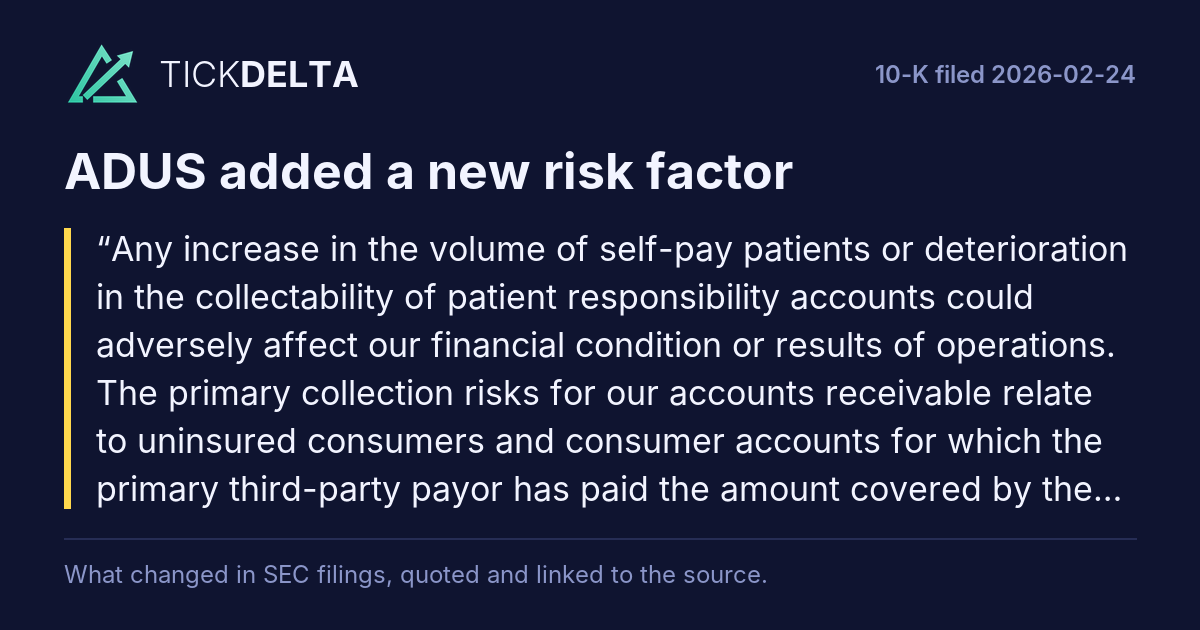
Any increase in the volume of self-pay patients or deterioration in the collectability of patient responsibility accounts could adversely affect our financial condition or results of operations.
The primary collection risks for our accounts receivable relate to uninsured consumers and consumer accounts for which the primary third-party payor has paid the amount covered by the applicable agreement but consumer responsibility amounts (generally deductibles and copayments) remain outstanding. Collections are impacted by the economic ability of consumers to pay and the effectiveness of our collection efforts. Our ability to collect consumer responsibility accounts may be limited by statutory, regulatory and investigatory initiatives.
Any increase in the volume of self-pay consumers or deterioration in collectability of uninsured, self-pay and other consumer responsibility accounts could adversely affect our cash flows and results of operations. We may experience growth in total uncompensated care as a result of a number of factors, including conditions impacting the overall economy. In recent years, federal and state legislatures have considered or passed various proposals impacting the size of the uninsured population. For example, federal legislation temporarily enhanced subsidies available for purchasing coverage through the ACA health insurance marketplaces, but these enhanced subsidies expired at the end of 2025. Their expiration is expected to adversely impact health insurance exchange enrollment and increase the uninsured rate. The OBBBA is expected to further adversely affect the uninsured rate, including by effectively ending automatic renewals of ACA marketplace coverage and by limiting Medicare and Medicaid eligibility based on immigration status and other factors. Other legislative and regulatory initiatives related to health insurance, such as permitting the sale of insurance plans that lack currently required consumer protections, could also increase rates of uninsured and underinsured individuals. It is difficult to predict what, whether and when legislation and regulatory changes may be made in the future.
We may also be adversely affected by growth in consumer responsibility accounts as a result of increases in the adoption of health plan structures that shift greater payment responsibility for care to individuals through greater exclusions and copayment and deductible amounts.
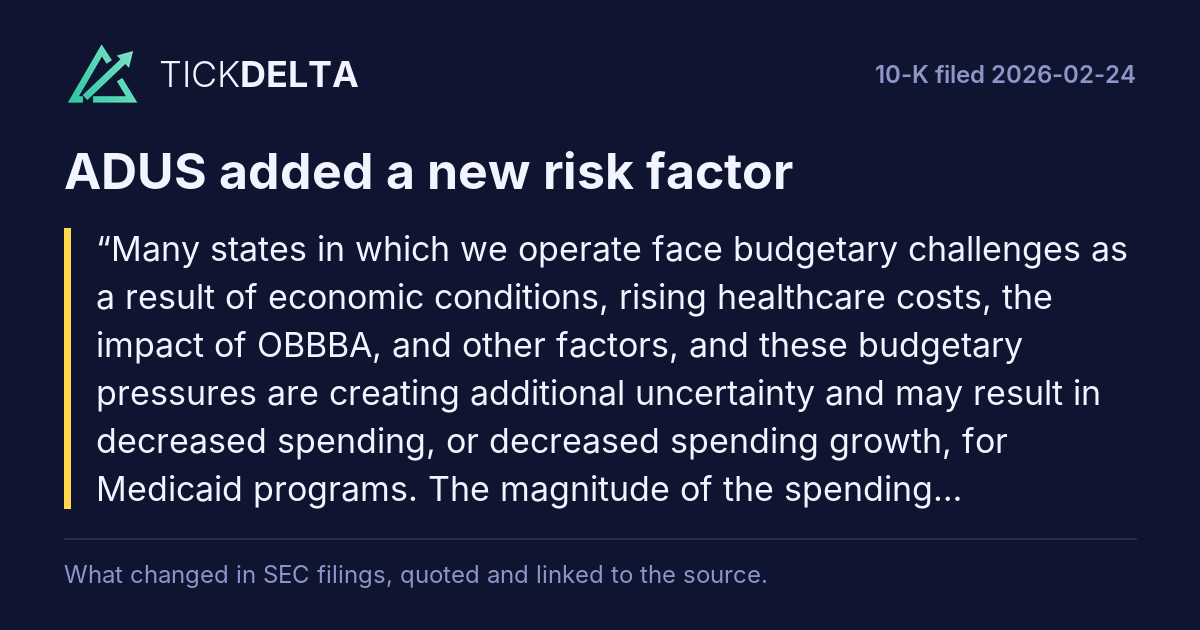
Many states in which we operate face budgetary challenges as a result of economic conditions, rising healthcare costs, the impact of OBBBA, and other factors, and these budgetary pressures are creating additional uncertainty and may result in decreased spending, or decreased spending growth, for Medicaid programs. The magnitude of the spending reductions anticipated as a result of the OBBBA may limit the ability of states to cover services and result in significant reductions in access to care, especially for services such as HCBS that are optional under Medicaid. Budgetary shortfalls and funding changes may affect our contracts and the reimbursement we receive, as governmental agencies generally condition their agreements upon a sufficient budgetary appropriation.
As federal healthcare expenditures continue to increase and as many state governments navigate budgetary pressures, federal and state governments have made, and may continue to make, significant changes to the Medicare and Medicaid programs, including changes to reimbursement for or coverage of items and services rendered to beneficiaries of such programs. Cost containment initiatives at the federal or state level have included, and in the future may include, for example:
distribution, maintenance and dispensing of pharmaceuticals and controlled substances;
Paragraphs in the 10-Q filed Nov 4, 2026 that were not in the one before
New in the latest 10-Q
12 paragraphs in the 10-Q filed Nov 4, 2026 with nothing like
them in the 10-Q filed Aug 4, 2026 (at least half the words must differ; new numbers alone do not count).
Quoted exactly, grouped by the item heading above them. This is text that changed, not a judgement of how serious it is.
Financial statements and notes
On September 12, 2026, the Company entered into a definitive equity and asset purchase agreement to acquire the personal care division of AccentCare, Inc. (the “AccentCare Acquisition”) for an anticipated purchase price, after customary purchase price adjustments, of approximately $275.0 million. The AccentCare Acquisition relates only to the seller’s personal care operations outside of New York and does not relate to its hospice and home health operations. The acquired operations serve an average daily census of approximately 13,700 customers through locations in Texas, Illinois, California, Arizona, Colorado, Georgia, Minnesota, Pennsylvania, Tennessee, and Washington. The Company expects to close the AccentCare Acquisition following completion of regulatory approvals and subject to customary closing conditions and to fund it through a combination of the Company’s revolver and cash on hand.
Read in the 10-Qopen_in_new
On September 12, 2026, the Company entered into a definitive equity and asset purchase agreement to acquire the personal care division of AccentCare, Inc. for an anticipated purchase price, after customary purchase price adjustments, of approximately $275.0 million. The AccentCare Acquisition relates only to the seller’s personal care operations outside of New York and does not relate to its hospice and home health operations. The acquired operations serve an average daily census of approximately 13,700 customers through locations in Texas, Illinois, California, Arizona, Colorado, Georgia, Minnesota, Pennsylvania, Tennessee, and Washington. The Company expects to close the AccentCare Acquisition following completion of regulatory approvals and subject to customary closing conditions and to fund it through a combination of the Company’s revolver and cash on hand.
Read in the 10-Qopen_in_new
Three Months Ended September 30, 2026 Compared to Three Months Ended September 30, 2025
Read in the 10-Qopen_in_new
Nine Months Ended September 30, 2026 Compared to Nine Months Ended September 30, 2025
Read in the 10-Qopen_in_new
Nine Months Ended September 30, 2026 Compared to Nine Months Ended September 30, 2025
Read in the 10-Qopen_in_new
Show the other 7
Risk Factors
We may fail to complete the acquisition of AccentCare on a timely basis or at all and may not realize the benefits that are anticipated from the AccentCare Acquisition.
Read in the 10-Qopen_in_new
We have entered into a definitive equity and asset purchase agreement to acquire the personal care division of AccentCare for a purchase price of approximately $275.0 million, subject to customary adjustments. The AccentCare Acquisition is expected to close upon the completion of regulatory approvals and subject to the satisfaction of other closing conditions.
Read in the 10-Qopen_in_new
We cannot provide any assurance that we will be able to successfully consummate the AccentCare Acquisition as provided for under the equity and asset purchase agreement, or, if such acquisition is completed, we cannot predict the timing of such closing. In addition, we have incurred, and will continue to incur, significant costs, expenses and fees for professional services and other transaction costs in connection with the AccentCare Acquisition, and these fees and costs are payable by us regardless of whether the AccentCare Acquisition is consummated. If we fail to consummate the AccentCare Acquisition or should the completion be significantly delayed, we could fail to realize all or a portion of the intended economic benefits of such acquisition. Any failure to complete the AccentCare Acquisition could have a negative impact on our business, financial condition and the market price of our common stock.
Read in the 10-Qopen_in_new
The benefits that are expected to result from the AccentCare Acquisition will depend, in part, on our ability to realize the growth opportunities we anticipate from the AccentCare Acquisition, which is contingent, in part, on successful integration and AccentCare performing in accordance with our expectations. Even a successful integration and meeting performance expectations may not result in the realization of the full benefits we currently expect, nor can we give assurances that these benefits will be achieved when expected or at all. Moreover, we expect to incur expenses in connection with the integration of AccentCare, and as such, the benefits may be offset by costs incurred or delays in integrating the businesses. Further, our due diligence review of AccentCare may not have successfully identified all potential issues. In addition, the integration of AccentCare may result in material unanticipated problems, expenses, liabilities, regulatory risks, and diversion of management’s attention.
Read in the 10-Qopen_in_new
The pendency of the AccentCare Acquisition could cause disruptions and create uncertainty surrounding our business and affect our relationships with our customers and employees. We have diverted, and will continue to divert, significant management resources to complete the AccentCare Acquisition, which could have a negative impact on our ability to manage existing operations or pursue alternative strategic transactions, which could adversely affect our business, financial condition and results of operations. Until the completion of the AccentCare Acquisition, holders of shares of our common stock will be exposed to the risks faced by our existing business without any of the potential benefits from the AccentCare Acquisition. As a result of investor perceptions about the terms, conditions, risks or benefits of the AccentCare Acquisition, the market price of shares of our common stock may decline.
Read in the 10-Qopen_in_new
Item 6
10.2 Equity and Asset Purchase Agreement, dated September 12, 2026, by and between AccentCare, Inc. and Addus Healthcare, Inc.** 8-K 001-34504 09/14/2026 10.1
Read in the 10-Qopen_in_new
** Schedules and exhibits have been omitted pursuant to Item 601 of Regulation S-K. The Company hereby undertakes to furnish supplementally a copy of any of the omitted schedules and exhibits upon request by the Securities and Exchange Commission.
Read in the 10-Qopen_in_new
The 10-Q's risk factors against the 10-K
Item 1A of the 10-Q filed Nov 4, 2026 against Item 1A of the 10-K filed Feb 24, 2026.
A 10-Q repeats only the risks that changed, so a 10-K paragraph that is missing from it is not counted as removed.
Added is a paragraph with nothing like it in the 10-K, Reworded a sentence that is in both with several words changed,
Quiet changes a sentence in both where one to four words changed and one is a hedge or a modal
(cut words struck through, new words highlighted).
Text on the page, not a score; each links to the filing at sec.gov.
Added10-Q Nov 4, 2026 vs 10-K Feb 24, 2026
Investing in our common stock involves a high degree of risk. You should carefully consider the risk factors discussed under the caption “Risk Factors” set forth in Part I, Item 1A, of our Annual Report on Form 10-K for the year ended December 31, 2025, filed with the SEC. Except as set forth below, there have been no material changes to the risk factors previously disclosed under the caption “Risk Factors” in our Annual Report on Form 10-K. Additional risks and uncertainties not currently known to us or that we currently deem to be immaterial also may materially adversely affect our business, financial condition, or operating results.
Read it in the 10-Q at sec.govopen_in_new
Added10-Q Nov 4, 2026 vs 10-K Feb 24, 2026
We may fail to complete the acquisition of AccentCare on a timely basis or at all and may not realize the benefits that are anticipated from the AccentCare Acquisition.
Read it in the 10-Q at sec.govopen_in_new
Added10-Q Nov 4, 2026 vs 10-K Feb 24, 2026
We have entered into a definitive equity and asset purchase agreement to acquire the personal care division of AccentCare for a purchase price of approximately $275.0 million, subject to customary adjustments. The AccentCare Acquisition is expected to close upon the completion of regulatory approvals and subject to the satisfaction of other closing conditions.
Read it in the 10-Q at sec.govopen_in_new
Added10-Q Nov 4, 2026 vs 10-K Feb 24, 2026
We cannot provide any assurance that we will be able to successfully consummate the AccentCare Acquisition as provided for under the equity and asset purchase agreement, or, if such acquisition is completed, we cannot predict the timing of such closing. In addition, we have incurred, and will continue to incur, significant costs, expenses and fees for professional services and other transaction costs in connection with the AccentCare Acquisition, and these fees and costs are payable by us regardless of whether the AccentCare Acquisition is consummated. If we fail to consummate the AccentCare Acquisition or should the completion be significantly delayed, we could fail to realize all or a portion of the intended economic benefits of such acquisition. Any failure to complete the AccentCare Acquisition could have a negative impact on our business, financial condition and the market price of our common stock.
Read it in the 10-Q at sec.govopen_in_new
Added10-Q Nov 4, 2026 vs 10-K Feb 24, 2026
The benefits that are expected to result from the AccentCare Acquisition will depend, in part, on our ability to realize the growth opportunities we anticipate from the AccentCare Acquisition, which is contingent, in part, on successful integration and AccentCare performing in accordance with our expectations. Even a successful integration and meeting performance expectations may not result in the realization of the full benefits we currently expect, nor can we give assurances that these benefits will be achieved when expected or at all. Moreover, we expect to incur expenses in connection with the integration of AccentCare, and as such, the benefits may be offset by costs incurred or delays in integrating the businesses. Further, our due diligence review of AccentCare may not have successfully identified all potential issues. In addition, the integration of AccentCare may result in material unanticipated problems, expenses, liabilities, regulatory risks, and diversion of management’s attention.
Read it in the 10-Q at sec.govopen_in_new
Show the other 1
Added10-Q Nov 4, 2026 vs 10-K Feb 24, 2026
The pendency of the AccentCare Acquisition could cause disruptions and create uncertainty surrounding our business and affect our relationships with our customers and employees. We have diverted, and will continue to divert, significant management resources to complete the AccentCare Acquisition, which could have a negative impact on our ability to manage existing operations or pursue alternative strategic transactions, which could adversely affect our business, financial condition and results of operations. Until the completion of the AccentCare Acquisition, holders of shares of our common stock will be exposed to the risks faced by our existing business without any of the potential benefits from the AccentCare Acquisition. As a result of investor perceptions about the terms, conditions, risks or benefits of the AccentCare Acquisition, the market price of shares of our common stock may decline.
Read it in the 10-Q at sec.govopen_in_new
Phrases used for the first time
Two-word phrases in Risk Factors of the 10-K filed Feb 24, 2026 that are in none of the 1 earlier 10-Ks stored, back to Feb 25, 2025
responsibility accounts ×4value-based payment ×4federal matching ×3matching funds ×3laws regulations ×2illinois new ×2medicaid eligibility ×2regulatory initiatives ×2underinsured individuals ×2healthcare policy ×2medicaid financing ×2financing mechanisms ×2restrictions intended ×2funds received ×2decreased spending ×2medicaid managed ×2
Where each one is used
- responsibility accounts: Any increase in the volume of self-pay patients or deterioration in the collectability of patient responsibility accounts could adversely affect our financial condition or results of operations.
- value-based payment: The industry trend toward value-based payment models may negatively impact our revenues.
- federal matching: A significant portion of our caseload and revenues are derived from government healthcare programs, primarily Medicare and Medicaid. For the year ended December 31, 2025, we derived approximately 39.3% of our net service revenues from state and local governmental agencies, primarily through Medicaid state programs...
- matching funds: A significant portion of our caseload and revenues are derived from government healthcare programs, primarily Medicare and Medicaid. For the year ended December 31, 2025, we derived approximately 39.3% of our net service revenues from state and local governmental agencies, primarily through Medicaid state programs...
- laws regulations: Private third-party payors may also conduct audits and investigations, and we also perform internal audits and monitoring. These audits and investigations can result and have resulted in recoupments by Medicare, state programs and other payors of amounts previously paid to us if it is determined that we failed to...
- illinois new: Our revenues are particularly sensitive to regulatory and economic changes in states in which we generate a significant portion of our revenues including Illinois, New Mexico and Texas. In 2025, we derived approximately 37.0% of our net service revenues from services provided in Illinois, 13.1% from services...
- medicaid eligibility: Any increase in the volume of self-pay consumers or deterioration in collectability of uninsured, self-pay and other consumer responsibility accounts could adversely affect our cash flows and results of operations. We may experience growth in total uncompensated care as a result of a number of factors, including...
- regulatory initiatives: Any increase in the volume of self-pay consumers or deterioration in collectability of uninsured, self-pay and other consumer responsibility accounts could adversely affect our cash flows and results of operations. We may experience growth in total uncompensated care as a result of a number of factors, including...
The 10-K at sec.govopen_in_new
Used at least twice, small words left out. Counted, not picked: a phrase can be new because the company renamed something.
Changes in the volume of uninsured patients could adversely affect our cash flows and results of operations. In recent years, federal and state legislatures have considered or passed various proposals impacting the size of the uninsured population. For example, federal legislation temporarily enhanced subsidies available for purchasing coverage through the federal and state-based health insurance marketplaces by lowering premiums and raising income eligibility thresholds. These subsidies were extended through 2025, but further extension is uncertain, and their expiration would adversely...
In the 10-K filed Feb 25, 2025open_in_new
The Medicaid program, which is jointly funded by the federal and state governments, is often a state’s largest program. Governmental agencies generally condition their agreements upon a sufficient budgetary appropriation. Almost all of the states in which we operate have experienced periodic financial pressures and budgetary shortfalls due to challenging economic conditions and the rising costs of healthcare, among other factors. As a result, many states have made, are considering or may consider making changes in their Medicaid or other state and local medical and social programs,...
In the 10-K filed Feb 25, 2025open_in_new
Sources
Item 1A of each 10-K and 10-Q on EDGAR, quoted exactly. Each paragraph links to the filing at sec.gov.
Also
10-K change: what was reworded or cut, section by section.
Work with it
Excel workbook · CSV. Google Sheet that stays up to date: paste =IMPORTDATA("https://tickdelta.com/company/ADUS/export.csv") into a cell.