Paragraph 118 · 46% changed
Every version of it
Screener
/
SEC EDGAR
/CIK 0000919012
/10-K filed Mar 30, 2026, compared with Mar 20, 2025
/Numbers from the XBRL of the 10-Ks
NYSE
Consumer discretionary · Apparel Retail
American Eagle Outfitters Inc AEO
The 10-K against last year's
118 changes: 31 added, 24 removed, 60 reworded, 3 quiet changes
10-K Mar 30, 2026 vs Mar 20, 2025
Risk Factors
19.2%
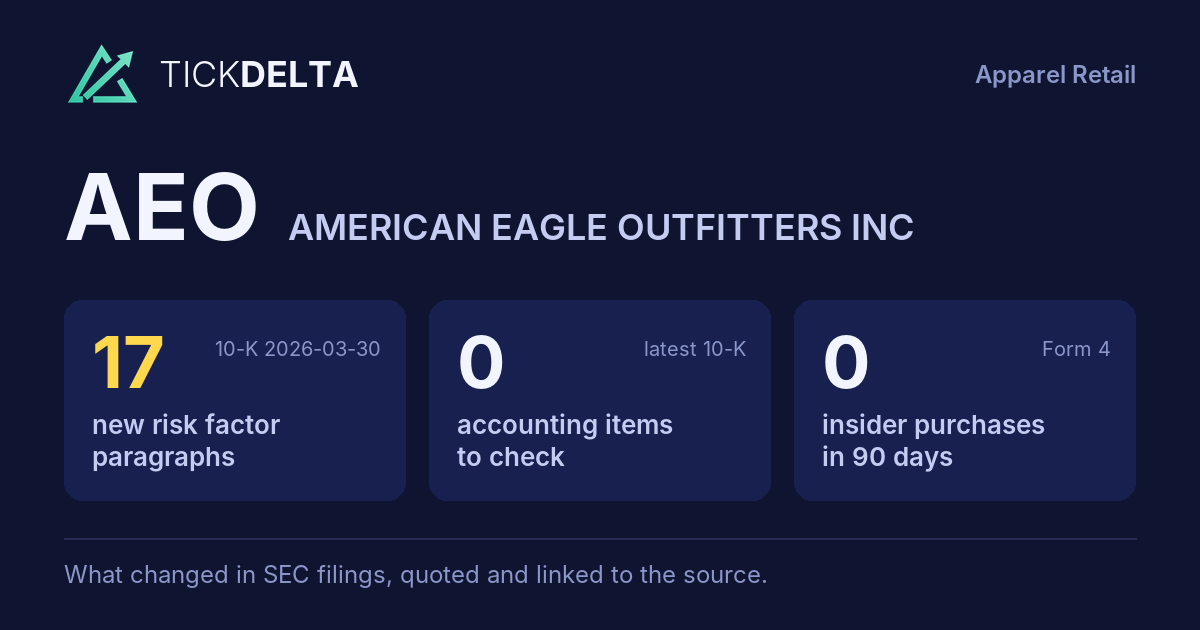
of the text changed · 12,147 words now · 17 new paragraphs, 5 gone
MD&A
24.8%
of the text changed · 6,301 words now · 14 new paragraphs, 19 gone
Legal Proceedings
16.9%
of the text changed · 4,606 words now
Accounting Policies
16.9%
of the text changed · 4,606 words now
10-K 0001193125-26-132097 (Mar 30, 2026) vs 10-K 0000950170-25-042746 (Mar 20, 2025)
Every paragraph, and how much of it changed
One bar per paragraph, in the order of the 10-K. Height and colour show the share of its words not in the closest paragraph a year earlier; the tallest bars are new paragraphs.
Risk Factors
128 paragraphs · 17 new · 45 reworded · 5 gone · 10-K Mar 30, 2026 against Mar 20, 2025
New paragraph
Reworded (5% of its words or more)
Same or nearly
Paragraph 85 · 46% changed
Every version of it
Paragraph 52 · 43% changed
Every version of it
Our business depends on the value and reputation of our brands and our ability to anticipate, identify, and respond to consumer demands and preferences, and to fashion trends. In addition, the increasing use of technology, including AI tools and social media platforms platforms, allows for rapid communication and any negative publicity related to the aforementioned concerns may reduce demand for our merchandise. Public perception about Further, with the increasing rise of social media as a channel of communication with our products or our stores, whether justified or not, could impair our reputation, involve us in litigation, damage customers, the reputation of our brands may be impacted by our social media interactions and campaigns through heightened public focus. Due to the volatile and uncertain nature of consumer reactions to social media messaging, we may adversely impact face difficulties in predicting messaging that will resonate with consumer expectations and result in positive publicity. If our business, results of operations, social media efforts are not successful or result in negative public attention, we may be subject to reputational damage and adverse impacts to our business and financial condition.
Paragraph 39 · 39% changed
Every version of it
Increasingly, consumers are using mobile-based devices and applications to shop online with us and with our competitors, and to do comparison shopping, as well as to engage with us and our competitors through digital services and experiences that are offered on mobile platforms. In Fiscal 2024, 2025, digital sales represented 37% 39% of our total revenue. In order to grow and remain competitive, we will need to continue to adapt to future changes in technology, including the development of AI, technology to address the changing demands of consumers. Any failure on For example, customers are increasingly using AI shopping assistant tools to help find products, compare prices and make purchase decisions. Use of these AI tools could transform commerce, including in ways that we fail to anticipate, and affect our part ability to provide attractive, effective, reliable, secure, user-friendly digital commerce platforms that offer a wide assortment of merchandise with rapid delivery options and that continually meet the changing expectations of online shoppers or any failure to provide attractive digital experiences efficiently attract potential customers to our customers could place us at a competitive disadvantage, result in the loss of digital commerce platforms and other sales, harm retain our reputation with consumers, have a material adverse impact on the growth of our digital commerce business globally and have a material adverse impact on our business and results of operations. customer base.
Paragraph 54 · 38% changed
Every version of it
Paragraph 21 · 38% changed
Every version of it
Paragraph 40 · 28% changed
Every version of it
Paragraph 20 · 26% changed
Every version of it
The sale of apparel, accessories, intimates, and personal care products is a highly competitive business with numerous participants, including individual and chain specialty apparel retailers, fast-fashion retailers, local, regional, national, and international department stores; stores, online businesses, discount stores and online businesses. Competition in the apparel industry is particularly enhanced in the digital marketplace, where there are new entrants in the market, greater pricing pressure and heightened customer expectations and competitive pressure related to, among other things, customer engagement, delivery speed, shipping charges and return privileges. In addition, fast fast-fashion retailers. Fast fashion, value fashion and off-price retailers have shifted customer expectations of pricing for well-known brands and have contributed to additional promotional and pricing pressure in recent years. Changing consumer preferences has resulted and may continue to result in new competition for our products. Additionally, competition in the apparel industry is particularly enhanced in the digital marketplace, where there are new entrants in the market as well as established competitors. The substantial sales growth in the digital channel within the last several years has increased competition due to new entrants and established competitors, particularly in terms of customer engagement, delivery speed, shipping charges and return privileges. Some of these competitors have robust digital consumer experiences and highly efficient delivery systems. Furthermore, an overall decrease in mall traffic continues to place a greater reliance on the digital channel, which in turn increases competitive risks with respect to digital and online sales.
Paragraph 118 · 46% changed
Every version of it
10-K Mar 20, 2025We believe that our trademarks and service marks, as described in Part I, Item 1, Business, are important to our success and our competitive position due to their name recognition with our customers. We devote substantial resources to establishing and protecting our trademarks and service marks. We are not aware of any material claims of infringement or material challenges to our right to use any of our trademarks. Nevertheless, the actions we have taken, including to establish and protect our trademarks and service marks, may not be adequate to prevent others from imitating our products or seeking to block sales of our products. Other parties may also claim that some of our products infringe on their trademarks, copyrights or other intellectual property rights. In addition, the laws of certain foreign countries may not protect our proprietary rights to the same extent as do the laws of the U.S. Litigation regarding our trademarks, copyrights and other intellectual property rights could adversely affect our business, financial condition, and results of operations.
10-K Mar 30, 2026
In addition, the laws of certain foreign countries may not protect our proprietary rights to the same extent as do the laws of the U.S. Litigation regarding our trademarks, copyrights and other intellectual property rights could adversely affect our business, financial condition, and results of operations.
Paragraph 85 · 46% changed
Every version of it
10-K Mar 20, 2025In addition, the U.S. government periodically considers other restrictions on the importation of products obtained by our vendors and us. Furthermore, the impact of the potential implementation of more restrictive trade policies, higher tariffs or the renegotiation of existing trade agreements in the U.S. or countries where we sell or procure products could disrupt our operations and have a material adverse effect on our business. In particular, future trade disputes or future phases of trade negotiations with China could lead to the imposition of tariffs that could adversely affect our supply chain and our business. General trade tensions between the U.S. and China have been high. For example, in recent years, the U.S. has imposed significant new tariffs on China related to the importation of certain product categories. A substantial portion of our products are manufactured abroad, including in China. As a result of these tariffs, our cost of goods imported from China increased slightly. The U.S. has proposed additional tariffs on goods shipped from China. These proposed tariffs or other tariffs on goods shipped from China would likely increase the cost of our merchandise and negatively impact our operating results. Although such changes would have implications across the entire industry, we may fail to effectively adapt to and manage the adjustments in strategy that would be necessary in response to those changes. We are working with our current suppliers to mitigate our exposure to current or potential tariffs and seeking opportunities to engage suppliers outside of China, but there can be no assurance that we will be able to offset any increased costs or secure suppliers outside of China. In addition, other countries may change their business and trade policies in anticipation of or in response to increased import tariffs and other changes in U.S. trade policy and regulations already enacted or that may be enacted in the future.
10-K Mar 30, 2026
Although such changes have implications across the entire industry, we may fail to effectively adapt to and manage the adjustments in strategy that would be necessary in response to these changes. We have and are continuing to work with our suppliers to mitigate our exposure to current or potential tariffs, but there can be no assurance that we will be able to offset any increased costs. In addition, U.S. trading partners may take retaliatory measures or may change their business and trade policies in anticipation of or in response to increased import tariffs and other changes in U.S. trade policy and regulations already enacted or that may be enacted in the future. Further, our efforts to mitigate the impacts of tariffs are time-consuming and costly, and may not be effective.
Paragraph 52 · 43% changed
Every version of it
10-K Mar 20, 2025
Our business depends on the value and reputation of our brands and our ability to anticipate, identify, and respond to consumer demands and preferences, and to fashion trends. In addition, the increasing use of social media platforms allows for rapid communication and any negative publicity related to the aforementioned concerns may reduce demand for our merchandise. Public perception about our products or our stores, whether justified or not, could impair our reputation, involve us in litigation, damage our brands and may adversely impact our business, results of operations, and financial condition.
10-K Mar 30, 2026
Our business depends on the value and reputation of our brands and our ability to anticipate, identify, and respond to consumer demands and preferences, and to fashion trends. In addition, the increasing use of technology, including AI tools and social media platforms, allows for rapid communication and any negative publicity related to the aforementioned concerns may reduce demand for our merchandise. Further, with the increasing rise of social media as a channel of communication with our customers, the reputation of our brands may be impacted by our social media interactions and campaigns through heightened public focus. Due to the volatile and uncertain nature of consumer reactions to social media messaging, we may face difficulties in predicting messaging that will resonate with consumer expectations and result in positive publicity. If our social media efforts are not successful or result in negative public attention, we may be subject to reputational damage and adverse impacts to our business and financial condition.
Paragraph 39 · 39% changed
Every version of it
10-K Mar 20, 2025
Increasingly, consumers are using mobile-based devices and applications to shop online with us and with our competitors, and to do comparison shopping, as well as to engage with us and our competitors through digital services and experiences that are offered on mobile platforms. In Fiscal 2024, digital sales represented 37% of our total revenue. In order to grow and remain competitive, we will need to continue to adapt to future changes in technology, including the development of AI, to address the changing demands of consumers. Any failure on our part to provide attractive, effective, reliable, secure, user-friendly digital commerce platforms that offer a wide assortment of merchandise with rapid delivery options and that continually meet the changing expectations of online shoppers or any failure to provide attractive digital experiences to our customers could place us at a competitive disadvantage, result in the loss of digital commerce and other sales, harm our reputation with consumers, have a material adverse impact on the growth of our digital commerce business globally and have a material adverse impact on our business and results of operations.
10-K Mar 30, 2026
Increasingly, consumers are using mobile-based devices and applications to shop online with us and with our competitors, and to do comparison shopping, as well as to engage with us and our competitors through digital services and experiences that are offered on mobile platforms. In Fiscal 2025, digital sales represented 39% of our total revenue. In order to grow and remain competitive, we will need to continue to adapt to future changes in technology to address the changing demands of consumers. For example, customers are increasingly using AI shopping assistant tools to help find products, compare prices and make purchase decisions. Use of these AI tools could transform commerce, including in ways that we fail to anticipate, and affect our ability to efficiently attract potential customers to our digital platforms and retain our customer base.
Paragraph 54 · 38% changed
Every version of it
10-K Mar 20, 2025Our business depends on the value and reputation of our brands and our ability to anticipate, identify, and respond to consumer demands and preferences, and to fashion trends. In addition, the increasing use of social media platforms allows for rapid communication and any negative publicity related to the aforementioned concerns may reduce demand for our merchandise. Public perception about our products or our stores, whether justified or not, could impair our reputation, involve us in litigation, damage our brands and may adversely impact our business, results of operations, and financial condition.
10-K Mar 30, 2026
Public perception about us, our products or our stores, whether justified or not, could impair our reputation, involve us in litigation, damage our brands and may adversely impact our business, results of operations, and financial condition.
Paragraph 21 · 38% changed
Every version of it
10-K Mar 20, 2025The sale of apparel, accessories, intimates, and personal care products is a highly competitive business with numerous participants, including individual and chain specialty apparel retailers, fast-fashion retailers, local, regional, national, and international department stores; discount stores and online businesses. Competition in the apparel industry is particularly enhanced in the digital marketplace, where there are new entrants in the market, greater pricing pressure and heightened customer expectations and competitive pressure related to, among other things, customer engagement, delivery speed, shipping charges and return privileges. In addition, fast fashion, value fashion and off-price retailers have shifted customer expectations of pricing for well-known brands and have contributed to additional promotional and pricing pressure in recent years. Changing consumer preferences has resulted and may continue to result in new competition for our products. The substantial sales growth in the digital channel within the last several years has increased competition due to new entrants and established competitors, particularly in terms of customer engagement, delivery speed, shipping charges and return privileges. Some of these competitors have robust digital consumer experiences and highly efficient delivery systems. Furthermore, an overall decrease in mall traffic continues to place a greater reliance on the digital channel, which in turn increases competitive risks with respect to digital and online sales.
10-K Mar 30, 2026
within the last several years has led to greater pricing pressure and heightened customer expectations and competitive pressure related to, among other things, customer engagement, delivery speed, shipping charges and return privileges. Some of our competitors have robust digital consumer experiences and highly efficient delivery systems. Furthermore, an overall decrease in mall traffic continues to place a greater reliance on the digital channel, which in turn increases competitive risks with respect to digital and online sales.
Paragraph 40 · 28% changed
Every version of it
10-K Mar 20, 2025Increasingly, consumers are using mobile-based devices and applications to shop online with us and with our competitors, and to do comparison shopping, as well as to engage with us and our competitors through digital services and experiences that are offered on mobile platforms. In Fiscal 2024, digital sales represented 37% of our total revenue. In order to grow and remain competitive, we will need to continue to adapt to future changes in technology, including the development of AI, to address the changing demands of consumers. Any failure on our part to provide attractive, effective, reliable, secure, user-friendly digital commerce platforms that offer a wide assortment of merchandise with rapid delivery options and that continually meet the changing expectations of online shoppers or any failure to provide attractive digital experiences to our customers could place us at a competitive disadvantage, result in the loss of digital commerce and other sales, harm our reputation with consumers, have a material adverse impact on the growth of our digital commerce business globally and have a material adverse impact on our business and results of operations.
10-K Mar 30, 2026
Any failure on our part or on the part of our third-party providers to provide attractive, effective, reliable, secure, user-friendly digital commerce platforms that offer a wide assortment of merchandise with rapid delivery options and that continually meet the changing expectations of online shoppers or any failure to provide attractive digital experiences to our customers could place us at a competitive disadvantage, result in the loss of digital commerce and other sales, harm our reputation with consumers, have a material adverse impact on the growth of our digital commerce business globally and have a material adverse impact on our business and results of operations.
Paragraph 20 · 26% changed
Every version of it
10-K Mar 20, 2025
The sale of apparel, accessories, intimates, and personal care products is a highly competitive business with numerous participants, including individual and chain specialty apparel retailers, fast-fashion retailers, local, regional, national, and international department stores; discount stores and online businesses. Competition in the apparel industry is particularly enhanced in the digital marketplace, where there are new entrants in the market, greater pricing pressure and heightened customer expectations and competitive pressure related to, among other things, customer engagement, delivery speed, shipping charges and return privileges. In addition, fast fashion, value fashion and off-price retailers have shifted customer expectations of pricing for well-known brands and have contributed to additional promotional and pricing pressure in recent years. Changing consumer preferences has resulted and may continue to result in new competition for our products. The substantial sales growth in the digital channel within the last several years has increased competition due to new entrants and established competitors, particularly in terms of customer engagement, delivery speed, shipping charges and return privileges. Some of these competitors have robust digital consumer experiences and highly efficient delivery systems. Furthermore, an overall decrease in mall traffic continues to place a greater reliance on the digital channel, which in turn increases competitive risks with respect to digital and online sales.
10-K Mar 30, 2026
The sale of apparel, accessories, intimates, and personal care products is a highly competitive business with numerous participants, including individual and chain specialty apparel retailers, local, regional, national, and international department stores, online businesses, discount stores and fast-fashion retailers. Fast fashion, value fashion and off-price retailers have shifted customer expectations of pricing for well-known brands and have contributed to additional promotional and pricing pressure in recent years. Changing consumer preferences has resulted and may continue to result in new competition for our products. Additionally, competition in the apparel industry is particularly enhanced in the digital marketplace, where there are new entrants in the market as well as established competitors. The substantial sales growth in the digital channel
MD&A
119 paragraphs · 14 new · 61 reworded · 19 gone · 10-K Mar 30, 2026 against Mar 20, 2025
New paragraph
Reworded (5% of its words or more)
Same or nearly
Paragraph 22 · 50% changed
Paragraph 38 · 50% changed
Paragraph 95 · 50% changed
On February 1, 2024, our March 11, 2025, the Company’s Board of Directors authorized the public 50 million additional shares for repurchase as part of 30.0 million shares under a new its existing share repurchase program, which expires on was previously announced in February 3, 2029. During Fiscal 2024, there were 9.5 million shares repurchased under this authorization. 2024.
Paragraph 52 · 46% changed
Aerie. The increase was primarily the result of the $65 million increase in gross profit was margin, driven by an increase of $51 million in higher merchandise margin due to increased on the $196 million, or 12%, increase in total net revenue from American Eagle and Aerie, revenue, which was partially offset by a $24 million increase in markdowns year-over-year. increased promotional activity
Paragraph 79 · 46% changed
Fiscal Years Ending (Decrease)/Increase January 31, February 1, 2026 2025 (In thousands) Total cash provided by (used for): Operating activities $456.2 $476.8 $(20.6) Investing activities (202.7) (217.5) 14.9 Financing activities (326.9) (301.9) (24.9) Effect of foreign currency exchange rate changes on cash and cash equivalents 3.3 (2.5) 0.1 (2.6) 5.8 (Decrease) increase in cash and cash equivalents $(70.0) $(45.1) $(24.9)
Paragraph 19 · 45% changed
During Fiscal 2023 2024 and Fiscal 2024, 2025, our results were negatively impacted by macro-economic challenges and global inflationary pressures impacting consumer spending behavior, which constrained revenue and increased margin pressure to clear through excess inventory. Given ongoing external uncertainties, we have taken additional actions to improve financial performance, including more operating efficiency initiatives, as described below under "Profit Improvement Program." For further information about the risks associated with global economic conditions and the effect of economic pressures on our business, see “Risk Factors” in Part I, Item 1A of this Annual Report.
Paragraph 37 · 45% changed
The increase decrease in gross profit was driven by an increase a decrease of $51 $30 million in merchandise margin due to increased promotional activity and $70 million of incremental tariffs, net revenue from American Eagle of mitigation efforts, as well as an inventory charge taken in the first quarter of Fiscal 2025 related to the write-down of spring and Aerie, partially offset by a $24 million increase in markdowns year-over-year. summer merchandise.
Paragraph 51 · 43% changed
American Eagle. The increase decrease was primarily the result of the 1% increase in total net revenue discussed above, leading to the $2 $114 million increase decline in gross profit margin, driven by an increase in lower merchandise margin due to increased promotional activity and decreased buying, occupancy, and warehousing costs. The increase was further driven by a decrease in $44 million of incremental tariffs, net of mitigation efforts. SG&A expenses of $2 million, and a decrease increased $28 million primarily due to planned investments in depreciation advertising. Depreciation and amortization expense also increased $10 million primarily as a result of $3 million to arrive at the $7 million increase in operating income. remodeled stores.
Paragraph 22 · 50% changed
10-K Mar 20, 2025During Fiscal 2023 and Fiscal 2024, our results were negatively impacted by macro-economic challenges and global inflationary pressures impacting consumer spending behavior, which constrained revenue and increased margin pressure to clear through excess inventory. Given ongoing external uncertainties, we have taken additional actions to improve financial performance, including more operating efficiency initiatives, as described below under "Profit Improvement Program." For further information about the risks associated with global economic conditions and the effect of economic pressures on our business, see “Risk Factors” in Part I, Item 1A of this Annual Report.
10-K Mar 30, 2026
For further information about the risks associated with global economic conditions and the effect of economic pressures on our business, see "Risk Factors" in Part I, Item 1A of this Annual Report.
Paragraph 38 · 50% changed
10-K Mar 20, 2025•Net income increased 94% to $329.4 million and increased by 300 basis points to 6.2% as a percentage of total revenue. Diluted earnings per share increased to $1.68 for Fiscal 2024 compared to $0.86 for Fiscal 2023. Adjusted net income increased 14% to $342.4 million and increased by 70 basis points to 6.4% as a percentage of revenue. Adjusted diluted earnings per share increased to $1.74 for Fiscal 2024 compared to $1.52 for Fiscal 2023.
10-K Mar 30, 2026
Additionally, buying, occupancy, and warehousing costs increased $34 million year-over-year, primarily due to new store openings and digital sales volume. As a percentage of net revenue, buying, occupancy, and warehousing costs leveraged 10 basis points compared to Fiscal 2024, due to higher sales in Fiscal 2025.
Paragraph 95 · 50% changed
10-K Mar 20, 2025
On February 1, 2024, our Board authorized the public repurchase of 30.0 million shares under a new share repurchase program, which expires on February 3, 2029. During Fiscal 2024, there were 9.5 million shares repurchased under this authorization.
10-K Mar 30, 2026
On March 11, 2025, the Company’s Board of Directors authorized 50 million additional shares for repurchase as part of its existing share repurchase program, which was previously announced in February 2024.
Paragraph 52 · 46% changed
10-K Mar 20, 2025
The increase in gross profit was driven by an increase of $51 million in merchandise margin due to increased net revenue from American Eagle and Aerie, partially offset by a $24 million increase in markdowns year-over-year.
10-K Mar 30, 2026
Aerie. The increase was primarily the result of the $65 million increase in gross margin, driven by higher merchandise margin on the $196 million, or 12%, increase in total net revenue, which was partially offset by increased promotional activity
Paragraph 79 · 46% changed
10-K Mar 20, 2025
Effect of foreign currency exchange rate changes on cash and cash equivalents (2.5) 0.1 (2.6)
10-K Mar 30, 2026
Fiscal Years Ending (Decrease)/Increase January 31, February 1, 2026 2025 (In thousands) Total cash provided by (used for): Operating activities $456.2 $476.8 $(20.6) Investing activities (202.7) (217.5) 14.9 Financing activities (326.9) (301.9) (24.9) Effect of foreign currency exchange rate changes on cash and cash equivalents 3.3 (2.5) 5.8 (Decrease) increase in cash and cash equivalents $(70.0) $(45.1) $(24.9)
Paragraph 19 · 45% changed
10-K Mar 20, 2025
During Fiscal 2023 and Fiscal 2024, our results were negatively impacted by macro-economic challenges and global inflationary pressures impacting consumer spending behavior, which constrained revenue and increased margin pressure to clear through excess inventory. Given ongoing external uncertainties, we have taken additional actions to improve financial performance, including more operating efficiency initiatives, as described below under "Profit Improvement Program." For further information about the risks associated with global economic conditions and the effect of economic pressures on our business, see “Risk Factors” in Part I, Item 1A of this Annual Report.
10-K Mar 30, 2026
During Fiscal 2024 and Fiscal 2025, our results were negatively impacted by macro-economic challenges and global inflationary pressures impacting consumer spending behavior, which constrained revenue and increased margin pressure to clear through excess inventory.
Paragraph 37 · 45% changed
10-K Mar 20, 2025
The increase in gross profit was driven by an increase of $51 million in merchandise margin due to increased net revenue from American Eagle and Aerie, partially offset by a $24 million increase in markdowns year-over-year.
10-K Mar 30, 2026
The decrease in gross profit was driven by a decrease of $30 million in merchandise margin due to increased promotional activity and $70 million of incremental tariffs, net of mitigation efforts, as well as an inventory charge taken in the first quarter of Fiscal 2025 related to the write-down of spring and summer merchandise.
Paragraph 51 · 43% changed
10-K Mar 20, 2025
American Eagle. The increase was primarily the result of the 1% increase in total net revenue discussed above, leading to the $2 million increase in gross profit driven by an increase in merchandise margin and decreased buying, occupancy, and warehousing costs. The increase was further driven by a decrease in SG&A expenses of $2 million, and a decrease in depreciation and amortization expense of $3 million to arrive at the $7 million increase in operating income.
10-K Mar 30, 2026
American Eagle. The decrease was primarily the result of the $114 million decline in gross margin, driven by lower merchandise margin due to increased promotional activity and $44 million of incremental tariffs, net of mitigation efforts. SG&A expenses increased $28 million primarily due to planned investments in advertising. Depreciation and amortization expense also increased $10 million primarily as a result of remodeled stores.
A paragraph is matched with the one last year that shares the most of its words; under half in common makes it new. The paragraphs shown are the 8 reworded the most in each section.
The paragraph that changed most in each section
The redline
Marked against last year's 10-K: cut words struck through, new words highlighted.
Risk Factors248 words changed in this paragraph; it is 44% similar to last year's version.
Source: Item 1A, 10-K 0001193125-26-132097 vs Item 1A, 10-K 0000950170-25-042746
Accounting Policies140 words changed in this paragraph; it is 33% similar to last year's version.
In November 2023, September 2025, the FASB issued ASU 2023-07, 2025-06, Intangibles—Goodwill and Other—Internal-Use Software (Subtopic 350-40): Targeted Improvements to Reportable Segment Disclosures the Accounting for Internal-Use Software ("ASU 2023-07"), which requires that segment expenses deemed significant to 2025-06"). The new guidance modernizes accounting for the chief operating decision maker (CODM) typically incorporated in measuring profit or loss costs of internal-use software by removing "project stages" from the segment should be disclosed. The guidance also requires that the difference between segment revenues and these significant segment expenses is disclosed. Any annually disclosed segment information is now required to be reported in interim periods as well. capitalization process. The guidance is effective for fiscal years beginning after December 15, 2023, and interim annual periods beginning after December 15, 2024. Public entities are required to apply the amendment retrospectively to prior 2027 and interim periods presented in the financial statements. within those years. Early adoption is permitted. The Company adopted plans to adopt ASU 2023-07 2025-06 effective for its Fiscal year 2024 and for the interim periods beginning in Fiscal 2025. 2028.
Source: Item 8, Note 2 – Summary of Significant Accounting Policies, 10-K 0001193125-26-132097 vs Item 8, Note 2 – Summary of Significant Accounting Policies, 10-K 0000950170-25-042746
Legal Proceedings140 words changed in this paragraph; it is 33% similar to last year's version.
In November 2023, September 2025, the FASB issued ASU 2023-07, 2025-06, Intangibles—Goodwill and Other—Internal-Use Software (Subtopic 350-40): Targeted Improvements to Reportable Segment Disclosures the Accounting for Internal-Use Software ("ASU 2023-07"), which requires that segment expenses deemed significant to 2025-06"). The new guidance modernizes accounting for the chief operating decision maker (CODM) typically incorporated in measuring profit or loss costs of internal-use software by removing "project stages" from the segment should be disclosed. The guidance also requires that the difference between segment revenues and these significant segment expenses is disclosed. Any annually disclosed segment information is now required to be reported in interim periods as well. capitalization process. The guidance is effective for fiscal years beginning after December 15, 2023, and interim annual periods beginning after December 15, 2024. Public entities are required to apply the amendment retrospectively to prior 2027 and interim periods presented in the financial statements. within those years. Early adoption is permitted. The Company adopted plans to adopt ASU 2023-07 2025-06 effective for its Fiscal year 2024 and for the interim periods beginning in Fiscal 2025. 2028.
Source: Item 3, via Note 2 – Summary of Significant Accounting Policies, 10-K 0001193125-26-132097 vs Item 3, via Note 2 – Summary of Significant Accounting Policies, 10-K 0000950170-25-042746
MD&A83 words changed in this paragraph; it is 40% similar to last year's version.
American Eagle. The increase decrease was primarily the result of the 1% increase in total net revenue discussed above, leading to the $2 $114 million increase decline in gross profit margin, driven by an increase in lower merchandise margin due to increased promotional activity and decreased buying, occupancy, and warehousing costs. The increase was further driven by a decrease in $44 million of incremental tariffs, net of mitigation efforts. SG&A expenses of $2 million, and a decrease increased $28 million primarily due to planned investments in depreciation advertising. Depreciation and amortization expense also increased $10 million primarily as a result of $3 million to arrive at the $7 million increase in operating income. remodeled stores.
Source: Item 7, 10-K 0001193125-26-132097 vs Item 7, 10-K 0000950170-25-042746
Sentences and paragraphs added, removed or reworded
Every change, by type
Sentences and paragraphs of AEO's Risk Factors and MD&A, 10-K Mar 30, 2026 against 10-K Mar 20, 2025. Each links to the text at sec.gov.
Quiet changes are sentences kept from last year with one to four words changed, at least one of them a hedge, a modal or a qualifier (may, could, will, not, significant, material…). A year or date rolling forward is not counted.
The full word list
adverse, adversely, all, although, anticipate, anticipates, any, approximately, believe, believes, can, cannot, certain, could, expect, expects, generally, however, if, intend, intends, largely, likely, many, material, materially, may, might, most, must, never, no, not, possible, primarily, probable, should, significant, significantly, some, substantial, substantially, unlikely, will, would
AddedRisk Factors
Investing in our common stock involves a high degree of risk. You should consider and carefully read all of the risks and uncertainties described below, as well as other information included in this Annual Report and in our other public filings. The risks described below are not the only ones facing us. The occurrence of any of the following risks or additional risks and uncertainties not presently known to us or that we currently believe to be immaterial could materially and adversely affect our business, financial condition or results of operations. In such case, the trading price of our common stock could decline, and you may lose all or part of your original investment. This Annual Report also contains forward-looking statements and estimates that involve risks and uncertainties. Our actual results could differ materially from those anticipated in the forward-looking statements as a result of specific factors, including the risks and uncertainties described below.
Read it in 10-K Mar 30, 2026 at sec.gov
AddedRisk Factors
•The current domestic and international political environment, including volatile trade relations, conflicts in multiple locations, and the related disruption to shipping lanes and civil unrest have resulted in uncertainty surrounding the future state of the global economy. There is uncertainty with respect to potential further changes in trade policy and regulations, sanctions and export controls, which increase volatility in the global economy and foreign currency exchange rates. This environment has affected and may continue to affect production and distribution lead times, increasing our costs and potentially affecting our ability to meet customer demand. If these disruptions persist, they may require us to modify our current sourcing practices, which may impact our product costs, and, correspondingly, could have a material adverse effect on our business and results of operations.
Read it in 10-K Mar 30, 2026 at sec.gov
AddedRisk Factors
•Trade policies and regulations, such as new, increased, or continuing uncertainty concerning tariffs or other trade restrictions may also increase the costs for imported materials and finished goods. Any resulting increase in prices we charge for our goods could negatively impact demand for our products, our sales and results of operations. Further, increases in consumer expenses more generally, may reduce discretionary spending and heighten price sensitivity, which could similarly negatively impact the demand for our products, our sales, and results of operations.
Read it in 10-K Mar 30, 2026 at sec.gov
AddedRisk Factors
Failure to continue to obtain or maintain high-quality endorsers of our products, or actions taken by our endorsers, could harm our business.
Read it in 10-K Mar 30, 2026 at sec.gov
AddedRisk Factors
From time to time, we establish relationships with artists, designers, musicians, athletes, social media influencers and other public figures to develop, evaluate and promote our products. If we are unable to recruit endorsers with consumer appeal or endorsers were to stop using our products contrary to their endorsement agreements, our business could be adversely affected. In addition, actions taken, allegations of wrongdoing or statements made by our endorsers, associated with our products or brand or otherwise, that harm the reputations of those endorsers or our decisions to cease collaborating with certain endorsers in light of actions taken, allegations of wrongdoing or statements made by them, could also seriously harm our brand image with consumers and, as a result, could have an adverse effect on our business.
Read it in 10-K Mar 30, 2026 at sec.gov
AddedRisk Factors
We rely on third parties to drive traffic to our platform, and these providers may change their algorithms or pricing, or may be subject to new laws and regulations, in ways that could negatively affect our business, financial condition, cash flows, and results of operations.
Read it in 10-K Mar 30, 2026 at sec.gov
AddedRisk Factors
We continue to invest in digital marketing to drive qualified traffic to our site. Our success with these efforts depends on an ability to attract customers cost effectively and, to do so, we rely heavily on relationships with providers of online services, search engines, social media and other websites and e-commerce businesses to provide content, advertising banners and other links that direct customers to our websites. We also use social media, including Facebook, Instagram, YouTube and others, as well as affiliate marketing, email, SMS, and direct mail, as part of our multi-channel approach to marketing and we expect that our use of social media for marketing purposes will increase over time. We rely on these relationships to provide significant traffic to our website and as important marketing channels and sources of information regarding potential customers. If digital platforms change or penalize us with their algorithms, terms of service, display and featuring of search results, or if competition increases for advertisements, we may be unable to cost-effectively attract customers. Our relationships with digital platforms are not covered by long-term contractual agreements and do not require any specific
Read it in 10-K Mar 30, 2026 at sec.gov
AddedRisk Factors
performance commitments. In addition, many of the platforms and agencies with whom we have advertising arrangements provide advertising services to other companies, including retailers with whom we compete.
Read it in 10-K Mar 30, 2026 at sec.gov
Show the other 60
AddedRisk Factors
As competition for online advertising has increased, the cost for some of these services has also increased. A significant increase in the cost of the marketing providers upon which we rely could adversely impact our ability to attract customers cost effectively and harm our business, financial condition, results of operations and prospects. In addition, laws and regulations governing the use of these platforms and other digital marketing channels are rapidly evolving. It may become more difficult for us or our partners to comply with such laws, and future data privacy laws and regulations or industry standards, as well as related enforcement, may restrict or limit our ability to use some or all of the marketing strategies on which we currently rely. The failure by us, our employees or third parties acting at our direction to abide by applicable laws and regulations in the use of these platforms could adversely impact our reputation or subject us to fines or other penalties.
Read it in 10-K Mar 30, 2026 at sec.gov
AddedRisk Factors
access to consumer data. Additionally, we maintain other confidential, proprietary, or otherwise sensitive information relating to our business and from third parties. Further, with the use of AI and other machine learning technologies, by us or our services providers, there is a risk that the data inputted into such technologies may contain confidential information or personal data, resulting in such information becoming accessible by third parties. The use of AI or machine learning technologies by our third-party service providers in their business activities, whether or not known to use, could also expose us to risks. While we believe we conduct appropriate diligence prior to onboarding third-party service providers, the failure of one or more such service provider to meet our expectations, including by use of AI tools in contravention of agreements with us, inputting our confidential or proprietary information into AI tools, or roll-out of new AI tools without approval, may give rise to issues pertaining to data privacy and data protection.
Read it in 10-K Mar 30, 2026 at sec.gov
AddedRisk Factors
insurance or insurance not being available to us on economically feasible terms, or at all. Insurers may also deny us coverage as to any future claim. Any of these results could harm our growth prospects, financial condition, business, and reputation.
Read it in 10-K Mar 30, 2026 at sec.gov
AddedRisk Factors
In addition, recent trade policies and uncertainty related thereto, including with respect to tariffs and other restrictions, with respect to countries from which we source our merchandise and raw materials, have created a dynamic and unpredictable trade landscape. This has and may continue to adversely impact our business and operations. On February 20, 2026, the U.S. Supreme Court held that the U.S. administration’s imposition of tariffs unlawful pursuant to the International Emergency Economic Powers Act (“IEEPA”) was unlawful, striking down the 10% global baseline tariff, as well as the higher tariffs imposed on certain U.S. trading partners. The U.S. Supreme Court’s ruling did not affect all of the recently imposed tariffs, including those imposed following trade remedy investigations by the Department of Commerce or the U.S. Trade Representative. Nor does it prohibit the imposition of future tariffs through alternative trade authorities available to the U.S. administration. On February 20, 2026, shortly after the announced U.S. Supreme Court decision, the U.S. administration announced that it would be imposing a new 10% global tariff for a period of 150 days pursuant to a balance-of-payments
Read it in 10-K Mar 30, 2026 at sec.gov
RemovedRisk Factors
RemovedRisk Factors
RemovedRisk Factors
RemovedRisk Factors
RemovedRisk Factors
RewordedRisk Factors
Inflation and other macroeconomic pressures in the U.S. and the global economy such as rising or uncertain interest rates, new or increased tariffs imposed by the U.S. government, government and/or reciprocal tariffs imposed by other countries, changes in trade policies, supply chain disruptions, recession fears , fears, geopolitical conflicts, such as Russia’s invasion of Ukraine, the conflict in the Middle East, and U.S. foreign policy in Latin America, continue to create a complex and challenging retail environment for us and our customers, and consumers may reduce discretionary spending.
Read it in 10-K Mar 30, 2026 at sec.gov
RewordedRisk Factors
Furthermore, if our information technology systems are damaged, breached or cease to properly function for any reason, including the poor performance of, failure of, or cyber-attack on third-party service providers, catastrophic events, power outages, cybersecurity breaches, network outages, failed upgrades or similar events, and if our disaster recovery and business continuity plans do not effectively resolve such issues, we may suffer interruptions in our ability to manage or conduct business, as well as reputational harm, and we may be subject to governmental investigations and litigation, any of which may adversely impact our business, results of operations, and financial condition.
Read it in 10-K Mar 30, 2026 at sec.gov
RewordedRisk Factors
Our quarterly results of operations also may fluctuate based upon such factors as the timing of certain holiday seasons, the number and timing of new store openings, the acceptability of seasonal merchandise offerings, the timing and level of markdowns, store closings and remodels, competitive factors, weather, and general economic and political conditions.
Read it in 10-K Mar 30, 2026 at sec.gov
RewordedRisk Factors
We have and are working continuing to work with our current suppliers to mitigate our exposure to current or potential tariffs and seeking opportunities to engage suppliers outside of China, tariffs, but there can be no assurance that we will be able to offset any increased costs or secure suppliers outside of China. costs.
Read it in 10-K Mar 30, 2026 at sec.gov
RewordedRisk Factors
Furthermore, we could face significantly higher U.S. income and similar taxes with respect to sales of products purchased from foreign suppliers if the U.S. were to adopt a system of taxation, such as a border adjustment tax, under which the cost of imported products was not deductible in determining such products' tax base.
Read it in 10-K Mar 30, 2026 at sec.gov
RewordedRisk Factors
We could also face potential claims, investigations, regulatory proceedings, liability and litigation, and bear other substantial costs in connection with remediating and otherwise responding to any data security breach, all of which may not be adequately covered by insurance, and which may result in an increase in our costs for insurance or insurance not being available to us on economically feasible terms, or at all.
Read it in 10-K Mar 30, 2026 at sec.gov
RewordedRisk Factors
Our operations, those of our licensees, our suppliers, or our customers, could be negatively impacted by various events beyond our control, including, without limitation, natural disasters, such as hurricanes, tornadoes, floods, earthquakes, extreme cold events, unseasonably warm weather, and other adverse weather conditions; public health crises, such as pandemics and epidemics; political crises, such as terrorist attacks, war, geopolitical uncertainty, labor unrest, and other political instability (including, without limitation, the ongoing war between Russia and Ukraine and Ukraine, the conflict in the Middle East); East and U.S. foreign policy in Latin America); negative global climate patterns, especially in water-stressed regions; or other catastrophic events, such as fires or other disasters occurring at our distribution centers or our vendors' manufacturing facilities, whether occurring in the U.S. or internationally.
Read it in 10-K Mar 30, 2026 at sec.gov
RewordedRisk Factors
For example, the ongoing war between Russia and Ukraine and Ukraine, the conflict in the Middle East East, and U.S. foreign policy in Latin America, have caused and continue to cause disruption, instability and volatility in global markets.
Read it in 10-K Mar 30, 2026 at sec.gov
RewordedRisk Factors
RewordedRisk Factors
The sale of apparel, accessories, intimates, and personal care products is a highly competitive business with numerous participants, including individual and chain specialty apparel retailers, fast-fashion retailers, local, regional, national, and international department stores; stores, online businesses, discount stores and online businesses. fast-fashion retailers.
Read it in 10-K Mar 30, 2026 at sec.gov
RewordedRisk Factors
For example, as AI continues to evolve, cyber-attackers could also use AI to develop malicious code and sophisticated phishing attempts. or hone their attacks.
Read it in 10-K Mar 30, 2026 at sec.gov
RewordedRisk Factors
In addition, other countries U.S. trading partners may take retaliatory measures or may change their business and trade policies in anticipation of or in response to increased import tariffs and other changes in U.S. trade policy and regulations already enacted or that may be enacted in the future.
Read it in 10-K Mar 30, 2026 at sec.gov
Quiet changesRisk Factors
Global economic conditions and the effect of economic pressures and other business factors on discretionary consumer spending and changes in consumer preferences have had, and could will likely continue to have, a material adverse effect on our business, results of operations and financial condition.
Read it in 10-K Mar 30, 2026 at sec.gov
Quiet changesRisk Factors
Although such changes would have implications across the entire industry, we may fail to effectively adapt to and manage the adjustments in strategy that would be necessary in response to those these changes.
Read it in 10-K Mar 30, 2026 at sec.gov
Quiet changesRisk Factors
We are subject to income taxes in many the U.S. and certain foreign jurisdictions.
Read it in 10-K Mar 30, 2026 at sec.gov
AddedMD&A
In addition, recent trade policies and uncertainty related thereto, including with respect to tariffs and other restrictions, with respect to countries from which we source our merchandise and raw materials, have created a dynamic and unpredictable trade landscape. This has and may continue to adversely impact our business and operations. On February 20, 2026, the U.S. Supreme Court held that the U.S. administration’s imposition of tariffs unlawful pursuant to the International Emergency Economic Powers Act (“IEEPA”) was unlawful, striking down the 10% global baseline tariff, as well as the higher tariffs imposed on certain U.S. trading partners. The U.S. Supreme Court’s ruling did not affect all of the recently imposed tariffs, including those imposed following trade remedy investigations by the Department of Commerce or the U.S. Trade Representative. Nor does it prohibit the imposition of future tariffs through alternative trade authorities available to the U.S. administration. On February 20, 2026, shortly after the announced U.S. Supreme Court decision, the U.S. administration announced that it would be imposing a new 10% global tariff for a period of 150 days pursuant to a balance-of-payments provision in Section 122 of the Trade Act of 1974, effective February 24, 2026, which is being challenged in court by several US states. The U.S. administration further announced that it would begin additional trade remedy investigations into unidentified trading partners pursuant to Section 301 of the Trade Act of 1974 and with respect to certain unidentified product sectors pursuant to Section 232 of the Trade Expansion Act of 1962. The Court of International Trade subsequently issued an interim order requiring U.S. Customs and Border Protection ("CBP") to process unliquidated entries without the unlawful tariffs and to develop a plan that could result in refunds of duties previously collected. CBP has indicated it is developing a plan within 45 days to implement that order, however the scope, timing, and ultimate availability of any refunds remains uncertain. While the Company has taken steps to preserve its rights should a refund process be established, no assurance can be given that refunds will be realized.
Read it in 10-K Mar 30, 2026 at sec.gov
AddedMD&A
Accordingly, uncertainty with respect to tariffs remains ongoing. The imposition of tariffs by the U.S. government, associated geopolitical tensions, including reciprocal tariffs by trading partners, and uncertainties regarding U.S. import tariffs have and may further affect our margins and operations or could lead to further weakened business conditions for our industry. We continue to evaluate the impact of tariffs and other trade policies on our business.
Read it in 10-K Mar 30, 2026 at sec.gov
AddedMD&A
With a deliberate action plan that ignited growth, we improved profitability and cash flow fueling a strong finish to Fiscal 2025. Initiatives across merchandising, operations and marketing continue to strengthen our company and position our brands for long-term success. We remain committed to driving continued profitable growth and strong cash flow for our shareholders. Except as otherwise indicated, all comparisons are to Fiscal 2024.
Read it in 10-K Mar 30, 2026 at sec.gov
AddedMD&A
American Eagle. Net revenue was relatively flat year-over-year. American Eagle comparable sales were flat year-over-year.
Read it in 10-K Mar 30, 2026 at sec.gov
AddedMD&A
SG&A expenses increased $54 million year-over-year. The increase was primarily related to planned investments in advertising.
Read it in 10-K Mar 30, 2026 at sec.gov
AddedMD&A
(1)As part of our continued supply chain network optimization project, the Company made the decision to close the Quiet Platforms business and discontinue services for all third-party customers. The Company recorded $59.0 million of impairment and restructuring charges related to closing Quiet fulfillment centers.
Read it in 10-K Mar 30, 2026 at sec.gov
AddedMD&A
(2)The Company recorded $42.6 million of impairment and restructuring charges related to corporate operations and store impairment.
Read it in 10-K Mar 30, 2026 at sec.gov
AddedMD&A
and $26 million of incremental tariffs, net of mitigation efforts, as well as a $19 million increase in buying, occupancy, and warehousing costs primarily related to delivery and new store rent. SG&A expenses increased $33 million primarily due to store compensation and planned investments in advertising.
Read it in 10-K Mar 30, 2026 at sec.gov
AddedMD&A
Other. The reduction in loss was primarily related to planned lower volume from Quiet Platforms.
Read it in 10-K Mar 30, 2026 at sec.gov
AddedMD&A
The increase in other (income), net consists of a $26 million gain on equity method investments, partially offset by foreign currency fluctuations.
Read it in 10-K Mar 30, 2026 at sec.gov
AddedMD&A
will continue to evaluate the potential effect of Pillar Two on future reporting periods and expects the impact to be immaterial.
Read it in 10-K Mar 30, 2026 at sec.gov
AddedMD&A
On March 14, 2025, the Company entered into an accelerated share repurchase agreement (the "ASR Agreement") with Bank of America, N.A. ("Bank of America") to repurchase an aggregate of $200 million of the Company’s common stock.
Read it in 10-K Mar 30, 2026 at sec.gov
RemovedMD&A
RemovedMD&A
RemovedMD&A
RemovedMD&A
RemovedMD&A
RemovedMD&A
RemovedMD&A
RemovedMD&A
RemovedMD&A
RemovedMD&A
RemovedMD&A
RemovedMD&A
RewordedMD&A
Fiscal Years Ending January 31, 2026 February 1, 2025 February 3, 2024 (In thousands) (Percentage of revenue) (In thousands) (Percentage of revenue) Total net revenue $ 5,547,236 100.0 % $ 5,328,652 100.0 % $ 5,261,770 100.0% Cost of sales, including certain buying, occupancy and warehouse expenses 3,521,915 63.5 3,239,719 60.8 3,237,192 61.5 Gross profit(1) profit 2,025,321 36.5 2,088,933 39.2 2,024,578 38.5 Selling, general and administrative expenses 1,485,535 26.8 1,431,814 26.9 1,433,300 27.2 Impairment Impairment, restructuring and restructuring other charges(1) 101,603 1.8 17,561 0.3 141,695 2.7 Depreciation and amortization expense 211,961 3.8 212,255 4.0 226,866 4.4 Operating Income(1) 226,222 4.1 427,303 8.0 222,717 4.2 Interest (income) expense, expense (income), net 4,112 0.1 (7,769) (0.1) (6,190) Other (income), net (27,278) (0.5) (4,685) (0.1) Other income, net (7,162) (0.1) (10,951) (0.2) Income before income taxes $ 442,234 249,388 4.5 $ 439,757 8.2 $ 239,858 4.5 Provision for income taxes 63,866 1.2 112,854 2.0 69,820 1.3 2.1 Net Income(1) $ 185,522 3.3% $ 326,903 6.1% Net loss attributable to noncontrolling interests 6,461 0.2 2,477 0.1 Net income attributable to AEO 191,983 3.5 329,380 6.2% $ 170,038 3.2% 6.2 Diluted net income per common share(1) share attributable to AEO(1) $ 1.09 $ 1.68 $ 0.86 (1) Please see “Non-GAAP Information” below for non-GAAP financial measures.
Read it in 10-K Mar 30, 2026 at sec.gov
RewordedMD&A
During Fiscal 2024, 2025, cash used for financing activities consisted primarily of $190.9 $201.8 million, including commissions and excise taxes, used to repurchase the Company's common stock under our publicly announced programs, and $96.5 the ASR Agreement (as defined below), $85.3 million for cash dividends paid at a quarterly rate of $0.125 per share for all four quarters of Fiscal 2024. 2025, and $56.9 million, including commissions and excise taxes, used for the repurchase of common stock under our publicly announced repurchase program
Read it in 10-K Mar 30, 2026 at sec.gov
RewordedMD&A
Fiscal Year Ended February 1, January 31, (In thousands) 2025 Corporate restructuring costs 10,729 Hong Kong retail operations 2026 Quiet Platforms impairment and restructuring costs 6,832 charges (1) 58,966 Corporate and store impairment and restructuring charges (2) 42,637 Total impairment, impairment and restructuring and other charges $ 17,561 Impairment, 101,603 Impairment and restructuring and other charges as a percentage of net revenue 0.3% 1.8%
Read it in 10-K Mar 30, 2026 at sec.gov
RewordedMD&A
Fiscal Years Ending Increase/(Decrease) January 31, February 1, February 3, 2026 2025 2024 (In thousands) (In thousands) (Percentage) Store, fixture, and visual investments $145,643 $131,938 $87,625 $44,313 51% $13,705 10% Information technology initiatives 50,955 51,399 57,355 (5,956) (10) (444) (1) Supply chain infrastructure 13,621 17,923 27,616 (9,693) (35) (4,302) (24) Other home office projects 21,279 1,841 19,438 1056 50,576 21,278 29,298 138 Capital Expenditures $222,539 $174,437 $48,102 28% $260,795 $222,538 $38,257 17%
Read it in 10-K Mar 30, 2026 at sec.gov
RewordedMD&A
Fiscal Years Ending Increase/(Decrease) January 31, February 1, February 3, 2026 2025 2024 (In thousands) (In thousands) (Percentage) American Eagle $ 84,047 $ 74,220 $ 77,195 $ (2,975) (4 )% 9,827 13% Aerie 59,574 59,097 61,249 (2,152) (4) 477 1 Other 68,340 78,938 88,422 (9,484) (11) (10,598) (13) Total depreciation and amortization expense $ 211,961 $ 212,255 $ 226,866 $ (14,611) (6 (294) (0 )% Total depreciation and amortization expense as a percentage of net revenue 3.8% 4.0% 4.4% 40 20 basis points
Read it in 10-K Mar 30, 2026 at sec.gov
RewordedMD&A
The effective income tax rate was 25.5% 25.6% for Fiscal 2024, 2025, compared to an effective income tax rate of 29.1% 25.7% for Fiscal 2023.The 2024.The lower effective income tax rate in Fiscal 2024 was primarily driven by changes in non-deductible executive compensation and non-deductible goodwill impairment charge, partially offset by international provisions of the Tax Cut and Jobs Act of 2017 (the "Tax Act") and federal credits. partially offset by changes in non-deductible executive compensation.
Read it in 10-K Mar 30, 2026 at sec.gov
RewordedMD&A
Fiscal Years Ending Increase/(Decrease) January 31, February 1, February 3, 2026 2025 2024 (In thousands) (In thousands) (Percentage) Other (income), Interest expense (income) net $ (7,162) 4,112 $ (10,951) (7,769) $ (3,789) (35 )% Other (income), net (11,881) 153% Interest expense (income) as a percentage of net revenue 0.1% (0.1 )% (0.2 )% 10 -20 basis points
Read it in 10-K Mar 30, 2026 at sec.gov
RewordedMD&A
The increase decrease in total operating income was primarily driven by higher lower gross profit, profit in the American Eagle brand and lower depreciation and amortization expense, increased investments in advertising, as well as a $135 an $84 million reduction increase in impairment, restructuring, restructuring and other charges during Fiscal 2024. 2025.
Read it in 10-K Mar 30, 2026 at sec.gov
RewordedMD&A
Net income per diluted share attributable to AEO for Fiscal 2024 2025 was $1.68, $1.09, which includes $17.6 included $97.9 million ($0.06 (net of $3.7 million of non-controlling interest), or $0.43 per diluted share) share, of pre-tax impairment, impairment and restructuring and other charges.
Read it in 10-K Mar 30, 2026 at sec.gov
RewordedMD&A
Net revenue decreased compared to Fiscal 2023 2024 primarily due to planned lower revenue from Quiet Platforms offset by lower intersegment eliminations of this revenue (net reduction of $25 million) due to our shift change in strategy to improve business profitability. for this business.
Read it in 10-K Mar 30, 2026 at sec.gov
RewordedMD&A
Fiscal Years Ending Increase/(Decrease) January 31, February 1, February 3, 2026 2025 2024 (In thousands) (In thousands) (Percentage) Provision for income taxes $ 63,866 $ 112,854 $ 69,820 $ 43,034 62% 48,988 43% Provision for income taxes as a percentage of net revenue 2.0% 1.3% -70 1.2% 2.1% 90 basis points Effective tax rate 25.5% 29.1% 25.6% 25.7%
Read it in 10-K Mar 30, 2026 at sec.gov
RewordedMD&A
Fiscal Years Ending Increase/(Decrease) January 31, February 1, February 3, 2026 2025 2024 (In thousands) (In thousands) (Percentage) Net income attributable to AEO $ 191,983 $ 329,380 $ 170,038 $ 159,342 94% (137,397) -42% Net income attributable to AEO as a percentage of net revenue 3.5% 6.2% 3.2% 300 -270 basis points
Read it in 10-K Mar 30, 2026 at sec.gov
Sources
The two latest 10-Ks on EDGAR, section by section. Each change links to the text at sec.gov.
Also
New risk factors: paragraphs with nothing like them last year, quoted in full.
Work with it
Excel workbook · CSV. Google Sheet that stays up to date: paste =IMPORTDATA("https://tickdelta.com/company/AEO/export.csv") into a cell.