Added10-Q Sep 10, 2026 vs 10-K Mar 30, 2026
ITEM 2. UNREGISTERED SALES OF EQUITY SECURITIES, USE OF PROCEEDS, AND ISSUER PURCHASES OF EQUITY SECURITIES
Each branch is a paragraph in Risk Factors with nothing like it in the 10-K filed Mar 20, 2025. A box jumps to the paragraph as filed, below.
17 paragraphs in Risk Factors of the 10-K filed Mar 30, 2026 with nothing like them in the 10-K filed Mar 20, 2025. Quoted exactly. Paragraphs that were only edited are under 10-K change.
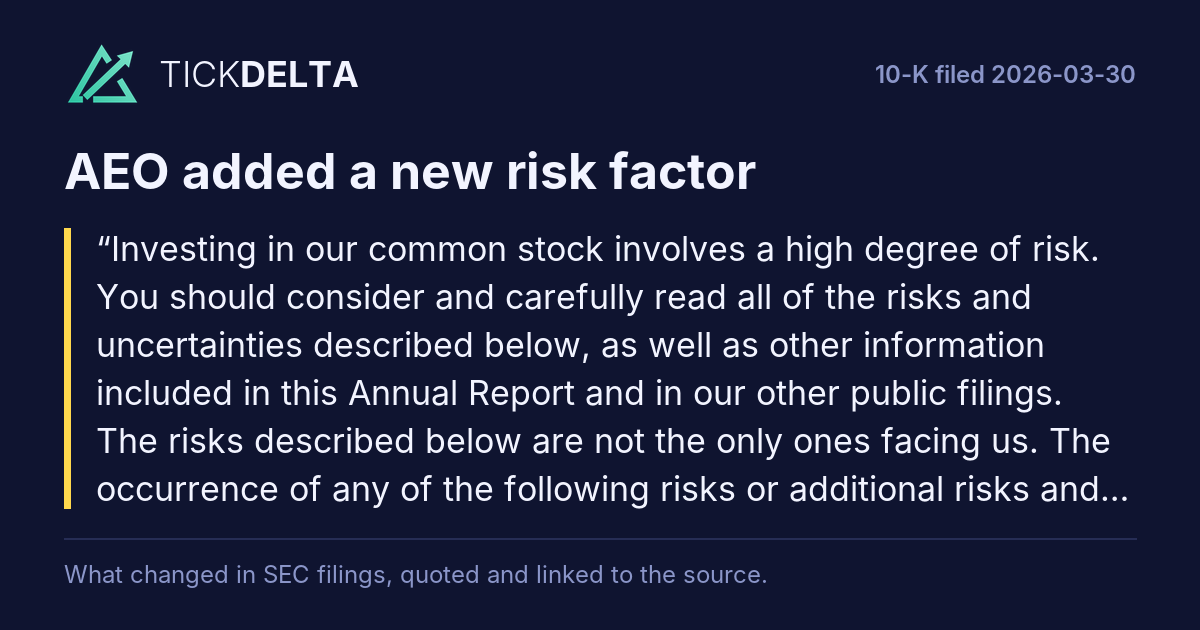
Investing in our common stock involves a high degree of risk. You should consider and carefully read all of the risks and uncertainties described below, as well as other information included in this Annual Report and in our other public filings. The risks described below are not the only ones facing us. The occurrence of any of the following risks or additional risks and uncertainties not presently known to us or that we currently believe to be immaterial could materially and adversely affect our business, financial condition or results of operations. In such case, the trading price of our common stock could decline, and you may lose all or part of your original investment. This Annual Report also contains forward-looking statements and estimates that involve risks and uncertainties. Our actual results could differ materially from those anticipated in the forward-looking statements as a result of specific factors, including the risks and uncertainties described below.
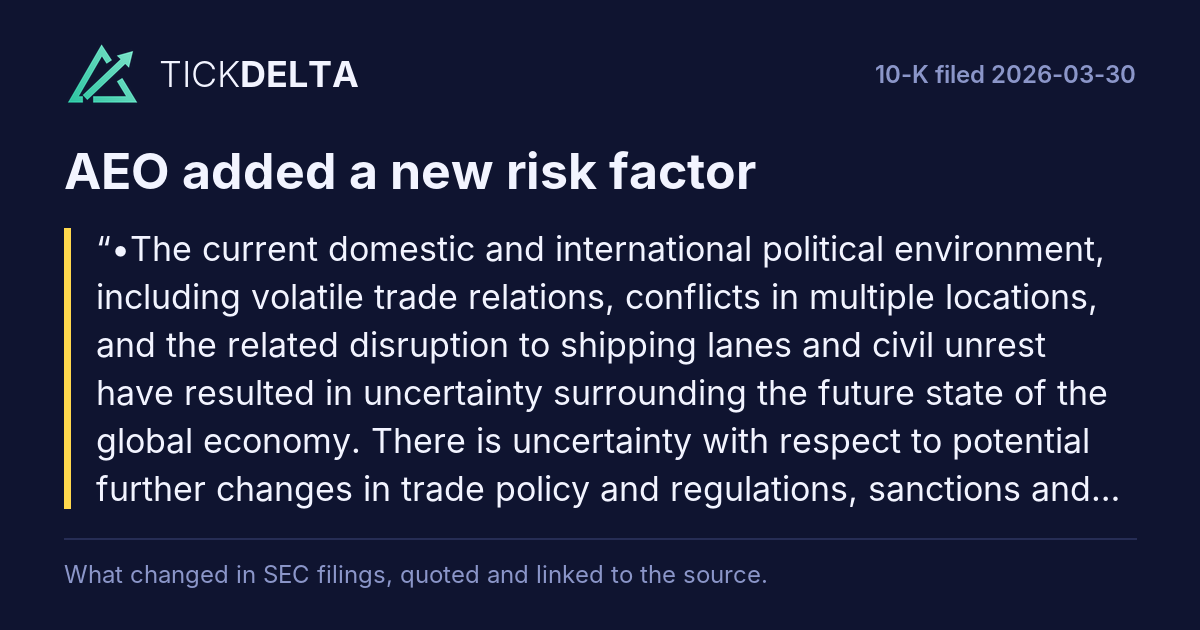
•The current domestic and international political environment, including volatile trade relations, conflicts in multiple locations, and the related disruption to shipping lanes and civil unrest have resulted in uncertainty surrounding the future state of the global economy. There is uncertainty with respect to potential further changes in trade policy and regulations, sanctions and export controls, which increase volatility in the global economy and foreign currency exchange rates. This environment has affected and may continue to affect production and distribution lead times, increasing our costs and potentially affecting our ability to meet customer demand. If these disruptions persist, they may require us to modify our current sourcing practices, which may impact our product costs, and, correspondingly, could have a material adverse effect on our business and results of operations.
•Trade policies and regulations, such as new, increased, or continuing uncertainty concerning tariffs or other trade restrictions may also increase the costs for imported materials and finished goods. Any resulting increase in prices we charge for our goods could negatively impact demand for our products, our sales and results of operations. Further, increases in consumer expenses more generally, may reduce discretionary spending and heighten price sensitivity, which could similarly negatively impact the demand for our products, our sales, and results of operations.
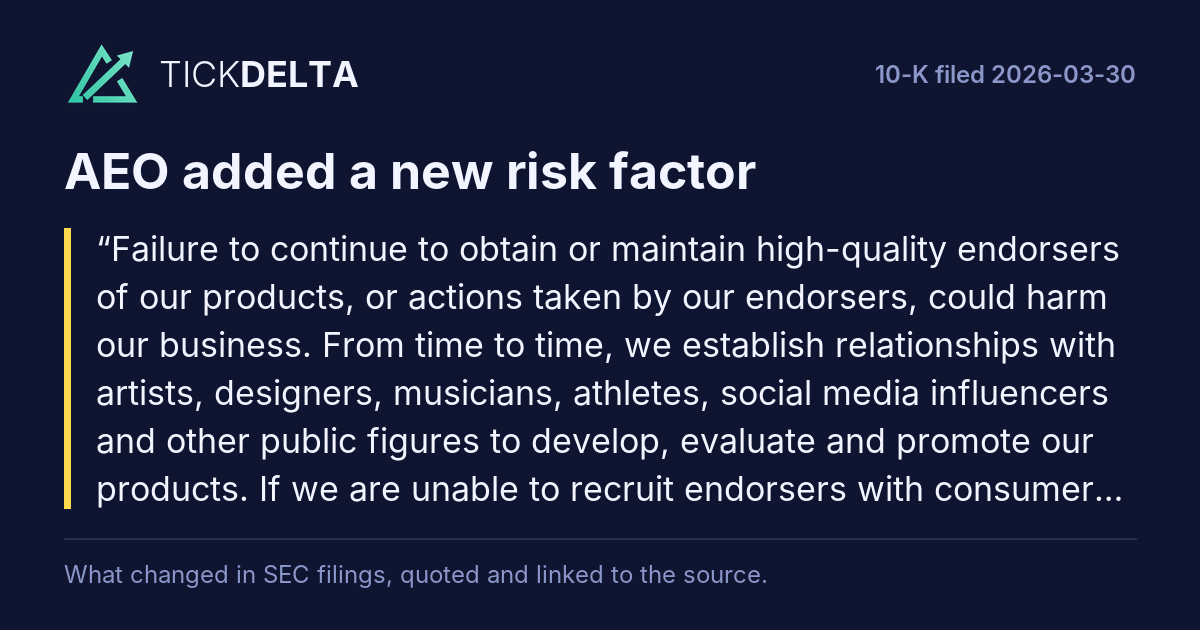
Failure to continue to obtain or maintain high-quality endorsers of our products, or actions taken by our endorsers, could harm our business.
From time to time, we establish relationships with artists, designers, musicians, athletes, social media influencers and other public figures to develop, evaluate and promote our products. If we are unable to recruit endorsers with consumer appeal or endorsers were to stop using our products contrary to their endorsement agreements, our business could be adversely affected. In addition, actions taken, allegations of wrongdoing or statements made by our endorsers, associated with our products or brand or otherwise, that harm the reputations of those endorsers or our decisions to cease collaborating with certain endorsers in light of actions taken, allegations of wrongdoing or statements made by them, could also seriously harm our brand image with consumers and, as a result, could have an adverse effect on our business.
We rely on third parties to drive traffic to our platform, and these providers may change their algorithms or pricing, or may be subject to new laws and regulations, in ways that could negatively affect our business, financial condition, cash flows, and results of operations.
We continue to invest in digital marketing to drive qualified traffic to our site. Our success with these efforts depends on an ability to attract customers cost effectively and, to do so, we rely heavily on relationships with providers of online services, search engines, social media and other websites and e-commerce businesses to provide content, advertising banners and other links that direct customers to our websites. We also use social media, including Facebook, Instagram, YouTube and others, as well as affiliate marketing, email, SMS, and direct mail, as part of our multi-channel approach to marketing and we expect that our use of social media for marketing purposes will increase over time. We rely on these relationships to provide significant traffic to our website and as important marketing channels and sources of information regarding potential customers. If digital platforms change or penalize us with their algorithms, terms of service, display and featuring of search results, or if competition increases for advertisements, we may be unable to cost-effectively attract customers. Our relationships with digital platforms are not covered by long-term contractual agreements and do not require any specific
performance commitments. In addition, many of the platforms and agencies with whom we have advertising arrangements provide advertising services to other companies, including retailers with whom we compete.
As competition for online advertising has increased, the cost for some of these services has also increased. A significant increase in the cost of the marketing providers upon which we rely could adversely impact our ability to attract customers cost effectively and harm our business, financial condition, results of operations and prospects. In addition, laws and regulations governing the use of these platforms and other digital marketing channels are rapidly evolving. It may become more difficult for us or our partners to comply with such laws, and future data privacy laws and regulations or industry standards, as well as related enforcement, may restrict or limit our ability to use some or all of the marketing strategies on which we currently rely. The failure by us, our employees or third parties acting at our direction to abide by applicable laws and regulations in the use of these platforms could adversely impact our reputation or subject us to fines or other penalties.
access to consumer data. Additionally, we maintain other confidential, proprietary, or otherwise sensitive information relating to our business and from third parties. Further, with the use of AI and other machine learning technologies, by us or our services providers, there is a risk that the data inputted into such technologies may contain confidential information or personal data, resulting in such information becoming accessible by third parties. The use of AI or machine learning technologies by our third-party service providers in their business activities, whether or not known to use, could also expose us to risks. While we believe we conduct appropriate diligence prior to onboarding third-party service providers, the failure of one or more such service provider to meet our expectations, including by use of AI tools in contravention of agreements with us, inputting our confidential or proprietary information into AI tools, or roll-out of new AI tools without approval, may give rise to issues pertaining to data privacy and data protection.
insurance or insurance not being available to us on economically feasible terms, or at all. Insurers may also deny us coverage as to any future claim. Any of these results could harm our growth prospects, financial condition, business, and reputation.
In addition, recent trade policies and uncertainty related thereto, including with respect to tariffs and other restrictions, with respect to countries from which we source our merchandise and raw materials, have created a dynamic and unpredictable trade landscape. This has and may continue to adversely impact our business and operations. On February 20, 2026, the U.S. Supreme Court held that the U.S. administration’s imposition of tariffs unlawful pursuant to the International Emergency Economic Powers Act (“IEEPA”) was unlawful, striking down the 10% global baseline tariff, as well as the higher tariffs imposed on certain U.S. trading partners. The U.S. Supreme Court’s ruling did not affect all of the recently imposed tariffs, including those imposed following trade remedy investigations by the Department of Commerce or the U.S. Trade Representative. Nor does it prohibit the imposition of future tariffs through alternative trade authorities available to the U.S. administration. On February 20, 2026, shortly after the announced U.S. Supreme Court decision, the U.S. administration announced that it would be imposing a new 10% global tariff for a period of 150 days pursuant to a balance-of-payments
provision in Section 122 of the Trade Act of 1974, effective February 24, 2026, which is being challenged in court by several US states. The U.S. administration further announced that it would begin additional trade remedy investigations into unidentified trading partners pursuant to Section 301 of the Trade Act of 1974 and with respect to certain unidentified product sectors pursuant to Section 232 of the Trade Expansion Act of 1962. The Court of International Trade subsequently issued an interim order requiring U.S. Customs and Border Protection ("CBP") to process unliquidated entries without the unlawful tariffs and to develop a plan that could result in refunds of duties previously collected. CBP has indicated it is developing a plan within 45 days to implement that order, however the scope, timing, and ultimate availability of any refunds remains uncertain. While the Company has taken steps to preserve its rights should a refund process be established, no assurance can be given that refunds will be realized.
Accordingly, uncertainty with respect to tariffs remains ongoing, and U.S. import tariffs and international trade arrangements will continue to change, potentially without warning and to an extent or duration that is difficult to predict. Changing tariff rates and shifting trade policies have created significant uncertainty for suppliers, consumers, and us. If tariffs from countries from which we source products are sustained at heightened levels, it will further increase our merchandise costs, may result in increased prices for our customers, and may negatively impact our margins and consumer demand for our products, any of which could harm our competitive position or otherwise negatively impact our operating results. Moreover, tariff and other trade-related cost pressures and supply chain disruptions may lead to reputational harm if we are unable to deliver our products or services on expected timelines. We may not be able to forecast such impacts accurately.
intellectual property generated through the use of AI tools. The impact of AI on intellectual property rights may result in increased costs with respect to policing and ownership disputes. Use of AI and other machine learning technologies, by us or our service providers, in connection with the creation or development of intellectual property may present challenges in asserting ownership over the resulting output, which may not be eligible for copyright or patent protection under various laws (including those of the U.S.) without sufficient human authorship or inventorship, respectively.
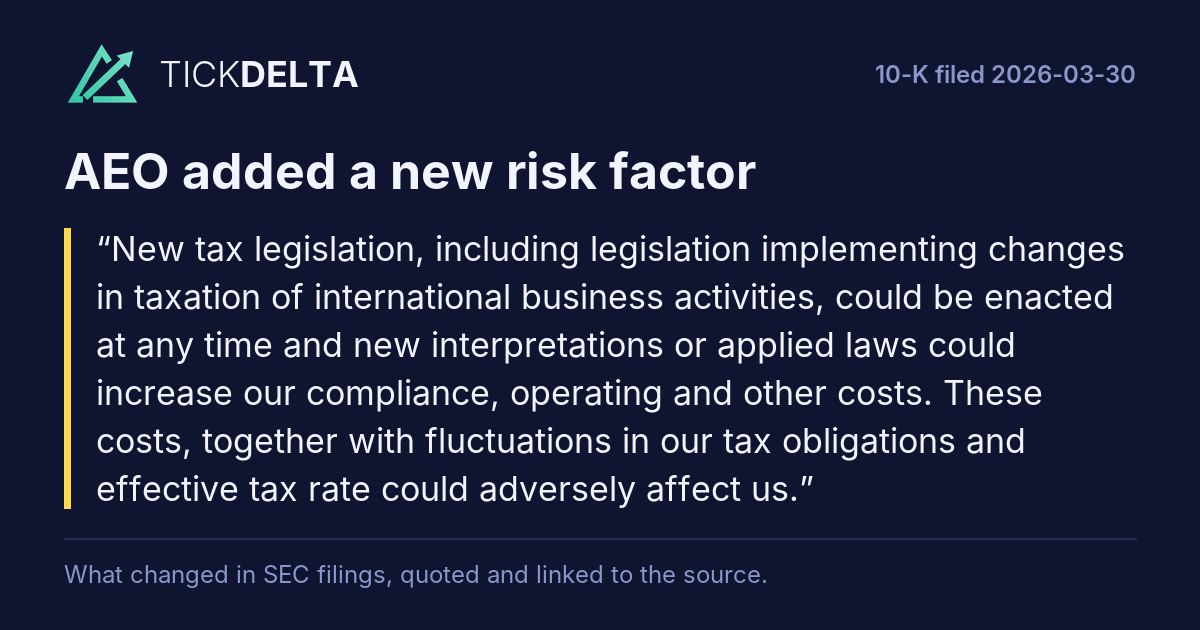
New tax legislation, including legislation implementing changes in taxation of international business activities, could be enacted at any time and new interpretations or applied laws could increase our compliance, operating and other costs. These costs, together with fluctuations in our tax obligations and effective tax rate could adversely affect us.
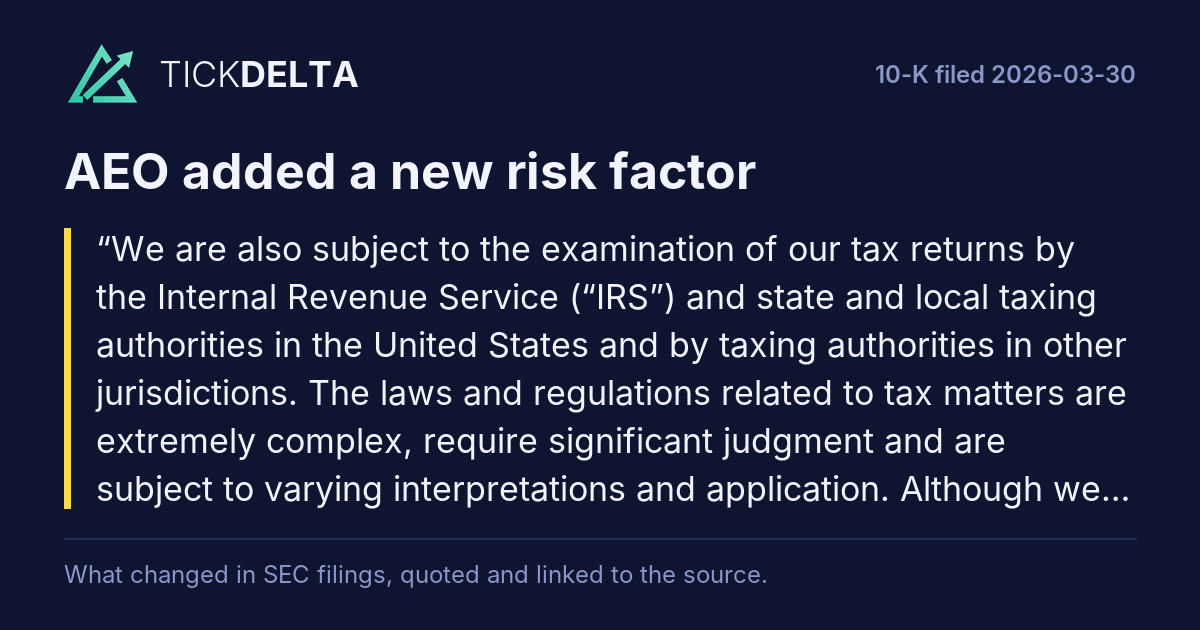
We are also subject to the examination of our tax returns by the Internal Revenue Service (“IRS”) and state and local taxing authorities in the United States and by taxing authorities in other jurisdictions. The laws and regulations related to tax matters are extremely complex, require significant judgment and are subject to varying interpretations and application. Although we believe our positions are reasonable, they are subject to challenge and the results of audits or related disputes could have an adverse effect on our financial statements for the period or periods for which the applicable final determinations are made. For example, we and our subsidiaries are also engaged in a number of intercompany transactions across multiple tax jurisdictions. Although we believe we have clearly reflected the economics of these transactions and the proper local transfer pricing documentation is in place, tax authorities may propose and sustain adjustments that could result in changes that may impact our mix of earnings in countries with differing statutory tax rates.
New in the latest 10-Q
35 paragraphs in the 10-Q filed Sep 10, 2026 with nothing like them in the 10-Q filed Jun 3, 2026 (at least half the words must differ; new numbers alone do not count). Quoted exactly, grouped by the item heading above them. This is text that changed, not a judgement of how serious it is.
• the planned opening of new stand-alone and side-by-side locations, the selection of existing stores for remodeling, and the closure of certain stores at the expiration of their lease terms;
Read in the 10-Q
We have based these forward-looking statements largely on our current expectations and projections about our business, the industry in which we operate and financial trends that we believe may affect our business, financial condition, results of operations and prospects, and these forward-looking statements are not guarantees of future performance or results. In addition, statements that “we believe” and similar statements reflect our beliefs and opinions on the relevant subject. These statements are based upon information available to us as of the date of this Quarterly Report, and while we believe such information forms a reasonable basis for such statements, such information may be limited or incomplete, and our statements should not be read to indicate that we have conducted an exhaustive inquiry into, or review of, all potentially available relevant information. These statements are inherently uncertain, and you are cautioned not to unduly rely upon these statements.
Read in the 10-Q
Selling, general and administrative expenses consist of compensation and employee benefit expenses, including salaries, incentives and related benefits associated with our stores and corporate headquarters. Selling, general and administrative expenses also include advertising costs, supplies for our stores and home office, communication costs, travel and entertainment, leasing costs and services purchased.
Read in the 10-Q
Selling, general and administrative expenses do not include compensation, employee benefit expenses and travel for our design, sourcing and importing teams, our buyers and our distribution centers as these amounts are recorded in cost of sales. Additionally, selling, general and administrative expenses do not include rent and utilities, operating costs of our distribution centers, and shipping and handling costs related to our e-commerce operations, all of which are included in cost of sales.
Read in the 10-Q
The Company submitted all refund claims eligible for refund in the first phase of CAPE in the amount of $189.8 million during the 26 weeks ended August 1, 2026. As of August 1, 2026, the Company has received $189.3 million of these refunds, or $195.7 million including interest, of which $191.9 million was recognized as a reduction of cost of sales and $3.8 million was recognized as a reduction of SG&A expenses in the Consolidated Statements of Operations.
Read in the 10-Q
Level 2 - Inputs other than Level 1 that are observable, either directly or indirectly.
Read in the 10-Q
On June 4, 2026, the Credit Agreement was amended to extend the maturity date of the Credit Facility to June 4, 2031 and simplify the interest rate calculation by removing the SOFR Adjustment and Term CORRA Adjustment (as such terms are defined in the Credit Agreement) and increasing the applicable margin (the “June 2026 Amendment”).
Read in the 10-Q
9. Share-Based Payments The Company accounts for share-based compensation under the provisions of ASC 718, Compensation - Stock Compensation, which requires the Company to measure and recognize compensation expense for all share-based payments at fair value. Total share-based compensation expense included in the Consolidated Statements of Operations for the 13 and 26 weeks ended August 1, 2026 was $6.8 million ($5.1 million, net of tax) and $28.9 million ($22.0 million, net of tax), and for the 13 and 26 weeks ended August 2, 2025 was $6.5 million ($5.0 million, net of tax) and $27.1 million ($20.6 million, net of tax), respectively.
Read in the 10-Q
Additionally, the Company paid $70.8 million related to the Participation Agreement during the 13 weeks ended August 1, 2026, representing substantially all of refund claims purchased by the buyer, plus interest,
Read in the 10-Q
The U.S. Supreme Court’s ruling did not affect all of the recently imposed tariffs, including those imposed following trade remedy investigations by the Department of Commerce or the U.S. Trade Representative. Nor does the ruling prohibit the imposition of future tariffs through alternative trade authorities available to the U.S. administration. On July 23, 2026, the U.S. administration announced plans to implement additional tariffs under Section 301 of the Trade Act of 1974, effective July 24, 2026. Accordingly, uncertainty with respect to tariffs remains ongoing.
Read in the 10-Q
• Operating income of $211 million increased 105% compared to $103 million for the same period last year. Included in operating income in the current quarter are tariff refunds of $196 million, partially offset by $35 million of incremental incentive expense attributable to the gain recognized as a result of tariff refunds. Net tariff refunds of $161 million contributed 1,170 basis points of operating margin expansion.
Read in the 10-Q
August 1, 2026 ────────────────────────────────────────────────────────── American Eagle: American Eagle stand-alone 599 Aerie side-by-side 183 AE brand, Aerie brand and OFFLINE™ 14 OFFLINE™ side-by-side 6 Total American Eagle 802 Aerie: Aerie stand-alone 225 OFFLINE™ stand-alone 49 OFFLINE™ side-by-side 61 Total Aerie 335 Todd Snyder 23 Unsubscribed 7
Read in the 10-Q
Comparison of the 13 weeks ended August 1, 2026 to the 13 weeks ended August 2, 2025
Read in the 10-Q
Other. The decrease in net revenue for the current period was primarily attributable to planned decreased revenue from Quiet Platforms due to completion of its operational wind-down.
Read in the 10-Q
Included in gross profit this period is a net benefit of $179 million related to tariff refunds, including interest, which drove 1,300 basis points of the gross margin expansion. Net tariff refunds consist of $192 million of IEEPA tariff refunds, partially offset by $13 million of incremental incentive expense attributable to the gain recognized as a result of tariff refunds.
Read in the 10-Q
Additionally, merchandise margin increased $78 million but deleveraged 330 basis points, with margin rate improvement in Aerie offset by promotional activity in American Eagle.
Read in the 10-Q
Buying, occupancy, and warehousing costs increased $22 million year-over-year, including $12 million related to compensation, and $7 million related to rent. Of the $12 million increase in compensation, $6 million is attributable to incremental incentives related to tariff refunds described above. The increase in rent is attributable to store lease renewals.
Read in the 10-Q
General corporate expenses. The increase was primarily the result of $35 million of incremental incentive expense attributable to the gain recognized as a result of the tariff refunds received.
Read in the 10-Q
Comparison of the 26 weeks ended August 1, 2026 to the 26 weeks ended August 2, 2025
Read in the 10-Q
Other. The decrease in net revenue for the current period was primarily attributable to planned decreased revenue from Quiet Platforms due to completion of its operational wind-down.
Read in the 10-Q
Included in gross profit for the 26 weeks ended August 1, 2026 is a net benefit of $179 million related to tariff refunds, which drove 700 basis points of the gross margin expansion. Net tariff refunds consist of $192 million of IEEPA tariff refunds, partially offset by $13 million of incremental incentive expense attributable to the gain recognized as a result of tariff refunds.
Read in the 10-Q
Additionally, merchandise margin increased $147 million due to higher sales and lower promotional activity period-over-period.
Read in the 10-Q
Buying, occupancy, and warehousing costs increased $27 million year-over-year. This increase includes $14 million related to compensation, $6 million of which is attributable to incremental incentives related to tariff refunds described above, and $10 million related to increased rent obligations.
Read in the 10-Q
General corporate expenses. The increase in operating income was primarily the result of $35 million of incremental incentive expense attributable to the gain recognized as a result of the tariff refunds received in the current period.
Read in the 10-Q
On June 4, 2026, the Credit Agreement was amended to extend the maturity date of the Credit Facility to June 4, 2031 and simplify the interest rate calculation by removing the SOFR Adjustment and Term CORRA Adjustment (as such terms are defined in the Credit Agreement) and increasing the applicable margin.
Read in the 10-Q
Exhibit 3.1 Amended and Restated Certificate of Incorporation of American Eagle Outfitters, Inc., as amended (incorporated by reference to Exhibit 3.1 to the Company’s Form 10-Q filed on September 6, 2007 (SEC File No. 001-33338))
Read in the 10-Q
Exhibit 3.2 Amended and Restated Bylaws of American Eagle Outfitters, Inc. (incorporated by reference to Exhibit 3.2 to the Company’s Form 10-K filed on March 13, 2023 (SEC File No. 001-33338))
Read in the 10-Q
Exhibit 10,1+ Amendment No. 2 to Second Amended and Restated Credit Agreement, dated as of June 4, 2026, between American Eagle Outfitters, Inc., American Eagle Outfitters Canada Corporation, the other borrowers thereto from time to time, the lenders party thereto from time to time and PNC Bank, National Association, as administrative agent. (incorporated by reference to Exhibit 10.1 to the Company’s Current Report on Form 8-K filed on June 4, 2026)
Read in the 10-Q
^ Exhibit 10.2 American Eagle Outfitters, Inc. Amended and Restated 2023 Stock Award and Incentive Plan (incorporated by reference to Exhibit 10.1 to the Company’s Current Report Form 8-K filed on June 29, 2026).
Read in the 10-Q
*^ Exhibit 10.3 Transition Agreement between American Eagle Outfitters, Inc. and Michael Mathias, dated June 29, 2026.
Read in the 10-Q
*^ Exhibit 10.4 Letter Agreement between American Eagle Outfitters, Inc. and Ravi Thanawala, dated June 12, 2026.
Read in the 10-Q
*^ Exhibit 10.5 Change in Control Agreement between American Eagle Outfitters, Inc. and Ravi Thanawala, dated June 12, 2026
Read in the 10-Q
* Exhibit 101. INS Inline XBRL Instance Document - The instance document does not appear in the Interactive Data File because its XBRL tags are embedded within the Inline XBRL document.
Read in the 10-Q
* Exhibit 101. SCH Inline XBRL Taxonomy Extension Schema With Embedded Linkbase Documents.
Read in the 10-Q
+ Certain exhibits and schedules to the Amendment No. 2 to Second Amended and Restated Credit Agreement have been omitted pursuant to Item 601(a)(5) of Regulation S-K. The Company hereby undertakes to furnish a copy of the omitted exhibits and schedules to the Amendment No. 2 to Second Amended and Restated Credit Agreement to the Securities and Exchange Commission upon request.
Read in the 10-Q
Item 1A of the 10-Q filed Sep 10, 2026 against Item 1A of the 10-K filed Mar 30, 2026.
A 10-Q repeats only the risks that changed, so a 10-K paragraph that is missing from it is not counted as removed.
Added is a paragraph with nothing like it in the 10-K, Reworded a sentence that is in both with several words changed,
Quiet changes a sentence in both where one to four words changed and one is a hedge or a modal
(cut words struck through, new words highlighted).
Text on the page, not a score; each links to the filing at sec.gov.
What the 10-Q itself says about its risk factors:Risk factors that affect our business and financial results are discussed within Part I, Item 1A of our Fiscal 2025 Form 10-K. There have been no material changes to our risk factors as disclosed in the Fiscal 2025 Form 10-K.
Read in the 10-Q
Two-word phrases in Risk Factors of the 10-K filed Mar 30, 2026 that are in none of the 1 earlier 10-Ks stored, back to Mar 20, 2025
Used at least twice, small words left out. Counted, not picked: a phrase can be new because the company renamed something.
5 paragraphs of last year's Risk Factors with nothing like them now. The longest are quoted.
Item 1A of each 10-K and 10-Q on EDGAR, quoted exactly. Each paragraph links to the filing at sec.gov.
10-K change: what was reworded or cut, section by section.
Excel workbook · CSV. Google Sheet that stays up to date: paste =IMPORTDATA("https://tickdelta.com/company/AEO/export.csv") into a cell.