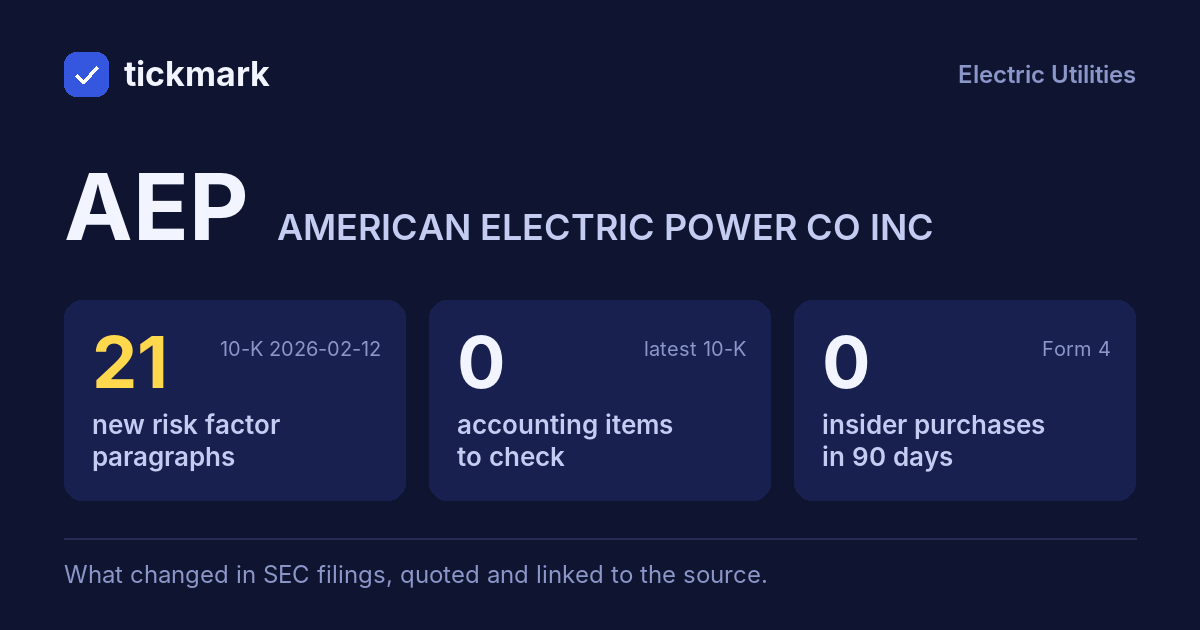
Marked against last year's 10-K:
cut words struck through, new words highlighted and underlined.
MD&A 325 words changed in this paragraph; it is 33% similar to last year's version.
In January 2024, July 2025, APCo filed a request with the KPSC Virginia SCC to finance, through the issuance of proposed 20-year securitization bonds, approximately $1.4 billion of Virginia jurisdictional undepreciated property balances and a major storm operation and maintenance regulatory asset deferral balance. This proposed securitization included: (a) $1.2 billion of undepreciated Virginia jurisdictional plant balances as of December 31, 2023 for the Amos and Mountaineer Plants and (b) $141 million of Virginia jurisdictional major storm other operation and maintenance expenses deferred during the 2024-2025 biennial period. In September 2025, Virginia SCC staff submitted testimony concluding that all costs proposed by APCo for securitization are eligible for securitization in accordance with Virginia law. While also concluding that APCo’s proposed securitization of the Amos and Mountaineer Plants over 20 years offers benefits to customers through rate relief, Virginia SCC staff took no position on APCo’s proposed securitization of major storm other operation and maintenance expenses due to the apparent lack of significant benefit or cost savings for customers. In October 2025, the Hearing Examiner recommended the Virginia SCC approve the requested $1.4 billion for securitization. In November 2025, the Virginia SCC issued a financing order approving KPCo’s request to securitize certain regulatory assets balances as securitization of the time securitization bonds are issued and concluding that costs requested for recovery through securitization were prudently incurred. The KPSC’s financing order includes certain additional requirements related to securitization bond structuring, marketing, placement and issuance that were not reflected in KPCo’s proposal. $1.4 billion of Virginia jurisdictional costs. In accordance with Kentucky Virginia statutory requirements and the financing order, the issuance of the securitized securitization bonds is subject to final review by the KPSC Virginia SCC after bond pricing. KPCo APCo expects to proceed with the securitized securitization bond issuance process and to complete the securitization process in the first half of 2025, 2026, subject to market conditions. As of December 31, 2024, regulatory asset balances expected to be recovered through securitization total $491 million and include: (a) $303 million of plant retirement costs, (b) $79 million of deferred storm costs related to 2020, 2021, 2022 and 2023 major storms, (c) $50 million of deferred purchased power expenses, (d) $57 million of under-recovered purchased power rider costs and (e) $2 million of deferred issuance-related expenses, including KPSC advisor expenses. If any of these costs are not recoverable, it could reduce future net income and cash flows and impact financial condition.
Source: Item 7, 10-K 0000004904-26-000013 vs Item 7, 10-K 0000004904-25-000027
Legal Proceedings 218 words changed in this paragraph; it is 69% similar to last year's version.
AEP sold the Gavin Power Station to Gavin Power LLC and Lighthouse Generation LLC in 2017. Pursuant to the PSA for that transaction, AEP maintained responsibility to complete closure of the 300 acre unlined fly ash reservoir (FAR) pond in accordance with the closure plan approved by the Ohio EPA and to indemnify the purchasers for that work. In July 2021, closure work was completed by AEP. In November 2022, the Federal EPA issued a final decision denying Gavin Power LLC’s requested extension to allow a CCR surface impoundment another pond at the Gavin Power Station Station, the CCR surface impoundment, to continue to receive CCR and non-CCR waste streams after April 11, 2021 until May 4, 2023 (the Gavin Denial). As part of the Gavin Denial, the Federal EPA made several assertions related to the CCR Rule (see “Environmental Issues - CCR Rule” section of Management’s Discussion and Analysis of Financial Condition and Results of Operations for additional information), Rule, including an assertion that the closure of the 300 acre unlined fly ash reservoir (FAR) FAR is noncompliant with the CCR Rule in multiple respects. The Gavin Power Station was formerly owned and operated by AEP and was sold to Gavin Power LLC and Lightstone Generation LLC in 2017. Pursuant to the PSA, AEP maintained responsibility to complete closure of the FAR in accordance with the closure plan approved by the Ohio EPA which was completed in July 2021. The PSA contains indemnification provisions, pursuant to which the owners of the Gavin Power Station have notified AEP that they believe they are entitled to indemnification for any damages that may result from these claims, including any future enforcement or litigation resulting from any determinations of noncompliance by the Federal EPA with various aspects of the CCR Rule consistent with the Gavin Denial. The owners of the Gavin Power Station have also sought indemnification for landowner claims for property damage allegedly caused by modifications to the FAR. Management does not believe that the owners of the Gavin Power Station have any valid claim for indemnity or otherwise against AEP under the PSA. In January 2024, Gavin Power LLC also filed a complaint with the United States District Court for the Southern District of Ohio, alleging various violations of the Administrative Procedure Act and asserting that the Federal EPA, through its prior inaction, has waived and is estopped from raising certain objections raised in the Gavin Denial. Management The complaint does not assert any claims against AEP. In August 2025, the District Court dismissed the complaint at the Federal EPA’s request. Based on the information currently available, management does not believe a loss is unable to probable and cannot determine a range of potential losses losses, if any, that is reasonably possible of occurring.
Source: Item 3, via Note 6 – COMMITMENTS, GUARANTEES AND CONTINGENCIES, 10-K 0000004904-26-000013 vs Item 3, via Note 6 – COMMITMENTS, GUARANTEES AND CONTINGENCIES, 10-K 0000004904-25-000027
Risk Factors 189 words changed in this paragraph; it is 49% similar to last year's version.
AEP’s business plan and capital investment plans for the construction of new projects, including providing service to new data centers and other large load customers, involves a number involve execution risks that could adversely affect AEP’s financial performance and/or impair AEP’s ability to execute on these plans. These risks include delays, supply chain disruption and the unavailability of risks, including incomplete materials, cost overruns, inflation, the cost and availability of capital, labor disputes or inaccurate forecasting, planning and procurement, construction delays, non-performance by equipment shortages and other third-party suppliers factors that could cause the total cost and increases in equipment and labor costs. To timing of any project to exceed estimates. While AEP utilizes measures to limit the risks impact of these construction projects, AEP’s subsidiaries enter into interconnection and service agreements, equipment purchase orders and construction contracts and incur engineering and design service costs in advance of receiving necessary regulatory approvals, cost recovery and/or siting or environmental permits. If events, if any of these projects are canceled for any reason, including shifts in large customer needs, preferences or financial stability, shifts in demand for large customer products or services, changes in technology, failure to receive necessary regulatory approvals, cost recovery and/or siting or environmental permits, mitigation efforts might not be sufficient and it could result in significant unrecoverable costs or cancellation penalties under and the equipment purchase orders execution of AEP’s business and construction contracts could occur. capital investment plans would be negatively impacted. In addition, if any construction work or investments have been recorded as an asset, an impairment may need to be recorded in the event the a project is canceled. This would cause financial results to be diminished.
Source: Item 1A, 10-K 0000004904-26-000013 vs Item 1A, 10-K 0000004904-25-000027
Accounting Policies 91 words changed in this paragraph; it is 80% similar to last year's version.
For commercial activities, exchange-traded derivatives, namely futures contracts, are generally fair valued based on unadjusted quoted prices in active markets and are classified as Level 1. Level 2 inputs primarily consist of OTC broker quotes in moderately active or less active markets, as well as exchange-traded derivatives where there is insufficient market liquidity to warrant inclusion in Level 1. Management verifies price curves using these broker quotes and classifies these fair values within Level 2 when substantially all of the fair value can be corroborated. Management typically obtains multiple broker quotes, which are nonbinding in nature but are based on recent trades in the marketplace. When multiple broker quotes are obtained, the quoted bid and ask prices are averaged. In certain circumstances, a broker quote may be discarded if it is a clear outlier. Management uses a historical correlation analysis between the broker quoted location and the illiquid locations. If the points are highly correlated, these locations are included within Level 2 as well. Certain OTC and bilaterally executed derivative instruments are executed in less active markets with a lower availability of pricing information. Illiquid transactions, complex structured transactions, FTRs and counterparty credit risk may require nonmarket-based inputs. Some of these inputs may be internally developed or extrapolated and utilized to estimate fair value. When such inputs have a significant impact on the measurement of fair value, the instrument is categorized as Level 3. The main driver of contracts being classified as Level 3 is the inability to substantiate energy price curves in the market. A portion of the Level 3 instruments have been economically hedged which limits potential earnings volatility.
Source: Item 8, Note 1 – ORGANIZATION AND SUMMARY OF SIGNIFICANT ACCOUNTING POLICIES, 10-K 0000004904-26-000013 vs Item 8, Note 1 – ORGANIZATION AND SUMMARY OF SIGNIFICANT ACCOUNTING POLICIES, 10-K 0000004904-25-000027