Paragraph 50 · 49% changed
Every version of it
Screener
/
SEC EDGAR
/CIK 0001820953
/10-K filed Aug 27, 2026, compared with Aug 28, 2025
/Numbers from the XBRL of the 10-Ks
Nasdaq
Financials · Personal Credit Institutions
Affirm Holdings, Inc. AFRM
The 10-K against last year's
211 changes: 43 added, 36 removed, 130 reworded, 2 quiet changes
10-K Aug 27, 2026 vs Aug 28, 2025
Risk Factors
16.0%
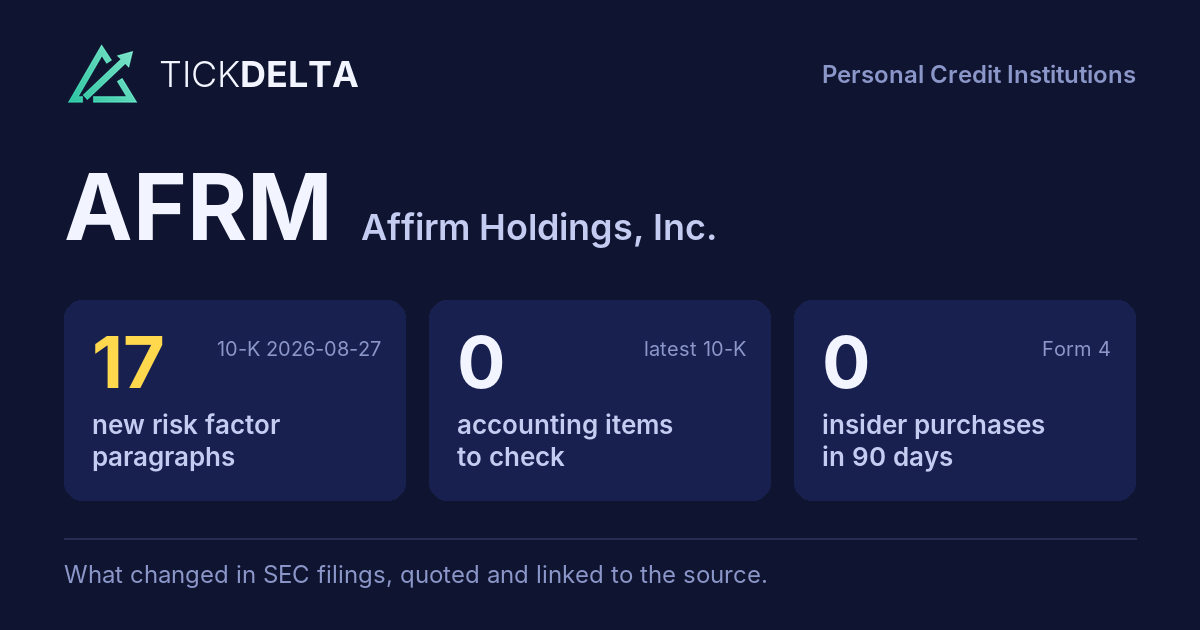
of the text changed · 24,034 words now · 17 new paragraphs, 27 gone
MD&A
32.6%
of the text changed · 10,825 words now · 26 new paragraphs, 9 gone
Legal Proceedings
3.6%
of the text changed · 1,085 words now
Accounting Policies
22.2%
of the text changed · 6,547 words now
10-K 0001628280-26-059279 (Aug 27, 2026) vs 10-K 0001820953-25-000080 (Aug 28, 2025)
Every paragraph, and how much of it changed
One bar per paragraph, in the order of the 10-K. Height and colour show the share of its words not in the closest paragraph a year earlier; the tallest bars are new paragraphs.
Risk Factors
267 paragraphs · 17 new · 86 reworded · 27 gone · 10-K Aug 27, 2026 against Aug 28, 2025
New paragraph
Reworded (5% of its words or more)
Same or nearly
Paragraph 120 · 48% changed
Every version of it
Our future success is aided by our ability to identify, hire, develop, motivate, and retain highly qualified personnel for all areas of our organization, in particular, a highly experienced sales force, data scientists, and engineers. Competition for these types of highly skilled employees is extremely intense, particularly in the San Francisco Bay Area. Trained and experienced personnel are in high demand and may be in short supply. Many of the companies with which we compete for experienced employees have greater resources than we do and may be able to offer more attractive terms of employment. In addition, we invest significant time and expense in training our employees, which increases their value to competitors that may seek to recruit them. We may not be able to attract, develop, and maintain the skilled workforce necessary to operate our business, and labor expenses may increase as a result of a shortage in the supply of qualified personnel. If we are unable to maintain and build our highly experienced sales force, or are unable to continue to attract experienced engineering and technology personnel, our business, results of operations, financial condition, and future prospects could be materially and adversely affected.
Paragraph 184 · 48% changed
Every version of it
Paragraph 114 · 47% changed
Every version of it
In addition to the risks of various taxing jurisdictions stated above, the Organisation for Economic Co-operation and Development (“OECD”) continues to put forth has developed various initiatives, including a framework to implement a global minimum corporate tax of 15% for certain large multinational enterprises with global revenues and profits above certain thresholds (referred enterprise groups (“MNEs”), commonly referred to as “Pillar Two”). While it is uncertain whether the United States will enact legislation to adopt Pillar Two, certain countries Two.” Certain jurisdictions in which we operate have adopted legislation, enacted, and other countries are in the process of introducing others may enact, legislation to implement implementing Pillar Two. As of June 30, 2025, based on the countries in which we do business that have enacted legislation, we do not currently expect Pillar Two to have a material impact on our financial statements. However, this may change as other countries enact similar legislation and further guidance is released. Two, including qualified domestic minimum top-up taxes.
Paragraph 175 · 46% changed
Every version of it
For example, certain installment loans are originated by our originating bank partners and then disbursed to merchants via one-time-use virtual cards facilitated through our partnership with an issuer processor. This issuer processor issues one-time-use virtual cards through an issuing bank partner, which allow loans facilitated through our platform to be processed over the card network. Such loans facilitated through our platform can be used at merchants where we are not integrated at checkout, allowing consumers to complete purchases with virtual cards just as they would with a standard credit or debit card. In the event that our issuer processor becomes unable or unwilling to facilitate the disbursements to merchants and we are unable to reach an agreement with another third-party partner, such loans would no longer be able to be facilitated through our platform.
Paragraph 80 · 45% changed
Every version of it
Paragraph 196 · 42% changed
Every version of it
Paragraph 116 · 41% changed
Every version of it
As of June 30, 2026, we do not currently expect Pillar Two to have a material impact on our financial statements; however, the ultimate impact will depend on future legislation, administrative guidance, interpretation, our operating results, jurisdictional income mix, tax attributes, and other facts. As a result of these risks, we may not be successful in managing our existing international operations, and our future international expansion efforts also may not be successful.
Paragraph 50 · 49% changed
Every version of it
10-K Aug 28, 2025Each of our Primary Originating Banks and our Card Issuing Bank handles a variety of consumer and commercial financing programs. The Celtic Bank loan program agreement had an initial three-year term that expired in calendar year 2023. The term automatically renewed for an additional one-year term and will continue to automatically renew in one-year terms thereafter unless either party provides notice of its intent not to renew. The Lead Bank loan program agreement has an initial three-year term which will expire in calendar year 2026. The term will automatically renew for additional one-year terms thereafter unless either party provides notice of its intent not to renew. The Evolve Bank loan program agreement has an initial two-year term that expired in calendar year 2023. The term automatically renewed for an additional one-year term and will continue to automatically renew in one-year terms thereafter unless either party provides notice of its intent not to renew. The Stride Bank loan program agreement has an initial five-year term which will expire in calendar year 2030. The term will automatically renew in one-year terms thereafter unless either party provides notice of its intent not to renew. In addition, upon the occurrence of certain early termination events, either we or any of our Primary Originating Banks or Card Issuing Bank may terminate the respective agreement immediately upon the occurrence of certain termination events.
10-K Aug 27, 2026
In addition, upon the occurrence of certain early termination events, either we or any of our Primary Originating Banks or Card Issuing Banks may terminate the respective agreement immediately upon the occurrence of certain termination events.
Paragraph 120 · 48% changed
Every version of it
10-K Aug 28, 2025
Our future success is aided by our ability to identify, hire, develop, motivate, and retain highly qualified personnel for all areas of our organization, in particular, a highly experienced sales force, data scientists, and engineers. Competition for these types of highly skilled employees is extremely intense, particularly in the San Francisco Bay Area. Trained and experienced personnel are in high demand and may be in short supply. Many of the companies with which we compete for experienced employees have greater resources than we do and may be able to offer more attractive terms of employment. In addition, we invest significant time and expense in training our employees, which increases their value to competitors that may seek to recruit them. We may not be able to attract, develop, and maintain the skilled workforce necessary to operate our business, and labor expenses may increase as a result of a shortage in the supply of qualified personnel. If we are unable to maintain and build our highly experienced sales force, or are unable to continue to attract experienced engineering and technology personnel, our business, results of operations, financial condition, and future prospects could be materially and adversely affected.
10-K Aug 27, 2026
Our future success is aided by our ability to identify, hire, develop, motivate, and retain highly qualified personnel for all areas of our organization, in particular, a highly experienced sales force, data scientists, and engineers. Competition for these types of highly skilled employees is extremely intense, particularly in the San
Paragraph 184 · 48% changed
Every version of it
10-K Aug 28, 2025Any real or perceived errors, failures, bugs, or defects in the software may not be found until our consumers use our platform and could result in outages or degraded quality of service on our platform that could adversely impact our business (including through causing us not to meet contractually required service levels), as well as negative publicity, loss of or delay in market acceptance of our products and services, and harm to our brand or weakening of our competitive position. In such an event, we may be required, or may choose, to expend significant additional resources in order to correct the problem. For example, in the second half of fiscal year 2025, we reallocated significant resources to prioritize system stability and reduce outages, which may delay certain strategic objectives, including the launch of products or services and our launch in certain international jurisdictions, and adversely affect our business, results of operations, financial condition, and future prospects.
10-K Aug 27, 2026
significant additional resources in order to correct the problem. For example, in the second half of fiscal year 2025, we reallocated significant resources to prioritize system stability and reduce outages, resulting in delays to certain product launches and other strategic objectives. Similar reallocations of resources in the future could adversely affect our business, results of operations, financial condition, and future prospects.
Paragraph 114 · 47% changed
Every version of it
10-K Aug 28, 2025
In addition to the risks of various taxing jurisdictions stated above, the Organisation for Economic Co-operation and Development (“OECD”) continues to put forth various initiatives, including a framework to implement a global minimum corporate tax of 15% for certain multinational enterprises with global revenues and profits above certain thresholds (referred to as “Pillar Two”). While it is uncertain whether the United States will enact legislation to adopt Pillar Two, certain countries in which we operate have adopted legislation, and other countries are in the process of introducing legislation to implement Pillar Two. As of June 30, 2025, based on the countries in which we do business that have enacted legislation, we do not currently expect Pillar Two to have a material impact on our financial statements. However, this may change as other countries enact similar legislation and further guidance is released.
10-K Aug 27, 2026
In addition to the risks of various taxing jurisdictions stated above, the Organisation for Economic Co-operation and Development (“OECD”) has developed various initiatives, including a framework to implement a global minimum corporate tax of 15% for certain large multinational enterprise groups (“MNEs”), commonly referred to as “Pillar Two.” Certain jurisdictions in which we operate have enacted, and others may enact, legislation implementing Pillar Two, including qualified domestic minimum top-up taxes.
Paragraph 175 · 46% changed
Every version of it
10-K Aug 28, 2025
For example, certain installment loans are originated by our originating bank partners and then disbursed to merchants via one-time-use virtual cards facilitated through our partnership with an issuer processor. This issuer processor issues one-time-use virtual cards through an issuing bank partner, which allow loans facilitated through our platform to be processed over the card network. Such loans facilitated through our platform can be used at merchants where we are not integrated at checkout, allowing consumers to complete purchases with virtual cards just as they would with a standard credit or debit card. In the event that our issuer processor becomes unable or unwilling to facilitate the disbursements to merchants and we are unable to reach an agreement with another third-party partner, such loans would no longer be able to be facilitated through our platform.
10-K Aug 27, 2026
For example, certain installment loans are originated by our originating bank partners and then disbursed to merchants via virtual cards facilitated through our partnership with an issuer processor. This issuer processor issues
Paragraph 80 · 45% changed
Every version of it
10-K Aug 28, 2025We currently use and expect to continue to use generative AI, a relatively new and emerging technology in the early stages of commercial use, in certain aspects of our business, including our customer service chatbot, which could expose us to additional risks. Generative AI may create inaccurate, incomplete or misleading outputs, reflect unintended biases, or produce other discriminatory or unexpected results, errors or inadequacies, any of which may not be easily detectable. While we have processes and controls in place designed to mitigate the risks associated with using generative AI, including human involvement in the training and monitoring of our AI tools and the alignment of our AI development policies and procedures with guidelines for secure development practices, if the content, analyses, or recommendations that generative AI assists in producing or our products and services are, or are perceived to be, deficient, inaccurate, biased, unethical or otherwise flawed, our reputation, competitive position and business may be adversely affected and we may incur additional costs, including in the form of damages or fines.
10-K Aug 27, 2026
analyses, or recommendations that generative AI assists in producing or our products and services are, or are perceived to be, deficient, inaccurate, biased, unethical or otherwise flawed, our reputation, competitive position and business may be adversely affected and we may incur additional costs, including in the form of damages or fines.
Paragraph 196 · 42% changed
Every version of it
10-K Aug 28, 2025In addition, we cannot guarantee that we have entered into agreements containing obligations of confidentiality with each party that has or may have had access to proprietary information, know-how, or trade secrets owned or held by us. Moreover, our contractual arrangements may be breached or may otherwise not effectively prevent disclosure of, or control access to, our confidential or otherwise proprietary information or provide an adequate remedy in the event of an unauthorized disclosure. The measures we have put in place may not prevent misappropriation, infringement, or other violation of our intellectual property or other proprietary rights or information and any resulting loss of competitive advantage, and we may be required to litigate to protect our intellectual property or other proprietary rights or information from misappropriation, infringement, or other violation by others, which is expensive, could cause a diversion of resources, and may not be successful, even when our rights have been infringed, misappropriated, or otherwise violated. Our efforts to enforce our intellectual property and other proprietary rights may be met with defenses, counterclaims, and countersuits attacking the validity and enforceability of our intellectual property and other proprietary rights, and if such defenses, counterclaims, or countersuits are successful, it could diminish or we could otherwise lose valuable intellectual property and other proprietary rights. Additionally, the laws of some foreign countries may not be as protective of
10-K Aug 27, 2026
our rights have been infringed, misappropriated, or otherwise violated. Our efforts to enforce our intellectual property and other proprietary rights may be met with defenses, counterclaims, and countersuits attacking the validity and enforceability of our intellectual property and other proprietary rights, and if such defenses, counterclaims, or countersuits are successful, it could diminish or we could otherwise lose valuable intellectual property and other proprietary rights. Additionally, the laws of some foreign countries may not be as protective of intellectual property and other proprietary rights as those in the United States, and the mechanisms for enforcement of intellectual property and other proprietary rights may be inadequate.
Paragraph 116 · 41% changed
Every version of it
10-K Aug 28, 2025
As a result of these risks, we may not be successful in managing our existing international operations, and our future international expansion efforts also may not be successful.
10-K Aug 27, 2026
As of June 30, 2026, we do not currently expect Pillar Two to have a material impact on our financial statements; however, the ultimate impact will depend on future legislation, administrative guidance, interpretation, our operating results, jurisdictional income mix, tax attributes, and other facts. As a result of these risks, we may not be successful in managing our existing international operations, and our future international expansion efforts also may not be successful.
MD&A
142 paragraphs · 26 new · 79 reworded · 9 gone · 10-K Aug 27, 2026 against Aug 28, 2025
New paragraph
Reworded (5% of its words or more)
Same or nearly
Paragraph 63 · 50% changed
Merchant network revenue as a percentage of GMV decreased to 2.3% for the year ended June 30, 2025 increased by $208.1 million, or 31%, compared to the same period in 2024. The increase is primarily attributed to an increase of $10.0 billion or 38% in GMV 2026 from 2.4% for the year ended June 30, 2025. The portion of GMV attributed to 0% APR loans, including Pay-in-X, increased from $26.6 billion as of by 48% for the year ended June 30, 2024 to $36.7 billion as of June 30, 2025. GMV from the top five merchants and platform partners as of June 30, 2025, increased 38% 2026, compared to the same period in 2024. Our active merchant base and 2025; however, the number impact of active consumers also grew, reaching approximately 377 thousand and 23.0 million, respectively, a higher percentage of GMV attributed to 0% APR loans was offset by an increase in direct to consumer transactions as a percentage of June 30, 2025, up from approximately 303 thousand and 18.7 million, respectively, as GMV, led by the growth of June 30, 2024. Affirm Card.
Paragraph 67 · 48% changed
Paragraph 24 · 46% changed
Paragraph 47 · 44% changed
Paragraph 51 · 44% changed
Paragraph 68 · 44% changed
Paragraph 70 · 44% changed
Paragraph 49 · 43% changed
Paragraph 63 · 50% changed
10-K Aug 28, 2025
Merchant network revenue for the year ended June 30, 2025 increased by $208.1 million, or 31%, compared to the same period in 2024. The increase is primarily attributed to an increase of $10.0 billion or 38% in GMV for the year ended June 30, 2025. GMV increased from $26.6 billion as of June 30, 2024 to $36.7 billion as of June 30, 2025. GMV from the top five merchants and platform partners as of June 30, 2025, increased 38% compared to the same period in 2024. Our active merchant base and the number of active consumers also grew, reaching approximately 377 thousand and 23.0 million, respectively, as of June 30, 2025, up from approximately 303 thousand and 18.7 million, respectively, as of June 30, 2024.
10-K Aug 27, 2026
Merchant network revenue as a percentage of GMV decreased to 2.3% for the year ended June 30, 2026 from 2.4% for the year ended June 30, 2025. The portion of GMV attributed to 0% APR loans, including Pay-in-X, increased by 48% for the year ended June 30, 2026, compared to the same period in 2025; however, the impact of a higher percentage of GMV attributed to 0% APR loans was offset by an increase in direct to consumer transactions as a percentage of GMV, led by the growth of Affirm Card.
Paragraph 67 · 48% changed
10-K Aug 28, 2025Interest income for the year ended June 30, 2025 increased by $403.9 million, or 34%, compared to the same period in 2024. Generally, interest income is correlated with the changes in the average balance of loans held for investment, which increased by 28% to $6.5 billion for the year ended June 30, 2025, compared to the same period in 2024. As a result, interest income from interest-bearing loans increased $380.4 million, or 36%, compared to the same period in 2024.
10-K Aug 27, 2026
The increase was primarily driven by contractual interest income for interest-bearing loans, which grew approximately $373.9 million for the year ended June 30, 2026, compared to the same period in 2025, comprising 85% of the total increase. Interest income from the amortization of the discount on 0% and below market APR loans grew approximately $77.9 million over the same period, comprising 18% of the total increase.
Paragraph 24 · 46% changed
10-K Aug 28, 2025Provision for credit losses increased by $156.1 million, or 34%, for the year ended June 30, 2025 compared to the same period in 2024, primarily driven by growth in the volume of loans held for investment. For the year ended June 30, 2025, the average balance of loans held for investment was $6.5 billion, an increase of $1.4 billion, or 28%, as compared to the same period in 2024. The allowance for credit losses as a percentage of loans held for investment increased from 5.5% as of June 30, 2024 to 5.6% as of June 30, 2025. The increase in the allowance rate year over year is primarily driven by an increase in loans held on our balance sheet as well as a change in the loan mix when compared to June 30, 2024, in line with expected credit performance.
10-K Aug 27, 2026
Loans held for investment increased by 36% and 24%, respectively, over the years ended June 30, 2026 and 2025. The balance and product mix of loans held for investment in a given period is driven by the volume and composition of loan purchases and originations as well as the volume, composition and timing of loan sales to third party investors and securitizations.
Paragraph 47 · 44% changed
10-K Aug 28, 2025for the year ended June 30, 2023. Overall, the increase in GMV was driven by growth in several key areas including our top five merchants and platform partners, our direct to consumer products, including Affirm Card, and overall increases in our active merchant base, active consumers and average transactions per consumer.
10-K Aug 27, 2026
For the year ended June 30, 2026, GMV was $50.2 billion, which represented an increase of approximately 37% and 88% compared to the years ended June 30, 2025 and 2024, respectively. Overall, the increase in GMV was driven by growth in our direct to consumer products, including Affirm Card, and overall increases in active merchants, active consumers and average transactions per consumer. In addition, for the year ended June 30, 2026, GMV from our top five merchants and platform partners collectively grew 26% and 75% as compared to the same period in 2025 and 2024, respectively. The composition of our top five merchants and platform partners is determined based on GMV for each reporting period and, accordingly, the specific merchants and/or platform partners included in the top five may change period-over-period. During the year ended June 30, 2026, the concentration of GMV derived from our top five partners declined slightly to 44% compared to 47% for the years ended 2025 and 2024 as a result of the continued diversification of GMV across merchants, platform partners and through our direct to consumer products. GMV attributable to Amazon represented 22% of total GMV for the year ended June 30, 2026, compared to 22% and 21% for the same period in 2025 and 2024, respectively.
Paragraph 51 · 44% changed
10-K Aug 28, 2025The top five merchants and platform partners as of June 30, 2025 and 2024 represented approximately 47% of total GMV. The top five merchants and platform partners as of June 30, 2023 represented approximated 42% of total GMV. For the years ended June 30, 2025, 2024, and 2023, GMV attributable to Amazon represented 22%, 21% and less than 20%, respectively, of total GMV.
10-K Aug 27, 2026
GMV from 0% APR monthly installment loans grew 46% and 138% as compared to the same period in 2025 and 2024, respectively. 0% APR installment loans represented 14%, 13%, and 11% of total GMV for the years ended June 30, 2026, 2025, and 2024, respectively.
Paragraph 68 · 44% changed
10-K Aug 28, 2025Interest income for the year ended June 30, 2025 increased by $403.9 million, or 34%, compared to the same period in 2024. Generally, interest income is correlated with the changes in the average balance of loans held for investment, which increased by 28% to $6.5 billion for the year ended June 30, 2025, compared to the same period in 2024. As a result, interest income from interest-bearing loans increased $380.4 million, or 36%, compared to the same period in 2024.
10-K Aug 27, 2026
Although the average balance of interest bearing loans held for investment increased during the year ended June 30, 2026, compared to the same period in 2025, growth in average loan balances varied by product type. In particular, the average balance of 0% APR loans grew more on a percentage basis than the average balance of interest bearing loans. As a result, interest income from the amortization of the loan discount grew at a higher rate than contractual interest income.
Paragraph 70 · 44% changed
10-K Aug 28, 2025Gain on sales of loans for the year ended June 30, 2025 increased by $184.5 million, or 94%, compared to the same period in 2024. The increase is driven by higher loan sale volume to third-party loan buyers and favorable transaction economics which are impacted by the composition of our loan portfolio sold and other market factors. We sold loans with an unpaid principal balance of $15.8 billion for the year ended June 30, 2025, compared to $10.2 billion for the year ended June 30, 2024, an increase of 54%.
10-K Aug 27, 2026
The volume-driven increase in gain on sales of loans, for the year ended June 30, 2026, was further accelerated by a decrease in our estimated recourse liability for loans sold to third-party investors of $12.2 million, or 38%, compared to the same period in 2025.
Paragraph 49 · 43% changed
10-K Aug 28, 2025The top five merchants and platform partners as of June 30, 2025 and 2024 represented approximately 47% of total GMV. The top five merchants and platform partners as of June 30, 2023 represented approximated 42% of total GMV. For the years ended June 30, 2025, 2024, and 2023, GMV attributable to Amazon represented 22%, 21% and less than 20%, respectively, of total GMV.
10-K Aug 27, 2026
GMV from interest-bearing installment loans grew 33% and 79% as compared to the same period in 2025 and 2024, respectively. Interest-bearing installment loans represented 70%, 72%, and 74% of total GMV for the years ended June 30, 2026, 2025, and 2024, respectively.
A paragraph is matched with the one last year that shares the most of its words; under half in common makes it new. The paragraphs shown are the 8 reworded the most in each section.
The paragraph that changed most in each section
The redline
Marked against last year's 10-K: cut words struck through, new words highlighted.
Risk Factors211 words changed in this paragraph; it is 32% similar to last year's version.
In March 2022, in response to inflationary conditions, the U.S. Federal Reserve began raising the federal funds interest rate and continued to do so through July 2023. While the U.S. Federal Reserve lowered the federal funds interest rate in the second half of 2024, 2024 and again in the second half of 2025, as of August 2025, 2026, the federal funds interest rate remains elevated compared to March 2022 rates, and the timing of additional interest rate cuts, if any, is uncertain. Elevated interest rates have had, and may continue to have, an adverse impact on the spending levels of consumers and their ability and willingness to borrow money. Higher interest rates often lead to higher payment obligations, which may reduce the ability of consumers to remain current on their obligations and, therefore, lead to increased delinquencies, defaults, consumer bankruptcies and charge-offs, and decreasing recoveries, all of which could have an adverse effect on our business. Certain of our funding arrangements bear a variable interest rate. Given the fixed interest rates charged on the loans originated on our platform, in the event that variable interest rates rise across the market, our interest margin earned in these funding arrangements would be reduced. Dramatic increases in interest rates may make these forms of funding nonviable. In addition, certain of our loan sale agreements are repriced on a recurring basis using a mechanism tied to interest rates. To reduce our exposure to broad changes in prevailing interest rates, we maintain an interest rate hedging program which eliminates some, but not all, of the interest rate risk.
Source: Item 1A, 10-K 0001628280-26-059279 vs Item 1A, 10-K 0001820953-25-000080
MD&A191 words changed in this paragraph; it is 30% similar to last year's version.
Net cash provided by operating activities was $450.1 $793.9 million for the year ended June 30, 2024. Net loss of $517.8 million was adjusted 2025, which reflected adjustments for the add back of net significant non-cash items by $1.0 billion, offset by a net decrease in operating cash flows from net changes in our operating assets and liabilities of $63.0 million. The non-cash item adjustments are primarily attributable to $460.6 million items, including provision for credit losses, $406.7 million commercial agreement warrant expense, $344.5 million stock-based compensation expense, and $169.0 million depreciation and amortization expense, which were partially offset by $197.2 million gain on sale of loans and $187.7 million amortization of premiums and discounts on loans. The net decrease loans, gain on sale of loans, commercial agreement warrant expense, stock-based compensation, depreciation and amortization, and changes in cash from operating assets and liabilities. Total adjustments and changes in operating assets and liabilities was primarily driven by an increase of accounts receivable of $167.8 million, collectively resulted in a decrease in accrued expenses and other liabilities of $55.2 million, which was partially offset by an net increase in payable to third-party loans owners operating cash flows of $105.8 $741.7 million. In addition, cash used for the purchase and origination of loans held for sale was $4.2 billion, which was offset by cash proceeds generated from the sale of loans held for sale of $4.2 billion.
Source: Item 7, 10-K 0001628280-26-059279 vs Item 7, 10-K 0001820953-25-000080
Accounting Policies154 words changed in this paragraph; it is 34% similar to last year's version.
In November 2023, July 2025, the FASB issued Accounting Standards Update (“ASU”) 2023-07, “Segment Reporting ASU 2025-05, “Financial Instruments—Credit Losses (Topic 280): Improvements to Reportable Segment Disclosures”. 326): Measurement of Credit Losses for Accounts Receivable and Contract Assets”. The new guidance modifies the existing annual introduces a practical expedient for estimating expected credit losses on current accounts receivable and interim segment reporting disclosures. The purpose of the update is to enable investors to better understand an entity’s overall performance and assess potential future cash flows, primarily through enhanced disclosure requirements on significant segment expenses. current contract assets arising from transactions accounted for under Topic 606. The ASU is effective for annual reporting periods beginning after December 15, 2023 and interim periods within fiscal years beginning after December 15, 2024, 2025 and interim periods within those annual reporting periods, and should be applied retrospectively to all prior periods presented in the financial statements. on a prospective basis. Early adoption is permitted. The Company adopted We are in the new process of evaluating the impact of adopting this accounting standard effective June 30, 2025. Refer to Note 19. Segments update on our consolidated financial statements and Geographical Information for the enhanced disclosures.
Source: Item 8, Note 2 – Summary of Significant Accounting Policies, 10-K 0001628280-26-059279 vs Item 8, Note 2 – Summary of Significant Accounting Policies, 10-K 0001820953-25-000080
Legal Proceedings73 words changed in this paragraph; it is 89% similar to last year's version.
On December 8, 2022, plaintiff Mark Kusnier filed a putative class action lawsuit against Affirm, Max Levchin, and Michael Linford in the U.S. District Court for the Northern District of California (the “Kusnier action”). On May 5, 2023, plaintiffs Kusnier and Chris Meinsen filed their first amended complaint alleging that the defendants (i) caused Affirm to make materially false and/or misleading statements and/or failed to disclose that Affirm’s BNPL service facilitated excessive consumer debt (including with respect to certain for-profit educational institutions), regulatory arbitrage, and data harvesting; (ii) made false and/or misleading statements about certain public regulatory actions; and (iii) made false and/or misleading statements about whether Affirm’s business model was vulnerable to interest rate changes. On December 20, 2023, the Court granted Affirm’s motion to dismiss the first amended complaint with leave to amend. On January 19, 2024, plaintiffs filed their second amended complaint, which contains contained only the allegations from the first amended complaint relating to false and/or misleading statements about whether Affirm’s business model was vulnerable to interest rate changes. In light of the above, plaintiffs assert that Affirm violated Section 10(b) of the Exchange Act and Rule 10b-5 promulgated thereunder, and that Levchin and Linford violated Section 20(a) of the Exchange Act. Plaintiffs seek sought class certification, unspecified compensatory and punitive damages, and costs and expenses. Affirm filed its motion to dismiss the second amended complaint on February 2, 2024. On August 26, 2024, the Court granted Affirm’s motion to dismiss with leave to amend. On September 23, 2024, plaintiffs filed a motion for leave to file a motion for reconsideration of the Court's Order granting Affirm's motion to dismiss. On August 14, 2025, the Court resolved plaintiffs' motion in Affirm's favor favor. On September 30, 2025, the Court dismissed the action with prejudice. On October 29, 2025, plaintiffs filed a notice of appeal to the U.S. Court of Appeals for the Ninth Circuit. Briefing on the appeal is complete and directed plaintiffs to file a third amended complaint or stand on their second amended complaint and submit a joint proposed form the parties are awaiting the scheduling of judgment. oral argument.
Source: Item 3, via Note 7 – Commitments and Contingencies, 10-K 0001628280-26-059279 vs Item 3, via Note 8 – Commitments and Contingencies, 10-K 0001820953-25-000080
Sentences and paragraphs added, removed or reworded
Every change, by type
Sentences and paragraphs of AFRM's Risk Factors and MD&A, 10-K Aug 27, 2026 against 10-K Aug 28, 2025. Each links to the text at sec.gov.
Quiet changes are sentences kept from last year with one to four words changed, at least one of them a hedge, a modal or a qualifier (may, could, will, not, significant, material…). A year or date rolling forward is not counted.
The full word list
adverse, adversely, all, although, anticipate, anticipates, any, approximately, believe, believes, can, cannot, certain, could, expect, expects, generally, however, if, intend, intends, largely, likely, many, material, materially, may, might, most, must, never, no, not, possible, primarily, probable, should, significant, significantly, some, substantial, substantially, unlikely, will, would
AddedRisk Factors
These disclosures reflect the Company’s beliefs and opinions as to factors that could materially and adversely affect the Company and its securities in the future. References to past events are provided by way of example only and are not intended to be a complete listing or a representation as to whether or not such factors have occurred in the past or their likelihood of occurring in the future.
Read it in 10-K Aug 27, 2026 at sec.gov
AddedRisk Factors
Form 10-Q or Annual Report on Form 10-K, we will disclose the respective percentage contribution in our “Management’s Discussion and Analysis of Financial Condition and Results of Operations” for that period.
Read it in 10-K Aug 27, 2026 at sec.gov
AddedRisk Factors
Even if our relationships with our originating bank partners remain intact, these partners may lack the operational capacity, capital resources, regulatory headroom, or technological infrastructure to keep pace with our growing origination volumes. As our GMV increases and we expand into new product categories, geographies, and merchant verticals, our originating bank partners must scale their compliance, underwriting, and loan-processing capabilities accordingly. If one or more of our bank partners is unable or unwilling to accommodate increased origination volumes on a timely basis, we may be forced to limit loan originations, slow our growth, or allocate a disproportionate share of volume to our remaining bank partners, which would increase our concentration risk. Adding new originating bank partners to supplement capacity requires significant lead time for regulatory approvals, systems integration, and compliance onboarding, and there is no assurance that we could do so on acceptable terms or within a timeframe that avoids disruption to our business.
Read it in 10-K Aug 27, 2026 at sec.gov
AddedRisk Factors
Each of our Primary Originating Banks and Card Issuing Banks handles a variety of consumer and commercial financing programs:
Read it in 10-K Aug 27, 2026 at sec.gov
AddedRisk Factors
A portion of our funding is provided by private credit funds and other institutional investors through forward flow arrangements. These counterparties are subject to their own liquidity, fundraising, leverage, and market conditions. In particular, certain of these counterparties may be structured as pooled investment vehicles whose investors may request redemptions or be unable to meet capital calls, which could limit the funds available to purchase loans from us. One or more of these counterparties have experienced redemption pressures in the past, and if additional counterparties experience redemption pressures, fundraising shortfalls, or have other constraints on available capital, they may be unable to fulfill purchase commitments (which may constitute a default under the respective forward flow arrangement), seek to renegotiate commercial terms, or fail to renew existing arrangements. Any such reduction in participation could reduce our funding capacity, increase our cost of funds, require us to retain more loans on our balance sheet, or constrain our ability to originate loans, any of which could adversely affect our business, financial condition, and results of operations.
Read it in 10-K Aug 27, 2026 at sec.gov
AddedRisk Factors
Lastly, our employees use AI tools to perform regular job responsibilities. In connection with employee AI usage, we incur, and expect to continue to incur, costs to procure, deploy, and govern AI tools. These costs, including licenses, usage-based fees, infrastructure, training, and oversight, may increase as adoption grows. We may not achieve the productivity, efficiency, quality, or cost-saving benefits we anticipate from employee AI use, whether because of uneven adoption, the need for human review of AI outputs, limits on use with sensitive data, vendor pricing or performance changes, or other factors. If AI-related costs rise faster than expected, or if expected benefits do not materialize, our operating expenses and results of operations could be adversely affected.
Read it in 10-K Aug 27, 2026 at sec.gov
AddedRisk Factors
On January 5, 2026, the OECD released administrative guidance containing the Side-by-Side (“SbS”) package, which includes certain safe harbors for MNEs headquartered in jurisdictions with eligible tax regimes, and the United States has been listed in the OECD Central Record as a jurisdiction with a Qualified SbS Regime for fiscal years commencing on or after January 1, 2026.
Read it in 10-K Aug 27, 2026 at sec.gov
AddedRisk Factors
We may not achieve sustained profitability if we are unable to generate sufficient revenue to support the costs of operating and growing our business.
Read it in 10-K Aug 27, 2026 at sec.gov
Show the other 63
AddedRisk Factors
or adverse judgment, in connection with any formal or informal proceeding or investigation by a government agency, may prompt litigation or additional investigations or proceedings as other litigants or other government agencies begin independent reviews of the same or similar activities.
Read it in 10-K Aug 27, 2026 at sec.gov
AddedRisk Factors
State regulatory agencies and attorneys general have increased their examination and enforcement focus on BNPL products and providers, particularly as the CFPB has signaled reduced prioritization of BNPL enforcement at the federal level. In December 2025, a coalition of seven state attorneys general initiated coordinated inquiries into BNPL providers' business practices and compliance with consumer protection laws. We hold state lending, servicing, and money transmission licenses in numerous jurisdictions and are subject to periodic examination by each licensing authority. An increase in the frequency, scope, or intensity of state examinations and investigations could result in findings requiring remediation, fines, consent orders, or restrictions on our product offerings in affected states. Examination findings or enforcement actions by one state regulator or attorney general may prompt similar inquiries or proceedings by other states, compounding the financial, operational, and reputational impact.
Read it in 10-K Aug 27, 2026 at sec.gov
AddedRisk Factors
In March 2022, in response to inflationary conditions, the U.S. Federal Reserve began raising the federal funds interest rate and continued to do so through July 2023. While the U.S. Federal Reserve lowered the federal funds interest rate in the second half of 2024 and again in the second half of 2025, as of August 2026, the federal
Read it in 10-K Aug 27, 2026 at sec.gov
AddedRisk Factors
We have applied to establish Affirm Bank as an industrial loan company to be chartered in the State of Nevada, and there can be no assurance that our application will be approved, or that we will realize the expected benefits of obtaining a bank charter and federal deposit insurance.
Read it in 10-K Aug 27, 2026 at sec.gov
RemovedRisk Factors
RemovedRisk Factors
RemovedRisk Factors
RemovedRisk Factors
RemovedRisk Factors
RemovedRisk Factors
RemovedRisk Factors
RemovedRisk Factors
RemovedRisk Factors
RemovedRisk Factors
RemovedRisk Factors
RemovedRisk Factors
RewordedRisk Factors
While we have processes and controls in place designed to mitigate the risks associated with using generative AI, including human involvement in the training and monitoring of our AI tools and the alignment of our AI development policies and procedures with guidelines for secure development practices, if the content, analyses, or recommendations that generative AI assists in producing or our products and services are, or are perceived to be, deficient, inaccurate, biased, unethical or otherwise flawed, our reputation, competitive position and business may be adversely affected and we may incur additional costs, including in the form of damages or fines.
Read it in 10-K Aug 27, 2026 at sec.gov
RewordedRisk Factors
For example, in the second half of fiscal year 2025, we reallocated significant resources to prioritize system stability and reduce outages, which may delay resulting in delays to certain product launches and other strategic objectives, including the launch of products or services and our launch in certain international jurisdictions, and adversely affect our business, results of operations, financial condition, and future prospects. objectives.
Read it in 10-K Aug 27, 2026 at sec.gov
RewordedRisk Factors
In addition, as of the end of fiscal 2025, 2026, we relied on a single two Card Issuing Bank Banks to issue the Affirm Card, and we had entered into a payments program partnership with Stride Bank to be an additional issuing bank of the Affirm Card upon launch of the program. Card.
Read it in 10-K Aug 27, 2026 at sec.gov
RewordedRisk Factors
To the extent that any commercial partner constitutes a material portion of our total revenue or GMV for a fiscal period for which financial results are being reported in a Quarterly Report on Form 10-Q or Annual Report on Form 10-K, we will disclose the respective percentage contribution in our “Management’s Discussion and Analysis of Financial Condition and Results of Operations” for that period.
Read it in 10-K Aug 27, 2026 at sec.gov
RewordedRisk Factors
If our controls designed to enable us to comply with all applicable anti-money laundering and anti-terrorism financing laws and regulations are ineffective in ensuring compliance with all such laws and regulations, our failure to comply with these laws and regulations could result in a breach and termination of our agreements with our originating bank partners or criticism by international or state governmental agencies, which would have a material adverse effect on our business, results of operations, financial condition, and future prospects.
Read it in 10-K Aug 27, 2026 at sec.gov
RewordedRisk Factors
The process of developing new technologies and products, such as the Affirm Card, Edge, which offers embeds Affirm's pay-over-time functionality in the Affirm App, directly into customers’ primary banking and credit union apps, and AdaptAI, which is Affirm’s AI-powered personalized promotion platform, is complex, and we seek to build our own technology using the latest in artificial intelligence (“AI”) and machine learning (together, “AI/ML”), cloud-based technologies, and other tools to differentiate our products and technologies.
Read it in 10-K Aug 27, 2026 at sec.gov
RewordedRisk Factors
RewordedRisk Factors
If we fail to retain our relationship with existing consumers, if we do not attract new consumers to our platform and products, or if we do not continually expand usage and volume from consumers on our platform, our business, results of operations, financial condition, and prospects would be materially and adversely affected.
Read it in 10-K Aug 27, 2026 at sec.gov
RewordedRisk Factors
Any significant underperformance of the loans facilitated through our platform may adversely impact our relationship with such funding sources and result in their loss of confidence in us, which could lead to the termination of our existing funding arrangements, which would have a material adverse effect on our business, results of operations, financial condition, and future prospects.
Read it in 10-K Aug 27, 2026 at sec.gov
RewordedRisk Factors
In addition to the risks of various taxing jurisdictions stated above, the Organisation for Economic Co-operation and Development (“OECD”) continues to put forth has developed various initiatives, including a framework to implement a global minimum corporate tax of 15% for certain large multinational enterprises with global revenues and profits above certain thresholds (referred enterprise groups (“MNEs”), commonly referred to as “Pillar Two”). Two.
Read it in 10-K Aug 27, 2026 at sec.gov
RewordedRisk Factors
We have in the past acquired or invested in, and we continue to seek to acquire or invest in, businesses, technologies, or other assets that we believe could complement or expand our business. business, including acquisitions of new lines of business that are adjacent to or outside of our existing ecosystems or geographic territories.
Read it in 10-K Aug 27, 2026 at sec.gov
RewordedRisk Factors
Any change in the nature or amount of personal information that we are required to collect from consumers may cause some consumers to choose not to complete their purchases — or purchase less frequently — with us, which may adversely impact our conversion rates, and, as a result, adversely impact our revenue, GMV, and other of our key operating metrics.
Read it in 10-K Aug 27, 2026 at sec.gov
AddedMD&A
partner with several sub-servicers to manage consumer care, first priority collections, and third-party collections in accordance with our policies and procedures.
Read it in 10-K Aug 27, 2026 at sec.gov
AddedMD&A
Additionally, our operating results are impacted by the percentage of GMV related to transactions occurring through direct merchant point-of-sale integrations relative to GMV processed by our card-issuing partners, which includes transactions on the Affirm Card, our virtual debit cards, and with merchants that integrate Affirm services through one of our platform partners or utilize one of our card-issuing partners to process transactions. While commercial and economic terms vary across these offerings, we generally earn a portion of the interchange fees paid by the merchant which are shared with us through our agreement with the card-issuing partner.
Read it in 10-K Aug 27, 2026 at sec.gov
AddedMD&A
Our operating results are also impacted by the percentage and mix of loans we hold on our balance sheet versus those sold to third-party investors. This is driven by our funding strategy, prevailing capital market conditions, and the supply of capital available from our diverse funding channels and relationships. Because the majority of transactions on our platform result in a loan origination, changes in GMV product mix are generally correlated with the mix of loans purchased from our bank partner or originated through one of our subsidiaries.
Read it in 10-K Aug 27, 2026 at sec.gov
AddedMD&A
The following table presents the composition of loans held for investment, less accrued interest receivable, by loan product, as of the end of each period presented (in thousands):
Read it in 10-K Aug 27, 2026 at sec.gov
AddedMD&A
The following table presents the composition of the average balance of loans held for investment, less accrued interest receivable, by loan product, for each period presented (in thousands):
Read it in 10-K Aug 27, 2026 at sec.gov
AddedMD&A
(1) The average balance of loans held for investment, less accrued interest receivable, is calculated using the ending
Read it in 10-K Aug 27, 2026 at sec.gov
AddedMD&A
balances at each quarter-end during the fiscal year, including the prior fiscal year-end.
Read it in 10-K Aug 27, 2026 at sec.gov
AddedMD&A
During the year ended June 30, 2026, we purchased $40.2 billion of loans from our originating bank partners and directly originated $9.5 billion of loans. The purchased volume of loans originated by our bank partners during the periods primarily included a mix of interest bearing and 0% APR monthly installment products whereas the volume of loans originated through one of our subsidiaries during the periods was primarily Pay-in-X. The total volume and composition of loans purchased and originated during the periods is correlated with the volume and composition of GMV.
Read it in 10-K Aug 27, 2026 at sec.gov
AddedMD&A
During the year ended June 30, 2026, we held substantially all Pay-in-X loans on our balance sheet, while selling a percentage of our interest bearing monthly installment loans and 0% APR monthly installment loans to third party investors, either directly or through off balance sheet securitizations. During the year ended June 30, 2026, we sold loans with an unpaid principal balance of $21.9 billion, comprised of 86% interest-bearing monthly installment loans and 14% 0% APR monthly installment loans.
Read it in 10-K Aug 27, 2026 at sec.gov
AddedMD&A
Refer to Key Operating Metrics for additional information on GMV for the year ended June 30, 2026, compared to the same period in 2025.
Read it in 10-K Aug 27, 2026 at sec.gov
AddedMD&A
•Managing delinquency rates: We are continuously optimizing our underwriting to manage delinquency rates. While these actions did not adversely affect our GMV growth rates during fiscal 2026, any future credit tightening could adversely impact GMV growth rates.
Read it in 10-K Aug 27, 2026 at sec.gov
AddedMD&A
•Volatile capital markets: Since fiscal 2024, capital markets have shown improvement against prior periods. Strong loan performance has allowed us to add substantial capacity across funding channels.
Read it in 10-K Aug 27, 2026 at sec.gov
RemovedMD&A
RemovedMD&A
RemovedMD&A
RemovedMD&A
RemovedMD&A
RemovedMD&A
RemovedMD&A
RemovedMD&A
RemovedMD&A
RewordedMD&A
Additionally, amortization expense related to the Amazon commercial agreement decreased decrease was also driven by $12.2 a $15.4 million, or 37%, 58%, decrease in Shopify warrant expense during the year ended June 30, 2025, 2026, compared to the same period in 2024, 2025, primarily due to the renewal of the commercial an amendment made in our partnership agreement in February 2024, agreement, which extended the amortization period of benefit over which we amortize the commercial agreement asset. asset from six to nine years.
Read it in 10-K Aug 27, 2026 at sec.gov
RewordedMD&A
RewordedMD&A
RewordedMD&A
RewordedMD&A
RewordedMD&A
Data infrastructure and hosting costs costs, including data provider costs, increased by $24.6 $52.2 million, or 29%, 33%, for the year ended June 30, 2025, 2026, compared to the same period in 2024, due to a 47% increase in consumer transactions as a result of continued growth at our merchants and platform partners. 2025.
Read it in 10-K Aug 27, 2026 at sec.gov
RewordedMD&A
RewordedMD&A
RewordedMD&A
RewordedMD&A
The income tax expense/(benefit) benefit for the year ended June 30, 2025 2026 was $1.4 billion, compared to an income tax expense of $9.3 million changed from $2.2 million for the same period in 2024, an overall increase to income tax expense of $7.0 million, or 316%. 2025.
Read it in 10-K Aug 27, 2026 at sec.gov
RewordedMD&A
As of June 30, 2025, 2026, we had approximately 23.0 27.8 million active consumers, which represented an increase of 23% 21% and 48% compared to approximately 18.7 million as of June 30, 2025, and June 30, 2024, and 40% compared to approximately 16.5 million as of June 30, 2023. respectively.
Read it in 10-K Aug 27, 2026 at sec.gov
RewordedMD&A
The average unpaid principal balance of loans owned held by third-party loan owners investors and off-balance sheet securitizations increased from $4.9 to $9.1 billion during for the year ended June 30, 2024 2026, compared to $6.6 billion during the year ended June 30, same period in 2025, an increase of 36%. 42%.
Read it in 10-K Aug 27, 2026 at sec.gov
Quiet changesMD&A
In connection with the loan agreement, the master trust issued a variable funding note (“VFN”), where borrowings will be are secured by loan collateral sold to the master trust.
Read it in 10-K Aug 27, 2026 at sec.gov
Quiet changesMD&A
(1)Operating lease amounts include minimum rental payments under our non-cancelable leases primarily for office facilities.
Read it in 10-K Aug 27, 2026 at sec.gov
Sources
The two latest 10-Ks on EDGAR, section by section. Each change links to the text at sec.gov.
Also
New risk factors: paragraphs with nothing like them last year, quoted in full.
Work with it
Excel workbook · CSV. Google Sheet that stays up to date: paste =IMPORTDATA("https://tickdelta.com/company/AFRM/export.csv") into a cell.