Affirm Holdings, Inc. AFRM
New risk paragraphs, branching off last year
Each branch is a paragraph in Risk Factors with nothing like it in the 10-K filed Aug 28, 2025. A box jumps to the paragraph as filed, below.
Paragraphs with nothing like them in last year's 10-K
17 paragraphs in Risk Factors of the 10-K filed Aug 27, 2026 with nothing like them in the 10-K filed Aug 28, 2025. Quoted exactly. Paragraphs that were only edited are under 10-K change.
These disclosures reflect the Company’s beliefs and opinions as to factors that could materially and adversely affect the Company and its securities in the future. References to past events are provided by way of example only and are not intended to be a complete listing or a representation as to whether or not such factors have occurred in the past or their likelihood of occurring in the future.
Form 10-Q or Annual Report on Form 10-K, we will disclose the respective percentage contribution in our “Management’s Discussion and Analysis of Financial Condition and Results of Operations” for that period.
Even if our relationships with our originating bank partners remain intact, these partners may lack the operational capacity, capital resources, regulatory headroom, or technological infrastructure to keep pace with our growing origination volumes. As our GMV increases and we expand into new product categories, geographies, and merchant verticals, our originating bank partners must scale their compliance, underwriting, and loan-processing capabilities accordingly. If one or more of our bank partners is unable or unwilling to accommodate increased origination volumes on a timely basis, we may be forced to limit loan originations, slow our growth, or allocate a disproportionate share of volume to our remaining bank partners, which would increase our concentration risk. Adding new originating bank partners to supplement capacity requires significant lead time for regulatory approvals, systems integration, and compliance onboarding, and there is no assurance that we could do so on acceptable terms or within a timeframe that avoids disruption to our business.
Each of our Primary Originating Banks and Card Issuing Banks handles a variety of consumer and commercial financing programs:
A portion of our funding is provided by private credit funds and other institutional investors through forward flow arrangements. These counterparties are subject to their own liquidity, fundraising, leverage, and market conditions. In particular, certain of these counterparties may be structured as pooled investment vehicles whose investors may request redemptions or be unable to meet capital calls, which could limit the funds available to purchase loans from us. One or more of these counterparties have experienced redemption pressures in the past, and if additional counterparties experience redemption pressures, fundraising shortfalls, or have other constraints on available capital, they may be unable to fulfill purchase commitments (which may constitute a default under the respective forward flow arrangement), seek to renegotiate commercial terms, or fail to renew existing arrangements. Any such reduction in participation could reduce our funding capacity, increase our cost of funds, require us to retain more loans on our balance sheet, or constrain our ability to originate loans, any of which could adversely affect our business, financial condition, and results of operations.
Lastly, our employees use AI tools to perform regular job responsibilities. In connection with employee AI usage, we incur, and expect to continue to incur, costs to procure, deploy, and govern AI tools. These costs, including licenses, usage-based fees, infrastructure, training, and oversight, may increase as adoption grows. We may not achieve the productivity, efficiency, quality, or cost-saving benefits we anticipate from employee AI use, whether because of uneven adoption, the need for human review of AI outputs, limits on use with sensitive data, vendor pricing or performance changes, or other factors. If AI-related costs rise faster than expected, or if expected benefits do not materialize, our operating expenses and results of operations could be adversely affected.
Show the other 8
On January 5, 2026, the OECD released administrative guidance containing the Side-by-Side (“SbS”) package, which includes certain safe harbors for MNEs headquartered in jurisdictions with eligible tax regimes, and the United States has been listed in the OECD Central Record as a jurisdiction with a Qualified SbS Regime for fiscal years commencing on or after January 1, 2026.
We may not achieve sustained profitability if we are unable to generate sufficient revenue to support the costs of operating and growing our business.
or adverse judgment, in connection with any formal or informal proceeding or investigation by a government agency, may prompt litigation or additional investigations or proceedings as other litigants or other government agencies begin independent reviews of the same or similar activities.
State regulatory agencies and attorneys general have increased their examination and enforcement focus on BNPL products and providers, particularly as the CFPB has signaled reduced prioritization of BNPL enforcement at the federal level. In December 2025, a coalition of seven state attorneys general initiated coordinated inquiries into BNPL providers' business practices and compliance with consumer protection laws. We hold state lending, servicing, and money transmission licenses in numerous jurisdictions and are subject to periodic examination by each licensing authority. An increase in the frequency, scope, or intensity of state examinations and investigations could result in findings requiring remediation, fines, consent orders, or restrictions on our product offerings in affected states. Examination findings or enforcement actions by one state regulator or attorney general may prompt similar inquiries or proceedings by other states, compounding the financial, operational, and reputational impact.
In March 2022, in response to inflationary conditions, the U.S. Federal Reserve began raising the federal funds interest rate and continued to do so through July 2023. While the U.S. Federal Reserve lowered the federal funds interest rate in the second half of 2024 and again in the second half of 2025, as of August 2026, the federal
We have applied to establish Affirm Bank as an industrial loan company to be chartered in the State of Nevada, and there can be no assurance that our application will be approved, or that we will realize the expected benefits of obtaining a bank charter and federal deposit insurance.
In January 2026, we submitted applications to the Nevada Financial Institutions Division and the FDIC to establish Affirm Bank, a proposed industrial loan company chartered in the State of Nevada. The application process is subject to extensive regulatory review, including evaluation of our business plan, the proposed Bank’s capital adequacy, management qualifications, the proposed Bank’s compliance infrastructure, and Community Reinvestment Act commitments. Our application has attracted opposition from industry and advocacy groups, and may be subject to public comment periods, supplemental information requests, or extended review timelines. There can be no assurance that the FDIC or the Nevada Financial Institutions Division will approve our application, or that any approval will not be subject to conditions that are more burdensome than anticipated, including heightened capital requirements, leverage ratio minimums, activity restrictions, or ongoing supervisory commitments.
Even if our application is approved, the expected benefits of operating an industrial loan company, including reduced reliance on third-party originating bank partners, lower funding costs, and greater control over our product offerings, may not be realized in the manner or to the extent we anticipate. Establishing Affirm Bank will require significant investment in compliance, risk management, and operational infrastructure, and may divert management attention and resources from other business priorities. As an FDIC-insured institution, Affirm Bank would be subject to comprehensive federal and state banking regulations, including capital adequacy requirements, examination and enforcement authority, restrictions on transactions with affiliates, and consumer protection and fair lending obligations. Failure by Affirm Bank to comply with any such requirements could result in supervisory actions, fines, restrictions on activities, or loss of deposit insurance or revocation of the proposed Bank’s charter.
The application of some consumer financial licensing laws to our platform and the related activities it performs is unclear. In addition, licensing requirements may evolve over time, including, in particular, recent trends
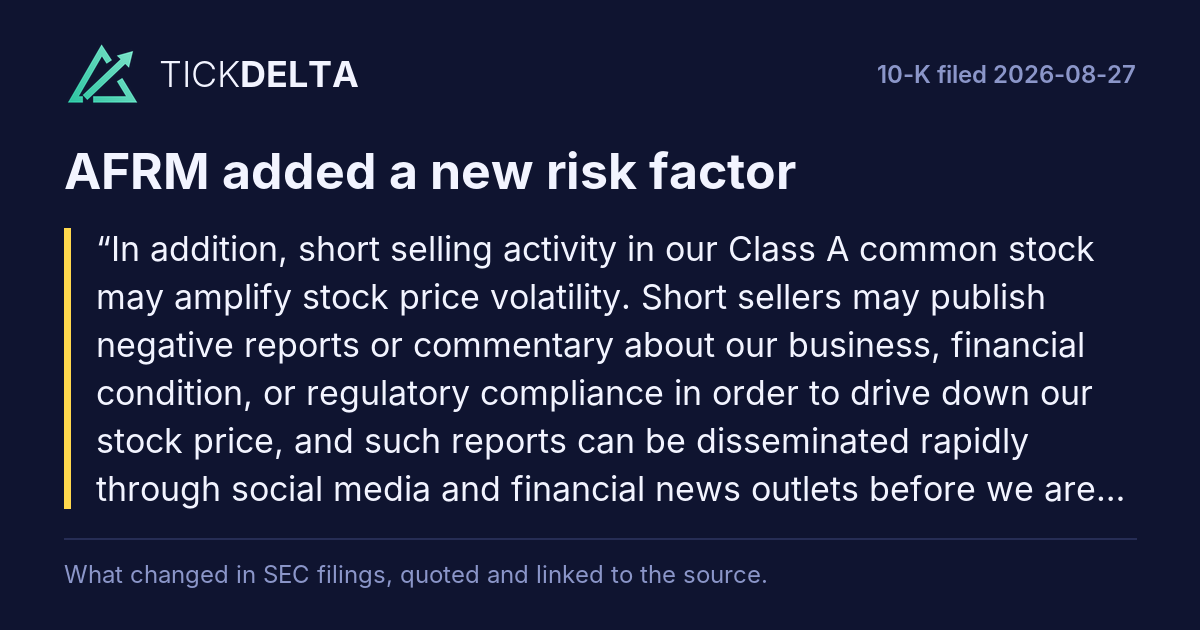
In addition, short selling activity in our Class A common stock may amplify stock price volatility. Short sellers may publish negative reports or commentary about our business, financial condition, or regulatory compliance in order to drive down our stock price, and such reports can be disseminated rapidly through social media and financial news outlets before we are able to investigate or respond. Significant short interest may also contribute to rapid, unpredictable price movements, including short squeezes, that do not reflect the underlying fundamentals of our business. The publication of short-seller reports could trigger securities class action litigation, derivative suits, or regulatory inquiries regardless of the accuracy of the underlying claims, and responding to such matters can be costly and divert management attention.
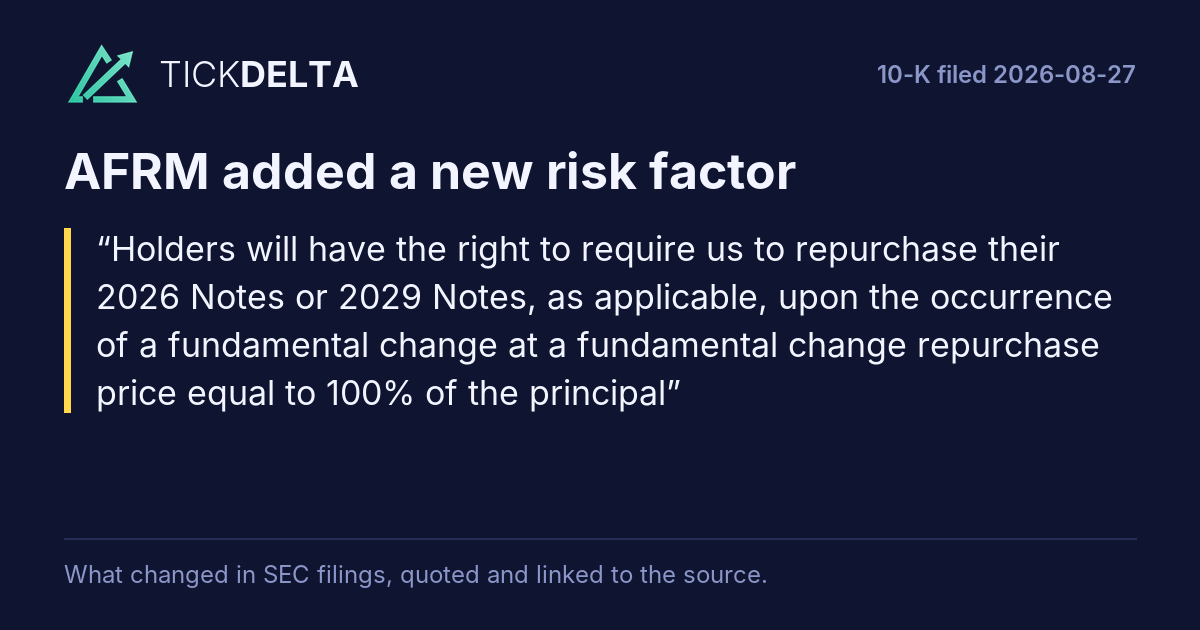
Holders will have the right to require us to repurchase their 2026 Notes or 2029 Notes, as applicable, upon the occurrence of a fundamental change at a fundamental change repurchase price equal to 100% of the principal
Paragraphs in the 10-Q filed Nov 5, 2026 that were not in the one before
New in the latest 10-Q
28 paragraphs in the 10-Q filed Nov 5, 2026 with nothing like them in the 10-Q filed May 7, 2026 (at least half the words must differ; new numbers alone do not count). Quoted exactly, grouped by the item heading above them. This is text that changed, not a judgement of how serious it is.
10-Q
• the plan for the establishment of Affirm Bank and the benefits and timing thereof;
Read in the 10-Q
Financial statements and notes
Within the interim condensed consolidated financial statements and tables presented in the accompanying notes, certain columns and rows may not sum due to the use of rounded numbers for disclosure purposes. Prior period deferred tax amounts have been reclassified out of other assets to conform to the current period presentation as a separate line item on the interim condensed consolidated statements of cash flows. There was no effect on cash flows from operating activities.
Read in the 10-Q
Accounts receivable, net was $ 356.9 million and $ 284.4 million as of September 30, 2026 and June 30, 2026, respectively, which includes $ 97.1 million and $ 88.0 million of receivables from contracts with customers, respectively. Accounts receivable are subject to an allowance for credit losses which was $ 23.8 million and $ 22.7 million as of September 30, 2026 and June 30, 2026, respectively.
Read in the 10-Q
Shopify is deemed to be a related party because they are a principal owner of more than ten percent of the Company’s voting interest. Under the commercial agreement, certain of our platform services are made available to eligible Shopify merchants. In the ordinary course of business, we incur fees in connection with transactions processed on the Shopify platform under the agreement.
Read in the 10-Q
Fair Value Unrealized Losses Fair Value Unrealized Losses Fair Value Unrealized Losses
Read in the 10-Q
Show the other 23
As of September 30, 2026 and June 30, 2026, there were no transfers between levels.
Read in the 10-Q
activity related to servicing assets and liabilities, including both the initial recognition upon loan sales and subsequent changes in fair value, during the periods presented in our interim condensed consolidated statements of operations and comprehensive income.
Read in the 10-Q
Significant unobservable inputs used in our Level 3 fair value measurements of servicing assets and liabilities include default rates, discount rates, and adequate compensation assumptions. When the adequate compensation assumption is held constant, adverse changes in the default rate and discount rate assumptions are not expected to result in a material change to the fair values of servicing assets or liabilities. A hypothetical increase in the adequate compensation assumption of 10% or 20% would have the following impacts:
Read in the 10-Q
• As of September 30, 2026: The fair value of servicing assets would decrease by approximately $ 0.8 million and $ 1.6 million, respectively, resulting in the derecognition of the $ 0.6 million servicing asset and the recognition of servicing liabilities of approximately $ 0.2 million or $ 1.0 million, respectively. For the agreements currently measured at zero fair value, estimated servicing liabilities of approximately $ 7.3 million and $ 14.6 million, respectively, would be recognized.
Read in the 10-Q
• As of June 30, 2026: The fair value of servicing assets would decrease by approximately $ 1.3 million and $ 2.5 million, respectively, resulting in the derecognition of the $ 0.8 million servicing asset and the recognition of servicing liabilities of approximately $ 0.4 million or $ 1.7 million, respectively. For the agreements currently measured at zero fair value, estimated servicing liabilities of approximately $ 6.4 million and $ 12.8 million, respectively, would be recognized.
Read in the 10-Q
As of September 30, 2026 and June 30, 2026, the aggregate fair value of the performance fee liability was measured at $ 2.6 million and $ 2.5 million, respectively. Activity related to the performance fee liability, including initial recognition upon purchases of loans, settlements, and subsequent changes in fair value, was not material during the periods presented in our interim condensed consolidated statements of operations and comprehensive income.
Read in the 10-Q
Adverse changes in discount rate, refund rate, or loss rate assumptions are not expected to result in a material change in the fair value of the performance fee liability.
Read in the 10-Q
Significant unobservable inputs used in our Level 3 fair value measurements of notes receivable and residual trust certificates include default rates, discount rates, and prepayment rate assumptions. When the default rate assumption is held constant, adverse changes in the discount rate and prepayment rate assumptions are not expected to result in a material change to the fair values of the notes receivable and residual trust certificates. A hypothetical increase in the default rate assumption of 25% or 50% would have the following impacts:
Read in the 10-Q
Adverse changes in discount rate, default rate, or prepayment rate assumptions are not expected to result in a material change in the fair value of residual interests in structured transactions.
Read in the 10-Q
Adverse changes in discount rate and program profitability assumptions are not expected to result in a material change in the fair value of profit share liability.
Read in the 10-Q
(1) Prepayment rate is not a significant unobservable input for the risk sharing asset balance as of September 30, 2026.
Read in the 10-Q
For the three months ended September 30, 2026 and 2025, income tax expense was $ 40.9 million and $ 2.3 million, resulting in effective tax rates of 20.0 % and 2.8 %, respectively. The increase in the effective tax rate was primarily due to the release of a significant portion of our domestic valuation allowance in fiscal year 2026, which had offset most of the income tax expense on domestic earnings for the three months ended September 30, 2025. For the three months ended September 30, 2026, the effective tax rate differed from the U.S. federal statutory rate primarily due to state income taxes, research and development tax credits, nondeductible stock compensation, valuation allowances in certain foreign jurisdictions, and a net discrete tax benefit primarily related to stock-based compensation.
Read in the 10-Q
We continue to maintain a valuation allowance against certain foreign net deferred tax assets and certain domestic capital loss deferred tax assets for which it is not more likely than not that the related tax benefits will be realized.
Read in the 10-Q
partner with several sub-servicers to manage consumer care, first priority collections, and third-party collections in accordance with our policies and procedures.
Read in the 10-Q
balances at each quarter-end during the fiscal year, including the prior fiscal year-end.
Read in the 10-Q
(3) Amounts include stock-based compensation expense. See Note 14. Equity Incentive Plans for the amounts presented within each operating expense line item for the periods presented.
Read in the 10-Q
Income tax expense for the three months ended September 30, 2026 was $40.9 million, an increase of $38.6 million compared to the same period in 2025. The effective tax rate increased to 20.0% from 2.8%, primarily due to the release of a significant portion of our domestic valuation allowance in fiscal year 2026, which had offset most of the income tax expense on domestic earnings for the three months ended September 30, 2025. For the three months ended September 30, 2026, the effective tax rate differed from the U.S. federal statutory rate primarily due to state
Read in the 10-Q
income taxes, research and development tax credits, nondeductible stock compensation, valuation allowances in certain foreign jurisdictions, and a net discrete tax benefit primarily related to stock-based compensation.
Read in the 10-Q
Refer to “Convertible Senior Notes” below for the maturities of our convertible senior notes.
Read in the 10-Q
our future consolidated financial statement presentation, financial condition, results of operations, and cash flows may be affected.
Read in the 10-Q
Other information
On September 10, 2026, Noel Watson, a member of our Board of Directors, adopted a Rule 10b5-1 trading arrangement providing for the sale of the Company's Class A common stock that is intended to satisfy the affirmative defense conditions of Exchange Act Rule 10b5-1(c) (a “Rule 10b5-1 Trading Plan”). Mr. Watson’s Rule 10b5-1 Trading Plan provides for the sale of up to 13,100 shares of our Class A common stock on or after December 10, 2026 until August 31, 2027, or earlier if all transactions under the trading arrangement are completed. A portion of these shares may be sold pursuant to one or more limit orders.
Read in the 10-Q
On September 14, 2026, Michael Linford, our President, adopted a Rule 10b5-1 Trading Plan. Mr. Linford’s Rule 10b5-1 Trading Plan provides for the exercise of up to 354,651 employee stock options, less any employee stock options that were exercised under Mr. Linford's previous Rule 10b5-1 Trading Plan entered into on December 9, 2025, and the sale of the underlying shares of our Class A common stock pursuant to one or more limit orders on or after December 14, 2026 until September 1, 2027, or earlier if all transactions under the trading arrangement are completed.
Read in the 10-Q
On September 15, 2026, Siphelele Jiyane, our Chief Accounting Officer, adopted a Rule 10b5-1 Trading Plan. Ms. Jiyane’s Rule 10b5-1 Trading Plan provides for the sale of up to 119,705 shares of our Class A common stock pursuant to one or more limit orders on or after December 15, 2026 until June 15, 2027, or earlier if all transactions under the trading arrangement are completed.
Read in the 10-Q
The 10-Q's risk factors against the 10-K
Item 1A of the 10-Q filed Nov 5, 2026 against Item 1A of the 10-K filed Aug 27, 2026.
A 10-Q repeats only the risks that changed, so a 10-K paragraph that is missing from it is not counted as removed.
Added is a paragraph with nothing like it in the 10-K, Reworded a sentence that is in both with several words changed,
Quiet changes a sentence in both where one to four words changed and one is a hedge or a modal
(cut words struck through, new words highlighted).
Text on the page, not a score; each links to the filing at sec.gov.
What the 10-Q itself says about its risk factors:There have been no material changes from the risk factors previously disclosed under the heading “Risk Factors” in our Annual Report on Form 10-K for the fiscal year ended June 30, 2026.
Read in the 10-Q
Phrases used for the first time
Two-word phrases in Risk Factors of the 10-K filed Aug 27, 2026 that are in none of the 1 earlier 10-Ks stored, back to Aug 28, 2025
Where each one is used
- third party: Personal loans facilitated through our platform are not secured by any collateral, not guaranteed or insured by any third party, and not backed by any governmental authority in any way. Therefore, if we hold the loans for investment on our balance sheet, we are limited in our ability to collect on these loans if a...
- affirm bank: We have applied to establish Affirm Bank as an industrial loan company to be chartered in the State of Nevada, and there can be no assurance that our application will be approved, or that we will realize the expected benefits of obtaining a bank charter and federal deposit insurance.
- pay later: Negative publicity about us or our industry, including the transparency, fairness, responsible lending, user experience, quality, and reliability of our platform or pay later products in general, effectiveness of our risk model, our ability to effectively manage and resolve complaints, our privacy and security...
- later products: Negative publicity about us or our industry, including the transparency, fairness, responsible lending, user experience, quality, and reliability of our platform or pay later products in general, effectiveness of our risk model, our ability to effectively manage and resolve complaints, our privacy and security...
- industrial loan: We have applied to establish Affirm Bank as an industrial loan company to be chartered in the State of Nevada, and there can be no assurance that our application will be approved, or that we will realize the expected benefits of obtaining a bank charter and federal deposit insurance.
- proposed bank’s: In January 2026, we submitted applications to the Nevada Financial Institutions Division and the FDIC to establish Affirm Bank, a proposed industrial loan company chartered in the State of Nevada. The application process is subject to extensive regulatory review, including evaluation of our business plan, the...
- origination volumes: Even if our relationships with our originating bank partners remain intact, these partners may lack the operational capacity, capital resources, regulatory headroom, or technological infrastructure to keep pace with our growing origination volumes. As our GMV increases and we expand into new product categories,...
- bank issuing: •The Evolve Bank issuing program agreement has an initial two-year term that expired in calendar year 2023. The term automatically renewed for an additional one-year term and will continue to automatically renew in three-month terms unless either party provides notice of its intent not to renew.
Used at least twice, small words left out. Counted, not picked: a phrase can be new because the company renamed something.
What was taken out
27 paragraphs of last year's Risk Factors with nothing like them now. The longest are quoted.
Sources
Item 1A of each 10-K and 10-Q on EDGAR, quoted exactly. Each paragraph links to the filing at sec.gov.
Also
10-K change: what was reworded or cut, section by section.
Work with it
Excel workbook · CSV. Google Sheet that stays up to date: paste =IMPORTDATA("https://tickdelta.com/company/AFRM/export.csv") into a cell.