Paragraph 61 · 44% changed
Every version of it
Screener
/
SEC EDGAR
/CIK 0001423689
/10-K filed Feb 23, 2026, compared with Feb 21, 2025
/Numbers from the XBRL of the 10-Ks
Nasdaq
Real estate · REIT
AGNC Investment Corp. AGNC
The 10-K against last year's
159 changes: 27 added, 15 removed, 109 reworded, 8 quiet changes
10-K Feb 23, 2026 vs Feb 21, 2025
Risk Factors
10.9%
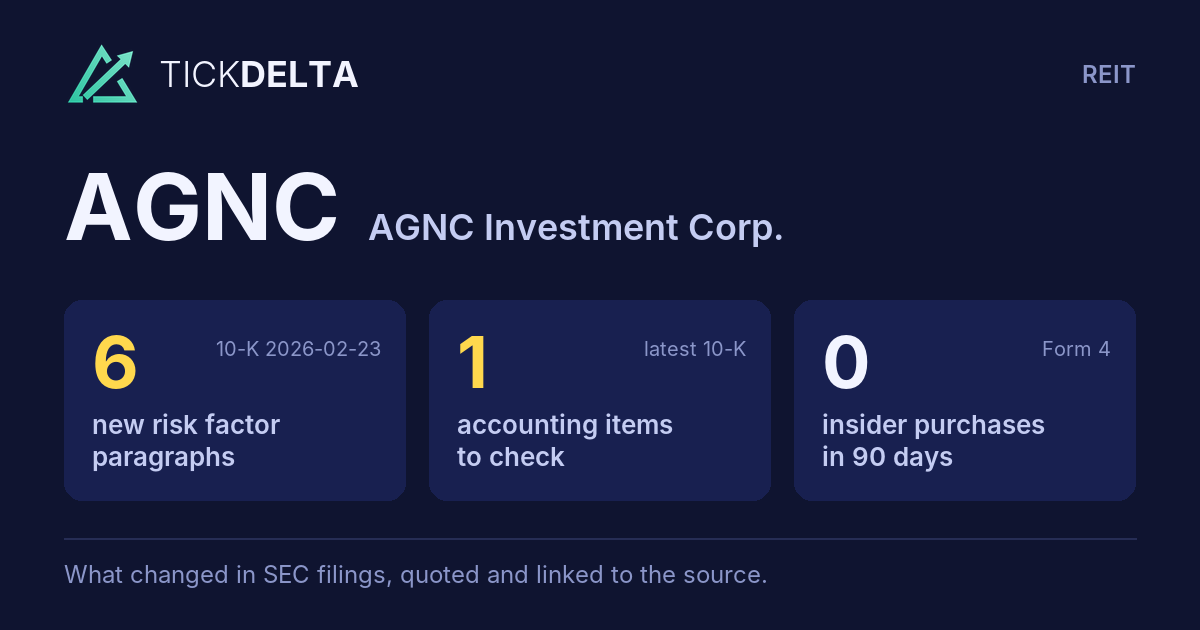
of the text changed · 12,722 words now · 6 new paragraphs, 1 gone
MD&A
25.4%
of the text changed · 9,746 words now · 21 new paragraphs, 14 gone
Accounting Policies
7.9%
of the text changed · 4,105 words now
10-K 0001423689-26-000043 (Feb 23, 2026) vs 10-K 0001423689-25-000007 (Feb 21, 2025) Not compared: Legal Proceedings.
Every paragraph, and how much of it changed
One bar per paragraph, in the order of the 10-K. Height and colour show the share of its words not in the closest paragraph a year earlier; the tallest bars are new paragraphs.
Risk Factors
148 paragraphs · 6 new · 69 reworded · 1 gone · 10-K Feb 23, 2026 against Feb 21, 2025
New paragraph
Reworded (5% of its words or more)
Same or nearly
Paragraph 3 · 39% changed
Every version of it
Paragraph 129 · 36% changed
Every version of it
Paragraph 127 · 32% changed
Every version of it
U.S. Government legislative and administrative actions may have an adverse impact on financial markets for fixed income securities, including Agency RMBS. To the extent the markets do not respond favorably to any such actions or such actions do not function as intended, they could have broad and adverse market implications and could negatively impact our financial condition and results of operations. For example, the actual or anticipated actions or inaction on U.S. fiscal policy matters, including the U.S. dept ceiling and the amount and tenor of U.S. Treasury debt required to fund the government, could result in a wide range of negative economic effects, including increased financial market and interest rate volatility and wider market spreads between mortgage assets and benchmark interest rates.
Paragraph 72 · 28% changed
Every version of it
Paragraph 17 · 28% changed
Every version of it
Our investment portfolio largely consists of securities backed by pools of mortgage loans that receive payments related to the underlying mortgage loans. When borrowers prepay their mortgage loans at rates faster or slower than anticipated, we are exposed to prepayment or extension risk. Generally, prepayments increase during periods of falling mortgage interest rates and decrease during periods of rising mortgage interest rates; however, other factors can also affect prepayment rates, including loan age and size, loan-to-value ratios, housing price trends, general economic conditions, government policies that promote housing turnover or refinancings, and GSE buyouts of delinquent loans. If our assets prepay at a faster rate than anticipated, we may be unable to reinvest the resulting repayments at acceptable yields. If the proceeds are reinvested at lower yields than our existing assets, our net interest margins would be negatively impacted. We also amortize or accrete into interest income any premiums and discounts we pay or receive at purchase relative to the stated principal of our assets over their projected lives using the effective interest method. If the actual and estimated future prepayment experience differs from our prior estimates, we are required to record an a current period adjustment to interest income for the impact of the cumulative difference in the effective yield, which could negatively affect our interest income.
Paragraph 58 · 25% changed
Every version of it
Our funding and derivative agreements require that we maintain certain levels of collateral with our counterparties and may result in margin calls initiated against us if, for example, the value of our collateral declines. A margin call means that the counterparty requires us to pledge additional collateral to re-establish the required collateral level to protect it from loss in the event we default on our obligations. The requirement to meet margin calls can create liquidity risks. In the event of a margin call, we must generally provide additional collateral on the same business day. If we fail to meet the margin call, we would be in default, and our counterparty could terminate outstanding transactions, require us to settle our entire obligation under the agreement agreement, and enforce their interests against existing collateral. Furthermore, we may also be subject to certain cross-default and acceleration rights, such that if we were to fail to meet a margin call under one agreement that failure could also lead to defaults, accelerations, or other adverse events under other agreements, as well. agreements. The threat or occurrence of margin calls or the accelerated settlement of our obligations under our agreements could force us to sell our investments under adverse market conditions and result in substantial losses.
Paragraph 2 · 24% changed
Every version of it
When the differential (or "spread") between the market yield on our assets and our interest rate hedges widens, our tangible net book value will typically decline, a dynamic we refer to as "spread risk." As a levered investor primarily in fixed-rate Agency RMBS, spread risk is an inherent component of our business. Although we use hedging instruments in an effort to protect against moves in interest rates, our hedges will typically not protect us against spread risk. Spreads may widen due to numerous factors, including actual or expected monetary policy actions by U.S. and foreign central banks; legislative, regulatory or other administrative actions affecting the Agency RMBS market; changes in fiscal policy and rising federal budget deficits; increased market volatility; reduced market liquidity; higher Agency RMBS supply; and shifts in investor return requirements and sentiment.
Paragraph 61 · 44% changed
Every version of it
10-K Feb 21, 2025Our derivative agreements also subject us to margin calls. Collateral requirements under our derivative agreements are typically dictated by contract or clearinghouse rules and regulations adopted by the U.S. Commodity Futures Trading Commission (“CFTC”) and regulators of other countries. Thus, changes in clearinghouse rules and other regulations can increase our margin requirements and the cost of our hedges. Our counterparties typically have the sole discretion to determine eligible collateral, the value of our collateral and, in the case of our derivative counterparties, the value of our derivative instruments. Additionally, for cleared swaps and futures, the futures commission merchant, or FCM, that we transact through typically has the right to require more collateral than the clearinghouse requires.
10-K Feb 23, 2026
instruments. Additionally, for cleared swaps and futures, the futures commission merchant, or FCM, that we transact through typically has the right to require more collateral than the clearinghouse requires.
Paragraph 3 · 39% changed
Every version of it
10-K Feb 21, 2025When the differential between the market yield on our assets and our interest rate hedges widens, our tangible net book value will typically decline, a dynamic we refer to as "spread risk." As a levered investor primarily in fixed-rate Agency RMBS, spread risk is an inherent component of our business. Although we use hedging instruments in an effort to protect against moves in interest rates, our hedges will typically not protect us against spread risk. Spreads may widen due to numerous factors, including actual or expected monetary policy actions by U.S. and foreign central banks; legislative, regulatory or other administrative actions affecting the Agency RMBS market; changes in fiscal policy and rising federal budget deficits; increased market volatility; reduced market liquidity; higher Agency RMBS supply; and shifts in investor return requirements and sentiment.
10-K Feb 23, 2026
numerous factors, including actual or expected monetary policy actions by U.S. and foreign central banks; legislative, regulatory or other administrative actions affecting the Agency RMBS market; changes in fiscal policy and rising federal budget deficits; increased market volatility; reduced market liquidity; higher Agency RMBS supply; and shifts in investor return requirements and sentiment.
Paragraph 129 · 36% changed
Every version of it
10-K Feb 21, 2025U.S. Government legislative and administrative actions may have an adverse impact on financial markets for fixed income securities, including Agency RMBS. To the extent the markets do not respond favorably to any such actions or such actions do not function as intended, they could have broad adverse market implications and could negatively impact our financial condition and results of operations. For example, the actual or anticipated actions or inaction on U.S. fiscal policy matters, including the U.S. dept ceiling and the amount and tenor of U.S. Treasury debt required to fund the government, could result in a wide range of negative economic effects, including increased financial market and interest rate volatility and wider market spreads between mortgage assets and benchmark interest rates.
10-K Feb 23, 2026
Actual or anticipated actions or inaction on U.S. fiscal policy matters, including the amount and tenor of U.S. Treasury debt required to fund the government and the U.S. debt ceiling, could result in a wide range of negative economic effects, including increased financial market and interest rate volatility and wider mortgage spreads.
Paragraph 127 · 32% changed
Every version of it
10-K Feb 21, 2025
U.S. Government legislative and administrative actions may have an adverse impact on financial markets for fixed income securities, including Agency RMBS. To the extent the markets do not respond favorably to any such actions or such actions do not function as intended, they could have broad adverse market implications and could negatively impact our financial condition and results of operations. For example, the actual or anticipated actions or inaction on U.S. fiscal policy matters, including the U.S. dept ceiling and the amount and tenor of U.S. Treasury debt required to fund the government, could result in a wide range of negative economic effects, including increased financial market and interest rate volatility and wider market spreads between mortgage assets and benchmark interest rates.
10-K Feb 23, 2026
U.S. Government legislative and administrative actions may have an adverse impact on financial markets for Agency RMBS. To the extent the markets do not respond favorably to any such actions or such actions do not function as intended, they could have broad and adverse market implications and could negatively impact our financial condition and results of operations.
Paragraph 72 · 28% changed
Every version of it
10-K Feb 21, 2025If a repurchase agreement counterparty defaults on its obligation to resell collateral to us, we could incur a loss on the transaction equal to the difference between the value of our collateral and the amount of our borrowing. Similarly, if a derivative agreement counterparty fails to return collateral to us at the conclusion of the derivative transaction or fails to pledge collateral to us or to make other payments we are entitled to under the terms of our agreement as and when due, we could incur a loss equal to the value of our collateral and other amounts due to us.
10-K Feb 23, 2026
collateral to us or to make other payments we are entitled to under the terms of our agreement when due, we could incur a loss equal to the value of our collateral and other amounts due to us.
Paragraph 17 · 28% changed
Every version of it
10-K Feb 21, 2025
If our assets prepay at a faster rate than anticipated, we may be unable to reinvest the repayments at acceptable yields. If the proceeds are reinvested at lower yields than our existing assets, our net interest margins would be negatively impacted. We also amortize or accrete into interest income any premiums and discounts we pay or receive at purchase relative to the stated principal of our assets over their projected lives using the effective interest method. If the actual and estimated future prepayment experience differs from our prior estimates, we are required to record an adjustment to interest income for the impact of the cumulative difference in the effective yield, which could negatively affect our interest income.
10-K Feb 23, 2026
Our investment portfolio largely consists of securities backed by pools of mortgage loans that receive payments related to the underlying mortgage loans. When borrowers prepay their mortgage loans at rates faster or slower than anticipated, we are exposed to prepayment or extension risk. Generally, prepayments increase during periods of falling mortgage interest rates and decrease during periods of rising mortgage interest rates; however, other factors can also affect prepayment rates, including loan age and size, loan-to-value ratios, housing price trends, general economic conditions, government policies that promote housing turnover or refinancings, and GSE buyouts of delinquent loans. If our assets prepay at a faster rate than anticipated, we may be unable to reinvest the resulting repayments at acceptable yields. If the proceeds are reinvested at lower yields than our existing assets, our net interest margins would be negatively impacted. We also amortize or accrete into interest income any premiums and discounts we pay or receive at purchase relative to the stated principal of our assets over their projected lives using the effective interest method. If the actual and estimated future prepayment experience differs from our prior estimates, we are required to record a current period adjustment to interest income for the impact of the cumulative difference in the effective yield, which could negatively affect our interest income.
Paragraph 58 · 25% changed
Every version of it
10-K Feb 21, 2025
in default, and our counterparty could terminate outstanding transactions, require us to settle our entire obligation under the agreement and enforce their interests against existing collateral. Furthermore, we may also be subject to certain cross-default and acceleration rights, such that if we were to fail to meet a margin call under one agreement that failure could lead to defaults, accelerations, or other adverse events under other agreements, as well. The threat or occurrence of margin calls or the accelerated settlement of our obligations under our agreements could force us to sell our investments under adverse market conditions and result in substantial losses.
10-K Feb 23, 2026
Our funding and derivative agreements require that we maintain certain levels of collateral with our counterparties and may result in margin calls initiated against us if, for example, the value of our collateral declines. A margin call means that the counterparty requires us to pledge additional collateral to re-establish the required collateral level to protect it from loss in the event we default on our obligations. The requirement to meet margin calls can create liquidity risks. In the event of a margin call, we must generally provide additional collateral on the same business day. If we fail to meet the margin call, we would be in default, and our counterparty could terminate outstanding transactions, require us to settle our entire obligation under the agreement, and enforce their interests against existing collateral. Furthermore, we may also be subject to certain cross-default and acceleration rights, such that if we were to fail to meet a margin call under one agreement that failure could also lead to defaults, accelerations, or other adverse events under other agreements. The threat or occurrence of margin calls or the accelerated settlement of our obligations under our agreements could force us to sell our investments under adverse market conditions and result in substantial losses.
Paragraph 2 · 24% changed
Every version of it
10-K Feb 21, 2025
When the differential between the market yield on our assets and our interest rate hedges widens, our tangible net book value will typically decline, a dynamic we refer to as "spread risk." As a levered investor primarily in fixed-rate Agency RMBS, spread risk is an inherent component of our business. Although we use hedging instruments in an effort to protect against moves in interest rates, our hedges will typically not protect us against spread risk. Spreads may widen due to numerous factors, including actual or expected monetary policy actions by U.S. and foreign central banks; legislative, regulatory or other administrative actions affecting the Agency RMBS market; changes in fiscal policy and rising federal budget deficits; increased market volatility; reduced market liquidity; higher Agency RMBS supply; and shifts in investor return requirements and sentiment.
10-K Feb 23, 2026
When the differential (or "spread") between the market yield on our assets and our interest rate hedges widens, our tangible net book value will typically decline, a dynamic we refer to as "spread risk." As a levered investor primarily in fixed-rate Agency RMBS, spread risk is an inherent component of our business. Although we use hedging instruments in an effort to protect against moves in interest rates, our hedges will typically not protect us against spread risk. Spreads may widen due to
MD&A
146 paragraphs · 21 new · 41 reworded · 14 gone · 10-K Feb 23, 2026 against Feb 21, 2025
New paragraph
Reworded (5% of its words or more)
Same or nearly
Paragraph 115 · 49% changed
The terms and conditions of our bilateral repurchase agreements are determined established on a transaction-by-transaction basis when at the time each such borrowing is initiated or renewed and, in the case of GCF Repo, and are governed by the prevailing margin requirements calculated provisions of a Master Repurchase Agreement. For GCF Repo transactions, the terms and conditions are set by the FICC, which acts as the central counterparty. The amount FICC's clearing rules and applicable operating procedures. Each of our repurchase agreements requires that borrowed is generally equal amounts be subject to the fair value of the securities pledged, as determined by the lending counterparty, less an assessed discount, referred to as a "haircut," that reflects the underlying risk of the specific collateral collateralization requirements, and protects the counterparty against a change in its value. Interest interest rates are generally fixed based on and reflect prevailing market rates corresponding to for the specified borrowing term of the borrowing. None of our repo and collateral type. Our repurchase agreement counterparties are not obligated to renew or otherwise enter into new borrowings at upon the conclusion maturity of our existing borrowings. agreements.
Paragraph 15 · 49% changed
For 2025, AGNC earned generated total comprehensive income of $1.74 per diluted common share and an economic return of 22.7% on tangible common equity, comprised of $1.44 in dividends declared and a $0.47 increase in tangible net book value per common share. This compares to total comprehensive income of $0.84 per diluted common share and an economic return of 13.2% for fiscal year 2024, an increase from $0.30 comprised of $1.44 in dividends and a $0.29 decline in tangible net book value per share in 2023. Net spread and dollar roll income per diluted common share decreased to $1.88 in 2024 from $2.61 in 2023, primarily due to a narrowing of our net interest rate spread, which averaged 242 basis points in 2024, down from 306 basis points in 2023. share.
Paragraph 121 · 48% changed
The value of Agency RMBS collateral is impacted by market factors and is reduced by monthly principal pay-downs on the underlying mortgage pools. Fannie Mae and Freddie Mac publish monthly security pay-down factors for their mortgage pools on the fifth day after month-end, but do not remit payment to security holders until generally the 25th day after month-end. Bi-lateral repo counterparties assess margin to account for the reduction in value of Agency collateral when factors are released. The FICC assesses margin on the last day of each month, prior to the factor release date, based on its internally projected pay-down rates (referred to as the "blackout period exposure adjustment" or "blackout margin"). On the factor release date, the blackout margin is released and collateralization requirements are adjusted to actual factor data. Due to the timing difference between associated margin calls related to principal pay-downs and our receipt of principal pay-downs, the corresponding cash flows temporarily reduces our available liquidity is temporarily reduced each month for principal repayments. month. We attempt to manage the this liquidity risk associated with principal pay-downs by monitoring conditions impacting factors that influence prepayment rates activity and through disciplined asset selection. As of December 31, 2024, 2025, approximately 9% 14% of our investment portfolio consisted of TBA securities, which are not subject to monthly principal pay-downs. The remainder of our portfolio portfolio, primarily consisted consisting of Agency RMBS, which had an average one-year CPR forecast of 7% as of December 31, 2024. 12%.
Paragraph 20 · 46% changed
Paragraph 116 · 41% changed
Paragraph 107 · 40% changed
Paragraph 114 · 40% changed
Paragraph 25 · 37% changed
Paragraph 115 · 49% changed
10-K Feb 21, 2025
The terms and conditions of our repurchase agreements are determined on a transaction-by-transaction basis when each such borrowing is initiated or renewed and, in the case of GCF Repo, by the prevailing margin requirements calculated by the FICC, which acts as the central counterparty. The amount borrowed is generally equal to the fair value of the securities pledged, as determined by the lending counterparty, less an assessed discount, referred to as a "haircut," that reflects the underlying risk of the specific collateral and protects the counterparty against a change in its value. Interest rates are generally fixed based on prevailing rates corresponding to the term of the borrowing. None of our repo counterparties are obligated to renew or otherwise enter into new borrowings at the conclusion of our existing borrowings.
10-K Feb 23, 2026
The terms of bilateral repurchase agreements are established on a transaction-by-transaction basis at the time each borrowing is initiated or renewed and are governed by the provisions of a Master Repurchase Agreement. For GCF Repo transactions, the terms and conditions are set by the FICC's clearing rules and applicable operating procedures. Each of our repurchase agreements requires that borrowed amounts be subject to collateralization requirements, and interest rates are generally fixed and reflect prevailing market rates for the specified borrowing term and collateral type. Our repurchase agreement counterparties are not obligated to renew or enter into new borrowings upon the maturity of existing agreements.
Paragraph 15 · 49% changed
10-K Feb 21, 2025
AGNC earned total comprehensive income of $0.84 per diluted common share for fiscal year 2024, an increase from $0.30 per share in 2023. Net spread and dollar roll income per diluted common share decreased to $1.88 in 2024 from $2.61 in 2023, primarily due to a narrowing of our net interest rate spread, which averaged 242 basis points in 2024, down from 306 basis points in 2023.
10-K Feb 23, 2026
For 2025, AGNC generated total comprehensive income of $1.74 per diluted common share and an economic return of 22.7% on tangible common equity, comprised of $1.44 in dividends declared and a $0.47 increase in tangible net book value per common share. This compares to total comprehensive income of $0.84 per diluted common share and an economic return of 13.2% for 2024, comprised of $1.44 in dividends and a $0.29 decline in tangible net book value per common share.
Paragraph 121 · 48% changed
10-K Feb 21, 2025
The value of Agency RMBS collateral is impacted by market factors and is reduced by monthly principal pay-downs on the underlying mortgage pools. Fannie Mae and Freddie Mac publish monthly security pay-down factors for their mortgage pools on the fifth day after month-end, but do not remit payment to security holders until generally the 25th day after month-end. Bi-lateral repo counterparties assess margin to account for the reduction in value of Agency collateral when factors are released. The FICC assesses margin on the last day of each month, prior to the factor release date, based on its internally projected pay-down rates (referred to as the "blackout period exposure adjustment" or "blackout margin"). On the factor release date, the blackout margin is released and collateralization requirements are adjusted to actual factor data. Due to the timing difference between associated margin calls and our receipt of principal pay-downs, our liquidity is temporarily reduced each month for principal repayments. We attempt to manage the liquidity risk associated with principal pay-downs by monitoring conditions impacting prepayment rates and through asset selection. As of December 31, 2024, approximately 9% of our investment portfolio consisted of TBA securities, which are not subject to monthly principal pay-downs. The remainder of our portfolio primarily consisted of Agency RMBS, which had an average one-year CPR forecast of 7% as of December 31, 2024.
10-K Feb 23, 2026
The timing difference between margin calls related to principal pay-downs and our receipt of the corresponding cash flows temporarily reduces our available liquidity each month. We manage this liquidity risk by monitoring factors that influence prepayment activity and through disciplined asset selection. As of December 31, 2025, approximately 14% of our investment portfolio consisted of TBA securities, which are not subject to monthly principal pay-downs. The remainder of our portfolio, primarily consisting of Agency RMBS, had an average one-year CPR forecast of 12%.
Paragraph 20 · 46% changed
10-K Feb 21, 2025The weighted average coupon on our fixed-rate Agency RMBS and TBA securities increased to 5.02% at the end of 2024, up from 4.83% at the end of 2023. The average projected life Constant Prepayment Rate (CPR) for the portfolio decreased to 7.7% at year-end, from 11.4% at the end of 2023. Actual CPRs for 2024 averaged 7.5%, slightly up from 6.3% in 2023.
10-K Feb 23, 2026
The average projected life Constant Prepayment Rate ("CPR") for our portfolio increased to 9.6% as of December 31, 2025, from 7.7% as of December 31, 2024, largely reflecting a 70 basis point decline in the average 30-year mortgage rate, which was 6.16% at year end. Actual CPRs averaged 8.4% for the year, compared to 7.5% for the prior year.
Paragraph 116 · 41% changed
10-K Feb 21, 2025The use of TBA dollar roll transactions increases our funding diversification, expands our available pool of assets, and increases our overall liquidity position, as TBA contracts typically have lower implied haircuts relative to Agency RMBS pools funded with repo financing. TBA dollar roll transactions may also have a lower implied cost of funds than comparable repo funded transactions (referred to as "dollar roll specialness") offering incremental return potential. However, if it were to become uneconomical to roll our TBA contracts into future months it may be necessary to take physical delivery of the underlying securities and fund those assets with cash or other financing sources, which could reduce our liquidity position.
10-K Feb 23, 2026
TBA dollar roll transactions enhance our funding diversification, expand our available pool of assets, and improve our liquidity position by typically requiring less collateral than Agency RMBS financed with repo. These transactions may also benefit from lower implied costs, or "specialness." However, if rolling TBA contracts into future months becomes uneconomical, we may need to take physical delivery of the underlying securities and fund those securities with other sources, potentially reducing our liquidity position.
Paragraph 107 · 40% changed
10-K Feb 21, 20252.Reported in gain (loss) on derivative instruments and other securities, net in our consolidated statements of comprehensive income.
10-K Feb 23, 2026
Total gain (loss) on derivative instruments and other securities, net $ (1,082) $ 2,028 $ 386
Paragraph 114 · 40% changed
10-K Feb 21, 2025Our primary financing sources are collateralized borrowings structured as repurchase agreements. We enter into repurchase agreements, or "repo," through bi-lateral arrangements with financial institutions and independent dealers. We also enter into third-party repurchase agreements through our wholly-owned registered broker-dealer subsidiary, Bethesda Securities, LLC, such as tri-party repo offered through the FICC's GCF Repo service. We manage our repurchase agreement funding position through a variety of methods, including diversification of counterparties, maintaining a suitable maturity profile and utilization of interest rate hedging strategies. We also use TBA dollar roll transactions as a means of synthetically financing Agency RMBS.
10-K Feb 23, 2026
We primarily finance our assets through collateralized borrowings structured as repurchase agreements ("repo"). We enter into these agreements on a bilateral basis with financial institutions and independent dealers, as well as through tri-party and centrally cleared repo platforms—such as the FICC's GCF Repo service—accessed through our wholly owned, registered broker-dealer subsidiary, Bethesda Securities, LLC. We manage our repo funding through counterparty diversification, maintaining a suitable maturity profile, interest rate hedging, and other strategies. In addition to repo, we also utilize TBA dollar roll transactions to synthetically finance Agency RMBS.
Paragraph 25 · 37% changed
10-K Feb 21, 20259.Economic return on tangible common equity represents the sum of the change in tangible net book value per common share and dividends declared per share of common stock during the period over beginning tangible net book value per common share.
10-K Feb 23, 2026
1.Economic return represents the sum of the change in tangible net book value per common share and dividends declared per share of common stock during the period over beginning tangible net book value per common share. Peer group includes Annaly Capital Management, Inc. ("NLY"), ARMOUR Residential REIT, Inc. ("ARR"), Dynex Capital, Inc. ("DX"), Invesco Mortgage Capital Inc. ("IVR"), Orchid Island Capital, Inc. ("ORC"), and Two Harbors Investment Corp. ("TWO")
A paragraph is matched with the one last year that shares the most of its words; under half in common makes it new. The paragraphs shown are the 8 reworded the most in each section.
The paragraph that changed most in each section
The redline
Marked against last year's 10-K: cut words struck through, new words highlighted.
MD&A233 words changed in this paragraph; it is 43% similar to last year's version.
Fiscal Year Statement of Comprehensive Income Data 2025 2024 2023 2022 Comprehensive Interest income (loss) available (attributable) to common stockholders $ 657 3,523 $ 187 2,949 $ (2,268) Adjustments to exclude realized and unrealized (gains) losses reported through net income: Realized loss on sale of investment securities, net 188 1,567 2,916 Unrealized (gain) loss on investment securities measured at fair value through net income, net 885 (1,678) 3,795 Gain on derivative instruments and other securities, net (2,028) (386) (4,630) Adjustment to exclude unrealized (gain) loss reported through other comprehensive income: Unrealized (gain) loss on available-for-sale securities measure at fair value through other comprehensive income, net 74 (155) 973 Other adjustments: Estimated "catch-up" premium amortization benefit due to change in CPR forecast 1 (51) (5) (238) TBA dollar roll income, net 2 21 31 518 2,041 Interest rate swap periodic income, net 2 1,815 2,202 675 Other expense 2,848 2,931 2,287 Net interest income (expense), (expense) 675 18 (246) Other gain, net 2,3 (87) (146) (65) 1,122 955 497 Operating expenses 127 110 96 Net spread and dollar roll income 1,670 863 155 Dividends on preferred stock 161 132 123 Net income available to common stockholders (non-GAAP measure) 1,474 1,617 1,676 $ 1,509 $ 731 $ 32 Net income $ 1,670 $ 863 $ 155 Other comprehensive income (loss), net 268 (74) 155 Comprehensive income 1,938 789 310 Dividends on preferred stock 161 132 123 Comprehensive income available to common stockholders $ 1,777 $ 657 $ 187 Weighted average number of common shares outstanding - basic 1,020.0 783.4 618.4 537.0 Weighted average number of common shares outstanding - diluted 1,023.7 786.0 619.6 538.1 Net spread and dollar roll income per common share - basic $ 1.88 1.48 $ 2.61 0.93 $ 3.12 0.05 Net spread and dollar roll income per common share - diluted $ 1.88 1.47 $ 2.61 0.93 $ 3.11 0.05 Comprehensive income per common share - basic $ 1.74 $ 0.84 $ 0.30 Comprehensive income per common share - diluted $ 1.74 $ 0.84 $ 0.30 Dividends declared per common share $ 1.44 $ 1.44 $ 1.44
Source: Item 7, 10-K 0001423689-26-000043 vs Item 7, 10-K 0001423689-25-000007
Risk Factors212 words changed in this paragraph; it is 63% similar to last year's version.
We utilize TBA dollar roll transactions, which represent a form of off-balance sheet financing and increase our "at risk" leverage, transactions as an alternate alternative means of investing in and financing Agency RMBS. It may become uneconomical for These transactions represent a form of off-balance sheet financing, increase our "at risk" leverage, and subject us to roll forward our TBA positions prior to their settlement dates due to market margin requirements. Market conditions, which can be impacted by a variety of factors, such as including changes in the pace or manner of the Fed’s Fed's runoff of its portfolio of Agency RMBS portfolio or, if they occur, the Fed’s Fed's, GSE's or other government-entity purchases or sales of Agency RMBS in the TBA market. market, may make it uneconomical for us to roll our TBA positions prior to their settlement dates. Because TBA dollar roll transactions include a deferred purchase price obligation on our part. An obligation, an inability or unwillingness decision not to continue rolling forward our position has positions have effects similar to a termination of financing. In that circumstance, such circumstances, we would be required to settle the our obligations for in cash and would then take physical delivery of the underlying Agency RMBS. We may not have sufficient funds or alternative financing sources available to settle such obligations. do so. Additionally, if upon settlement, we take delivery of the underlying securities, we can expect to would generally receive the "cheapest to deliver" securities with that satisfy the TBA contract. "Cheapest to deliver" securities typically have the least favorable prepayment attributes that satisfy the terms of the TBA contract. Further, the specific securities that we receive and may include few, if any, "whole pool" securities, which securities. As a result, taking delivery could inhibit adversely affect our returns and could limit our ability to remain exempt from regulation as an investment company under the Investment Company Act (see "Loss of our exemption from regulation pursuant to the Investment Company Act would adversely affect us" below). TBA contracts also subject us to margin requirements as described further below. Our inability to roll forward our TBA positions, failure to obtain adequate financing to settle our obligations, or failure to meet margin calls under our TBA contracts could force us to sell assets under adverse market conditions causing us to incur conditions, resulting in significant losses.
Source: Item 1A, 10-K 0001423689-26-000043 vs Item 1A, 10-K 0001423689-25-000007
Accounting Policies79 words changed in this paragraph; it is 52% similar to last year's version.
Goodwill is the cost of an acquisition in excess of the fair value of identified assets acquired and liabilities assumed and is recognized as an asset on our consolidated balance sheets. As of December 31, 2024 2025 and 2023, 2024, we had $526 million of goodwill related to our acquisition of AGNC Management, LLC, our former manager, on July 1, 2016. Goodwill is not subject to amortization but must be tested for impairment at least annually and at interim periods when events or circumstances may make it more likely than not that an impairment has occurred. If a qualitative analysis indicates that there may be an impairment, a quantitative analysis is performed. The quantitative analysis requires that we compare the carrying value of the
Source: Item 8, Note 2 – Summary of Significant Accounting Policies, 10-K 0001423689-26-000043 vs Item 8, Note 2 – Summary of Significant Accounting Policies, 10-K 0001423689-25-000007
Sentences and paragraphs added, removed or reworded
Every change, by type
Sentences and paragraphs of AGNC's Risk Factors and MD&A, 10-K Feb 23, 2026 against 10-K Feb 21, 2025. Each links to the text at sec.gov.
Quiet changes are sentences kept from last year with one to four words changed, at least one of them a hedge, a modal or a qualifier (may, could, will, not, significant, material…). A year or date rolling forward is not counted.
The full word list
adverse, adversely, all, although, anticipate, anticipates, any, approximately, believe, believes, can, cannot, certain, could, expect, expects, generally, however, if, intend, intends, largely, likely, many, material, materially, may, might, most, must, never, no, not, possible, primarily, probable, should, significant, significantly, some, substantial, substantially, unlikely, will, would
AddedRisk Factors
In addition, other government-related entities, including GSEs and U.S. government agencies, may be significant participants in the Agency RMBS market. In January 2026, President Trump announced he had instructed the GSEs to invest $200 billion in Agency RMBS; however, the pace, nature, scope and duration of this initiative are not known. Government entities may purchase or sell Agency RMBS for a variety of purposes, including implementing housing policy or other public policy objectives, supporting market liquidity, earning profits, responding to conditions in Agency RMBS markets or changes in public policy. The GSEs have also provided repo financing to Agency RMBS investors, and a reallocation of capital towards increased Agency RMBS purchases could reduce the availability of such financing and contribute to higher repo rates. Changes in the investment or lending activities of these entities, including increased sales, reduced purchases or funding, or other shifts in demand, could materially affect Agency RMBS prices, spreads, and market liquidity, and could adversely affect our tangible net book value, results of operations, liquidity, and financial condition.
Read it in 10-K Feb 23, 2026 at sec.gov
AddedRisk Factors
The use of artificial intelligence by us or our third-party vendors could expose us to additional risks.
Read it in 10-K Feb 23, 2026 at sec.gov
AddedRisk Factors
We currently make limited use of AI technologies in our operations; however, we may expand our use of AI over time, and certain third-party service providers on which we rely may also utilize AI in providing services to us. AI technologies are rapidly evolving and may present risks related to data quality or completeness, model accuracy, cybersecurity, bias, explainability, intellectual property, and other operational, legal and business risks. Increased use of AI, whether by us or our vendors, could require additional governance, controls, and oversight and may increase our reliance on third-party data and technology.
Read it in 10-K Feb 23, 2026 at sec.gov
AddedRisk Factors
If AI-driven tools, models, or outputs are inaccurate, unreliable, misconfigured, or misused, or if we fail to appropriately manage risks associated with the use of AI by us or our vendors, our operations, results of operations, or financial condition could be adversely affected.
Read it in 10-K Feb 23, 2026 at sec.gov
AddedRisk Factors
(other than through receivership) and to require that Fannie Mae and Freddie Mac achieve sufficient capital levels prior to being released from conservatorship. During 2025, the Trump Administration indicated that it was actively considering the capital structure and status of the GSEs, which could include stock offerings, a recapitalization, or a re-listing of their common stock, and expressed a desire to end the conservatorships at some time in the future. Nonetheless, Administration officials have stated that any such actions would be pursued in a manner intended to preserve mortgage market stability and not lead to higher mortgage rates. It is unclear what actions, if any, may be taken, or the form, nature, scope, timing, or the effects of any such actions.
Read it in 10-K Feb 23, 2026 at sec.gov
AddedRisk Factors
In recent years, the U.S. Government has sought to advance housing policy objectives through the GSEs. In 2025, the Trump Administration increased its focus on housing affordability, including the cost of home mortgages. In January 2026, President Trump stated that he had instructed the GSEs to acquire approximately $200 billion of Agency MBS to lower mortgage rates and improve housing affordability. The Administration has also solicited input from industry groups, think tanks, and other market participants regarding potential measures to reduce the cost of homeownership. A number of these proposals would be expected to have a benign or only modest effect on the Agency RMBS market or on our business, financial condition, or results of operations. However, certain of these proposals (or other future proposals), if implemented, could have broad adverse implications for Agency RMBS markets and our business by significantly changing prepayment speeds, artificially altering mortgage spreads on an unsustainable basis, or purporting to modify the terms of existing mortgages and existing Agency RMBS in a manner unfavorable to holders of Agency RMBS. Such proposals (or other future proposals), if adopted, could lead to reduced investor interest in Agency RMBS, lower market liquidity, increased Agency RMBS volatility, wider mortgage spreads, and as a result higher mortgage lending rates for homeowners. It is unclear whether the Trump Administration or Congress will seek to implement any of these or any other proposals or what the form, nature, scope, implementation timeline or effects of such actions could be.
Read it in 10-K Feb 23, 2026 at sec.gov
RemovedRisk Factors
RewordedRisk Factors
Show the other 55
RewordedRisk Factors
Similarly, if a derivative agreement counterparty fails to return collateral to us at the conclusion of the derivative transaction or fails to pledge collateral to us or to make other payments we are entitled to under the terms of our agreement as and when due, we could incur a loss equal to the value of our collateral and other amounts due to us.
Read it in 10-K Feb 23, 2026 at sec.gov
RewordedRisk Factors
Asset purchases purchases, particularly when undertaken on an uneconomic basis, by the Fed or other government-related entities generally would be expected to tighten mortgage spreads and thus drive Agency RMBS values higher and tighten mortgage spreads, higher, which increases would increase our tangible net book value but reduces reduce the return potential on new investments.
Read it in 10-K Feb 23, 2026 at sec.gov
RewordedRisk Factors
During the final year of the first Trump Administration, FHFA established new regulatory capital requirements for an exit from conservatorship, and the Treasury Department amended the terms of its liquidity backstop to enable Fannie Mae and Freddie Mac to retain a greater amount of additional capital in order to achieve meet these levels, requirements, subject to certain conditions.
Read it in 10-K Feb 23, 2026 at sec.gov
RewordedRisk Factors
RewordedRisk Factors
RewordedRisk Factors
Such actions may could create market uncertainty, may have the effect of reducing reduce the actual or perceived credit quality of securities issued or guaranteed by the GSEs, may impact GSE securities, limit the ability of banks, foreign investors, mutual funds or others to own Agency RMBS, or may otherwise adversely impact the liquidity, size and scope of the Agency RMBS markets. market.
Read it in 10-K Feb 23, 2026 at sec.gov
RewordedRisk Factors
Additionally, if upon settlement, we take delivery of the underlying securities, we can expect to would generally receive the "cheapest to deliver" securities with the least favorable prepayment attributes that satisfy the terms of the TBA contract.
Read it in 10-K Feb 23, 2026 at sec.gov
RewordedRisk Factors
However, we treat our TBAs as qualifying assets for purposes of the REIT 75% asset test, and we treat income and gains from our TBAs as qualifying income for purposes of the 75% gross income test, based on a legal opinion of Skadden, Arps, Slate, Meagher & Flom LLP (“Skadden”) ("Skadden") substantially to the effect that (i) for purposes of the REIT asset tests, our ownership of a TBA should be treated as ownership of the underlying Agency RMBS, and (ii) for purposes of the 75% REIT gross income test, any gain recognized by us in
Read it in 10-K Feb 23, 2026 at sec.gov
RewordedRisk Factors
At the same time, the market value of our assets could decline, while most of and our hedging instruments would may not receive any incremental generate sufficient offsetting gains. gains to fully mitigate the decline in asset values.
Read it in 10-K Feb 23, 2026 at sec.gov
RewordedRisk Factors
RewordedRisk Factors
Since 2022, the Fed has reduced these its Agency RMBS holdings by approximately $500 billion through prepayment runoff. runoff to approximately $2.1 trillion as of December 31, 2025.
Read it in 10-K Feb 23, 2026 at sec.gov
Quiet changesRisk Factors
In addition, if the counterparty is a broker or dealer subject to the Securities Investor Protection Act of 1970, or an insured depository institution subject to the Federal Deposit Insurance Act, our ability to recover our assets under our agreements or to be compensated for any damages resulting from the counterparty's insolvency may be further limited by those statutes.
Read it in 10-K Feb 23, 2026 at sec.gov
Quiet changesRisk Factors
Our ability to satisfy the asset tests depends on determining the characterization and fair market value of our assets, which may not be precisely measurable and or may lack independent appraisals.
Read it in 10-K Feb 23, 2026 at sec.gov
Quiet changesRisk Factors
Additionally, the classification of certain instruments as debt or equity for tax purposes may be uncertain, which could adversely impact the application of the REIT asset requirements.
Read it in 10-K Feb 23, 2026 at sec.gov
Quiet changesRisk Factors
It is not possible to predict if whether we would be entitled to benefit from such provisions.
Read it in 10-K Feb 23, 2026 at sec.gov
Quiet changesRisk Factors
Distributions of our taxable income must generally occur in the taxable year to which they relate, or in the following taxable year if declared before we timely file our tax return for the year and if paid -paid with or before the first regular dividend payment after such declaration.
Read it in 10-K Feb 23, 2026 at sec.gov
Quiet changesRisk Factors
Furthermore, if we should fail failed to distribute during each calendar year at least the sum of (a) 85% of our REIT ordinary income for such year, (b) 95% of our REIT capital gain net income for such year, and (c) any undistributed taxable income from prior periods, we would be subject to a non-deductible 4% excise tax on the excess of such required distribution over the sum of (x) the amounts actually distributed, (y) the amounts of income we retained and on which we have paid corporate income tax and (z) any excess distributions from prior periods.
Read it in 10-K Feb 23, 2026 at sec.gov
Quiet changesRisk Factors
Thus, the potential returns on our investment portfolio may be lower than they would be if we were not subject to such requirements.
Read it in 10-K Feb 23, 2026 at sec.gov
Quiet changesRisk Factors
AddedMD&A
Agency RMBS outperformed domestic fixed income alternatives in 2025, and this favorable asset class performance, coupled with AGNC's active portfolio management strategies, drove AGNC's best-in-class economic return for the year.1 In 2025, the Bloomberg US Mortgage Backed Securities Index (the "Agency MBS Index"), which represents the entire Agency RMBS market, generated a total return of 8.6% for the year, its best annual performance since 2002. Also notable, given the similar credit profile, the Agency MBS Index outperformed the Bloomberg US Treasury Index by 2.3 percentage points, or 36%.
Read it in 10-K Feb 23, 2026 at sec.gov
AddedMD&A
A number of factors that materialized over the course of the year catalyzed the strong performance of Agency RMBS, including:
Read it in 10-K Feb 23, 2026 at sec.gov
AddedMD&A
•The Federal Reserve (the "Fed") shifted monetary policy toward lower short-term interest rates and greater accommodation, which contributed to the positive performance of all domestic fixed income asset classes.
Read it in 10-K Feb 23, 2026 at sec.gov
AddedMD&A
•Greater fiscal policy clarity and the stable supply outlook for U.S. Treasury securities contributed to reduced interest rate volatility.
Read it in 10-K Feb 23, 2026 at sec.gov
AddedMD&A
•Improved conditions in short-term funding markets, particularly late in the year, benefited Agency RMBS, as the Fed announced an expansion of its balance sheet through reserve management purchases of short-term Treasury bills, as well as other actions that improved the functionality and accessibility of its Standing Repo Program.
Read it in 10-K Feb 23, 2026 at sec.gov
AddedMD&A
•The Administration articulated a framework for GSE reform that focused on reducing Agency mortgage spreads, maintaining mortgage market stability, and improving housing affordability.
Read it in 10-K Feb 23, 2026 at sec.gov
AddedMD&A
Collectively, these factors—along with sizable Agency MBS purchases by the GSEs later in the year—led to lower Agency RMBS spread volatility, tighter mortgage spreads to benchmark rates, and the outperformance of Agency RMBS relative to other fixed income asset classes.
Read it in 10-K Feb 23, 2026 at sec.gov
AddedMD&A
As we enter 2026, many of these favorable dynamics remain in place, and the Administration's focus on housing affordability and maintaining mortgage market stability provide a favorable backdrop for mortgage spreads. Looking ahead, the supply and demand outlook for Agency RMBS appears well balanced. At current interest rate levels, the net supply of new Agency RMBS in 2026 is expected to be approximately $200 billion, which, when coupled with $200 billion of anticipated runoff of the Fed's Agency RMBS holdings, yields approximately $400 billion of total net supply to be absorbed by the market in 2026, an amount comparable to the prior two years. Offsetting this supply, demand for Agency RMBS should remain robust, assuming conditions remain generally consistent with current expectations. GSE purchases have the potential to account for approximately half of the projected 2026 supply, and banks, money managers, foreign investors, and REITs are expected to continue to be active purchasers of Agency RMBS.
Read it in 10-K Feb 23, 2026 at sec.gov
AddedMD&A
Taken together, this favorable fundamental and technical backdrop for Agency RMBS is supportive of our positive outlook.
Read it in 10-K Feb 23, 2026 at sec.gov
AddedMD&A
Net spread and dollar roll income (a non-GAAP measure) per diluted common share decreased to $1.50 in 2025 from $1.88 in 2024. The decline was primarily driven by lower swap income resulting from the maturity of legacy interest rate swaps with low fixed pay rates, as well as a timing mismatch between the issuance and deployment of $345 million and $2.0 billion of new preferred and common equity capital, respectively, during the year.
Read it in 10-K Feb 23, 2026 at sec.gov
AddedMD&A
Another driver of net spread and dollar roll income in 2025 was the level of unhedged short-term debt in our funding mix. As of December 31, 2025, our hedge ratio was 77%, reflecting the level of interest rate swap and U.S. Treasury hedges (excluding option based-hedges) relative to total funding liabilities, compared to 88% as of December 31, 2024. Our average hedge ratio for 2025 (excluding option based-hedges) was approximately 82%, compared to 93% for 2024. This decline reflects the shift toward a more accommodative monetary policy environment and moderately reduced our net spread and dollar roll income in the near term, while positioning AGNC's earnings profile to benefit from rate cuts as they occur.
Read it in 10-K Feb 23, 2026 at sec.gov
AddedMD&A
Our investment portfolio totaled $94.8 billion as of December 31, 2025, an increase of $21.5 billion for the year, including a $6.1 billion increase in our TBA position to $13.0 billion. As of December 31, 2025, 30-year fixed-rate Agency RMBS and TBAs represented 95% of our investment portfolio, largely unchanged from December 31, 2024.
Read it in 10-K Feb 23, 2026 at sec.gov
RemovedMD&A
RemovedMD&A
RemovedMD&A
RemovedMD&A
RemovedMD&A
RemovedMD&A
RemovedMD&A
RemovedMD&A
RemovedMD&A
RemovedMD&A
RemovedMD&A
RemovedMD&A
RewordedMD&A
Impact of Changes in the Principal Elements Impacting Economic Interest Income Due to Change in Average Fiscal Year 2025 vs 2024 Total Increase / Portfolio Asset (Decrease) Size Yield Interest Income (GAAP measure) $ 574 $ 472 $ 102 Estimated "catch-up" premium amortization due to change in CPR forecast 63 — 63 Interest income, excluding "catch-up" premium amortization 637 472 165 TBA dollar roll income - implied interest income 262 304 (42) Economic interest income, excluding "catch-up" amortization (non-GAAP measure) $ 899 $ 776 $ 123 Due to Change in Average Fiscal Year 2024 vs 2023 Total Increase / Portfolio Asset (Decrease) Size Yield Interest Income (GAAP measure) $ 908 $ 408 $ 500 Estimated "catch-up" premium amortization due to change in CPR forecast (46) — (46) Interest income, excluding "catch-up" premium amortization 862 408 454 TBA dollar roll income - implied interest income (224) (242) 18 Economic interest income, excluding "catch-up" amortization (non-GAAP measure) $ 638 $ 166 $ 472 Due to Change in Average Fiscal Year 2023 vs 2022 Total Increase / Portfolio Asset (Decrease) Size Yield Interest Income (GAAP measure) $ 451 $ 99 $ 352 Estimated "catch-up" premium amortization due to change in CPR forecast 233 — 233 Interest income, excluding "catch-up" premium amortization 684 99 585 TBA dollar roll income - implied interest income (222) (384) 162 Economic interest income, excluding "catch-up" amortization (non-GAAP measure) $ 462 $ (285) $ 747
Read it in 10-K Feb 23, 2026 at sec.gov
RewordedMD&A
Impact of Changes in the Principal Elements of Economic Interest Expense Due to Change in Average Fiscal Year 2025 vs 2024 Total Increase / (Decrease) Borrowing / Swap Balance Borrowing / Swap Rate Investment securities repurchase agreement and other debt interest expense $ (83) $ 526 $ (609) TBA dollar roll income - implied interest expense 186 283 (97) Interest rate swap periodic income/cost 778 (233) 1,011 Total change in economic interest expense $ 881 $ 576 $ 305 Due to Change in Average Fiscal Year 2024 vs 2023 Total Increase / (Decrease) Borrowing / Swap Balance Borrowing / Swap Rate Investment securities repurchase agreement and other debt interest expense $ 644 $ 552 $ 92 TBA dollar roll income - implied interest expense benefit/expense (214) (227) 13 Interest rate swap periodic income/cost 387 171 216 Total change in economic interest expense benefit/expense $ 817 $ 496 $ 321 Due to Change in Average Fiscal Year 2023 vs 2022 Total Increase / (Decrease) Borrowing / Swap Balance Borrowing / Swap Rate Investment securities repurchase agreement and other debt interest expense $ 1,662 $ 40 $ 1,622 TBA dollar roll income - implied interest benefit/expense 265 (117) 382 Interest rate swap periodic income/cost (1,527) 32 (1,559) Total change in economic interest benefit/expense $ 400 $ (45) $ 445
Read it in 10-K Feb 23, 2026 at sec.gov
RewordedMD&A
Collateral requirements under our derivative agreements are typically subject to our counterparties' assessment of their maximum risk of loss associated with the derivative instrument, referred initial and variation margin requirements, similar to as the initial or minimum margin requirement, those for centrally cleared repo transactions, and may be adjusted based on changes in the value of the derivative agreements, collateral values, market volatility volatility, and other factors.
Read it in 10-K Feb 23, 2026 at sec.gov
RewordedMD&A
Cash/coupon interest income $ 3,700 5.15% $ 3,072 4.99% $ 2,242 4.41% $ 1,603 3.36% Net premium amortization benefit (cost) (177) (0.31)% (123) (0.29)% (201) (0.50)% (13) (0.13)% Interest income (GAAP measure) 3,523 4.84% 2,949 4.70% 2,041 3.91% 1,590 3.23% Estimated "catch-up" premium amortization cost (benefit) due to change in CPR forecast 12 0.02% (51) (0.08)% (5) (0.01)% (238) (0.48)% Interest income, excluding "catch-up" premium amortization 3,535 4.86% 2,898 4.62% 2,036 3.90% 1,352 2.75% TBA dollar roll income - implied interest income 1,2 562 5.17% 300 5.55% 524 5.24% 746 3.60% Economic interest income (non-GAAP measure) 3 $ 4,097 4.90% $ 3,198 4.70% $ 2,560 4.11% $ 2,098 3.00% Weighted average actual portfolio CPR for investment securities held during the period 8.4 % 7.5 % 6.3 % 11.1 % Weighted average projected CPR for the remaining life of investment securities held as of period end 9.6 % 7.7 % 11.4 % 7.4 % 30-year fixed rate mortgage rate as of period end 4 6.16 % 6.86 % 6.56 % 6.52 % 10-year U.S.
Read it in 10-K Feb 23, 2026 at sec.gov
RewordedMD&A
The terms and conditions of our bilateral repurchase agreements are determined established on a transaction-by-transaction basis when at the time each such borrowing is initiated or renewed and, in the case of GCF Repo, and are governed by the prevailing margin requirements calculated by the FICC, which acts as the central counterparty. provisions of a Master Repurchase Agreement.
Read it in 10-K Feb 23, 2026 at sec.gov
RewordedMD&A
Fiscal Year Other Data (Unaudited) * 2025 2024 2023 2022 Average investment securities - at par $71,766 $61,613 $50,878 $47,761 Average investment securities - at cost $72,737 $62,698 $52,262 $49,195 Net TBA portfolio - at par (as of period end) 3 $13,180 $6,955 $5,331 $19,050 Net TBA portfolio - at cost (as of period end) 3 $12,917 $6,887 $5,288 $18,407 Net TBA portfolio - at market value (as of period end) 3 $12,988 $6,861 $5,354 $18,574 Net TBA portfolio - at carrying value (as of period end) 3,4 $71 $(26) $66 $167 Average net TBA dollar roll position - at cost $10,853 $5,389 $10,000 $20,631 Average total assets - at fair value $100,770 $79,058 $63,409 $61,028 Average repurchase agreements and other debt outstanding 5 $64,472 $54,658 $44,027 $41,363 Average stockholders' equity 6 $10,663 $8,885 $7,817 $8,475 Average tangible net book value "at risk" leverage 7 7.4:1 7.2:1 7.4:1 7.8:1 Tangible net book value "at risk" leverage (as of period end) 8 7.2:1 7.2:1 7.0:1 7.4:1 Economic return on tangible common equity 9 22.7% 13.2% 3.0% (28.4)% Expenses % of average total assets 0.13% 0.14% 0.15% 0.12% Expenses % of average assets, including average net TBA position 0.11% 0.13% 0.13% 0.09% Expenses % of average stockholders' equity 1.19% 1.24% 1.23% 0.87%
Read it in 10-K Feb 23, 2026 at sec.gov
RewordedMD&A
RewordedMD&A
We concluded 2024 ended the year with $6.1 a large liquidity position of $7.6 billion in unencumbered cash and unencumbered Agency RMBS, representing 66% 64% of tangible stockholders’ equity, compared to $5.1 $6.1 billion and 66% of tangible equity 66%, respectively, as of December 31, 2023. 2024.
Read it in 10-K Feb 23, 2026 at sec.gov
RewordedMD&A
However, if it were to become uneconomical to roll our rolling TBA contracts into future months it becomes uneconomical, we may be necessary need to take physical delivery of the underlying securities and fund those assets securities with cash or other financing sources, which could reduce potentially reducing our liquidity position.
Read it in 10-K Feb 23, 2026 at sec.gov
RewordedMD&A
RewordedMD&A
Estimated "catch-up" premium amortization benefit cost (benefit) due to change in CPR forecast 1 12 (51) (5) (238) TBA dollar roll income, net 2 97 21 31 518 Interest rate swap periodic income, net 2 1,037 1,815 2,202 675 Other interest income (expense), net 2,3 2 (87) (146) (65) Net spread and dollar roll income available to common stockholders (non-GAAP measure) 1,535 1,474 1,617 1,676 Weighted average number of common shares outstanding - basic 1,020.0 783.4 618.4 537.0 Weighted average number of common shares outstanding - diluted 1,023.7 786.0 619.6 538.1 Net spread and dollar roll income per common share - basic $ 1.50 $ 1.88 $ 2.61 $ 3.12 Net spread and dollar roll income per common share - diluted $ 1.50 $ 1.88 $ 2.61 $ 3.11
Read it in 10-K Feb 23, 2026 at sec.gov
RewordedMD&A
We manage our repurchase agreement repo funding position through a variety of methods, including diversification of counterparties, counterparty diversification, maintaining a suitable maturity profile and utilization of profile, interest rate hedging hedging, and other strategies.
Read it in 10-K Feb 23, 2026 at sec.gov
Sources
The two latest 10-Ks on EDGAR, section by section. Each change links to the text at sec.gov.
Also
New risk factors: paragraphs with nothing like them last year, quoted in full.
Work with it
Excel workbook · CSV. Google Sheet that stays up to date: paste =IMPORTDATA("https://tickdelta.com/company/AGNC/export.csv") into a cell.