AGNC Investment Corp. AGNC
New risk paragraphs, branching off last year
Each branch is a paragraph in Risk Factors with nothing like it in the 10-K filed Feb 21, 2025. A box jumps to the paragraph as filed, below.
Paragraphs with nothing like them in last year's 10-K
6 paragraphs in Risk Factors of the 10-K filed Feb 23, 2026 with nothing like them in the 10-K filed Feb 21, 2025. Quoted exactly. Paragraphs that were only edited are under 10-K change.
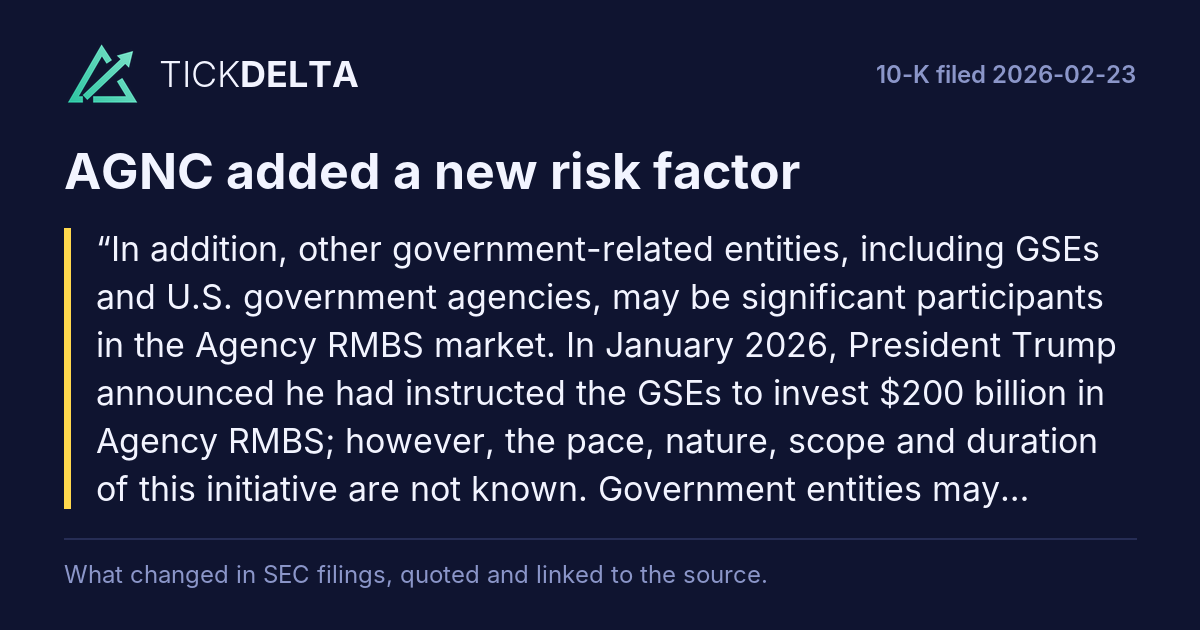
In addition, other government-related entities, including GSEs and U.S. government agencies, may be significant participants in the Agency RMBS market. In January 2026, President Trump announced he had instructed the GSEs to invest $200 billion in Agency RMBS; however, the pace, nature, scope and duration of this initiative are not known. Government entities may purchase or sell Agency RMBS for a variety of purposes, including implementing housing policy or other public policy objectives, supporting market liquidity, earning profits, responding to conditions in Agency RMBS markets or changes in public policy. The GSEs have also provided repo financing to Agency RMBS investors, and a reallocation of capital towards increased Agency RMBS purchases could reduce the availability of such financing and contribute to higher repo rates. Changes in the investment or lending activities of these entities, including increased sales, reduced purchases or funding, or other shifts in demand, could materially affect Agency RMBS prices, spreads, and market liquidity, and could adversely affect our tangible net book value, results of operations, liquidity, and financial condition.
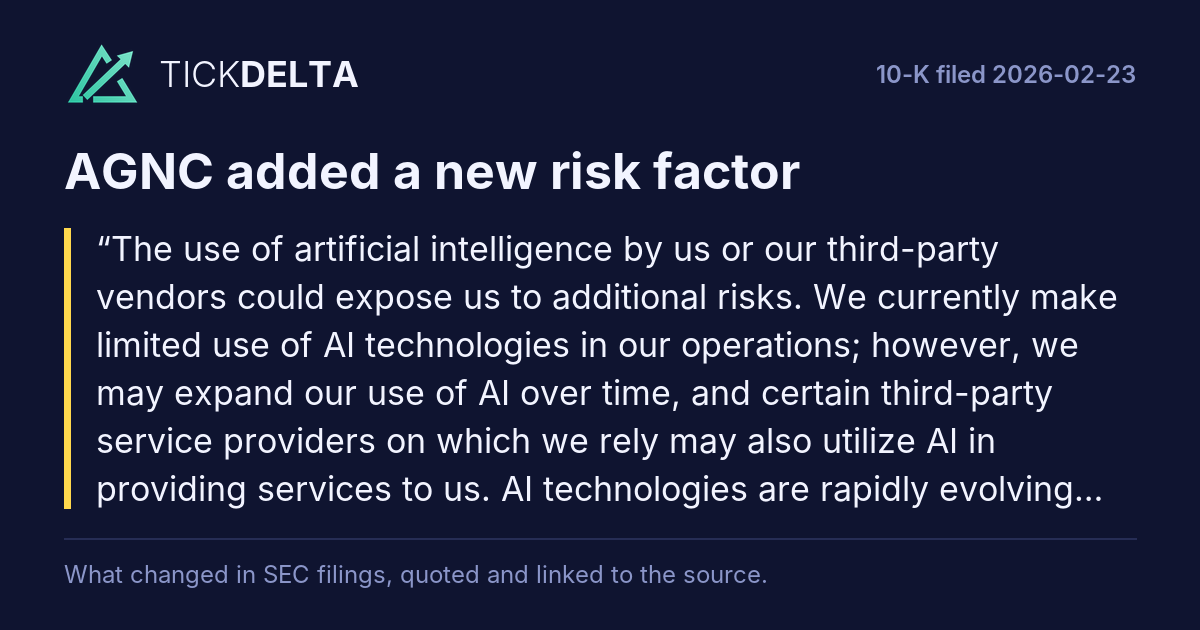
The use of artificial intelligence by us or our third-party vendors could expose us to additional risks.
We currently make limited use of AI technologies in our operations; however, we may expand our use of AI over time, and certain third-party service providers on which we rely may also utilize AI in providing services to us. AI technologies are rapidly evolving and may present risks related to data quality or completeness, model accuracy, cybersecurity, bias, explainability, intellectual property, and other operational, legal and business risks. Increased use of AI, whether by us or our vendors, could require additional governance, controls, and oversight and may increase our reliance on third-party data and technology.
If AI-driven tools, models, or outputs are inaccurate, unreliable, misconfigured, or misused, or if we fail to appropriately manage risks associated with the use of AI by us or our vendors, our operations, results of operations, or financial condition could be adversely affected.
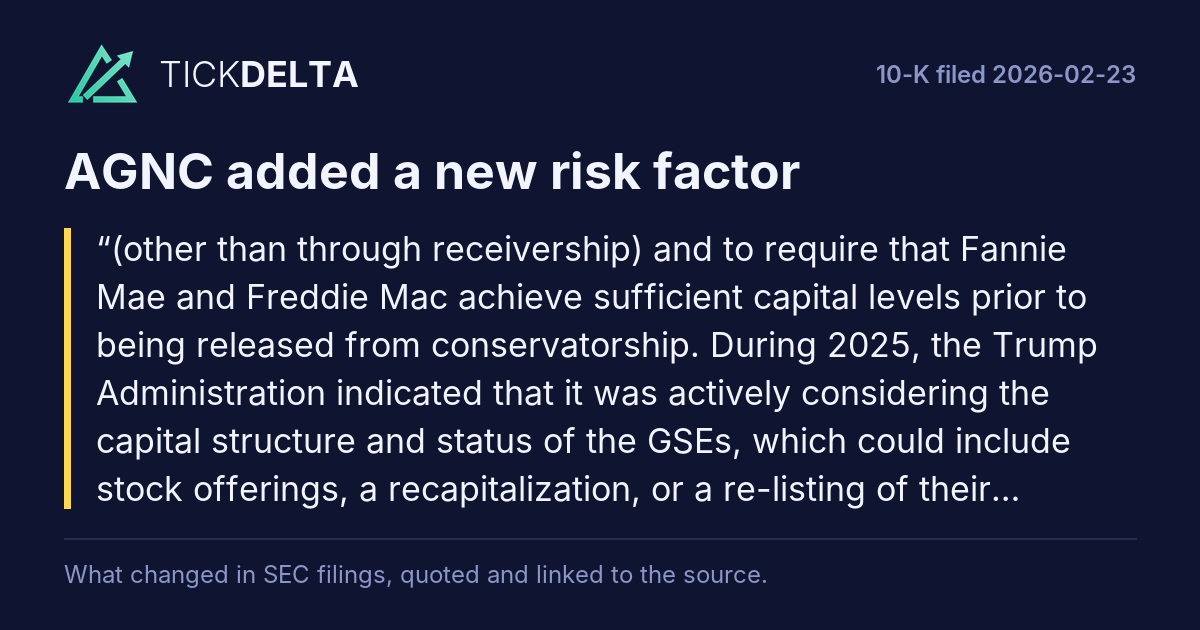
(other than through receivership) and to require that Fannie Mae and Freddie Mac achieve sufficient capital levels prior to being released from conservatorship. During 2025, the Trump Administration indicated that it was actively considering the capital structure and status of the GSEs, which could include stock offerings, a recapitalization, or a re-listing of their common stock, and expressed a desire to end the conservatorships at some time in the future. Nonetheless, Administration officials have stated that any such actions would be pursued in a manner intended to preserve mortgage market stability and not lead to higher mortgage rates. It is unclear what actions, if any, may be taken, or the form, nature, scope, timing, or the effects of any such actions.
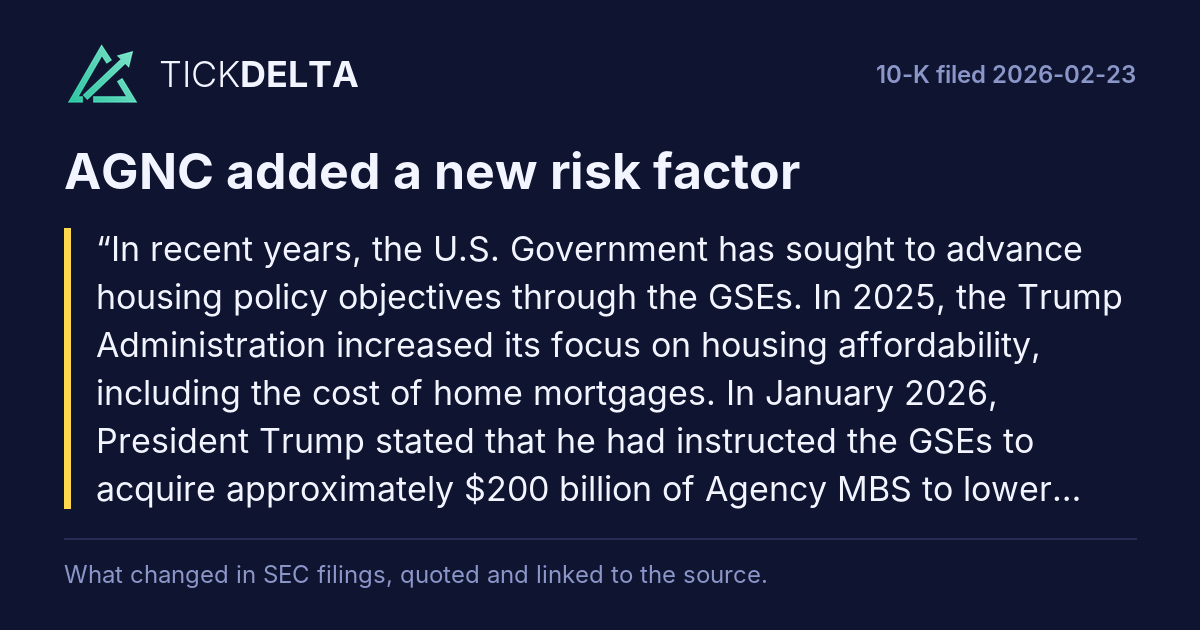
In recent years, the U.S. Government has sought to advance housing policy objectives through the GSEs. In 2025, the Trump Administration increased its focus on housing affordability, including the cost of home mortgages. In January 2026, President Trump stated that he had instructed the GSEs to acquire approximately $200 billion of Agency MBS to lower mortgage rates and improve housing affordability. The Administration has also solicited input from industry groups, think tanks, and other market participants regarding potential measures to reduce the cost of homeownership. A number of these proposals would be expected to have a benign or only modest effect on the Agency RMBS market or on our business, financial condition, or results of operations. However, certain of these proposals (or other future proposals), if implemented, could have broad adverse implications for Agency RMBS markets and our business by significantly changing prepayment speeds, artificially altering mortgage spreads on an unsustainable basis, or purporting to modify the terms of existing mortgages and existing Agency RMBS in a manner unfavorable to holders of Agency RMBS. Such proposals (or other future proposals), if adopted, could lead to reduced investor interest in Agency RMBS, lower market liquidity, increased Agency RMBS volatility, wider mortgage spreads, and as a result higher mortgage lending rates for homeowners. It is unclear whether the Trump Administration or Congress will seek to implement any of these or any other proposals or what the form, nature, scope, implementation timeline or effects of such actions could be.
Paragraphs in the 10-Q filed Oct 29, 2026 that were not in the one before
New in the latest 10-Q
16 paragraphs in the 10-Q filed Oct 29, 2026 with nothing like them in the 10-Q filed Jul 31, 2026 (at least half the words must differ; new numbers alone do not count). Quoted exactly, grouped by the item heading above them. This is text that changed, not a judgement of how serious it is.
Financial statements and notes
We have maintained a stock repurchase plan that enables us to repurchase shares of our common stock from time to time. We intend to repurchase shares under the stock repurchase plan only when the repurchase price is equal to or less than our then-current estimate of tangible net book value per common share. Our existing stock repurchase plan, which had $1 billion in remaining capacity, was due to expire on December 31, 2026. During October 2026, our Board of Directors terminated this stock repurchase plan and replaced it with a new plan authorizing us to repurchase up to $1 billion of common stock through December 31, 2028. Under the new plan, we may repurchase shares in the open market or through privately negotiated transactions or pursuant to a trading plan that may be adopted in accordance with Rule 10b5-1 of the Securities Exchange Act of 1934, as amended (the “Exchange Act”). Our stock repurchase plan may be limited or terminated at any time without prior notice.
Read in the 10-Q
Fixed income markets experienced significant pressure during the third quarter of 2026, particularly in the final weeks of September, as a confluence of adverse developments caused investor sentiment to turn decidedly bearish, interest rates to increase sharply, and interest rate volatility to spike. Instability in the U.S. Treasury market drove pronounced weakness in the Agency RMBS market, and Agency RMBS was the worst performing sector of the Bloomberg U.S. Aggregate Bond Index during the quarter. Consistent with the material underperformance of our underlying asset class, AGNC's economic return on tangible common equity per share was -12.7% for the third quarter. 1
Read in the 10-Q
The challenging fixed income environment was driven by a number of negative catalysts, including substantial monetary policy uncertainty, mixed inflation data, historically high levels of corporate debt issuance, heightened geopolitical risk, elevated energy prices associated with the conflict in the Middle East, and stronger-than-expected domestic economic growth. Monetary policy uncertainty was potentially the most significant of these factors. At the Jackson Hole Economic Symposium in August, Federal Reserve (“Fed”) Chairman Warsh signaled a more restrictive policy stance, and the Fed raised the federal funds rate by 25 basis points at its September meeting, its first increase since 2023. Although Chairman Warsh characterized the increase as the removal of a “dose of accommodation,” the market's subsequent repricing of monetary policy expectations was considerably sharper. In late February 2026, federal funds futures reflected the expectation of three rate cuts by year-end, consistent with the Fed's own projections and its gradual progression toward a neutral policy stance. Following the September
Read in the 10-Q
rate increase, however, federal funds futures priced in four additional rate increases by mid-2027, representing a 200-basis-point increase in the expected path of monetary policy over a very short period of time.
Read in the 10-Q
Against this backdrop, the yield on the 10-year U.S. Treasury increased 82 basis points during the quarter to 5.29%, with 54 basis points of that increase occurring in September. A quarterly increase of that magnitude has occurred on only four other occasions over the last 30 years. This weakness in the U.S. Treasury market extended to other fixed income asset classes, as evidenced by the approximately -3.5% total return of the Bloomberg U.S. Aggregate Bond Index for the third quarter.
Read in the 10-Q
Show the other 11
As is often the case when U.S. Treasury yields rise sharply, Agency RMBS experienced greater weakness than other fixed income sectors during the third quarter. The Bloomberg U.S. Mortgage Backed Securities Index (the “Agency MBS Index”) generated a total return of approximately -4.25% for the quarter and, on a duration-matched basis, underperformed U.S. Treasuries by nearly 120 basis points. Since 2010, the Agency MBS Index has underperformed U.S. Treasuries by a wider margin in only two other quarters: the third quarter of 2022, when the Fed raised short-term interest rates by 150 basis points while rapidly reducing its balance sheet, and the third quarter of 2011, when the S&P 500 Index declined 14% and the 10-year U.S. Treasury yield fell below 2%.
Read in the 10-Q
Agency RMBS underperformance was fairly uniform across the coupon stack, with negative excess returns by coupon, as measured by the Agency MBS Index, ranging from 110 to 140 basis points. Middle-coupon securities modestly underperformed lower-coupon securities, which benefited from limited supply and bond fund inflows, and higher-coupon securities, which experienced sharply reduced prepayment risk as interest rates moved higher. At quarter-end, the spread differential between current-coupon Agency RMBS and a blend of hedges was approximately 165 basis points against the swap curve and 135 basis points against the Treasury curve, in each case approximately 20 basis points higher than at June 30, 2026, placing Agency RMBS spreads near the upper end of their multi-year trading range.
Read in the 10-Q
Despite the challenging environment, we believe there are a number of reasons for optimism in the outlook for Agency RMBS once interest rate volatility subsides. First, the return profile of Agency RMBS is considerably more attractive at current valuation levels. At quarter-end, the yield on a new production current-coupon Agency RMBS was approximately 6.4%, which, for a security backed by the support of the U.S. government, should appeal to a broad range of investors. For hedged investors, the return opportunity is also compelling, with spreads to benchmark rates ending the quarter near the upper end of their multi-year trading range. Agency RMBS also appear increasingly attractive relative to investment grade corporate debt.
Read in the 10-Q
Second, mortgage cash flows have become more stable. As interest rates increase, the duration of Agency RMBS also increases, reflecting the extension risk inherent in mortgage-backed securities. At a certain rate level, however, mortgage durations plateau and become relatively insensitive to further rate increases. Given the magnitude of the increase in interest rates during the third quarter, we believe that inflection point has largely been reached and that the vast majority of the duration extension in the mortgage universe has already occurred. Prepayment risk has also diminished. With the primary mortgage rate meaningfully above the average note rate of the outstanding mortgage universe, less than 2% of outstanding Agency RMBS has a refinance incentive of 50 basis points or more, and a one percentage point decline in mortgage rates would increase that share to only approximately 10%.
Read in the 10-Q
Third, supply and demand technicals continue to support favorable Agency RMBS performance once interest rate volatility subsides. With the 30-year primary mortgage rate near 7.4% at quarter-end and seasonal factors that typically slow origination activity late in the year, the supply of new Agency RMBS for the remainder of 2026 and into 2027 is expected to be materially lower than previously anticipated. At the same time, we expect demand for Agency RMBS to remain steady, supported by strong bond fund inflows, the finalization of bank capital rules, the reemergence of the GSEs as purchasers, and increased participation from other investors seeking to take advantage of attractive return opportunities in the Agency RMBS market.
Read in the 10-Q
Taken together, we believe these conditions should benefit Agency RMBS performance over time. Interest rate volatility and macroeconomic uncertainty, however, are likely to remain elevated over the near term, and Agency RMBS performance will likely remain sensitive to that backdrop.
Read in the 10-Q
During the third quarter, AGNC was added to the S&P MidCap 400 Index. The announcement and subsequent index rebalancing activity drove elevated trading volume in our common stock, and we took advantage of this liquidity to issue 97.6 million shares of common stock at a significant premium to our tangible net book value per common share through our At-the-Market (“ATM”) offering program for net proceeds of $992 million.
Read in the 10-Q
Market risk
Interest Rate Sensitivity 1 September 30, 2026 December 31, 2025 Change in Interest Rate Weighted Average Projected CPR Weighted Average Asset Yield 2 Weighted Average Projected CPR Weighted Average Asset Yield 2 -75 Basis Points 7.6% 4.97% 16.6% 4.79% -50 Basis Points 7.2% 4.98% 13.6% 4.84% -25 Basis Points 6.9% 4.99% 11.3% 4.89% Actual as of Period End 6.7% 4.99% 9.6% 4.93% +25 Basis Points 6.5% 5.00% 8.3% 4.96% +50 Basis Points 6.3% 5.00% 7.5% 4.98% +75 Basis Points 6.2% 5.00% 7.0% 5.00%
Read in the 10-Q
and prices as of such dates; however, our portfolio’s sensitivity to mortgage spread changes will vary with changes in interest rates and in the size and composition of our portfolio. Therefore, actual results could differ materially from our estimates.
Read in the 10-Q
repurchase agreements and derivative agreements was less than 2% and less than 1%, respectively, of tangible stockholders’ equity.
Read in the 10-Q
Item 6
104** Cover Page Interactive Data File (embedded within the Inline XBRL document and included in Exhibit 101)
Read in the 10-Q
The 10-Q's risk factors against the 10-K
Item 1A of the 10-Q filed Oct 29, 2026 against Item 1A of the 10-K filed Feb 23, 2026.
A 10-Q repeats only the risks that changed, so a 10-K paragraph that is missing from it is not counted as removed.
Added is a paragraph with nothing like it in the 10-K, Reworded a sentence that is in both with several words changed,
Quiet changes a sentence in both where one to four words changed and one is a hedge or a modal
(cut words struck through, new words highlighted).
Text on the page, not a score; each links to the filing at sec.gov.
What the 10-Q itself says about its risk factors:There have been no material changes to the risk factors previously disclosed in our Annual Report on Form 10-K for the year ended December 31, 2025.
Read in the 10-Q
1 paragraph in the 10-Q's Item 1A, and none of them adds, rewords or quietly edits a paragraph of the 10-K's.
Phrases used for the first time
Two-word phrases in Risk Factors of the 10-K filed Feb 23, 2026 that are in none of the 1 earlier 10-Ks stored, back to Feb 21, 2025
Where each one is used
- government-related entities: The participation of the Fed and other government-related entities in the Agency mortgage market could have an adverse effect on our Agency RMBS investments.
- nature scope: In addition, other government-related entities, including GSEs and U.S. government agencies, may be significant participants in the Agency RMBS market. In January 2026, President Trump announced he had instructed the GSEs to invest $200 billion in Agency RMBS; however, the pace, nature, scope and duration of this...
- wider mortgage: The value of our assets is influenced by multiple factors. In particular, the value of our long-term fixed-rate securities is highly sensitive to fluctuations in longer-term interest rates. Additionally, the amount of market liquidity can significantly impact asset values, as reduced liquidity may lead to wider...
- january president: In addition, other government-related entities, including GSEs and U.S. government agencies, may be significant participants in the Agency RMBS market. In January 2026, President Trump announced he had instructed the GSEs to invest $200 billion in Agency RMBS; however, the pace, nature, scope and duration of this...
- president trump: In addition, other government-related entities, including GSEs and U.S. government agencies, may be significant participants in the Agency RMBS market. In January 2026, President Trump announced he had instructed the GSEs to invest $200 billion in Agency RMBS; however, the pace, nature, scope and duration of this...
- housing policy: In addition, other government-related entities, including GSEs and U.S. government agencies, may be significant participants in the Agency RMBS market. In January 2026, President Trump announced he had instructed the GSEs to invest $200 billion in Agency RMBS; however, the pace, nature, scope and duration of this...
- public policy: In addition, other government-related entities, including GSEs and U.S. government agencies, may be significant participants in the Agency RMBS market. In January 2026, President Trump announced he had instructed the GSEs to invest $200 billion in Agency RMBS; however, the pace, nature, scope and duration of this...
- increased agency: In addition, other government-related entities, including GSEs and U.S. government agencies, may be significant participants in the Agency RMBS market. In January 2026, President Trump announced he had instructed the GSEs to invest $200 billion in Agency RMBS; however, the pace, nature, scope and duration of this...
Used at least twice, small words left out. Counted, not picked: a phrase can be new because the company renamed something.
What was taken out
1 paragraph of last year's Risk Factors with nothing like them now. The longest are quoted.
Sources
Item 1A of each 10-K and 10-Q on EDGAR, quoted exactly. Each paragraph links to the filing at sec.gov.
Also
10-K change: what was reworded or cut, section by section.
Work with it
Excel workbook · CSV. Google Sheet that stays up to date: paste =IMPORTDATA("https://tickdelta.com/company/AGNC/export.csv") into a cell.