Screener / SEC EDGAR /CIK 0001273813 /10-K filed Feb 27, 2026, compared with Feb 28, 2025 /Numbers from the XBRL of the 10-Ks
NYSE Financials · Surety Insurance

Assured Guaranty Ltd AGO

Compare with peers Embed
SEC comment letters, last 20 years

3 reviews of AGO's filings by SEC staff

UPLOAD and CORRESP
Reviews 3 latest letter Aug 16, 2016
Questions asked 12 each answered in the company's own letter
No closing letter 0 reviews without a letter saying the staff completed it

When the SEC's staff reviews a filing, it writes to the company with numbered questions, and the company answers each one in a letter. SEC publishes the exchange once the review is over, at least 20 business days later. A question is not an accusation; most reviews end with the company adding detail to its next filing.

How the reviews went

Every review on EDGAR, from the first staff letter to the letter that closes it

  1. 1. Staff letters 4 UPLOAD
  2. 2. Questions in them 12 numbered comments
  3. 3. Company replies 5 CORRESP
  4. 4. Reviews closed 3 of 3 closing letter

Half the closed reviews took 44 days or less from the first letter to the closing letter.

Form 10-K

2016-08-16 to 2017-01-19 · 3 questions · 2 letters from the SEC, 3 from the company
Review closed 2017-01-19
Non-GAAP measuresResults discussion (MD&A)Derivatives and hedging
Financial Condition and Results of Operations · Net Earned Premiums, page 82
SEC asked (1)
Given the significant increase in the line item ‘Acceleration of net earned premiums’ in the table of Net Earned Premiums from the prior year, please separately quantify for us the increase due to refunding or termination of insurance and change in the expected lives of the insured obligations and explain the reason(s) for the increase.
Rest of the question

This comment applies to the increase related to the quarters ended March 31, 2016 and June 30, 2016 as well.

AGO answered
The increase in net earned premiums due to accelerations is attributable to changes in the expected lives of insured obligations driven by (a) refundings of insured obligations or (b) terminations of insured obligations either through negotiated agreements or the exercise of our contractual rights to make claim payments on an accelerated basis.

Refundings occur in the public finance market and have been at historically high levels in recent years due primarily to the low interest rate environment, which has allowed many municipalities and other public finance issuers to refinance their debt
Rest of the answer

obligations at lower rates. The premiums associated with the insured obligations of municipalities and other public finance issuers are generally received upfront when the obligations are issued and insured. When such issuers pay down insured obligations prior to their originally scheduled maturities, the Company is no longer on risk for payment defaults, and therefore accelerates the recognition of the nonrefundable unearned premiums remaining from the original upfront payment, as described in the Company's accounting policy on page 182 of the Form10-K.

Terminations are generally negotiated agreements with issuers resulting in the extinguishment of the Company’s insurance obligation with respect to the insured obligations. Terminations are more common in the structured finance asset class, but may also occur in the public finance asset class. While each termination may have different terms, they all result in the expiration of the Company’s insurance risk, such that the Company accelerates the recognition of the associated unearned premiums.

In future filings, when the variance is material, the Company will provide an explanation similar to the above, provide a breakdown of these two drivers of accelerations within the body of the table as shown below (see highlighted rows for additional breakout), and remove the footnote in favor of providing quantification of the components of the change.

Year Ended

Quarter Ended

December 31,

March 31,

June 30,

2015

2014

2016

(in millions)

Financial guaranty:

Read in the reply
In its next report

First report after the company's reply of Aug 26, 2016: 10-Q filed Nov 4, 2016 ↗, against the 10-Q filed Aug 4, 2016 ↗.

Tickdelta does not hold the text of both reports, so they are not compared here.
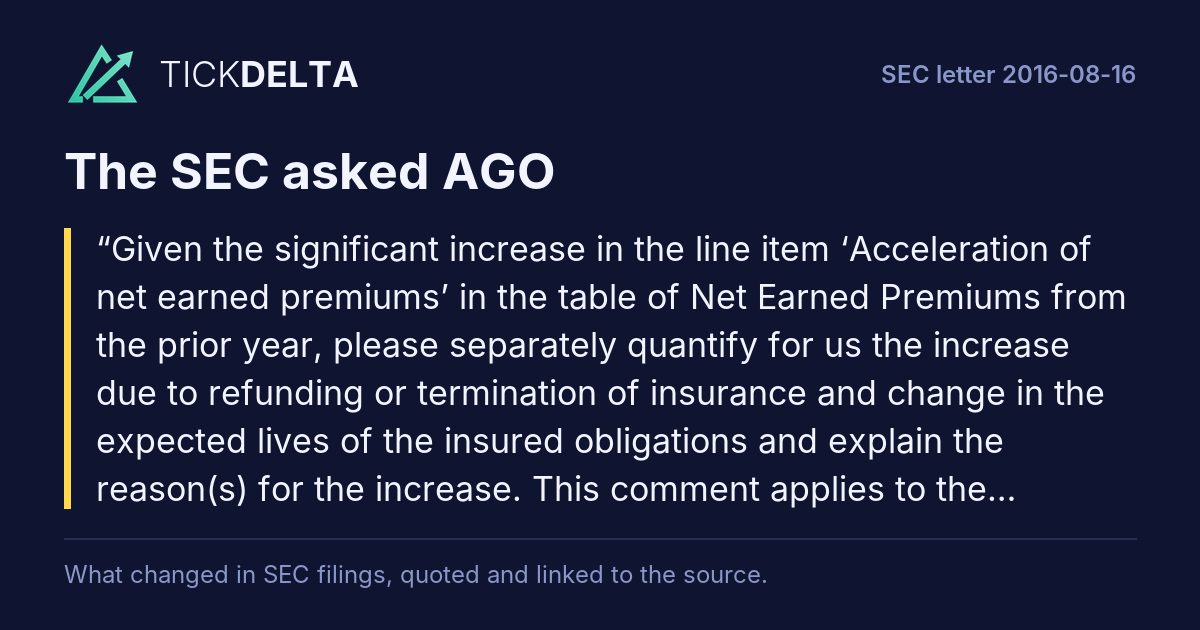
Exhibit 99.1, page 10 and Exhibit 99.2, pages 4 and 5
SEC asked (2)
You present full non-GAAP income statements to reconcile to your non-GAAP results, which is inconsistent with updated Compliance and Disclosure Interpretations 102.10 on Non-GAAP Measures issued on May 17, 2016. Please review this guidance when preparing your next earnings release and future periodic reports.
AGO answered
The Company reviewed the updated Compliance and Disclosure Interpretations (“CDI”) on Non-GAAP financial measures, as well as its previous SEC Staff comment letter response on this topic dated October 8, 2014, when preparing its earnings press release and periodic filings as of and for the periods ended June 30, 2016. The Company has made a number of changes to its disclosures as a result of that review.
Rest of the answer

For example, the Company revised its reconciliations to show adjustments gross of their tax effect, and now shows the tax effects separately.

While management recognizes the changes made to the CDI in May 2016, the Company respectfully requests that the Staff reconsider management’s assessment of the appropriateness of its current disclosures, especially given the Staff’s recognition that “whether a non-GAAP measure is more prominent than the comparable GAAP measure depends on the facts and circumstances in which the disclosure is made”. We believe greater prominence is placed on the GAAP financial measures in our income reconciliation by virtue of the fact that the reconciliation starts with the GAAP amounts in the first column (bolded) and clearly labels the non-GAAP financial measures as non-GAAP.

We know that various users of our financial statements find the current presentation of our GAAP and non-GAAP results to be informative, useful and transparent because (a) it more accurately reflects the economics of the Company, (b) it is how management and analysts view the Company's performance, and (c) analysts’ models are based on a non-GAAP income statement. Below is an analysis of why management believes the Company’s current reconciliation of the components of GAAP and non-GAAP income is in compliance with non-GAAP rules. This analysis has been updated from the October 8, 2014, SEC comment letter response.

Background

Assured Guaranty’s operating subsidiaries are financial guaranty insurance companies that provide credit protection products for the benefit of holders of debt instruments and other monetary obligations in respect of defaults in scheduled payments of principal and interest. If an obligor defaults on a scheduled payment due on an obligation, the Company is required under its unconditional and irrevocable financial guaranty to pay the amount of the shortfall to the holder of the obligation. Although the Company’s contracts are written in various forms and may include the insurance of a monetary obligation of a variable interest entity, what the Company guarantees is payment upon the failure of an obligor to make payment on a debt instrument or other monetary obligation when such payment is due. The various state insurance departments that regulate the financial guaranty industry and the rating agencies that assign financial strength ratings to financial guaranty companies consider our financial guaranties to be insurance contracts that should be presented as such under one consistent insurance accounting model. This is consistent with management’s view and with the views of our investors and analysts.

GAAP accounting rules have evolved over the years, often as a response to actual or perceived issues in a broad range of industries. In 2009, when the FASB's financial guaranty industry-specific guidance became effective with the intent to eliminate some of the diversity in accounting practice in the industry, its scope did not include the Company’s contracts written in derivative form, despite the economic similarities of these contracts to those written in the form of a financial guaranty insurance contract. As a result, the Company records changes in the fair value of the contracts that are considered derivatives under GAAP rules in its GAAP reported net income even though the contractual terms of these contracts do not permit the Company to unilaterally exit them. Movements in fair value that are in excess of the present value of expected losses are non-economic and will reverse as the contracts approach their maturities. These changes can be significant.

In 2010, the FASB's new rules regarding the consolidation of variable interest entities became effective, but again did not scope out financial guaranty contracts. This resulted in a third GAAP accounting model for economically similar contracts, which has a significant effect on many of the components of GAAP reported net income. The Company’s economic exposure under a consolidated FG VIE is the same as that of a financial guaranty insurance contract.

Derivative and VIE consolidation rules are the most significant drivers of non-economic volatility in our GAAP reported income statement. We believe that while these rules are valuable in reporting the economics of certain types of financial instruments in other financial services industries, they do not fully consider the unique characteristics of financial guaranty contracts.

Because management, investors, analysts, and insurance regulators view us as an insurance company whose results should be measured consistently regardless of contract form or structure, the Company has developed non-GAAP operating income measures in order to present all contracts under the financial guaranty insurance accounting model in ASC 944. We believe that the GAAP financial guaranty insurance accounting model, which was developed specifically for our industry, is the accounting model that most clearly reflects the economics of our business.

There have been many published reports by analysts and rating agencies that highlight the lack of transparency the derivative and consolidation of variable interest entity accounting models create in determining the economics of the Company’s business. Analysts have communicated their dissatisfaction with these GAAP rules (as they apply to financial guaranty companies) and indicated that they rely on the company’s non-GAAP financial statements because they more accurately reflect the Company’s economic exposure. The disclosures that management currently presents for its non-GAAP measures were formulated in response to requests by users of our financial statements for help in understanding the effect that these and other pronouncements have had on each component of net income.

Over the years, management has devoted much time and effort to creating supplemental disclosures to provide essential information to users that present a more economic view of the results of operations and financial condition, while still complying with SEC rules and regulations, and in a way that disseminates the information timely and consistently to all users in accordance with Regulation FD. We believe that users of our financial statements understand these adjustments and incorporate them in their analysis of the Company’s results.

Compliance with non-GAAP disclosure rules

The primary purpose of the reconciliation between the components of GAAP reported net income and non-GAAP earnings is to present the required reconciliation between each non-GAAP financial measure included in operating income and its most directly comparable GAAP financial measure. We believe that our presentation, while in the form of an income statement, does not place undue prominence on our non-GAAP financial measures, because equal if not greater prominence is placed on the GAAP financial measures by virtue of the fact that the reconciliation starts with the GAAP amounts in the first column (bolded) and clearly labels the non-GAAP financial measures as non-GAAP. For these reasons, we believe this presentation fulfills the requirements of Item 10(e)(1)(i)(A) of Regulation S-K.

Since most line items in the GAAP reported income statement are affected by the non-GAAP to GAAP reconciliation, management believes that it is beneficial to users to have all the components of non-GAAP operating income and GAAP reported net income in one place. Management believes that the benefit to the user of having all components of non-GAAP operating income in one place (even those few line items that have no non-GAAP adjustments) in an easily understandable format far outweighs any potential confusion. It allows the user to easily find the amounts necessary to calculate financial ratios such as the expense ratio and the effective tax rate on both a GAAP reported basis and a non-GAAP basis. Such analysis would be more difficult if we presented separate reconciliations or excluded line items from the presentation. Users would be required to search filings for components necessary to calculate these and other ratios. We know from our discussions with our financial statement users that this schedule is informative and they have commented on its usefulness. In fact, if the Company no longer prepared the non-GAAP income statement format, they would undoubtedly attempt to compile it themselves which would lead to additional confusion and diversity in practice and reduced transparency. We believe that providing this comprehensive reconciliation and presentation fulfills the requirement in Item 10(e)(1)(i)(B), and is responsive to the needs of our financial statement users.

In addition to the quantitative reconciliation, the Company provides extensive qualitative disclosure describing the adjustments to GAAP reported net income and the reasons for each, along with the primary purposes of the non-GAAP financial measures in the section labeled “Explanation of Non-GAAP Financial Measures” in Exhibits 99.1 and 99.2 of the Form 8-K. This satisfies the requirements in Items 10(e)(1)(i)(C) and 10(e)(1)(i)(D).

It is the same format provided to and used by the Board of Directors and executive management of the Company in their oversight and decision making roles. It is our strong belief that this presentation is useful to analysts, investors and other users of the financial statements, conveys management’s view of the results of operations, and is not prohibited by Item 10(e)(1)(i).

To that end, the Company respectfully requests that the Staff consider the Company’s facts and circumstances, particularly the three separate accounting models applicable in the Company’s small industry, the extent of the non-GAAP adjustments developed by the Company in response, the fact that such adjustments affect the majority of the lines of the income statement and the presentation of the GAAP measures first and in bold, and to accept the Company’s proposal to continue the use of this presentation.

In summary, the Company believes that it has complied with the applicable rules and the Staff’s interpretation of such rules.

--------------------------

In connection with its responses, the Company acknowledges that:

• the Company is responsible for the adequacy and accuracy of the disclosure in the filings;

Staff comments or changes to disclosure in response to Staff comments do not foreclose the Commission from taking any action with respect to the filings; and the Company may not assert the Staff comments as a defense in any proceeding initiated by the Commission or any person under the federal securities laws of the United States.

Read in the reply
In its next report

First report after the company's reply of Aug 26, 2016: 10-Q filed Nov 4, 2016 ↗, against the 10-Q filed Aug 4, 2016 ↗.

Tickdelta does not hold the text of both reports, so they are not compared here.

Form 8-K filed May 4, 2016 · Exhibit 99.1, page 10 and Exhibit 99.2, pages 4 and 5
SEC asked
In your response to prior comment two you indicate that although the Company’s contracts are written in various forms, the various state and insurance departments that regulate the financial guarantee industry and the rating agencies that assign financial strength ratings to financial guaranty companies consider your financial guarantees to be insurance contracts that should be presented as such under one consistent
Rest of the question

insurance model. And, that this is consistent with management’s view and the views of your investors and analysts. As a result, you developed non-GAAP operating income measures in order to present all contracts under the financial guaranty insurance accounting model in ASC 944. Please provide us with the following additional information:  Tell us whether you continue to write contracts in various forms (i.e. derivative and financial guaranty insurance contracts) or if certain contracts are in run-off. If you continue to write various forms of contracts, explain why, given the “economic similarities” of the contracts. For example, tell us whether customer needs drive the form of the contracts you write; and  Tell us your consideration of the updated Compliance and Disclosure Interpretations Question 100.04 on Non-GAAP Measures issued on May 17, 2016, given your presentation of all contracts under ASC 944.

AGO answered
The Company does not currently write new financial guaranty contracts in credit default swap (CDS) form, and has not written any new CDS since 2009.

The remaining term until legal maturity of the inforce book of financial guaranty contracts accounted for as CDS ranges up to 31 years. The estimated weighted average remaining life of the portfolio is 5.0 years as of June 30, 2016.
Rest of the answer

The remaining inforce book of financial guaranty business written in CDS form and accounted for as derivatives had a total net par outstanding of $20.0 billion as of June 30, 2016, down from $122.4 billion as of December 31, 2009.

On a quarterly basis, the Company discloses the remaining net par of its contracts accounted for as credit derivatives in the notes to the financial statements, and makes the following disclosure in Note 1 to its quarterly consolidated financial statements filed on Form 10-Q:

"In the past, the Company sold credit protection by issuing policies that guaranteed payment obligations under credit derivatives, primarily credit default swaps ("CDS"). Financial guaranty contracts accounted for as credit derivatives are generally structured such that the circumstances giving rise to the Company’s obligation to make loss payments are similar to those for financial guaranty insurance contracts. The Company’s credit derivative transactions are governed by International Swaps and Derivative Association, Inc. (“ISDA”) documentation. The Company has not entered into any new CDS in order to sell credit protection since the beginning of 2009, when regulatory guidelines were issued that limited the terms under which such protection could be sold. The capital and margin requirements applicable under the Dodd-Frank Wall Street Reform and Consumer Protection Act also contributed to the Company not entering into such new CDS since 2009. The Company actively pursues opportunities to terminate existing CDS, which have the effect of reducing future fair value volatility in income and/or reducing rating agency capital charges."

Tell us your consideration of the updated Compliance and Disclosure Interpretations Question 100.04 on Non-GAAP Measures issued on May 17, 2016, given your presentation of all contracts under ASC 944.

Company Response:

The Company carefully considered Question 100.04 and the response to that question in the Staff’s updated Compliance and Disclosure Interpretations on Non-GAAP Measures. In the answer, the Staff observed that "non-GAAP measures that substitute individually tailored revenue recognition and measurement methods for those of GAAP could violate Rule 100 (b) of Regulation G," and that "other measures that use individually tailored recognition and measurement methods for financial statement line items other than revenue may also violate Rule 100(b) of Regulation G." [Emphasis added.] This interpretation was offered in response to a hypothetical question involving a company that wished to present a non-GAAP performance measure that was adjusted to accelerate revenue recognized ratably over time in accordance with GAAP as though it earned revenue when customers are billed. In the example, the individually tailored non-GAAP performance measure appeared to be designed to accelerate (increase) revenue in comparison to the GAAP income measure.

The Company's non-GAAP adjustments are not designed to accelerate revenue or to otherwise adjust a financial measurement, positively or negatively. The Company makes adjustments regardless of whether they represent gains or losses, and there have been periods when the Company had non-GAAP operating income lower than reported GAAP net income, as well as periods when the Company had non-GAAP operating income higher than reported GAAP net income.

The Company’s non-GAAP adjustments are designed to present all financial guaranty contracts (regardless of legal form) on a consistent financial guaranty insurance basis (i.e., in accordance with ASC 944, which is the GAAP pronouncement that best reflects the economics of our business ) because of their economic similarities, as has been requested by investors, rating agencies and analysts following the Company. Since these non-GAAP measures allow these users to analyze the Company’s insured portfolio on a consistent basis, the Company believes these adjustments are useful and informative, and not misleading or in violation of Rule 100(b).

Background:

Financial guaranty policies are structured so that if an obligor on or issuer of a debt instrument or other monetary obligation defaults on a scheduled payment due to be paid on an instrument or obligation insured by the Company, including a scheduled principal or interest payment, the Company is required under its unconditional and irrevocable financial guaranty to pay the amount of the shortfall. This is the case regardless of the form of the contract or the accounting model prescribed by GAAP.

In addition to ASC 944, which was written specifically for the financial guaranty industry, there are two accounting pronouncements to which the Company must adhere that have a significant effect on the recognition and measurement of its financial guaranty contracts: ASC 815, Derivatives and Hedging; and ASC 810, Consolidation.

Impact of ASC 815, Derivatives and Hedging. The Company is in the business of providing credit protection products, primarily in the form of financial guaranties. Prior to the financial crisis, certain users of the Company's products requested the Company to provide its financial guaranty product in derivative form. The Company was willing to provide its financial guaranty product in derivative form as long as the risk it was taking and the reward it received was economically similar to those it took and received with respect to its traditional financial guaranty policy. Consequently, the terms of the contracts written in derivative form were tailored to mirror the insurance terms of traditional financial guaranty insurance contracts, and differed from those typically available in the market. Importantly, the

Company’s contracts written in derivative form, just like its traditional financial guaranty products, do not require the Company to pay on an accelerated basis unless such acceleration is at the sole option of the Company. In addition, because the Company provided irrevocable financial guaranty contracts on the CDS, it cannot unilaterally terminate or sell its exposure under them, just as it cannot do do so under its traditional financial guaranty contracts.

These contracts were accounted for under ASC 815 due only to the fact that they did not meet the third criteria in the scope exception in ASC 815-10-15-58(c), which requires the guaranteed party to represent that they will hold the debt obligation to maturity. From the perspective of the Company, as the provider of an irrevocable guaranty on the CDS, the terms of the CDS it entered make the CDS economically similar to traditional financial guaranty insurance.

Impact of ASC 810, Consolidation. Consolidated FG VIEs are traditional financial guaranty insurance contracts that have triggered consolidation under ASC 810, with no change to the Company's obligation to make payments of scheduled principal and interest when due upon default. Typically, these FG VIEs are consolidated only because a performance trigger in the insured VIE allows the Company to exercise its right to change a servicer. The Company does not actually service the underlying contracts or even have the authority to direct the servicer how to service the contracts, but simply has the right to change a servicer when the performance of the underlying contracts breaches an objective measure the parties believed at closing could indicate poor servicing. Because servicing of the underlying assets in a VIE whose debt is insured by the Company is deemed to be its principal activity, under ASC 810 the Company is deemed the primary beneficiary and consequently must consolidate the entire FG VIE. Similar to contracts accounted for as derivatives, this difference in accounting model does not affect the economic obligation of the Company.

Conclusion. The primary users of the Company's financial statements - management, directors, analysts, investors, rating agencies and state insurance regulators - all recognize the similarities of the Company's financial guaranty products regardless of whether they involve CDS or VIEs or not, and prefer to view them on a consistent financial guaranty insurance basis of accounting, which best reflects the economics of our business. In order to present this information to our users, we developed the non-GAAP adjustments discussed in this letter, and users of the Company’s financial statements need this to analyze the Company's results. For example, at pages 10 to 11 of its July 27, 2016 article affirming the Company’s ratings, S&P Global Ratings (S&P) again (as it has for the past several years) addressed the application of ASC 815 and 810 in its section on accounting considerations. Addressing ASC 815, S&P observes: “In our opinion, ASC 815, insofar as it relates to the financial guarantee insurance industry, has introduced some earnings volatility that has little bearing on either the likelihood of a potential claim or a bond insurer’s intrinsic earnings power. Unlike other financial sectors for which ASC 815 may be more relevant, bond insurers’ contracts are not traded, and there is no business intention to realize gains. Therefore, recording a marked-to-market loss because of changing spreads in the marketplace does not make sense from our analytic perspective.” Addressing ASC 810, S&P says: “We do not view consolidation of these transactions as indicating different or incremental risk relative to the company’s non-consolidated insurance exposure. … Because of this, we do not include debt associated with [special purpose entities] in any leverage calculations or fixed-charge coverage ratios.”

The overriding driver of the Company's decision to make the adjustments discussed in this letter was to present all economically similar credit protection contracts on a consistent method of accounting that most accurately reflects the economics of its book of business, which is important to the users of our financial statements. Within GAAP, ASC 944 is the model best suited for this purpose as it was written specifically for financial guaranty insurance contracts, with their unique characteristics in mind. ASC 815 and 810 were written for broader audiences with businesses very different from ours, and unfortunately, certain of the Company's contracts contain triggers or provisions that scope them into these rules, but which do not change the timing and amount of the Company's right to receive premiums or obligation to make payments.

Finally, the non-GAAP financial measures discussed in this letter are key measures in the Company's internal management reporting and decision making process, and are important in determining management compensation. They are therefore a critical component of the Company's disclosures regarding its compensation process and decisions, and are important touchstones for users of the Company's financial statements.

--------------------------

In connection with its responses, the Company acknowledges that:

the Company is responsible for the adequacy and accuracy of the disclosure in the filings;

Staff comments or changes to disclosure in response to Staff comments do not foreclose the Commission from taking any action with respect to the filings; and the Company may not assert the Staff comments as a defense in any proceeding initiated by the Commission or any person under the federal securities laws of the United States.

Read in the reply
In its next report

First report after the company's reply of Oct 7, 2016: 10-Q filed Nov 4, 2016 ↗, against the 10-Q filed Aug 4, 2016 ↗.

Tickdelta does not hold the text of both reports, so they are not compared here.

Also in this review: company letter, Jan 18, 2017, closing letter, 2017-01-19
Form 10-K for the Fiscal Year Ended December 31, 2014

2015-06-10 to 2015-07-17 · 4 questions · 1 letter from the SEC, 1 from the company
Review closed 2015-07-17
Results discussion (MD&A)Critical estimatesReserves and insurance
Results of Operations · Estimates and Assumptions, page 79
SEC asked (1)
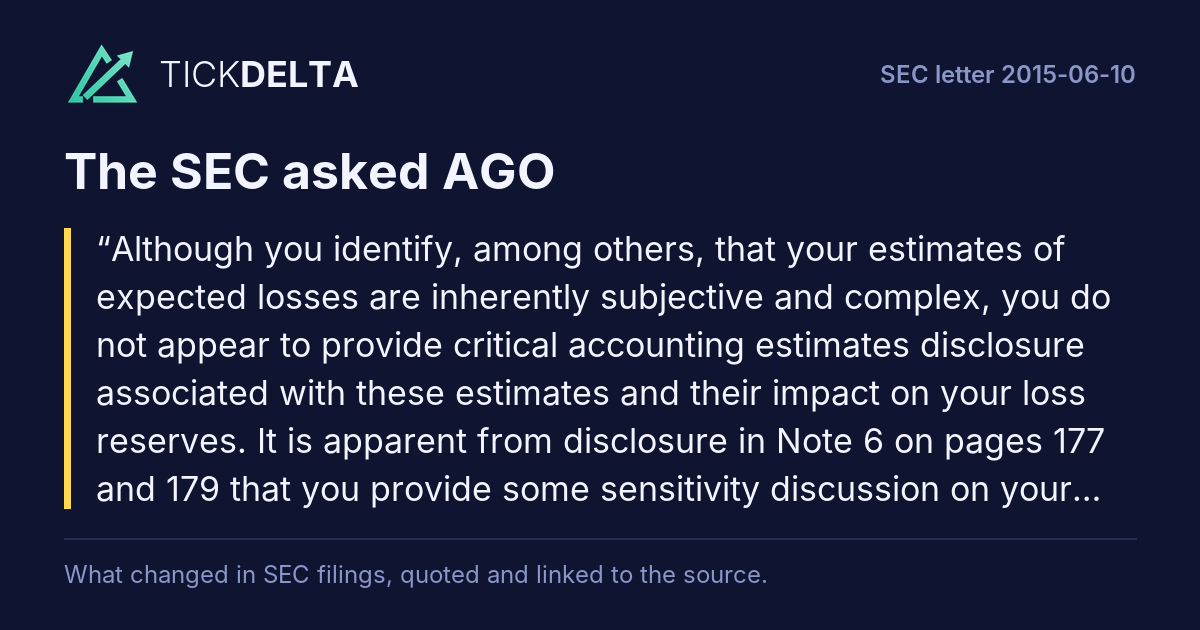
Although you identify, among others, that your estimates of expected losses are inherently subjective and complex, you do not appear to provide critical accounting estimates disclosure associated with these estimates and their impact on your loss reserves. It is apparent from disclosure in Note 6 on pages 177 and 179 that you provide some sensitivity discussion on your estimate of expected losses for U.S.
Rest of the question

first lien and second lien/HELOC RMBS contracts but do not quantify the impact on your loss reserves or provide sensitivity discussion for other significant expected losses, such as your other structured finance and U.S. public finance categories. Please tell us why such disclosure is not warranted or provide us proposed disclosure, including sensitivity to changes in material assumptions, to be included in future periodic reports. Please see FRC 501.14 added by FR-72.

AGO answered
The Company discloses expected losses and the related critical accounting estimates, based on criteria described below, with the goal of meeting the requirements of FCR 501.14 and providing the most useful information possible to investors. Expected losses to be paid represent the estimated future remaining net claim payments to be made, and economic development includes the full economic effect of changes in timing and assumptions on expected losses.
Rest of the answer

Management believes these to be the most meaningful measures of the Company's remaining cash flow requirements (on a present value basis), and the estimated periodic changes in the performance of the financial guaranty portfolio.

The Company follows a two-step process for determining what to disclose about its loss estimates and how to disclose it:

In order to determine which sectors, geographic concentrations and transactions to focus on in its disclosures, management prioritizes transactions with expected losses based on:

a.

how sensitive and variable the losses on these transactions are to changes in assumptions, b.

how significant the subjective judgments are that are incorporated into the loss scenarios, and c.

how material the losses generated by these transactions have been or could be in the future.

Read in the reply
In its next report

First report after the company's reply of Jun 23, 2015: 10-Q filed Aug 6, 2015 ↗, against the 10-Q filed May 8, 2015 ↗.

Tickdelta does not hold the text of both reports, so they are not compared here.

Note 7: Financial Guaranty Insurance Losses · Insurance Contracts’ Loss Information, page 186
SEC asked (2)
Although you provide a single “economic loss development” amount for each class of exposure in your net expected loss to be paid table on page 165, you do not appear to disclose or quantify the significant components of this development as required by ASC 944-40-50-9a2 and 50-9a3.
Rest of the question

Please provide us proposed revised disclosure to be included in future periodic reports including this information or tell us where you have made this disclosure in your filing.

AGO answered
In the Company's historical Form 10-Qs and Form 10-Ks, management has qualitatively disclosed instances where the economic loss development for any given sector was materially affected by changes in discount rates. However, in future filings beginning with its Form 10-Q for the quarter ended June 30, 2015, the Company will separate the economic loss development for the three months and six months ending June 30, 2015 between (1) changes due to accretion, (2) changes due to updating discount rates and (3) changes in timing and assumptions.
Rest of the answer

The Company's financial guarantees require it to pay scheduled principal and interest when due, so both the timing and amount of the Company's expected claim payments are driven by the same assumptions about the performance of collateral (in the case of structured finance) or issuer behavior (in the case of public finance). Consequently, management believes that the distinction between a change in timing versus a change in assumption does not provide better or more relevant information. Please see the rollforward table below, which will be included in the Company's next Form 10-Q filing and thereafter.

Net Expected Loss to be Paid

After Net Expected Recoveries for Breaches of R&W

Roll Forward

Three months ended June 30, 2015

Six months ended June 30, 2015

Expected loss to be paid, beginning of period

Economic loss development due to:

Read in the reply
In its next report

First report after the company's reply of Jun 23, 2015: 10-Q filed Aug 6, 2015 ↗, against the 10-Q filed May 8, 2015 ↗.

Tickdelta does not hold the text of both reports, so they are not compared here.

Measured and Carried at Fair Value · Fixed-Maturity Securities and Short-Term Investments, page 193
SEC asked (3)
You disclose that the fair value of bonds in your investment portfolio is generally based on prices received from third party pricing services or alternative pricing sources. Please provide us proposed revised disclosure to be included in future periodic reports that describes the procedures you perform to validate the valuations received from third party pricing services or alternative pricing sources.
AGO answered
The Company has historically described the pricing methods used by third party pricing sources, which management has approved and validated. The following is additional disclosure that will be incorporated into the Company’s future periodic reports, beginning with its next Form 10-Q filing, in order to describe the procedures performed by management to validate the valuations.

"Annually, the Company reviews each pricing service’s procedures, controls and models used in the valuations of the Company’s investment portfolio, as well as the competency of the pricing service’s key personnel.
Rest of the answer

In addition, on a quarterly basis, the Company holds a meeting of the internal valuation committee (comprised of individuals within the Company with market, valuation, accounting, and/or finance experience) that reviews and approves prices and assumptions used by the pricing services.

For Level 1 and 2 securities, the Company, on a quarterly basis, reviews internally developed analytic packages that highlight, at a CUSIP level, price changes from the previous quarter to the current quarter. Where unexpected price movements are noted for a specific CUSIP, the Company formally challenges the price provided, and reviews all key inputs utilized in the third party’s pricing model, and compares such information to management’s own market information.

For Level 3 securities, the Company, on a quarterly basis:

• reviews methodologies, any model updates and inputs and compares such information to management’s own market information and, where applicable, the internal models, reviews internally developed analytic packages that highlight, at a CUSIP level, price changes from the previous quarter to the current quarter, and evaluates, documents, and resolves any significant pricing differences with the assistance of the third party pricing source, and compares prices received from different third party pricing sources, and evaluates, documents the rationale for, and resolves any significant pricing differences."

Read in the reply
In its next report

First report after the company's reply of Jun 23, 2015: 10-Q filed Aug 6, 2015 ↗, against the 10-Q filed May 8, 2015 ↗.

Tickdelta does not hold the text of both reports, so they are not compared here.

Note 11: Investments and Cash · Accounting Policy, page 218
SEC asked (4)
You indicate that you record the non-credit component of the change in fair value of securities in OCI. Given that approximately 90.4% of your investment portfolio is managed by external investment managers and that you have granted discretionary investment authority to these managers as disclosed on page 17, please demonstrate to us how you have the ability to assert that you have the intent to hold, or will not
Rest of the question

morelikely-than-not be required to sell, securities in an unrealized loss position.

AGO answered
To ensure that the Company will have sufficient liquidity to meet its projected cash needs without selling securities over the coming quarter and year, the Company requires all external investment managers to hold a portion of their managed funds in cash/short-term investments. During 2014, the minimum required cash/short-term position was generally 5%.
Rest of the answer

Each quarter the Company prepares a liquidity analysis comparing major projected cash inflows against major projected cash outflows to determine if the anticipated cash and short-term holdings of the Company during the forecast period will be sufficient to meet its projected liquidity needs during that period without the need to sell securities. When there is an extraordinary anticipated need for cash (such as the purchase of Radian Asset Assurance Inc. on April 1, 2015), the Company will agree to the sale of investments in advance. Management of the Company reviews each manager's cash and short term balances periodically for adherence to this guideline.

While the Company grants its external investment managers discretionary authority, it is important to note the following:

Investment discretion is not unlimited, but in fact, guidelines are quite narrow including quantitative thresholds.

The Company communicates with each manager quarterly to agree on sales of impaired securities prior to quarter close.

The Company has established controls and procedures to review whether external managers adhere to guidelines and directives.

External investment managers have discretionary investment authority only within a tight set of investment guidelines that direct (1) what investment assets are acceptable to purchase, and (2) how much investment gain or loss is acceptable each period. As part of the Company's normal financial closing procedures and controls, management of the Company meets with the external investment managers, either in person or by telephone, twice per quarter: once to discuss potential impaired securities in the investment portfolio or securities the external managers would like to sell over the following quarter, and once to discuss the performance of the investment portfolio. The external investment managers provide a list of securities they intend to sell in the subsequent periods and management approves such listing. If the security is in an unrealized loss position at the end of the period, the Company records an impairment.

The Company must approve, for each manager, the sale of all securities in an unrealized loss position unless the unrealized loss is less than $150,000 for any individual security and less than $1.0 million in aggregate for all securities, in the one month period after the reporting date. The Company reviews activity reports from each investment manager detailing the trades to verify that these thresholds have not been breached.

--------------------------

In connection with its responses, the Company acknowledges that:

the Company is responsible for the adequacy and accuracy of the disclosure in the filing;

Staff comments or changes to disclosure in response to Staff comments do not foreclose the Commission from taking any action with respect to the filing; and the Company may not assert the Staff comments as a defense in any proceeding initiated by the Commission or any person under the federal securities laws of the United States.

Read in the reply
In its next report

First report after the company's reply of Jun 23, 2015: 10-Q filed Aug 6, 2015 ↗, against the 10-Q filed May 8, 2015 ↗.

Tickdelta does not hold the text of both reports, so they are not compared here.

Also in this review: closing letter, 2015-07-17

Form 10-K for the Year Ended December 31, 2013

2014-09-24 to 2014-11-07 · 5 questions · 1 letter from the SEC, 1 from the company
Review closed 2014-11-07
SegmentsResults discussion (MD&A)RevenueDerivatives and hedgingNon-GAAP measures
Available Information, page 42
SEC asked (1)
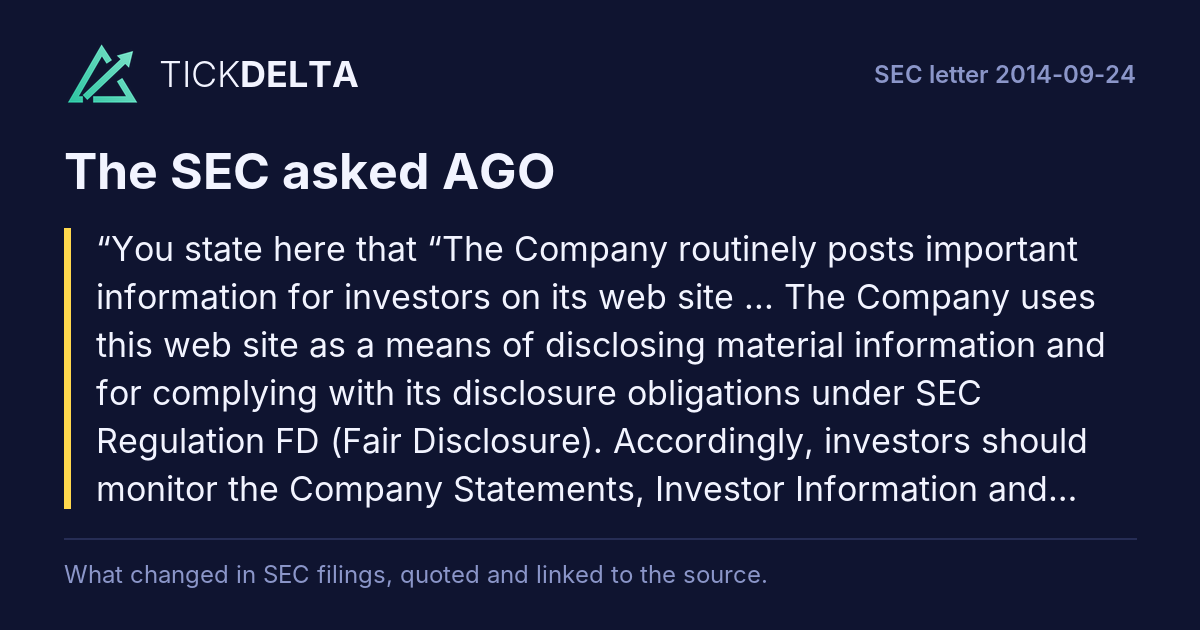
You state here that “The Company routinely posts important information for investors on its web site ... The Company uses this web site as a means of disclosing material information and for complying with its disclosure obligations under SEC Regulation FD (Fair Disclosure).
Rest of the question

Accordingly, investors should monitor the Company Statements, Investor Information and Businesses portions of the Company's web site, in addition to following the Company's press releases, SEC filings, public conference calls, presentations and webcasts. The information contained on, or that may be accessed through, the Company's web site is not incorporated by reference into, and is not a part of, this report.” In accordance with the above, we found that you posted separate audited fiscal year 2013 and unaudited quarterly financial statements for AGM, AGC, MAC and AG Re for each of the quarters ended March 31, 2013 through June 30, 2014 on your web site. In some cases, similar financial statements have been furnished on Forms 8-K under Items 2.02 and 9.01. Please address the following:  Tell us why you posted these select subsidiary financial statements to your web site, and why not all of these were furnished on Forms 8-K.  Tell us, if true, that the disclosure contained in these separate subsidiary financial statements does not contain any material information that would be significant to a readers analysis and understanding of your Forms 10-K and 10-Q.  Tell us how the preparation of separate subsidiary financial statements is consistent with your statement on page 143 that “The chief operating decision maker manages the operations of the Company at a consolidated level. Therefore, all results of operations are reported as one segment.”

AGO answered
Assured Guaranty provides credit protection products to the United States and international public finance (including infrastructure) and structured finance markets. It conducts its financial guaranty business principally from its insurance subsidiaries Assured Guaranty Corp. (AGC), Assured Guaranty Municipal Corp. (AGM), Municipal Assurance Corp. (MAC), and Assured Guaranty Re Ltd. (AG Re).

Assured Guaranty posts on its website (and either files or furnishes on a Form 8-K) all of the subsidiary financial statements that it prepares on the basis of U.S.
Rest of the answer

generally accepted accounting principles (GAAP) that are provided to (a) purchasers of securities insured by AGC or AGM or (b) ceding insurance companies reinsured by AG Re. As discussed further below, Assured Guaranty does not prepare GAAP financial statements for MAC, but it is required to prepare and does post on its website, financial statements for MAC that are prepared in accordance with statutory accounting principles under applicable insurance laws (SAP). Assured Guaranty also posts on its website the SAP financial statements it is required to prepare for AGC and AGM.

It is important for existing and potential purchasers of securities insured by AGC, AGM or MAC (i.e., securities issued by third-party issuers, the principal and interest payments of which are insured by AGC, AGM or MAC) to have access to financial information of the specific Assured Guaranty insurance subsidiary providing the insurance (as opposed to the consolidated group) because it is that insurance subsidiary that would be responsible for making any claim payments that arise. Likewise, it is important for insurance companies ceding exposure to AG Re to have access to that reinsurer’s financial information. As a result, Assured Guaranty posts GAAP and/or SAP financial statements for these insurance and reinsurance subsidiaries on its website, which it believes is the most efficient means of making such information available to purchasers of securities insured by AGC, AGM or MAC, and insurance companies ceding exposure to AG Re.

When insured securities are first issued, the issuer or underwriter typically requires that financial information about the insurer be included or incorporated by reference in the offering document.

When AGC insures securities that are issued pursuant to a registration statement filed with the SEC or an offering memorandum pursuant to Rule 144A, the issuer typically incorporates AGC’s GAAP financial statements into the offering document. Issuers and underwriters have been reluctant to incorporate by reference into SEC-filed or Rule 144A documents information from a website, rather than from an SEC filing. Therefore, Assured Guaranty files GAAP financial information for AGC on a Form 8-K in order to facilitate the incorporation by reference of such information into the offering documents of securities AGC insures.

When AGM insures a publicly-listed transaction in Europe, the non-U.S. stock exchange on which the bonds are listed requires guarantors to provide financial statements in the offering document that are prepared in accordance with, or equivalent to, international financial reporting standards (IFRS). It is for this reason that Assured Guaranty prepares GAAP financial statements for AGM. In the interest of transparent disclosure, Assured Guaranty furnishes on a Form 8-K the GAAP financial statements for AGM.

When AGM, MAC or AGC insures a U.S. public finance bond offering, the issuer of such bonds typically includes SAP financial information for the applicable Assured Guaranty insurance subsidiary in the official statement for such offering. In addition, under applicable insurance law, AGM, MAC and AGC are required to prepare SAP financial statements and to file those financial statements with the insurance departments of the states in which the insurance companies are licensed; such financial statements are also required to be filed with the National Association of Insurance Commissioners (NAIC) and the NAIC makes the financial statements available to insurance regulators and policyholders through its website. As is customary in the insurance industry, Assured Guaranty makes these SAP financial statements available through the Assured Guaranty website. Because it is not necessary for Assured Guaranty’s business purposes that the SAP financial statements be filed or furnished on a Form 8-K (in contrast with its GAAP financial statements) and because such financial statements are otherwise provided or available to existing and potential policyholders and to regulators, Assured Guaranty does not file or furnish them on Form 8-K.

In summary, Assured Guaranty posts on its website those GAAP and/or SAP financial statements of AGC, AGM, MAC, and AG Re that it believes are important to purchasers of securities insured or reinsured by those entities. Among these financial statements, the ones which are not filed or furnished on a Form 8-K are the SAP financial statements of AGC, AGM, and MAC.

Assured Guaranty believes that its Forms 10-K and Forms 10-Q provide all material information that a reasonable investor would require to analyze and understand Assured Guaranty’s consolidated results of operations and financial condition and that the additional subsidiary financial statements do not provide additional material information needed for a reader’s analysis and understanding of Assured Guaranty’s consolidated results of operations and financial condition.

Assured Guaranty considers the guidance in ASC 280 to determine its operating segments. While we prepare separate company financial statements for the various reasons discussed above, Assured Guaranty has only one product and its chief operating decision maker manages Assured Guaranty's resources and profitability as a consolidated group. No managers are responsible for the profitability of the operating entities on an individual basis. The same management team is responsible for, and manages, all of the operating entities to maximize the consolidated results. Therefore, Assured Guaranty believes the preparation of subsidiary financial statements is consistent with the statement on page 143.

Management’s Discussion and Analysis of Financial Condition and Results of Operations Executive Summary Key Business Strategies, page 75

Read in the reply
In its next report

First report after the company's reply of Oct 8, 2014: 10-Q filed Nov 7, 2014 ↗, against the 10-Q filed Aug 8, 2014 ↗.

Tickdelta does not hold the text of both reports, so they are not compared here.

Executive Summary · Key Business Strategies, page 75
SEC asked (2)
In the fourth paragraph of your loss mitigation disclosure on page 75 you indicate that you negotiated consensual restructurings with various obligors and that the settlements with Jefferson County, Alabama and the city of Harrisburg, Pennsylvania included your insurance of new revenue bonds issued by both municipalities.
Rest of the question

Please tell us how you accounted for the settlement under the previously existing insurance contracts and the new contracts. In your response, please summarize each settlement and explain to us how you determined the amount of revenue to allocate to the new insurance contracts and the amount of losses expected under your previously existing contracts. Reference for us the authoritative literature you relied upon to support your accounting. Notes to Consolidated Financial Statements Note 6: Expected Loss to be Paid U.S. First Lien RMBS Loss Projections: Alt-A First Lien, Option ARM, Subprime and Prime,

AGO answered
The following separately summarizes the Jefferson County, Alabama and Harrisburg, Pennsylvania restructurings and the Company’s accounting for such:

Jefferson County, Alabama

On November 9, 2011, Jefferson County filed for bankruptcy protection under Chapter 9 of the U.S. Bankruptcy Code. After several years of negotiations and litigation with various parties, Jefferson County's revised plan of adjustment was approved by the bankruptcy court and became effective in December 2013.
Rest of the answer

The key components of the Jefferson County settlement impacting the Company were as follows:

The cancellation of three direct financial guarantee insurance policies issued by the Company as well as the cancellation of the Company’s exposure through assumed reinsurance;

A decrease in the Company’s exposure to a fourth direct financial guarantee insurance policy from $271.5 million to $7.3 million of gross par outstanding; and

The issuance of new senior lien warrants by Jefferson County, as to which the Company provided a financial guarantee for a principal amount of approximately $600 million in exchange for an upfront insurance premium.

The Company followed the accounting guidance for the early retirement of a financial guarantee found in ASC 944-605-25-32 and -33 to account for both the cancellation of the Company’s original insurance policies and reinsurance exposures and the issuance of the new insurance policy. The three original direct financial guarantee insurance policies were legally terminated and, as a result, the Company’s financial obligation was extinguished on those obligations. The premium received on these policies was paid in full upon issuance and not returned;

therefore, the Company recognized the remaining unearned premium reserve (“UPR”) balance as income on the date of the settlement. The Company had previously paid claims under these policies. At the date of the settlement, it also had a recorded loss reserve related to potential future claim payments, based on the probability weighted cash flows of various potential scenarios, which it released as a result of the settlement.

There was a decrease in the Company’s exposure to one direct financial guarantee insurance policy from $271.5 million to $7.3 million of gross par outstanding. As part of the settlement, the Company received a cash payment of $7.3 million, which it recorded as salvage received.

The Company provided a new financial guarantee with respect to the senior lien warrants with a principal balance of approximately $600 million for which it received an insurance premium (the “Premium”). The Company followed the guidance in ASC 944-605-25-33 in accounting for this new financial obligation resulting from a previous retired financial obligation. Accordingly, the Company assessed the Premium related to the new guarantee to determine if the Premium received from the Issuer was commensurate with what the Company would charge to insure a similar financial obligation in a separate (standalone) transaction. The Company concluded that the Premium charged was commensurate with what would be charged in a separate (standalone) transaction. On the date of the settlement, the Company recorded the Premium as UPR. The Company does not currently expect to incur any losses on this transaction.

Harrisburg, Pennsylvania

The Company insured bonds issued by The Harrisburg Authority for a resource recovery facility. The resource recovery facility bonds were supported by the City of Harrisburg, PA and Dauphin County, PA. The key components of the Harrisburg, PA settlement impacting the Company were as follows:

In December 2013, the defaulted resource recovery facility bonds were paid in full with funds from the sale of the resource recovery facility, the sale of new parking system revenue bonds issued by the Pennsylvania Economic Development Financing Authority (“PEDFA”), guaranty payments made by Dauphin County, PA, and claim payments made by the Company;

The Company is entitled to receive reimbursements for claims it paid in connection with the defaulted resource recovery facility bonds. In connection with this, the Company received a residual note from PEDFA that it recorded as a settlement of salvage on its insurance policies; and

The Company insured a portion of the new parking system revenue bonds issued by PEDFA for an upfront premium that the Company determined was less than what we would charge to insure a similar financial obligation in a separate (standalone) transaction.

Given that the resource recovery facility bonds were paid in full, the Company’s financial obligation has been extinguished for these bonds. Pursuant to ASC 944-605-25-32 and -33, the Company recognized the remaining UPR balance on the resource recovery facility bonds as income on the settlement date. The Company had previously paid claims under these policies. At the date of the settlement, it also had a recorded loss reserve related to potential future claim payments, based on the probability weighted cash flows of various potential scenarios, which it released as a result of the settlement.

The Company followed the guidance in ASC 944-605-25-33 in accounting for the new financial obligations resulting from a previous retired financial obligation. Consequently, the Company recorded UPR based on the premium that we would charge to insure a similar financial obligation in a separate (standalone) transaction. The Company recorded a day one loss on the new insurance policies in its income statement for the shortfall between the premium received and the premium that the Company would charge to insure a similar financial obligation in a separate (standalone) transaction. The Company does not currently expect to incur any losses on the new PEDFA insurance policies.

Notes to Consolidated Financial Statements

Note 6: Expected Loss to be Paid U.S. First Lien RMBS Loss Projections: Alt-A First Lien, Option ARM, Subprime and Prime, page 173 U.S. Second Lien RMBS Loss Projections: HELOCs and Closed-End Second Lien, page 176

Read in the reply
In its next report

First report after the company's reply of Oct 8, 2014: 10-Q filed Nov 7, 2014 ↗, against the 10-Q filed Aug 8, 2014 ↗.

Tickdelta does not hold the text of both reports, so they are not compared here.

U.S. Second Lien RMBS Loss Projections: HELOCs and Closed-End Second Lien, page 176
SEC asked (3)
In the tables on pages 175, 176 and 177 you provide summaries of the various key assumptions you used to estimate your base case expected loss estimates. Please tell us how the broad range of many of these assumptions provides useful information to investors and explain to us why providing more precise information (for example, in terms of weightedaverage rates or concentrations within the ranges provided) would not
Rest of the question

be more meaningful to investors. Examples of the broad ranges provided, not intended to be a complete listing, are:  Plateau CDR for Alt-A First Lien at December 31, 2013 of 2.8% to 18.4%;  Initial CPR for Alt-A First Lien at December 31, 2013 of 0.0% to 34.2%;  Plateau CDR for Option Arm at December 31, 2013 of 4.9% to 16.8%;  Plateau CDR for HELOC at December 31, 2012 of 3.8% to 15.9%;  Initial CPR for HELOC at December 31, 2013 of 2.7% to 21.54%;

AGO answered
The Company has provided ranges of assumptions used to estimate its base case expected loss estimates, which because the performance of the underlying transactions varies by transaction and within transactions across periods, results in a wide range of values. These ranges are meant to supplement the textual explanations the Company provides below the table and to be viewed comparatively with prior periods to enable the reader to draw inferences with regard to how the transactions are trending.
Rest of the answer

For example, if the ranges are narrowing then the transactions are approaching a more central equilibrium assumption or if the whole range is shifting lower then the pool of transactions is improving as a whole. While the ranges have been, at times, broad, the Company believed that the alternative of providing weighted averages did not provide better information because the weighting may have masked trends in the portfolio. For example, if the weighting was based on par then a small group of transactions may have a disproportionate effect on the portfolio even if they do not necessarily contribute to the reserve. Or, for example, if the weighting was based on expected loss amount, then as the expected loss declined, transactions with larger par amounts but small expected losses would have a smaller contribution even though they may have a higher potential for future losses.

As RMBS volatility has declined over time and the market has stabilized, the use of weighted averages has become more useful. In future SEC filings, commencing with its Form 10-Q filing for the period ended September 30, 2014, the Company will amend its disclosure to include information on the weighted average amounts based on outstanding par for each of the significant assumptions used to calculate base case expected losses.

Commencing with its Form 10-Q filing for the period ended September 30, 2014, the Company will amend its disclosure in future SEC filings to include information on weighted average amounts as shown below:

The following table shows the range of key assumptions used in the calculation of expected loss to be paid for individual transactions for direct vintage 2004 - 2008 first lien U.S. RMBS.

Key Assumptions in Base Case Expected Loss Estimates

First Lien RMBS(1)

As of

December 31, 2013

December 31, 2012

December 31, 2011

Range

Weighted Average

Alt-A First Lien

Plateau CDR

2.8

%

–

18.4%

—%

3.8

23.2%

41.3%

Intermediate CDR

0.6

3.7%

0.8

4.6%

8.3%

Period until intermediate CDR

48 months

36 months

Final CDR

0.1

0.9%

0.2

1.2%

2.1%

Initial loss severity

65%

Initial conditional prepayment rate ("CPR")

0.0

34.2%

39.4%

37.5%

Final CPR

15%

Option ARM

4.9

16.8%

7.0

26.1%

9.6

31.5%

1.0

3.4%

1.4

5.2%

1.9

6.3%

0.8%

0.4

1.3%

0.5

1.6%

Initial CPR

13.1%

10.7%

29.1%

Subprime

5.6

16.2%

7.3

26.2%

8.3

29.9%

1.1

3.2%

1.5

1.7

6%

0.3

1.5%

90%

15.7%

17.6%

16.3%

The following table shows the range of key assumptions for the calculation of expected loss to be paid for individual transactions for direct vintage 2004 - 2008 second lien U.S. RMBS.

Second Lien RMBS(1)

HELOC key assumptions

2.3

7.7%

15.9%

4.0

27.4%

Final CDR trended down to

Period until final CDR

34 months

2.7

21.5%

2.9

15.4%

25.8%

10%

Loss severity

98%

Closed-end second lien key assumptions

15.1%

20.7%

6.9

29.5%

3.5

9.1%

3.1

12.0%

12.5%

0.9

14.7%

___________________

(1) Represents variables for most heavily weighted scenario (the “base case”).

Read in the reply
In its next report

First report after the company's reply of Oct 8, 2014: 10-Q filed Nov 7, 2014 ↗, against the 10-Q filed Aug 8, 2014 ↗.

Tickdelta does not hold the text of both reports, so they are not compared here.

Note 8: Fair Value Measurement · Quantitative Information About Level 3 Fair Value Inputs, page 205
SEC asked (4)
In these tables you provide the significant unobservable inputs used to value Level 3 assets and liabilities. Please tell us how the broad range of many of these inputs for your significant Level 3 estimates for FG VIEs’ assets and liabilities and credit derivative liabilities provides useful information to investors and explain to us why providing more precise information (for example, in terms of weighted-average
Rest of the question

rates or concentrations within the ranges provided) would not be more meaningful to investors. At December 31, 2013 the ranges of inputs for each of the inputs you identify for FG VIEs’ assets and liabilities and credit derivative liabilities each appears sufficiently wide as to question its meaningfulness to investors.

AGO answered
For FG VIEs’ assets and liabilities, the assets and liabilities are typically based on the fair value of RMBS. Similar to our response to question #3, above, the Company has provided ranges of assumptions because the performance of the underlying transactions has varied by transaction and within transactions across periods, which results in a wide range of values.
Rest of the answer

While the ranges have been, at times, broad, the Company felt the alternative of providing weighted averages did not provide better information because the weighting may have masked trends in the portfolio.

As the RMBS volatility has declined over time and the market has started to stabilize, the use of weighted averages has become more useful. Beginning with the Form 10-Q filing for the period ended September 30, 2014, the Company will add weighted averages based on outstanding par to its disclosures of FG VIEs’ assets and liabilities.

For credit derivative liabilities, net, the vast majority of the balances relate to the fair value of credit derivatives covering RMBS. Again, the performance of the underlying transactions has varied greatly by transaction and within transactions across periods. As RMBS volatility and the hedge cost, which is based on the Company’s own credit, have stabilized, the use of weighted averages here has become more useful as well. While we believe that there is significant useful information on the components of fair value of credit derivatives that is presented in the Footnote 9, “Financial Guaranty Contracts Accounted for as Credit Derivatives, adding the weighted average disclosure information to the Fair Value Measurement footnote would enhance it. As a result, beginning with the Form 10-Q filing for the period ended September 30, 2014 the Company will add weighted averages based on the outstanding notional amount of the credit derivatives to its disclosures of credit derivative liabilities.

Commencing with its Form 10-Q filing for the period ended September 30, 2014, the Company will amend its disclosure in future SEC filings to include information on the weighted average amounts for each of the significant Level 3 estimates for FG VIEs’ assets and liabilities and credit derivative liabilities as shown below:

Level 3 Fair Value Disclosures

Quantitative Information About Level 3 Fair Value Inputs

At December 31, 2013

Financial Instrument Description (1)

Fair Value at

(in millions)

Significant Unobservable Inputs

FG VIEs’ assets, at fair value

$

2,565

CPR

-

11.8%

CDR

3.0

37.5

102.0%

Yield

10.2%

Credit derivative liabilities, net

(1,693

)

Year 1 loss estimates

48.0%

Hedge cost (in bps)

46.3

525.0

Bank profit (in bps)

1,418.5

Internal floor (in bps)

100.0

Internal credit rating

AAA

CCC

FG VIEs’ liabilities, at fair value

(2,871

Read in the reply
In its next report

First report after the company's reply of Oct 8, 2014: 10-Q filed Nov 7, 2014 ↗, against the 10-Q filed Aug 8, 2014 ↗.

Tickdelta does not hold the text of both reports, so they are not compared here.

Form 8-K Item 2.02 filed August 8, 2014 · Exhibit 99.1
SEC asked (5)
In this exhibit you present a full statement of income to reconcile your GAAP earnings to non-GAAP earnings. Please represent to us that you will no longer present these tables in future Item 2.02 Form 8-K submissions or elsewhere. Please see Question 102.10 of our Compliance & Disclosure Interpretations for Non-GAAP Financial Measures.
Rest of the question

Please also see Instruction 2 to Item 2.02 of Form 8-K which indicates that the provisions of Item 10(e)(1)(i) apply to these public disclosures.

AGO answered

No numbered answer found in the reply. Read the reply ↗

In its next report

First report after the company's reply of Oct 8, 2014: 10-Q filed Nov 7, 2014 ↗, against the 10-Q filed Aug 8, 2014 ↗.

Tickdelta does not hold the text of both reports, so they are not compared here.

Also in this review: closing letter, 2014-11-07

From the SEC's correspondence on EDGAR: staff letters (form UPLOAD) and company letters (form CORRESP), 12 letters filed since 2014-09-24. Questions and answers are matched by their numbers; topics come from words in each question. The reports are compared word for word (same form, before the first SEC letter against the first report after the company's reply). No AI.

Sources

The SEC's correspondence on EDGAR: staff letters (form UPLOAD) and company letters (form CORRESP), matched question by question. No AI.

Also

Filings: the letters in the filing list.

Work with it

Excel workbook · CSV. Google Sheet that stays up to date: paste =IMPORTDATA("https://tickdelta.com/company/AGO/export.csv") into a cell.

Next in Owners and insiders:Insider trades
Esc

Type a ticker such as AAPL, a name, an investor such as Buffett, or a topic such as tariffs. ↑ ↓ to move, Enter to open.