Paragraph 82 · 49% changed
Every version of it
Screener
/
SEC EDGAR
/CIK 0000078749
/10-K filed May 21, 2026, compared with May 23, 2025
/Numbers from the XBRL of the 10-Ks
Nasdaq
Technology · IT Services
Agilysys Inc AGYS
The 10-K against last year's
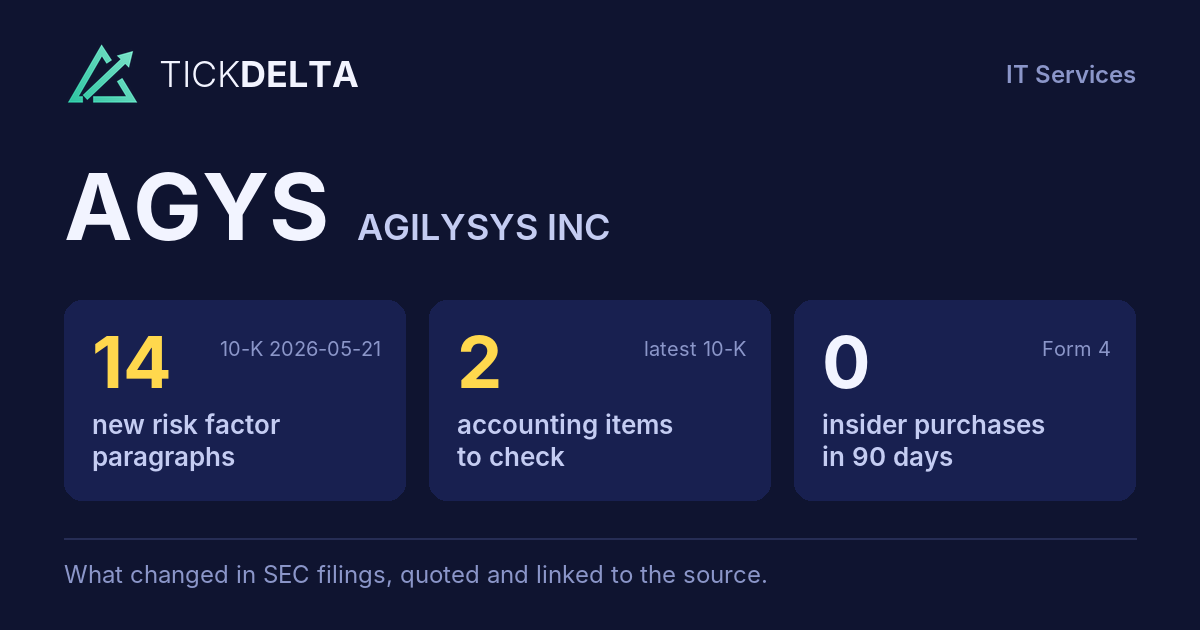
62 changes: 14 added, 3 removed, 43 reworded, 2 quiet changes
10-K May 21, 2026 vs May 23, 2025
Risk Factors
13.6%
of the text changed · 8,930 words now · 14 new paragraphs, 2 gone
MD&A
10.3%
of the text changed · 5,508 words now · 0 new paragraphs, 1 gone
Accounting Policies
10.9%
of the text changed · 3,618 words now
10-K 0001193125-26-234423 (May 21, 2026) vs 10-K 0000950170-25-076527 (May 23, 2025) Not compared: Legal Proceedings.
Every paragraph, and how much of it changed
One bar per paragraph, in the order of the 10-K. Height and colour show the share of its words not in the closest paragraph a year earlier; the tallest bars are new paragraphs.
Risk Factors
128 paragraphs · 14 new · 29 reworded · 2 gone · 10-K May 21, 2026 against May 23, 2025
New paragraph
Reworded (5% of its words or more)
Same or nearly
Paragraph 108 · 47% changed
Every version of it
Paragraph 72 · 47% changed
Every version of it
Paragraph 24 · 44% changed
Every version of it
Paragraph 65 · 34% changed
Every version of it
Paragraph 64 · 34% changed
Every version of it
The number and scale of cyberattacks have continued to increase and the methods and techniques used by threat actors, including sophisticated “supply-chain” attacks, continue to evolve at a rapid pace. As a result, we may be unable to identify current attacks, anticipate future attacks or implement adequate security measures. We may also experience security breaches that may remain undetected for an extended period and, therefore, have a greater impact on our systems, our products, the proprietary data contained therein, our customers, and ultimately, our business.
Paragraph 93 · 31% changed
Every version of it
Customers that we serve may seek to achieve economies of scale and other synergies by combining with or acquiring other companies. The hospitality industry has experienced recent consolidations, including the hotel and gaming sectors of the industry. Although recent consolidations in the hospitality industry have not materially adversely affected our business, there is no assurance that future consolidations will not have an impact. For example, if one of our current customers merges or consolidates with a company that relies on another provider’s products or services, it could decide to reduce or cease its purchases of products or services from us, which could have an adverse effect on our business.
Paragraph 37 · 30% changed
Every version of it
Despite testing prior to the release and throughout the lifecycle of a product or service, our on-premise and cloud-based solutions sometimes contain coding or configuration errors that can impact their function, performance and security, and result in other negative consequences. The detection and correction of any errors in released on-premise or cloud-based solutions can be time consuming and costly. Errors in our on-premise and cloud-based solutions could affect their ability to properly function, integrate or operate with other software or hardware offerings, could result in service interruptions, delays or outages, could create security vulnerabilities in our products or services, could delay the development or release of new products or services or new versions of products or services, and could adversely affect market acceptance of our products or services. This includes third-party software products Due to the centralized nature of SaaS delivery models, any service interruption or services incorporated into our own. If we experience any of these errors, or if there are delays in releasing our on-premise or cloud-based solutions or new versions of these offerings, our sales could be affected outage may have an immediate and revenues could decline. Customers rely on our on-premise and cloud-based solutions and related services to run their businesses, and errors in our solutions and related services could expose us to product liability, performance and warranty claims as well as significant harm to our brand and reputation, widespread impact across multiple customers simultaneously, which could impact our future sales. result in customer dissatisfaction, financial obligations under service level agreements, and reputational harm.
Paragraph 82 · 49% changed
Every version of it
10-K May 23, 2025If any of these providers experience financial, operational, or quality assurance difficulties, or if any cease production, or there is any other disruption in the services we or our customers receive, including as a result of the acquisition of a supplier or partner by a competitor, cyber security issues, macroeconomic issues, or otherwise, we will be required to locate and migrate to alternative sources or providers, to internally develop the applicable technologies, to redesign our products, or to remove certain features from our products or to reduce our service levels, any of which would likely increase our expenses, create delays, or negatively impact our revenues. Although we strive to establish contractual protections with key providers, such as source code escrows, warranties, and indemnities, we may not be successful in obtaining adequate protections, these agreements may be short-term in duration, and the counterparties may be unwilling or unable to stand behind such protections. Moreover, these types of contractual protections offer limited practical benefits to us in the event our relationship with a key provider is interrupted.
10-K May 21, 2026
protections, these agreements may be short-term in duration, and the counterparties may be unwilling or unable to stand behind such protections. Moreover, these types of contractual protections offer limited practical benefits to us in the event our relationship with a key provider is interrupted.
Paragraph 108 · 47% changed
Every version of it
10-K May 23, 2025We have significant deferred tax assets which can provide us with significant future cash tax savings if we are able to use them, including significant net operating losses. However, the extent to which we will be able to use these net operating losses may be impacted, restricted, or eliminated by a number of factors, including changes in tax rates, laws or regulations, and whether we generate sufficient future taxable income. To the extent that we are unable to utilize our net operating losses or other losses, our results of operations, liquidity, and financial condition could be materially adversely impacted. When we cease to have net operating losses available to us in a particular tax jurisdiction, either through their expiration, disallowance, or utilization, our cash tax liability will increase in that jurisdiction.
10-K May 21, 2026
When we cease to have net operating losses available to us in a particular tax jurisdiction, either through their expiration, disallowance, or utilization, our cash tax liability will increase in that jurisdiction.
Paragraph 72 · 47% changed
Every version of it
10-K May 23, 2025Additionally, we could be required to expend significant capital and other resources to investigate and address any actual or suspected cybersecurity incident or to prevent further or additional incidents. To maintain business relationships, we may find it necessary or desirable to incur costs to provide remediation and incentives to customers or other business partners following an actual or suspected security incident. We also cannot be sure that our existing cybersecurity insurance will continue to be available on acceptable terms, in sufficient amounts to cover any claims we submit, or at all. Further, we cannot be sure that insurers will not deny coverage as to any claim, and some security incidents may be outside the scope of our coverage, including in instances where they are considered force majeure events. Security incidents may result in increased costs for cybersecurity insurance. One or more large, successful claims against us in excess of our available insurance coverage, or changes in our insurance policies, including premium increases or large deductible or co-insurance requirements, could have an adverse effect on our business, operating results, and financial condition.
10-K May 21, 2026
increased costs for cybersecurity insurance. One or more large, successful claims against us in excess of our available insurance coverage, or changes in our insurance policies, including premium increases or large deductible or co-insurance requirements, could have an adverse effect on our business, operating results, and financial condition.
Paragraph 24 · 44% changed
Every version of it
10-K May 23, 2025Investments in new markets, solutions, and technologies, research and development, infrastructure and systems, geographic expansion, and talent are critical components for executing our strategy. In particular, we believe we must continue to dedicate a significant amount of resources to our research and development efforts to maintain our competitive position. Our investments in research and development may result in products or services that generate less revenue than we anticipate.
10-K May 21, 2026
position. Our investments in research and development may result in products or services that generate less revenue than we anticipate.
Paragraph 65 · 34% changed
Every version of it
10-K May 23, 2025The number and scale of cyberattacks have continued to increase and the methods and techniques used by threat actors, including sophisticated “supply-chain” attacks, continue to evolve at a rapid pace. As a result, we may be unable to identify current attacks, anticipate future attacks or implement adequate security measures. We may also experience security breaches that may remain undetected for an extended period and, therefore, have a greater impact on our systems, our products, the proprietary data contained therein, our customers, and ultimately, our business.
10-K May 21, 2026
current attacks, anticipate future attacks or implement adequate security measures. We have experienced attacks in the past, which did not have any material adverse effects on our business, financial condition or results of operations. However, we may experience security breaches that could remain undetected for an extended period and, therefore, have a greater impact on our systems, our products, the proprietary data contained therein, our customers, and ultimately, our business.
Paragraph 64 · 34% changed
Every version of it
10-K May 23, 2025
The number and scale of cyberattacks have continued to increase and the methods and techniques used by threat actors, including sophisticated “supply-chain” attacks, continue to evolve at a rapid pace. As a result, we may be unable to identify current attacks, anticipate future attacks or implement adequate security measures. We may also experience security breaches that may remain undetected for an extended period and, therefore, have a greater impact on our systems, our products, the proprietary data contained therein, our customers, and ultimately, our business.
10-K May 21, 2026
The number and scale of cyberattacks have continued to increase and the methods and techniques used by threat actors, including sophisticated “supply-chain” attacks, continue to evolve at a rapid pace. As a result, we may be unable to identify
Paragraph 93 · 31% changed
Every version of it
10-K May 23, 2025
Customers that we serve may seek to achieve economies of scale and other synergies by combining with or acquiring other companies. The hospitality industry has experienced recent consolidations, including the hotel and gaming sectors of the industry. Although recent consolidations in the hospitality industry have not materially adversely affected our business, there is no assurance that future consolidations will not have an impact. For example, if one of our current customers merges or consolidates with a company that relies on another provider’s products or services, it could decide to reduce or cease its purchases of products or services from us, which could have an adverse effect on our business.
10-K May 21, 2026
Customers that we serve may seek to achieve economies of scale and other synergies by combining with or acquiring other companies. The hospitality industry has experienced recent consolidations, including the hotel and gaming sectors of the industry. Although recent consolidations in the hospitality industry have not materially adversely affected our business,
Paragraph 37 · 30% changed
Every version of it
10-K May 23, 2025
Despite testing prior to the release and throughout the lifecycle of a product or service, our on-premise and cloud-based solutions sometimes contain coding or configuration errors that can impact their function, performance and security, and result in other negative consequences. The detection and correction of any errors in released on-premise or cloud-based solutions can be time consuming and costly. Errors in our on-premise and cloud-based solutions could affect their ability to properly function, integrate or operate with other software or hardware offerings, could result in service interruptions, delays or outages, could create security vulnerabilities in our products or services, could delay the development or release of new products or services or new versions of products or services, and could adversely affect market acceptance of our products or services. This includes third-party software products or services incorporated into our own. If we experience any of these errors, or if there are delays in releasing our on-premise or cloud-based solutions or new versions of these offerings, our sales could be affected and revenues could decline. Customers rely on our on-premise and cloud-based solutions and related services to run their businesses, and errors in our solutions and related services could expose us to product liability, performance and warranty claims as well as significant harm to our brand and reputation, which could impact our future sales.
10-K May 21, 2026
Despite testing prior to the release and throughout the lifecycle of a product or service, our on-premise and cloud-based solutions sometimes contain coding or configuration errors that can impact their function, performance and security, and result in other negative consequences. The detection and correction of any errors in released on-premise or cloud-based solutions can be time consuming and costly. Errors in our on-premise and cloud-based solutions could affect their ability to properly function, integrate or operate with other software or hardware offerings, could result in service interruptions, delays or outages, could create security vulnerabilities in our products or services, could delay the development or release of new products or services or new versions of products or services, and could adversely affect market acceptance of our products or services. Due to the centralized nature of SaaS delivery models, any service interruption or outage may have an immediate and widespread impact across multiple customers simultaneously, which could result in customer dissatisfaction, financial obligations under service level agreements, and reputational harm.
MD&A
85 paragraphs · 0 new · 37 reworded · 1 gone · 10-K May 21, 2026 against May 23, 2025
New paragraph
Reworded (5% of its words or more)
Same or nearly
Paragraph 30 · 44% changed
For fiscal 2025, 2026, the effective tax rate was different than the statutory rate due primarily to the benefit of excess tax benefits associated with share-based compensation, Net Controlled Foreign Corporation Tested Income (NCTI), previously global intangible low-taxed income (GILTI), and U.S. R&D credits and the release of valuation allowances recorded against foreign deferred tax assets, consisting primarily of Net Operating Losses. credits.
Paragraph 63 · 44% changed
Cash flows used in investing activities. Cash flows used in investing activities in fiscal 2023 2026 were $6.9 $1.8 million due to $7.3 million in purchases consisting of property and equipment, including internal use software and $0.4 million in cash received from final working capital adjustments related to the ResortSuite acquisition. equipment purchases.
Paragraph 6 · 43% changed
Agilysys has been a leader in hospitality software for more than 45 years, delivering innovative state-of-the-art cloud-native SaaS and on-premise guest-centric technology solutions. Customers around the world include: branded solutions for hotels, multi-amenity resorts, cruise lines, casinos, corporate foodservice management, restaurants, universities, stadiums, and independent hotels; multi-amenity resort properties; casinos; property, hotel and resort management companies; cruise lines; corporate dining providers; higher education campus dining providers; food service management companies; hospitals; lifestyle communities; senior living facilities; stadiums; and theme parks. Agilysys offers the most comprehensive healthcare facilities. The Company’s software solutions in the industry, including include point-of-sale (POS), property management (PMS), inventory and procurement, payments, and related applications, to applications that manage and enhance the entire guest journey. Agilysys is also known for its world class world-class customer-centric service. Some Many of the largest top hospitality companies around the world use Agilysys solutions to help improve guest loyalty, drive revenue growth growth, and increase operational efficiencies. The Company has one reportable segment serving the global hospitality industry. Agilysys operates across the Americas, Europe, the Middle East, Africa, Asia-Pacific, and India with headquarters located in Alpharetta, GA.
Paragraph 74 · 42% changed
Paragraph 82 · 31% changed
We use the market approach to derive standalone selling price (SSP) by maximizing observable data points (in the form of recently executed customer contracts) to determine the price customers are willing to pay for the goods and services transferred. Shipping and handling fees billed to customers are recognized as revenue and the related costs are recognized in cost of goods sold. Revenue is recorded net of any applicable taxes collected and remitted to governmental agencies.
Paragraph 22 · 31% changed
General and administrative. General and administrative increased $5.6 $1.4 million, or 18.3%, 3.4%, in fiscal 2024 2026 compared to fiscal 2023 2025 due to investments in our information security infrastructure along with hiring and increased compensation rates across our administrative teams, increased travel, and higher subscription charges for cloud computing arrangements. teams.
Paragraph 25 · 31% changed
Other (gains) charges, net. Other (gains) charges, net increased $2.9 changed $12.3 million due primarily to a significant increase in gains from employee retention credits during fiscal 2026 compared to significant acquisition costs related to business combinations and a reduction of gains on asset disposals during fiscal 2025 compared to fiscal 2024. 2025.
Paragraph 60 · 26% changed
Cash flow flows provided by operating activities. Cash flows provided by operating activities were $55.1 $70.0 million in fiscal 2025. The provision 2026 due to cash-based earnings of cash was due primarily to our net income $77.8 million and a decrease of $23.2 million adjusted for $26.2 million in non-cash expense including depreciation, amortization, share-based compensation, deferred income taxes and an increase of $5.7 $7.8 million from the changes in operating assets and liabilities. liabilities during fiscal 2026. Cash-based earnings is net income of $38.8 million and $39.0 million in non-cash adjustments including depreciation, amortization, share-based compensation, and deferred income taxes.
Paragraph 30 · 44% changed
10-K May 23, 2025
For fiscal 2025, the effective tax rate was different than the statutory rate due primarily to the benefit of U.S. R&D credits and the release of valuation allowances recorded against foreign deferred tax assets, consisting primarily of Net Operating Losses.
10-K May 21, 2026
For fiscal 2026, the effective tax rate was different than the statutory rate due primarily to excess tax benefits associated with share-based compensation, Net Controlled Foreign Corporation Tested Income (NCTI), previously global intangible low-taxed income (GILTI), and U.S. R&D credits.
Paragraph 63 · 44% changed
10-K May 23, 2025
Cash flows used in investing activities in fiscal 2023 were $6.9 million due to $7.3 million in purchases of property and equipment, including internal use software and $0.4 million in cash received from final working capital adjustments related to the ResortSuite acquisition.
10-K May 21, 2026
Cash flows used in investing activities. Cash flows used in investing activities in fiscal 2026 were $1.8 million consisting of property and equipment purchases.
Paragraph 6 · 43% changed
10-K May 23, 2025
Agilysys has been a leader in hospitality software for more than 45 years, delivering innovative state-of-the-art cloud-native SaaS and on-premise guest-centric technology solutions. Customers around the world include: branded and independent hotels; multi-amenity resort properties; casinos; property, hotel and resort management companies; cruise lines; corporate dining providers; higher education campus dining providers; food service management companies; hospitals; lifestyle communities; senior living facilities; stadiums; and theme parks. Agilysys offers the most comprehensive software solutions in the industry, including point-of-sale (POS), property management (PMS), inventory and procurement, payments, and related applications, to manage the entire guest journey. Agilysys is also known for its world class customer-centric service. Some of the largest hospitality companies around the world use Agilysys solutions to help improve guest loyalty, drive revenue growth and increase operational efficiencies.
10-K May 21, 2026
Agilysys has been a leader in hospitality software for more than 45 years, delivering innovative cloud-native SaaS and on-premise solutions for hotels, multi-amenity resorts, cruise lines, casinos, corporate foodservice management, restaurants, universities, stadiums, and healthcare facilities. The Company’s software solutions include point-of-sale (POS), property management (PMS), inventory and procurement, payments, and related applications that manage and enhance the entire guest journey. Agilysys is also known for its world-class customer-centric service. Many of the top hospitality companies around the world use Agilysys solutions to improve guest loyalty, drive revenue growth, and increase operational efficiencies. The Company has one reportable segment serving the global hospitality industry. Agilysys operates across the Americas, Europe, the Middle East, Africa, Asia-Pacific, and India with headquarters located in Alpharetta, GA.
Paragraph 74 · 42% changed
10-K May 23, 2025•Products revenue – Revenue earned from the sales of software licenses, third party hardware and operating systems.
10-K May 21, 2026
Revenue recognition. We derive revenue from the sale of products (proprietary software licenses, third party hardware and operating systems), subscription and maintenance, and professional services.
Paragraph 82 · 31% changed
10-K May 23, 2025
Shipping and handling fees billed to customers are recognized as revenue and the related costs are recognized in cost of goods sold. Revenue is recorded net of any applicable taxes collected and remitted to governmental agencies.
10-K May 21, 2026
We use the market approach to derive standalone selling price (SSP) by maximizing observable data points (in the form of recently executed customer contracts) to determine the price customers are willing to pay for the goods and services transferred. Shipping and handling fees billed to customers are recognized as revenue and the related costs are recognized in cost of goods sold. Revenue is recorded net of any applicable taxes collected and remitted to governmental agencies.
Paragraph 22 · 31% changed
10-K May 23, 2025
General and administrative. General and administrative increased $5.6 million, or 18.3%, in fiscal 2024 compared to fiscal 2023 due to investments in our information security infrastructure along with hiring and increased compensation rates across our administrative teams, increased travel, and higher subscription charges for cloud computing arrangements.
10-K May 21, 2026
General and administrative. General and administrative increased $1.4 million, or 3.4%, in fiscal 2026 compared to fiscal 2025 due to increased compensation rates across our administrative teams.
Paragraph 25 · 31% changed
10-K May 23, 2025
Other charges, net. Other charges, net increased $2.9 million due to a significant increase in acquisition costs related to business combinations and a reduction of gains on asset disposals during fiscal 2025 compared to fiscal 2024.
10-K May 21, 2026
Other (gains) charges, net. Other (gains) charges, net changed $12.3 million due primarily to significant gains from employee retention credits during fiscal 2026 compared to significant acquisition costs related to business combinations during fiscal 2025.
Paragraph 60 · 26% changed
10-K May 23, 2025
Cash flow provided by operating activities. Cash flows provided by operating activities were $55.1 million in fiscal 2025. The provision of cash was due primarily to our net income of $23.2 million adjusted for $26.2 million in non-cash expense including depreciation, amortization, share-based compensation, deferred income taxes and an increase of $5.7 million from the changes in operating assets and liabilities.
10-K May 21, 2026
Cash flows provided by operating activities. Cash flows provided by operating activities were $70.0 million in fiscal 2026 due to cash-based earnings of $77.8 million and a decrease of $7.8 million from the changes in operating assets and liabilities during fiscal 2026. Cash-based earnings is net income of $38.8 million and $39.0 million in non-cash adjustments including depreciation, amortization, share-based compensation, and deferred income taxes.
A paragraph is matched with the one last year that shares the most of its words; under half in common makes it new. The paragraphs shown are the 8 reworded the most in each section.
The paragraph that changed most in each section
The redline
Marked against last year's 10-K: cut words struck through, new words highlighted.
Accounting Policies170 words changed in this paragraph; it is 32% similar to last year's version.
In December 2023, 2025, the Financial Accounting Standards Board FASB issued ASU No. 2023-09 Income Taxes 2025-10, Government Grants (Topic 740): Improvements 832): Accounting for Government Grants Received by Business Entities (ASU 2025-10) to Income Tax Disclosures (“ASU 2023-09”) establish authoritative guidance on how to update income tax disclosure requirements primarily recognize, measure, and present government grants received by requiring specific categories and greater disaggregation within the rate reconciliation and disaggregation of income taxes paid by jurisdiction. The amendments in the business entities. ASU also remove disclosures related to certain unrecognized tax benefits and deferred taxes. ASU 2023-09 2025-10 is effective for fiscal years annual periods beginning after December 15, 2024, 2028, or our fiscal 2026. 2030, and interim reporting periods within those annual reporting periods. The amendments ASU may be applied prospectively using a modified prospective, modified retrospective or retrospectively retrospective approach with early adoption permitted. We are currently assessing the impact permitted in an interim or annual reporting period. If an entity early adopts in an interim reporting period, it must adopt as of the requirements on our income tax disclosures. beginning of the annual reporting period that includes that interim reporting period. We adopted ASU 2025-10 under the modified prospective approach effective as of April 1, 2025 – see Note 9, Income Taxes.
Source: Item 8, Note 2 – Summary of Significant Accounting Policies, 10-K 0001193125-26-234423 vs Item 8, Note 2 – Summary of Significant Accounting Policies, 10-K 0000950170-25-076527
Risk Factors124 words changed in this paragraph; it is 68% similar to last year's version.
Despite testing prior to the release and throughout the lifecycle of a product or service, our on-premise and cloud-based solutions sometimes contain coding or configuration errors that can impact their function, performance and security, and result in other negative consequences. The detection and correction of any errors in released on-premise or cloud-based solutions can be time consuming and costly. Errors in our on-premise and cloud-based solutions could affect their ability to properly function, integrate or operate with other software or hardware offerings, could result in service interruptions, delays or outages, could create security vulnerabilities in our products or services, could delay the development or release of new products or services or new versions of products or services, and could adversely affect market acceptance of our products or services. This includes third-party software products Due to the centralized nature of SaaS delivery models, any service interruption or services incorporated into our own. If we experience any of these errors, or if there are delays in releasing our on-premise or cloud-based solutions or new versions of these offerings, our sales could be affected outage may have an immediate and revenues could decline. Customers rely on our on-premise and cloud-based solutions and related services to run their businesses, and errors in our solutions and related services could expose us to product liability, performance and warranty claims as well as significant harm to our brand and reputation, widespread impact across multiple customers simultaneously, which could impact our future sales. result in customer dissatisfaction, financial obligations under service level agreements, and reputational harm.
Source: Item 1A, 10-K 0001193125-26-234423 vs Item 1A, 10-K 0000950170-25-076527
MD&A120 words changed in this paragraph; it is 52% similar to last year's version.
Agilysys has been a leader in hospitality software for more than 45 years, delivering innovative state-of-the-art cloud-native SaaS and on-premise guest-centric technology solutions. Customers around the world include: branded solutions for hotels, multi-amenity resorts, cruise lines, casinos, corporate foodservice management, restaurants, universities, stadiums, and independent hotels; multi-amenity resort properties; casinos; property, hotel and resort management companies; cruise lines; corporate dining providers; higher education campus dining providers; food service management companies; hospitals; lifestyle communities; senior living facilities; stadiums; and theme parks. Agilysys offers the most comprehensive healthcare facilities. The Company’s software solutions in the industry, including include point-of-sale (POS), property management (PMS), inventory and procurement, payments, and related applications, to applications that manage and enhance the entire guest journey. Agilysys is also known for its world class world-class customer-centric service. Some Many of the largest top hospitality companies around the world use Agilysys solutions to help improve guest loyalty, drive revenue growth growth, and increase operational efficiencies. The Company has one reportable segment serving the global hospitality industry. Agilysys operates across the Americas, Europe, the Middle East, Africa, Asia-Pacific, and India with headquarters located in Alpharetta, GA.
Source: Item 7, 10-K 0001193125-26-234423 vs Item 7, 10-K 0000950170-25-076527
Sentences and paragraphs added, removed or reworded
Every change, by type
Sentences and paragraphs of AGYS's Risk Factors and MD&A, 10-K May 21, 2026 against 10-K May 23, 2025. Each links to the text at sec.gov.
Quiet changes are sentences kept from last year with one to four words changed, at least one of them a hedge, a modal or a qualifier (may, could, will, not, significant, material…). A year or date rolling forward is not counted.
The full word list
adverse, adversely, all, although, anticipate, anticipates, any, approximately, believe, believes, can, cannot, certain, could, expect, expects, generally, however, if, intend, intends, largely, likely, many, material, materially, may, might, most, must, never, no, not, possible, primarily, probable, should, significant, significantly, some, substantial, substantially, unlikely, will, would
AddedRisk Factors
We use AI in our platform and product offerings, and our success is dependent upon our ability to leverage data, develop competitive products, and manage related risks.
Read it in 10-K May 21, 2026 at sec.gov
AddedRisk Factors
We utilize AI solutions both for internal productivity purposes and in products and services available to our customers. We also work with partners who have incorporated or may incorporate AI solutions in their products and services. While AI and machine learning present opportunities for enhanced productivity, AI also introduces cybersecurity, data privacy, IT, intellectual property, regulatory, legal, operational, competitive, reputational and other risks that could adversely impact our business. For example, if the content, recommendations or analyses that AI applications assist in producing are or are alleged to be deficient or inaccurate, or if the data used to train these applications are or are alleged to be deficient or
Read it in 10-K May 21, 2026 at sec.gov
AddedRisk Factors
inaccurate or legally impermissible to train on, we could be subject to competitive risks, potential legal liability, and reputational harm. Furthermore, the integration of third-party AI models, including Large Language Models, within our products and services may rely, in part, on certain safeguards implemented by the third-party developers of the underlying AI models, including those related to the accuracy, bias, and other variables of the data, and these safeguards may be insufficient. In addition, AI may present evolving ethical issues. If our use of AI becomes controversial, we may experience reputational harm or legal liability.
Read it in 10-K May 21, 2026 at sec.gov
AddedRisk Factors
Further, given the early stage of generative AI, the evolving regulatory landscape surrounding AI also poses a risk, as new laws and regulations could impose additional compliance burdens, resulting in increased operational costs to comply with U.S. and non-US laws concerning the use of AI. For example, the EU’s Artificial Intelligence Act, or AI Act, originally entered into force on August 1, 2024, and is expected to undergo amendments as introduced in the EU’s November 2025 Digital Omnibus. As enacted, the AI Act imposes significant obligations on providers and deployers of high-risk AI systems and encourages providers and deployers of AI systems to account for EU ethical principles in their development and use of these systems.
Read it in 10-K May 21, 2026 at sec.gov
AddedRisk Factors
Likewise, within the United States, the regulatory landscape is rapidly evolving as evidenced by several U.S. states introducing or enacting legislation that is designed to govern the development or use of AI. Our ability to use and offer AI and machine learning solutions may be constrained by current or future laws, regulatory, or self-regulatory requirements. At the federal level, the Trump Administration has endorsed a federal moratorium on the enforcement of state AI laws, including through a December 11, 2025 executive order on “Ensuring a National Policy Framework for Artificial Intelligence.” Federal efforts have thus far have not been successful in curtailing state action on AI regulation, which has contributed to an increasingly complicated regulatory landscape. The rapid evolution of AI, including potential additional government regulation of AI and its various uses, may require significant resources for us to implement compliant and ethical AI practices. We may also be subject to significant enforcement actions or litigation in the event of any perceived or actual non-compliance.
Read it in 10-K May 21, 2026 at sec.gov
AddedRisk Factors
The rapid adoption of AI technologies may create an “arms race” dynamic in our industry, in which competitors leverage AI to develop more efficient, automated, or lower-cost alternatives to our offerings or to disrupt traditional subscription-based software models. In addition, AI-enabled tools may bypass or reduce reliance on traditional application-layer workflows, which could diminish the value of our platform and adversely affect demand for our solutions.
Read it in 10-K May 21, 2026 at sec.gov
AddedRisk Factors
We have integrated AI and machine learning features into our technology stack to improve guest analytics, demand forecasting, and automated workflows, among other things. These models are complex and their efficacy depends on the quality of the data used for training. If the underlying data is flawed, or if the AI models experience "hallucinations" or logical failures, our platforms may produce inaccurate, biased, or unreliable outputs. In a hospitality context, such errors—ranging from incorrect pricing recommendations to failures in guest service automation—could result in operational disruptions for our customers, contractual disputes, and harm to our brand reputation. The "black box" nature of certain AI models may also make it difficult for us to troubleshoot these errors or provide transparent explanations to our users and regulators.
Read it in 10-K May 21, 2026 at sec.gov
AddedRisk Factors
Our solutions are primarily delivered through multi-tenant cloud architectures in which multiple customers are served through shared environments. Although we employ controls designed to logically segregate customer data, any failure, vulnerability, or misconfiguration could result in unauthorized access to or exposure of one customer’s data to another, which could lead to legal liability, regulatory scrutiny, and reputational harm.
Read it in 10-K May 21, 2026 at sec.gov
Show the other 31
AddedRisk Factors
We also rely on identity and access management controls to govern user access across our systems. Risks associated with overprivileged accounts or accounts not centrally managed through our single sign-on systems could create vulnerabilities. Any failure to promptly revoke or appropriately manage access credentials, including those of former personnel or compromised accounts, may result in unauthorized access or data exfiltration.
Read it in 10-K May 21, 2026 at sec.gov
AddedRisk Factors
In addition, our services depend on integrations with third-party applications through APIs, OAuth tokens, and similar authentication mechanisms. Mismanagement, compromise, or misuse of such credentials could enable unauthorized access and allow threat actors to move laterally across interconnected systems, increasing the scope and impact of a cybersecurity incident.
Read it in 10-K May 21, 2026 at sec.gov
AddedRisk Factors
The global regulatory landscape surrounding AI is rapidly evolving and remains highly uncertain. We are subject to emerging privacy and data protection mandates, which may impose stringent requirements on how we develop and deploy AI models. Compliance with these regulations requires substantial financial resources and management attention. Additionally, there is significant legal uncertainty regarding the use of proprietary or third-party data for AI training and the ownership of AI-generated content. We may face claims of intellectual property infringement or find that we are unable to protect our own AI-driven innovations. Furthermore, if our AI processes inadvertently process sensitive guest or employee data in a manner that violates privacy standards (such as GDPR or CCPA), we could be subject to fines, litigation, and regulatory enforcement actions.
Read it in 10-K May 21, 2026 at sec.gov
AddedRisk Factors
AI introduces new and sophisticated cybersecurity vulnerabilities. Malicious actors are increasingly using AI to automate the discovery of software vulnerabilities and to launch highly targeted social engineering or "deepfake" attacks against our employees and customers. Additionally, the AI models we use may be subject to novel attack vectors, such as "prompt injection" or "data poisoning," where attackers attempt to manipulate the model's logic or access underlying training data. Any breach that compromises our AI infrastructure or the sensitive data utilized therein could result in the loss of intellectual property, material financial costs for remediation, and loss of customer trust in the security of our products.
Read it in 10-K May 21, 2026 at sec.gov
RemovedRisk Factors
RemovedRisk Factors
RewordedRisk Factors
Although we strive to establish contractual protections with key providers, such as source code escrows, warranties, and indemnities, we may not be successful in obtaining adequate protections, these agreements may be short-term in duration, and the counterparties may be unwilling or unable to stand behind such protections.
Read it in 10-K May 21, 2026 at sec.gov
RewordedRisk Factors
Our business, markets, growth prospects and business model may be impacted or altered by decreases in travel and leisure activities resulting from weak economic conditions, increases in energy prices and changes in tariffs and currency values, political instability, heightened travel security measures, travel advisories, disruptions in air travel, and concerns over disease, disease and/or pandemics, violence, war, terrorism, and/or terrorism. other wide-ranging and sustained events.
Read it in 10-K May 21, 2026 at sec.gov
RewordedRisk Factors
Although recent consolidations in the hospitality industry have not materially adversely affected our business, there is no assurance that future consolidations will not have an impact.
Read it in 10-K May 21, 2026 at sec.gov
RewordedRisk Factors
As a result, we may be unable to identify current attacks, anticipate future attacks or implement adequate security measures.
Read it in 10-K May 21, 2026 at sec.gov
RewordedRisk Factors
Factors affecting that have affected and may continue to affect the trading price of our common stock may include, but are not limited to:
Read it in 10-K May 21, 2026 at sec.gov
RewordedRisk Factors
The market price for our common stock could has experienced and may continue to be subject to wide fluctuations in response to many risk factors listed in this section, and others beyond our control.
Read it in 10-K May 21, 2026 at sec.gov
RewordedRisk Factors
RewordedRisk Factors
During the year ended March 31, 2025, 2026, the trading price of our common stock ranged from a low close of $71.45 $65.76 to a high close of $141.74. $141.12.
Read it in 10-K May 21, 2026 at sec.gov
RewordedRisk Factors
Our product development activities also could be impacted by competition from products with new features or new technologies, such as artificial intelligence (AI), (AI) and/or machine learning, that might render our existing products less competitive or obsolete.
Read it in 10-K May 21, 2026 at sec.gov
RewordedRisk Factors
Security incidents may result in increased costs for cybersecurity insurance.
Read it in 10-K May 21, 2026 at sec.gov
Quiet changesRisk Factors
International sales are subject to many risks and difficulties, including but not limited to those arising from the following: building and maintaining a competitive presence in new markets; staffing and managing foreign operations; complying with a variety of foreign laws, rules and regulations; producing localized versions of our products; developing integrations between our products and other locally-used products; import and export restrictions and tariffs; enforcing contracts and collecting accounts receivable; unexpected changes in regulatory requirements; reduced protection for intellectual property rights in some countries; potential adverse tax treatment; language and cultural barriers; foreign currency fluctuations; inflation and any regulatory actions to counter inflation; and political and economic instability abroad.
Read it in 10-K May 21, 2026 at sec.gov
RemovedMD&A
RewordedMD&A
Products revenue decreased $7.8 $0.2 million, or 15.8%, 0.4%, due to increasing customer preference for subscription-based software licenses instead of perpetual software licenses and to their decreasing need for hardware due to improvements we have made to our technology enabling more support for consumer grade devices our customers can source elsewhere. licenses.
Read it in 10-K May 21, 2026 at sec.gov
RewordedMD&A
Other (gains) charges, net increased $2.9 changed $12.3 million due primarily to a significant increase in gains from employee retention credits during fiscal 2026 compared to significant acquisition costs related to business combinations and a reduction of gains on asset disposals during fiscal 2025 compared to fiscal 2024. 2025.
Read it in 10-K May 21, 2026 at sec.gov
RewordedMD&A
RewordedMD&A
General and administrative increased $5.6 $1.4 million, or 18.3%, 3.4%, in fiscal 2024 2026 compared to fiscal 2023 2025 due to investments in our information security infrastructure along with hiring and increased compensation rates across our administrative teams, increased travel, and higher subscription charges for cloud computing arrangements. teams.
Read it in 10-K May 21, 2026 at sec.gov
RewordedMD&A
For fiscal 2025, 2026, the effective tax rate was different than the statutory rate due primarily to the benefit of excess tax benefits associated with share-based compensation, Net Controlled Foreign Corporation Tested Income (NCTI), previously global intangible low-taxed income (GILTI), and U.S.
Read it in 10-K May 21, 2026 at sec.gov
RewordedMD&A
Subscription and maintenance revenue increased $32.0 $35.9 million, or 23.2%, 21.1%, driven by continued growth in subscription-based revenue including service to $21.3 million and $11.2 million of Book4Time customers. subscription-based revenue during the years ended March 31, 2026 and 2025, respectively.
Read it in 10-K May 21, 2026 at sec.gov
RewordedMD&A
Sales and marketing increased $4.7 $6.6 million, or 16.5%, 20.0%, in fiscal 2025 2026 compared with fiscal 2024 2025 due to hiring and increased compensation rates across our sales and marketing teams, and sales team additions from the Book4Time acquisition, continued expansion of marketing event and trade show activity. activity, and increased bad debt expense.
Read it in 10-K May 21, 2026 at sec.gov
RewordedMD&A
The provision of cash was due primarily to our net income cash-based earnings of $23.2 $38.2 million adjusted for $26.2 million in non-cash expense including depreciation, amortization, share-based compensation, deferred income taxes and an increase of $5.7 $10.0 million from the changes in operating assets and liabilities.
Read it in 10-K May 21, 2026 at sec.gov
RewordedMD&A
Cash flows provided by used in financing activities in fiscal 2025 2026 were $21.9 $24.5 million due primarily to $49.6 million in debt proceeds, net of issuance costs, debt repayments of $26.0 $24.0 million, proceeds from Employee Stock Purchase Plan purchases of $1.0 $1.5 million, and share repurchases of $2.7 $2.0 million to satisfy employee tax withholding on share-based compensation.
Read it in 10-K May 21, 2026 at sec.gov
RewordedMD&A
The provision of cash was due primarily to our net income cash-based earnings of $23.2 $49.4 million adjusted for $26.2 million in non-cash expense including depreciation, amortization, share-based compensation, deferred income taxes and an increase of $5.7 million from the changes in operating assets and liabilities.
Read it in 10-K May 21, 2026 at sec.gov
RewordedMD&A
Agilysys has been a leader in hospitality software for more than 45 years, delivering innovative state-of-the-art cloud-native SaaS and on-premise guest-centric technology solutions. solutions for hotels, multi-amenity resorts, cruise lines, casinos, corporate foodservice management, restaurants, universities, stadiums, and healthcare facilities.
Read it in 10-K May 21, 2026 at sec.gov
RewordedMD&A
Product development 22.8% 22.6% 23.9% Sales and marketing 12.0 12.5 12.0 General and administrative 13.2 14.8 15.3 Depreciation of fixed assets 1.2 1.3 1.6 Amortization of internal-use software and intangibles 1.8 1.4 0.6 Other (gains) charges, net (2.5) 1.7 0.7 Legal settlements settlements, net 0.1 0.4 0.0 Operating income 13.5% 8.2% 6.6%
Read it in 10-K May 21, 2026 at sec.gov
Quiet changesMD&A
Cash flows provided by financing activities in fiscal 2025 were $21.9 million due primarily to $49.6 million in debt proceeds, net of issuance costs, debt repayments of $26.0 million, proceeds from Employee Stock Purchase Plan purchases of $1.0 million, and share repurchases of $2.7 million to satisfy employee tax withholding on share-based compensation.
Read it in 10-K May 21, 2026 at sec.gov
Sources
The two latest 10-Ks on EDGAR, section by section. Each change links to the text at sec.gov.
Also
New risk factors: paragraphs with nothing like them last year, quoted in full.
Work with it
Excel workbook · CSV. Google Sheet that stays up to date: paste =IMPORTDATA("https://tickdelta.com/company/AGYS/export.csv") into a cell.