Form 10-K
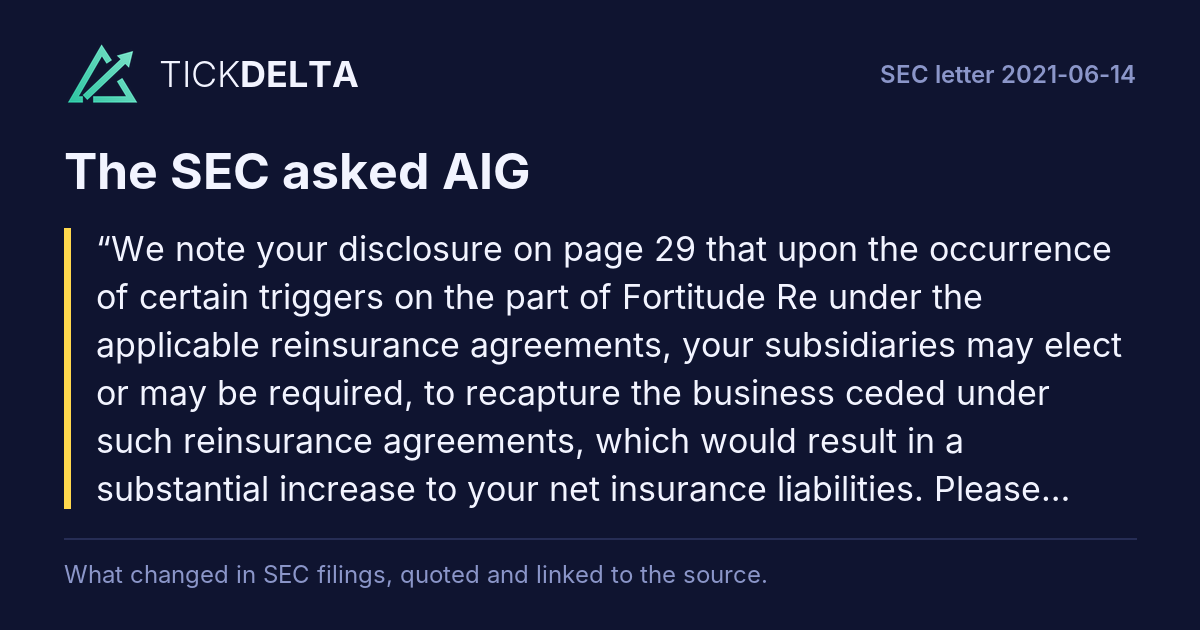
We note your disclosure on page 29 that upon the occurrence of certain triggers on the part of Fortitude Re under the applicable reinsurance agreements, your subsidiaries may elect or may be required, to recapture the business ceded under such reinsurance agreements, which would result in a substantial increase to your net insurance liabilities.Rest of the question
Please revise future filings to discuss the nature of the triggers and provide additional information regarding the triggers to allow an investor to fully understand the uncertainty, the likelihood of a trigger occurring and the reasonably likely impact on financial condition, results of operations, liquidity or capital resources.
We entered into a series of reinsurance transactions related to
AIG’s Run-Off portfolio in 2018 with Fortitude Re and made related disclosures in various sections of our 2020 Form 10-K, including the MD&A Executive Summary (page 69). These reinsurance agreements have standard termination and recapture provisions.
These provisions include the ability to terminate and recapture in the event Fortitude Re becomes insolvent or has been placed into liquidation, rehabilitation, conservatorship, supervision, receivership, bankruptcy or similar proceedings, certain regulatory ratios fall belowRead in the reply ↗Rest of the answer
certain thresholds, in the case of those reinsurance agreements made with Life and Retirement, Fortitude
Re’s failure to perform under the reinsurance agreements, or its entry into certain transactions without receiving our consent when required. While the result of a termination and recapture would have the effect of increasing our net insurance liabilities, with a corresponding increase in required statutory capital, the reinsurance agreements are fully collateralized at the current level of ceded loss reserves as per contractual terms with AIG maintaining control of the collateralized assets and associated future cash flows, including the ability to sell assets as required to pay losses.
In future filings, beginning with our 2021 Form 10-K, we will revise our existing disclosures to incorporate this additional information regarding the nature of the termination and recapture triggers to allow investors to fully understand the potential impact on AIG’s financial condition, results of operations, liquidity and/or capital resources. For the Staff’s convenience, we have underlined the changes we will make, specifically to our Risk Factors.
Following the Majority Interest Fortitude Sale, our largest reinsurance counterparty, Fortitude Re, is no longer affiliated with us, and a failure by Fortitude Re to perform its obligations could have a material effect on our business, results of operations or liquidity and the accounting treatment of our reinsurance agreements with Fortitude
Re could also lead to volatility in our net income. As of June 2, 2020, we consummated the Majority Interest Fortitude Sale, upon which Fortitude Holdings, the parent of Fortitude Re, became controlled 71.5% by affiliates of The Carlyle Group Inc. and 25% by affiliates of T&D Holdings, Inc., and our ownership interest in Fortitude Holdings was reduced to 3.5%. As of December 31, 2021, approximately
$[X] billion of reserves from AIG’s Life and Retirement Run-Off Lines and approximately $[X] billion of reserves from AIG’s General Insurance Run-Off Lines, related to business written by multiple wholly-owned AIG subsidiaries, had been ceded to Fortitude Re under these reinsurance transactions. These reserve balances are fully collateralized pursuant to the terms of the reinsurance agreements. While we retained a seat on the board of managers of Fortitude Holdings, our ability to influence its operations going forward will be very limited. Our subsidiaries continue to remain primarily liable to policyholders under the business reinsured with Fortitude Re. As a result, and if Fortitude Re is unable to successfully operate independently, or other issues arise that affect its financial condition or ability to satisfy or perform its obligations to our subsidiaries under the various reinsurance arrangements in force between Fortitude Re and such subsidiaries, we could experience a material adverse effect on our results of operations and liquidity to the extent the amount of collateral posted in respect of our reinsurance receivable is inadequate. Further, as is customary in similar reinsurance agreements, upon the occurrence of certain termination and recapture triggers on the part of Fortitude
Re under the applicable reinsurance agreements, our subsidiaries may elect or may be required, to recapture the business ceded under such reinsurance agreements, which would result in a substantial increase to our net insurance liabilities. These termination and recapture triggers are standard termination and recapture events and include Fortitude Re becoming insolvent or being placed into liquidation, rehabilitation, conservatorship, supervision, receivership, bankruptcy or similar proceedings, certain regulatory ratios fall below certain thresholds, in the case of those reinsurance agreements made with Life and Retirement, Fortitude Re’s failure to perform under the reinsurance agreements, or its entry into certain transactions without receiving our consent. In addition, pursuant to certain risk-sharing arrangements, AIG may be required to pay Fortitude Re for certain adverse development in property casualty related reserves, based on an agreed methodology, that may occur on or prior to December 31, 2023, up to a maximum payment of $500 million.
First report after the company's reply of 2021-06-25: 10-Q filed 2021-08-06 ↗, against the 10-Q filed 2021-05-07 ↗.
Tickdelta does not hold the text of both reports, so they are not compared here.
We note your disclosure that the sale of Fortitude Re is subject to a post-closing purchase price adjustment pursuant to which AIG will pay up to a maximum payment of $500 million to Fortitude Re for certain adverse development in property casualty related reserves that may occur on or prior to December 31, 2023.Rest of the question
We also note your disclosure on page 298, that you believe the likelihood that you will have to make any material payments is remote and no material liabilities have been recorded. Please tell us the accounting guidance you considered in accounting for the post-closing purchase price adjustment and revise future filings to disclose your accounting policy, or tell us where it is disclosed.
In accordance with ASC 810-10-40-3A, the post-closing purchase price adjustment was determined to be a component of the consideration we received for the sale of Fortitude Group Holdings, LLC
(“Fortitude Holdings”). A fair value was ascribed to this adjustment by AIG which reduced the overall consideration received and therefore was a component of the overall loss on the sale of Fortitude Holdings.
Upon deconsolidation of Fortitude Holdings, the post-closing purchase price adjustment is accounted for as a component of the reinsurance agreements with Fortitude Re.Read in the reply ↗Rest of the answer
Accordingly, the post-closing purchase price adjustment is accounted for under ASC 944 Financial Services – Insurance.
In future filings, beginning with our Form 10-Q for the quarterly period ending June 30, 2021, we will revise our existing disclosures to incorporate this additional information. For the Staff’s convenience, we have underlined the changes we will make, specifically to our reinsurance note.
SALE OF FORTITUDE HOLDINGS
On June 2, 2020, we completed the Majority Interest Fortitude Sale.
AIG established Fortitude Re, a wholly-owned subsidiary of Fortitude Holdings, in 2018 in a series of reinsurance transactions related to AIG’s Run-Off operations. As of June 30, 2021, approximately $[X] billion of reserves from AIG’s Life and
Retirement Run-Off Lines and approximately $[X] billion of reserves from AIG’s General Insurance Run-Off Lines, related to business written by multiple wholly-owned AIG subsidiaries, had been ceded to Fortitude Re under these reinsurance transactions. As of closing of the Majority Interest Fortitude Sale, these reinsurance transactions are no longer considered affiliated transactions and Fortitude
Re is the reinsurer of the majority of AIG’s Run-Off operations. Additionally, the Majority Interest Fortitude Sale is subject to a post-closing purchase price adjustment pursuant to which AIG will pay Fortitude Re for certain adverse development in property casualty related reserves, based on an agreed methodology, that may occur through December 31, 2023, up to a maximum payment of $500 million. Changes in the carrying value of the purchase price adjustment are recorded through Policyholder benefits and losses incurred as this amount represents a reinsurance payable.
First report after the company's reply of 2021-06-25: 10-Q filed 2021-08-06 ↗, against the 10-Q filed 2021-05-07 ↗.
Tickdelta does not hold the text of both reports, so they are not compared here.
We note throughout your MD&A you discuss the business reasons for changes in your various financial results. In circumstances where there is more than one business reason for the change, please revise future filings to quantify the incremental impact of each significant individual business reason. Please refer to Item 303(a)(3) of Regulation S-K and SEC Release No. 33-8350 for guidance.
ending June 30, 2021, we will enhance the MD&A to provide greater clarity and context to users regarding management’s assessment of financial results by quantifying incremental impacts of significant individual business reasons for changes thereto where appropriate. Read in the reply ↗
First report after the company's reply of 2021-06-25: 10-Q filed 2021-08-06 ↗, against the 10-Q filed 2021-05-07 ↗.
Tickdelta does not hold the text of both reports, so they are not compared here.
We note your disclosure that during the second quarter of 2020, AIG entered into a series of quota share reinsurance agreements, including with Lloyd’s Syndicate 2019, a Lloyd’s syndicate managed by Talbot, to reinsure risks related to PCG which caused net premiums written to decrease in 2020.Rest of the question
To the extent the Lloyd’s Syndicate arrangement is in the scope of ASC 808, please provide us and revise future filings to disclose the information required by ASC 808-10-50-1. If you do not believe the arrangement is in the scope of ASC 808, please tell us how you account for the arrangement and identify the relevant accounting guidance and revise future filings to disclose your accounting policies.
ASC 808 Collaborative
Arrangements establishes reporting requirements for participants in a collaborative arrangement which collectively share in the origination of transactions with third parties. We considered the guidance outlined in ASC 808-10-50-1 and determined that it does not apply to the facts and circumstances of Syndicate 2019, which does not have joint operating activities as described in ASC 808-10-15-7.Read in the reply ↗Rest of the answer
The operations of Syndicate 2019 and its Corporate members, 97.18% of which is PCG Corporate Member, a wholly-owned subsidiary of AIG, do not originate business with third parties but instead assume AIG’s Private Client Group (“PCG”) risks which are solely underwritten by wholly-owned AIG domestic subsidiaries. PCG Corporate Member further cedes via a 95% quota share reinsurance arrangement to a third party. Instead, these transactions are accounted for in accordance with ASC 810 Consolidation, to eliminate the effects of
PCG Corporate Member’s participation in the operations of Syndicate 2019, as well as ASC 944 Financial Services – Insurance, to reflect the PCG risks reinsured by third parties. Talbot Underwriting Limited (“TUL”), a wholly-owned subsidiary of AIG, is serving as managing agent to Syndicate 2019 at Lloyd's. TUL performs management and underwriting activities for the members of Syndicate
2019.
ending June 30, 2021, we will revise our existing disclosures to clarify our accounting for PCG. For the Staff’s convenience, we have underlined the changes we will make, specifically to our Business Segment Operations disclosure for General Insurance.
Business and Financial Highlights
[The below will be added within our MD&A Business and Financial
Highlights section]
During the second quarter of 2020, AIG entered into a series of quota share reinsurance agreements, including with Lloyd’s Syndicate 2019, a Lloyd’s syndicate managed by Talbot Underwriting
Ltd., and with PCG 2019 Corporate Member Ltd., both of which are wholly-owned subsidiaries of AIG, to cede PCG business written by our
General Insurance operations to third parties. Overall, these ceded reinsurance transactions, accounted for under ASC 944 Financial
Services – Insurance, further AIG’s continued optimization of its General Insurance portfolio, create additional products for clients and diversify AIG’s capital base. We consolidate our interest in Syndicate 2019 and account for the reinsurance transactions in a manner consistent with other third-party reinsurance arrangements.
First report after the company's reply of 2021-06-25: 10-Q filed 2021-08-06 ↗, against the 10-Q filed 2021-05-07 ↗.
Tickdelta does not hold the text of both reports, so they are not compared here.
Based on disclosure on page 125, it appears you classify certain unrealized activity including changes in your allowance for credit losses and unrealized changes in the fair value of derivatives as realized in the “Net realized capital gains (losses)” line item in the consolidated statements of income (loss).Rest of the question
If so, please revise you current line item description or revise your presentation to more accurately present the nature of the gains (losses).
ending June 30, 2021, we will replace “Net realized capital gains (losses)” with “Net realized gains (losses)” throughout to align with industry practice. Read in the reply ↗
First report after the company's reply of 2021-06-25: 10-Q filed 2021-08-06 ↗, against the 10-Q filed 2021-05-07 ↗.
Tickdelta does not hold the text of both reports, so they are not compared here.
Also in this review: company letter, 2021-08-04, closing letter, 2021-09-09