Paragraphs with nothing like them in last year's 10-K
Quoted exactly
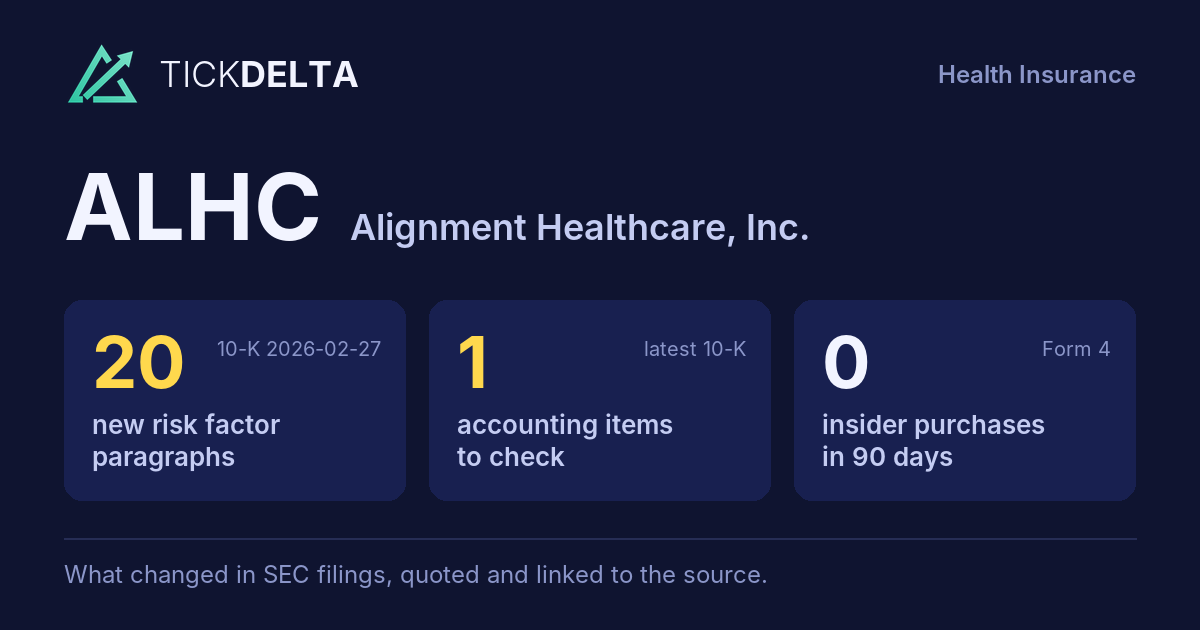
20 paragraphs in Risk Factors of the 10-K filed Feb 27, 2026
with nothing like them in the 10-K filed Feb 27, 2025. Quoted exactly.
Paragraphs that were only edited are under 10-K change.
•Our use of machine learning and artificial intelligence, including within our AVA platform, may introduce operational, regulatory and legal risks that could adversely affect our business, financial condition and results of operations.
Our use of machine learning and artificial intelligence, including within our AVA platform, may introduce operational, regulatory and legal risks that could adversely affect our business, financial condition and results of operations.
We use machine learning, artificial intelligence (“AI”) and other automated data-analysis technologies in certain aspects of our operations, including within AVA, which aggregates and analyzes member and provider information to generate insights, alerts and recommendations and to support risk adjustment, care management and other activities. AI models may produce inaccurate, incomplete, biased or non-reproducible outputs due to limitations in data quality, model design or changing data patterns, and certain methodologies may lack transparency or explainability. If AI-supported processes adversely affect clinical or operational activities, coding or documentation, risk adjustment, utilization management, quality measurement or member stratification, we could experience reduced revenue, increased medical costs, member harm, regulatory exposure or reputational damage. Our use of AI also increases risks relating to data governance, privacy, cybersecurity and third-party technology dependencies, including risks arising from aggregation and use of sensitive data.
The legal and regulatory framework governing AI in healthcare and insurance is rapidly evolving. Federal agencies, including HHS and CMS, are developing policies and guidance regarding the governance and permissible uses of AI in healthcare programs, and federal executive actions and proposed or enacted state laws seek to regulate AI use in sensitive or regulated contexts. New or changing AI-related requirements or enforcement priorities could restrict permissible uses of AI in Medicare Advantage or other regulated activities, require additional governance, validation, documentation, transparency or reporting, or increase audit, overpayment, penalty or liability risks. If our AI governance or use practices are determined to be deficient or non-compliant, we could be subject to investigations, sanctions, contractual liability or other adverse consequences.
If any of these risks were to materialize, our operations, regulatory compliance, reputation, financial condition and results of operations could be adversely affected.
prescription drug costs for which we are financially responsible and may increase variability in our ultimate payments from CMS.
This may increase administrative burdens for plans by requiring new payment tracking systems and risk management strategies. Finally, 2026 is the first year that CMS will implement negotiated prices on certain high-cost Part D drugs, and Part D plans must include these drugs on their formularies at the maximum fair price. These changes may significantly alter the plans that we offer and may adversely affect our business, results of operations and financial condition.
Currently, we are a holding company and do not have any material assets or operations other than ownership of equity interests of our subsidiaries. Our operations are conducted almost entirely through our subsidiaries, and our ability to generate cash to meet our obligations or to pay dividends is highly dependent on the earnings of, and receipt of funds from, our subsidiaries through dividends,
Show the other 4
The CCPA prompted the passage of “copycat” legislation in a number states. It also prompted passage of consumer privacy laws that protect consumer health data specifically, such as the Washington My Health My Data Act. These state laws generally exempt HIPAA regulated covered entities and business associates, PHI, and/or personal information collected in the context of employment and business-to-business relationships. However, this patchwork of state laws may still add additional complexity, variation in requirements, restrictions and potential legal risk, require additional investment of resources in compliance programs, impact strategies and the availability of previously useful data and could result in increased compliance costs and/or changes in business practices and policies.
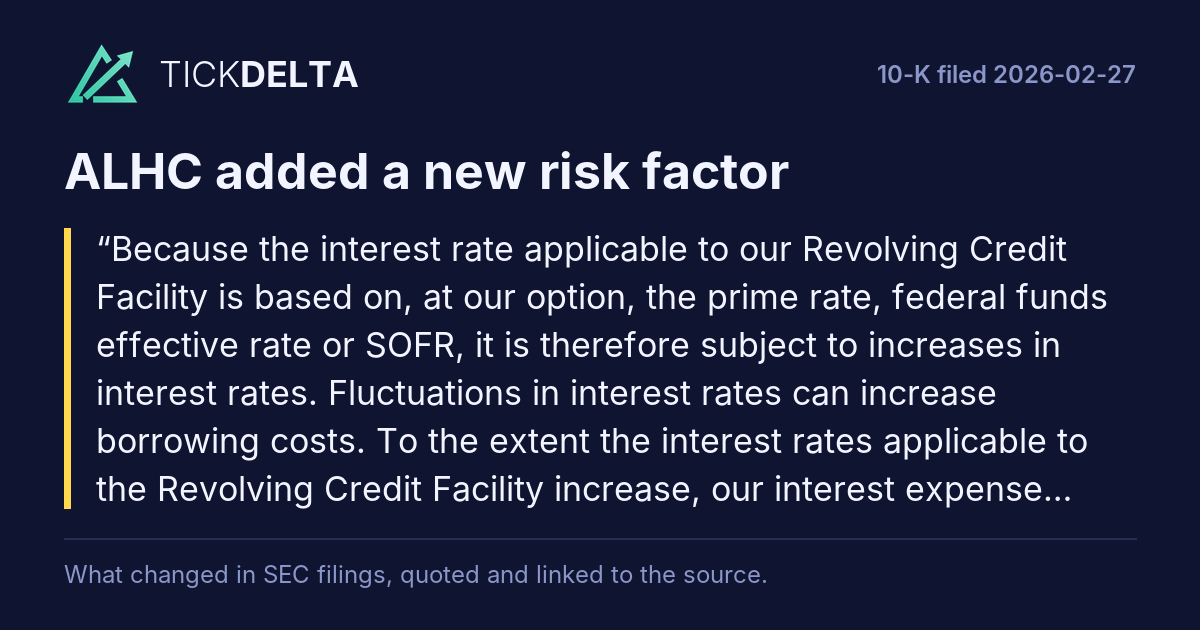
Additionally, we have entered into a senior secured revolving credit facility with various banks (the “Revolving Credit Facility”) in the principal amount of up to $200,000,000. Indebtedness under the Revolving Credit Facility bears interest at a variable rate based on (i) the prime rate announced by Citibank, (ii) the federal funds effective rate or (iii) the forward-looking Secured Overnight Financing Rate ("SOFR"), plus, in each case, an applicable margin based on a consolidated senior secured leverage ratio, as set forth in the credit
agreement governing the Revolving Credit Facility (the "Credit Agreement"). We have not yet borrowed any amount under the Revolving Credit Facility.
Because the interest rate applicable to our Revolving Credit Facility is based on, at our option, the prime rate, federal funds effective rate or SOFR, it is therefore subject to increases in interest rates. Fluctuations in interest rates can increase borrowing costs. To the extent the interest rates applicable to the Revolving Credit Facility increase, our interest expense will increase, in which event we may have difficulties making interest payments and funding our other fixed costs, and our available cash flow for general corporate requirements may be adversely affected.
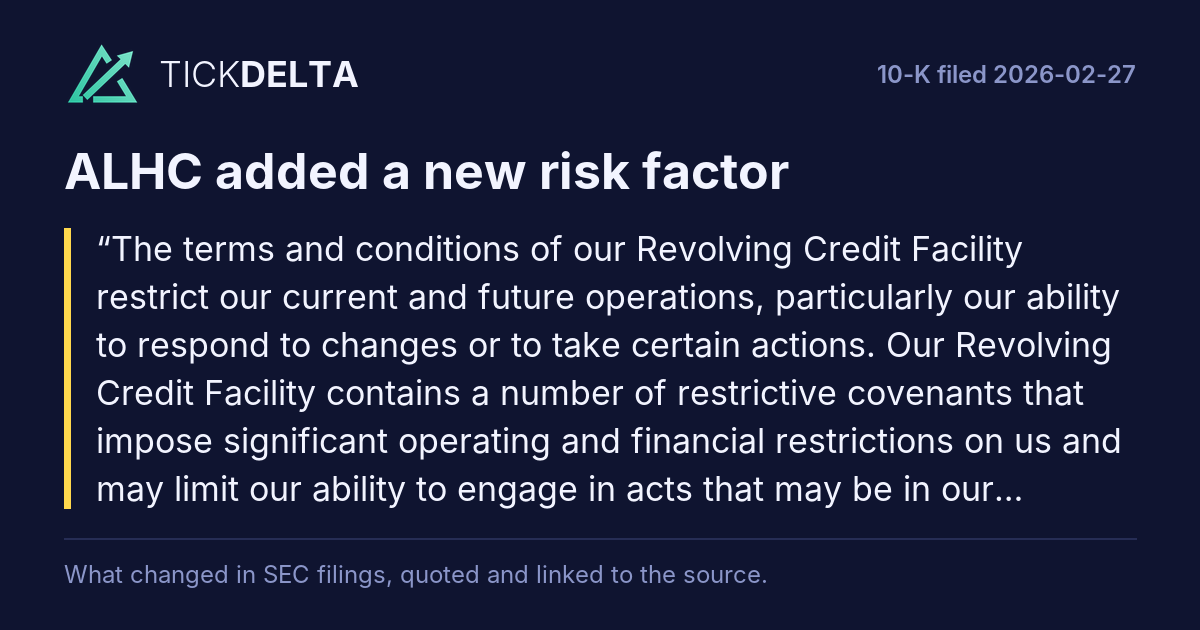
The terms and conditions of our Revolving Credit Facility restrict our current and future operations, particularly our ability to respond to changes or to take certain actions.
Our Revolving Credit Facility contains a number of restrictive covenants that impose significant operating and financial restrictions on us and may limit our ability to engage in acts that may be in our long-term best interests, including restrictions on our ability to:
•pay dividends on our equity interests or make other payments in respect of capital stock; and
The Credit Agreement includes financial covenants that require us to maintain, as of the last day of each fiscal quarter (commencing with the fiscal quarter ending June 30, 2026), (i) a ratio of senior secured indebtedness that is not subordinated in right of payment to the obligations under the Credit Agreement (including the indebtedness under the Credit Agreement) to Consolidated EBITDA (as defined in the Credit Agreement) for the period of four consecutive fiscal quarters ended on such date, of not more than 2.50 to 1.00 and (ii) Consolidated EBITDA for the period of four consecutive fiscal quarters ended on such date, of amounts specified in the Credit Agreement. Our ability to satisfy those tests can be affected by events beyond our control.
A breach of the covenants or restrictions under the Credit Agreement could result in an event of default under such document. Pursuant to a security agreement with the lenders, we granted a first priority security interest in substantially all of our assets (excluding those held by certain subsidiaries), including certain intellectual property and a pledge of the equity interests in certain subsidiaries, subject to customary exceptions. Accordingly, an event of default may allow the lenders to accelerate the debt and to seize our assets that serve as collateral for any outstanding indebtedness under the Credit Agreement. In the event lenders under the Credit Agreement accelerate the repayment, we may not have sufficient assets to repay that indebtedness or be able to borrow sufficient funds to refinance it. Even if we are able to obtain new financing, it may not be on commercially reasonable terms or on terms acceptable to us. As a result of these restrictions, we may be:
•unable to raise additional debt or equity financing to operate during general economic or business downturns; or
•unable to compete effectively or to take advantage of new business opportunities.
These restrictions, along with restrictions that may be contained in agreements evidencing or governing other future indebtedness, may affect our ability to grow in accordance with our growth strategy.
Paragraphs in the 10-Q filed Oct 29, 2026 that were not in the one before
New in the latest 10-Q
12 paragraphs in the 10-Q filed Oct 29, 2026 with nothing like
them in the 10-Q filed Jul 30, 2026 (at least half the words must differ; new numbers alone do not count).
Quoted exactly, grouped by the item heading above them. This is text that changed, not a judgement of how serious it is.
10-Q
• changes in medical costs and healthcare utilization, and our ability to accurately estimate, price for and manage such costs and utilization;
Read in the 10-Qopen_in_new
Legal proceedings
On July 10, 2026, the Company filed an action against the Centers for Medicare & Medicaid Services (“CMS”) and the Secretary of the U.S. Department of Health and Human Services in the U.S. District Court for the District of Columbia (Case No. 1:26-cv-02441) challenging CMS’s calculation of the Company’s Medicare Advantage Star Ratings for payment year 2027. The complaint alleges, among other things, that CMS’s use of certain measures and specifications that were not adopted through required notice-and-comment rulemaking to calculate the Company’s Star Ratings was in violation of the Administrative Procedure Act. The Company filed a motion for summary judgment on August 3, 2026, which has been fully briefed, and the parties are awaiting a potential hearing date and decision.
Read in the 10-Qopen_in_new
On October 9, 2026, the Company filed a separate action against CMS and the Secretary of the U.S. Department of Health and Human Services in the U.S. District Court for the District of Columbia (Case No. 1:26-cv-3550) challenging CMS’s calculation of the Company’s Medicare Advantage Star Ratings for payment year 2028. The complaint asserts claims consistent with those asserted in the Company’s payment year 2027 action regarding CMS’s use of certain Star Ratings measures and specifications and the calculation of the Company’s Star Ratings. For additional information regarding the Clover Health litigation, see Part II, Item 1A, “Risk Factors.”
Read in the 10-Qopen_in_new
Risk Factors
Our Star Rating has declined with respect to our largest Medicare Advantage contract, which will impact our quality bonus payments, and we may not be successful in maintaining or improving our Star ratings in future years.
Read in the 10-Qopen_in_new
CMS measures the quality of Medicare Advantage plans through a Five Star Quality Rating System. The Star Rating system considers various measures adopted by CMS, including, among others, quality of care, preventative services, chronic illness management and member satisfaction. The achievement of Star ratings of 4-Star or higher qualifies Medicare Advantage plans for an increase in the benchmark against which they bid (potentially increasing premium payments). With respect to the 2027 rating year, CMS recently announced that the Company’s California HMO health plan contract (H3815), which serves approximately 75% of the Company’s health plan membership, was awarded a 3.5-Star Rating. The Company retained a 4.0-Star or higher rating in each of its six other eligible plans, including three plans that achieved a 4.5-Star Rating, for the 2027 rating year. The rating year 2027 Stars results are not expected to impact our revenue for fiscal years 2026 or 2027. The change in Star Ratings performance for rating year 2027 will impact our quality bonus payments for fiscal year 2028.
Read in the 10-Qopen_in_new
Show the other 7
We may not be able to maintain or improve upon the Star ratings of our health plans in future years. Failure to maintain satisfactory quality and performance measures may negatively affect our premium rates, impede our ability to compete for new business in existing or new markets or result in the termination of our contracts, or affect our ability to enter into new CMS contracts or expand the service area of current health plans. Star ratings are an important component of how MA beneficiaries select an MA plan, both during each annual enrollment period and throughout each year. Low Star ratings may reduce our membership or result in lower membership growth rates, if members choose to enroll in higher-rated plans.
Read in the 10-Qopen_in_new
Various factors may make it difficult for us to maintain or increase our Star ratings. For example, there are numerous providers that serve our plans, and we engage multiple third-party vendors to provide supplemental plan benefits. We may have limited success in obtaining quality health care outcomes and satisfactory member experiences from these providers and vendors. As a result of our dependence upon these relationships, we may have limited ability to directly influence the overall quality rating of our plans. Additionally, our higher concentration of minority members and members residing in socioeconomically disadvantaged neighborhoods generally may make it more difficult for us to achieve and maintain high Star ratings as compared to our competitors, given the well-documented health disparities among different minority and socioeconomic groups. CMS has attempted to address some of this disparity, but the efforts may not work as intended or be sufficient to address the difficulties of serving varying member populations. More recently, based on our review of the data provided by CMS, the decline in Stars performance for H3815 for rating year 2027 was driven primarily by higher industry cut points and a decline in certain triple-weighted measures across Health Outcomes Survey (HOS) and Part D. We have
Read in the 10-Qopen_in_new
and will continue to implement enterprise-wide initiatives, including to enhance member and provider engagement, expand care gap closure programs and provide additional quality oversight. We believe these actions will strengthen our business and position H3815 to return to at least a 4.0-Star rating in future rating years. However, there can be no assurance that these initiatives will be successful or that H3815 will return to a 4.0-Star or higher rating in future rating years.
Read in the 10-Qopen_in_new
The Star Ratings program and the methodologies used to calculate Star Ratings are subject to change and uncertainty, including as a result of CMS actions, litigation and other legal and regulatory developments. For example, in May 2026, a federal district court ruled in favor of Clover Health in litigation challenging CMS’s use of certain measures in calculating its 2026 Star Rating and ordered CMS to recalculate Clover Health’s rating without the challenged measures. In response, CMS issued a memorandum announcing that it would voluntarily recalculate the 2027 quality bonus payment ratings for certain Medicare Advantage contracts and increase ratings where the recalculation resulted in a higher rating. CMS has appealed the district court’s decision. These developments, as well as other pending challenges to CMS’s Star Ratings methodologies, create substantial uncertainty regarding the measures and methodologies CMS may use to calculate Star Ratings in future years.
Read in the 10-Qopen_in_new
Additionally, CMS continues to make changes to Star Ratings methodology that could negatively impact our Star Ratings in future years. For example, for the 2027 Star Ratings, CMS determined not to implement the Excellent Health Outcomes for All reward, previously known as the Health Equity Index reward, and instead continued the historical reward factor. The elimination of this reward reduced the impact of investments that we made to align with CMS’s objectives under its prior implementation. Future adjustments to, or legal challenges involving, the Star rating methodology may have a negative impact on our Star ratings.
Read in the 10-Qopen_in_new
In addition, audits of our performance for past or future periods may result in downgrades to our Star ratings. For example, if a CMS audit finds that a particular issue of noncompliance impacts the data source for a Star measure, the Star measure may be reduced if the data set is deemed inaccurate or biased.
Read in the 10-Qopen_in_new
As a result of the foregoing, our plans may receive a lower Star rating and may not be eligible for full level quality bonus payments, which could adversely affect the benefits we can offer, reduce membership and/or reduce profit margins. Also, CMS has the authority to terminate contracts that have had a rating of less than three Stars for three consecutive years, whereas Medicare Advantage plans with five Stars are permitted to conduct enrollment throughout almost the entire year. Because low quality ratings can potentially lead to the termination of one or more of our contracts, we may not be able to prevent the potential termination of a plan or a shift of members to other plans based upon quality issues, which could, in turn, have a material adverse effect on our business, results of operations, financial condition and cash flows.
Read in the 10-Qopen_in_new
The 10-Q's risk factors against the 10-K
Item 1A of the 10-Q filed Oct 29, 2026 against Item 1A of the 10-K filed Feb 27, 2026.
A 10-Q repeats only the risks that changed, so a 10-K paragraph that is missing from it is not counted as removed.
Added is a paragraph with nothing like it in the 10-K, Reworded a sentence that is in both with several words changed,
Quiet changes a sentence in both where one to four words changed and one is a hedge or a modal
(cut words struck through, new words highlighted).
Text on the page, not a score; each links to the filing at sec.gov.
What the 10-Q itself says about its risk factors:Except as set forth below, there have been no material changes to the risk factors disclosed in the Annual Report.
Read in the 10-Qopen_in_new
Added10-Q Oct 29, 2026 vs 10-K Feb 27, 2026
and will continue to implement enterprise-wide initiatives, including to enhance member and provider engagement, expand care gap closure programs and provide additional quality oversight. We believe these actions will strengthen our business and position H3815 to return to at least a 4.0-Star rating in future rating years. However, there can be no assurance that these initiatives will be successful or that H3815 will return to a 4.0-Star or higher rating in future rating years.
Read it in the 10-Q at sec.govopen_in_new
Added10-Q Oct 29, 2026 vs 10-K Feb 27, 2026
The Star Ratings program and the methodologies used to calculate Star Ratings are subject to change and uncertainty, including as a result of CMS actions, litigation and other legal and regulatory developments. For example, in May 2026, a federal district court ruled in favor of Clover Health in litigation challenging CMS’s use of certain measures in calculating its 2026 Star Rating and ordered CMS to recalculate Clover Health’s rating without the challenged measures. In response, CMS issued a memorandum announcing that it would voluntarily recalculate the 2027 quality bonus payment ratings for certain Medicare Advantage contracts and increase ratings where the recalculation resulted in a higher rating. CMS has appealed the district court’s decision. These developments, as well as other pending challenges to CMS’s Star Ratings methodologies, create substantial uncertainty regarding the measures and methodologies CMS may use to calculate Star Ratings in future years.
Read it in the 10-Q at sec.govopen_in_new
Reworded10-Q Oct 29, 2026 vs 10-K Feb 27, 2026
These changes, if finalized, and future Future adjustments to to, or legal challenges involving, the Star rating methodology may have a negative impact on our Star ratings.
Read it in the 10-Q at sec.govopen_in_newThe 10-K sentenceopen_in_new
Reworded10-Q Oct 29, 2026 vs 10-K Feb 27, 2026
However, we We may not be able to maintain or improve upon these the Star ratings of our health plans in future years.
Read it in the 10-Q at sec.govopen_in_newThe 10-K sentenceopen_in_new
Reworded10-Q Oct 29, 2026 vs 10-K Feb 27, 2026
Low Star ratings may reduce our membership, membership or result in lower membership growth rates, if members choose to enroll in higher-rated plans.
Read it in the 10-Q at sec.govopen_in_newThe 10-K sentenceopen_in_new
Phrases used for the first time
Two-word phrases in Risk Factors of the 10-K filed Feb 27, 2026 that are in none of the 1 earlier 10-Ks stored, back to Feb 27, 2025
revolving credit ×11credit facility ×11credit agreement ×9cybersecurity breaches ×7transfer restriction ×4restriction agreements ×4machine learning ×3artificial intelligence ×3phi pii ×3senior secured ×3introduce operational ×2operational regulatory ×2legal risks ×2reward factor ×2cybersecurity breach ×2civil claims ×2
Where each one is used
- revolving credit: Additionally, we have entered into a senior secured revolving credit facility with various banks (the “Revolving Credit Facility”) in the principal amount of up to $200,000,000. Indebtedness under the Revolving Credit Facility bears interest at a variable rate based on (i) the prime rate announced by Citibank, (ii)...
- credit facility: Additionally, we have entered into a senior secured revolving credit facility with various banks (the “Revolving Credit Facility”) in the principal amount of up to $200,000,000. Indebtedness under the Revolving Credit Facility bears interest at a variable rate based on (i) the prime rate announced by Citibank, (ii)...
- credit agreement: agreement governing the Revolving Credit Facility (the "Credit Agreement"). We have not yet borrowed any amount under the Revolving Credit Facility.
- cybersecurity breaches: •Cybersecurity breaches, loss of data and other disruptions could compromise sensitive business or member information, or prevent access to critical information and expose us to liability.
- transfer restriction: In jurisdictions where the corporate practice of medicine is prohibited, we have historically operated by maintaining long-term business support contracts with multiple associated professional medical entities that are wholly owned by physicians and, in turn, employ or contract with physicians to provide those...
- restriction agreements: In jurisdictions where the corporate practice of medicine is prohibited, we have historically operated by maintaining long-term business support contracts with multiple associated professional medical entities that are wholly owned by physicians and, in turn, employ or contract with physicians to provide those...
- machine learning: •Our use of machine learning and artificial intelligence, including within our AVA platform, may introduce operational, regulatory and legal risks that could adversely affect our business, financial condition and results of operations.
- artificial intelligence: •Our use of machine learning and artificial intelligence, including within our AVA platform, may introduce operational, regulatory and legal risks that could adversely affect our business, financial condition and results of operations.
The 10-K at sec.govopen_in_new
Used at least twice, small words left out. Counted, not picked: a phrase can be new because the company renamed something.
Our relatively limited operating history makes it difficult to evaluate our current business and prospectus and plan for our future growth. We were founded in 2013, with most of our growth occurring in recent years. We have encountered and will continue to encounter significant risks and uncertainties frequently experienced by new and growing companies in heavily regulated and rapidly changing industries, such as determining appropriate investments for our limited resources, scaling our model and technology platform, attracting and retaining members, efficiently navigating and complying...
In the 10-K filed Feb 27, 2025open_in_new
The Lead Sponsor and its affiliates engage in a broad spectrum of activities, including investments in the healthcare industry generally. In the ordinary course of their business activities, the Lead Sponsor and its affiliates may engage in activities where their interests conflict with our interests or those of our other stockholders, such as investing in or advising businesses that directly or indirectly compete with certain portions of our business or are suppliers or customers of ours. Our certificate of incorporation provides that none of the Lead Sponsor, any of its affiliates or any...
In the 10-K filed Feb 27, 2025open_in_new
The CCPA has prompted a number of proposals for new federal and state-level privacy legislation. Such proposed legislation, if enacted, may add additional complexity, variation in requirements, restrictions and potential legal risk, require additional investment of resources in compliance programs, impact strategies and the availability of previously useful data and could result in increased compliance costs and/or changes in business practices and policies. For example, the Virginia Consumer Data Protection Act, which became effective January 1, 2023, gives Virginia residents expanded...
In the 10-K filed Feb 27, 2025open_in_new
As of December 31, 2024, funds managed by General Atlantic, L.P. (“Lead Sponsor”) beneficially owned approximately 31.9% of our outstanding common stock, which means that, based on its percentage voting power, the Lead Sponsor has the ability to significantly influence the vote of all matters submitted to a vote of our shareholders, including the election of the members of our board of directors (the “Board”) and all other corporate decisions. Accordingly, the Lead Sponsor has significant influence with respect to our management, business plans and policies, including the appointment and...
In the 10-K filed Feb 27, 2025open_in_new
Sources
Item 1A of each 10-K and 10-Q on EDGAR, quoted exactly. Each paragraph links to the filing at sec.gov.
Also
10-K change: what was reworded or cut, section by section.
Work with it
Excel workbook · CSV. Google Sheet that stays up to date: paste =IMPORTDATA("https://tickdelta.com/company/ALHC/export.csv") into a cell.