Screener / SEC EDGAR /CIK 0000766421 /10-K filed Feb 12, 2026, compared with Feb 14, 2025 /Numbers from the XBRL of the 10-Ks
NYSE Industrials · Airlines

Alaska AIR Group, Inc. ALK

Compare with peers Embed
SEC comment letters, last 20 years

2 reviews of ALK's filings by SEC staff

UPLOAD and CORRESP
Reviews 2 latest letter Dec 22, 2020
Questions asked 3 each answered in the company's own letter
No closing letter 0 reviews without a letter saying the staff completed it

When the SEC's staff reviews a filing, it writes to the company with numbered questions, and the company answers each one in a letter. SEC publishes the exchange once the review is over, at least 20 business days later. A question is not an accusation; most reviews end with the company adding detail to its next filing.

How the reviews went

Every review on EDGAR, from the first staff letter to the letter that closes it

  1. 1. Staff letters 2 UPLOAD
  2. 2. Questions in them 3 numbered comments
  3. 3. Company replies 2 CORRESP
  4. 4. Reviews closed 2 of 2 closing letter

Half the closed reviews took 44 days or less from the first letter to the closing letter.

Form 10-K

2020-12-22 to 2021-01-21 · 1 question · 1 letter from the SEC, 1 from the company
Review closed 2021-01-21
Risk factorsLegal and contingenciesDerivatives and hedging
Annual Report on Form 10-K for Fiscal Year Ended December 31, 2019 · General
SEC asked
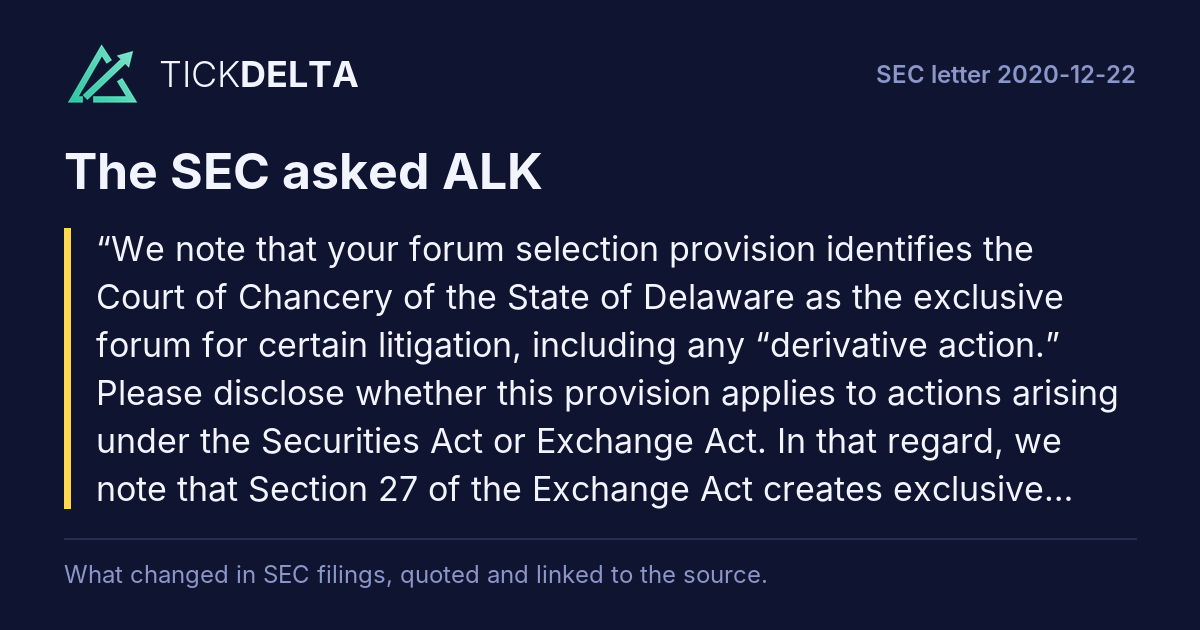
We note that your forum selection provision identifies the Court of Chancery of the State of Delaware as the exclusive forum for certain litigation, including any “derivative action.” Please disclose whether this provision applies to actions arising under the Securities Act or Exchange Act.
Rest of the question

In that regard, we note that Section 27 of the Exchange Act creates exclusive federal jurisdiction over all suits brought to enforce any duty or liability created by the Exchange Act or the rules and regulations thereunder, and Section 22 of the Securities Act creates concurrent jurisdiction for federal and state courts over all suits brought to enforce any duty or liability created by the Securities Act or the rules and regulations thereunder. If the provision applies to Securities Act claims, please also revise your disclosure to state that there is uncertainty as to whether a court would enforce such provision and that stockholders cannot waive compliance with the federal securities laws and the rules and regulations thereunder. In addition, please provide corresponding risk factor disclosure regarding the impact of your exclusive forum provision on stockholders, including that they may be subject to increased costs to bring a claim and that the provision could discourage claims or limit their ability to bring a claim in a judicial forum that they find favorable. Further, if this provision does not apply to actions arising under the Securities Act or Exchange Act, please tell us how you will inform stockholders in future filings that the provision does not apply to any actions arising under the Securities Act or Exchange Act.

ALK answered
We respectfully advise the Staff that the Delaware forum selection provision included in the Company’s Amended and Restated Bylaws is not intended to apply to actions arising under the Securities Act of 1933 or the Securities Exchange Act of 1934. As noted in the Staff’s comment, only federal courts have jurisdiction over suits brought to enforce any duty or liability created by the Exchange Act or the rules and regulations thereunder.
Rest of the answer

In addition, federal and state courts have concurrent jurisdiction over suits brought to enforce any duty or liability created by the Securities Act or the rules and regulations thereunder, and the Company’s existing forum selection provision is not intended to modify the scope of this concurrent jurisdiction. We also respectfully advise the Staff that we previously included the following disclosure in the Description of Capital Stock exhibit that we filed as Exhibit 4.1 to our Quarterly Report on Form 10-Q for the quarter ended March 31, 2020 to inform stockholders that the provision does not apply to actions arising under the Securities Act or Exchange Act:

Under the provisions of our bylaws, unless we consent in writing to the selection of an alternative forum, the Court of Chancery of the State of Delaware will be the sole and exclusive forum for: (i) any derivative action or proceeding brought on behalf of us; (ii) any action asserting a claim of breach of a fiduciary duty owned by any of our directors, officers, other employee or stockholder to us or our stockholders; (iii) any action asserting a claim arising pursuant to any provision of the Delaware General Corporation Law (the “DGCL”) or as to which the DGCL confers jurisdiction on the Court of Chancery of the State of Delaware; or (iv) any action asserting a claim governed by the internal affairs doctrine.

This exclusive forum provision is intended to apply to claims arising under Delaware state law and would not apply to claims brought pursuant to the Securities Exchange Act of 1934, as amended, or the Securities Act of 1933, as amended, or any other claim for which the federal courts have exclusive jurisdiction. The exclusive forum provision in our bylaws will not relieve us of any of our duties to comply with the federal securities laws and the rules and regulations thereunder, and our stockholders will not be deemed to have waived our compliance with these laws, rules and regulations.

We intend to include similar disclosure in our future filings of the Description of Capital Stock exhibit required by Item 601(b)(4) of Regulation S-K as well as in future filings describing our Delaware forum selection provision. In addition, in response to the Staff’s comment, we will include a risk factor in the Annual Report on Form 10-K we file for the year ended December 31, 2020 (and other applicable future filings) regarding the impact of our Delaware forum selection provision on stockholders, including that they may be subject to increased costs to bring a claim and that the provision could discourage claims or limit their ability to bring a claim in a judicial forum they find favorable. We expect this risk factor will be substantially similar to the risk factor we included on page PS-7 of the prospectus supplement (filed under Rule 424(b)(7)) to our registration statement on Form S-3 filed with the Commission on September 25, 2020.

If the Staff has any questions regarding the foregoing response to the Staff’s comment, please contact me at your convenience at (206) 392-5292 or by email at [email protected].
Read in the reply

Also in this review: closing letter, 2021-01-21

Form 10-K For the Fiscal Year Ended December 31, 2017

2018-07-24 to 2018-09-06 · 2 questions · 1 letter from the SEC, 1 from the company
Review closed 2018-09-06
Results discussion (MD&A)DebtRevenue
Form 8-K Furnished April 23, 2018 · Exhibit 99.1, page 5
SEC asked (1)
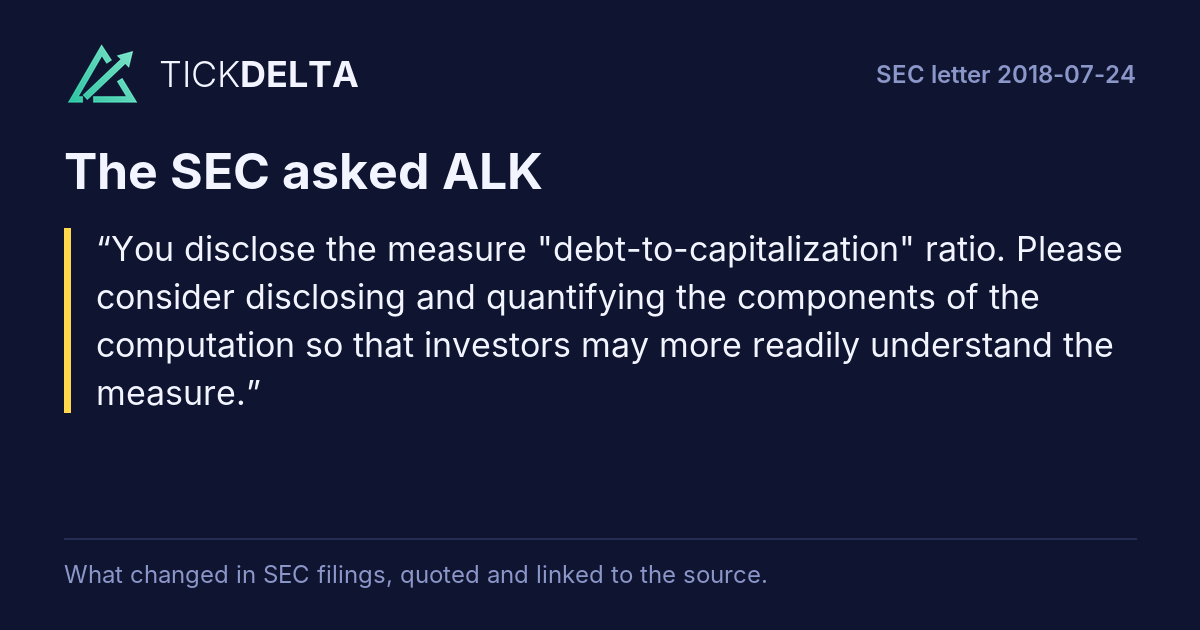
You disclose the measure "debt-to-capitalization" ratio. Please consider disclosing and quantifying the components of the computation so that investors may more readily understand the measure.
ALK answered
Beginning with our Second Quarter 2018 Earnings Release furnished on Form 8-K on July 26, 2018, we have added a disclosure to quantify the components of the computation of “debt-to-capitalization” ratio for our investors. We will add this disclosure in all future filings that include the “debt-to-capitalization” ratio.
Read in the reply
In its next report

First report after the company's reply of Jul 27, 2018: 10-Q filed Aug 8, 2018 ↗, against the 10-Q filed May 4, 2018 ↗.

Tickdelta does not hold the text of both reports, so they are not compared here.

Note 3. Revenue · Passenger Ticket and Ancillary Services Revenue, page 12
SEC asked (2)
You disclose that passenger ticket breakage is recorded in advance of the flight date using estimates based on the company’s historical experience of expired tickets, and other facts such as program changes and modifications.
Rest of the question

Please explain to us why the recognition of breakage in advance of the flight date rather than on the scheduled flight date is appropriate and represents the expected breakage amount in proportion to the pattern of rights exercised by the customer as prescribed in ASC 606-10-55-48. Additionally, explain to us your ticket validity policy (i.e., the status and value of a ticket after its scheduled departure date but prior to its contractual expiration date and exceptions made to accept invalid/expired tickets) and how it is factored into determining the amount of breakage.

ALK answered
To clarify our disclosure, we estimate ticket breakage in advance at the time of the sale, but we do not record the breakage revenue until the departure date or flight date. We will update the disclosure in our future filings to state “Passenger ticket breakage is recorded at the flight date using estimates made at the time of sale based on the Company’s historical experience of expired tickets, and other facts such as program changes and modifications.”

Generally, our tickets expire one year from the date on which transportation commences, or if no portion of the ticket is used and the
Rest of the answer

passenger informs us in advance of travel, one year from date of issuance of the original or reissued ticket. If a passenger changes their ticket prior to departure date, the value of the ticket is applied toward the new ticket and the passenger pays any change in fare plus the applicable ticket change fee. If the passenger informs us that they cannot use the ticket before their departure date, they will receive a refund - if the ticket is fully refundable - or receive a credit in their account for the value of the ticket less the applicable change fee if the ticket is non-refundable. If a passenger does not inform us prior to the departure date, they are considered a “no show,” and the ticket is cancelled whether the ticket is refundable or non-refundable. We recognize revenue associated with “no show” tickets on the departure date, as there is no future obligation to carry that passenger. Exceptions to these policies are made on a case-by-case basis and are immaterial to the revenue breakage recorded. We use historical data of actual ticket expiration aligned with original departure date to inform our estimates of ticket breakage recognition.

Our full ticket rules (contract of carriage) can be found at https://www.alaskaair.com/content/legal/contract-of-carriage/rule-1.

With respect to the preceding responses, the Company acknowledges that management is responsible for the adequacy and accuracy of the disclosure in the filing.

Should the staff have any additional questions or comments after reviewing this letter, we will be pleased to respond promptly with any additional information or material that we can provide. Please direct any questions about this letter to me at (206) 392-5260.

Read in the reply
In its next report

First report after the company's reply of Jul 27, 2018: 10-Q filed Aug 8, 2018 ↗, against the 10-Q filed May 4, 2018 ↗.

Tickdelta does not hold the text of both reports, so they are not compared here.

Also in this review: closing letter, 2018-09-06

From the SEC's correspondence on EDGAR: staff letters (form UPLOAD) and company letters (form CORRESP), 6 letters filed since 2018-07-24. Questions and answers are matched by their numbers; topics come from words in each question. The reports are compared word for word (same form, before the first SEC letter against the first report after the company's reply). No AI.

Sources

The SEC's correspondence on EDGAR: staff letters (form UPLOAD) and company letters (form CORRESP), matched question by question. No AI.

Also

Filings: the letters in the filing list.

Work with it

Excel workbook · CSV. Google Sheet that stays up to date: paste =IMPORTDATA("https://tickdelta.com/company/ALK/export.csv") into a cell.

Next in Owners and insiders:Insider trades
Esc

Type a ticker such as AAPL, a name, an investor such as Buffett, or a topic such as tariffs. ↑ ↓ to move, Enter to open.