Form 10-K for the Fiscal Year Ended December 31, 2020
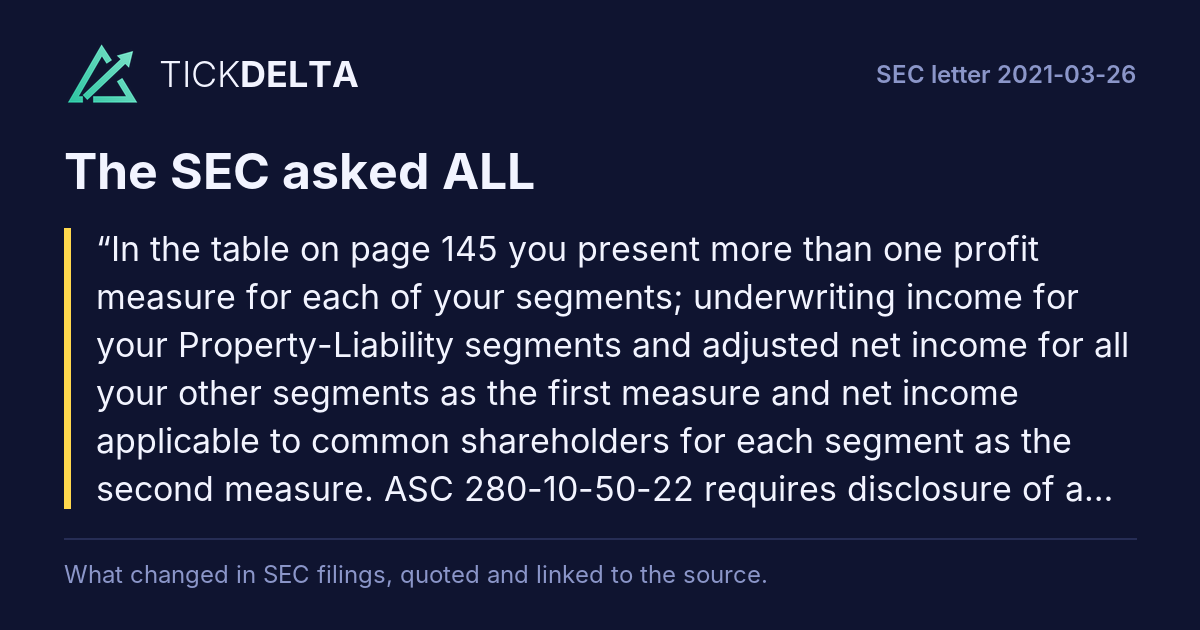
In the table on page 145 you present more than one profit measure for each of your segments; underwriting income for your Property-Liability segments and adjusted net income for all your other segments as the first measure and net income applicable to common shareholders for each segment as the second measure.Rest of the question
ASC 280-10-50-22 requires disclosure of a single measure of segment profit or loss and ASC 280-10-50-28 indicates that when more than one segment profit measure is utilized the one with the measurement principles most consistent with GAAP becomes the segment measure of profit or loss. As a result, please address the following: • Tell us which of the two sets of measures is your single measure of segment profit or loss and explain why, referencing the authoritative literature you rely upon to support your position. • Provide us proposed draft footnote disclosure to be included in future periodic reports that presents only that single measure of segment profit or loss and reconciles this measure to your consolidated income measure as required by ASC 280-10-50-30b. • Tell us whether you intend to continue to disclose the second measure in your Management's Discussion and Analysis and, to the extent you anticipate doing so, represent to us that you will identify it as a non-GAAP measure and provide all the disclosures required by Item 10(e)(1)(i) of Regulation S-K.
As noted on page 143, we define the segment measure as follows: “The measure of segment profit or loss used in evaluating performance is underwriting income for the Allstate Protection and Discontinued Lines and Coverages segments and adjusted net income for the Protection Services, Allstate Life, Allstate Benefits, Allstate Annuities, and Corporate and Other segments.”
As noted in the definition on page 145, we also provide a reconciliation of the segment profit or loss measures to net income applicable to common shareholders.Read in the reply ↗Rest of the answer
The reconciliations were not intended to introduce a second segment measure, and we will remove segment level net income attributable to common shareholders from future filings.
•Provide us proposed draft footnote disclosure to be included in future periodic reports that presents only that single measure of segment profit or loss and reconciles this measure to your consolidated income measure as required by ASC 280-10-50-30b.
Please see the proposed disclosure below. We will provide each segment profit or loss measure along with a reconciliation to net income applicable to common shareholders in total.
Reportable segments financial performance
For the years ended December 31,
($ in millions) 2020 2019 2018
Underwriting income (loss) by segment
Allstate Protection $ 4,566 $ 2,912 $ 2,343
Discontinued Lines and Coverages (144) (108) (90)
Adjusted net income (loss) by segment, after-tax
Protection Services 153 38 8
Allstate Life 194 261 295
Allstate Benefits 96 115 124
Allstate Annuities (53) 10 131
Corporate and Other (428) (438) (406)
Reconciling items
Property-Liability net investment income 1,421 1,533 1,464
Realized capital gains (losses) 1,356 1,885 (877)
Business combination expenses and amortization of purchased intangibles (106) (123) (103)
Impairment of purchased intangibles — (54) —
Valuation changes on embedded derivatives that are not hedged (46) (19) 4
DAC and DSI amortization related to realized capital gains and losses and valuation changes on embedded derivatives that are not hedged 10 (6) (9)
Premium deficiency for immediate annuities (225) — —
Gain on disposition of operations 4 5 5
Pension and other postretirement remeasurement gains (losses) 51 (114) (468)
Curtailment gains (losses) 9 — —
Tax Legislation benefit — — 34
Income tax (expense) benefit (1,397) (1,219) (443)
Consolidated net income applicable to common shareholders $ 5,461 $ 4,678 $ 2,012
•Tell us whether you intend to continue to disclose the second measure in your Management's Discussion and Analysis and, to the extent you anticipate doing so, represent to us that you will identify it as a non-GAAP measure and provide all the disclosures required by Item 10(e)(1)(i) of Regulation S-K.
We will discontinue disclosure of net income applicable to common shareholders for reporting segments.
First report after the company's reply of 2021-04-02: 10-Q filed 2021-05-05 ↗, against the 10-Q filed 2020-11-04 ↗.
Tickdelta does not hold the text of both reports, so they are not compared here.
Please represent to us that in future earnings releases furnished on Forms 8-K you will revise your non-GAAP reconciliations on page 10 of this release to show each reconciling item before taxes and separately present and explain the aggregate income tax impact of the reconciling items. See Question 102.11 of the Compliance and Disclosure Interpretations for Non-GAAP Financial Measures.
In future filings starting in the first quarter of 2021 we will show the impact of reconciling items before tax and the income taxes impact as a separate line in the reconciliation below.
The following tables reconcile net income applicable to common shareholders and adjusted net income.
Twelve months ended December 31,
Consolidated Per diluted common share
2020 2019 2020 2019
Net income applicable to common shareholders $ 5,461 $ 4,678 $ 17.31 $ 14.03
Realized capital (gains) losses (1,356) (1,885) (4.30) (5.65)
Pension and other postretirement remeasurement (gains) losses (51) 114Read in the reply ↗Rest of the answer
(0.16) 0.34
Curtailment (gains) losses (9) — (0.03) —
Valuation changes on embedded derivatives that are not hedged 46 19 0.14 0.06
DAC and DSI amortization relating to realized capital gains and losses and valuation changes on embedded derivatives that are not hedged (10) 6 (0.03) 0.02
First report after the company's reply of 2021-04-02: 10-Q filed 2021-05-05 ↗, against the 10-Q filed 2020-11-04 ↗.
Tickdelta does not hold the text of both reports, so they are not compared here.
Also in this review: closing letter, 2021-04-20