Screener / SEC EDGAR /CIK 0001034670 /10-K filed Feb 19, 2026, compared with Feb 20, 2025 /Numbers from the XBRL of the 10-Ks
NYSE Consumer discretionary · Auto Parts

Autoliv Inc ALV

Compare with peers Embed
The 10-K against last year's

230 changes: 19 added, 12 removed, 194 reworded, 5 quiet changes

10-K Feb 19, 2026 vs Feb 20, 2025

10-K 0001193125-26-058162 (Feb 19, 2026) vs 10-K 0000950170-25-023852 (Feb 20, 2025)

Every paragraph, and how much of it changed

One bar per paragraph, in the order of the 10-K. Height and colour show the share of its words not in the closest paragraph a year earlier; the tallest bars are new paragraphs.

Risk Factors

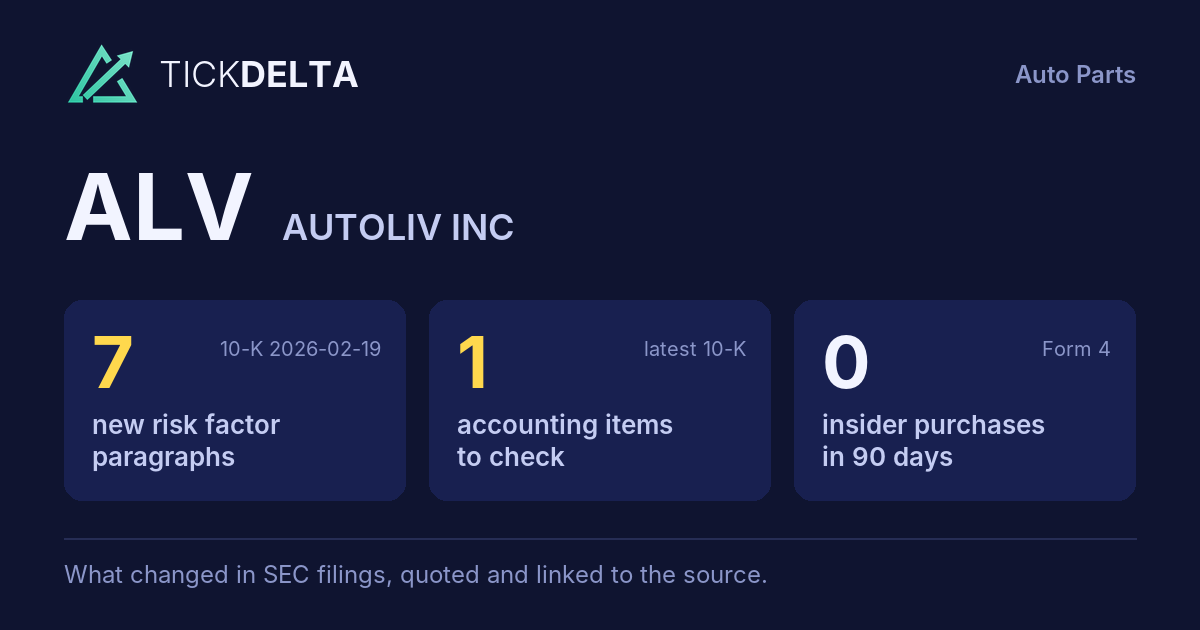
92 paragraphs · 7 new · 49 reworded · 4 gone · 10-K Feb 19, 2026 against Feb 20, 2025
New paragraph Reworded (5% of its words or more) Same or nearly
Paragraph 63 · 43% changed Every version of it
Our international operations also depend upon favorable trade relations between the countries where we manufacture and sell products and those foreign countries in which our customers and suppliers have operations. The current U.S. presidential administration has created uncertainty about the future relationship relationships between the U.S. and certain of its trading partners, including with respect to the trade policies and agreements, treaties, government regulations regulations, and the tariffs that could apply to trade between the U.S. and other nations. For example, in 2025 the U.S. administration has indicated that it intends imposed tariffs affecting imports to impose tariffs the U.S. from nearly every country by executive action adopted and modified without predictable timelines, creating increased operational and financial exposure for companies dependent on imports from Mexico, Canada, and the European Union. In February 2025, additional tariffs have been applied to imports from China and China cross-border trade. Other countries, including China, responded with retaliatory tariffs on or, like the import of American goods. Changes in national policy, other governmental action related to tariffs or international trade agreements, changes in social, political regulatory, and economic conditions or in laws and policies governing foreign trade, manufacturing, development and investment in the territories and countries where the Company currently manufactures and sells products, and any resulting negative sentiments towards the Company as a result of such changes could depress economic activity and restrict our access to suppliers or customers and have a material adverse effect on our cash flows, operating results and financial condition. European Union, announced it is considering retaliatory tariffs.
Paragraph 50 · 41% changed Every version of it
We rely extensively on information technology (“IT”) networks and systems, and those of our third-party service providers, and our global data centers and services provided over the internet to process, transmit and store electronic information, and to manage or support a variety of business processes or activities across our facilities worldwide. In addition, a greater number of our employees are working remotely which may increase cybersecurity vulnerabilities and risk to our IT networks and systems. The secure operation of our IT networks and systems systems, and those of our third-party service providers, and the proper processing and maintenance of this information are critical to our business operations. We have been, and likely will continue to be, subject to cyber-attacks. Although we seek to deploy comprehensive security measures to prevent, detect, address and mitigate these threats, there has been an increased level of activity, and an associated level of sophistication, in cyber-attacks against large multinational companies. Threat actors, including nation state attackers, could also use artificial intelligence for malicious purposes, increasing the frequency frequency, velocity, and complexity of their attacks. The ever-evolving threats mean we and our third-party service providers and vendors must continually evaluate and adapt our respective systems and processes and overall security environment, as well as those of any companies we acquire. There is no guarantee that these measures will be fully implemented, complied with, or effective in safeguarding against all data security breaches, incidents, system compromises or misuses of data. Our security measures may be breached compromised due to human or technological error, employee malfeasance, system malfunctions or attacks from uncoordinated individuals or from organized threat actors groups using sophisticated and targeted measures known as advanced persistent threats, directed at the Company, its us, our products, its our customers, its our third-party service providers, and/or other entities with whom we do business. Because techniques used to obtain unauthorized access or to sabotage systems change frequently and generally are not recognized until they are launched against a target, we may be unable to anticipate these techniques or to implement adequate preventative measures. Disruptions and attacks on our IT systems or the systems of third parties storing our data or employee malfeasance or human or technological error could result in the misappropriation, loss, destruction or corruption of our critical data and confidential or proprietary information, personal information of our employees, the leakage of our or our customers’ confidential information, improper use of our systems and networks, production downtimes and both internal and external supply shortages, which could have a material adverse effect on our results of operations. It may also result in the theft of intellectual property or other misappropriation of assets, or otherwise compromise our confidential or proprietary information and materially disrupt our operations. The potential consequences of a material cybersecurity incident include reputational damage, damaged customer relationships, loss of revenue, lower order intake in the future, theft of intellectual property, litigation with third parties, diminution in the value of our investment in research, development and engineering, diversion of the attention of management away from the operation of our business and increased cybersecurity protection and remediation costs, legal claims and liability, regulatory scrutiny, sanctions, fines or penalties (which may not be covered by our insurance policies), negative publicity, release of sensitive and/or confidential information, increases in operating expenses, or lost revenues which in turn could adversely affect our competitiveness and results of operations. To the extent that any disruption or security breach results in a misappropriation, loss, destruction or corruption of our customer’s information, it could affect our relationships with our customers, create significant expense for us to investigate and remediate damage, lead to claims against the Company and ultimately harm our business, strategy, result of operations, or financial condition. In addition, we may be required to incur significant costs to protect against damage caused by these disruptions or security breaches in the future. In the event that our systems are breached or attacked, we may also suffer an outage, failure, or unavailability of data or information technology systems, and interruptions to our business operations while such breach or attacked is being remedied; this may impact data or systems operated by us or by third-party service providers. In addition, as the regulatory environment related to information security, data collection and use, and privacy becomes increasingly rigorous, with new and constantly changing requirements applicable to our business, compliance with those requirements could result in additional costs. Furthermore, our technology systems are vulnerable to damage or interruption from natural disasters, power loss and telecommunication failures. We continuously seek to maintain a robust program of information security and controls, however, any future significant compromise or breach of our data security, whether external or internal, or misuse of customer, associate, supplier or Company data, could result in significant costs, lost sales, fines, lawsuits, and damage to our reputation.
Paragraph 58 · 41% changed Every version of it
We have developed, and will continue to develop and set, goals, targets, ambitions and other objectives related to sustainability matters, including our net-zero emission targets both for ourselves and our supply chain. Some of these are based on our internal scenario analysis, which may not prove to be accurate and carries inherent uncertainties. Statements related to these goals, targets, ambitions and objectives reflect our current plans and do not constitute a guarantee that they will be achieved. Our efforts to research, establish, accomplish, and accurately report on these goals, targets, and objectives expose us to numerous operational, reputational, financial, legal, and other risks. Additionally, greenhouse gas emissions, particular emissions there can be no assurance that come we will be able to secure pricing from individuals our customers that reflects any increased costs of developing and entities up manufacturing sustainable products. If we are unable to recover these costs, our business, operating results, cash flows, and down the value chain (otherwise known as Scope 3 emissions), are very difficult to estimate and our estimates financial condition may be materially different than actual emissions. Additionally, accepted methodologies or regulatory requirements for estimating emissions, particularly Scope 3 emissions, continue to evolve. The manner in which we estimate and disclose Scope 3 emissions may differ from other companies and may be different than future regulatory requirements, and currently, we do not include downstream Scope 3 emissions in our targets and ambitions. If future governmental regulations require us to modify the basis of our Scope 3 emissions disclosure, our historically disclosed Scope 3 emissions may change materially. Our ability to achieve any stated goal, target, ambition or objective, including with respect to emissions reduction, is subject to numerous factors and conditions, some of which are outside of our control. adversely affected.
Paragraph 60 · 36% changed Every version of it
Our business may face increased scrutiny interest from investors and other stakeholders related to our sustainability activities, initiatives, including the goals, targets, and objectives that we announce, and our methodologies and timelines for pursuing them. If our sustainability practices do not meet investor or other stakeholder expectations and standards, which continue to evolve, our reputation, our ability to attract or retain employees, and our attractiveness as an investment or business partner could be negatively affected. Similarly, our failure Failure or perceived failure to pursue or fulfill our sustainability-focused goals, targets, ambitions and objectives, to comply with ethical, environmental, or other standards, regulations, or expectations, or to satisfy various reporting standards with respect to these matters, within the timelines we announce, or at all, such initiatives could adversely affect our business or reputation, as well as expose us to government enforcement actions and private litigation.
Paragraph 64 · 35% changed Every version of it
Our international operations also depend upon favorable trade relations between the countries where we manufacture and sell products and those foreign countries in which our customers and suppliers have operations. The current U.S. presidential administration has created uncertainty about the future relationship between the U.S. and certain of its trading partners, including with respect to the trade policies and agreements, treaties, government regulations and tariffs that could apply to trade between the U.S. and other nations. For example, the U.S. administration has indicated that it intends to impose tariffs on imports from Mexico, Canada, and the European Union. In February 2025, additional tariffs have been applied to imports from China and China responded with retaliatory tariffs on the import of American goods. Changes in national policy, other governmental action related to tariffs or international trade agreements, changes in social, political regulatory, and economic conditions or in laws and policies governing foreign trade, manufacturing, development and investment in the territories and countries where the Company we currently manufactures manufacture and sells sell products, and as well as any resulting negative sentiments towards the Company us as a result of such changes could depress economic activity and activity, restrict our access to suppliers or customers customers, and have a material adverse effect on our business, operating results, cash flows, operating results and financial condition.
Paragraph 57 · 28% changed Every version of it
Our goals, targets targets, and ambitions related to sustainability and emissions reduction, and our public statements and disclosures regarding them, may, from time to time, result in additional considerations or expectations and expose us to numerous risks
Paragraph 59 · 25% changed Every version of it
We have developed, and will continue to develop and set, goals, targets, ambitions and other objectives related to sustainability matters, including our net-zero emission targets both for ourselves and our supply chain. Some of these are based on our internal scenario analysis, which may not prove to be accurate and carries inherent uncertainties. Statements related to these goals, targets, ambitions and objectives reflect our current plans and do not constitute a guarantee that they will be achieved. Our efforts to research, establish, accomplish, and accurately report on these goals, targets, and objectives expose us to numerous operational, reputational, financial, legal, and other risks. Additionally, greenhouse Greenhouse gas emissions, particular emissions that come from individuals and entities up and down the value chain (otherwise known as Scope 3 emissions), are very difficult to estimate and our estimates may be materially different than actual emissions. Additionally, accepted methodologies or regulatory requirements for estimating emissions, particularly Scope 3 emissions, continue to evolve. The manner in which we estimate and disclose Scope 3 emissions may differ from other companies and may be different than future regulatory requirements, and currently, we do not include downstream Scope 3 emissions in our targets and ambitions. If future governmental regulations require us to modify the basis of our Scope 3 emissions disclosure, our historically disclosed Scope 3 emissions may change materially. Our ability to achieve any stated goal, target, ambition or objective, including with respect to emissions reduction, is subject to numerous factors and conditions, some of which are outside of our control.
Paragraph 25 · 21% changed Every version of it
Our inability to effectively manage the timing, quality quality, and costs of new program launches could adversely affect our business, operating results, cash flows, and financial performance condition

MD&A

211 paragraphs · 12 new · 94 reworded · 8 gone · 10-K Feb 19, 2026 against Feb 20, 2025
New paragraph Reworded (5% of its words or more) Same or nearly
Paragraph 106 · 47% changed
In relation to net sales, capital expenditures, net (expenditures for property, plant and equipment less proceeds from sale of property, plant and equipment) was 5.4% 3.9% compared to 5.4% in previous year. The 5.4% lower level of capital expenditure, net is slightly above what mainly related to the Company expects for the longer term, due to investments in capacity, mainly in Asia, and in finalizing of several footprint optimization, mainly optimization projects in Europe and Japan. Americas and less capacity expansion projects, especially in Asia.
Paragraph 107 · 47% changed
In relation to net sales, capital expenditures, net was 5.4% compared to 5.4% in previous year. The 5.4% 3.9% level is slightly above below what the Company expects for the longer term, due which is to investments on average be below 5% in capacity, mainly in Asia, and in footprint optimization, mainly in Europe and Japan. relation to sales.
Paragraph 63 · 46% changed
Selling, General and Administrative (S,G&A) expenses increased in 2024 2025 by $30 million. The main reason for the cost increase was higher costs for personnel, $40 million, mainly due to high $20 million in increased personnel costs driven by wage inflation. inflation, $13 million in higher IT costs mainly due to higher license costs, $6 million in negative FX translation effects. S,G&A costs in relation to sales increased from 4.8% 5.1% to 5.1%. 5.3%, a level that is considered to be slightly above normal.
Paragraph 141 · 44% changed
These Solar Farm agreements have During 2025 the Company has entered into a contract period ranging from 20-25 years. global 5-year Enterprise Subscription Agreement. The subscription fees for the software licenses will be paid annually in advance. The future payments (undiscounted) relating to these this unrecognized unconditional purchase agreements software subscription agreement are in total $62 approximately $42 million to be paid over the following years: 1-3 Less than 1 year: $12 million; 2-3 years: $6 $25 million; 4-5 years: $4 million and; more than 5 years: $52 $5 million.
Paragraph 65 · 42% changed
Other income (expense), net was an expense of $19 $2 million in 2024 2025 compared to an expense of $207 $19 million in 2023. 2024. Almost all of the $188 $17 million in lower expense was due to lower capacity alignment accruals restructuring costs in 2024 2025 compared to 2023. The high level of capacity alignment accrual in 2023 relate to a structural efficiency program aiming at reducing indirect headcount by up to 2,000. No significant further accruals are expected for this program. 2024.
Paragraph 142 · 41% changed
The Additionally, the Company has entered into a number of unrecognized unconditional purchase agreements relating to Solar Farms in US and China software license agreements, mainly during 2024, 2025, of which none is individually significant for disclosure. Together The future payments (undiscounted) for these unrecognized software license agreements have an aggregated termination fee (discounted) of approximately $51 are in total $26 million to be paid as of December 31, 2024. follows: Less than 1 year: $8 million; 2-3 years: $12 million and 4-5 years: $6 million.
Paragraph 60 · 40% changed
Americas Europe China Asia excl. China Global Autoliv (1.7)% 3.3 % 1.4% (3.2)% 6.6% 0.4% 4.0 % 5.9% 3.4% Main growth drivers Stellantis, Toyota, Honda, Ford Stellantis, BMW, VW Renault, Mercedes, Ford Geely, Chery, Changan Hyundai, Great Wall, Nio Suzuki, Tata Geely, Mercedes, Renault Toyota, Hyundai Stellantis, Suzuki, Toyota Main decline drivers Stellantis, EV OEM, Nissan Stellantis, Volvo, Fisker GOEM, GM, Hyundai EV GOEM, JLR, Hyundai EV GOEM, VW, Mercedes Mitsubishi, Honda, GM EV OEM Nissan, Mazda, Renault Stellantis, EV OEM, GM GOEM, JLR, Lixiang
Paragraph 19 · 39% changed
The past several years’ high order intake share has resulted in the Company's supported a strong sales development outperforming the underlying LVP significantly. over time. In the past 5 years, the Company's organic sales development outpaced global LVP between on average by around 2 and 9 4.3 percentage points every year. points. During 2024, 2025, growth was positively affected through recent launches of several new models, including Subaru Forester, Honda Passport, Ford Expedition, Hyundai Santa Fe, Nissan Kicks, Dacia Duster, Toyota Landcruiser, Zeekr 7z Palisade, Onvo L90, Mercedes CLA, Citroen C3 Aircross and Toyota 4Runner. Opel Frontera.

A paragraph is matched with the one last year that shares the most of its words; under half in common makes it new. The paragraphs shown are the 8 reworded the most in each section.

The paragraph that changed most in each section

The redline

Marked against last year's 10-K: cut words struck through, new words highlighted.

Risk Factors713 words changed in this paragraph; it is 32% similar to last year's version.
We face risks related to product liability claims, warranty claims, and recalls in the event that any of our products actually or allegedly are defective, fail to perform as expected, or the use of our products results, or is alleged to result, in bodily injury and/or property damage. We may not be able to anticipate all of the possible performance or reliability problems that could arise with our products after they are released to the market. Additionally, increasing regulation and reporting requirements regarding potentially defective products, particularly in the U.S., may increase the possibility that we become involved in additional product liability or recall investigations or claims. See – “Our business may be adversely affected by changes in automotive safety regulations or concerns that drive further regulation of the automobile safety market”. Although we currently carry product liability and product recall insurance in excess of our self-insured amounts, there can be no assurance can be made that such insurance will provide adequate coverage against potential claims, that such insurance is will be available or will continue to be available in the appropriate markets, or that we will be able to obtain such insurance on acceptable terms in the future. The cost of such this insurance has risen in recent years and our self-insured amounts have risen increased as well. Although we have invested and will continue to invest in our engineering, design, and quality infrastructure, we cannot give any assurance that our products will not be free suffer from defects or other deficiencies or that we will not experience material warranty claims or product recalls. In the future, we could experience incur material warranty or product liability losses and incur significant costs to process and defend these claims. A successful claim brought against us in excess of available insurance coverage, if any, or a requirement to participate in any product recall, could have a material adverse effect on our operating results, cash flows, or and financial condition. Future recalls could result in costs not covered by insurance in excess of our self-insurance, further government inquiries, litigation, reputational harm, and could divert management’s attention away from other matters. The main variables affecting the costs of a recall are the number of vehicles ultimately determined to be affected by the issue, the cost per vehicle associated with a recall, the determination of proportionate responsibility among the customer, the Company, and any relevant sub-suppliers, and actual insurance recoveries. Every vehicle manufacturer has its own practices regarding product recalls and other product liability actions relating to its suppliers, and the performance and remedial requirements vary between jurisdictions. Due to recall activity in the automotive industry over the past decade, some vehicle manufactures have become even more sensitive to product recall risks. Government regulators have also become more focused on potential recall risks as demonstrated by the US National Highway Traffic Safety Administration (“NHTSA”) investigation of the ARC inflators. If NHTSA proceeds with any recalls of ARC inflators, such a recall could have a material impact on our results of operations. As suppliers become more integrally involved in the vehicle design process and assume more of the vehicle assembly functions, vehicle manufacturers are increasingly looking to their suppliers for contribution when faced with recalls and product liability claims. Product recalls in our industry, even when they do not involve our products, can harm the reputations of our customers, competitors, and us, particularly if those recalls cause consumers to question the safety or reliability of products similar to those we produce. In addition, with global platforms and procedures, vehicle manufacturers are increasingly evaluating our quality performance on a global basis; any one or more quality, warranty or other recall issue(s) (including issues affecting few units and/or having a small financial impact) may cause a vehicle manufacturer to implement measures which may have a severe impact on our operations, such as a global, temporary or prolonged suspension of new orders. In addition, as our products more frequently use global designs and are based on or utilize the same or similar parts, components or solutions, there is a risk that the number of vehicles affected globally by a failure or defect will increase significantly with a corresponding increase in our costs. A warranty, recall or product liability claim brought against us in excess of our available insurance may have a material adverse effect on our business. Vehicle manufacturers are also increasingly requiring their outside suppliers to guarantee or warrant their products and bear the costs of repair and replacement of such products under new vehicle warranties. A vehicle manufacturer may attempt to hold us responsible for some or the entire repair or replacement costs of defective products under new vehicle warranties when the product supplied did not perform as represented. Accordingly, the future costs of warranty claims by our customers may be material. However, the final amounts determined to be due related to these matters could differ materially from our recorded warranty estimates and our business prospects, operating results, cash flows or financial condition may be materially impacted as a result. In addition, as we adopt new technology, we face an inherent risk of exposure to the claims of others that we have allegedly violated their intellectual property rights. We cannot assure that we will not experience any material warranty, product liability or

Source: Item 1A, 10-K 0001193125-26-058162 vs Item 1A, 10-K 0000950170-25-023852

Accounting Policies205 words changed in this paragraph; it is 38% similar to last year's version.
In November 2023, December 2025, the FASB issued ASU 2023-07, Segment 2025-11, Interim Reporting (Topic 280), Improvements 270), Narrow-Scope Improvements, to Reportable Segment Disclosures, which improve reportable segment provide clarity about the current requirements, rather than evaluate whether to expand or reduce interim disclosure requirements, primarily through enhanced disclosures about significant segment expenses. requirements. The amendments in this update require ASU 2025-11 result in a comprehensive list of interim disclosures that a public entity make additional disclosures related to segments if it has them. A public entity that has a single reportable segment would be required to provide all the disclosures are required by the amendments in this update and all existing segment disclosures in Topic 280. GAAP. The amendments in this update is ASU 2025-11 also include a disclosure principle that requires entities to disclose events since the end of the last annual reporting period that have a material impact on the entity. The amendments in ASU 2025-11 are effective for fiscal years interim reporting periods within annual reporting periods beginning after December 15, 2023, and interim periods within fiscal years beginning after December 15, 2024. 2027. Early adoption is permitted. The amendments in this update should ASU 2025-11 can be applied either (1) prospectively or (2) retrospectively to any or all prior periods presented in the financial statements. The Company adopted expects to early adopt ASU 2023-07 2025-11 prospectively to all prior periods presented in the fourth first quarter of 2024.The 2026. The Company expects that the adoption of this guidance resulted in incremental disclosures in the Company’s financial statements. See Note 20. Segment Information. ASU 2025-11 will not have a significant impact on its interim disclosures.

Source: Item 8, Note 2 – Summary of Significant Accounting Policies, 10-K 0001193125-26-058162 vs Item 8, Note 2 – Summary of Significant Accounting Policies, 10-K 0000950170-25-023852

MD&A163 words changed in this paragraph; it is 40% similar to last year's version.
In 2007, the U.S. adopted new regulations for head impact Japan and enhanced thorax protection in side impact crashes, which now have been fully phased-in. China introduced a South Korea are continuously upgrading their vehicle rating program in 2006 programs, JNCAP and during the past 18 years this China NCAP, together with the additional Chinese rating program, CIASI, from 2017, drive Chinese vehicle safety performance and safety content with regards to crashworthiness and occupant protection. KNCAP, respectively. Latin America introduced a basic rating program in 2010 followed by ASEAN NCAP in Southeast Asia in 2011, and 2011. Global NCAP is rating vehicles sold advocates for vehicle standards, and its programs are addressing less regulated markets in significant emerging markets. Latin America, Africa, India, and South east Asia to promote government and industry action. Several newly industrialized countries, e.g., such as Malaysia and Thailand, are increasingly adopting the UN Regulations regarding vehicle safety under the UN 1958 agreement, and Malaysia started a world the world's first motorcycle safety rating program in 2021. India has required frontal airbags for the driver since July 2019, and passenger airbags since 2021 for all new passenger vehicles. In addition, India started its Bharat NCAP in October 2023 and is working on an upgrade for the next four-year cycle with implementation in October 2027.

Source: Item 7, 10-K 0001193125-26-058162 vs Item 7, 10-K 0000950170-25-023852

Legal Proceedings92 words changed in this paragraph; it is 56% similar to last year's version.
Volvo Car USA, LLC (together with its affiliates, “Volvo”) has recalled approximately 762,000 vehicles relating to the malfunction of inflators produced by ZF (the “ZF Inflator Recall”). The recalled ZF inflators were included in airbag modules supplied by the Company only to Volvo. The recall commenced in November 2020 and later expanded in September 2021. Because the Company’s airbags were involved with the ZF Inflator Recall, In August 2025, Volvo irrevocably discharged all potential claims against the Company has determined pursuant to ASC 450 that a loss is reasonably possible with respect to the ZF Inflator Recall. The Company continues to evaluate this matter with Volvo and ZF and no accrual has been made. Although the Company currently estimates a range of $0 to $43 million with respect relating to this potential loss, the Company anticipates that any losses net of insurance claims and claims against ZF will be immaterial. recall.

Source: Item 3, via Note 19 – Contingent Liabilities, 10-K 0001193125-26-058162 vs Item 3, via Note 18 – Contingent Liabilities, 10-K 0000950170-25-023852

Sentences and paragraphs added, removed or reworded

Every change, by type

Sentences and paragraphs of ALV's Risk Factors and MD&A, 10-K Feb 19, 2026 against 10-K Feb 20, 2025. Each links to the text at sec.gov.

Quiet changes are sentences kept from last year with one to four words changed, at least one of them a hedge, a modal or a qualifier (may, could, will, not, significant, material…). A year or date rolling forward is not counted.

The full word list

adverse, adversely, all, although, anticipate, anticipates, any, approximately, believe, believes, can, cannot, certain, could, expect, expects, generally, however, if, intend, intends, largely, likely, many, material, materially, may, might, most, must, never, no, not, possible, primarily, probable, should, significant, significantly, some, substantial, substantially, unlikely, will, would

AddedRisk Factors
We face risks related to product liability claims, warranty claims, and recalls if any of our products are, or are alleged to be defective, fail to perform as expected, or result, or are alleged to result, in bodily injury and/or property damage. We may not be able to anticipate all potential performance or reliability issues that could arise after our products are released to the market. Additionally, increasing regulations and reporting requirements regarding potentially defective products, particularly in the U.S., may increase the possibility that we become involved in additional product liability or recall investigations or claims. See “–Risks Related to Government Regulations and Taxes–Our business may be adversely affected by changes in automotive safety regulations or concerns that drive further regulation of the automobile safety market”.
Read it in 10-K Feb 19, 2026 at sec.gov
AddedRisk Factors
Although we currently carry product liability and product recall insurance in excess of our self-insured amounts, there can be no assurance that such insurance will provide adequate coverage against potential claims, that such insurance will be available or continue to be available in the appropriate markets, or that we will be able to obtain such insurance on acceptable terms in the future. The cost of this insurance has risen in recent years and our self-insured amounts have increased as well. Although we have invested and will continue to invest in our engineering, design, and quality infrastructure, we cannot give any assurance that our products will be free suffer from defects or other deficiencies or that we will not experience material warranty claims or product recalls. In the future, we could incur material warranty or product liability losses and significant costs to process and defend these claims. A successful claim brought against us in excess of available insurance coverage, if any, or a requirement to participate in any product recall, could have a material adverse effect on our operating results, cash flows, and financial condition.
Read it in 10-K Feb 19, 2026 at sec.gov
AddedRisk Factors
We increasingly utilize artificial intelligence (“AI”) and machine‑learning technologies across various aspects of our manufacturing operations, including quality assurance, predictive maintenance, production automation, and supply‑chain planning. While these technologies are intended to improve efficiency and reduce costs, their deployment introduces significant risks that could adversely affect our business, operating results, and financial condition. AI systems depend on the availability of accurate, comprehensive, and properly structured data. If the data underlying these systems is incomplete, inconsistent, or of poor quality, AI outputs may be unreliable, resulting in inaccurate demand forecasts, flawed inventory or production decisions, or erroneous quality‑control assessments. Such outcomes could disrupt manufacturing, increase costs, and reduce our ability to fulfill customer requirements. Our integration of AI with interconnected operational technology also increases our vulnerability to cybersecurity threats. AI‑enabled systems and Internet‑of‑Things (“IoT”) devices expand the potential attack surface for threat actors, and certain legacy equipment used in our facilities may not have been designed with modern cybersecurity protections. A successful cyberattack on an AI-enabled system could compromise sensitive data, disrupt production processes, damage equipment, or lead to extended downtime. In addition, the use of AI tools may require processing confidential and proprietary manufacturing data. If such data is improperly handled, stored, or transmitted—especially through AI platforms that connect to external networks—there is a heightened risk of inadvertent disclosure or theft of intellectual property, including proprietary production methods, equipment configurations, and process data. Such exposure could erode our competitive advantages. If we fail to implement effective AI governance, risk‑management protocols, cybersecurity controls, or compliance processes, we may be unable to mitigate these risks adequately. Further, the legal and regulatory environment relating to AI is uncertain and rapidly evolving, both in the U.S. and internationally, and includes regulatory schemes targeted specifically at AI as well as provisions in intellectual property, privacy, consumer protection, employment, and other laws applicable to the use of AI. These evolving laws and regulations could require changes in our implementation of AI technology and increase compliance costs and the risk of non-compliance. Any of the foregoing risks, individually or in the aggregate, could materially and adversely affect our operations, reputation, competitive position, and financial performance.
Read it in 10-K Feb 19, 2026 at sec.gov
AddedRisk Factors
Tariffs, sanctions, and geopolitical conflicts may disrupt our multi‑tier automotive supply chain, constrain access to critical components, and adversely affect our production capabilities and financial performance
Read it in 10-K Feb 19, 2026 at sec.gov
AddedRisk Factors
Our operations rely on a geographically distributed, multi‑tier supply chain structure that makes us acutely sensitive to shifts in global trade policy, export‑control regimes, and geopolitical conflict. Recent U.S. trade actions affecting imports from major automotive manufacturing hubs—including broad, rapidly shifting tariff frameworks and sector‑specific levies—have increased global cost volatility and introduced uncertainty regarding long‑term sourcing strategies. Wide‑ranging tariff escalation across key trade partners has reshaped global trade flows and imposed substantial cost burdens on manufacturers dependent on cross‑border supply chains. Such measures can directly affect our ability to procure components and precision‑machined parts at competitive prices. These increased input costs may not be fully recoverable through pricing, particularly under fixed‑price or lifetime‑pricing automotive supply agreements. Semiconductor and sensor sourcing relies heavily on global electronics supply chains, which are increasingly affected by export controls, entity‑list restrictions, and sanctions targeting technology supply routes. Expanding U.S. and international restrictions on transfers of semiconductors and related technologies—such as licensing requirements for chip exports to certain entities—have already produced material disruptions and revenue impacts within the broader electronics ecosystem. If our Tier‑1 or Tier‑2 suppliers lose access to critical silicon or manufacturing equipment due to export controls or sanctions, we may face prolonged allocation constraints, extended lead times, or forced redesigns. Military conflicts routinely create systemic disruptions across global automotive supply chains. They may block critical choke points, destabilize upstream manufacturing regions, or restrict access to raw materials such as aluminum, nickel, palladium, and specialized production sourced from conflict‑affected areas. A significant proportion of global enterprises have experienced conflict‑driven disruptions, with impacts concentrated in logistics paralysis, supplier instability, and escalating compliance obligations. State‑based armed conflict is also identified as one of the most immediate global risks to supply chain continuity, threatening transportation corridors, energy markets, and manufacturing hubs essential to the automotive sector. Many of these geopolitical and regulatory shocks originate deep within Tier‑2, Tier‑3, or Tier‑N suppliers of rare‑earth magnets and critical minerals. Because sub‑tier suppliers are often located in high‑risk regions or depend on fragile logistics networks, disruptions—whether due to conflict, export controls, sanctions, or other regulatory actions—may propagate upstream before detection. A substantial portion of global supply chain disruptions originate at these deeper tiers, underscoring the structural risk inherent in automotive supply networks with limited transparency below Tier‑1. Any combination of tariff escalation, sanctions, or military conflict may: reduce availability of critical electronic and mechanical components; necessitate redesigns of products due to unavailable semiconductors or restricted materials; increase logistics costs through rerouted shipments or loss of air/sea corridors; force production slowdowns or stoppages at our facilities or those of our OEM customers; require emergency multi‑sourcing, localized manufacturing transitions, or new supplier qualifications that extend program timing. Because automotive supply contracts typically impose strict delivery, quality, and cost‑reduction obligations, disruptions of this nature could materially affect our business, operating results, cash flows, and financial condition. We may also incur higher safety‑stock requirements, expedited freight costs, or capital expenditures to re‑engineer systems or tool new suppliers. As geopolitical conditions evolve, we cannot ensure that our mitigation strategies—including dual sourcing, buffer inventories, and supplier diversification—will fully offset the operational and financial impacts of these events.
Read it in 10-K Feb 19, 2026 at sec.gov
RemovedRisk Factors
proposals, if adopted by countries in which we operate, could result in changes to tax policies, including transfer pricing policies, which could ultimately impact our tax liabilities.
Read it in 10-K Feb 20, 2025 at sec.gov
Show the other 52
RemovedRisk Factors
The macro-economic uncertainty has been exacerbated by the war in Ukraine and the war in Israel/Gaza, and disruptions to shipping in the Red Sea. Although the length and impact of the ongoing war/conflicts is highly unpredictable, it exacerbated volatility in commodity prices, energy prices, inflationary pressures, credit markets, foreign exchange rates and supply chain disruptions. Furthermore, governments in the United States, United Kingdom, Canada, and European Union have each imposed export controls on certain products and financial and economic sanctions on certain industry sectors and parties in Russia. Existing or additional sanctions could further adversely affect the global economy and further disrupt the global supply chain. Inflation is also currently high world-wide and may continue for an unforeseen time, which could lead to fluctuations in interest rates.
Read it in 10-K Feb 20, 2025 at sec.gov
RemovedRisk Factors
Due in part to the negative impact of the war in Ukraine, we have experienced exacerbated increases in raw materials and increased costs for transportation, energy, and commodities. Although we have negotiated and continue to negotiate with our customers with respect to these additional costs, commercial negotiations with our customers may not be successful or may not offset all of the adverse impact of higher transportation, energy and commodity costs. Additionally, even if we are successful with respect to negotiations with customers relating to cost increases, there may be delay before we recover any increased costs. These may have a material negative impact on our business, results of operations, and financial condition.
Read it in 10-K Feb 20, 2025 at sec.gov
RewordedRisk Factors
Similarly, our failure Failure or perceived failure to pursue or fulfill our sustainability-focused goals, targets, ambitions and objectives, to comply with ethical, environmental, or other standards, regulations, or expectations, or to satisfy various reporting standards with respect to these matters, within the timelines we announce, or at all, such initiatives could adversely affect our business or reputation, as well as expose us to government enforcement actions and private litigation.
Read it in 10-K Feb 19, 2026 at sec.gov
RewordedRisk Factors
If one or more of our any OEM customers determine customer determines that they could achieve overall using a competitor's product would yield better financial results by incorporating a competitor’s new or existing product, would help maintain supply chain resilience, it may result in loss in business and could affect our ability to be competitive and may decrease our current market share.
Read it in 10-K Feb 19, 2026 at sec.gov
RewordedRisk Factors
Even where we are able to pass price increases along on to our customer, customers, there may be (i) a lapse of time delay before we are able can do so, requiring us to do so such that we must absorb the cost increase, increase in the interim, and (ii) a negative impact on our relationships with such customers and suppliers suppliers, which may limit our success in securing ability to secure future awards from customers and securing or obtain acceptable supplies from suppliers.
Read it in 10-K Feb 19, 2026 at sec.gov
RewordedRisk Factors
Our restructuring, efficiency, and strategic initiatives and capacity alignments include efforts to adjust our manufacturing capacity, direct and indirect labor workforce, and cost structure to meet current and projected operational and market requirements, including plant closures, transfer of sourcing to best cost countries, consolidation of our supplier base, and standardization of products to reduce our overhead costs and consolidate our operational centers. requirements.
Read it in 10-K Feb 19, 2026 at sec.gov
RewordedRisk Factors
There are significant resources associated with complying with these requirements, including diligence efforts to determine the sources of conflict minerals used in our products and potential changes to our processes or supplies as a consequence of such diligence efforts.
Read it in 10-K Feb 19, 2026 at sec.gov
RewordedRisk Factors
Any Current and any future regulations aimed at mitigating climate change may negatively impact the prices of raw materials and energy, as well as the demand for certain of our customer’s products which could in turn impact demand for our products and impact adversely affect our operating results of operations. and financial condition.
Read it in 10-K Feb 19, 2026 at sec.gov
RewordedRisk Factors
Furthermore, if raw material costs for raw materials go down, decrease, the price for our products may decrease also decrease, as well as the price is such prices are often indexed to the cost of raw materials. material costs.
Read it in 10-K Feb 19, 2026 at sec.gov
RewordedRisk Factors
The introduction of new laws or regulations or regulations, changes in existing laws or regulations, or the interpretations thereof, changes in their interpretations, could increase the costs of doing business for us us, our customers, or our customers or suppliers suppliers, or restrict our actions and adversely affect our business prospects, business, operating results, cash flows or flows, and financial condition.
Read it in 10-K Feb 19, 2026 at sec.gov
RewordedRisk Factors
Changes in national policy, other governmental action related to tariffs or international trade agreements, changes in social, political regulatory, and economic conditions or in laws and policies governing foreign trade, manufacturing, development and investment in the territories and countries where the Company we currently manufactures manufacture and sells sell products, and as well as any resulting negative sentiments towards the Company us as a result of such changes could depress economic activity and activity, restrict our access to suppliers or customers customers, and have a material adverse effect on our business, operating results, cash flows, operating results and financial condition.
Read it in 10-K Feb 19, 2026 at sec.gov
RewordedRisk Factors
We cannot assure you that we will not experience any material warranty, product liability or intellectual property claim losses in the future, or that we will not incur significant costs to defend against such claims.
Read it in 10-K Feb 19, 2026 at sec.gov
RewordedRisk Factors
Furthermore, any The costs to comply with new or amended laws and violations of these laws laws, which may result in substantial fines and penalties, remediation costs, third party damages, or a suspension or cessation of our operations. operations, may be significant.
Read it in 10-K Feb 19, 2026 at sec.gov
RewordedRisk Factors
For example, in high-income markets, light vehicles have an average passive safety content values value of around $340 approximately $350 per vehicle, whereas in growth markets markets, such as China and India India, the average passive safety content per vehicle value is approximately $200 $210 and $120, $140 per vehicle, respectively.
Read it in 10-K Feb 19, 2026 at sec.gov
AddedMD&A
The effects of the new tariffs imposed in 2025 did not have a significant impact on our profitability in 2025, as we achieved customer compensations for more than 80% of tariff costs. Including the dilutive effect of recovered tariffs, operating margin was negatively impacted by around 20 bps. While it is our ambition and expectation to continue passing tariff costs on to our customers, there is significant uncertainty as future recovery levels may vary. Geopolitical developments and the evolving trade environment are likely to continue creating a challenging and unpredictable operating landscape. Any new, increased or modified tariffs or other trade restrictions could materially affect our operations, customer relationships or cost recovery ability as well as contribute to the uncertainty of industry expectations. We continue to closely monitor the tariff policy environment and remain prepared to be agile to adjust our commercial and operational responses to any such developments.
Read it in 10-K Feb 19, 2026 at sec.gov
AddedMD&A
The strong growth of Chinese OEMs' LVP in both domestic and export markets is a trend the Company expects to continue. It is therefore instrumental to have a solid position with this customer category. Over the past few years, the Company has taken significant steps to strengthen its position with Chinese OEMs through investments in manufacturing and R,D&E capacities, as well as by signing several strategic co-operation agreements with Chinese OEMs. These efforts have supported an improved performance, as shown by a strong order intake, with 30% of the Company's total order intake value in 2025 coming from Chinese OEMs. Additionally, the Company's sales to Chinese OEMs grew by 23% in 2025.
Read it in 10-K Feb 19, 2026 at sec.gov
AddedMD&A
Another important market trend is the rapid growth of the automotive market in India. In recent years, India's significance for the automotive industry has increased substantially. In 2025, LVP in India represented 6.7% of global LVP. As safety content per vehicle has also grown rapidly over the past few years, India's importance for the Company has risen from around 2% of total sales in 2020 to 5% in 2025. Through timely investments in capacity for both manufacturing and R, D&E, the Company is the clear market leader in India.
Read it in 10-K Feb 19, 2026 at sec.gov
AddedMD&A
Direct labor efficiency has developed well in both 2024 and 2025, supported by the direct labor workforce reduction program, improved call-off accuracy and a focused automation effort. It is the Company's estimate that the program's target of 6,000 direct labor workforce reduction was achieved by the end of 2025.
Read it in 10-K Feb 19, 2026 at sec.gov
AddedMD&A
The tax rate for 2025 was 25.4%, compared to 26.0% in 2024. Discrete tax items, net, had a favorable impact of 3.1pp in 2025 compared to 4.8pp favorable impact in 2024. The reported 25.4% tax rate as well as the underlying tax rate excluding discrete items was within our expected normal tax rate range of 25-30%.
Read it in 10-K Feb 19, 2026 at sec.gov
AddedMD&A
Net cash provided by operating activities was $1,157 million in 2025 compared to $1,059 million in 2024. The increase of $98 million in 2025 was mainly due to $88 million in higher net income. The improvement was also supported by more positive effects compared to in 2024 from non-cash items such as $20 million from depreciation and amortization and $55 million from Other non-cash adjustments, which mainly constitutes positive effects from deferred income taxes, pension liabilities and other long term liabilities. This was partly offset by $65 million in less favorable effects from changes in operating working capital compared to 2024.
Read it in 10-K Feb 19, 2026 at sec.gov
AddedMD&A
The United States upgraded its vehicle rating program, US NCAP, in 2011 and again in 2024. In December 2024, NHTSA issued the Final Notice for the U.S. NCAP, outlining mid‑ and long‑term updates across the VRU Safety Program, Crash Avoidance Program, and Crashworthiness Program, including the adoption of advanced ATDs such as the THOR‑05F. The U.S. Department of Transportation also signaled regulatory modernization efforts, including potential use of negotiated rulemaking, and emphasized priorities such as transparency, vehicle affordability, and improved female occupant protection.
Read it in 10-K Feb 19, 2026 at sec.gov
AddedMD&A
Europe upgraded the Euro NCAP rating system during 2018, and is updating its rating protocol for cars in 2026, and then plans further enhancements on a three-year rolling schedule. Euro NCAP established a rating program for heavy goods vehicles in 2024, which will add assessment of occupant protection in a 2030-timeframe.
Read it in 10-K Feb 19, 2026 at sec.gov
AddedMD&A
China introduced a vehicle rating program in 2006, and together with the C-IASI, a rating program established in 2017 by CAERI, they drive the Chinese vehicle safety market and are beginning to influence developments in other regions. The next major upgrades to China NCAP will be phased in from 2027 through 2030. Both Euro NCAP and China NCAP are considering the use of virtual crash testing with virtual human body models as a new method to evaluate the robust safety performance of passenger vehicles, taking into account a wider number of load cases and variations in occupant weight, sex and age.
Read it in 10-K Feb 19, 2026 at sec.gov
AddedMD&A
Japan and South Korea are continuously upgrading their vehicle rating programs, JNCAP and KNCAP, respectively. Latin America introduced a basic rating program in 2010 followed by ASEAN NCAP in Southeast Asia in 2011. Global NCAP advocates for vehicle standards, and its programs are addressing less regulated markets in Latin America, Africa, India, and South east Asia to promote government and industry action. Several newly industrialized countries, such as Malaysia and Thailand, are increasingly adopting the UN Regulations regarding vehicle safety under the UN 1958 agreement, and Malaysia started the world's first motorcycle safety rating program in 2021. India has required frontal airbags for the driver since July 2019, and passenger airbags since 2021 for all new passenger vehicles. In addition, India started its Bharat NCAP in October 2023 and is working on an upgrade for the next four-year cycle with implementation in October 2027.
Read it in 10-K Feb 19, 2026 at sec.gov
RemovedMD&A
The tax rate for 2024 was 26.0%, compared to 20.1% in 2023. Discrete tax items, net, decreased the tax rate in 2023 by 17.3pp, mainly related to a net deferred tax asset recognized in the fourth quarter of 2023 due to the transfer of certain assets and operations as part of restructuring activities. Discrete tax items, net, decreased the tax rate in 2024 by 4.8pp. In addition, country mix impacted the 2024 tax rate favorably by 6.1pp compared to the prior year. The Company considers a tax rate in the range of 25%-30% to be within normal parameters.
Read it in 10-K Feb 20, 2025 at sec.gov
RemovedMD&A
With respect to the Andrews litigation settlement, the Company has treated this specific settlement as a non-recurring charge because of the unique nature of the lawsuit, including the facts and legal issues involved.
Read it in 10-K Feb 20, 2025 at sec.gov
RemovedMD&A
Net cash provided by operating activities was $1,059 million in 2024 compared to $982 million in 2023. The increase of $77 million in 2024 was mainly due to $159 million in higher net income. The improvement was also a supported by continued reduction of working capital, although on a smaller scale compared to the 2023 reduction. The improvement of operating assets and liabilities, net in both 2023 and 2024 was mainly a result of improved customer call-off accuracy enabling more precise planning and use of resources as well as a multi-year working capital efficiency program aiming at improving working capital by $800 million. At the end of 2024, the Company estimates that around $700 million improvement in working capital has been achieved since the start of the program. The remaining around $100 million in the program is targeted to be achieved mainly in inventories and is dependent on a continued improvement in customer call-off accuracy in the years to come.
Read it in 10-K Feb 20, 2025 at sec.gov
RemovedMD&A
In June 2020, the Company utilized its SEK 3,000 million facility with Swedish Export Credit Corporation which was signed in May 2020. The SEK 3,000 million loan mature in May 2025 carrying a floating interest rate of 3M STIBOR +1.85%.
Read it in 10-K Feb 20, 2025 at sec.gov
RemovedMD&A
In 2007, the U.S. adopted new regulations for head impact and enhanced thorax protection in side impact crashes, which now have been fully phased-in. China introduced a vehicle rating program in 2006 and during the past 18 years this China NCAP, together with the additional Chinese rating program, CIASI, from 2017, drive Chinese vehicle safety performance and safety content with regards to crashworthiness and occupant protection. Latin America introduced a basic rating program in 2010 followed by ASEAN NCAP in Southeast Asia in 2011, and Global NCAP is rating vehicles sold in significant emerging markets. Several countries, e.g., Malaysia and Thailand, are increasingly adopting the UN Regulations regarding vehicle safety under the UN 1958 agreement, and Malaysia started a world first motorcycle safety rating program in 2021.
Read it in 10-K Feb 20, 2025 at sec.gov
RemovedMD&A
The United States upgraded its vehicle rating program, US NCAP, in 2011 and again in 2024. Europe upgraded the Euro NCAP rating system during 2018, and is now completing a new upgrade, intended to be fully implemented by 2025. Japan and South Korea are continuously upgrading their respective vehicle rating programs, JNCAP and KNCAP respectively. India requires frontal airbags for the driver from July 2019, and passenger airbags from 2021 for all new passenger vehicles (M1), moreover has announced that side airbags shall become mandatory in 2023. In addition, India's Bharat NCAP went into effect in 2023 and was updated in 2024.
Read it in 10-K Feb 20, 2025 at sec.gov
RewordedMD&A
In addition to the assumptions noted below, below and our business and market update provided herein, the Company's guidance for 2025 2026 is mainly based on our its customer call-offs, call-offs and the achievement of our its targeted cost compensation effects and adjustments with its customers, including no material changes to tariffs or trade restrictions. restrictions, as compared to what is in effect as of January 23, 2026, as well as no significant changes in the macro-economic environment, changes to customer call-off volatility or significant supply chain disruptions.
Read it in 10-K Feb 19, 2026 at sec.gov
RewordedMD&A
Costs for Financial and non-operating items, net, costs increased improved by $27 $3 million in 2024 2025 compared to previous year, mainly due to $14 $5 million in increased lower interest expense as the result of higher debt and higher interest rates, and $13 partly offset by $3 million in increased expenses for Other non-operating items. lower interest income.
Read it in 10-K Feb 19, 2026 at sec.gov
RewordedMD&A
During 2024, 2025, growth was positively affected through recent launches of several new models, including Subaru Forester, Honda Passport, Ford Expedition, Hyundai Santa Fe, Nissan Kicks, Dacia Duster, Toyota Landcruiser, Zeekr 7z Palisade, Onvo L90, Mercedes CLA, Citroen C3 Aircross and Toyota 4Runner. Opel Frontera.
Read it in 10-K Feb 19, 2026 at sec.gov
RewordedMD&A
Years ended December 31, Components of change in net sales 2025 2024 2023 Reported Currency Organic 3) change effects 1) Airbags, Steering Wheels and Other2) $ 7,023 $7,055 (0.5 (1.2 0.7 7,302 $7,023 4.0% 0.6% 3.4% Seatbelt products and Other2) 3,513 3,367 3,420 (1.6 (1.3 (0.2 4.3% 0.8% 3.5% Total $ 10,390 $10,475 (0.8 (1.2 0.4 10,815 $10,390 4.1% 0.7% 3.4%
Read it in 10-K Feb 19, 2026 at sec.gov
RewordedMD&A
The increase decrease of $190 $311 million in cash used in financial activities was mainly the result of $200 $201 million additional less in repurchased shares in 2024 as 2025 compared to 2023. 2024 and a higher net increase in short-term debt by $137 million in 2025 compared to 2024.
Read it in 10-K Feb 19, 2026 at sec.gov
RewordedMD&A
For the years ended December 31, 2025 and 2024 and 2023 respectively respectively, management’s estimation process has been consistent and the ultimate outcome for settled product recall matters during the years ended December 31, 2025 have been in line with estimates and for December 31, 2024 and 2023 as were favorable compared to management estimations have been favorable. Management’s estimate.
Read it in 10-K Feb 19, 2026 at sec.gov
RewordedMD&A
During 2024 2025 and 2023, 2024, the Company repurchased and retired 3.1 million and 5.1 million and 3.7 million shares, respectively, under the new stock repurchase program approved by the Board of Directors in November 2021. respectively.
Read it in 10-K Feb 19, 2026 at sec.gov
RewordedMD&A
The future payments (undiscounted) relating to these this unrecognized unconditional purchase agreements software subscription agreement are in total $62 approximately $42 million to be paid over the following years: 1-3 years: $6 million; 4-5 years: $4 million and; more than 5 years: $52 million.
Read it in 10-K Feb 19, 2026 at sec.gov
RewordedMD&A
The largest contributor to the increase was side airbags and inflatable curtains, followed by steering wheels, followed by center airbags, side airbags, inflatable curtains and inflators, partly offset by decreases for passenger airbags, knee airbags and driver airbags.
Read it in 10-K Feb 19, 2026 at sec.gov
RewordedMD&A
The drivers behind the gross profit improvement was mostly due to that better customer call-off accuracy supported an were mainly improved operational efficiency with around $82 million in lower costs for labor, logistics, premium freight and waste and scrap.
Read it in 10-K Feb 19, 2026 at sec.gov
RewordedMD&A
For further information, see Note 18 Contingent Liabilities describing information regarding the significant on-going claims and lawsuits the company Company is involved in. in, see Note 19 Contingent Liabilities, to the Consolidated Financial Statements.
Read it in 10-K Feb 19, 2026 at sec.gov
RewordedMD&A
Receivables Receivables, net outstanding in relation to annualized fourth quarter sales was 20% at December 31, 2025, compared to 19% at December 31, 2024, compared to 20% at December 31, 2023. 2024.
Read it in 10-K Feb 19, 2026 at sec.gov
Quiet changesMD&A
However, such insurance may not be sufficient to cover every possible claim that can arise in the Company’s businesses, now or in the future, or may not always will be available should the Company, now or in the future, wish to extend, renew, increase or otherwise adjust such insurance.
Read it in 10-K Feb 19, 2026 at sec.gov

Sources

The two latest 10-Ks on EDGAR, section by section. Each change links to the text at sec.gov.

Also

New risk factors: paragraphs with nothing like them last year, quoted in full.

Work with it

Excel workbook · CSV. Google Sheet that stays up to date: paste =IMPORTDATA("https://tickdelta.com/company/ALV/export.csv") into a cell.

Next:Related parties
Esc

Type a ticker such as AAPL, a name, an investor such as Buffett, or a topic such as tariffs. ↑ ↓ to move, Enter to open.