Autoliv Inc ALV
New risk paragraphs, branching off last year
Each branch is a paragraph in Risk Factors with nothing like it in the 10-K filed Feb 20, 2025. A box jumps to the paragraph as filed, below.
Paragraphs with nothing like them in last year's 10-K
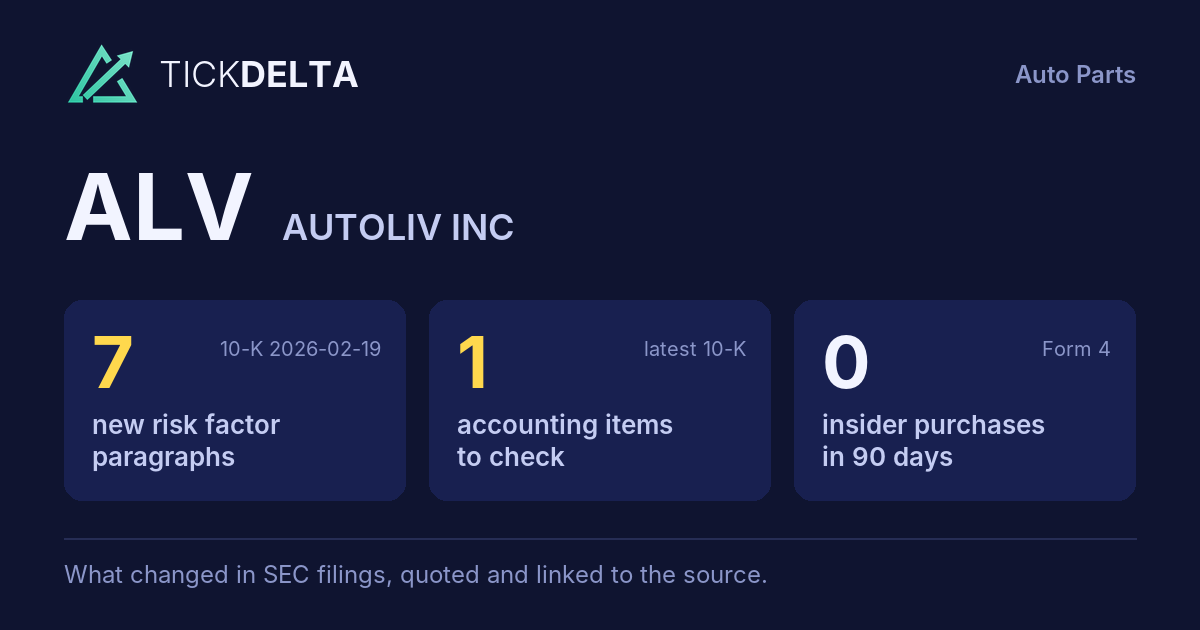
7 paragraphs in Risk Factors of the 10-K filed Feb 19, 2026 with nothing like them in the 10-K filed Feb 20, 2025. Quoted exactly. Paragraphs that were only edited are under 10-K change.
We face risks related to product liability claims, warranty claims, and recalls if any of our products are, or are alleged to be defective, fail to perform as expected, or result, or are alleged to result, in bodily injury and/or property damage. We may not be able to anticipate all potential performance or reliability issues that could arise after our products are released to the market. Additionally, increasing regulations and reporting requirements regarding potentially defective products, particularly in the U.S., may increase the possibility that we become involved in additional product liability or recall investigations or claims. See “–Risks Related to Government Regulations and Taxes–Our business may be adversely affected by changes in automotive safety regulations or concerns that drive further regulation of the automobile safety market”.
Although we currently carry product liability and product recall insurance in excess of our self-insured amounts, there can be no assurance that such insurance will provide adequate coverage against potential claims, that such insurance will be available or continue to be available in the appropriate markets, or that we will be able to obtain such insurance on acceptable terms in the future. The cost of this insurance has risen in recent years and our self-insured amounts have increased as well. Although we have invested and will continue to invest in our engineering, design, and quality infrastructure, we cannot give any assurance that our products will be free suffer from defects or other deficiencies or that we will not experience material warranty claims or product recalls. In the future, we could incur material warranty or product liability losses and significant costs to process and defend these claims. A successful claim brought against us in excess of available insurance coverage, if any, or a requirement to participate in any product recall, could have a material adverse effect on our operating results, cash flows, and financial condition.
Changes in our product mix may impact our operating results and financial condition
Increasing reliance on artificial intelligence technologies exposes us to operational, cybersecurity, and intellectual property risks
We increasingly utilize artificial intelligence (“AI”) and machine‑learning technologies across various aspects of our manufacturing operations, including quality assurance, predictive maintenance, production automation, and supply‑chain planning. While these technologies are intended to improve efficiency and reduce costs, their deployment introduces significant risks that could adversely affect our business, operating results, and financial condition. AI systems depend on the availability of accurate, comprehensive, and properly structured data. If the data underlying these systems is incomplete, inconsistent, or of poor quality, AI outputs may be unreliable, resulting in inaccurate demand forecasts, flawed inventory or production decisions, or erroneous quality‑control assessments. Such outcomes could disrupt manufacturing, increase costs, and reduce our ability to fulfill customer requirements. Our integration of AI with interconnected operational technology also increases our vulnerability to cybersecurity threats. AI‑enabled systems and Internet‑of‑Things (“IoT”) devices expand the potential attack surface for threat actors, and certain legacy equipment used in our facilities may not have been designed with modern cybersecurity protections. A successful cyberattack on an AI-enabled system could compromise sensitive data, disrupt production processes, damage equipment, or lead to extended downtime. In addition, the use of AI tools may require processing confidential and proprietary manufacturing data. If such data is improperly handled, stored, or transmitted—especially through AI platforms that connect to external networks—there is a heightened risk of inadvertent disclosure or theft of intellectual property, including proprietary production methods, equipment configurations, and process data. Such exposure could erode our competitive advantages. If we fail to implement effective AI governance, risk‑management protocols, cybersecurity controls, or compliance processes, we may be unable to mitigate these risks adequately. Further, the legal and regulatory environment relating to AI is uncertain and rapidly evolving, both in the U.S. and internationally, and includes regulatory schemes targeted specifically at AI as well as provisions in intellectual property, privacy, consumer protection, employment, and other laws applicable to the use of AI. These evolving laws and regulations could require changes in our implementation of AI technology and increase compliance costs and the risk of non-compliance. Any of the foregoing risks, individually or in the aggregate, could materially and adversely affect our operations, reputation, competitive position, and financial performance.
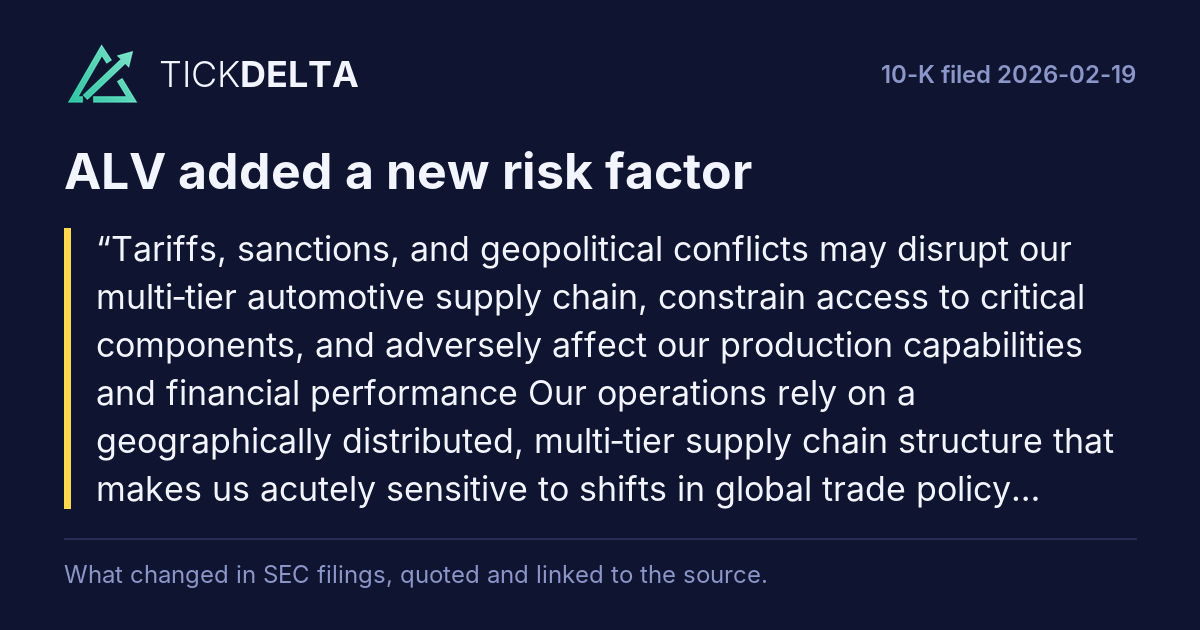
Tariffs, sanctions, and geopolitical conflicts may disrupt our multi‑tier automotive supply chain, constrain access to critical components, and adversely affect our production capabilities and financial performance
Our operations rely on a geographically distributed, multi‑tier supply chain structure that makes us acutely sensitive to shifts in global trade policy, export‑control regimes, and geopolitical conflict. Recent U.S. trade actions affecting imports from major automotive manufacturing hubs—including broad, rapidly shifting tariff frameworks and sector‑specific levies—have increased global cost volatility and introduced uncertainty regarding long‑term sourcing strategies. Wide‑ranging tariff escalation across key trade partners has reshaped global trade flows and imposed substantial cost burdens on manufacturers dependent on cross‑border supply chains. Such measures can directly affect our ability to procure components and precision‑machined parts at competitive prices. These increased input costs may not be fully recoverable through pricing, particularly under fixed‑price or lifetime‑pricing automotive supply agreements. Semiconductor and sensor sourcing relies heavily on global electronics supply chains, which are increasingly affected by export controls, entity‑list restrictions, and sanctions targeting technology supply routes. Expanding U.S. and international restrictions on transfers of semiconductors and related technologies—such as licensing requirements for chip exports to certain entities—have already produced material disruptions and revenue impacts within the broader electronics ecosystem. If our Tier‑1 or Tier‑2 suppliers lose access to critical silicon or manufacturing equipment due to export controls or sanctions, we may face prolonged allocation constraints, extended lead times, or forced redesigns. Military conflicts routinely create systemic disruptions across global automotive supply chains. They may block critical choke points, destabilize upstream manufacturing regions, or restrict access to raw materials such as aluminum, nickel, palladium, and specialized production sourced from conflict‑affected areas. A significant proportion of global enterprises have experienced conflict‑driven disruptions, with impacts concentrated in logistics paralysis, supplier instability, and escalating compliance obligations. State‑based armed conflict is also identified as one of the most immediate global risks to supply chain continuity, threatening transportation corridors, energy markets, and manufacturing hubs essential to the automotive sector. Many of these geopolitical and regulatory shocks originate deep within Tier‑2, Tier‑3, or Tier‑N suppliers of rare‑earth magnets and critical minerals. Because sub‑tier suppliers are often located in high‑risk regions or depend on fragile logistics networks, disruptions—whether due to conflict, export controls, sanctions, or other regulatory actions—may propagate upstream before detection. A substantial portion of global supply chain disruptions originate at these deeper tiers, underscoring the structural risk inherent in automotive supply networks with limited transparency below Tier‑1. Any combination of tariff escalation, sanctions, or military conflict may: reduce availability of critical electronic and mechanical components; necessitate redesigns of products due to unavailable semiconductors or restricted materials; increase logistics costs through rerouted shipments or loss of air/sea corridors; force production slowdowns or stoppages at our facilities or those of our OEM customers; require emergency multi‑sourcing, localized manufacturing transitions, or new supplier qualifications that extend program timing. Because automotive supply contracts typically impose strict delivery, quality, and cost‑reduction obligations, disruptions of this nature could materially affect our business, operating results, cash flows, and financial condition. We may also incur higher safety‑stock requirements, expedited freight costs, or capital expenditures to re‑engineer systems or tool new suppliers. As geopolitical conditions evolve, we cannot ensure that our mitigation strategies—including dual sourcing, buffer inventories, and supplier diversification—will fully offset the operational and financial impacts of these events.
Paragraphs in the 10-Q filed Oct 23, 2026 that were not in the one before
New in the latest 10-Q
11 paragraphs in the 10-Q filed Oct 23, 2026 with nothing like them in the 10-Q filed Jul 17, 2026 (at least half the words must differ; new numbers alone do not count). Quoted exactly, grouped by the item heading above them. This is text that changed, not a judgement of how serious it is.
Financial statements and notes
value1) value value1) value Long-term debt Bonds $ 1,660 $ 1,633 $ 1,715 $ 1,736 Loans 21 21 17 17 Other 2 2 2 2 Total long-term debt 1,683 1,656 1,734 1,755 Short-term debt Short-term portion of long-term debt - - 285 287 Overdrafts and other short-term debt 251 251 134 134 Total short-term debt $ 251 $ 251 $ 419 $ 421 1) Debt as reported in balance sheet.
Read in the 10-Q
We continued to deliver well across all key areas in the third quarter. Our sales in India grew by nearly 30% and our sales to Chinese OEMs grew by more than 20%. Strong sales growth in Japan contributed to our sales in Asia exceeding China in the quarter. Globally, our organic sales performance exceeded global LVP by around 1pp, significantly outpacing LVP growth in India, Japan and with Chinese OEMs.
Read in the 10-Q
To support our growing partnerships with Chinese OEMs, our innovation capabilities, global competitiveness and long term growth, we opened our second R&D center in China in the third quarter of 2026.
Read in the 10-Q
The business environment remains uncertain but we anticipate a strong fourth quarter supported by an increasing number of product launches and significant raw material recoveries. Throughout the year, cost headwinds have increased materially, mainly related to raw materials, logistics, the recent flooding in Thailand and lower call off accuracy since the first quarter. We have been able to offset the majority of these cost headwinds mainly through labor efficiency, material savings through Value Engineering and successful negotiations with customers and suppliers. However, the additional headwinds narrows our full year adjusted operating margin expectation to around 10.5%, the low end of our range of around 10.5-11%. We continue to expect unchanged organic sales growth (Non-GAAP measure) and an operating cash flow of around $1.2 billion.
Read in the 10-Q
Finally, we would like to invite you to our 2027 Investor Day, which will take place in Shanghai, China, on April 26 and 27, 2027. It will be held in connection with the Auto Shanghai, the largest and most important auto show in the world.
Read in the 10-Q
Show the other 6
EV OEM Main decline drivers Ford, Stellantis, VW, BMW, Stellantis Subaru, Mitsubishi, Ford Honda,VW, BMW VW, Ford, Stellantis
Read in the 10-Q
• On September 8, 2026, Autoliv announced it is advancing the development of virtual testing through its Human Body Model (HBM) Safety Suite. The platform is designed to support the development of safer vehicles, with Toyota as the first customer to evaluate its capabilities.
Read in the 10-Q
• On October 2, 2026, Autoliv announced the appointments of Natalie Draisin and Thomas Manfred Müller to its Research Advisory Board. Natalie Draisin serves as Director of the North American Office and United Nations Representative at FIA Foundation and is an External Affiliate at the Johns Hopkins Bloomberg School of Public Health. Thomas Manfred Müller, PhD, is a Board Member, Advisor and Business Angel with extensive international experience across leadership and executive roles at Audi, BMW, Volvo Cars, and Volkswagen Group.
Read in the 10-Q
• Autoliv today published on its website its Green Financing Framework which has been updated to incorporate the latest market practices and standards, and to support the long-term commitment of the Company to integrate sustainability across the entire organization.
Read in the 10-Q
• Autoliv invites investors, analysts and journalists to an Investor Day in Shanghai, China. It will take place on April 26 and 27, 2027, with management presentations, site visits and a full day at the world's leading auto show, Auto Shanghai 2027. Focus will be on global growth, innovations and key trends shaping China’s automotive industry and Autoliv’s strategy for success in the Chinese market. This includes how we strengthen our relationships with leading Chinese OEMs in China and overseas. Further details regarding agenda and registration will be provided at a later stage.
Read in the 10-Q
Other information
During the three months period ended September 30, 2026, no director or officer of the Company adopted or terminated a “Rule 10b5-1 trading arrangement” or “non-Rule 10b5-1 trading arrangement,” as each term is defined in Item 408(a) of Regulation S-K.
Read in the 10-Q
The 10-Q's risk factors against the 10-K
Item 1A of the 10-Q filed Oct 23, 2026 against Item 1A of the 10-K filed Feb 19, 2026.
A 10-Q repeats only the risks that changed, so a 10-K paragraph that is missing from it is not counted as removed.
Added is a paragraph with nothing like it in the 10-K, Reworded a sentence that is in both with several words changed,
Quiet changes a sentence in both where one to four words changed and one is a hedge or a modal
(cut words struck through, new words highlighted).
Text on the page, not a score; each links to the filing at sec.gov.
What the 10-Q itself says about its risk factors:As of September 30, 2026, there have been no material changes to the risk factors that were previously disclosed in Item 1A in the Company’s Form 10-K for the year ended December 31, 2025 filed with the SEC on February 19, 2026.
Read in the 10-Q
1 paragraph in the 10-Q's Item 1A, and none of them adds, rewords or quietly edits a paragraph of the 10-K's.
Phrases used for the first time
Two-word phrases in Risk Factors of the 10-K filed Feb 19, 2026 that are in none of the 1 earlier 10-Ks stored, back to Feb 20, 2025
Where each one is used
- safety cpv: Growth rates in safety CPV, which can be impacted by changes in consumer trends, political decisions, crash test ratings and safety regulations could affect our results in the future
- see risks: We face risks related to product liability claims, warranty claims, and recalls if any of our products are, or are alleged to be defective, fail to perform as expected, or result, or are alleged to result, in bodily injury and/or property damage. We may not be able to anticipate all potential performance or...
- security incidents: Cybersecurity incidents or other damage to our technology infrastructure could disrupt business operations, result in the loss of critical and confidential information, and adversely impact our reputation and operating results
- supply chains: Our operations rely on a geographically distributed, multi‑tier supply chain structure that makes us acutely sensitive to shifts in global trade policy, export‑control regimes, and geopolitical conflict. Recent U.S. trade actions affecting imports from major automotive manufacturing hubs—including broad, rapidly...
- tier suppliers: Our operations rely on a geographically distributed, multi‑tier supply chain structure that makes us acutely sensitive to shifts in global trade policy, export‑control regimes, and geopolitical conflict. Recent U.S. trade actions affecting imports from major automotive manufacturing hubs—including broad, rapidly...
- content value: We estimate that the average global content of passive safety systems per light vehicle in 2025 was close to $270. Vehicles produced in different markets may have various passive safety content values. For example, in high-income markets, light vehicles have an average passive safety content value of approximately...
- tariffs sanctions: We, as with other component manufactures in the automotive industry, ship our products to customer vehicle assembly facilities throughout the world on a “just-in-time” basis for our customers to maintain low inventory levels. Our suppliers (external suppliers as well as our own production sites) use a similar...
- geopolitical conflicts: We, as with other component manufactures in the automotive industry, ship our products to customer vehicle assembly facilities throughout the world on a “just-in-time” basis for our customers to maintain low inventory levels. Our suppliers (external suppliers as well as our own production sites) use a similar...
Used at least twice, small words left out. Counted, not picked: a phrase can be new because the company renamed something.
What was taken out
4 paragraphs of last year's Risk Factors with nothing like them now. The longest are quoted.
Sources
Item 1A of each 10-K and 10-Q on EDGAR, quoted exactly. Each paragraph links to the filing at sec.gov.
Also
10-K change: what was reworded or cut, section by section.
Work with it
Excel workbook · CSV. Google Sheet that stays up to date: paste =IMPORTDATA("https://tickdelta.com/company/ALV/export.csv") into a cell.