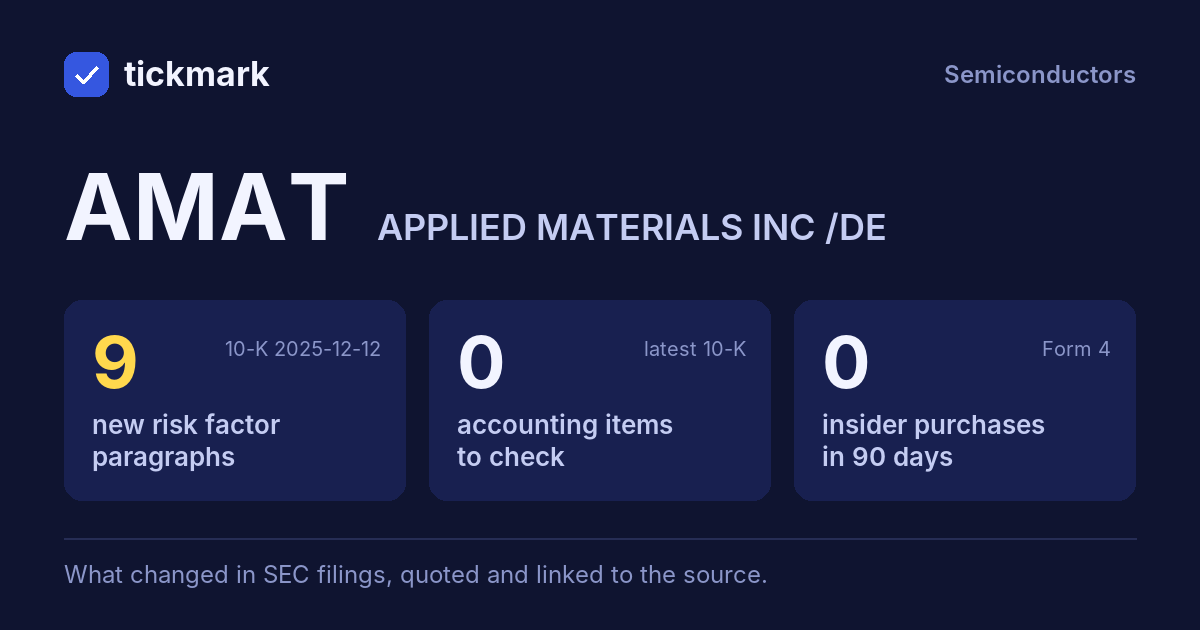
10-K 0001628280-25-056742 (2025-12-12) vs 10-K 0000006951-24-000044 (2024-12-13)
| Section | Compared text | Words now | Changed |
|---|
| Risk Factors | Item 1A | 10,278 |
24.0% |
| MD&A | Item 7 | 6,170 |
26.1% |
| Legal Proceedings | Item 3 | 488 |
0.8% |
| Accounting Policies | Item 8 (note not found) | 0 |
not compared |
The redline: what was cut and what was added
In each section, the paragraph that changed most, marked against last year's 10-K:
cut words struck through, new words highlighted and underlined.
Risk Factors 272 words changed in this paragraph; it is 79% similar to last year's version.
In the conduct of our business, we collect, use, transmit, store and otherwise process data using information technology systems, including systems owned and maintained by us or our third-party providers. These data include confidential information and intellectual property belonging to us or our customers or other business partners, and personal information of individuals. All information technology systems are subject to disruptions, outages, failures and security breaches or incidents, which may be caused by a variety of internal and external factors. We and our third-party providers have experienced, and expect to continue to experience, cybersecurity incidents. Cybersecurity incidents may range from physical attacks on our computer system or network infrastructure, to employee or contractor error or misuse or unauthorized use of information technology systems or confidential information, to individual attempts to gain unauthorized access to these information systems, to sophisticated cybersecurity attacks, or advanced persistent threats, any of which may target or impact us directly or indirectly through our third-party providers and global supply chain. Threat actors may also attempt to influence employees, suppliers and other third-party providers, or customers to disclose sensitive information in order to gain access to our, our customers’ or business partners’ data. Cybersecurity attacks are increasing in number and the attackers are increasingly organized and well-financed, or at times supported by state actors. Geopolitical tensions or conflicts, such as Russia’s invasion of Ukraine and increasing Ukraine, tension with China, China and conflict in the Middle East may create a heightened risk of cybersecurity attacks. To the extent artificial intelligence capabilities improve and are increasingly adopted The techniques used by threat actors, they may be used actors to identify vulnerabilities and craft cybersecurity attacks change frequently and may increasingly sophisticated cybersecurity attacks. Artificial intelligence involve the use of new technologies, including AI and quantum computing. AI and deepfake technologies could be used to attack information systems by creating more effective phishing emails or social engineering and by exploiting vulnerabilities in electronic security programs utilizing false image or voice recognition. Vulnerabilities, technical errors and other risks may be introduced through the use of artificial intelligence AI by us, our customers, suppliers and other business partners and third-party providers, or through the use of third-party hardware and software. Advances in quantum computing have the potential to undermine current encryption standards and may allow threat actors to circumvent existing protective measures. Although we are not aware of any cybersecurity incidents impacting our information systems that have been determined to have a material impact on us to date, we continue to devote significant resources to network security, data encryption, encryption and other measures to protect our systems and data from unauthorized access or misuse, and we may be required to expend greater resources in the future, especially in the face of evolving and increasingly sophisticated cybersecurity threats and laws, regulations, and other actual and asserted obligations to which we are or may become subject relating to privacy, data protection, and cybersecurity. future. We may be unable to anticipate, prevent, prevent or remediate future attacks, vulnerabilities, breaches, or incidents, and in some instances instances, we may be unaware of vulnerabilities or cybersecurity breaches or incidents or their magnitude and effects, particularly as attackers are increasingly able to circumvent controls and remove forensic evidence. Cybersecurity incidents, including cybersecurity incidents on third-party provider networks, may result in business disruption; delay in the development and delivery of our products; disruption of our manufacturing processes, internal communications, interactions with customers and suppliers and processing and reporting financial results; the theft or misappropriation of intellectual property; corruption, loss of, or inability to access (e.g., through ransomware or denial of service) confidential information and critical data (i.e., that of our company and our third-party providers and customers); reputational damage; private claims, demands, and litigation or regulatory investigations, enforcement actions, or other proceedings related to contractual or regulatory privacy, cybersecurity, data protection, protection or other confidentiality obligations; diminution in the value of our investment in research, development and engineering; and increased costs associated with the implementation of cybersecurity measures to detect, deter, protect against, against and recover from such these incidents. Our efforts to comply with, with and changes to, to laws, regulations, regulations and contractual and other actual and asserted obligations concerning privacy, cybersecurity, cybersecurity and data protection, including developing restrictions on cross-border data transfer and data localization, could result in significant expense, and any actual or alleged failure to comply could result in inquiries, investigations, investigations and other proceedings against us by regulatory authorities or other third parties. Customers and third-party providers increasingly demand rigorous contractual provisions regarding privacy, cybersecurity, data protection, confidentiality, confidentiality and intellectual property, which may increase our overall compliance burden.
Source: Item 1A, 10-K 0001628280-25-056742 vs Item 1A, 10-K 0000006951-24-000044
MD&A 178 words changed in this paragraph; it is 30% similar to last year's version.
Disaggregation Measurement of Income Statements Expenses. Credit Losses for Accounts Receivable and Contract Assets. In November 2024, July 2025, the Financial Accounting Standards Board (FASB) FASB issued an accounting standard update to improve income statement expenses disclosures (Subtopic 220-40). provide a practical expedient that simplifies the calculation of expected credit losses (Topic 326). The standard requires more detailed information related practical expedient allows an entity to assume that current conditions as of the types balance sheet date do not change for the remaining life of expenses, including (among other items) the amounts asset, therefore, an entity will no longer need to develop reasonable and supportable forecasts of purchases of inventory, employee compensation, depreciation and intangible asset amortization included within each interim and annual income statement’s expense caption, as applicable. future economic conditions. This authoritative guidance can be applied prospectively or retrospectively and will be effective for us in beginning with our interim and annual reporting for fiscal 2028 for annual periods and in the first quarter of fiscal 2029 for interim periods, year 2027, with early adoption permitted. We are evaluating the effect of Although this guidance will simplify our process of calculating expected credit losses on accounts receivable and contract assets, we do not expect this guidance to materially impact our consolidated financial statements and or related disclosures.
Source: Item 7, 10-K 0001628280-25-056742 vs Item 7, 10-K 0000006951-24-000044
Legal Proceedings 5 words changed in this paragraph; it is 94% similar to last year's version.
The information set forth under “Legal Matters” in Note 13 14 of Notes to Consolidated Financial Statements is incorporated herein by reference. See also “Risk Factors – Risks Related to Legal, Compliance, Compliance and Other Risks – We are exposed to risks related to legal proceedings, claims and investigations.”
Source: Item 3, 10-K 0001628280-25-056742 vs Item 3, 10-K 0000006951-24-000044
Every change, by type
Sentences and paragraphs of AMAT's Risk Factors and MD&A, 10-K 2025-12-12 against 10-K 2024-12-13.
Each links to the text at sec.gov.
Quiet changes are sentences kept from last year with one to four words changed, at least one of them a hedge, a modal or a qualifier
(may, could, will, not, significant, material…). A year or date rolling forward is not counted.
The full word list
adverse, adversely, all, although, anticipate, anticipates, any, approximately, believe, believes, can, cannot, certain, could, expect, expects, generally, however, if, intend, intends, largely, likely, many, material, materially, may, might, most, must, never, no, not, possible, primarily, probable, should, significant, significantly, some, substantial, substantially, unlikely, will, would
AddedRisk Factors
on personnel travel and in shipping materials or products; our ability to develop relationships with local customers, suppliers and governments; performance of our geographically diverse third-party providers; impacts of regional or global health epidemics, natural disasters and extreme and chronic weather events; fluctuations in interest rates and currency exchange rates; as well as other factors discussed in this Risk Factors section. Any of these factors may have an adverse impact on our business and manufacturing operations or demand for our products and services, and our performance and results of operations may be adversely affected.
Read it in 10-K 2025-12-12 at sec.gov ↗
AddedRisk Factors
Our business, financial condition and results of operations may be adversely affected by uncertainty and changes in trade policies, including tariffs, and trade disputes between the United States and other countries. The United States has announced changes to its trade policy, including increased tariffs on imports. These actions have caused substantial uncertainty and have resulted in retaliatory measures, including new tariffs on U.S. goods imposed by China and other countries. Some of these actions have been followed by announcements of limited exemptions and temporary pauses and trade frameworks with certain countries.
Read it in 10-K 2025-12-12 at sec.gov ↗
AddedRisk Factors
A significant number of our customers and suppliers are located outside of the United States. Increases in tariffs increase our costs and can negatively impact our margins and reduce the competitiveness of our products due to the increase in the cost of importing materials, parts and components used in manufacturing our products. Tariffs can also increase supply chain complexity and may make it more difficult to purchase necessary equipment and supplies to manufacture our products. Increases in tariffs, including reciprocal and sector-based tariffs, also increase the cost to our customers of importing our products, which could harm customer demand for our products. Uncertainty or volatility with respect to tariffs and trade disputes may also make it difficult for us and our customers and suppliers to make and execute business and capital equipment investment plans; lead to global or regional inflation and economic recession and reduce demand for semiconductor chips and electronic devices; cause our customers to delay or cancel orders or negatively impact our competitive position; impede our ability to purchase materials, including critical materials and minerals, and disrupt supply chain and logistics. For example, in 2025 the Chinese government implemented export controls on the export of rare earth minerals that are used in certain of our products and may implement additional controls in the future. We may take actions to mitigate the impact of increases in tariffs and changes in trade policies, but there can be no assurance that we will be successful, and any such actions could result in additional costs, manufacturing delays or other difficulties, as well as additional risks, and may not be effective. Any or all of these factors may have a material and adverse impact on our business, financial condition and results of operations.
Read it in 10-K 2025-12-12 at sec.gov ↗
AddedRisk Factors
performance becoming significantly dependent on quarter-end production and delivery schedules.
Read it in 10-K 2025-12-12 at sec.gov ↗
AddedRisk Factors
•impacts of natural disasters, extreme and chronic weather events, regional or global health epidemics, or other events beyond our control.
Read it in 10-K 2025-12-12 at sec.gov ↗
AddedRisk Factors
Any of these events impacting our supply chain could affect our ability to meet our customers’ demand, result in higher costs to us and have an adverse effect on customer relationships and our business, financial condition and results of operations.
Read it in 10-K 2025-12-12 at sec.gov ↗
AddedRisk Factors
•improve the productivity of capital invested in research and development activities;
Read it in 10-K 2025-12-12 at sec.gov ↗
AddedRisk Factors
could have an adverse impact on our competitive position and business. Changes in intellectual property laws or their interpretation may impact our ability to protect and assert our intellectual property rights, increase costs and uncertainties in the prosecution of patent applications or related enforcement actions and diminish the value and competitive advantage conferred by our intellectual property assets.
Read it in 10-K 2025-12-12 at sec.gov ↗
AddedRisk Factors
As of October 26, 2025, we had $6.5 billion in aggregate principal amount of senior unsecured notes outstanding. Under the indenture governing the senior unsecured notes, we may be required to offer to repurchase the notes at a price equal to
Read it in 10-K 2025-12-12 at sec.gov ↗
RemovedRisk Factors
Uncertain or adverse economic and market conditions, difficulties in obtaining capital, increased costs or reduced profitability may cause some customers to scale back operations, exit businesses, merge with other manufacturers, or file for bankruptcy protection and potentially cease operations, which can result in lower sales, additional inventory or bad debt expense. Economic and industry uncertainty may impair the ability of suppliers to deliver parts and negatively affect our ability to manage operations and deliver products. These conditions may also lead to consolidation or strategic alliances among other equipment manufacturers, which could adversely affect our ability to compete effectively.
Read it in 10-K 2024-12-13 at sec.gov ↗
RemovedRisk Factors
•uncertain or adverse global economic, political and business conditions and demand;
Read it in 10-K 2024-12-13 at sec.gov ↗
RemovedRisk Factors
•positions taken by governmental agencies regarding national, commercial or security issues posed by the development, sale or export of certain products, technologies and raw materials, including critical materials and critical minerals;
Read it in 10-K 2024-12-13 at sec.gov ↗
RemovedRisk Factors
•political and social attitudes, laws, rules, regulations and policies within countries, including in China, the United States, and countries in Europe and Asia, that favor domestic companies over non-domestic companies, including efforts to promote the development and growth of local competitors and reduce dependence on foreign semiconductor equipment and manufacturing capabilities through policies and financial incentives;
Read it in 10-K 2024-12-13 at sec.gov ↗
RemovedRisk Factors
•efforts to influence us to conduct more or less of our operations and sourcing in a particular country;
Read it in 10-K 2024-12-13 at sec.gov ↗
RemovedRisk Factors
•different and changing local, regional, national or international laws and regulations, including contract, intellectual property, cybersecurity, data privacy, labor, tax, and import/export laws, and the interpretation and application of laws and regulations;
Read it in 10-K 2024-12-13 at sec.gov ↗
RemovedRisk Factors
•ineffective or inadequate legal protection of intellectual property rights in certain countries;
Read it in 10-K 2024-12-13 at sec.gov ↗
RemovedRisk Factors
•the availability of raw materials, including critical materials and critical minerals, and increases and volatility of commodity, energy and shipping costs;
Read it in 10-K 2024-12-13 at sec.gov ↗
RemovedRisk Factors
•delays or restrictions on personnel travel and in shipping materials or products;
Read it in 10-K 2024-12-13 at sec.gov ↗
RemovedRisk Factors
•geographically diverse operations and projects, and our ability to maintain appropriate business processes, procedures and internal controls, and comply with environmental, health and safety, anti-corruption and other regulatory requirements;
Read it in 10-K 2024-12-13 at sec.gov ↗
RemovedRisk Factors
•challenges in hiring and integrating workers in different countries, and in effectively managing a diverse workforce with different experience levels, languages, cultures, customs, business practices and worker expectations, and differing employment practices and labor issues;
Read it in 10-K 2024-12-13 at sec.gov ↗
RemovedRisk Factors
•fluctuations in interest rates and currency exchange rates, including the relative strength or weakness of the U.S. dollar against the Japanese yen, Israeli shekel, euro, Taiwanese dollar, Singapore dollar, Chinese yuan or Korean won;
Read it in 10-K 2024-12-13 at sec.gov ↗
RewordedRisk Factors
Factors that impact demand Demand for our products and services include is impacted by technology inflections and advances in fabrication processes, new and emerging technologies and market drivers, such as demand for high-bandwidth memory and other forms of advanced packaging and technologies related to artificial intelligence and data center computing, production capacity relative to demand for semiconductor chips and electronic devices, end-user demand, the timing of customers’ investment in new or expanded fabrication plants, customers’ capacity utilization, production volumes, access to affordable capital, business and consumer buying patterns and general economic and political conditions.
Read it in 10-K 2025-12-12 at sec.gov ↗
RewordedRisk Factors
Transferring If a supplier fails to meet our requirements concerning quality, cost, intellectual property protection or other performance factors, or does not meet regulatory requirements applicable to our supply chain, we may transfer our business to alternative suppliers sources, which could result in manufacturing delays, additional costs or other difficulties, and may impair our ability to protect, enforce and extract the full value of our intellectual property rights, rights and the intellectual property rights of our customers and other third parties.
Read it in 10-K 2025-12-12 at sec.gov ↗
RewordedRisk Factors
Although we are not aware of any cybersecurity incidents impacting our information systems that have been determined to have a material impact on us to date, we continue to devote significant resources to network security, data encryption, encryption and other measures to protect our systems and data from unauthorized access or misuse, and we may be required to expend greater resources in the future, especially in the face of evolving and increasingly sophisticated cybersecurity threats and laws, regulations, and other actual and asserted obligations to which we are or may become subject relating to privacy, data protection, and cybersecurity. future.
Read it in 10-K 2025-12-12 at sec.gov ↗
RewordedRisk Factors
As a result of the global nature of our operations, we are subject to a number of factors that could have an adverse impact on our business performance business, financial condition and results of operations may be adversely affected by a number of factors, including: operations.
Read it in 10-K 2025-12-12 at sec.gov ↗
RewordedRisk Factors
The CISO reports to our Chief Information Officer (“CIO”), Officer, who has more than 30 years of experience in information technology and is responsible for administering secure and scalable security infrastructure. infrastructure and reports to our Chief Digital Officer, each of whom has extensive experience in information technology.
Read it in 10-K 2025-12-12 at sec.gov ↗
RewordedRisk Factors
If customers do not place orders, or they substantially reduce, delay or cancel orders (including as a result of uncertain or adverse economic conditions, our inability to fulfill orders due to export regulations, shortage of parts, transportation capacity/interruptions or any other reason), orders, we may not be able to replace the business, which may have a material and adverse impact on our results of operations and financial condition.
Read it in 10-K 2025-12-12 at sec.gov ↗
RewordedRisk Factors
Uncertain Our business and the industries in which we operate can be impacted by uncertain or adverse economic and business conditions, including uncertainties and volatility in the financial markets, national debt, fiscal or monetary concerns, inflation and changes in interest rates, bank failures, tariffs and trade policies and economic recession, could materially and adversely impact our operating results. recession.
Read it in 10-K 2025-12-12 at sec.gov ↗
RewordedRisk Factors
Violations of these law, rules and regulations, including, among others, those related to financial and other disclosures, trade (including import and export regulations), antitrust, environment, health and safety, privacy, data protection, and anti-corruption, regulations could result in fines, criminal penalties, restrictions on our business, and damage to our reputation, and could have an adverse impact on our business operations, financial condition and results of operations.
Read it in 10-K 2025-12-12 at sec.gov ↗
RewordedRisk Factors
The risks to our Our investment portfolio is subject to general credit, liquidity, market and interest rate risks, which may be exacerbated if financial market conditions deteriorate due to by rising inflation, rising interest rates, bank failures or economic recession and the value and liquidity of the investment our portfolio and returns on pension assets could be negatively impacted and lead to impairment charges.
Read it in 10-K 2025-12-12 at sec.gov ↗
RewordedRisk Factors
For example, several various countries where we do business have enacted or plan to enact new tax laws to implement the global minimum tax regimes based on the Organization for Economic Cooperation and Development (“OECD”) Base Erosion and Profit Shifting Project. Project, and where enacted, the rules began to be effective in fiscal 2025.
Read it in 10-K 2025-12-12 at sec.gov ↗
RewordedRisk Factors
Factors that could lead to impairment of goodwill and intangible assets include adverse industry or economic trends, reduced estimates of future cash flows, declines in the market price of our common stock, changes in our strategies or product portfolio and restructuring activities.
Read it in 10-K 2025-12-12 at sec.gov ↗
RewordedRisk Factors
The semiconductor industry is industries in which we operate are characterized by factors particular to this industry that impact demand for and the profitability of our semiconductor manufacturing equipment products and service products, including: services and our operating results.
Read it in 10-K 2025-12-12 at sec.gov ↗
AddedMD&A
In the fourth quarter of fiscal 2025, we approved a workforce reduction plan (Fiscal 2025 Restructuring Plan) to position us for continued growth as a more competitive and productive organization and expect approximately 4% of our global workforce to be impacted under this plan. In the fourth quarter of fiscal 2025, we recognized $181 million of restructuring charges consisting primarily of severance and other employment termination benefits to be paid in cash, and other non-cash related charges. We expect to complete the plan in fiscal 2026.
Read it in 10-K 2025-12-12 at sec.gov ↗
AddedMD&A
Our effective tax rate for fiscal 2025 was higher than the prior fiscal year primarily due to a $659 million remeasurement of deferred tax assets resulting from new tax incentive agreements in Singapore and the recognition of a $407 million valuation allowance against deferred tax assets related to corporate alternative minimum tax (CAMT) credits. These credits are not expected to be realized as a result of changes in the timing of future tax deductions, following the enactment of the One Big Beautiful Bill Act. No prudent and feasible tax-planning strategies are currently available. The amount of the valuation allowance may be adjusted in future quarters if estimates of future taxable income change.
Read it in 10-K 2025-12-12 at sec.gov ↗
AddedMD&A
Change 2025 2024 2025 over 2024 (In millions, except percentages and ratios) Operating income (loss) Semiconductor Systems $ 7,379 $ 6,981 $ 398 6% Applied Global Services 1,792 1,812 (20) (1)% Corporate and Other (882) (926) 44 5% Total $ 8,289 $ 7,867 $ 422 5% Operating margin Semiconductor Systems 35.5 % 35.1 % 0.4 points Applied Global Services 28.1 % 29.1 % (1.0) points
Read it in 10-K 2025-12-12 at sec.gov ↗
AddedMD&A
AGS’ operating margin for fiscal 2025 decreased compared to the same periods in the prior year primarily due to a decrease in 200mm equipment net revenue, higher expense related to an increase in headcount to support business growth, and higher excess and obsolete inventory charges, partially offset by higher net revenue from services and spares.
Read it in 10-K 2025-12-12 at sec.gov ↗
AddedMD&A
On July 4, 2025, the U.S. government enacted the One Big Beautiful Bill Act (OBBBA). The OBBBA includes a broad range of tax reform provisions including extending and modifying certain key Tax Act provisions and expanding certain Chips Act incentives. These changes include full expensing of domestic research costs, immediate expensing of qualifying property and increasing the investment tax credit for certain investments in domestic semiconductor manufacturing from 25% to 35%. Key tax provisions of the OBBBA are designed to accelerate tax deductions but that may have a detrimental impact on our ability to use certain tax credits. The use of certain tax credits may not be economically viable if it requires electing to forgo significant tax deductions. Most of the provisions are effective beginning in fiscal years 2026 or 2027, with immediate expensing of qualifying property being effective in fiscal 2025. We will continue to evaluate the full impact of these legislative changes as more guidance becomes available.
Read it in 10-K 2025-12-12 at sec.gov ↗
AddedMD&A
Various countries where we do business have enacted or plan to enact new tax laws to implement the global minimum tax regimes based on the Organization for Economic Cooperation and Development Base Erosion and Profit Shifting Project, and where enacted, the rules began to be effective in fiscal 2025. The impact of the currently enacted legislation is not material to our fiscal 2025 financial results. We continue to monitor developments and evaluate impacts, if any, of these rules on our results of operations and cash flows. The adoption and effective dates of these rules vary by country and could increase tax complexity and uncertainty and may adversely affect our provision for income taxes in future years.
Read it in 10-K 2025-12-12 at sec.gov ↗
AddedMD&A
The acceleration of tax deductions for U.S. tax purposes, under the One Big Beautiful Bill Act, limits our ability to use our corporate minimum tax credits. As a result, we have recorded a full valuation allowance against this deferred tax asset. We reviewed potential tax-planning strategies to accelerate income recognition within a reasonable time, but none were prudent and feasible. We will continue to evaluate new strategies as additional One Big Beautiful Bill Act guidance is issued.
Read it in 10-K 2025-12-12 at sec.gov ↗
RemovedMD&A
The Display segment encompasses products for manufacturing liquid crystal and OLED displays, and other display technologies for TVs, monitors, laptops, personal computers (PC), tablets, smart phones, other consumer-oriented devices, equipment upgrades and solar energy cells. The segment is focused on expanding its presence through technologically-differentiated equipment and products that provide customers with improved performance and yields. Display segment growth depends primarily on consumer demand for increasingly larger and more advanced TVs and high-resolution displays for mobile devices and information technology (IT) products, including laptops, monitors and tablets, as well as new form factors, including thin, light, curved and flexible displays, and new applications such as augmented and virtual reality. The timing of customer investment in manufacturing equipment is also affected by the timing of next-generation process development and of capacity expansion to meet end-market demand.
Read it in 10-K 2024-12-13 at sec.gov ↗
RemovedMD&A
Our effective tax rate for fiscal 2024 was higher than the prior fiscal year primarily due to lower tax credits in fiscal 2024, partially offset by higher proportion of pre-tax income in lower tax jurisdictions in fiscal 2024.
Read it in 10-K 2024-12-13 at sec.gov ↗
RemovedMD&A
Display’s operating margin for fiscal 2024 decreased primarily due to unfavorable changes in product mix.
Read it in 10-K 2024-12-13 at sec.gov ↗
RemovedMD&A
Fair Value Measurement of Equity Securities Subject to Contractual Sale Restrictions. In June 2022, the FASB issued an accounting standard update which clarifies how the fair value of equity securities subject to contractual sale restrictions is determined (Topic 820). The amendment clarifies that a contractual sale restriction should not be considered in measuring fair value. It also requires certain qualitative and quantitative disclosures related to equity securities subject to contractual sale restrictions. We will adopt this guidance in the first quarter of fiscal 2025. The adoption of this guidance is not expected to have a significant impact on our consolidated financial statements.
Read it in 10-K 2024-12-13 at sec.gov ↗
RemovedMD&A
On August 16, 2022, the U.S. government enacted the Inflation Reduction Act. The Inflation Reduction Act introduced a new 15% corporate minimum tax, based on adjusted financial statement income of certain large corporations. Applicable corporations are allowed to claim a credit for the minimum tax paid against regular tax in future years. We are subject to the minimum tax in fiscal 2024 and expect to claim a credit for the minimum tax in future years.
Read it in 10-K 2024-12-13 at sec.gov ↗
RemovedMD&A
Several countries where we do business have enacted global minimum tax regimes based on the Organization for Economic Cooperation and Development (“OECD”) Base Erosion and Profit Shifting Project. This will change various aspects of the existing framework under which our global tax obligations are determined and is expected to increase our tax liabilities beginning in fiscal 2025. The OECD continues to release additional guidance on this new global minimum tax framework. We will continue to monitor these developments, as each jurisdiction incorporates changes into its tax laws.
Read it in 10-K 2024-12-13 at sec.gov ↗
RewordedMD&A
We used $4.5 $6.0 billion of cash in financing activities in fiscal 2024, 2025, consisting primarily of repurchases of common stock of $3.8 $4.9 billion, cash dividends to stockholders of $1.2 $1.4 billion, repayment of $700 million senior notes and tax withholding payments for vested equity awards of $291 million, and net payments of principal on financing leases of $102 $248 million, partially offset by net proceeds received from the issuance of senior unsecured notes of $694 $991 million and proceeds received from common stock issuances under our employee stock purchase plan of $243 $261 million.
Read it in 10-K 2025-12-12 at sec.gov ↗
RewordedMD&A
The year-over-year change in RD&E expenses was primarily due to additional headcount to support our ongoing investments in product development initiatives, initiatives and higher depreciation expenses, consistent with our growth strategy, offset by lower depreciation expense as a result of changes in certain assets’ useful lives effective as of the beginning of fiscal 2024. strategy.
Read it in 10-K 2025-12-12 at sec.gov ↗
RewordedMD&A
For a description of these risks, see the risk factor factors entitled “Business and Industry Risks - Global trade issues and changes in and uncertainties with respect to trade policies and export regulations, including import and export license requirements, trade sanctions, tariffs and international trade disputes, have adversely impacted and could further adversely impact our business and operations, and reduce the competitiveness of our products and services relative to local and global competitors” and “Business and Industry Risks - We are exposed to risks and uncertainty related to changes in trade policies, and increased tariffs and trade disputes ” in Part I, Item 1A, “Risk Factors.”
Read it in 10-K 2025-12-12 at sec.gov ↗
RewordedMD&A
We have credit facilities for unsecured borrowings in various currencies of up to $1.6 billion, an aggregate amount of which $1.5 billion is comprised of a committed revolving credit agreement (Revolving Credit Agreement) with a group of banks. $4.1 billion.
Read it in 10-K 2025-12-12 at sec.gov ↗
RewordedMD&A
In June 2024, September 2025, we issued $700 $550 million in aggregate principal amount of 4.800% 4.000% senior unsecured notes due 2029 2031 and $450 million in aggregate principal amount of 4.600% senior unsecured notes due 2036, in a registered public offering.
Read it in 10-K 2025-12-12 at sec.gov ↗
RewordedMD&A
In addition, we do not allocate to our reportable segments severance, charges associated with restructuring actions, such as employee severance costs and asset impairment and any associated charges related to charges, unless the restructuring actions, unless these actions pertain to a specific reportable segment.
Read it in 10-K 2025-12-12 at sec.gov ↗
RewordedMD&A
Change 2025 2024 2023 2025 over 2024 over 2023 (In millions) Research, development and engineering (RD&E) $3,570 $3,233 $3,102 $131 $337 Marketing and selling $858 $836 $776 $60 $22 General and administrative (G&A) $910 $961 $852 $109 $(51) Restructuring charges $181 $— $181
Read it in 10-K 2025-12-12 at sec.gov ↗
RewordedMD&A
Deferred tax assets and liabilities are recognized for the estimated future tax effects of events that have been recognized in our financial statements or temporary differences between the book and tax returns. bases of assets and liabilities.
Read it in 10-K 2025-12-12 at sec.gov ↗
RewordedMD&A
Our AGS net revenue in fiscal 2024 2025 increased compared to the prior year primarily due to an increase in net revenue associated with higher customer spending on long-term service agreements and customer spending on spares, partially offset by lower customer spending on 200mm equipment.
Read it in 10-K 2025-12-12 at sec.gov ↗
RewordedMD&A
Discussions of 2023 2024 items and year-to-year comparisons between 2024 and 2023 and 2022 that are not included in this Form 10-K can be found in "Management's “Management's Discussion and Analysis of Financial Condition and Results of Operations" Operations” in Part II, Item 7 of our Annual Report on Form 10-K for the fiscal year ended October 29, 2023, 27, 2024, filed on December 15, 2023. 13, 2024.
Read it in 10-K 2025-12-12 at sec.gov ↗
RewordedMD&A
Foundry and logic customers’ spending decreased in fiscal 2025 increased driven primarily by lower higher customer investments in leading-edge manufacturing technologies, partially offset by increased customer investments in non-leading edge manufacturing technologies.
Read it in 10-K 2025-12-12 at sec.gov ↗
RewordedMD&A
We continued to prioritize existing RD&E investments in technical capabilities and critical RD&E programs in current and new markets, with a focus on the development of new unit process systems and integrated materials solutions. markets.
Read it in 10-K 2025-12-12 at sec.gov ↗