tickdelta
Sign in

Tickdelta is free for now. Sign up and get Pro free

← Screener

AMATApplied Materials

Technology · Semiconductors · Nasdaq

Applied Materials, Inc. is the leader in the materials engineering solutions used to produce virtually every semiconductor in the world. 10-K, Item 1

Headquarters
Santa Clara, CA
CEO
Gary E. Dickerson
Next results
around Nov 12, 2026
Compare with peers → Embed

When the SEC's staff reviews a filing, it writes to the company with numbered questions, and the company answers each one in a letter. SEC publishes the exchange once the review is over, at least 20 business days later. Below: what the staff asked AMAT, and the company's answer to each question, quoted from the letters. A question is not an accusation; most reviews end with the company adding detail to its next filing.

Form 10-K for the fiscal year ended October 27, 2019

2020-01-24 to 2020-02-13 · 2 questions · 1 letter from the SEC, 1 from the company
Review closed 2020-02-13
SegmentsRevenue
Financial Statements · Consolidated Statements of Operations, page 61
SEC asked (1)
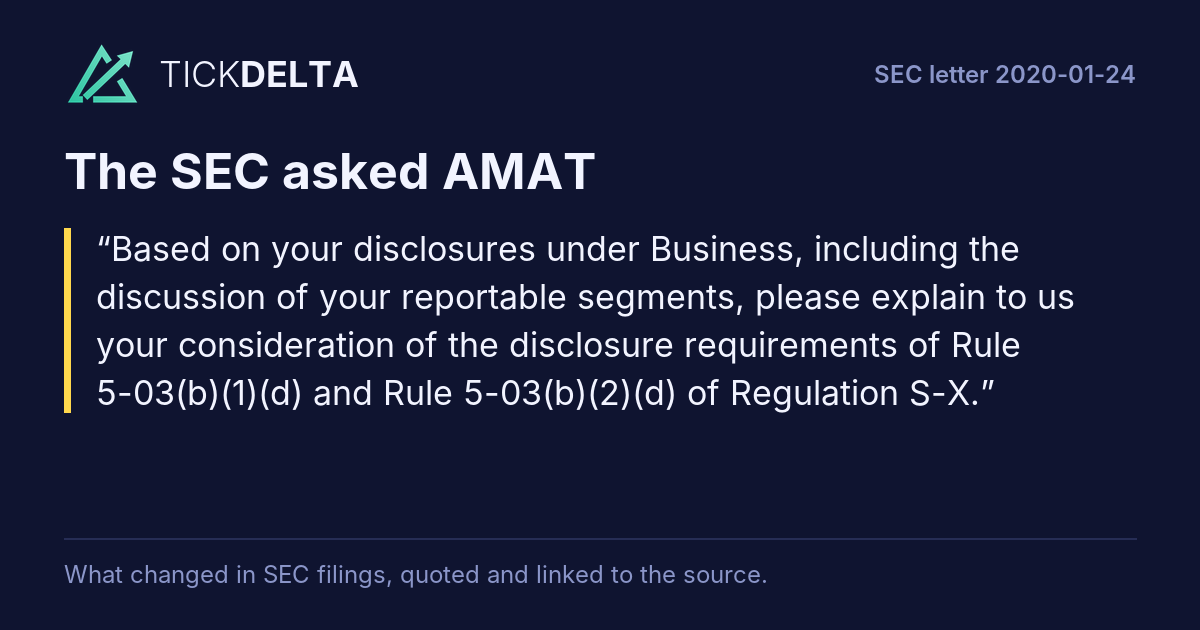
Based on your disclosures under Business, including the discussion of your reportable segments, please explain to us your consideration of the disclosure requirements of Rule 5-03(b)(1)(d) and Rule 5-03(b)(2)(d) of Regulation S-X.
AMAT answered
Applied operates in three reportable segments. Semiconductor Systems and Display and Adjacent Markets segments derive revenue from the sale of tangible products, including semiconductor capital equipment, products for manufacturing liquid crystal displays (LCDs), organic light-emitting diodes (OLEDs), and other display technologies. Applied Global Services segment derives revenue from the sale of tangible products such as spare parts, capital equipment upgrades, remanufactured earlier generation equipment and software, as well as from services such as equipment service agreements.
Rest of the answer

For the fiscal year ended October 27, 2019, the majority of Applied Global Services segment revenue came from the sale of tangible products.

In considering Rule 5-03(b)(1)(d) and Rule 5-03(b)(2)(d) of Regulation S-X we review the revenue derived from the relevant sub captions described under Rule 5-03(b) and assess if any of those revenue streams represents more than 10% of our total revenue. For the fiscal year ended October 27, 2019, we concluded that our total revenue from services as defined in Regulation S-X is less than 10% of the revenue line item within the Statements of Operations. Therefore, in accordance with Rule 5-03(b), service revenue and cost of services have not been separately disclosed on the face of the Statements of Operations. We will continue to assess the percentage attributable to the different revenue streams on a quarterly basis for the purposes of considering Rule 5-03(b)(1)(d) and Rule 5-03(b)(2)(d) of Regulation S-X, and to the extent the percentage of service revenue exceeds 10% of total revenue in the future, we will modify the presentation.

Read in the reply ↗
In its next report

First report after the company's reply of 2020-02-07: 10-Q filed 2020-02-20 ↗, against the 10-Q filed 2019-08-22 ↗.

Tickdelta does not hold the text of both reports, so they are not compared here.
Note 1 Summary of Significant Accounting Policies, page 66
SEC asked (2)
In regard to your adoption of ASC 606, please address the following: • We note your disclosure under identifying the performance obligations that service agreements are one performance obligation. Please more fully explain the nature of the products and services transferred in these agreements and provide us your analysis regarding how you determined that the products and services in these agreements should be
Rest of the question

combined. Refer to ASC 606-10-25-19 through 22. • We note your disclosures under payment terms that “terms vary by contract”, “generally, the majority of payments are due within a certain number of days from shipment of goods or performance of service”, and “the remainder is typically due upon customer technical acceptance”. Based on your other disclosures, it is not clear if or how customer acceptance provisions impact when you recognize revenue. Please explain the nature of these customer acceptance provisions and how you considered if and how they affect your determination of when your customer obtains control of products or services. Refer to ASC 606-10-25-30(e) and ASC 606-10-5586 and 55-87. • Please explain your consideration of providing disaggregated disclosures for revenue recognized at a point in time and over time based on the provisions of ASC 606-1050-5 and ASC 606-10-55-89 through 55-91.

AMAT answered
Applied’s service agreements for which revenue is recognized over time are contracts entered into with customers to deliver service against an agreed upon key performance metric during the term of the contract, such as a commitment to achieve a specified throughput from a customer’s manufacturing tool, or to achieve a limited defect rate of silicon wafers processed through a customer’s manufacturing tool.
Rest of the answer

In order to meet the key performance metric Applied performs, at its discretion, various activities, such as tool maintenance, diagnostics, and engineering solutions to improve the performance of the manufacturing tools.

In accordance with ASC 606-10-25-19, Applied considered whether these activities were distinct goods and services that the customer could benefit from on its own and whether the promise to transfer the goods or services to the customer is separately identifiable from other promises in the contract. Applied concluded that the nature of the promise is to provide an integrated set of highly interdependent activities described above that are combined to achieve the contractually defined performance level of a customer’s tool and the individual activities conducted by Applied would not enable the customer to obtain the intended benefit from the contract unless those activities are combined. As such, these activities are not distinct performance obligations within the context of the contract and are instead combined into a single stand-ready performance obligation, consistent with ASC 606-10-10-21(c) and 22.

•We note your disclosures under payment terms that “terms vary by contract”, “generally, the majority of payments are due within a certain number of days from shipment of goods or performance of service”, and “the remainder is typically due upon customer technical acceptance”. Based on your other disclosures, it is not clear if or how customer acceptance provisions impact when you recognize revenue. Please explain the nature of these customer acceptance provisions and how you considered if and how they affect your determination of when your customer obtains control of products or services. Refer to ASC 606-10-25-30(e) and ASC 606-10-55-86 and 55-87.

In accordance with ASC 606-10-25-30, Applied considers various indicators when assessing transfer of control, including but not limited to, whether

•Applied has a right to payment;

•Applied has transferred physical possession of the asset;

•the customer has legal title to the asset;

•the customer has the significant risks and rewards of ownership of the asset; and

•the customer has accepted the asset.

For goods or services delivered to a customer with agreed-upon specifications where the specifications have previously been delivered and accepted by the customer, or have been demonstrated based on repeatable data obtained from the customer and/or Applied’s test labs, Applied typically considers the technical acceptance a formality that does not affect the determination of when the customer has obtained control of the good or service. Where Applied does not have prior experience of meeting agreed-upon specifications (for example, in cases of a new product with no history of meeting customer specifications), technical acceptance is considered a requirement before we conclude that the customer has obtained control, as described in ASC 606-10-55-87, and revenue is recognized. The majority of goods and services provided by Applied to its customers involve situations where Applied has prior experience of meeting agreed-upon specifications in a contract as described in ASC 606-10-55-86, and therefore Applied generally recognizes revenue upon delivery, rather than upon customer’s technical acceptance, of a good or service based on its experience with contracts for similar goods or services as outlined above.

•Please explain your consideration of providing disaggregated disclosures for revenue recognized at a point in time and over time based on the provisions of ASC 606-10-50-5 and ASC 606-10-55-89 through 55-91.

In consideration of providing disaggregated disclosures for revenue recognized at a point in time and over time based on the provisions of ASC 606-10-50-5 and ASC 606-10-55-89 through 55-91, Applied evaluated the timing of transfer of goods and services to customers for each of its three reportable segments. Revenue reported by the Semiconductor Systems and Display and Adjacent Markets segments is primarily derived from the sale of equipment and recognized at a point in time. Revenue reported by the Applied Global Services segment is derived from both the sale of tangible products such as spare parts for customers’ equipment or refurbished equipment, which is recognized at a point in time, and from service agreements, which is recognized over time. Although service agreements are typically entered into for a period of 12 months, the vast majority of those contracts are deemed to have a shorter term under ASC 606-10-25-4, with binding contractual terms not exceeding three months. We considered the guidance of ASC 606-10-55-90 and 55-91 and concluded that, because of the short-term nature of the service contracts and the fact that less than 10% of Applied’s revenue is derived from service contracts, further disaggregation of revenue based on the timing of transfer of goods and service did not provide useful information to the users of the financial statements about how the nature, amount, timing, and uncertainty of revenue and cash flows are affected by economic factors. We acknowledge that the provisions of ASC606-10-55-91(f) provide timing of transfer of goods or services as an example of a category of revenue disaggregation that may be considered and, in response to the staff’s comments, will include in future filings, beginning with the Form10-Q for the fiscal quarter ending January 26, 2020, the following additional disclosure:

Semiconductor Systems and Display and Adjacent Markets revenues are recognized at a point in time. Applied Global Services revenue is recognized at a point in time for tangible goods such as spare parts and equipment, and over time for service agreements. The majority of revenue recognized over time is recognized within 12 months of the contract inception.

****

Should you require additional information with respect to this response, or wish to discuss it further, please contact me at (408) 563 5656.

Read in the reply ↗
In its next report

First report after the company's reply of 2020-02-07: 10-Q filed 2020-02-20 ↗, against the 10-Q filed 2019-08-22 ↗.

Tickdelta does not hold the text of both reports, so they are not compared here.

Also in this review: closing letter, 2020-02-13
Form S-4

2014-03-19 to 2014-03-19 · 33 questions · 1 letter from the SEC, 0 from the company
No closing letter
AcquisitionsRevenueResults discussion (MD&A)Risk factorsDebtSegmentsLiquidity and cashGoodwill and impairmentCritical estimatesInventoryIncome taxes
SEC letter of 2014-03-19 ↗ no reply letter on EDGAR (the company may have answered in an amended filing)
Letter to Stockholders of Applied Materials
SEC asked (1)
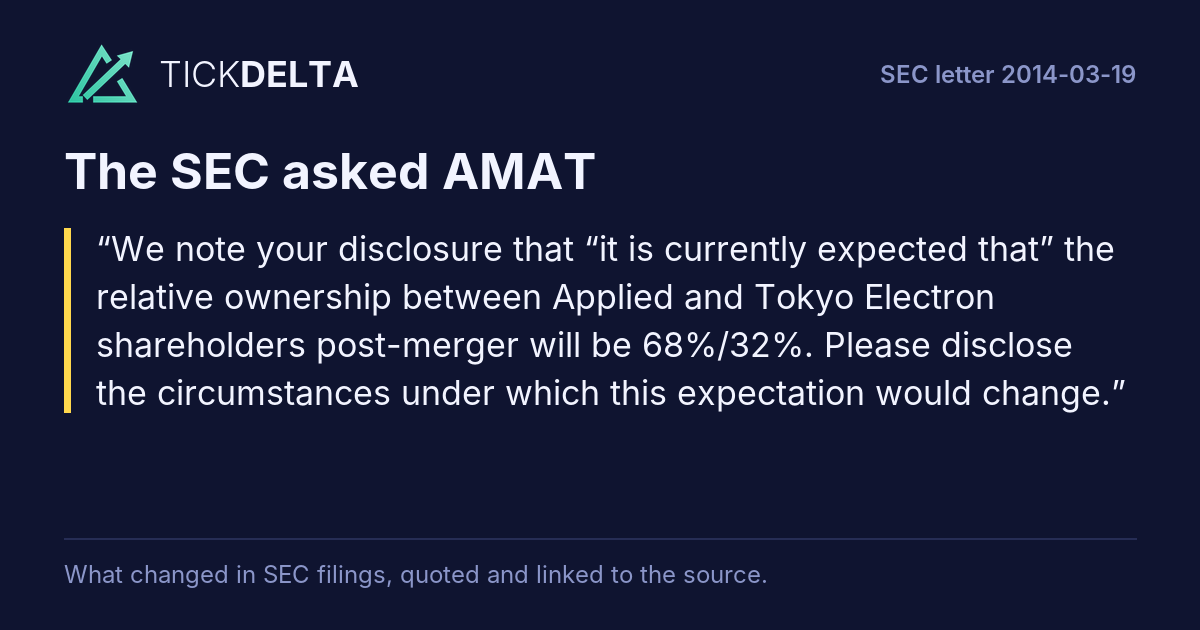
We note your disclosure that “it is currently expected that” the relative ownership between Applied and Tokyo Electron shareholders post-merger will be 68%/32%. Please disclose the circumstances under which this expectation would change.
AMAT answered

No reply letter found.

What are the specific proposals on which I am being asked to vote, page 1
SEC asked (2)
Please present as separate proposals the adoption of the Business Combination Agreement and each provision of the HoldCo governing instruments that will differ from the provisions in Applied’s charter and bylaws, or advise.
Rest of the question

For guidance, please refer to the September 2004 Interim Supplement to Publicly Available Telephone Interpretations (Regarding Unbundling under Rule 14a-4(a)(3) in the M&A Context), available on the Commission’s website.

AMAT answered

No reply letter found.

Comparative Per Share Information for Applied and TEL, page 21
SEC asked (3)
Please revise your calculation of the equivalent price per share of TEL common stock in U.S. dollars to reflect the U.S. dollar equivalent as of September 23, 2013, of ¥ 4,850, the trading price of TEL common stock on that day. It is unclear why you have calculated this value by reference to the trading price of Applied common stock on September 23, 2013. Similarly revise the table on page 161.
AMAT answered

No reply letter found.

The National Tax Agency of Japan may not agree, page 30
SEC asked (4)
To the extent known, please quantify the additional taxes referenced in the first bullet point of this risk factor.
AMAT answered

No reply letter found.

Background of the Business Combination, page 61
SEC asked (5)
Describe in greater detail the negotiation during the meetings on August 24, 2013 and September 23, 2013 to provide shareholders with an understanding of how, when and why these terms of the proposed transaction evolved. For instance, with respect to the exchange ratios and ownership percentages, explain how each was determined and which party or parties proposed the final figures.
AMAT answered

No reply letter found.

Background of the Business Combination, page 61
SEC asked (6)
We note your disclosure in the first full paragraph on page 63 that the Investment Committee “considered potential merger-and-acquisition opportunities.” Please describe any such opportunities in more detail and discuss why you ultimately decided not to pursue them.
AMAT answered

No reply letter found.

Background of the Business Combination, page 61
SEC asked (7)
Please also revise to describe the material terms of the proposals made on August 20, 2013 through August 26, 2013.
AMAT answered

No reply letter found.

Background of the Business Combination, page 61
SEC asked (8)
We note your reference on page 67 to an analysis presented by Goldman Sachs on September 21, 2013. Please provide all disclosure required by Item 4(b) of Form S-4 for this presentation, including the summary required by Item 1015(b)(6) of Regulation M-A.
AMAT answered

No reply letter found.

Summary of Certain Financial Projections Reviewed by the Applied Board, page 78
SEC asked (9)
Please expand your disclosure to describe how Applied’s management adjusted the projections provided by TEL management about TEL and explain why the Appliedprepared projections were used instead of the TEL-prepared projections.
AMAT answered

No reply letter found.

Opinion of Applied’s Financial Advisor, page 80
SEC asked (10)
Please provide us with copies of the materials prepared by Goldman Sachs and Morgan Stanley in connection with their fairness opinions, including, among other things, any “board books,” drafts of fairness opinions, and any summaries of presentations made to the boards.
AMAT answered

No reply letter found.

Opinion of Applied’s Financial Advisor, page 80
SEC asked (11)
Please revise to discuss the meaning and significance of each analysis performed by Goldman Sachs. Clarify how, based on the specific terms of this transaction, the conclusions drawn support the conclusion that the exchange ratio is fair to the holders of Applied common stock.
AMAT answered

No reply letter found.

Illustrative Financial Contribution Analysis, page 87
SEC asked (12)
Revise to clarify how Goldman Sachs determined the valuation multiples used in this analysis to calculate the implied equity contribution.
AMAT answered

No reply letter found.

The Business Combination Agreement, page 114
SEC asked (13)
We note your disclosure that the “representations, warranties and covenants [made in the Business Combination Agreement] were made only for the purposes of the Business Combination Agreement” and that “no person should rely on the representations and warranties.” Because the description and the full agreement now appear in a disclosure document, please confirm that you have no additional information that would call
Rest of the question

into question the accuracy of the information contained in your disclosure.

AMAT answered

No reply letter found.

Notes to Unaudited Pro Forma Condensed Combined Financial Statements, page 155 · Note 1. Description of Transaction and Basis of Presentation, page 155
SEC asked (14)
We reference the statement that HoldCo, Applied and TEL have different fiscal yearends. Please revise to clarify the year end that will continue for the combined company.
AMAT answered

No reply letter found.

Note 3. Preliminary Purchase Price Allocation, page 156
SEC asked (15)
We see that you preliminarily allocated $1.4 billion of the purchase price to developed technology. Please revise to provide a brief discussion of the nature of the developed technology.
AMAT answered

No reply letter found.

Note 4. Pro Forma Adjustments, page 158
SEC asked (16)
Please revise to disclose how you determined the preliminary fair value of the noncontrolling interest of Tokyo Electron Device Limited of $70 million in Note (i).
AMAT answered

No reply letter found.

Management’s Discussion and Analysis, page 190 · Segment Information, page 200
SEC asked (17)
We note that you present segment profit (loss) for each segment but you do not provide any analysis of the changes in segment profit (loss) for each period. Please tell us why you do not believe that a discussion of segment profit (loss) would enhance an investor’s understanding of your financial performance.
AMAT answered

No reply letter found.

Financial Position, Liquidity and Capital Resources, page 208 · Contractual Obligations, page 211
SEC asked (18)
Please tell us why you did not include short term borrowings of $8.9 billion Japanese yen within the presentation of contractual obligations.
AMAT answered

No reply letter found.

Critical Accounting Policies, page 212
SEC asked (19)
Please tell us why you do not include inventory valuation as a critical accounting policy. We see that you recorded a significant write-down of inventory each fiscal year and during the nine months ended December 31, 2013. Please discuss the reason for these inventory impairments each period.
AMAT answered

No reply letter found.

Revenue Recognition, page 212
SEC asked (20)
Please revise to provide a discussion, if significant, of customer acceptance, return policies, post shipment obligations (installation, training), warranties, credits and discounts, rebates, price protection. Please discuss any judgments and assumptions you use in determining how these customer privileges affect your accounting policies.
AMAT answered

No reply letter found.

Revenue Recognition, page 212
SEC asked (21)
In addition, as it relates to the use of the percentage-of-completion method in accounting for PV production equipment sales, if material, please revise to discuss the estimates used in determining the appropriate timing and amount of revenue recognition for long-term contracts.
AMAT answered

No reply letter found.

Comparison of Shareholder Rights, page 227
SEC asked (22)
We note your disclosure in the first paragraph under “Nomination and Election of Directors” on page 232 that directors will be appointed by the General Meeting of HoldCo shareholders upon a binding nomination of the HoldCo board.
Rest of the question

Please clarify the term “binding nomination.” Also disclose whether shareholders will vote on the board’s nominations at the meeting other than to overrule a nomination as described on page 233. If so, disclose the applicable voting standard; if not, revise to so state.

AMAT answered

No reply letter found.

Comparison of Shareholder Rights, page 227
SEC asked (23)
Please revise your discussion of HoldCo shareholders’ rights with respect to advance notice requirements for shareholder nominations and other proposals beginning on page 237 to clarify whether the items that shareholders representing at least 3% of issued share capital will be entitled to include on a general meeting agenda may include director nominations.
AMAT answered

No reply letter found.

Comparison of Shareholder Rights, page 227
SEC asked (24)
Please revise your discussion of HoldCo shareholders’ rights with respect to mergers, consolidations and similar transactions beginning on page 239 to disclose the voting standard that will be applied in obtaining the approval of the General Meeting of HoldCo shareholders for resolutions of the HoldCo board.
AMAT answered

No reply letter found.

Material Tax Consequences of the Business Combination, page 244
SEC asked (25)
Please identify in each relevant section the tax advisor or counsel whose opinion the disclosure constitutes.
AMAT answered

No reply letter found.

Material Tax Consequences of the Business Combination, page 244
SEC asked (26)
Here and throughout your document, as appropriate, please provide unequivocal disclosure regarding the tax consequences, rather than merely what the tax consequences may be “generally” or what you intend them to be.
Rest of the question

Also, if you are unable to provide unequivocal disclosure, you should disclose why, describing the degree of uncertainty and providing risk factor disclosure setting forth the risks to investors due to the uncertainty. For example, we note your disclosure in the penultimate paragraph on page 247 that the remainder of the discussion assumes that HoldCo will not be treated as a U.S. corporation under Section 7874 of the Internal Revenue Code, and your statement in the fourth full paragraph on page 261 that you expect HoldCo to be a tax resident solely of the Netherlands and that the discussion assumes that is the case. Please provide disclosure of the alternative tax treatments.

AMAT answered

No reply letter found.

Exhibit 5.1
SEC asked (27)
Refer to paragraph 3.1(b). Please file a revised opinion that does not contain an assumption as to whether the agreement constitutes legal, valid and binding obligations with respect to HoldCo, as this appears fundamental to the opinion given.
AMAT answered

No reply letter found.

Exhibit 5.1
SEC asked (28)
With respect to the limitation in paragraph 4 regarding matters not disclosed to you, please note that the opinion must be based on all relevant facts and law and should not be conditioned on information not disclosed in an investigation. Please submit a revised opinion accordingly.
AMAT answered

No reply letter found.

Exhibit 5.1
SEC asked (29)
Please tell us why the qualification regarding insolvency and winding-up proceedings in paragraph 5.1(b) is appropriate, given that it appears to reflect necessary requirements of the conclusion in paragraph 4.1 of this opinion.
AMAT answered

No reply letter found.

Exhibit 5.1
SEC asked (30)
With respect to paragraph 5.1(c), please file a revised opinion that also addresses whether a shareholder may become liable for assessments or calls on the security by the registrant or its creditors. For guidance, refer to Section II.B.1.a of Staff Legal Bulletin No. 19 (CF) (Oct. 14, 2011).
AMAT answered

No reply letter found.

Exhibit 5.1
SEC asked (31)
We note the statement in paragraph 6.1 that the opinion and statements in the opinion are limited and are to be construed in accordance with Netherlands law. We further note the statement in paragraph 7.2 that all liability and other matters relating to this opinion shall be governed exclusively by Dutch law.
Rest of the question

Please provide an analysis as to whether these statements attempt to suggest to investors a legal conclusion contrary to Section 14 of the Securities Act. Alternatively, file a revised opinion that does not contain these statements.

AMAT answered

No reply letter found.

Exhibit 8.1
SEC asked (32)
Please file an opinion that states clearly that the disclosure in the applicable section of the prospectus constitutes the opinion of counsel, rather than simply stating that the statements contained in the disclosure are “accurate summaries of the matters described therein in all material respects.” Please also apply this comment to Exhibits 8.2, 8.3 and 8.4.
AMAT answered

No reply letter found.

Form 10-K of Applied Materials, Inc. for period ended October 27, 2013 · Note 14. Income Taxes, page 107
SEC asked (33)
We see that the effect of foreign operations taxed at various rates significantly impacted the reconciliation between the statutory U.S. federal income tax rate to the actual effective income tax rate for fiscal 2013. As required by FASB ASC 740-10-50-14, please revise future filings to disclose the nature and effect of significant matters affecting comparability of information for all periods presented.
Rest of the question

In this regard, please disclose the identities of specific jurisdictions that materially affect the effective tax rate, their tax rates and information about the effects on such foreign jurisdictions on the effective tax rate.

AMAT answered

No reply letter found.

1 other letter: notices that a filing will not be reviewed, requests to declare a registration effective, and the like
  • 2014-05-13 · SEC: review completed · Applied Materials, Inc. · Form 10-K for the year ended October 27, 2013 · Filed...

From the SEC's correspondence on EDGAR: staff letters (form UPLOAD) and company letters (form CORRESP), 5 letters filed since 2014-03-20. Questions and answers are matched by their numbers; topics come from words in each question. The reports are compared word for word (same form, before the first SEC letter against the first report after the company's reply). No AI.

Work on AMAT in a spreadsheet: Excel workbook (a sheet per section, ten years by column, charts, links to the filings) · CSV. For a Google Sheet that stays up to date, paste =IMPORTDATA("https://tickdelta.com/company/AMAT/export.csv") into a cell.