Paragraph 47 · 43% changed
Every version of it
Screener
/
SEC EDGAR
/CIK 0001280263
/10-K filed Mar 23, 2026, compared with Mar 28, 2025
/Numbers from the XBRL of the 10-Ks
Nasdaq
Technology · Semiconductors
Ambarella Inc AMBA
The 10-K against last year's
83 changes: 8 added, 14 removed, 60 reworded, 1 quiet changes
10-K Mar 23, 2026 vs Mar 28, 2025
Risk Factors
9.5%
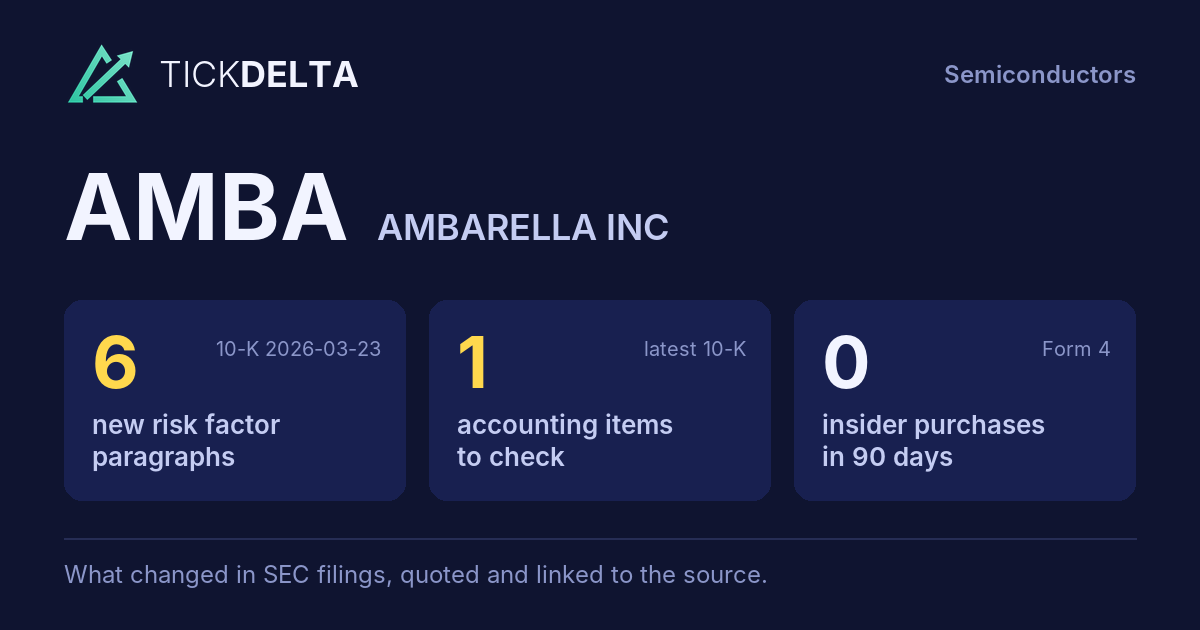
of the text changed · 19,678 words now · 6 new paragraphs, 10 gone
MD&A
15.0%
of the text changed · 6,879 words now · 2 new paragraphs, 4 gone
Legal Proceedings
7.5%
of the text changed · 487 words now
Accounting Policies
12.5%
of the text changed · 5,103 words now
10-K 0001193125-26-119321 (Mar 23, 2026) vs 10-K 0000950170-25-046499 (Mar 28, 2025)
Every paragraph, and how much of it changed
One bar per paragraph, in the order of the 10-K. Height and colour show the share of its words not in the closest paragraph a year earlier; the tallest bars are new paragraphs.
Risk Factors
240 paragraphs · 6 new · 55 reworded · 10 gone · 10-K Mar 23, 2026 against Mar 28, 2025
New paragraph
Reworded (5% of its words or more)
Same or nearly
Paragraph 5 · 38% changed
Every version of it
Paragraph 43 · 36% changed
Every version of it
Paragraph 88 · 34% changed
Every version of it
accurately process or record transactions, and security or technical reliability issues. All of these could harm our ability to conduct core operating functions and could impact our internal control compliance efforts. Due to conflicts and geopolitical events, we and many third parties we work with are vulnerable to a heightened risk of cybersecurity attacks, and other means of causing security breaches and incidents from nation-state and affiliated actors.
Paragraph 44 · 33% changed
Every version of it
We believe that our future revenue growth, if any, significantly depends on our ability to expand within the Internet of Things, or IoT, camera and automotive markets with our new artificial intelligence, or AI, computer vision SoC solutions, and penetrate, or further penetrate, the OEM automotive, robotics and industrial markets. Our AI computer vision SoC solutions have functionality that may also be applicable to other developing markets, such as processing of large language models (LLMs). Each of these markets presents distinct and substantial risks and, in many cases, requires us to develop new functionality or software to address the particular requirements of that market. The application of AI functionality in these markets is relatively new, and we may be unable to predict the timing or development of these markets with accuracy. If any of these markets do not develop as we currently anticipate, the technical requirements of these markets evolve in ways we do not anticipate, the development of such markets is delayed or impacted by factors outside of our control, or if we are unable to penetrate penetrate, or further penetrate, them successfully with our solutions, our revenue could decline and our financial condition would be negatively impacted. Some of these markets are primarily served by only a few large, multinational OEMs with substantial negotiating power relative to us and, in some instances, with internal solutions that are competitive to our products. Meeting the technical requirements and securing design wins with any of these companies requires a substantial investment of our time and resources and we cannot assure you that we will secure design wins from these or other companies or that we will achieve meaningful revenue from the sales of our solutions into these markets. In addition, we face competition from larger competitors with greater resources and more history in these markets, which may put us at a competitive disadvantage to these larger competitors. If we fail to penetrate these or other new markets we are targeting, our financial condition would likely suffer. Moreover, if we are successful in achieving design wins in these new markets, it will likely take longer to generate revenue from such design wins than in our traditional markets.
Paragraph 85 · 31% changed
Every version of it
A breach of our security systems systems, or other security breaches or incidents with respect to our products, networks or systems, may have a material adverse effect on our business.
Paragraph 17 · 30% changed
Every version of it
•A breach of our security systems systems, or other security breaches or incidents with respect to our products, networks or systems, may have a material adverse effect on our business.
Paragraph 45 · 28% changed
Every version of it
Paragraph 47 · 43% changed
Every version of it
10-K Mar 28, 2025During the COVID-19 global pandemic, various restrictions were put in place causing a temporary decline in demand for certain items. As restrictions began easing across the world, an increase in demand for products containing semiconductor chips exacerbated bottlenecks in the supply chain, resulting in a global semiconductor supply shortage impacting our industry, which resulted in a lengthening of the manufacturing lead time for our products and impacting the normal forecasting and ordering patterns of our customers. To the extent customers faced supply chain issues with respect to other components needed to pair with our products in order to produce their end products, such customers delayed orders of our products or held inventory of our products for longer periods of time, resulting in a decline in our revenue. Customers may experience or cause similar delays in the future. With respect to our suppliers, we experienced supply constraints for certain chips from Samsung and we may experience similar issues in the future. While these supply chain challenges have largely subsided, we remain dependent on a global supply chain that can be affected by many factors, including macroeconomic conditions and geopolitical factors such as trade wars and tariffs, and we may face similar issues in the future.
10-K Mar 23, 2026
Managing our manufacturing capacity and supply chain is complex. Our ability to manage our supply chain has been, and could continue to be, adversely affected by a variety of factors including geopolitical conditions such as international trade tensions between the U.S. and China, military conflicts, natural disasters, health crises, and other factors beyond our control. Disruptions in the supply chain for materials used to produce semiconductors or significant increase in demand for semiconductors has, and may in the future, result in a lengthening of the manufacturing lead time for our products and impact the normal forecasting and ordering patterns of our customers. For example, we have experienced supply constraints for certain chips from Samsung Electronics Corporation (Samsung) and we may experience similar issues in the future, which could increase our manufacturing costs and reduce the gross margin of our products. To the extent our customers face supply chain issues with respect to other components needed to pair with our products, such as memory components, in order to produce their end products, such customers may delay orders of our products or hold inventory of our products for longer periods of time, which could result in a decline in our revenue, a decline in gross margin or other adverse impact on our business.
Paragraph 5 · 38% changed
Every version of it
10-K Mar 28, 2025If we fail to penetrate new markets, including the automotive OEM and ADAS market, our revenue and financial condition could be harmed.
10-K Mar 23, 2026
•Our target markets may not grow or develop as we currently expect, and if we fail to successfully penetrate new markets, our revenue and financial condition could be harmed.
Paragraph 43 · 36% changed
Every version of it
10-K Mar 28, 2025If we fail to penetrate new markets, including the automotive OEM and ADAS market, our revenue and financial condition could be harmed.
10-K Mar 23, 2026
Our target markets may not grow or develop as we currently expect, and if we fail to successfully penetrate new markets, our revenue and financial condition could be harmed.
Paragraph 88 · 34% changed
Every version of it
10-K Mar 28, 2025
many third parties we work with are vulnerable to a heightened risk of cybersecurity attacks, and other means of causing security breaches and incidents from nation-state and affiliated actors.
10-K Mar 23, 2026
accurately process or record transactions, and security or technical reliability issues. All of these could harm our ability to conduct core operating functions and could impact our internal control compliance efforts. Due to conflicts and geopolitical events, we and many third parties we work with are vulnerable to a heightened risk of cybersecurity attacks, and other means of causing security breaches and incidents from nation-state and affiliated actors.
Paragraph 44 · 33% changed
Every version of it
10-K Mar 28, 2025
We believe that our future revenue growth, if any, significantly depends on our ability to expand within the Internet of Things, or IoT, camera markets with our new artificial intelligence, or AI, computer vision SoC solutions, and penetrate, or further penetrate, the OEM automotive, robotics and industrial markets. Our AI computer vision SoC solutions have functionality that may also be applicable to other developing markets, such as processing of large language models (LLMs). Each of these markets presents distinct and substantial risks and, in many cases, requires us to develop new functionality or software to address the particular requirements of that market. If any of these markets do not develop as we currently anticipate, the technical requirements of these markets evolve in ways we do not anticipate, the development of such markets is delayed or impacted by factors outside of our control, or if we are unable to penetrate them successfully with our solutions, our revenue could decline and our financial condition would be negatively impacted. Some of these markets are primarily served by only a few large, multinational OEMs with substantial negotiating power relative to us and, in some instances, with internal solutions that are competitive to our products. Meeting the technical requirements and securing design wins with any of these companies requires a substantial investment of our time and resources and we cannot assure you that we will secure design wins from these or other companies or that we will achieve meaningful revenue from the sales of our solutions into these markets. In addition, we face competition from larger competitors with greater resources and more history in these markets, which may put us at a competitive disadvantage to these larger competitors. If we fail to penetrate these or other new markets we are targeting, our financial condition would likely suffer. Moreover, if we are successful in achieving design wins in these new markets, it will likely take longer to generate revenue from such design wins than in our traditional markets.
10-K Mar 23, 2026
We believe that our future revenue growth, if any, significantly depends on our ability to expand within the Internet of Things, or IoT, and automotive markets with our new artificial intelligence, or AI, SoC solutions, and penetrate, or further penetrate, the robotics and industrial markets. Each of these markets presents distinct and substantial risks and, in many cases, requires us to develop new functionality or software to address the particular requirements of that market. The application of AI functionality in these markets is relatively new, and we may be unable to predict the timing or development of these markets with accuracy. If any of these markets do not develop as we currently anticipate, the technical requirements of these markets evolve in ways we do not anticipate, the development of such markets is delayed or impacted by factors outside of our control, or if we are unable to penetrate, or further penetrate, them successfully with our solutions, our revenue could decline and our financial condition would be negatively impacted.
Paragraph 85 · 31% changed
Every version of it
10-K Mar 28, 2025
A breach of our security systems may have a material adverse effect on our business.
10-K Mar 23, 2026
A breach of our security systems, or other security breaches or incidents with respect to our products, networks or systems, may have a material adverse effect on our business.
Paragraph 17 · 30% changed
Every version of it
10-K Mar 28, 2025
•A breach of our security systems may have a material adverse effect on our business.
10-K Mar 23, 2026
•A breach of our security systems, or other security breaches or incidents with respect to our products, networks or systems, may have a material adverse effect on our business.
Paragraph 45 · 28% changed
Every version of it
10-K Mar 28, 2025We believe that our future revenue growth, if any, significantly depends on our ability to expand within the Internet of Things, or IoT, camera markets with our new artificial intelligence, or AI, computer vision SoC solutions, and penetrate, or further penetrate, the OEM automotive, robotics and industrial markets. Our AI computer vision SoC solutions have functionality that may also be applicable to other developing markets, such as processing of large language models (LLMs). Each of these markets presents distinct and substantial risks and, in many cases, requires us to develop new functionality or software to address the particular requirements of that market. If any of these markets do not develop as we currently anticipate, the technical requirements of these markets evolve in ways we do not anticipate, the development of such markets is delayed or impacted by factors outside of our control, or if we are unable to penetrate them successfully with our solutions, our revenue could decline and our financial condition would be negatively impacted. Some of these markets are primarily served by only a few large, multinational OEMs with substantial negotiating power relative to us and, in some instances, with internal solutions that are competitive to our products. Meeting the technical requirements and securing design wins with any of these companies requires a substantial investment of our time and resources and we cannot assure you that we will secure design wins from these or other companies or that we will achieve meaningful revenue from the sales of our solutions into these markets. In addition, we face competition from larger competitors with greater resources and more history in these markets, which may put us at a competitive disadvantage to these larger competitors. If we fail to penetrate these or other new markets we are targeting, our financial condition would likely suffer. Moreover, if we are successful in achieving design wins in these new markets, it will likely take longer to generate revenue from such design wins than in our traditional markets.
10-K Mar 23, 2026
Some of these markets are primarily served by only a few large, multinational OEMs with substantial negotiating power relative to us and, in some instances, with internal solutions that are competitive to our products. Meeting the technical requirements and securing design wins in these markets requires a substantial investment of our time and resources and we cannot assure you that we will secure design wins or that we will achieve meaningful revenue from the sales of our solutions into these markets. In addition, we face competition from larger competitors with greater resources and more history in these markets, which may put us at a competitive disadvantage to these larger competitors. If we fail to penetrate these or other new markets we are targeting, our financial condition would likely suffer. Moreover, if we are successful in achieving design wins in these new markets, it will likely take longer to generate revenue from such design wins than in our traditional markets.
MD&A
80 paragraphs · 2 new · 30 reworded · 4 gone · 10-K Mar 23, 2026 against Mar 28, 2025
New paragraph
Reworded (5% of its words or more)
Same or nearly
Paragraph 46 · 47% changed
Fiscal year 2025 2026 compared to fiscal year 2024: Net cash 2025: Cash provided by financing operating activities increased primarily due to approximately $3.0 million improved operating results and higher cash receipts inflows from stock activities, partially offset by approximately $1.1 million higher principal payments associated with long-term software license agreements. changes in working capital.
Paragraph 10 · 46% changed
•We generated $73.5 million of cash flows from operating activities of in fiscal year 2026, as compared to $33.8 million in fiscal year 2025, as compared to $19.0 million in fiscal year 2024. 2025. The increase in cash flows from operating activities was primarily attributable to lower net loss adjusted for certain non-cash items and increased liabilities mainly driven by improved operating results and higher cash advances inflows from NRE projects and development funding. The increase changes in cash flows from operating activities was partially offset by lower collections of accounts receivable associated with the timing of sales and increased inventory purchases based on expected future demand from customers. working capital.
Paragraph 52 · 45% changed
There were no shares repurchased in fiscal years 2025, 2024 2025 and 2023. 2024. In the first quarter of fiscal year 2026, we repurchased a total of 24,152 of our ordinary shares for approximately $1.0 million in cash. The repurchased shares were recorded as authorized but unissued shares. On May 29, 2024, 28, 2025, our Board of Directors approved an extension of our the existing share repurchase program for an additional twelve months through June 30, 2025. As 2026. Refer to Purchases of January 31, 2025, there was approximately $49.0 million available Equity Securities by the Issuer within Item 5 Market for repurchases through June 30, 2025. Repurchases under the program may be made from time-to-time through open market purchases, 10b5-1 plans or privately negotiated transactions subject to market conditions, applicable legal requirements Registrant's Common Equity, Related Stockholder Matters and other relevant factors. The repurchase program does not obligate us to acquire any particular amount Issuer Purchases of ordinary shares, and it may be suspended at any time at the company's discretion. Repurchases are funded using working capital and any repurchased shares will be recorded as authorized but unissued shares. Equity Securities for additional information.
Paragraph 43 · 40% changed
Income tax expense increased in fiscal 2024, 2026, as compared to fiscal year 2023, 2025, primarily due to a one-time charge of $22.7 million of valuation allowance against the Company’s remaining U.S. net deferred tax assets, a decrease in the proportion of profits generated in lower tax jurisdictions reduced pre-tax loss and a decrease reduction in the benefit from FIN48 reserves upon the lapse of the statute of limitations, income tax reserve release, partially offset by a decrease in non-deductible stock-based compensation.
Paragraph 47 · 40% changed
Fiscal year 2024 2025 compared to fiscal year 2023: 2024: Cash provided by operating activities decreased increased primarily due to higher net loss adjusted for certain non-cash items, improved operating results, partially offset by increased working capital higher cash outflows as a result of better management on accounts receivable and liabilities, as well as decreased inventory purchases due to lower demand from customers. changes in working capital.
Paragraph 18 · 38% changed
Impact of Global Supply Chain Conditions on Our Business. Due in part to impacts of the COVID-19 pandemic, the The semiconductor industry faced significant global supply chain challenges over the past few years. Supply chain issues can impact our business as they relate to both our suppliers and our customers. With respect to our suppliers, we We have experienced supply constraints for certain chips from Samsung Electronics Corporation and we may in the future experience similar issues. With respect to our customers, to the extent customers face supply chain issues with other components needed to pair with our products in order to produce their end products or otherwise take actions in an attempt to adjust their inventory levels, such customers may delay future orders seen cycles of our products or hold inventory of our products for longer periods of time. Recent supply chain challenges have subsided and we expect conditions to return to more stability in future periods. However, challenges the past, which may recur in future periods as well, with constant changes in the macro-economic environment, including potential retaliatory tariffs and restrictions on exports to foreign locations due to the recent imposition of tariffs by the U.S. Government on imports and restrictions on exports to foreign locations. imports.
Paragraph 39 · 38% changed
Selling, general and administrative expense decreased increased in fiscal year 2024, 2026, as compared to fiscal year 2023, 2025, primarily due to approximately $1.1 $1.7 million of lower traveling, sales support, professional service higher personnel costs, including employee benefits, and facility-related approximately $0.7 million of higher marketing and travel expenses. The decrease was also attributable to approximately $0.8 million lower personnel costs as a result of lower headcount.
Paragraph 63 · 36% changed
Paragraph 46 · 47% changed
10-K Mar 28, 2025
Fiscal year 2025 compared to fiscal year 2024: Net cash provided by financing activities increased primarily due to approximately $3.0 million higher cash receipts from stock activities, partially offset by approximately $1.1 million higher principal payments associated with long-term software license agreements.
10-K Mar 23, 2026
Fiscal year 2026 compared to fiscal year 2025: Cash provided by operating activities increased primarily due to improved operating results and higher cash inflows from changes in working capital.
Paragraph 10 · 46% changed
10-K Mar 28, 2025
•We generated cash flows from operating activities of $33.8 million in fiscal year 2025, as compared to $19.0 million in fiscal year 2024. The increase in cash flows from operating activities was primarily attributable to lower net loss adjusted for certain non-cash items and increased liabilities driven by higher cash advances from NRE projects and development funding. The increase in cash flows from operating activities was partially offset by lower collections of accounts receivable associated with the timing of sales and increased inventory purchases based on expected future demand from customers.
10-K Mar 23, 2026
•We generated $73.5 million of cash from operating activities in fiscal year 2026, as compared to $33.8 million in fiscal year 2025. The increase in cash flows from operating activities was mainly driven by improved operating results and higher cash inflows from changes in working capital.
Paragraph 52 · 45% changed
10-K Mar 28, 2025
There were no shares repurchased in fiscal years 2025, 2024 and 2023. On May 29, 2024, our Board of Directors approved an extension of our existing share repurchase program for an additional twelve months through June 30, 2025. As of January 31, 2025, there was approximately $49.0 million available for repurchases through June 30, 2025. Repurchases under the program may be made from time-to-time through open market purchases, 10b5-1 plans or privately negotiated transactions subject to market conditions, applicable legal requirements and other relevant factors. The repurchase program does not obligate us to acquire any particular amount of ordinary shares, and it may be suspended at any time at the company's discretion. Repurchases are funded using working capital and any repurchased shares will be recorded as authorized but unissued shares.
10-K Mar 23, 2026
There were no shares repurchased in fiscal years 2025 and 2024. In the first quarter of fiscal year 2026, we repurchased a total of 24,152 of our ordinary shares for approximately $1.0 million in cash. The repurchased shares were recorded as authorized but unissued shares. On May 28, 2025, our Board of Directors approved an extension of the existing share repurchase program for an additional twelve months through June 30, 2026. Refer to Purchases of Equity Securities by the Issuer within Item 5 Market for Registrant's Common Equity, Related Stockholder Matters and Issuer Purchases of Equity Securities for additional information.
Paragraph 43 · 40% changed
10-K Mar 28, 2025
Income tax expense increased in fiscal 2024, as compared to fiscal year 2023, primarily due to a one-time charge of $22.7 million of valuation allowance against the Company’s remaining U.S. net deferred tax assets, a decrease in the proportion of profits generated in lower tax jurisdictions and a decrease in the benefit from FIN48 reserves upon the lapse of the statute of limitations, partially offset by a decrease in non-deductible stock-based compensation.
10-K Mar 23, 2026
Income tax expense increased in fiscal 2026, as compared to fiscal year 2025, primarily due to reduced pre-tax loss and a reduction in benefit from income tax reserve release, partially offset by a decrease in non-deductible stock-based compensation.
Paragraph 47 · 40% changed
10-K Mar 28, 2025
Fiscal year 2024 compared to fiscal year 2023: Cash provided by operating activities decreased primarily due to higher net loss adjusted for certain non-cash items, partially offset by increased working capital as a result of better management on accounts receivable and liabilities, as well as decreased inventory purchases due to lower demand from customers.
10-K Mar 23, 2026
Fiscal year 2025 compared to fiscal year 2024: Cash provided by operating activities increased primarily due to improved operating results, partially offset by higher cash outflows as a result of changes in working capital.
Paragraph 18 · 38% changed
10-K Mar 28, 2025
Impact of Global Supply Chain Conditions on Our Business. Due in part to impacts of the COVID-19 pandemic, the semiconductor industry faced significant global supply chain challenges over the past few years. Supply chain issues can impact our business as they relate to both our suppliers and our customers. With respect to our suppliers, we have experienced supply constraints for certain chips from Samsung Electronics Corporation and we may in the future experience similar issues. With respect to our customers, to the extent customers face supply chain issues with other components needed to pair with our products in order to produce their end products or otherwise take actions in an attempt to adjust their inventory levels, such customers may delay future orders of our products or hold inventory of our products for longer periods of time. Recent supply chain challenges have subsided and we expect conditions to return to more stability in future periods. However, challenges may recur in future periods with changes in the macro-economic environment, including imposition of tariffs by the U.S. Government on imports and restrictions on exports to foreign locations.
10-K Mar 23, 2026
Impact of Global Supply Chain Conditions on Our Business. The semiconductor industry faced significant global supply chain challenges over the past few years. Supply chain issues can impact our business as they relate to both our suppliers and our customers. We have seen cycles of supply chain challenges in the past, which may recur in future periods as well, with constant changes in the macro-economic environment, including potential retaliatory tariffs and restrictions on exports to foreign locations due to the recent imposition of tariffs by the U.S. Government on imports.
Paragraph 39 · 38% changed
10-K Mar 28, 2025
Selling, general and administrative expense decreased in fiscal year 2024, as compared to fiscal year 2023, primarily due to approximately $1.1 million of lower traveling, sales support, professional service and facility-related expenses. The decrease was also attributable to approximately $0.8 million lower personnel costs as a result of lower headcount.
10-K Mar 23, 2026
Selling, general and administrative expense increased in fiscal year 2026, as compared to fiscal year 2025, primarily due to approximately $1.7 million of higher personnel costs, including employee benefits, and approximately $0.7 million of higher marketing and travel expenses.
Paragraph 63 · 36% changed
10-K Mar 28, 2025(5)Service commitment represents future cash payments for our IT infrastructure service from a third party.
10-K Mar 23, 2026
(4)Service commitment represents future cash payments for our IT infrastructure services and support and maintenance for software licenses.
A paragraph is matched with the one last year that shares the most of its words; under half in common makes it new. The paragraphs shown are the 8 reworded the most in each section.
The paragraph that changed most in each section
The redline
Marked against last year's 10-K: cut words struck through, new words highlighted.
Risk Factors261 words changed in this paragraph; it is 37% similar to last year's version.
Source: Item 1A, 10-K 0001193125-26-119321 vs Item 1A, 10-K 0000950170-25-046499
Accounting Policies192 words changed in this paragraph; it is 86% similar to last year's version.
Restricted Cash Amounts included In the first quarter of fiscal year 2026, the Company entered into a Letter of Credit of approximately $0.4 million with a financial institution as collateral for the security deposit on its new office lease located in Santa Clara, California. Refer to Note 8 Leases for detailed lease information. The Letter of Credit is irrevocable for one year, during which the Company has the obligation to maintain the full amount of the Letter of Credit. The restricted cash represent also includes those amounts required to be set aside to secure certain transactions in a foreign entity. As of January 31, 2025 and 2024, the restricted cash was immaterial, respectively. The following table presents cash, cash equivalents and restricted cash reported on the consolidated balance sheets, and the sums are presented on the consolidated statements of cash flows: As of January 31, 2026 2025 2024 2023 (in thousands) ─────────────────────────────────────────────────────────────────────────────────────────────────────────────────────────────────── Cash and cash equivalents $ 144,622 191,019 $144,622 $144,914 $113,541 Restricted cash 442 7 7 8 Total as presented in the consolidated statements of cash flows $ 144,629 191,461 $144,629 $144,921 $113,549 Trade Accounts Receivable and Allowance for Credit Losses The Company’s accounts receivables are recorded at invoiced amounts less allowance for any credit losses. In arrangements where revenue recognition occurs in advance of invoicing, an unbilled receivable is recorded, less allowance for any credit losses, within accounts receivable, when collection of these unbilled amounts are conditional only on the passage of time. The Company recognizes credit losses based on a forward-looking current expected credit losses (CECL). The Company makes estimates of expected credit losses based upon its assessment of various factors, including historical collection experience, the age of accounts receivable balances, credit quality of its customers, current economic conditions, reasonable and supportable forecasts of future economic conditions, and other factors that may affect its ability to collect from customers. The changes in allowance for credit losses are recognized in the consolidated statement of operations. The uncollectible accounts receivables are written off in the period in which a determination is made that all commercially reasonable means of recovering them have been exhausted. There were no material credit losses and or write-offs of accounts receivable for the fiscal years ended January 31, 2025, 2024 2026, 2025 and 2023, 2024, respectively. There was no material allowance recorded as of January 31, 2025 2026 and 2024, 2025, respectively. Inventories The Company records inventories at the lower of cost or net realizable value. The cost includes materials and other production costs and is computed using standard cost on a first-in, first-out basis. Inventory reserves are recorded for estimated obsolescence or unmarketable inventories based on forecast of future demand and market conditions. Any adjustments to reduce the cost of inventories to their net realizable value are recognized in earnings in the current period. Once inventory is written down, a new accounting cost basis is established and, accordingly, any associated reserve is not released until the inventory is sold or scrapped. Property and Equipment Property and equipment are stated at cost and depreciated using the straight-line method over the estimated useful life for computer equipment, computer software, machinery, equipment and furniture and fixtures. Leasehold improvements are amortized over the shorter of the lease term or their estimated useful lives. Repairs and maintenance are charged to expense as incurred. Intangible Assets The Company’s intangible assets primarily consist of software licenses as well as developed technology, customer relationships and trade name that were acquired from business combinations. The intangible asset acquired from a business combination is amortized over its estimated useful life. The Company accounts for a noncancelable on-premise internal-use software license as the acquisition of an intangible asset and the incurrence of a liability to the extent that all or a portion of the software licensing fees are not paid on or before the license acquisition date. The intangible asset and related liability are recorded at net present value and interest expense is recorded over the payment term. The internal-use software license is amortized over its license term. The Company expenses the cost of purchased software that is to be sold, leased or otherwise marketed as part of a product until the technological feasibility of the product has been established. Once the technological feasibility of the product, to be externally marketed, has been established or where the software has an alternative future use, the Company capitalizes the cost of the purchased software until the associated product is available for general release to customers, at which point the capitalized cost is amortized on a product-by-product basis over the remaining estimated economic life of the product.
Source: 10-K text, Note 1 – Organization and Summary of Significant Accounting Policies, 10-K 0001193125-26-119321 vs 10-K text, Note 1 – Organization and Summary of Significant Accounting Policies, 10-K 0000950170-25-046499
MD&A148 words changed in this paragraph; it is 36% similar to last year's version.
There were no shares repurchased in fiscal years 2025, 2024 2025 and 2023. 2024. In the first quarter of fiscal year 2026, we repurchased a total of 24,152 of our ordinary shares for approximately $1.0 million in cash. The repurchased shares were recorded as authorized but unissued shares. On May 29, 2024, 28, 2025, our Board of Directors approved an extension of our the existing share repurchase program for an additional twelve months through June 30, 2025. As 2026. Refer to Purchases of January 31, 2025, there was approximately $49.0 million available Equity Securities by the Issuer within Item 5 Market for repurchases through June 30, 2025. Repurchases under the program may be made from time-to-time through open market purchases, 10b5-1 plans or privately negotiated transactions subject to market conditions, applicable legal requirements Registrant's Common Equity, Related Stockholder Matters and other relevant factors. The repurchase program does not obligate us to acquire any particular amount Issuer Purchases of ordinary shares, and it may be suspended at any time at the company's discretion. Repurchases are funded using working capital and any repurchased shares will be recorded as authorized but unissued shares. Equity Securities for additional information.
Source: Item 7, 10-K 0001193125-26-119321 vs Item 7, 10-K 0000950170-25-046499
Legal Proceedings74 words changed in this paragraph; it is 90% similar to last year's version.
15. Commitments and Contingencies Contract Manufacturer Commitments The Company’s components and products are procured and built by independent contract manufacturers based on sales forecasts. These forecasts include estimates of future demand, historical trends, analysis of sales and marketing activities, and adjustment of overall market conditions. The Company regularly issues purchase orders to independent contract manufacturers which are cancelable upon agreement between the Company and third-party manufacturers. These manufacturing purchase commitments typically provide the Company with flexibility to cancel, reschedule or adjust requirements based upon business needs but the Company may incur certain costs depending on the production stage of the products. As of January 31, 2025 2026 and 2024, 2025, total manufacturing purchase commitments were approximately $56.4 $80.4 million and $30.7 $56.4 million, respectively. The Company also reviews and assesses the need for any expected loss liabilities on quarterly basis for all products that it does not expect to sell for which it has committed purchases from suppliers. There were no material loss liabilities recorded in the consolidated balance sheets from adverse purchase commitments as of January 31, 2025 2026 and 2024, 2025, respectively. Other Commitments During fiscal year 2025, From time-to-time, the Company entered enters into a noncancellable service contract contracts with a third-party third-parties for its IT infrastructure service. services and support and maintenance for software licenses. As of January 31, 2025, 2026, the total commitment for the service was approximately $8.0 million. The Company also entered into a new office lease for its headquarters in Santa Clara, California for 104 months beginning from September 1, 2025 to April 30, 2034. The total future undiscounted cash committed payments for the lease are these services were approximately $15.7 $12.4 million. Indemnification The Company, from time to time, in the normal course of business, indemnifies certain vendors with whom it enters into contractual relationships. The Company has agreed to hold the other party harmless against third-party claims in connection with the Company’s future products. The Company also indemnifies certain customers against third-party claims related to certain intellectual property and product liability matters. It is not possible to determine the maximum potential amount of liability under these indemnification obligations due to the limited history of prior indemnification claims and the unique facts and circumstances that are likely to be involved in each particular claim. The Company has not made payments under these obligations as of January 31, 2025, 2026, and no liabilities have been recorded for these obligations in the consolidated balance sheets as of January 31, 2025 2026 and 2024, 2025, respectively. Other Matters
Source: Item 3, via Note 15 – Commitments and Contingencies, 10-K 0001193125-26-119321 vs Item 3, via Note 15 – Commitments and Contingencies, 10-K 0000950170-25-046499
Sentences and paragraphs added, removed or reworded
Every change, by type
Sentences and paragraphs of AMBA's Risk Factors and MD&A, 10-K Mar 23, 2026 against 10-K Mar 28, 2025. Each links to the text at sec.gov.
Quiet changes are sentences kept from last year with one to four words changed, at least one of them a hedge, a modal or a qualifier (may, could, will, not, significant, material…). A year or date rolling forward is not counted.
The full word list
adverse, adversely, all, although, anticipate, anticipates, any, approximately, believe, believes, can, cannot, certain, could, expect, expects, generally, however, if, intend, intends, largely, likely, many, material, materially, may, might, most, must, never, no, not, possible, primarily, probable, should, significant, significantly, some, substantial, substantially, unlikely, will, would
AddedRisk Factors
We are a global company and our business, results of operations, and financial condition are impacted by global macroeconomic conditions. Macroeconomic events such as recession, high inflation, geopolitical tensions, war, public health crises, supply chain disruptions, rising energy costs, changes to U.S. trade policies and responses by foreign governments to such policies, and global banking concerns have caused economic volatility, which have in the past, and may continue to, harm our business. Economic volatility and adverse economic conditions have affected and may continue to affect the demand for our products and our customers’ products. Reduced demand for our customers’ products may negatively affect demand for our products and lead to a buildup of inventory at many of our customers, including their affiliates, partners, and contract manufacturers. Reduced demand for our products could result in decreases in our sales and materially harm our results of operations. The future effects of macroeconomic events on our business and results of operations, including inventory levels at our customers and their affiliates, partners, and contract manufacturers as well as demand for our products, are uncertain and difficult to predict.
Read it in 10-K Mar 23, 2026 at sec.gov
AddedRisk Factors
In addition, for some markets we address or seek to address we need to establish and maintain relationships with third-party suppliers or software providers in order to effectively market our solutions to end-customers. Failure to establish these relationships could harm our ability to achieve design wins.
Read it in 10-K Mar 23, 2026 at sec.gov
AddedRisk Factors
General trade tensions between the United States and China have been escalating, which has, in our view, created and will perpetuate an uncertain business environment. Tariffs on Chinese-origin products increased and may do so further. The specific duty rates have fluctuated, with the United States imposing, revoking, and postponing various tariffs. Similarly, China has taken measures in response, including increased tariffs on U.S. products and the imposition of new export controls on rare earth metals, critical minerals, and other items. Though certain items have been exempted from some of these recent U.S. tariff actions, including computers, semiconductors and other consumer electronics, the risk of additional U.S. tariffs has materially increased in light of recent comments and new Section 232 investigations opened by the U.S. presidential administration.
Read it in 10-K Mar 23, 2026 at sec.gov
AddedRisk Factors
Changes in applicable laws could cause us to experience fluctuations in our tax obligations and effective tax rates and otherwise adversely affect our tax positions and/or our tax liabilities.
Read it in 10-K Mar 23, 2026 at sec.gov
AddedRisk Factors
Further, the One Big Beautiful Bill Act (OBBBA) was enacted on July 4, 2025, and made a number of changes to existing tax law, including extending or making permanent certain business and international tax measures initially established under the Tax Cuts and Jobs Act of 2017 (TCJA), which were set to expire. The OBBBA requires complex computations to be performed that were initially introduced by the TCJA. The U.S. Treasury Department, the Internal Revenue Service (IRS), and other standard-setting bodies could interpret or issue guidance on how provisions of the OBBBA will be applied or otherwise administered that is different from our interpretation. We have considered the impact of the OBBBA in the current financial year. We are also in the process of evaluating the financial statement impact of these provisions for future periods. We do not currently expect the OBBBA to have a material impact on our consolidated financial statements. As we evaluate the effect of the OBBBA, collect and prepare necessary data, and interpret any additional guidance, we may adjust provisional amounts that we have recorded that may impact our provision for income taxes in the period in which the adjustments are made.
Read it in 10-K Mar 23, 2026 at sec.gov
AddedRisk Factors
Additional changes to global tax laws are likely to occur, and such changes may adversely affect our statutory tax rate, operating results, and cash flow.
Read it in 10-K Mar 23, 2026 at sec.gov
RemovedRisk Factors
RemovedRisk Factors
Show the other 39
RemovedRisk Factors
RemovedRisk Factors
RemovedRisk Factors
RemovedRisk Factors
RemovedRisk Factors
RemovedRisk Factors
RemovedRisk Factors
RemovedRisk Factors
RewordedRisk Factors
RewordedRisk Factors
We design our solutions to conform to a broad range of technology standards set by industry standards setting bodies, including video compression standards, including standards such as MPEG-2, H.264 Advanced Video Coding (AVC) and H.265 High Efficiency Video Coding (HEVC), set by industry standards setting bodies such as ITU-T Video Coding Experts Group and the ISO/IEC Moving Picture Experts Group. (HEVC).
Read it in 10-K Mar 23, 2026 at sec.gov
RewordedRisk Factors
To the extent our customers faced face supply chain issues with respect to other components needed to pair with our products products, such as memory components, in order to produce their end products, such customers delayed may delay orders of our products or held hold inventory of our products for longer periods of time, resulting which could result in a decline in our revenue. revenue, a decline in gross margin or other adverse impact on our business.
Read it in 10-K Mar 23, 2026 at sec.gov
RewordedRisk Factors
In general, we expect to increase our research and development expenditures in future periods as compared to prior periods as part of our strategy of focusing on the development of innovative computer vision, video and image processing solutions AI inference SoCs with increased functionality, and as we target key markets, such as the automotive OEM and robotics markets. increasing levels of functionality.
Read it in 10-K Mar 23, 2026 at sec.gov
RewordedRisk Factors
Several of our customers, including Hangzhou Hikvision Digital Technology Co., Ltd, or Hikvision, Zhejiang Dahua Technology Co., Ltd., or Dahua, and affiliates of Shenzhen Dajiang Baiwang Technology Co., Ltd., Chinese customers have been added to the BIS Entity List, which imposes limitations on the supply of U.S. controlled items to the listed entities.
Read it in 10-K Mar 23, 2026 at sec.gov
RewordedRisk Factors
RewordedRisk Factors
Because we currently hold, and expect to continue to hold, a substantial amount of cash or cash equivalents, and because the calculation of the value of our assets may be based in part on the value of our ordinary shares, which may fluctuate and may fluctuate considerably given that market prices of technology companies historically often have been volatile, we may be a PFIC for any taxable year.
Read it in 10-K Mar 23, 2026 at sec.gov
RewordedRisk Factors
RewordedRisk Factors
In the IoT market, our primary competitors include AMLogic Inc., Fuzhou Rockchip Electronics Co., Ltd., HiSilicon Technologies Co., Ltd., or HiSilicon, which is owned by Huawei Technologies Co., Ingenic Semiconductor Co., Ltd., Novatek Microelectronics Corp., or Novatek, NVIDIA Corporation, or NVIDIA, OmniVision Technologies, Inc., Qualcomm Incorporated, or Qualcomm, and SigmaStar Technology Corp., and Socionext Inc. Corp.
Read it in 10-K Mar 23, 2026 at sec.gov
RewordedRisk Factors
One proposal, which has been enacted or is being considered by many jurisdictions, proposal is a framework that ensures an effective global minimum tax rate of 15% on certain multinationals that meet a consolidated revenues above threshold of EUR 750 million or equivalent annually. annually (Pillar Two).
Read it in 10-K Mar 23, 2026 at sec.gov
RewordedRisk Factors
A breach of our security systems systems, or other security breaches or incidents with respect to our products, networks or systems, may have a material adverse effect on our business.
Read it in 10-K Mar 23, 2026 at sec.gov
RewordedRisk Factors
Our research and development expense was approximately $238.5 million, $226.1 million, $215.1 million and $204.9 $215.1 million in fiscal years 2025, 2024 2026, 2025 and 2023, 2024, respectively.
Read it in 10-K Mar 23, 2026 at sec.gov
Quiet changesRisk Factors
Because we generally indemnify our customers for certain intellectual property claims made against them for products incorporating our technology, any litigation could trigger technical support and indemnification obligations under some of our license agreements, which could result in substantial expense to us.
Read it in 10-K Mar 23, 2026 at sec.gov
AddedMD&A
We are a leading developer of low power system on a chip (SoC) semiconductors and software that enable advanced edge and physical AI applications. Our solutions combine state of the art video processing, high resolution image capture, and our proprietary CVflow® AI acceleration architecture to deliver high performance at extremely low power. Historically, our technologies supported human viewing applications such as enterprise, public infrastructure, and home security cameras, as well as sports cameras, wearables, aerial drones, and aftermarket automotive recorders. Building on this foundation, our recent product generations incorporate advanced AI inference capabilities that allow edge devices to interpret complex scenes, perform multi modal sensor fusion, and support autonomous decision making.
Read it in 10-K Mar 23, 2026 at sec.gov
AddedMD&A
Our latest SoC families integrate third generation CVflow technology with advanced video processing, image signal processing, audio processing, and system control functions on a single chip. CVflow is optimized for a broad range of AI inference workloads, including object detection, classification, tracking, segmentation, stereo depth processing, radar perception, and transformer based models. This architecture supports multi modal sensor inputs, including camera, lidar, 4D radar, thermal, and near infrared, enabling environmental perception for edge devices. These capabilities allow our customers to deploy differentiated AI models and solutions across applications, such as next generation automotive camera systems, video security, robotics, and consumer devices, while achieving high image quality, low latency, and low power consumption.
Read it in 10-K Mar 23, 2026 at sec.gov
RemovedMD&A
RemovedMD&A
RemovedMD&A
RemovedMD&A
RewordedMD&A
The increase marginal decrease in other income, net, in fiscal year 2025, 2026, as compared to fiscal year 2024, 2025, was primarily due to an approximately $1.2 a $0.6 million impairment charge relating to an equity investment recognized government grant released in the prior fiscal year 2025 that did not recur in the current fiscal year, year 2026, offset by approximately $0.9 $0.6 million of higher interest income and yields from our cash deposits and debt security investments, as well as $0.8 million of net gains from a government grant and foreign currency transactions and remeasurements. investments.
Read it in 10-K Mar 23, 2026 at sec.gov
RewordedMD&A
Income tax expense increased in fiscal 2024, 2026, as compared to fiscal year 2023, 2025, primarily due to a one-time charge of $22.7 million of valuation allowance against the Company’s remaining U.S. net deferred tax assets, a decrease in the proportion of profits generated in lower tax jurisdictions reduced pre-tax loss and a decrease reduction in the benefit from FIN48 reserves upon the lapse of the statute of limitations, income tax reserve release, partially offset by a decrease in non-deductible stock-based compensation.
Read it in 10-K Mar 23, 2026 at sec.gov
RewordedMD&A
Gross margin increased marginally decreased in fiscal year 2025, 2026, as compared to fiscal year 2024, 2025, primarily due to higher manufacturing costs associated with advanced process technologies, as well as lower sales of previously reserved inventory, partially offset by a higher percentage of sales from higher average selling price AI inference processors, as well as increased higher margin NRE project service revenue, partially offset by higher manufacturing costs associated with advanced process technologies. processors.
Read it in 10-K Mar 23, 2026 at sec.gov
RewordedMD&A
Research and development expense increased in fiscal year 2025, 2026, as compared to fiscal year 2024, 2025, primarily due to approximately $4.2 $4.8 million of additional engineering-related expenses costs, including chip development cost and tools and equipment expense, associated with supporting our AI inference processor the progress and radar solutions, and $3.4 million number of additional SoC development cost from our foundries associated with our chip development progress. chips in development.
Read it in 10-K Mar 23, 2026 at sec.gov
RewordedMD&A
Net cash used in investing activities increased decreased primarily due to approximately $36.5 $15.2 million of additional net cash payments for our debt security purchases and $13.5 million of less cash proceeds received from maturities and sales of our debt security investments, partially offset by $1.6 approximately $5.1 million less in payment higher payments for the our purchase of property capital assets and equipment. software licenses.
Read it in 10-K Mar 23, 2026 at sec.gov
RewordedMD&A
The increase in revenue was primarily attributable to higher product unit shipments driven by customers' new product ramps, and an increased percentage of our sales from higher value average selling price AI inference processors which contributed to as a higher average selling price, as well as higher result of high demand for our edge AI solutions, partially offset by lower nonrecurring engineering (NRE) project service revenue.
Read it in 10-K Mar 23, 2026 at sec.gov
RewordedMD&A
RewordedMD&A
Selling, general and administrative expense decreased increased in fiscal year 2024, 2026, as compared to fiscal year 2023, 2025, primarily due to approximately $1.1 $1.7 million of lower traveling, sales support, professional service higher personnel costs, including employee benefits, and facility-related approximately $0.7 million of higher marketing and travel expenses.
Read it in 10-K Mar 23, 2026 at sec.gov
RewordedMD&A
Net cash provided by financing activities increased decreased primarily due to approximately $3.0 $2.6 million higher less cash receipts received from stock activities, activities and our repurchase of approximately $1.0 million of our ordinary shares, partially offset by approximately $1.1 $1.0 million of higher principal payments associated with long-term software license agreements.
Read it in 10-K Mar 23, 2026 at sec.gov
RewordedMD&A
We expect our selling, general and administrative expense to increase in absolute dollars as we continue to maintain the infrastructure and expand the size of our sales and marketing organization to support our business strategy of addressing new opportunities with our AI technology. technology, including, but not limited to, costs expected to be incurred on the expansion of an indirect sales channel.
Read it in 10-K Mar 23, 2026 at sec.gov
RewordedMD&A
Research and development 61 79 95 61 Selling, general and administrative 19 25 34 23 Total operating expenses 80 104 129 84 Loss from operations (21) (44) (69) (22) Other income, net 2 3 3 1 Loss before income taxes (19) (41) (66) (21) Provision (benefit) for income taxes — — 9 (2) Net loss (19 )% (41 )% (75 )% (19 )%
Read it in 10-K Mar 23, 2026 at sec.gov
RewordedMD&A
As of January 31, 2025, 2026, we had cash, cash equivalents and marketable debt securities on hand of approximately $250.3 $312.6 million, compared with approximately $219.9 $250.3 million of cash, cash equivalents and marketable debt securities on hand as of January 31, 2024. 2025.
Read it in 10-K Mar 23, 2026 at sec.gov
Sources
The two latest 10-Ks on EDGAR, section by section. Each change links to the text at sec.gov.
Also
New risk factors: paragraphs with nothing like them last year, quoted in full.
Work with it
Excel workbook · CSV. Google Sheet that stays up to date: paste =IMPORTDATA("https://tickdelta.com/company/AMBA/export.csv") into a cell.