Screener / SEC EDGAR /CIK 0001280263 /10-K filed Mar 23, 2026, compared with Mar 28, 2025 /Numbers from the XBRL of the 10-Ks
Nasdaq Technology · Semiconductors

Ambarella Inc AMBA

Compare with peers Embed
New in the 10-K 6 paragraphs with nothing like them in the 10-K filed Mar 28, 2025 New in the 10-Q 5 paragraphs not in the 10-Q filed Jun 2, 2026 10-Q against the 10-K 30 risk factor paragraphs and sentences added or reworded

New risk paragraphs, branching off last year

Each branch is a paragraph in Risk Factors with nothing like it in the 10-K filed Mar 28, 2025. A box jumps to the paragraph as filed, below.

6 new

Paragraphs with nothing like them in last year's 10-K

Quoted exactly

6 paragraphs in Risk Factors of the 10-K filed Mar 23, 2026 with nothing like them in the 10-K filed Mar 28, 2025. Quoted exactly. Paragraphs that were only edited are under 10-K change.

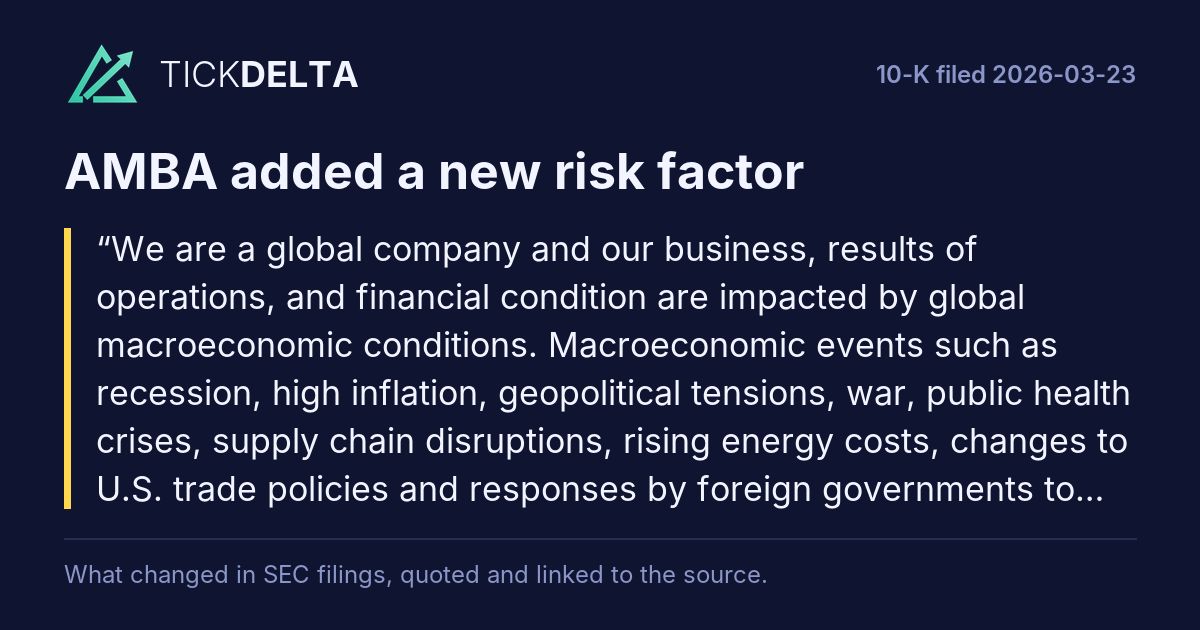
We are a global company and our business, results of operations, and financial condition are impacted by global macroeconomic conditions. Macroeconomic events such as recession, high inflation, geopolitical tensions, war, public health crises, supply chain disruptions, rising energy costs, changes to U.S. trade policies and responses by foreign governments to such policies, and global banking concerns have caused economic volatility, which have in the past, and may continue to, harm our business. Economic volatility and adverse economic conditions have affected and may continue to affect the demand for our products and our customers’ products. Reduced demand for our customers’ products may negatively affect demand for our products and lead to a buildup of inventory at many of our customers, including their affiliates, partners, and contract manufacturers. Reduced demand for our products could result in decreases in our sales and materially harm our results of operations. The future effects of macroeconomic events on our business and results of operations, including inventory levels at our customers and their affiliates, partners, and contract manufacturers as well as demand for our products, are uncertain and difficult to predict.

Read in the 10-K

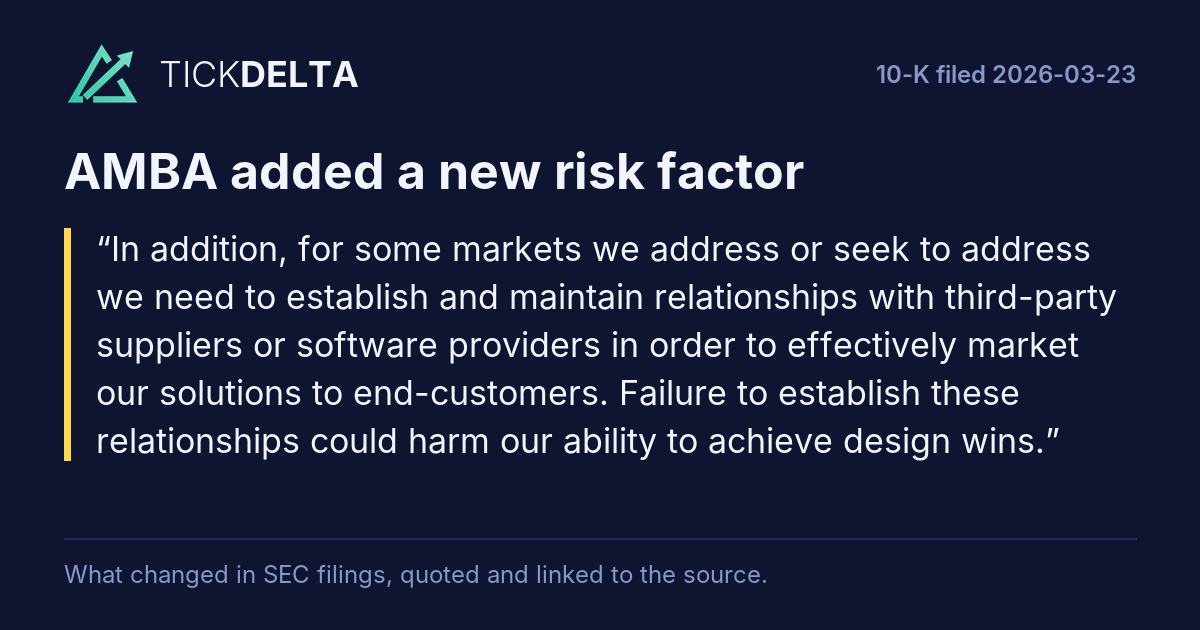
In addition, for some markets we address or seek to address we need to establish and maintain relationships with third-party suppliers or software providers in order to effectively market our solutions to end-customers. Failure to establish these relationships could harm our ability to achieve design wins.

Read in the 10-K

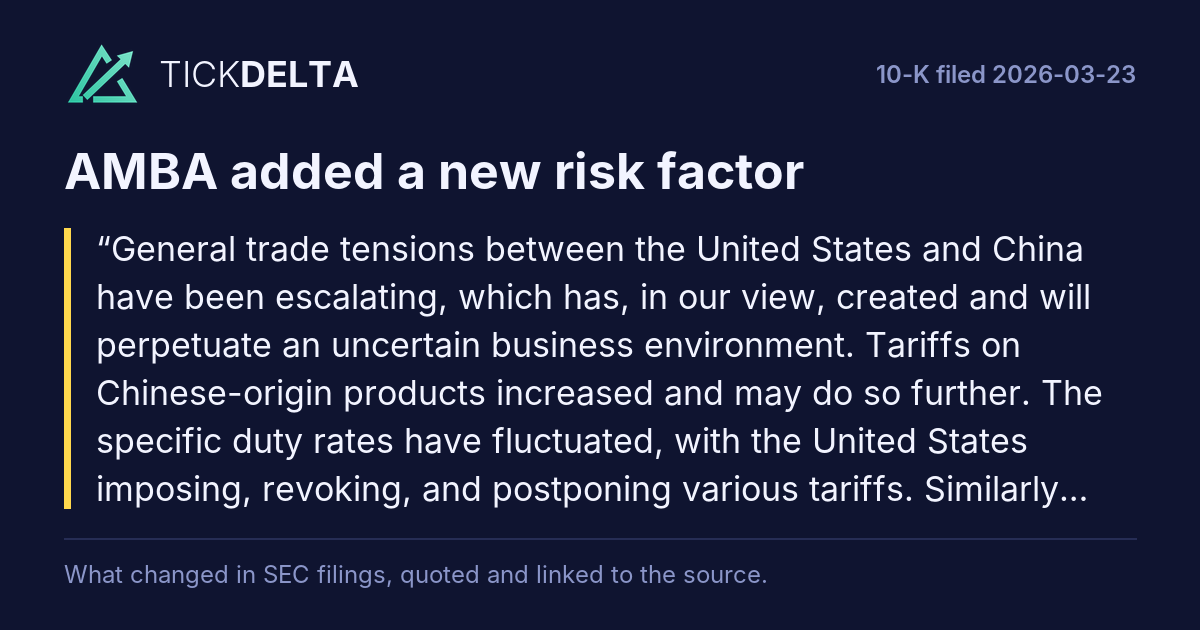
General trade tensions between the United States and China have been escalating, which has, in our view, created and will perpetuate an uncertain business environment. Tariffs on Chinese-origin products increased and may do so further. The specific duty rates have fluctuated, with the United States imposing, revoking, and postponing various tariffs. Similarly, China has taken measures in response, including increased tariffs on U.S. products and the imposition of new export controls on rare earth metals, critical minerals, and other items. Though certain items have been exempted from some of these recent U.S. tariff actions, including computers, semiconductors and other consumer electronics, the risk of additional U.S. tariffs has materially increased in light of recent comments and new Section 232 investigations opened by the U.S. presidential administration.

Read in the 10-K

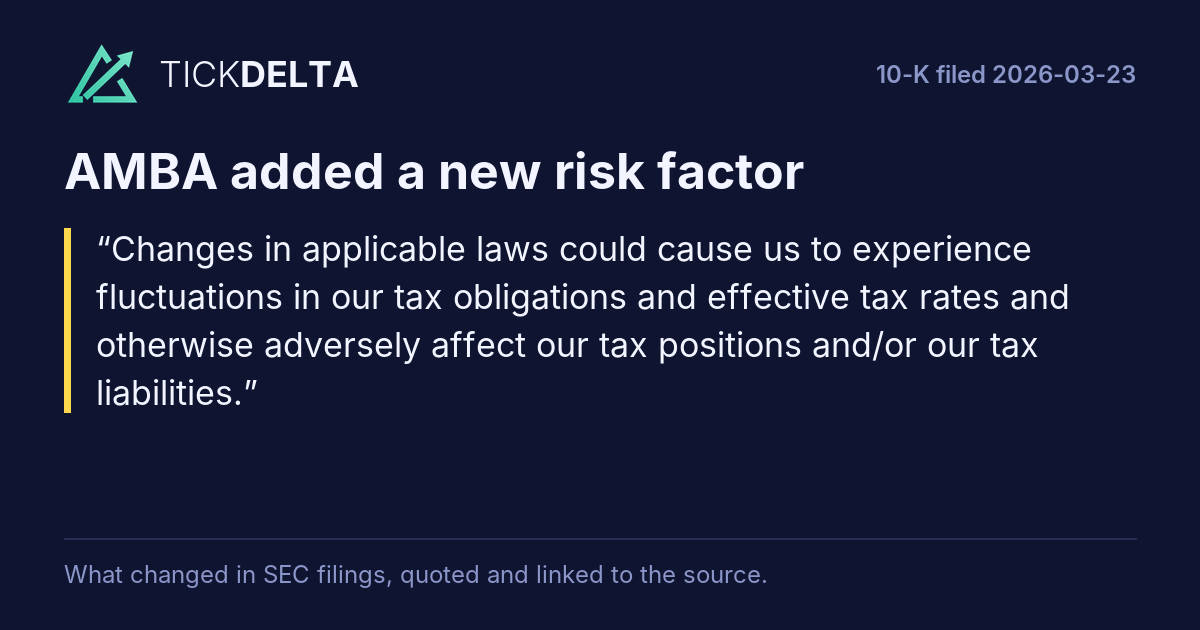
Changes in applicable laws could cause us to experience fluctuations in our tax obligations and effective tax rates and otherwise adversely affect our tax positions and/or our tax liabilities.

Read in the 10-K

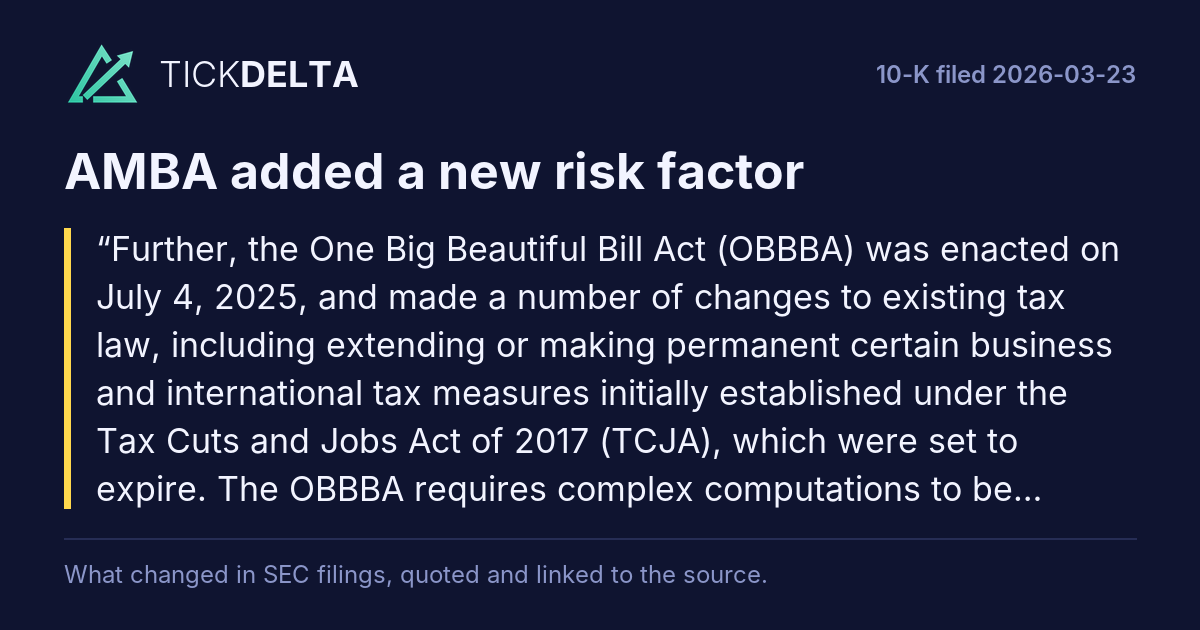
Further, the One Big Beautiful Bill Act (OBBBA) was enacted on July 4, 2025, and made a number of changes to existing tax law, including extending or making permanent certain business and international tax measures initially established under the Tax Cuts and Jobs Act of 2017 (TCJA), which were set to expire. The OBBBA requires complex computations to be performed that were initially introduced by the TCJA. The U.S. Treasury Department, the Internal Revenue Service (IRS), and other standard-setting bodies could interpret or issue guidance on how provisions of the OBBBA will be applied or otherwise administered that is different from our interpretation. We have considered the impact of the OBBBA in the current financial year. We are also in the process of evaluating the financial statement impact of these provisions for future periods. We do not currently expect the OBBBA to have a material impact on our consolidated financial statements. As we evaluate the effect of the OBBBA, collect and prepare necessary data, and interpret any additional guidance, we may adjust provisional amounts that we have recorded that may impact our provision for income taxes in the period in which the adjustments are made.

Additional changes to global tax laws are likely to occur, and such changes may adversely affect our statutory tax rate, operating results, and cash flow.

Read in the 10-K

Paragraphs in the 10-Q filed Sep 4, 2026 that were not in the one before

New in the latest 10-Q

5 paragraphs in the 10-Q filed Sep 4, 2026 with nothing like them in the 10-Q filed Jun 2, 2026 (at least half the words must differ; new numbers alone do not count). Quoted exactly, grouped by the item heading above them. This is text that changed, not a judgement of how serious it is.

Financial statements and notes

Six Months Ended July 31, 2026 2025 ────────────────────────────────────────────────────────────────────────────────────────────────────────────────────────────────────────────────────────────────── Cash flows from operating activities: Net loss $ (24,782) $ (44,323) Adjustments to reconcile net loss to net cash provided by (used in) operating activities: Depreciation and amortization 12,840 13,384 Amortization (accretion) of premium (discount) on marketable debt securities, net (74) (128) Stock-based compensation 44,593 51,318 Deferred income taxes 74 (174) Other non-cash items, net (120) 34 Changes in operating assets and liabilities: Accounts receivable 1,740 (13,129) Inventories (24,557) 597 Prepaid expenses and other current assets (1,018) 541 Other non-current assets 7 (48) Accounts payable (26,404) 7,252 Accrued and other current liabilities (6,250) 1,195 Income taxes payable 778 330 Deferred revenue (1,520) 5,307 Operating lease liabilities (1,291) (1,945) Other long-term liabilities 98 96 Net cash provided by (used in) operating activities (25,886) 20,307 Cash flows from investing activities: Purchase of investments (73,425) (34,569) Sales of investments 12,076 4,647 Maturities of investments 11,181 17,511 Purchase of tangible and intangible assets (10,779) (8,688) Net cash used in investing activities (60,947) (21,099) Cash flows from financing activities: Share repurchase (2,441) (1,000) Proceeds from exercise of stock options and employee stock purchase plan 5,929 4,893 Long-term financing payment for intangible assets (5,824) (4,549) Net cash used in financing activities (2,336) (656) Net decrease in cash, cash equivalents and restricted cash (89,169) (1,448) Cash, cash equivalents and restricted cash at beginning of period 191,461 144,629 Cash, cash equivalents and restricted cash at end of period $ 102,292 $ 143,181 Supplemental disclosure of cash flow information: Cash paid for income taxes $ 416 $ 838 Supplemental disclosure of noncash investing activities: Unpaid liabilities related to tangible and intangible assets purchases $ 1,783 $ 2,227

Read in the 10-Q

A substantial portion of the Company’s revenue is derived from sales through two of its distributors, WT Microelectronics Co., Ltd., formerly Wintech Microelectronics Co., Ltd., or WT, which serves as its non-exclusive sales representative and fulfillment partner in Asia other than Japan, and Hakuto Co., Ltd., or Hakuto, a Japanese distributor. Termination of the relationships with these customers could result in a temporary or permanent loss of revenue. Furthermore, any credit issues from these customers could impair their abilities to make timely payment to the Company. See Note 15 for additional information regarding revenue and credit concentration with these customers.

Read in the 10-Q

As of July 31, 2026, the aggregate intrinsic value of unvested restricted stock units was $246.3 million.

Read in the 10-Q

16. Subsequent Events During the second fiscal quarter ended July 31, 2026, the Company's shareholders approved an increase of 2,750,000 ordinary shares available for issuance under the existing Amended and Restated 2021 Equity Incentive Plan. The shares were registered with the Securities and Exchange Commission (SEC) on August 3, 2026 by filing a Registration Statement in Form S-8 under the United States Securities Act of 1933.

Read in the 10-Q

Item 6

* Management contracts or compensation plans or arrangements in which directors or executive officers are eligible to participate.

Read in the 10-Q

The 10-Q's risk factors against the 10-K

Item 1A of the 10-Q filed Sep 4, 2026 against Item 1A of the 10-K filed Mar 23, 2026. A 10-Q repeats only the risks that changed, so a 10-K paragraph that is missing from it is not counted as removed. Added is a paragraph with nothing like it in the 10-K, Reworded a sentence that is in both with several words changed, Quiet changes a sentence in both where one to four words changed and one is a hedge or a modal (cut words struck through, new words highlighted). Text on the page, not a score; each links to the filing at sec.gov.

Added10-Q Sep 4, 2026 vs 10-K Mar 23, 2026
Further, while we will continue to seek to expand our end market exposure, we anticipate that sales to a limited number of markets will continue to account for a significant percentage of our total revenue for the foreseeable future. Our concentration in a limited number of markets may cause our financial performance to fluctuate significantly from period to period based on the success or failure of products that our SoCs are designed into as well as the overall growth or decline in the video capture markets in which we compete.

Read it in the 10-Q at sec.gov

Show the other 18
Added10-Q Sep 4, 2026 vs 10-K Mar 23, 2026
• repurchases of our ordinary shares under our share repurchase program or failure to meet any expectations relating to our share repurchase program;

Read it in the 10-Q at sec.gov

Added10-Q Sep 4, 2026 vs 10-K Mar 23, 2026
We have adopted a share repurchase program to repurchase our ordinary shares; however, any future decisions to reduce or discontinue repurchasing our ordinary shares pursuant to such share repurchase program could cause the market price of our ordinary shares to decline.

Read it in the 10-Q at sec.gov

Added10-Q Sep 4, 2026 vs 10-K Mar 23, 2026
Although our Board of Directors has authorized a share repurchase program, any determination to execute share repurchases will be subject to, among other things, our financial position and results of operations, available cash and cash flow, capital requirements, market and business conditions, share price, acquisition opportunities and other factors, as well as our Board of Director’s continuing determination that the repurchase program is in the best interests of our shareholders and is in compliance with all laws and agreements applicable to the repurchase programs. Our share repurchase program does not oblige us to acquire any particular amount of ordinary shares, and it may be suspended at any time at the Company’s discretion. If we fail to meet any expectations related to share repurchases, the market price of our ordinary shares could decline. Additionally, price volatility of our ordinary shares over a given period may cause the average price at which we repurchase our ordinary shares to exceed the share’s market price at a given point in time. We may further increase or decrease the amount of repurchases of our ordinary shares in the future. Any reduction or discontinuance by us of repurchases of our ordinary shares pursuant to our current share repurchase program could cause the market price of our ordinary shares to decline.

Read it in the 10-Q at sec.gov

Reworded10-Q Sep 4, 2026 vs 10-K Mar 23, 2026
Any security breach or incident or theft, misuse, loss, unavailability or other unauthorized processing of information, or the perception that any of these matters has occurred, could result in, among other things, damage to our reputation, allegations by our customers that we have not performed our contractual obligations, regulatory investigations and other proceedings, litigation and possible penalties, damages, and other liabilities, any of which could have a material adverse effect on our business, financial condition, our reputation, and our relationships with our customers and partners.

Read it in the 10-Q at sec.govThe 10-K sentence

Reworded10-Q Sep 4, 2026 vs 10-K Mar 23, 2026
Further, the One Big Beautiful Bill Act (OBBBA) was enacted on July 4, 2025, and made a number of changes to existing tax law, including extending or making permanent certain business and international tax measures initially established under the Tax Cuts and Jobs Act of 2017 (TCJA), which were set to expire. law.

Read it in the 10-Q at sec.govThe 10-K sentence

Reworded10-Q Sep 4, 2026 vs 10-K Mar 23, 2026
Approximately 70%, 63% and 53% of our revenue was derived from sales through WT for the fiscal years ended January 31, 2026, 2025 and 2024. 2024, respectively, and approximately 61% of our revenue was derived from sales through WT for the six months ended July 31, 2026.

Read it in the 10-Q at sec.govThe 10-K sentence

Reworded10-Q Sep 4, 2026 vs 10-K Mar 23, 2026
The semiconductor industry recently experienced significant shortages is currently experiencing a tightening of manufacturing capacity, which resulted may result in a lengthening of the manufacturing lead time for our products and which has at times harmed could potentially negatively impact our revenue.

Read it in the 10-Q at sec.govThe 10-K sentence

Reworded10-Q Sep 4, 2026 vs 10-K Mar 23, 2026
We In addition, we believe that revenue from our top 10 end customers, either directly or through a distributor or an ODM, accounted for approximately 67% of our total revenue in fiscal year 2026 and accounted for approximately 67% of our total revenue for the six months ended July 31, 2026.

Read it in the 10-Q at sec.govThe 10-K sentence

Reworded10-Q Sep 4, 2026 vs 10-K Mar 23, 2026
Treasury Department, the Internal Revenue Service (IRS), and other standard-setting bodies could interpret or issue guidance on how provisions of the OBBBA will be applied or otherwise administered that is different from administered, which can adversely affect our interpretation. future income tax obligations and effective tax rates.

Read it in the 10-Q at sec.govThe 10-K sentence

Reworded10-Q Sep 4, 2026 vs 10-K Mar 23, 2026
To There have been tightening supply conditions in the memory market and to the extent our customers face supply chain issues with respect to other components needed to pair with our products, such as memory components, in order to produce their end products, such customers may delay orders of our products or hold inventory of our products for longer periods of time, which could result in a decline in our revenue, a decline in gross margin margin, excess inventory or other adverse impact on our business.

Read it in the 10-Q at sec.govThe 10-K sentence

Reworded10-Q Sep 4, 2026 vs 10-K Mar 23, 2026
We have experienced and may again experience in the future supply constraints at our primary foundry and assembly vendors resulting from industry wide supply chain challenges. challenges, which has and could again, negatively impact our revenue.

Read it in the 10-Q at sec.govThe 10-K sentence

Quiet changes10-Q Sep 4, 2026 vs 10-K Mar 23, 2026
Department of Commerce, or Commerce, imposes on Hong Kong the same stringent export and reexport controls applicable to China, including licensing requirements such as those applicable to certain SoCs and semiconductor end-uses.

Read it in the 10-Q at sec.govThe 10-K sentence

The first 23 of 30 are shown (at most 12 of each type).

Phrases used for the first time

Two-word phrases in Risk Factors of the 10-K filed Mar 23, 2026 that are in none of the 1 earlier 10-Ks stored, back to Mar 28, 2025

data processing ×4processing privacy ×4global macroeconomic ×3geopolitical tensions ×3gross margin ×3statutory tax ×3concerns trade ×2restrictions geopolitical ×2face intense ×2share revenue ×2products networks ×2macroeconomic events ×2health crises ×2economic volatility ×2reduced demand ×2affiliates partners ×2
Where each one is used
  • data processing: We are subject to governmental laws, regulations and other legal obligations related to data processing, privacy, data protection and cybersecurity.
  • processing privacy: We are subject to governmental laws, regulations and other legal obligations related to data processing, privacy, data protection and cybersecurity.
  • global macroeconomic: •Global macroeconomic and political conditions, including high inflation, recessionary concerns, trade restrictions, geopolitical tensions and war may adversely impact our business and financial condition in ways that we currently cannot predict.
  • geopolitical tensions: •Global macroeconomic and political conditions, including high inflation, recessionary concerns, trade restrictions, geopolitical tensions and war may adversely impact our business and financial condition in ways that we currently cannot predict.
  • gross margin: •Shortages in, or increased costs of, wafers and materials could adversely impact our gross margins and lead to reduced revenues.
  • statutory tax: We face tax risks, including relating to the complexity of calculating our tax provision, changes in statutory tax rates, or unfavorable tax law changes.
  • concerns trade: •Global macroeconomic and political conditions, including high inflation, recessionary concerns, trade restrictions, geopolitical tensions and war may adversely impact our business and financial condition in ways that we currently cannot predict.
  • restrictions geopolitical: •Global macroeconomic and political conditions, including high inflation, recessionary concerns, trade restrictions, geopolitical tensions and war may adversely impact our business and financial condition in ways that we currently cannot predict.

The 10-K at sec.gov

Used at least twice, small words left out. Counted, not picked: a phrase can be new because the company renamed something.

What was taken out

10 paragraphs of last year's Risk Factors with nothing like them now. The longest are quoted.

Across all companies
If, for U.S. federal income tax purposes, a United States person owns, or is considered to own as a result of certain attribution rules, 10% or more of the voting power or value of the stock of a non-U.S. corporation, such person is “United States shareholder” of such corporation, and may be treated as a “United States shareholder” with respect to each non-U.S. corporation in our group that is a subsidiary of that corporation. A non-U.S. corporation is a controlled foreign corporation, or CFC, for U.S. federal income tax purposes if United States shareholders, as defined in the immediately...
In the 10-K filed Mar 28, 2025
We are focusing our development resources on addressing computer vision applications, primarily in the automotive and IoT markets. The application of computer vision functionality in these markets is relatively new, and we may be unable to predict the timing or development of these markets with accuracy. For example, a slower than expected adoption rate for AI technology in automotive or IP security camera applications could slow the demand for our new solutions. Similarly, changes in the projected growth rate for ADAS or autonomous driving technology in the automotive market due to...
In the 10-K filed Mar 28, 2025
In December 2018, the Cayman Islands passed the International Tax Co-Operation (Economic Substance) Law, 2018, which requires Cayman Islands companies carrying on one or more relevant activities to maintain a substantial economic presence in the Cayman Islands. Effective from December 31, 2019, we have structured our activities to comply with the new law. However, the legislation remains subject to further clarification and interpretation and accordingly, there is no guarantee that we will be deemed to be compliant. Furthermore, this legislation may require us to make additional changes to...
In the 10-K filed Mar 28, 2025
We sell many of our products to customers through distributors who maintain their own inventory of our products for sale to ODMs and end customers. We allow limited price adjustments on sales to distributors. Price adjustments may be effected by way of credits for future product or by cash payments to the distributor, either in arrears or in advance, using estimates based on historical transactions. In accordance with ASC 606, we recognize revenue on sales to distributors upon shipment and transfer of control (known as “sell-in” revenue recognition) based on the amount of consideration...
In the 10-K filed Mar 28, 2025

Sources

Item 1A of each 10-K and 10-Q on EDGAR, quoted exactly. Each paragraph links to the filing at sec.gov.

Also

10-K change: what was reworded or cut, section by section.

Work with it

Excel workbook · CSV. Google Sheet that stays up to date: paste =IMPORTDATA("https://tickdelta.com/company/AMBA/export.csv") into a cell.

Next:10-K change
Esc

Type a ticker such as AAPL, a name, an investor such as Buffett, or a topic such as tariffs. ↑ ↓ to move, Enter to open.