Added10-Q Nov 9, 2026 vs 10-K Feb 27, 2026
We may not realize the anticipated benefits of the Kashiv Acquisition, and the acquisition may increase our exposure to existing risks.
Each branch is a paragraph in Risk Factors with nothing like it in the 10-K filed Feb 28, 2025. A box jumps to the paragraph as filed, below.
11 paragraphs in Risk Factors of the 10-K filed Feb 27, 2026 with nothing like them in the 10-K filed Feb 28, 2025. Quoted exactly. Paragraphs that were only edited are under 10-K change.
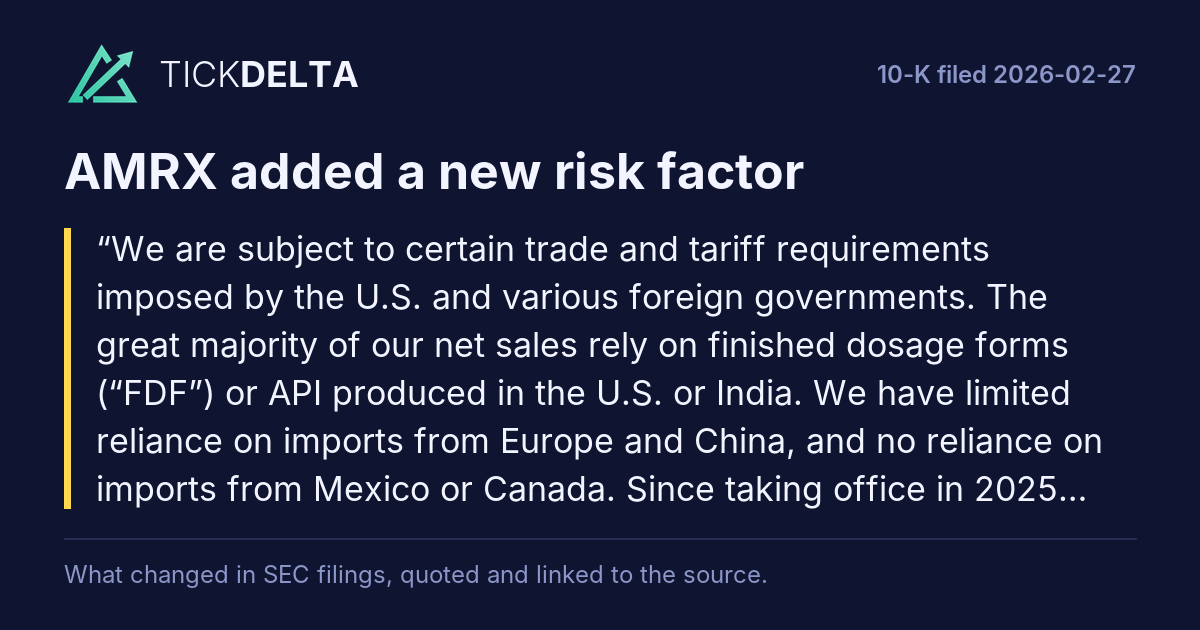
We are subject to certain trade and tariff requirements imposed by the U.S. and various foreign governments. The great majority of our net sales rely on finished dosage forms (“FDF”) or API produced in the U.S. or India. We have limited reliance on imports from Europe and China, and no reliance on imports from Mexico or Canada.
Since taking office in 2025, President Trump has announced a number of tariff actions, and while there are currently no reciprocal tariffs on pharmaceutical products imported into the U.S., this can change at any moment. On February 1, 2025, the Administration imposed a 10% tariff on all products from China under the International Emergency Economic Powers Act, (50 U.S.C. 1701 et seq) (the “IEEPA”), and related authorities as announced in the Federal Register Notice and Executive Order 14195 dated February 1, 2025 (as amended). On February 20, 2026, the Supreme Court of the United States issued an opinion ruling that President Trump’s tariffs exceeded presidential authority under the IEEPA, which had the effect of invalidating the tariffs imposed thereunder to date.
On April 14, 2025, the Department of Commerce Bureau of Industry and Security (“DOCBIS”) announced that it had initiated, as of April 1, 2025, a broad investigation under section 232 of the Trade Expansion Act to determine the effects on national security of imports of pharmaceuticals (i.e. FDF, API, key starting materials, derivatives, and medical countermeasures), including whether trade remedies such as tariffs should be imposed. This investigation covers both generic and brand products. On September 26, 2025, DOCBIS announced that it had initiated, as of September 2, 2025, a separate Section 232 national security investigation of imports of personal protective equipment, medical consumables (including syringes and intravenous bags), and medical equipment (including devices). These Section 232 investigations are ongoing. On February 20, 2026, President Trump imposed a 10% global tariff for 150 days under Section 122 of the Trade Act of 1974. FDF and API are exempt from the Section 122 tariff as of the date of this filing.
Given the global nature of pharmaceutical supply chains, any changes to historically prevailing tariff requirements could impact us and our industry by increasing costs, affecting product availability, and/or disrupting supply chains. The Company is closely monitoring these tariff and trade developments, which remain uncertain and unpredictable.
A U.S. government shutdown could adversely impact our regulatory, operational and financial performance.
We rely heavily on timely interactions with the FDA, the DEA, and other agencies of the U.S. federal government for, among other things, new product reviews and approvals, procurement quotas for controlled substances, facility inspections, and regulatory guidance. During a government shutdown, delays in these interactions could negatively impact our regulatory, operational and financial performance.
Additionally, our AvKARE segment provides pharmaceuticals, medical and surgical products and services primarily to governmental agencies, predominantly focused on the U.S. Department of Defense and the U.S. Department of Veterans Affairs. Interruptions in government contracting and procurement processes, and slower payment cycles to distributors which AvKARE uses to do business with these governmental agencies, could also negatively impact our operational and financial performance.
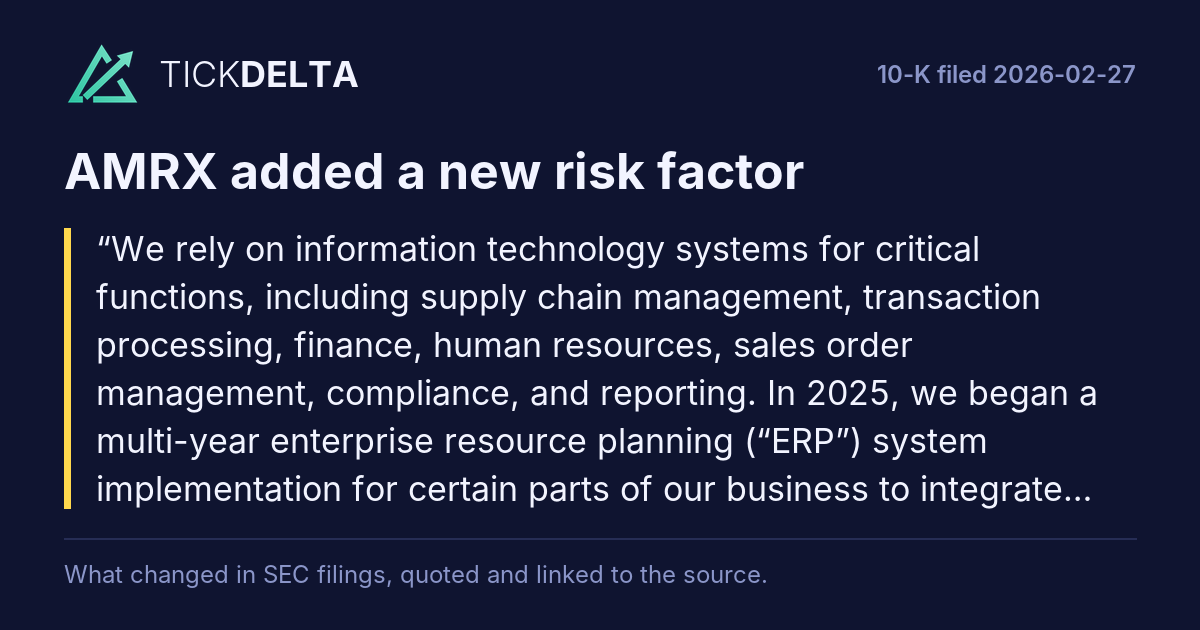
We rely on information technology systems for critical functions, including supply chain management, transaction processing, finance, human resources, sales order management, compliance, and reporting. In 2025, we began a multi-year enterprise resource planning (“ERP”) system implementation for certain parts of our business to integrate and modernize these processes. If the ERP system is not implemented as planned or does not operate effectively, it could disrupt operations, increase costs, and impair our ability to manage our business and maintain effective internal control over financial reporting.
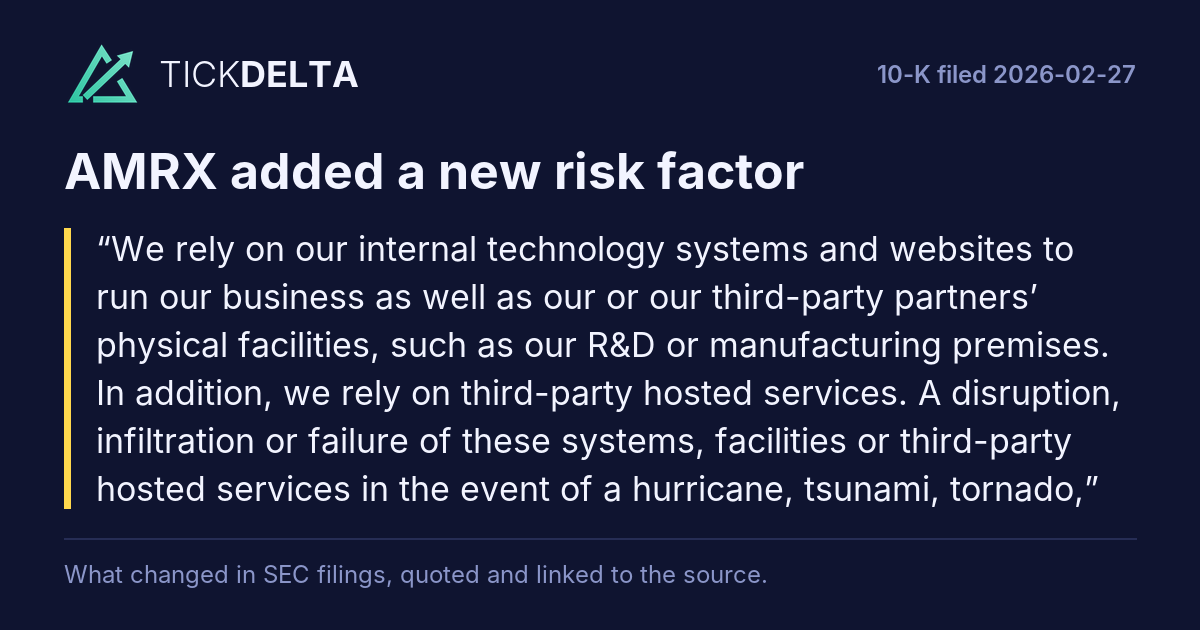
We rely on our internal technology systems and websites to run our business as well as our or our third-party partners’ physical facilities, such as our R&D or manufacturing premises. In addition, we rely on third-party hosted services. A disruption, infiltration or failure of these systems, facilities or third-party hosted services in the event of a hurricane, tsunami, tornado,
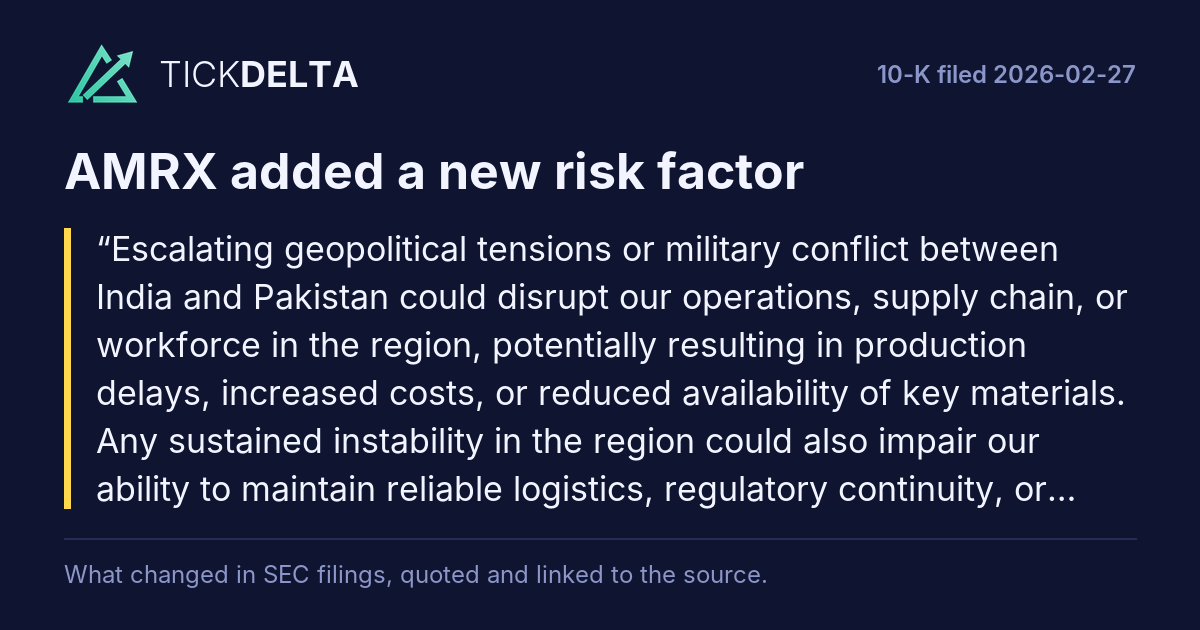
Escalating geopolitical tensions or military conflict between India and Pakistan could disrupt our operations, supply chain, or workforce in the region, potentially resulting in production delays, increased costs, or reduced availability of key materials. Any sustained instability in the region could also impair our ability to maintain reliable logistics, regulatory continuity, or business continuity planning across affected jurisdictions.
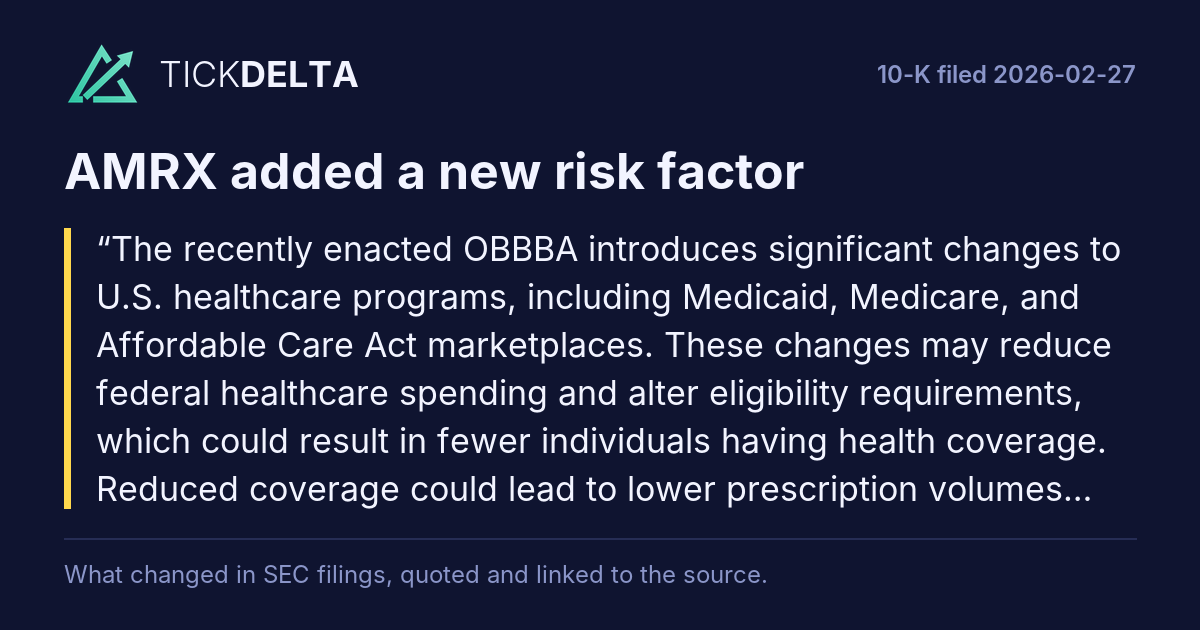
The recently enacted OBBBA introduces significant changes to U.S. healthcare programs, including Medicaid, Medicare, and Affordable Care Act marketplaces. These changes may reduce federal healthcare spending and alter eligibility requirements, which could result in fewer individuals having health coverage. Reduced coverage could lead to lower prescription volumes and decreased demand for our products. Additionally, OBBBA includes provisions that may increase compliance obligations and administrative complexity for manufacturers participating in government programs. These changes could require additional resources and may increase our costs. The full impact of OBBBA is uncertain and will depend on implementation details and potential state-level actions. These developments could adversely affect our business, results of operations, or financial condition.
New in the latest 10-Q
88 paragraphs in the 10-Q filed Nov 9, 2026 with nothing like them in the 10-Q filed Aug 6, 2026 (at least half the words must differ; new numbers alone do not count). Quoted exactly, grouped by the item heading above them. This is text that changed, not a judgement of how serious it is.
• risks related to integrating our acquisition of Kashiv BioSciences, LLC (“Kashiv”) and realizing the anticipated benefits of the acquisition;
Read in the 10-Q
On August 10, 2026, the Company completed the Kashiv Acquisition for a preliminary purchase price of $ 1.3 billion. Kashiv’s operating results have been included in the Company’s consolidated financial statements since the acquisition date. The cash
Read in the 10-Q
portion of the consideration was funded through borrowings under the Company’s credit facilities (refer to Note 14. Debt for additional information). The Kashiv Acquisition was accounted for as a business combination under the acquisition method of accounting, with Amneal as the accounting acquirer.
Read in the 10-Q
Cash consideration (1) $ 266,066 Equity consideration (2) 491,610 Fair value of contingent consideration – milestone payments (3) 137,000 Fair value of contingent consideration – royalty payments (4) 252,000 Repayment of certain Kashiv debt obligations (5) 162,180 Receivable from sellers related to purchase price adjustment (6) (1,814) Settlement of pre-existing relationship (7) (4,556) Preliminary fair value of consideration transferred $ 1,302,486
Read in the 10-Q
(1) The cash consideration paid at closing of $ 266.1 million reflects the initial cash consideration of $ 375.0 million, less $ 180.0 million of indebtedness and $ 3.0 million of transaction expenses, plus $ 3.9 million of estimated closing cash, $ 66.7 million of working capital adjustments and $ 3.5 million of prepayment adjustments, each as determined pursuant to the terms of the Purchase Agreement. Certain amounts remain subject to customary post-closing adjustments.
Read in the 10-Q
(2) The Company issued 28.9 million shares of its Class A common stock to the sellers of Kashiv. The fair value of the equity consideration was based on the $ 17.88 closing price of the Company’s Class A common stock on NASDAQ on August 10, 2026, adjusted by a 5 % discount for lack of marketability reflecting temporary transfer restrictions associated with the then-unregistered shares.
Read in the 10-Q
(3) The sellers of Kashiv are eligible to receive up to $ 350.0 million in contingent milestone payments upon the achievement of certain regulatory milestones in the United States for up to six designated Kashiv product candidates (consisting of up to $ 250.0 million for the first tranche of designated products and up to $ 100.0 million for the second tranche of designated products). The preliminary fair value of the contingent consideration for milestone payments on the acquisition date of approximately $ 137.0 million was based on significant Level 3 inputs that were not observable in the market. Key assumptions included the discount rate, probability of achievement of milestones, and projected year of payments. Refer to Note 16. Fair Value Measurements for additional information on the methodology and determination of this liability.
Read in the 10-Q
(4) The sellers of Kashiv are also eligible to receive, during the 12-year period following the acquisition date, royalty payments equal to 25 % of the amount by which annual aggregate gross profits for certain products exceed specified gross profit hurdle amounts for the corresponding annual royalty period. The preliminary fair value of the contingent consideration for royalty payments on the acquisition date of approximately $ 252.0 million was based on significant Level 3 inputs that were not observable in the market. Key assumptions included projected future gross profits for the underlying products, the timing and probability of expected payments, and the discount rate applied to the estimated future cash flows. Refer to Note 16. Fair Value Measurements for additional information on the methodology and determination of this liability.
Read in the 10-Q
(5) Represents amounts paid at closing to repay certain debt obligations of Kashiv, including related prepayment amounts.
Read in the 10-Q
(6) Represents an estimated amount due from the sellers related to post-closing purchase price adjustments.
Read in the 10-Q
(7) The pre-existing balances between the Company and Kashiv were effectively settled upon completion of the acquisition.
Read in the 10-Q
The initial accounting for the acquisition remains incomplete, primarily related to the valuation of certain acquired assets and liabilities, including working capital, property, plant and equipment, intangible assets and contingent consideration, due to the
Read in the 10-Q
(1) Includes a $ 6.5 million inventory fair value step-up adjustment, which will be recognized in cost of goods sold as the related inventory is sold.
Read in the 10-Q
(2) Includes a $ 10.9 million fair value step-up adjustment for acquired property, plant and equipment from its historical carrying value to its preliminary fair value, which will be recognized over the remaining service lives of the assets as depreciation expense.
Read in the 10-Q
(3) Includes a $ 2.0 million adjustment to reflect favorable lease terms relative to market.
Read in the 10-Q
(1) During September 2026, following the regulatory approval and launch of lanreotide, the related acquired IPR&D was reclassified to marketed product rights and began amortizing over an estimated useful life of approximately five years.
Read in the 10-Q
(2) IPR&D assets are considered indefinite‑lived until completion or abandonment of the related projects and are not amortized during the development period. Upon commercialization, the Company will determine a useful life and begin amortization.
Read in the 10-Q
The preliminary fair value of the identifiable intangible assets was determined using the income approach, which is a valuation technique that provides an estimate of the fair value of an asset based on market participant expectations of the cash flows an asset would generate over its remaining useful life. The assumptions, including the expected projected cash flows, utilized in the purchase price allocation and in determining the preliminary purchase price were based on management’s best estimates as of the closing date of the Kashiv Acquisition on August 10, 2026.
Read in the 10-Q
Some of the more significant assumptions inherent in the development of these asset valuations included projected revenues and revenue growth rates, estimated EBITDA margins, probability of success, and the discount rates applied to the projected cash flows. In developing these assumptions, management considered factors such as expected net cash flows for each asset or product, including anticipated revenues and associated costs, the risks and uncertainties associated with regulatory and commercial success, the expected lifecycle of each asset, and competitive and market trends. These assumptions reflect management's best estimates as of the acquisition date and involve significant judgment and uncertainty. Changes in the underlying assumptions could result in materially different fair value estimates; accordingly, actual results may vary significantly from estimated results.
Read in the 10-Q
The preliminary purchase price allocation remains subject to change as additional information regarding the fair values of assets acquired and liabilities assumed becomes available during the measurement period. Such changes could be material given the proximity of the acquisition date to September 30, 2026. Adjustments to the preliminary fair values of the net assets acquired could affect the Company’s consolidated financial statements in future periods.
Read in the 10-Q
Goodwill is measured as the excess of the preliminary fair value of the consideration transferred over the preliminary fair value of identifiable assets acquired, net of liabilities assumed. Goodwill primarily reflects the value of the assembled workforce, strategic positioning in the biosimilars market that Amneal anticipates capturing with the acquired platform, expected synergies and future revenue growth opportunities not attributable to currently identifiable assets, all of which was allocated to the Company’s Affordable Medicines segment.
Read in the 10-Q
The transaction was treated as an asset purchase for income tax purposes. The tax bases of the acquired assets and liabilities approximated their amounts recognized for financial reporting purposes at the acquisition date; accordingly, no deferred tax assets or liabilities were initially recognized with respect to those assets and liabilities. The goodwill, acquired intangible assets (marketed product rights and IPR&D), and tangible assets are expected to be fully deductible for income tax purposes.
Read in the 10-Q
For the three and nine months ended September 30, 2026, acquisition-related costs incurred and expensed in connection with the Kashiv Acquisition were $ 19.0 million and $ 31.7 million, respectively, and were recorded in acquisition and integration costs in the consolidated statements of operations.
Read in the 10-Q
For the three and nine months ended September 30, 2026, Kashiv contributed total net revenue of approximately $ 1.2 million and operating loss of $ 28.4 million to the Company’s consolidated results of operations.
Read in the 10-Q
(assuming the closing of the Kashiv Acquisition occurred on January 1, 2025) were as follows (in thousands):
Read in the 10-Q
The pro forma results have been prepared for comparative purposes only and are not necessarily indicative of the actual results of operations had the Kashiv Acquisition closed on January 1, 2025. Furthermore, the pro forma results do not purport to project the future results of operations of the Company.
Read in the 10-Q
Adjustments to arrive at the unaudited pro forma information primarily reflect: (i) the elimination of intercompany transactions between Amneal and Kashiv, including the related impacts on net revenue, cost of goods sold and research and development (“R&D”) expenses; (ii) increases to cost of goods sold resulting primarily from amortization of acquired finite-lived intangible assets recognized in connection with the acquisition; (iii) a net increase in interest expense resulting from borrowings under the existing Term Loan due 2032 and Revolving Credit Facility used to finance the acquisition, partially offset by the elimination of historical interest expense associated with Kashiv term loan repaid on the acquisition date; and (iv) the removal of non-recurring transaction costs recognized in the historical financial statements and the presentation of such costs as if incurred on January 1, 2025. These adjustments are presented net of the related income tax effects.
Read in the 10-Q
(5) Net revenue was recognized for achievement of a regulatory approval milestone.
Read in the 10-Q
In connection with the closing of the Kashiv Acquisition on August 10, 2026, the Company acquired a product licensing and supply agreement with Alvotech hf. (“Alvotech”) pursuant to which Alvotech has exclusive rights to obtain regulatory approval for and commercialize a biosimilar to XOLAIR® (omalizumab) in the European Union, the United Kingdom, Australia, Canada
Read in the 10-Q
and New Zealand. Under the agreement, the Company is responsible for certain R&D activities and dossier-related support, while Alvotech is responsible for regulatory approval, commercialization, marketing and sales activities within the licensed territories. The agreement provides for potential future development, regulatory and commercial milestone payments of up to $ 25.0 million and royalties based on net sales of the licensed product, subject to specified deductions. No milestone revenue was recognized under the agreement during the period from the acquisition date through September 30, 2026.
Read in the 10-Q
In connection with the closing of the Kashiv Acquisition on August 10, 2026, the Company acquired an exclusive license agreement with Intas Pharmaceuticals Limited (“Intas”) pursuant to which Intas has the commercialization rights of lanreotide in Europe and India. The agreement provides for potential future development, regulatory, launch and sales-based milestone payments totaling up to approximately $ 23.5 million. Upon regulatory approval, the Company will be responsible for manufacturing and supplying drug substance to Intas. No milestone revenue was recognized under the agreement during the period from the acquisition date through September 30, 2026.
Read in the 10-Q
(1) The increase in accrued royalty income primarily reflects profit share income under the ALYMSYS® distribution agreement with Valorum Oncology, LLC, as described in Note 4. Alliance and Collaboration in the Company’s 2025 Annual Report on Form 10-K.
Read in the 10-Q
During the three months ended September 30, 2026, the Company recorded a $ 13.8 million impairment charge related to certain equipment used in R&D activities as a result of a change in the expected future utilization of the assets. The impairment charge was recorded in R&D expense for the three and nine months ended September 30, 2026.
Read in the 10-Q
For the nine months ended September 30, 2026, goodwill acquired during the period was associated with the Kashiv Acquisition. Refer to Note 2. Acquisition for additional information.
Read in the 10-Q
In connection with the Kashiv Acquisition on August 10, 2026, the Company recognized $ 1,003.0 million of intangible assets at their preliminary acquisition-date fair values, consisting of $ 40.0 million of product rights and $ 963.0 million of IPR&D. Product rights are amortized to cost of goods sold over their estimated useful lives. Refer to Note 2. Acquisition for additional information regarding the preliminary purchase price allocation for the Kashiv Acquisition.
Read in the 10-Q
The following table presents future amortization expense for the next five years and thereafter, excluding $ 849.1 million of IPR&D intangible assets (in thousands):
Read in the 10-Q
On August 10, 2026, the Company entered into Amendment No. 4 to its Term Loan Credit Agreement. Pursuant to the amendment, the Company borrowed an additional $ 350.0 million under the Term Loan Due 2032 (the “Incremental Term Loans”) with substantially the same terms. The proceeds of the Incremental Term Loans were used to finance a portion of the cash consideration paid in connection with the Kashiv Acquisition. Beginning December 31, 2026, the Company will make quarterly principal payments of 0.25 % of the aggregate outstanding balance of the Incremental Term Loans.
Read in the 10-Q
In connection with the Kashiv Acquisition, the Company assumed a rupee-denominated term loan facility (the “Kashiv Rupee Term Loan Facility”) with an outstanding principal balance of $ 16.6 million as of the acquisition date. The facility provided aggregate commitments of approximately $ 72.0 million, bore interest at a variable rate based on the benchmark rate plus an
Read in the 10-Q
applicable margin. The outstanding principal balance was $ 16.5 million as of September 30, 2026, which the Company repaid in full on October 1, 2026. The Kashiv Rupee Term Loan Facility was subsequently terminated.
Read in the 10-Q
The 2025 Revolving Credit Facility bears an interest rate equal to the alternate base rate (“ABR”) or SOFR, plus an applicable margin, in each case, subject to an ABR floor of 1.00% or a SOFR floor of 0.00%, as applicable. The applicable margin on borrowings under the 2025 Revolving Credit Facility ranges from 0.25% to 0.50% per annum for ABR loans and from 1.25% to 1.50% per annum for SOFR loans determined by the average historical excess availability.
Read in the 10-Q
(2) The fair value measurement of contingent consideration liability has been classified as a Level 3 recurring liability as its valuation requires judgment and estimation of factors that are not currently observable in the market. If different assumptions were used for various inputs, the estimated fair value could be higher or lower than what the Company determined. As of September 30, 2026, the contingent consideration liability associated with the Kashiv Acquisition of $ 383.0 million recorded in the Company’s consolidated balance sheet included $ 59.0 million in contingent consideration - related party - short term and $ 324.0 million in contingent consideration - related party - long-term. Refer to Note 2. Acquisition and Note 20. Related Party Transactions for additional information associated with the Kashiv Acquisition.
Read in the 10-Q
The following table provides a reconciliation of the contingent consideration liability measured at fair value on a recurring basis using significant unobservable inputs (Level 3) (in thousands):
Read in the 10-Q
The fair value measurement of the contingent consideration liabilities was determined based on significant unobservable inputs, including the discount rate, estimated probabilities of success, timing of achieving specified regulatory milestones and the estimated amount of future revenues and gross profits for the underlying products subject to contingent royalty payments. The contingent consideration liability is estimated by applying a probability-weighted expected payment model for contingent milestone payments and a Monte Carlo simulation model for contingent royalty payments, which are then discounted to present value. Changes to the fair value of the contingent consideration liabilities can result from changes to one or a number of the aforementioned inputs. If different assumptions were used for various inputs, the estimated fair value could be higher or lower than what the Company determined.
Read in the 10-Q
The following table summarizes the significant unobservable inputs used in the fair value measurement of the Company’s contingent consideration liabilities as of September 30, 2026:
Read in the 10-Q
(1) Unobservable inputs were weighted by the relative fair value of each product candidate acquired.
Read in the 10-Q
(2) Excludes three products that have all successfully launched as of September 30, 2026 and have a 100 % probability of payment.
Read in the 10-Q
(3) Projected year of payment represents the estimated timing of royalty payments utilized in the Monte Carlo Simulation valuation model. Payments are expected to occur from 2027 through 2038, with approximately 50 % of discounted expected payments occurring by 2032.
Read in the 10-Q
filed similar lawsuits in state courts in Pennsylvania, Connecticut, and New York. The Company has filed several motions to dismiss these cases, and some of those motions remain pending.
Read in the 10-Q
On October 9, 2026, the Company, Impax, and Sandoz entered into a settlement and license agreement to resolve their disputes. Under the terms of that agreement, the Company and Impax granted Sandoz a license to begin selling generic versions of CREXONT® on December 21, 2037, or earlier under certain circumstances. On November 3, 2026, the three above lawsuits were dismissed without prejudice.
Read in the 10-Q
On July 27, 2026, Value Drug Company filed a purported class action lawsuit on behalf of itself and other direct purchasers of RYTARY ® or generic versions of RYTARY ® in the Northern District of California alleging that Amneal and Impax illegally conspired with generic manufacturers Zydus Pharmaceuticals (USA) Inc. and Zydus Lifesciences Limited to suppress price competition for RYTARY ®. See Value Drug Company v. Amneal Pharmaceuticals LLC et al, No. 5:26-cv-7780 (N.D. Cal.). Value Drug Company filed an amended complaint on September 17, 2026. Defendants’ motion to dismiss the amended complaint is due on November 18, 2026.
Read in the 10-Q
On September 15, 2026, the Company entered into an equity purchase agreement to acquire a portion of the outstanding Rondo Class B Units for cash consideration of $ 19.8 million. Based on the terms of the agreement, the Company concluded that redemption of the related redeemable non-controlling interest was probable and, as of September 30, 2026, accreted the non-controlling interest to its redemption value, resulting in $ 14.2 million of accretion during the three and nine months ended September 30, 2026. The Company evaluated the remaining outstanding Rondo Class B Units and concluded that redemption was not probable; accordingly, no additional accretion was recognized. The transaction closed on October 1, 2026 and increased the Company's ownership interest in Rondo from approximately 65.1 % to 66.4 %.
Read in the 10-Q
On August 10, 2026, the Company issued 28.9 million shares of its Class A common stock to the sellers of Kashiv as the equity portion of the preliminary purchase consideration for the Kashiv Acquisition. Refer to Note 2. Acquisition for additional information about the acquisition and preliminary purchase consideration.
Read in the 10-Q
(1) Amounts relate to agreements previously between Amneal and Kashiv that were acquired in the Kashiv Acquisition and, following the closing of the transaction on August 10, 2026, became transactions among Amneal’s consolidated subsidiaries. Accordingly, the amounts presented for the three and nine months ended September 30, 2026 reflect activity only through August 10, 2026.
Read in the 10-Q
(2) Represents changes in the fair value of contingent consideration liabilities payable to the sellers of Kashiv pursuant to the Purchase Agreement.
Read in the 10-Q
(3) These agreements were acquired in the Kashiv Acquisition and are included in the Company’s related party disclosures for the three and nine months ended September 30, 2026 because the counterparties meet the definition of related parties. The amounts presented reflect activity from the acquisition date through September 30, 2026.
Read in the 10-Q
On August 10, 2026, the Company completed the Kashiv Acquisition. Prior to closing of the transaction, Kashiv and the Company were related parties. Following the closing, agreements previously between Amneal and Kashiv became intercompany arrangements between Amneal’s consolidated subsidiaries. Accordingly, the amounts presented for the three and nine months ended September 30, 2026 reflect activity only through August 10, 2026. Amounts due to and from Kashiv prior to closing were settled as part of the transaction.
Read in the 10-Q
The sellers of Kashiv are eligible to receive contingent milestone and royalty payments pursuant to the Purchase Agreement. Certain sellers remain related parties of the Company, including certain executive officers and a member of the Company’s Board of Directors. As of September 30, 2026, the Company had a receivable of $ 1.8 million from the sellers for post-closing purchase price adjustments, presented as “Preliminary working capital adjustment - sellers of Kashiv” within related party receivables - short term in the table above. The Company also had a contingent consideration liability of $ 383.0 million, including $ 59.0 million classified as current liabilities and $ 324.0 million classified as long-term liabilities in the Company’s consolidated balance sheets.
Read in the 10-Q
Certain agreements acquired as part of the Kashiv Acquisition are with counterparties that qualify as related parties of the Company. These agreements include an operating lease with Twenty NEA, LLC (“Twenty NEA”) under which Kashiv leases a research, development and manufacturing facility and a short-term lease arrangement with Avtar Investments, LLC (“Avtar”) to lease office space, both of which are located in the United States.
Read in the 10-Q
(2) Kashiv’s R&D expenses were provided to the CODMs in total following the Kashiv Acquisition in the third quarter of 2026 and primarily consist of employee compensation and benefits, materials and supplies, product development and studies, and facilities costs.
Read in the 10-Q
During the third week of July 2026, severe rain caused water damage to one of the Company’s facilities in India. Operations at this facility were temporarily suspended while the Company assessed the damage, completed remediation and repair activities, and restored operations. The Company concluded that certain property and equipment and inventory were damaged. The Company also incurred costs related to cleanup, repair and remediation. Accordingly, the Company recorded $5.4 million of charges related to inventory and property losses and associated cleanup, repair and remediation costs, comprised of the following (in thousands):
Read in the 10-Q
The Company maintains insurance coverage for property damage, inventory losses and business interruption. Insurance recoveries are recorded when realization is probable. No insurance recoveries have been recorded for the three and nine months ended September 30, 2026 in connection with this event.
Read in the 10-Q
In connection with the Kashiv Acquisition on August 10, 2026, the Company assumed certain operating leases that are significant to its operations. The significant leases acquired primarily consist of manufacturing sites, R&D facilities and warehouse space in the United States. The acquired leases assumed were recognized and measured at the acquisition date in accordance with ASC 805, Business Combinations, and ASC 842, Leases. As part of the preliminary purchase price allocation, the Company recognized operating lease right-of-use assets of approximately $ 33.9 million and operating lease liabilities of approximately $ 32.5 million related to the acquired leases, of which approximately $ 7.1 million and $ 5.2 million, respectively, relate to leases with related parties. Refer to Note 20. Related Party Transactions for additional information regarding the acquired related-party lease arrangements.
Read in the 10-Q
Any acquisition-date adjustments to the right-of-use assets for favorable or unfavorable lease terms relative to market were not material. Refer to Note 2. Acquisition for information regarding the preliminary operating lease right-of-use assets and lease liabilities recorded as of the acquisition date.
Read in the 10-Q
The tables below include information about the material operating leases assumed in the Kashiv Acquisition.
Read in the 10-Q
Maturities of lease liabilities assumed as part of the Kashiv Acquisition as of September 30, 2026 were as follows (in thousands):
Read in the 10-Q
On September 15, 2026, the Company entered into an equity purchase agreement to acquire a portion of the outstanding Rondo Class B Units for cash consideration of $ 19.8 million. The transaction closed on October 1, 2026 and increased the Company’s ownership interest in AvKARE, LLC and R&S from 65.1 % to 66.4 %. Refer to Note 19. Stockholders’ Equity (Deficiency) for additional information.
Read in the 10-Q
During the third quarter of 2026, the Company entered into a ten-year lease agreement for a manufacturing and warehouse facility in New Jersey, which commenced in October 2026. The aggregate lease payments over the lease term are approximately $ 49.6 million, net of lease incentives.
Read in the 10-Q
On October 5, 2026, the Company executed an amendment to its corporate headquarters lease in New Jersey to expand the leased premises and extend the lease term through November 30, 2031. The aggregate lease payments over the amended lease term are approximately $ 19.9 million.
Read in the 10-Q
On August 10, 2026, we completed the acquisition of Kashiv BioSciences, LLC (“Kashiv”), acquiring 100% of the outstanding membership interests in Kashiv (the “Kashiv Acquisition”). The transaction included the issuance of 28.9 million shares of our Class A common stock, cash consideration and contingent consideration consisting of contingent regulatory milestone and royalty payments. The acquisition was funded through a combination of existing and new borrowings under our credit facilities. Refer to Note 2. Acquisition for additional information regarding the transaction and purchase price allocation.
Read in the 10-Q
The Kashiv Acquisition is expected to strengthen our position in the growing biosimilars market by adding an integrated biosimilars development and manufacturing platform and expanding our portfolio of commercial and pipeline biosimilar products. We believe the acquisition enhances our Affordable Medicines business by combining Kashiv’s development and manufacturing capabilities with our commercial scale, creating opportunities to accelerate future biosimilar launches and support long-term growth.
Read in the 10-Q
Since the acquisition date, Kashiv’s operating results have been included in our consolidated financial statements and, for segment reporting purposes, within our Affordable Medicines segment.
Read in the 10-Q
On September 28, 2026, Congress passed the Lindsey Graham Russia Sanctions Act which empowers the President to place additional sanctions and tariffs on Russia as well as countries that purchase Russian energy, including India and China. On October 16, 2026, President Trump exercised his authority under the National Interest Exemption of the law to waive the imposition of sanctions both on Russia as well as countries that purchase Russian oil. The law permits the President to reverse this waiver upon good cause, which if reversed could have a product-level exposure on us if pharmaceutical products and their components are not exempted.
Read in the 10-Q
During the three months ended September 30, 2026, we recognized a $6.0 million gain related to the remeasurement of contingent consideration associated with the Kashiv Acquisition. The gain reflects the periodic remeasurement of the contingent consideration liability driven primarily by increases in the discount rate subsequent to the acquisition date. Refer to Note 16. Fair Value Measurements for information about the estimation of our contingent consideration liabilities.
Read in the 10-Q
During the third week of July 2026, severe rain caused water damage to one of our facilities in India. Operations at this facility were temporarily suspended while we assessed the damage, completed remediation and repair activities, and restored operations. We concluded that certain property and equipment and inventory were damaged. We also incurred costs related to cleanup, repair and remediation. Accordingly, we recorded $5.4 million of charges related to inventory and property losses and associated cleanup, repair and remediation costs for the three months ended September 30, 2026. For additional information, refer to Note 22. Property Losses and Associated Expenses
Read in the 10-Q
lower refinancing-related costs in the current year period as compared to costs incurred in connection with the refinancing of our long-term debt during the third quarter of 2025. For additional information, refer to Note 14. Debt.
Read in the 10-Q
During the three months ended September 30, 2026, we recognized a $6.0 million gain related to the remeasurement of contingent consideration associated with the Kashiv Acquisition. The gain reflects the periodic remeasurement of the contingent consideration liability driven primarily by increases in the discount rate subsequent to the acquisition date. Refer to Note 16. Fair Value Measurements for information about the estimation of our contingent consideration liabilities.
Read in the 10-Q
During the third week of July 2026, severe rain caused water damage to one of our facilities in India. Operations at this facility were temporarily suspended while we assessed the damage, completed remediation and repair activities, and restored operations. We concluded that certain property and equipment and inventory were damaged. We also incurred costs related to cleanup, repair and remediation. Accordingly, we recorded $5.3 million of charges related to inventory and property losses and associated cleanup, repair and remediation costs in our Affordable Medicines segment for the three months ended September 30, 2026. For additional information refer to Note 22. Property Losses and Associated Expenses.
Read in the 10-Q
During the nine months ended September 30, 2026, we recognized a $6.0 million gain related to the remeasurement of contingent consideration associated with the Kashiv Acquisition. The gain reflects the periodic remeasurement of the contingent consideration liability driven primarily by increases in the discount rate subsequent to the acquisition date. Refer to Note 16. Fair Value Measurements for information about the estimation of our contingent consideration liabilities.
Read in the 10-Q
During the third week of July 2026, severe rain caused water damage to one of our facilities in India. Operations at this facility were temporarily suspended while we assessed the damage, completed remediation and repair activities, and restored operations. We concluded that certain property and equipment and inventory were damaged. We also incurred costs related to cleanup, repair and remediation. Accordingly, we recorded $5.4 million of charges related to inventory and property losses and associated cleanup, repair and remediation costs in our Affordable Medicines and Specialty segments for the nine months ended September 30, 2026. For additional information, refer to Note 22. Property Losses and Associated Expenses.
Read in the 10-Q
During the nine months ended September 30, 2026, we recognized a $6.0 million gain related to the remeasurement of contingent consideration associated with the Kashiv Acquisition. The gain reflects the periodic remeasurement of the contingent consideration liability driven primarily by increases in the discount rate subsequent to the acquisition date. Refer to Note 16. Fair Value Measurements for information about the estimation of our contingent consideration liabilities.
Read in the 10-Q
During the third week of July 2026, severe rain caused water damage to one of our facilities in India. Operations at this facility were temporarily suspended while we assessed the damage, completed remediation and repair activities, and restored operations. We concluded that certain property and equipment and inventory were damaged. We also incurred costs related to cleanup, repair and remediation. Accordingly, we recorded $5.3 million of charges related to inventory and property losses and associated cleanup, repair and remediation costs in our Affordable Medicines segment for the nine months ended September 30, 2026. For additional information, refer to Note 22. Property Losses and Associated Expenses.
Read in the 10-Q
On August 10, 2026, we entered into Amendment No. 4 to our Term Loan Credit Agreement. Pursuant to the amendment, we incurred an additional $350.0 million of incremental borrowings under the Term Loan Due 2032 (the “Incremental Term Loans”) with substantially the same terms. The proceeds of the Incremental Term Loans were used primarily to finance a portion of the consideration paid in connection with the Kashiv Acquisition with any remaining proceeds available for general corporate purposes. We will begin making quarterly principal payments of 0.25% of the aggregate outstanding balance of the Incremental Term Loans beginning December 31, 2026.
Read in the 10-Q
As discussed in the section titled “Overview” in Item 2., Management’s Discussion and Analysis of Financial Condition and Results of Operations in this Quarterly Report on Form 10-Q, on August 10, 2026, we completed the acquisition of Kashiv BioSciences, LLC. The cash portion of the Kashiv Acquisition was funded through borrowings under our credit facilities. We also expect to incur post-closing integration costs. Refer to Note 2. Acquisition and Note 14. Debt in this Quarterly Report on Form 10-Q for additional information.
Read in the 10-Q
In connection with the Kashiv Acquisition, we assumed a rupee-denominated term loan facility (the “Kashiv Rupee Term Loan Facility”) with an outstanding principal balance of $16.6 million on the acquisition date. The outstanding principal balance was $16.5 million as of September 30, 2026, which we repaid in full on October 1, 2026. The facility was subsequently terminated. Refer to Note 14. Debt and Note 24. Subsequent Events for additional information on the Kashiv Rupee Term Loan Facility.
Read in the 10-Q
As of September 30, 2026, we had a contingent consideration liability of $383.0 million related to the Kashiv Acquisition, including $59.0 million classified in current liabilities and $324.0 million classified in long term liabilities. Future payments under these arrangements are contingent upon the achievement of specified regulatory milestones and future product performance. While the timing and amount of future payments remain uncertain, these obligations may require significant cash outflows in future periods. Refer to Note 2. Acquisition, Note 16. Fair Value Measurements and Note 20. Related Party Transactions for additional information.
Read in the 10-Q
On October 30, 2026, we repaid $50.0 million of the $180.0 million outstanding under the 2025 Revolving Credit Facility as of September 30, 2026.
Read in the 10-Q
We may not realize the anticipated benefits of the Kashiv Acquisition, and the acquisition may increase our exposure to existing risks.
Read in the 10-Q
We may not realize the anticipated benefits of our acquisition of Kashiv. Additionally, we may experience difficulties integrating Kashiv’s operations, personnel, systems and processes into our business. The acquisition increases our exposure to the risks associated with the development, regulatory approval, manufacturing and commercialization of biosimilar products, including uncertainty regarding the timing and success of product approvals and launches, market acceptance, competition and pricing. In addition, the acquisition increased our indebtedness and may result in significant integration costs, purchase accounting adjustments, impairment charges or other expenses. Any failure to successfully integrate Kashiv, advance its product pipeline or achieve the anticipated financial and strategic benefits of the acquisition could adversely affect our business, financial condition and results of operations.
Read in the 10-Q
Item 1A of the 10-Q filed Nov 9, 2026 against Item 1A of the 10-K filed Feb 27, 2026.
A 10-Q repeats only the risks that changed, so a 10-K paragraph that is missing from it is not counted as removed.
Added is a paragraph with nothing like it in the 10-K, Reworded a sentence that is in both with several words changed,
Quiet changes a sentence in both where one to four words changed and one is a hedge or a modal
(cut words struck through, new words highlighted).
Text on the page, not a score; each links to the filing at sec.gov.
What the 10-Q itself says about its risk factors:Other than as set forth below, there have been no material changes to the disclosures presented in our 2025 Annual Report on Form 10-K under Item 1A. Risk Factors, as supplemented by the disclosure presented in our Quarterly Report on Form 10-Q for the period ended March 31, 2026, filed with the SEC on May 7, 2026.
Read in the 10-Q
Two-word phrases in Risk Factors of the 10-K filed Feb 27, 2026 that are in none of the 1 earlier 10-Ks stored, back to Feb 28, 2025
Used at least twice, small words left out. Counted, not picked: a phrase can be new because the company renamed something.
6 paragraphs of last year's Risk Factors with nothing like them now. The longest are quoted.
Item 1A of each 10-K and 10-Q on EDGAR, quoted exactly. Each paragraph links to the filing at sec.gov.
10-K change: what was reworded or cut, section by section.
Excel workbook · CSV. Google Sheet that stays up to date: paste =IMPORTDATA("https://tickdelta.com/company/AMRX/export.csv") into a cell.