Screener / SEC EDGAR /CIK 0000880807 /10-K filed May 27, 2026, compared with May 21, 2025 /Numbers from the XBRL of the 10-Ks
Nasdaq Industrials · Electrical Equipment

American Superconductor Corp AMSC

Compare with peers Embed
The 10-K against last year's

103 changes: 20 added, 10 removed, 71 reworded, 2 quiet changes

10-K May 27, 2026 vs May 21, 2025

10-K 0001437749-26-018542 (May 27, 2026) vs 10-K 0001437749-25-017986 (May 21, 2025)

Every paragraph, and how much of it changed

One bar per paragraph, in the order of the 10-K. Height and colour show the share of its words not in the closest paragraph a year earlier; the tallest bars are new paragraphs.

Risk Factors

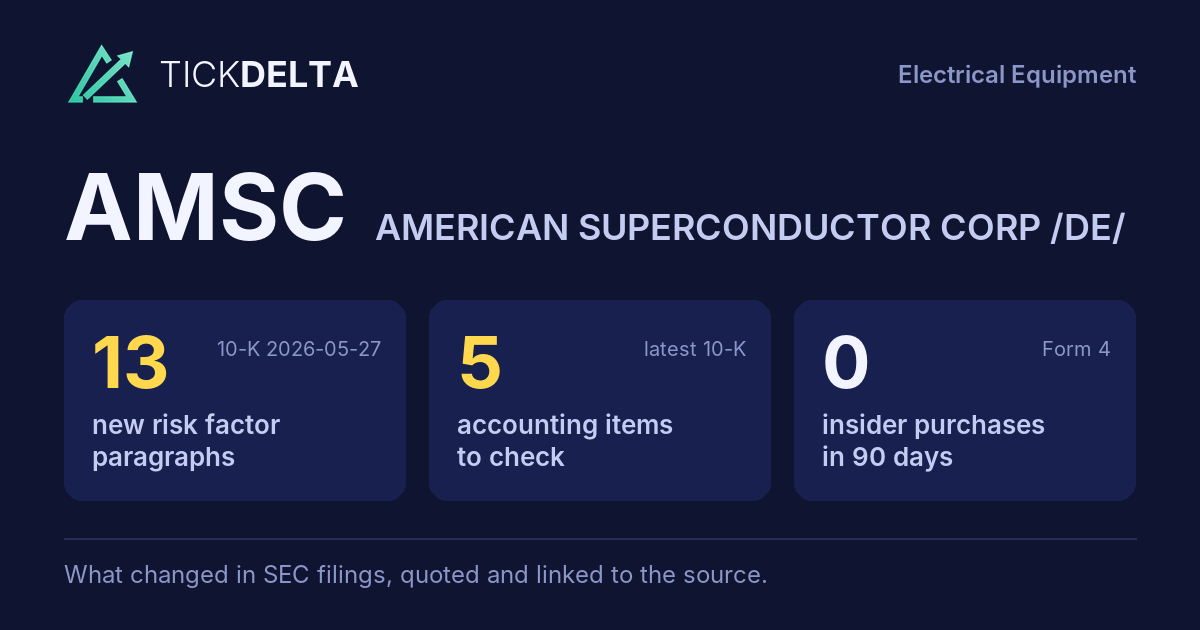
136 paragraphs · 13 new · 36 reworded · 7 gone · 10-K May 27, 2026 against May 21, 2025
New paragraph Reworded (5% of its words or more) Same or nearly
Paragraph 68 · 48% changed Every version of it
Maintaining effective internal control over financial reporting is necessary for us to produce reliable financial statements. If A material weaknesses weakness is a deficiency, or significant deficiencies a combination of deficiencies, in our internal control over financial reporting are discovered or occur in reporting, such that there is a reasonable possibility that a material misstatement of the future, our consolidated financial statements may contain material misstatements and we could will not be required to restate our financial results. prevented or detected on a timely basis.
Paragraph 96 · 43% changed Every version of it
We cannot predict with certainty the effect that new quotas, tariffs, taxes or other trade barriers upon the importation or exportation of our products or gauge the effect that new barriers would have on our financial position or results of operations. These new tariffs or any additional tariffs or other trade barriers may cause our costs to increase, our products to be less competitive, and our business, results of operations and financial position to be materially adversely affected. Moreover, in February 2026, the United States Supreme Court ruled that the use of the International Emergency Economic Powers Act ("IEEPA") to impose tariffs was not permitted, invalidating a significant portion of U.S. tariffs that had been in effect since April 2025. The Administration responded by invoking a 10% global tariff pursuant to section 122 of the Trade Act of 1974 for 150 days, effective February 24, 2026. The Administration also initiated trade investigations that could result in additional future tariffs. The ruling, and the Administration's subsequent actions, have created substantial uncertainty regarding the tariff environment, including with respect to (i) the timing and scope of any new tariffs that may be imposed under alternative mechanisms and (ii) the potential for further legal challenges to any such tariffs.
Paragraph 114 · 39% changed Every version of it
There has been increasing public focus by investors, customers, environmental activists, the media and governmental and nongovernmental organizations on climate, human capital, and other environmental, social and similar sustainability matters. If we are not effective in addressing environmental, social and other sustainability matters affecting our business, including any relevant sustainability goals, our reputation and financial results may suffer. While we may at times engage in voluntary initiatives (such as voluntary disclosures, certifications, or goals, among others) to improve our environmental, social, and governance ("ESG") profile or respond to stakeholder expectations, such initiatives may be costly and may not have the desired effect. For example, methodologies and data relevant to many ESG matters are evolving, in some cases quite rapidly; as a result, actions or statements that we may take based on information or processes we currently believe to be reasonable may subsequently be determined to be erroneous or not in keeping with current or future best practice. Moreover, we may not be able to successfully complete such initiatives due to factors that are within or outside of our control. Even if this is not the case, we cannot guarantee that our approaches or results will align with the expectations of any particular stakeholder. Stakeholder expectations are not uniform, and both advocates and opponents to certain ESG matters are increasingly resorting to a range of activism forms, including media campaigns and litigation, to advance their perspectives. There are also increasing evolving regulatory requirements related to various ESG matters. For example, various policymakers jurisdictions have adopted, or are considering adopting, requirements for the disclosure of climate- or other ESG-related information, or certain substantive considerations regarding ESG in operations, which may require significant additional costs to comply. As with other stakeholder expectations, such regulations are divergent and, at times, conflict, which may increase the costs and complexity of compliance and any associated risks. Any failure to successfully navigate regulatory developments and other stakeholder expectations may result in additional costs, difficulties in attracting or retaining customers or employees, reputational harm, regulatory or investor engagement, or other adverse impacts. Additionally, many of our customers and suppliers may be subject to similar expectations, which may augment or create additional risks, including risks that may not be known to us.
Paragraph 73 · 23% changed Every version of it
We have not been historically profitable, which may recur in the future. and there can be no assurance that we will sustain our recent profitability. Our operating results may fluctuate significantly from quarter to quarter and may fall below expectations in any particular fiscal quarter.
Paragraph 78 · 20% changed Every version of it
At March 31, 2025, 2026, we had approximately $85.4 $ 147.6 million of cash, cash equivalents and restricted cash, and during the fiscal year ended March 31, 2025, $28.3 2026, $ 23.1 million in cash was provided by our operating activities. In the current period, we experienced net income and positive operating cash flows. In prior years, we have experienced net losses and negative operating cash flows. We plan to continue to closely monitor our expenses and, if required, will further reduce operating costs and capital spending to enhance liquidity.
Paragraph 112 · 19% changed Every version of it
Increasing focus Evolving and scrutiny varied expectations on environmental sustainability and social initiatives could adversely impact our business and financial results.
Paragraph 113 · 18% changed Every version of it
There has been increasing public focus evolving and varied expectations by investors, customers, environmental activists, the media and governmental and nongovernmental organizations on climate, human capital, and other environmental, social and similar sustainability matters. If we are not effective in addressing environmental, social and other sustainability matters affecting our business, including any relevant sustainability goals, our reputation and financial results may suffer. While we may at times engage in voluntary initiatives (such as voluntary disclosures, certifications, or goals, among others) to improve our environmental, social, and governance ("ESG") profile or respond to certain stakeholder expectations, such initiatives may be costly and may not have the desired effect. For example, methodologies and data relevant to many ESG matters are evolving, in some cases quite rapidly; as a result, actions or statements that we may take based on information or processes we currently believe to be reasonable may subsequently be determined to be erroneous or not in keeping with current or future best practice. Moreover, we may not be able to successfully complete such initiatives due to factors that are within or outside of our control. Even if this is not the case, we cannot guarantee that our approaches or results will align with the expectations of any particular stakeholder. Stakeholder expectations are not uniform, and both advocates and opponents to certain ESG matters are increasingly resorting to a range of activism forms, including media campaigns and litigation, to advance their perspectives. There are also increasing regulatory requirements related to various ESG matters. For example, various policymakers have adopted, or are considering adopting, requirements for the disclosure of climate- or other ESG-related information, or certain substantive considerations regarding ESG in operations, which may require significant additional costs to comply. As with other stakeholder expectations, such regulations are divergent and, at times, conflict, which may increase the costs and complexity of compliance and any associated risks. Any failure to successfully navigate regulatory developments and other stakeholder expectations may result in additional costs, difficulties in attracting or retaining customers or employees, reputational harm, regulatory or investor engagement, or other adverse impacts. Additionally, many of our customers and suppliers may be subject to similar expectations, which may augment or create additional risks, including risks that may not be known to us.
Paragraph 19 · 15% changed Every version of it
unforeseen difficulties operating in new product areas, with new customers, or in new geographic areas. areas, including in emerging markets.

MD&A

65 paragraphs · 7 new · 35 reworded · 3 gone · 10-K May 27, 2026 against May 21, 2025
New paragraph Reworded (5% of its words or more) Same or nearly
Paragraph 15 · 50% changed
Cost of revenues increased by 46% 29% to $207.8 million in fiscal 2025, compared to $161.0 million in fiscal 2024, compared to $110.4 million in fiscal 2023. 2024. Gross margin increased to 31% in fiscal 2025 from 28% in fiscal 2024 from 24% 2024. Cost of revenues include total amortization expense of $0.6 million in the fiscal 2023. year ended March 31, 2026 as a result of Comtrafo acquired backlog intangible assets. In addition, $0.8 million related to a fair value adjustment for the step-up basis assigned to acquired inventory to properly reflect the fair value in purchase accounting was charged to cost of revenues in the fiscal year ended March 31, 2026. The increase in gross margin in fiscal 2024 2025 was due to additional revenues, a favorable product mix, higher revenues and a sharp improvement beneficial product mix in Neeltran project margins. the Grid and Wind business segments.
Paragraph 19 · 47% changed
The change in fair value of our contingent consideration for the earnout payment on the acquisition of NEPSI Comtrafo resulted in a loss of $3.4 $ 4.2 million resulting from an increase in fair value of the contingent consideration in fiscal 2024, and $4.9 million during fiscal 2023. During fiscal 2024, we issued 300,000 shares of our common stock to the selling stockholders following certification of the achievement of specified earnout revenue objectives. We also recorded a $3.3 million payment relating to the acquisition of NWL, as a payment to settle the remaining obligations after the acquisition. The value of this contingent consideration was de minimis at the Acquisition Date and the resulting change in fair value was recorded in September 2024 when the payment was calculated and paid. 2025.
Paragraph 64 · 46% changed
We regularly assess our ability to realize our deferred tax assets. Assessments of the realization of deferred tax assets require that management consider all available evidence, both positive and negative, and make significant judgments about many factors, including the amount and likelihood of future taxable income. Based on all As of March 31, 2026, the available evidence, we have Company recorded a $118.4 million non-cash income tax benefit related to the release of a substantial portion of its valuation allowances to reduce our allowance against deferred tax assets assets. This was based on the Company's evaluation of the positive evidence, including cumulative income position over the three year period ended March 31, 2026, revenue growth, current profitability, expectations regarding future forecasted income, and negative evidence, including uncertainty in economic and political environments from industry competition and dependence on government contracts. This release of the valuation allowance resulted in the recognition of a deferred tax asset and a corresponding increase to income tax benefit in fiscal 2025, the amount that effect of which is more likely than not to be realizable due to the taxable losses that have been incurred since our inception and uncertainty around our future profitability. an increase in reported net income.
Paragraph 52 · 42% changed
In March 2024, November 2025, the FASB issued ASU 2024-02, Codification Improvements—Amendments to Remove References to the Concepts Statements. 2025-08, Financial Instruments — Credit Losses: Purchased Loans. The amendments in ASU 2024-02 contain amendments to 2025-08 requires that loans acquired without credit deterioration and deemed “seasoned” will be considered purchased seasoned loans and accounted for using the Codification that remove references to various FASB Concepts Statements. gross-up approach at acquisition. Following the release of ASU 2024-02 2025-08 in March 2024, November 2025, the effective date will be annual reporting periods beginning after December 15, 2024. We are evaluating the 2026. As of April 1, 2025, we early adopted ASU 2025-08 and noted no material impact on our consolidated financial statements.
Paragraph 33 · 37% changed
Non-GAAP net income was $158.1 million, or $3.68 per share, for fiscal 2025, compared to $24.0 million, or $0.65 per share, for fiscal 2024, compared to 2024 and $0.6 million, or $0.02 per share, for fiscal 2023. The improvement in non-GAAP net income in fiscal 2024 2025 compared to fiscal 2023 2024 was due primarily to the non-cash tax benefit from the release of the majority of our valuation allowance against deferred income tax assets, and improved operating income driven by higher revenues margin in the Wind and gross margins. Grid business segments.
Paragraph 51 · 35% changed
In March 2024, July 2025, the FASB issued ASU 2024-02, Codification Improvements—Amendments to Remove References to the Concepts Statements. 2025-05, Financial Instruments—Credit Losses. The amendments in ASU 2024-02 2025-05 contain amendments updates to the Codification that remove references how entities are permitted to various FASB Concepts Statements. estimate expected credit losses for accounts receivable and contract assets. Following the release of ASU 2024-02 2025-05 in March July 2024, the effective date will be annual reporting periods beginning after December 15, 2024. We are evaluating the 2025. As of April 1, 2025, we early adopted ASU 2025-05 and noted no material impact on our consolidated financial statements.
Paragraph 4 · 32% changed
We operate our business under two market-facing business segments: Grid and Wind. We believe this market-centric market centric structure enables us to more effectively anticipate and meet the needs of power generation project developers, generators, power utilities, industrial manufacturers, the Navy's ship protection systems, electric utilities military and wind turbine manufacturers. renewable energy companies.
Paragraph 26 · 32% changed
We recorded an income tax benefit of $117.1 million in fiscal 2025, compared to $3.7 million in fiscal 2024, compared 2024. The net impact to income tax expense of $0.3 million in fiscal 2023. The net improvement in income tax is primarily a result of a non-cash tax benefit from the release of the majority of our valuation allowance against deferred tax assets due to the recording a change in facts and circumstances that impact our conclusion on realizability of the deferred tax liability from the acquisition of NWL. such assets.

A paragraph is matched with the one last year that shares the most of its words; under half in common makes it new. The paragraphs shown are the 8 reworded the most in each section.

The paragraph that changed most in each section

The redline

Marked against last year's 10-K: cut words struck through, new words highlighted.

MD&A154 words changed in this paragraph; it is 69% similar to last year's version.
Goodwill represents the excess of cost over net assets of acquired businesses that are consolidated. We perform our annual assessment of goodwill on February 28th of each fiscal year and whenever events or changes in circumstances or a triggering event indicate that the carrying amount may not be recoverable. An entity is permitted to Circumstances that could trigger an impairment test include, but are not limited to, a significant adverse change in the business climate or legal factors, an adverse action or assessment by a regulator, or unanticipated competition. The Company may first assess qualitatively qualitative factors to determine whether it is necessary to perform a the quantitative goodwill impairment test, or the Company can bypass the qualitative assessment and proceed directly to the quantitative test. Significant judgment is required to determine if an indication of impairment has taken place. Factors to be considered include the following: adverse change in operating results, decline in strategic business plans, significantly lower future cash flows, and sustainable declines in market data such as market capitalization. The quantitative goodwill impairment test is required only if requires the entity concludes that it is more likely than not that a reporting unit’s Company to estimate and compare the fair value is less than of the reporting unit with its carrying amount. value. We determine the fair value of a reporting unit, using a methodology which combines an income approach, using a discounted cash flow method, with a market approach. The income approach includes estimates and assumptions about revenue growth rates, operating margins EBITDA and terminal growth discount rates, discounted by an estimated weighted-average cost of capital derived from other publicly-traded publicly traded companies that are similar but not identical from an operational and economic standpoint. These estimates are based on historical experiences, our projects of future operating activity and our weighted-average cost of capital. A significant change in events, circumstances or any of these assumptions could adversely affect these estimates, which could result in an impairment.

Source: Item 7, 10-K 0001437749-26-018542 vs Item 7, 10-K 0001437749-25-017986

Risk Factors144 words changed in this paragraph; it is 76% similar to last year's version.
There has been increasing public focus evolving and varied expectations by investors, customers, environmental activists, the media and governmental and nongovernmental organizations on climate, human capital, and other environmental, social and similar sustainability matters. If we are not effective in addressing environmental, social and other sustainability matters affecting our business, including any relevant sustainability goals, our reputation and financial results may suffer. While we may at times engage in voluntary initiatives (such as voluntary disclosures, certifications, or goals, among others) to improve our environmental, social, and governance ("ESG") profile or respond to certain stakeholder expectations, such initiatives may be costly and may not have the desired effect. For example, methodologies and data relevant to many ESG matters are evolving, in some cases quite rapidly; as a result, actions or statements that we may take based on information or processes we currently believe to be reasonable may subsequently be determined to be erroneous or not in keeping with current or future best practice. Moreover, we may not be able to successfully complete such initiatives due to factors that are within or outside of our control. Even if this is not the case, we cannot guarantee that our approaches or results will align with the expectations of any particular stakeholder. Stakeholder expectations are not uniform, and both advocates and opponents to certain ESG matters are increasingly resorting to a range of activism forms, including media campaigns and litigation, to advance their perspectives. There are also increasing regulatory requirements related to various ESG matters. For example, various policymakers have adopted, or are considering adopting, requirements for the disclosure of climate- or other ESG-related information, or certain substantive considerations regarding ESG in operations, which may require significant additional costs to comply. As with other stakeholder expectations, such regulations are divergent and, at times, conflict, which may increase the costs and complexity of compliance and any associated risks. Any failure to successfully navigate regulatory developments and other stakeholder expectations may result in additional costs, difficulties in attracting or retaining customers or employees, reputational harm, regulatory or investor engagement, or other adverse impacts. Additionally, many of our customers and suppliers may be subject to similar expectations, which may augment or create additional risks, including risks that may not be known to us.

Source: Item 1A, 10-K 0001437749-26-018542 vs Item 1A, 10-K 0001437749-25-017986

Accounting Policies108 words changed in this paragraph; it is 68% similar to last year's version.
Deferred income taxes are recognized for the tax consequences in future fiscal years of differences between the tax bases of assets and liabilities and their financial reporting amounts at each fiscal year end based on enacted tax laws and statutory tax rates applicable to the periods in which the differences are expected to affect taxable income. Valuation allowances are established when necessary to reduce net deferred tax assets to the amount expected to be realized. As of March 31, 2026, the company recorded a $118.4 million non-cash income tax benefit related to the release of a substantial portion of its valuation allowance against deferred income tax assets. This was based on the Company's evaluation of the positive evidence, including cumulative net income position over the three year period ended March 31, 2026, revenue growth, current profitability, expectations regarding future forecasted income, and negative evidence, including uncertainty in economic and political environments from industry competition and dependence on government contracts. The Company has provided a valuation allowance against certain of its U.S., Poland, U.S. deferred income tax assets and Romania a full valuation allowance on its Poland deferred income tax assets since the Company believes that it is more likely than not that these deferred tax assets are not currently realizable due to uncertainty around profitability to fully utilize these deferred tax assets in the future.

Source: Item 8, Note 3 – Summary of Significant Accounting Policies, 10-K 0001437749-26-018542 vs Item 8, Note 3 – Summary of Significant Accounting Policies, 10-K 0001437749-25-017986

Legal Proceedings2 words changed in this paragraph; it is 96% similar to last year's version.
During the fiscal years ended March 31, 2025 2026, 2025, and 2024, 2024 all lease costs were recorded in selling, general and administrative expense. See Note 16, "Leases" for further details.

Source: Item 3, via Note 18 – Commitments and Contingencies, 10-K 0001437749-26-018542 vs Item 3, via Note 18 – Commitments and Contingencies, 10-K 0001437749-25-017986

Sentences and paragraphs added, removed or reworded

Every change, by type

Sentences and paragraphs of AMSC's Risk Factors and MD&A, 10-K May 27, 2026 against 10-K May 21, 2025. Each links to the text at sec.gov.

Quiet changes are sentences kept from last year with one to four words changed, at least one of them a hedge, a modal or a qualifier (may, could, will, not, significant, material…). A year or date rolling forward is not counted.

The full word list

adverse, adversely, all, although, anticipate, anticipates, any, approximately, believe, believes, can, cannot, certain, could, expect, expects, generally, however, if, intend, intends, largely, likely, many, material, materially, may, might, most, must, never, no, not, possible, primarily, probable, should, significant, significantly, some, substantial, substantially, unlikely, will, would

AddedRisk Factors
Our performance on contracts with the U.S. Department of Defense may result in restrictions to our ability to repurchase our common stock or U.S. government denial of Foreign Military Sales or ceasing of assistance for international Direct Commercial Sales.
Read it in 10-K May 27, 2026 at sec.gov
AddedRisk Factors
On January 7, 2026, the President of the United States signed an Executive Order titled "Prioritizing the Warfighter in Defense Contracting," (the "Executive Order") which directs the Secretary of Defense to identify contractors for critical weapons, supplies, and equipment that have engaged in stock repurchases or dividend distributions and are underperforming on their contracts, not investing capital into necessary production capacity, not prioritizing contract performance, or whose production speed is insufficient (collectively, "Underperformance"). Contractors that fail to remediate their Underperformance may be subject to enforcement actions under the Defense Production Act or contract law. Future defense contract awards will contain provisions prohibiting stock repurchases or dividend distributions and capping executive base salaries during periods of Underperformance as determined by the Secretary of Defense, and will require that executive incentive compensation be linked to on-time delivery of work under defense contracts, increased production, and facilitation of investments and operating improvements. The Secretary of Defense may also deny new advocacy cases for Foreign Military Sales or cease ongoing advocacy efforts for international Direct Commercial Sales for Underperforming contractors.
Read it in 10-K May 27, 2026 at sec.gov
AddedRisk Factors
Our failure to sufficiently perform and prioritize our U.S. defense contracts, invest capital into production, capacity, or perform our contracts at the appropriate speed could result in restrictions to our ability to repurchase our common stock, issue dividends, or compete for International Foreign Military Sales or Direct Commercial Sales Contracts. In addition, the U.S. government could terminate our existing contracts or withhold payment for completed work due to Underperformance. The U.S. government could also cap the base salaries for our executives based upon the Secretary of Defense's finding of Underperformance.
Read it in 10-K May 27, 2026 at sec.gov
AddedRisk Factors
Given the recency of the Executive Order, it is unclear how the U.S. government will implement its enforcement provisions or what metrics or conditions the Secretary of Defense will use to identify Underperforming defense contractors. If any of the foregoing were to occur, it could materially harm our business, result in reduced revenue and profitability, damage our reputation and customer relationships, or affect our stock price and increase its volatility.
Read it in 10-K May 27, 2026 at sec.gov
AddedRisk Factors
We are required to periodically review our deferred tax assets and determine whether, based on available evidence, a valuation allowance is necessary. In fiscal 2025, based on our evaluation of all available positive and negative evidence, we concluded that it was more-likely-than not that a significant portion of our federal and state deferred tax assets would be realized. Accordingly, we released the valuation allowance against these deferred tax assets. The assessment of the realizability of future tax assets involved considerable management judgement and required evaluation of all available evidence, including cumulative recent financial performance and forecasts of future taxable income. As a result of this assessment, we recognized a deferred income tax benefit of $118.4 million in fiscal 2025. Our judgement regarding the likelihood of realization of these deferred tax assets could change in future periods, which could result in a material impact to our income tax provision expense and our results of operations in the period in which the valuation allowance is adjusted.
Read it in 10-K May 27, 2026 at sec.gov
AddedRisk Factors
During the fourth quarter of fiscal 2025, in connection with the preparation of our financial statements for this Annual Report on Form 10-K, management identified the following material weakness: We did not maintain effective internal controls over preparation and review of the initial purchase accounting and the continuing fair value accounting associated with the Comtrafo Acquisition to ensure the accurate and timely reporting of our financial results related to this acquisition. Specifically, errors went undetected in amounts initially recorded to the opening balance sheet due to controls not operating at the appropriate level of precision during management's review process which could have led to a reasonable possibility of material misstatement to account balances or disclosures.
Read it in 10-K May 27, 2026 at sec.gov
AddedRisk Factors
Notwithstanding the material weakness, we believe that our financial statements contained in this Annual Report on Form 10-K fairly present our financial position, results of operations and cash flows for the periods covered by this report in all material respects.
Read it in 10-K May 27, 2026 at sec.gov
Show the other 47
AddedRisk Factors
Our management, with the oversight of our audit committee, has initiated steps and plans to take additional measures to remediate the underlying causes of the material weakness, which we currently believe will be primarily through the development and implementation of new levels of precision of management review controls around business acquisitions.
Read it in 10-K May 27, 2026 at sec.gov
AddedRisk Factors
While we achieved profitable results in fiscal 2025 and 2024, our ability to sustain profitability depends on numerous factors, many of which are outside of our control. If we are unable to maintain profitability, we could be required to take charges, including the potential restoration of some or all of the valuation allowance against our deferred tax assets, which could materially affect our financial condition and results of operations.
Read it in 10-K May 27, 2026 at sec.gov
AddedRisk Factors
The ongoing conflict between the United States, Israel, and Iran has disrupted global energy markets and supply chains and could adversely affect our business, financial condition, and results of operations
Read it in 10-K May 27, 2026 at sec.gov
AddedRisk Factors
In February 2026, the United States and Israel launched coordinated military strikes against Iran, which retaliated with missile attacks across the region. Although we do not have material operations in the Middle East, the ongoing conflict and any further escalation has and could continue to lead to significant disruption of global energy supplies and increases in global energy prices, which could affect demand for our Grid and Wind products and solutions in multiple ways. Higher energy prices and energy market volatility may alter utility and industrial customer spending patterns and priorities, potentially accelerating investment in grid infrastructure and resilience in certain markets while constraining capital budgets in others. The conflict could also increase the cost or reduce the availability of commodity-based raw materials we depend on, including stainless steel, nickel, and copper, and disrupt global supply chains on which we and our suppliers rely. In addition, further escalation could heighten inflationary pressures on our input costs, adversely affect global financial markets, increase currency exchange rate volatility, including with respect to Brazilian Real and the Euro, in which a significant portion of our revenues and costs are denominated, and elevate interest rates, which could increase the cost of future debt financing and affect our ability to execute our acquisition-driven growth strategy on favorable terms. The conflict could also affect U.S. defense spending priorities and appropriations, which could positively or negatively impact funding for our ship protection systems and other defense-related programs with the U.S. Navy. Finally, increased geopolitical instability in the Middle East could adversely affect our ability to pursue business opportunities in the region, including in countries where we have existing or prospective customer relationships. While the impacts of the conflict between the United States, Israel, and Iran may have an adverse effect on our business, financial condition, and results of operations, we are unable to predict the extent or nature of these impacts at this time.
Read it in 10-K May 27, 2026 at sec.gov
RemovedRisk Factors
We were profitable in fiscal 2024, however, we have recorded net losses for the prior three fiscal years. We may not be profitable in fiscal 2025 or future years. While we achieved profitable results in fiscal 2024, we cannot be certain that we will sustain profitability in future years.
Read it in 10-K May 21, 2025 at sec.gov
RemovedRisk Factors
We face competition from other companies offering FACTS systems similar to our D-VAR products. These include adaptive VAR compensators, Dynamic voltage restorers (“DVRs”), and STATCOMs produced by ABB, Hitachi, Ingeteam, Mitsubishi, RXHK, and Siemens, and battery-based uninterruptable power supply (“UPS”) systems offered by various companies around the world.
Read it in 10-K May 21, 2025 at sec.gov
RemovedRisk Factors
We face competition from other companies offering medium-voltage metal-enclosed power capacitor banks and harmonic filter banks for use on electric power systems similar to our NEPSI products. These include Southern States, Controllix, Powerside, Elgin Power Solutions (formally Gilbert), Scott Manufacturing Solutions, and QVARx.
Read it in 10-K May 21, 2025 at sec.gov
RemovedRisk Factors
We face competition from other companies offering DC power supply systems similar to our Neeltran products. These include SCR Controlled Rectifiers, IGBT-controlled choppers produced by ABB, Siemens, Friem, Dynapower, and Nidec offering systems around the world.
Read it in 10-K May 21, 2025 at sec.gov
RemovedRisk Factors
We face competition from other companies offering transformers and power supplies similar to our NWL products. These include industrial and military transformers produced by Espey Manufacturing & Electronics Corp., Hammond and Ocrev, and power supplies offered by Kraft Powercon, Andritz, Lonking Holdings, and Rico.
Read it in 10-K May 21, 2025 at sec.gov
RemovedRisk Factors
To date, there has been no widespread commercial use of the REG system. It is uncertain whether a robust commercial market for those new and unproven products will ever develop.
Read it in 10-K May 21, 2025 at sec.gov
RewordedRisk Factors
We cannot provide any assurance that we will realize any of the anticipated benefits of any acquisition, including our acquisition of Megatran Industries, Inc. including its subsidiaries, completed in August 2024, and if we fail to realize these anticipated benefits, our operating performance could suffer. Comtrafo Indústria de Transformadores Elétricos S.A.
Read it in 10-K May 27, 2026 at sec.gov
RewordedRisk Factors
We cannot provide any assurance that we will realize any of the anticipated benefits of any acquisition, including our acquisition of (“Comtrafo”), completed in December 2025, and Megatran Industries, Inc. including its subsidiaries, completed in August 2024, and if we fail to realize these anticipated benefits, our operating performance could suffer.
Read it in 10-K May 27, 2026 at sec.gov
RewordedRisk Factors
Our success depends significantly upon our ability to enhance our products and technologies and to develop and introduce, on a timely and cost-effective basis, new products and features that meet changing customer requirements and incorporate technological enhancements. enhancements, which may include artificial intelligence, machine learning, and other advanced digital technologies that are increasingly central to product development, manufacturing efficiency, and customer engagement.
Read it in 10-K May 27, 2026 at sec.gov
RewordedRisk Factors
Even if a commercial market for our REG systems were to develop, commercial terms requested by utilities and power grid operators third parties, such as relating to bonding requirements, limitations of liability, warranty periods, or other contractual provisions, may not be acceptable to us, which could impede our ability to enter into contractual arrangements for the sale of our REG system. products and systems.
Read it in 10-K May 27, 2026 at sec.gov
RewordedRisk Factors
Furthermore, widespread product failures or other shortcomings of our products may damage our market reputation and reputation, reduce our market share and share, create product liability obligations or cause sales to decline.
Read it in 10-K May 27, 2026 at sec.gov
RewordedRisk Factors
For more information, please refer to our risk factor titled “The increasing focus “Evolving and varied expectations on environmental sustainability and social initiatives could increase our costs, and inaction could harm our reputation and adversely impact our financial results."
Read it in 10-K May 27, 2026 at sec.gov
RewordedRisk Factors
For example, 52% of our revenues in fiscal 2025 and 31% of our revenues in fiscal 2024 and 37% of our revenues in fiscal 2023 were recognized from sales outside the United States.
Read it in 10-K May 27, 2026 at sec.gov
RewordedRisk Factors
To date, we have had limited success marketing and selling our superconductor products and system-level solutions. solutions and there has been no widespread commercial use of the REG system.
Read it in 10-K May 27, 2026 at sec.gov
RewordedRisk Factors
Our financial performance depends upon our ability to carry on our operations and sell our products in markets such as India, as well as other emerging markets around the world. markets.
Read it in 10-K May 27, 2026 at sec.gov
RewordedRisk Factors
Our business strategy envisions several initiatives, including driving revenue growth and enhancing operating results by increasing customer adoption of our products by targeting high-growth segments with commercial and system-level products. products as well as identifying and completing opportunistic acquisitions.
Read it in 10-K May 27, 2026 at sec.gov
RewordedRisk Factors
At March 31, 2025, 2026, we had approximately $85.4 $ 147.6 million of cash, cash equivalents and restricted cash, and during the fiscal year ended March 31, 2025, $28.3 2026, $ 23.1 million in cash was provided by our operating activities.
Read it in 10-K May 27, 2026 at sec.gov
RewordedRisk Factors
In the United States, various legislation and regulations designed to support the growth of wind energy have had been implemented or proposed by the federal government, proposed, such as the Inflation Reduction Act, Production Tax Credit for Renewable Energy (“PTC”) ("PTC") and the Clean Power Plan.
Read it in 10-K May 27, 2026 at sec.gov
Quiet changesRisk Factors
Any failure to manage, expand, or update our IT Systems or Confidential Information or any disruption to or failure in the operation of such IT Systems or Confidential Information could materially harm our business.
Read it in 10-K May 27, 2026 at sec.gov
Quiet changesRisk Factors
While we may at times engage in voluntary initiatives (such as voluntary disclosures, certifications, or goals, among others) to improve our environmental, social, and governance ("ESG") profile or respond to certain stakeholder expectations, such initiatives may be costly and may not have the desired effect.
Read it in 10-K May 27, 2026 at sec.gov
AddedMD&A
Guided by a belief in the power of next, we are a leading provider of power control solutions that apply innovation and creativity to address today’s challenges and enable a more resilient and sustainable energy future. Driven by our purpose “to power progress,” we integrate future-facing technologies to balance the growing global demand for power with the need for reliable, and efficient power delivery. Our advanced grid systems, engineering services, power electronics, software controls, and superconductor-based solutions help the traditional and renewable energy sectors, electric utilities, the materials and mining sector, industrial facilities, and other critical infrastructure operators optimize network reliability, improve power quality, alleviate grid constraints, and scale operations without added complexity or size.
Read it in 10-K May 27, 2026 at sec.gov
AddedMD&A
We also deliver ship protection and power management solutions that enhance fleet efficiency, survivability, and operational readiness for the U.S. Navy and allied fleets. In the wind power market, we provide advanced electrical control systems, engineering, and support services that help manufacturers lower the cost of wind energy and improve turbine performance. Beyond these markets, we provide industrial process, environmental and emission control capabilities that support operational efficiency across the broader energy infrastructure. Across our businesses, our solutions are helping optimize power networks, strengthen naval capabilities, and support gigawatts of renewable energy generation worldwide as governments and industries continue investing in more resilient, secure, and sustainable power systems.
Read it in 10-K May 27, 2026 at sec.gov
AddedMD&A
On December 5, 2025 (the "Comtrafo Acquisition Date"), we entered into a Stock Exchange Agreement (the "Stock Exchange Agreement") with the selling stockholders named therein. Pursuant to the terms of the Stock Exchange Agreement, Mardin Participações Ltda., an entity incorporated in Brazil (“AMSC Brazil”) and our wholly-owned subsidiary, directly or indirectly, purchased all of the issued and outstanding shares of Comtrafo Indústria de Transformadores Elétricos S.A. ("Comtrafo") (the "Comtrafo Acquisition") for (a) (i) 300.0 million Brazilian Real in cash; and (b) 2,417,142 restricted shares of our common stock, $0.01 par value per share (the "AMSC Shares") that were paid and issued, respectively, at closing. In addition, pursuant to certain additional real property agreements, AMSC Brazil through Comtrafo purchased certain real estate assets and transportation assets of Comtrafo for 155.6 million Brazilian Real and 13.4 million Brazilian Real, respectively, in cash. Additionally, AMSC Brazil has agreed to pay the selling stockholders up to an additional 382.5 million Brazilian Real in cash (the "Earnout") upon the achievement of specified earnings before interest, taxes, depreciation, and amortization ("EBITDA") objectives during the three years following the closing. On May 15, 2026, pursuant to the terms of the Stock Exchange Agreement, Comtrafo purchased a certain real estate asset from the selling stockholders that Comtrafo was leasing and using for administrative and manufacturing operations for 37.2 million Brazilian Real in cash. Comtrafo is a Brazil-based manufacturer of large power and distribution transformers primarily for utility customers and also for industrial customers.
Read it in 10-K May 27, 2026 at sec.gov
AddedMD&A
A discussion regarding our financial condition and results of operations for the year ended March 31, 2026 compared to the year ended March 31, 2025 is presented below. A discussion regarding our financial condition and results of operations for year ended March 31, 2025 compared to March 31, 2024 is included under "Management's Discussion and Analysis of Financial Condition and Results of Operations" in our Annual Report on Form 10-K for the year ended March 31, 2025 filed with the SEC on May 21, 2025.
Read it in 10-K May 27, 2026 at sec.gov
AddedMD&A
On the Comtrafo Acquisition Date, we entered into the Stock Exchange Agreement with the selling stockholders. Pursuant to the terms of the Stock Exchange Agreement, AMSC Brazil, directly or indirectly, purchased all of the issued and outstanding shares of Comtrafo for (a) (i) 300.0 million Brazilian Real in cash; and (b) AMSC Shares that were paid and issued, respectively, at closing. In addition, pursuant to certain additional real property agreements, AMSC Brazil through Comtrafo purchased certain real estate assets and transportation assets of Comtrafo for 155.6 million Brazilian Real and 13.4 million Brazilian Real, respectively, in cash. Additionally, AMSC Brazil has agreed to pay the Stockholders the Earnout upon the achievement of specified EBITDA objectives during the three years following the closing. Comtrafo is a Brazil-based manufacturer of large power and distribution transformers primarily for utility customers and also for industrial customers.
Read it in 10-K May 27, 2026 at sec.gov
AddedMD&A
In June 2025, we completed an offering of 4,743,750 shares of our common stock at a public offering price of $28.00 per share under our Registration Statement on Form S-3. We received aggregate net proceeds of approximately $124.6 million after deducting underwriting discounts and commissions and offering expenses.
Read it in 10-K May 27, 2026 at sec.gov
RemovedMD&A
We are a leading system provider of megawatt-scale power resiliency solutions that orchestrate the rhythm and harmony of power on the grid™, and protect and expand the capability of our Navy's fleet. Our solutions enhance the performance of the power grid, protect our Navy’s fleet, and lower the cost of wind power. In the power grid market, we enable electric utilities, industrial facilities, and renewable energy project developers to connect, transmit and distribute smarter, cleaner and better power through our transmission planning services and power electronics and superconductor-based systems. In the wind power market, we enable manufacturers to field highly competitive wind turbines through our advanced power electronics and control system products, engineering, and support services. Our power grid and wind products and services provide exceptional reliability, security, efficiency and affordability to our customers.
Read it in 10-K May 21, 2025 at sec.gov
RemovedMD&A
Our power system solutions help to improve energy efficiency, alleviate power grid capacity constraints, improve system resiliency, and increase the adoption of renewable energy generation. Demand for our solutions is driven by the growing needs for modernized smart grids that improve power reliability, security and quality, the U.S. Navy's effort to upgrade onboard power systems to support fleet electrification, and the needs for increased renewable sources of electricity, such as wind and solar energy. Concerns about these factors have led to increased spending by corporations and the military, as well as supportive government regulations and initiatives on local, state, and national levels, including renewable portfolio standards, tax incentives and international treaties.
Read it in 10-K May 21, 2025 at sec.gov
RemovedMD&A
We manufacture products using two proprietary core technologies: PowerModule™ programmable power electronic converters and our Amperium® high temperature superconductor ("HTS") wires. These technologies and our system-level solutions are protected by a robust intellectual property portfolio consisting of patents and patent applications worldwide and rights through exclusive and non-exclusive licenses.
Read it in 10-K May 21, 2025 at sec.gov
RewordedMD&A
The increase decrease in net cash provided by operations in fiscal 2024 2025 compared to fiscal 2023 2024 was driven due primarily to changes in deferred revenue and accounts receivable, offset by higher gross margins, favorable changes in accounts payable and accrued expenses, relief of deferred revenue, increased non-cash expenses like stock-based compensation, depreciation and amortization, and change income taxes, changes in fair value of contingent consideration, offset by decreased cash collections, increased prepaid balances, consideration and change in deferred income taxes. stock-based compensation expense.
Read it in 10-K May 27, 2026 at sec.gov
RewordedMD&A
The improvement in net income was driven primarily by the non-cash tax benefit from the release of the majority of our valuation allowance against deferred tax assets, higher revenues and improved gross margins in fiscal 2024 and other factors described above. 2025.
Read it in 10-K May 27, 2026 at sec.gov
RewordedMD&A
We believe this market-centric market centric structure enables us to more effectively anticipate and meet the needs of power generation project developers, generators, power utilities, industrial manufacturers, the Navy's ship protection systems, electric utilities military and wind turbine manufacturers. renewable energy companies.
Read it in 10-K May 27, 2026 at sec.gov
RewordedMD&A
The increase in gross margin in fiscal 2024 2025 was due to additional revenues, a favorable product mix, higher revenues and a sharp improvement beneficial product mix in Neeltran project margins. the Grid and Wind business segments.
Read it in 10-K May 27, 2026 at sec.gov
RewordedMD&A
The decrease increase in other expense expense, net was driven by the impacts of more favorable unfavorable fluctuations in foreign currencies exchange rates, resulting in fiscal 2024, compared to fiscal 2023. translation losses.
Read it in 10-K May 27, 2026 at sec.gov
RewordedMD&A
The decrease increase in cash provided by financing activities in fiscal 2025 compared to fiscal 2024 was primarily related to net proceeds received from an equity offering in fiscal 2023, while the Company had no equity offerings in fiscal 2024. June 2025.
Read it in 10-K May 27, 2026 at sec.gov
RewordedMD&A
Unallocated corporate expenses consisted of a loss on contingent consideration of $4.2 million in fiscal 2025 and $6.7 million in fiscal 2024, and a loss on contingent consideration of $4.9 million in fiscal 2023. 2024.
Read it in 10-K May 27, 2026 at sec.gov
RewordedMD&A
The increase in R&D expenses is primarily a result of additional total compensation and stock compensation expense due expenses in part to additional employees as a result of the acquisition of NWL. fiscal 2025.
Read it in 10-K May 27, 2026 at sec.gov
RewordedMD&A
The change in fair value of our contingent consideration for the earnout payment on the acquisition of NEPSI Comtrafo resulted in a loss of $3.4 $ 4.2 million resulting from an increase in fair value of the contingent consideration in fiscal 2024, and $4.9 million during fiscal 2023. 2025.
Read it in 10-K May 27, 2026 at sec.gov

Sources

The two latest 10-Ks on EDGAR, section by section. Each change links to the text at sec.gov.

Also

New risk factors: paragraphs with nothing like them last year, quoted in full.

Work with it

Excel workbook · CSV. Google Sheet that stays up to date: paste =IMPORTDATA("https://tickdelta.com/company/AMSC/export.csv") into a cell.

Next:Related parties
Esc

Type a ticker such as AAPL, a name, an investor such as Buffett, or a topic such as tariffs. ↑ ↓ to move, Enter to open.