Added10-Q Nov 4, 2026 vs 10-K May 27, 2026
The Company’s stock repurchase activity during the three months ended September 30, 2026 was as follows:
Each branch is a paragraph in Risk Factors with nothing like it in the 10-K filed May 21, 2025. A box jumps to the paragraph as filed, below.
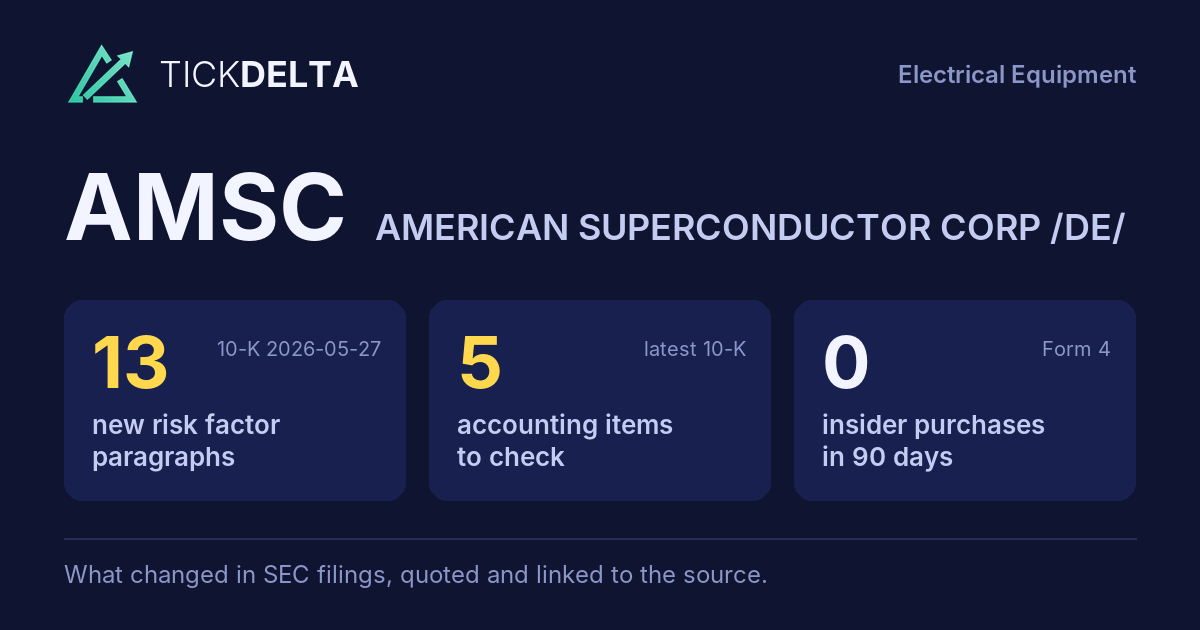
13 paragraphs in Risk Factors of the 10-K filed May 27, 2026 with nothing like them in the 10-K filed May 21, 2025. Quoted exactly. Paragraphs that were only edited are under 10-K change.
Our performance on contracts with the U.S. Department of Defense may result in restrictions to our ability to repurchase our common stock or U.S. government denial of Foreign Military Sales or ceasing of assistance for international Direct Commercial Sales.
On January 7, 2026, the President of the United States signed an Executive Order titled "Prioritizing the Warfighter in Defense Contracting," (the "Executive Order") which directs the Secretary of Defense to identify contractors for critical weapons, supplies, and equipment that have engaged in stock repurchases or dividend distributions and are underperforming on their contracts, not investing capital into necessary production capacity, not prioritizing contract performance, or whose production speed is insufficient (collectively, "Underperformance"). Contractors that fail to remediate their Underperformance may be subject to enforcement actions under the Defense Production Act or contract law. Future defense contract awards will contain provisions prohibiting stock repurchases or dividend distributions and capping executive base salaries during periods of Underperformance as determined by the Secretary of Defense, and will require that executive incentive compensation be linked to on-time delivery of work under defense contracts, increased production, and facilitation of investments and operating improvements. The Secretary of Defense may also deny new advocacy cases for Foreign Military Sales or cease ongoing advocacy efforts for international Direct Commercial Sales for Underperforming contractors.
Our failure to sufficiently perform and prioritize our U.S. defense contracts, invest capital into production, capacity, or perform our contracts at the appropriate speed could result in restrictions to our ability to repurchase our common stock, issue dividends, or compete for International Foreign Military Sales or Direct Commercial Sales Contracts. In addition, the U.S. government could terminate our existing contracts or withhold payment for completed work due to Underperformance. The U.S. government could also cap the base salaries for our executives based upon the Secretary of Defense's finding of Underperformance.
Given the recency of the Executive Order, it is unclear how the U.S. government will implement its enforcement provisions or what metrics or conditions the Secretary of Defense will use to identify Underperforming defense contractors. If any of the foregoing were to occur, it could materially harm our business, result in reduced revenue and profitability, damage our reputation and customer relationships, or affect our stock price and increase its volatility.
Changes in valuation allowance of deferred tax assets may affect our future operating results.
We are required to periodically review our deferred tax assets and determine whether, based on available evidence, a valuation allowance is necessary. In fiscal 2025, based on our evaluation of all available positive and negative evidence, we concluded that it was more-likely-than not that a significant portion of our federal and state deferred tax assets would be realized. Accordingly, we released the valuation allowance against these deferred tax assets. The assessment of the realizability of future tax assets involved considerable management judgement and required evaluation of all available evidence, including cumulative recent financial performance and forecasts of future taxable income. As a result of this assessment, we recognized a deferred income tax benefit of $118.4 million in fiscal 2025. Our judgement regarding the likelihood of realization of these deferred tax assets could change in future periods, which could result in a material impact to our income tax provision expense and our results of operations in the period in which the valuation allowance is adjusted.
During the fourth quarter of fiscal 2025, in connection with the preparation of our financial statements for this Annual Report on Form 10-K, management identified the following material weakness: We did not maintain effective internal controls over preparation and review of the initial purchase accounting and the continuing fair value accounting associated with the Comtrafo Acquisition to ensure the accurate and timely reporting of our financial results related to this acquisition. Specifically, errors went undetected in amounts initially recorded to the opening balance sheet due to controls not operating at the appropriate level of precision during management's review process which could have led to a reasonable possibility of material misstatement to account balances or disclosures.
Notwithstanding the material weakness, we believe that our financial statements contained in this Annual Report on Form 10-K fairly present our financial position, results of operations and cash flows for the periods covered by this report in all material respects.
Our management, with the oversight of our audit committee, has initiated steps and plans to take additional measures to remediate the underlying causes of the material weakness, which we currently believe will be primarily through the development and implementation of new levels of precision of management review controls around business acquisitions.
While we achieved profitable results in fiscal 2025 and 2024, our ability to sustain profitability depends on numerous factors, many of which are outside of our control. If we are unable to maintain profitability, we could be required to take charges, including the potential restoration of some or all of the valuation allowance against our deferred tax assets, which could materially affect our financial condition and results of operations.
The ongoing conflict between the United States, Israel, and Iran has disrupted global energy markets and supply chains and could adversely affect our business, financial condition, and results of operations
In February 2026, the United States and Israel launched coordinated military strikes against Iran, which retaliated with missile attacks across the region. Although we do not have material operations in the Middle East, the ongoing conflict and any further escalation has and could continue to lead to significant disruption of global energy supplies and increases in global energy prices, which could affect demand for our Grid and Wind products and solutions in multiple ways. Higher energy prices and energy market volatility may alter utility and industrial customer spending patterns and priorities, potentially accelerating investment in grid infrastructure and resilience in certain markets while constraining capital budgets in others. The conflict could also increase the cost or reduce the availability of commodity-based raw materials we depend on, including stainless steel, nickel, and copper, and disrupt global supply chains on which we and our suppliers rely. In addition, further escalation could heighten inflationary pressures on our input costs, adversely affect global financial markets, increase currency exchange rate volatility, including with respect to Brazilian Real and the Euro, in which a significant portion of our revenues and costs are denominated, and elevate interest rates, which could increase the cost of future debt financing and affect our ability to execute our acquisition-driven growth strategy on favorable terms. The conflict could also affect U.S. defense spending priorities and appropriations, which could positively or negatively impact funding for our ship protection systems and other defense-related programs with the U.S. Navy. Finally, increased geopolitical instability in the Middle East could adversely affect our ability to pursue business opportunities in the region, including in countries where we have existing or prospective customer relationships. While the impacts of the conflict between the United States, Israel, and Iran may have an adverse effect on our business, financial condition, and results of operations, we are unable to predict the extent or nature of these impacts at this time.
We face competition across our product lines from companies like ABB, Hitachi, Ingeteam, Mitsubishi and Siemens. We face more local competition in a subset of our business like power quality by companies that include, Southern States, Controllix, Powerside, Elgin Power, Scott Manufacturing and QVARx. Additionally, we face competition on our power transformers and power supplies from companies like Friem, Dynapower, Nidec, Espey Manufacturing, Hammond, WEG S.A., and Kraft Powercon.
New in the latest 10-Q
3 paragraphs in the 10-Q filed Nov 4, 2026 with nothing like them in the 10-Q filed Aug 5, 2026 (at least half the words must differ; new numbers alone do not count). Quoted exactly, grouped by the item heading above them. This is text that changed, not a judgement of how serious it is.
Infrequently, the Company receives requests from customers to hold product being purchased from it for a valid business purpose. The Company recognizes revenues for such arrangements provided the transactions meets, at a minimum, the following criteria: the reason for the bill-and-hold arrangement must be substantive; the product must be identified separately as belonging to the customer; the product must be then currently ready for physical transfer to the customer; the entity cannot have the ability to use the product or direct it to another customer. Revenue for the three and six months ended September 30, 2026 included $0.7 million from such held transactions. Revenue for the three and six months ended September 30, 2025 included $7.9 million from such held transactions.
Read in the 10-Q
Based on such evaluation, our Chief Executive Officer and Chief Financial Officer have concluded that our disclosure controls and procedures were effective at the reasonable level as of September 30, 2026.
Read in the 10-Q
During the second quarter of fiscal 2026, management implemented new procedures, policies, and processes, including revising the precision level of management review controls and additional level of review procedures around significant areas of judgements and material balances in order to remediate the material weakness. During this same quarter, we completed our testing of the operating effectiveness of the implemented controls and found them to be effective. As a result, we have concluded that the material weakness has been remediated as of September 30, 2026.
Read in the 10-Q
Item 1A of the 10-Q filed Nov 4, 2026 against Item 1A of the 10-K filed May 27, 2026.
A 10-Q repeats only the risks that changed, so a 10-K paragraph that is missing from it is not counted as removed.
Added is a paragraph with nothing like it in the 10-K, Reworded a sentence that is in both with several words changed,
Quiet changes a sentence in both where one to four words changed and one is a hedge or a modal
(cut words struck through, new words highlighted).
Text on the page, not a score; each links to the filing at sec.gov.
What the 10-Q itself says about its risk factors:There have been no material changes to the risk factors described in Part I, Item 1A of our Annual Report on Form 10-K for the fiscal year ended March 31, 2026, filed with the SEC on May 27, 2026.
Read in the 10-Q
Two-word phrases in Risk Factors of the 10-K filed May 27, 2026 that are in none of the 1 earlier 10-Ks stored, back to May 21, 2025
Used at least twice, small words left out. Counted, not picked: a phrase can be new because the company renamed something.
7 paragraphs of last year's Risk Factors with nothing like them now. The longest are quoted.
Item 1A of each 10-K and 10-Q on EDGAR, quoted exactly. Each paragraph links to the filing at sec.gov.
10-K change: what was reworded or cut, section by section.
Excel workbook · CSV. Google Sheet that stays up to date: paste =IMPORTDATA("https://tickdelta.com/company/AMSC/export.csv") into a cell.