Paragraph 162 · 50% changed
Every version of it
Screener
/
SEC EDGAR
/CIK 0002011286
/10-K filed Nov 25, 2025, compared with Dec 17, 2024
/Numbers from the XBRL of the 10-Ks
NYSE
Industrials · Business Services
Amentum Holdings, Inc. AMTM
The 10-K against last year's
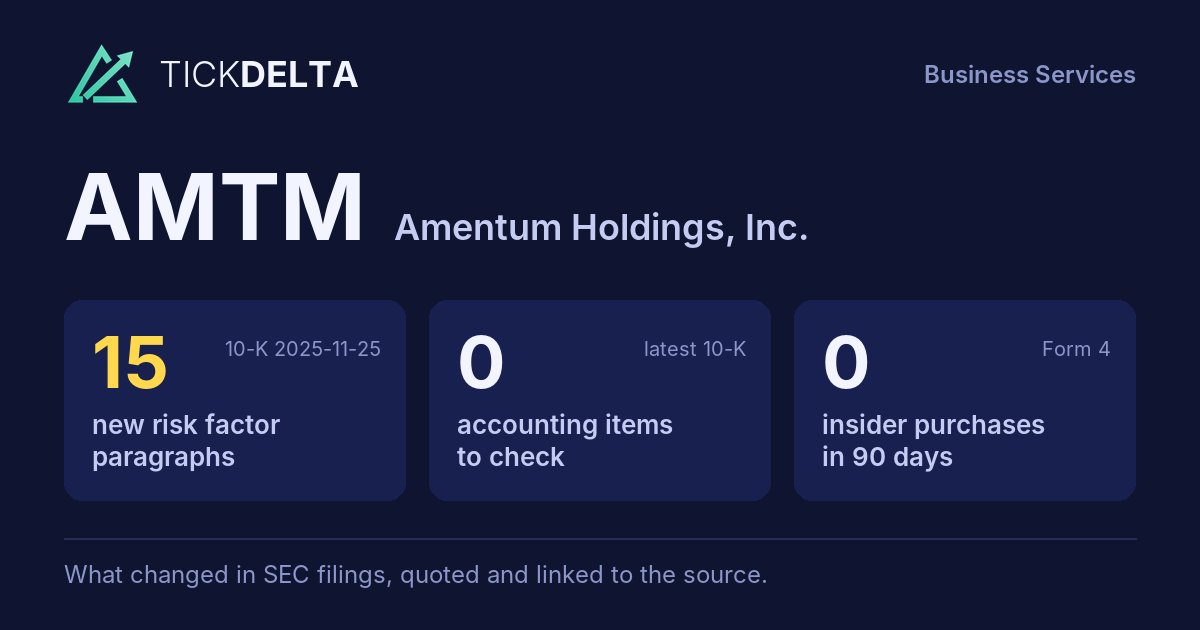
153 changes: 28 added, 52 removed, 67 reworded, 6 quiet changes
10-K Nov 25, 2025 vs Dec 17, 2024
Risk Factors
16.7%
of the text changed · 23,041 words now · 15 new paragraphs, 43 gone
MD&A
29.6%
of the text changed · 5,514 words now · 13 new paragraphs, 9 gone
Legal Proceedings
34.8%
of the text changed · 303 words now
Accounting Policies
5.2%
of the text changed · 3,635 words now
10-K 0001628280-25-053993 (Nov 25, 2025) vs 10-K 0002011286-24-000072 (Dec 17, 2024)
Every paragraph, and how much of it changed
One bar per paragraph, in the order of the 10-K. Height and colour show the share of its words not in the closest paragraph a year earlier; the tallest bars are new paragraphs.
Risk Factors
311 paragraphs · 15 new · 95 reworded · 43 gone · 10-K Nov 25, 2025 against Dec 17, 2024
New paragraph
Reworded (5% of its words or more)
Same or nearly
Paragraph 61 · 45% changed
Every version of it
Our revenues depend on new contract awards. Delays in the timing of the awards or cancellations of such projects as a result of economic conditions, material and equipment pricing and availability or other factors could impact our long-term projected results. It is particularly difficult to predict whether or when we will receive contracts for large-scale projects as these contracts frequently involve a lengthy and complex procurement and selection process, which is affected by a number of factors, such as market conditions or environmental and other governmental approvals. Since a significant portion of our revenues is generated from such projects, our results of operations and cash flows can fluctuate significantly from quarter to quarter depending on the timing of our contract awards and the commencement or progress of work under awarded contracts.
Paragraph 43 · 41% changed
Every version of it
Negative press reports or publicity, which could pertain to employee or subcontractor misconduct, conflicts of interest, termination of a contract or task order, poor contract performance, legal violations or investigations, deficiencies in services, reports or other deliverables, information security breaches or other aspects of our business, regardless of accuracy, could harm our reputation with the U.S. federal government. Due to the sensitive nature of our work and our confidentiality obligations to our customers, we may be unable or limited in our ability to respond to such negative publicity. In addition, the mishandling or the perception of mishandling sensitive information, such as our failure to maintain the confidentiality of the existence of our business relationships with certain of our customers, including as a result of misconduct or other improper activities by our employees or subcontractors, or a failure to maintain adequate protection against security breaches, including those resulting from cyberattacks, could harm our relationship with U.S. federal government agencies. Our ability to hire or retain employees and our standing in professional communities, to which we contribute and receive expert knowledge, could be diminished. To the extent our performance under a contract does not meet a government agency’s expectations, the customer might seek to terminate the contract prior to its scheduled expiration date, provide a negative assessment of our performance to government-maintained contractor past-performance data repositories, fail to award us additional business under existing contracts or otherwise, and direct future business to our competitors. If we were suspended or debarred from contracting with the federal government or any significant agency including the DOD, U.S. Intelligence Community, NASA and the DOE, if our reputation or relationship with government agencies was impaired, or if the government otherwise ceased doing business with us or significantly decreased the amount of business it does with us, our business, financial condition and results of operations would be materially and adversely affected.
Paragraph 217 · 40% changed
Every version of it
In particular, starting in fiscal year 2025, the Sarbanes-Oxley Act of 2002 will require requires us to document and test the effectiveness of our internal control over financial reporting in accordance with an established internal control framework, and to report on our conclusions as to the effectiveness of our internal controls. It also will require requires an independent registered public accounting firm to test our internal control over financial reporting and report on the effectiveness of such controls. In addition, we are required under the Exchange Act to maintain disclosure controls and procedures and internal control over financial reporting. Because of inherent limitations in any internal control environment, there can be no assurance that all control issues and instances of fraud, errors or misstatements, if any, within the Company has been or will be detected on a timely basis. Such deficiencies could result in the correction or restatement of financial statements of one or more periods.
Paragraph 171 · 37% changed
Every version of it
Paragraph 205 · 37% changed
Every version of it
Paragraph 80 · 36% changed
Every version of it
Paragraph 16 · 31% changed
Every version of it
•If we do not have adequate indemnification for our nuclear services, or business is slowed by the extensive regulatory processes for approval and licensing for new and existing nuclear technologies or socio-political opposition to nuclear-related technology and activities, it could adversely affect our business, financial condition and results of operations.
Paragraph 162 · 50% changed
Every version of it
10-K Dec 17, 2024Our industry continues to experience significant changes to business practices as a result of an increased focus on affordability, efficiencies and recovery of costs, among other items. U.S. federal government agencies may face restrictions or pressure regarding the type and amount of services that they may obtain from private contractors. Legislation, regulations and initiatives dealing with procurement reform, mitigation of potential organizational conflicts of interest, deterrence of fraud, and stricter environmental compliance or sustainability requirements could have an adverse effect on us. Federal and state laws, regulations and mandates relating to climate change that require GHG remissions reductions, carbon-free electricity, net-zero emissions from vehicles, buildings, procurement and operations or similar initiatives could diminish or weaken our ability to obtain new contracts or garner renewals. As a government services provider, we anticipate that requirements around supply chain management and specific procurement strategies to reduce contractor GHG emissions and GHG emissions associated with products used or acquired could impair us from effectively competing. Further, requirements around the disclosure of GHG emissions, particularly Scope 3 emissions, emission reduction targets, climate change related-risks and other climate change initiatives may lead us to expend substantial management resources and related costs for external support that could potentially have a negative impact on our business and our ability to secure certain contracts or contract renewals. New, rapidly shifting or revised government policies relating to such matters could have an equally adverse effect on us, as a government contractor. Moreover, shifts in the buying practices of U.S. federal government agencies (such as increased usage of fixed-price contracts, multiple award contracts and small business set-aside contracts) could have adverse effects on government contractors, including us. Any of these changes could impair our ability to obtain new contracts or contract renewals. Any new contracting requirements or procurement methods, including those related to climate change, could be costly or administratively difficult for us to implement and could adversely affect our business, financial condition and results of operations.
10-K Nov 25, 2025
sustainability requirements could have an adverse effect on us. Moreover, shifts in the buying practices of U.S. federal government agencies (such as increased usage of fixed-price contracts and multiple award contracts) could have adverse effects on government contractors, including us. Any of these changes could impair our ability to obtain new contracts or contract renewals. Any new contracting requirements or procurement methods could be costly or administratively difficult for us to implement and could adversely affect our business, financial condition and results of operations.
Paragraph 61 · 45% changed
Every version of it
10-K Dec 17, 2024
Our revenues depend on new contract awards. Delays in the timing of the awards or cancellations of such projects as a result of economic conditions, material and equipment pricing and availability or other factors could impact our long-term projected results. It is particularly difficult to predict whether or when we will receive contracts for large-scale projects as these contracts frequently involve a lengthy and complex procurement and selection process, which is affected by a number of factors, such as market conditions or environmental and other governmental approvals. Since a significant portion of our revenues is generated from such projects, our results of operations and cash flows can fluctuate significantly from quarter to quarter depending on the timing of our contract awards and the commencement or progress of work under awarded contracts.
10-K Nov 25, 2025
Our revenues depend on new contract awards. Delays in the timing of the awards or cancellations of such projects as a result of economic conditions, material and equipment pricing and availability or other factors could impact our long-term projected
Paragraph 43 · 41% changed
Every version of it
10-K Dec 17, 2024
Negative press reports or publicity, which could pertain to employee or subcontractor misconduct, conflicts of interest, termination of a contract or task order, poor contract performance, legal violations or investigations, deficiencies in services, reports or other deliverables, information security breaches or other aspects of our business, regardless of accuracy, could harm our reputation with the U.S. federal government. Due to the sensitive nature of our work and our confidentiality obligations to our customers, we may be unable or limited in our ability to respond to such negative publicity. In addition, the mishandling or the perception of mishandling sensitive information, such as our failure to maintain the confidentiality of the existence of our business relationships with certain of our customers, including as a result of misconduct or other improper activities by our employees or subcontractors, or a failure to maintain adequate protection against security breaches, including those resulting from cyberattacks, could harm our relationship with U.S. federal government agencies. Our ability to hire or retain employees and our standing in professional communities, to which we contribute and receive expert knowledge, could be diminished. To the extent our performance under a contract does not meet a government agency’s expectations, the customer might seek to terminate the contract prior to its scheduled expiration date, provide a negative assessment of our performance to government-maintained contractor past-performance data repositories, fail to award us additional business under existing contracts or otherwise, and direct future business to our competitors. If we were suspended or debarred from contracting with the federal government or any significant agency including the DOD, U.S. Intelligence Community, NASA and the DOE, if our reputation or relationship with government agencies was impaired, or if the government otherwise ceased doing business with us or significantly decreased the amount of business it does with us, our business, financial condition and results of operations would be materially and adversely affected.
10-K Nov 25, 2025
Negative press reports or publicity, which could pertain to employee or subcontractor misconduct, conflicts of interest, termination of a contract or task order, poor contract performance, legal violations or investigations, deficiencies in services, reports or other deliverables, information security breaches or other aspects of our business, regardless of accuracy, could harm our reputation with the U.S. federal government. Due to the sensitive nature of our work and our confidentiality obligations to our customers, we may be unable or limited in our ability to respond to such negative publicity. In addition, the mishandling or the perception of mishandling sensitive information, such as our failure to maintain the confidentiality of the existence of our
Paragraph 217 · 40% changed
Every version of it
10-K Dec 17, 2024
In particular, starting in fiscal year 2025, the Sarbanes-Oxley Act of 2002 will require us to document and test the effectiveness of our internal control over financial reporting in accordance with an established internal control framework, and to report on our conclusions as to the effectiveness of our internal controls. It also will require an independent registered public accounting firm to test our internal control over financial reporting and report on the effectiveness of such controls. In addition, we are required under the Exchange Act to maintain disclosure controls and procedures and internal control over financial reporting. Because of inherent limitations in any internal control environment, there can be no assurance that all control issues and instances of fraud, errors or misstatements, if any, within the Company has been or will be detected on a timely basis. Such deficiencies could result in the correction or restatement of financial statements of one or more periods.
10-K Nov 25, 2025
In particular, starting in fiscal year 2025, the Sarbanes-Oxley Act of 2002 requires us to document and test the effectiveness of our internal control over financial reporting in accordance with an established internal control framework, and to report on our conclusions as to the effectiveness of our internal controls. It also requires an independent registered public accounting firm to
Paragraph 171 · 37% changed
Every version of it
10-K Dec 17, 2024On August 13, 2024, the Company completed an offering of $1.0 billion in aggregate principal amount of 7.250% senior notes due August 1, 2032. Additionally, on September 27, 2024, we entered into a new first lien credit agreement, including a new senior secured credit facility which provided for a $3,750.0 million term loan facility and a $850.0 million revolving credit facility. Our level of indebtedness could have important consequences, including, but not limited to:
10-K Nov 25, 2025
The Credit Facility consists of our term facility maturing on September 27, 2031 and our revolving facility maturing on September 27, 2029. In August 2024, the Company also completed an offering of $1,000 million in aggregate principal amount of 7.250% senior notes due August 1, 2032.
Paragraph 205 · 37% changed
Every version of it
10-K Dec 17, 2024•Amentum will not enter into, and will not permit certain CMS Business subsidiaries to enter into, any transaction or series of transactions (or any agreement, understanding, or arrangement) as a result of which one or more persons would acquire (directly or indirectly) stock comprising 50% or more of the vote or value of the Amentum (taking into account the stock acquired pursuant to the merger) or such CMS Business subsidiaries;
10-K Nov 25, 2025
(directly or indirectly) stock comprising 50% or more of the vote or value of the Amentum (taking into account the stock acquired pursuant to the merger) or such CMS subsidiaries;
Paragraph 80 · 36% changed
Every version of it
10-K Dec 17, 2024The provision of our services may expose us to significant monetary damages or even criminal violations in the event of liabilities resulting from our activities, including noncompliance with regulatory requirements, and our insurance policies may not provide adequate coverage, which could have a material adverse impact on our business, financial condition, and results of operations and damage our reputation.
10-K Nov 25, 2025
may not provide adequate coverage, which could have a material adverse impact on our business, financial condition, and results of operations and damage our reputation.
Paragraph 16 · 31% changed
Every version of it
10-K Dec 17, 2024
•If we do not have adequate indemnification for our nuclear services, it could adversely affect our business, financial condition and results of operations.
10-K Nov 25, 2025
•If we do not have adequate indemnification for our nuclear services, or business is slowed by the extensive regulatory processes for approval and licensing for new and existing nuclear technologies or socio-political opposition to nuclear-related technology and activities, it could adversely affect our business, financial condition and results of operations.
MD&A
93 paragraphs · 13 new · 43 reworded · 9 gone · 10-K Nov 25, 2025 against Dec 17, 2024
New paragraph
Reworded (5% of its words or more)
Same or nearly
Paragraph 48 · 48% changed
Paragraph 46 · 48% changed
Global Engineering SolutionsFor the Year Ended October 3, 2025 Year to Year Change For the Year Ended September 27, 2024 Year to Year Change For the Year Ended September 29, 2023 Year 2024 to Year Change For the Year Ended September 30, 2022 2025 2023 to 2024 (Dollars in millions) Dollars Percent Dollars Percent Revenues $ 8,850 $ 2,443 38% $ 6,407 $ 441 7% $ 5,966 Adjusted EBITDA (1) 667 208 45% 459 22 5% 437
Paragraph 42 · 48% changed
Paragraph 47 · 48% changed
Paragraph 41 · 47% changed
For the Year Ended October 3, 2025 Year to Year Change For the Year Ended September 27, 2024 Year to Year Change For the Year Ended September 29, 2023 Year 2024 to Year Change For the Year Ended September 30, 2022 2025 2023 to 2024 (Dollars in millions) Dollars Percent Dollars Percent Revenues $ 5,543 $ 3,562 180% $ 1,981 $ 82 4% $ 1,899 Adjusted EBITDA (1) 437 278 175% 159 — —% 159
Paragraph 73 · 42% changed
Net cash used in financing activities changed increased by $1,836 $408 million primarily as a result of new borrowings associated with the acquisition of PAE partially offset by repayment of the Tranche 2 Term Loan (as defined below). Cash used in financing activities during when compared to the year ended September 29, 2023 was 27, 2024 primarily used toward debt repayments. due to increased principal payments on our Term Loan partially offset by financing activities completed in the year ended September 27, 2024 associated with the merger with CMS.
Paragraph 18 · 40% changed
Revenues — The increase in revenues was primarily attributable to new contract awards and growth on existing programs. revenues from the merger with CMS.
Paragraph 22 · 40% changed
Equity earnings of non-consolidated subsidiaries — Equity earnings of non-consolidated subsidiaries include our proportionate share of the income from equity method investments and increased decreased due to utilization of fair market value adjustments assigned to certain equity method investments obtained in the merger with CMS partially offset by the performance and operational efficiencies during the year ended September 27, 2024. of our non-consolidated subsidiaries.
Paragraph 48 · 48% changed
10-K Dec 17, 2024Revenues — The increase in revenues was primarily attributable to a full year of performance on legacy PAE contracts contributing $0.9 billion as well as new contract awards and growth on existing programs of $0.5 billion, partially offset by the completion of certain contracts which totaled $1.2 billion, including a follow-on contract which transitioned from a consolidated joint venture to an equity method investment.
10-K Nov 25, 2025
The increase in revenues for the year ended October 3, 2025, as compared to the year ended September 27, 2024, was primarily attributable to revenues from the merger with CMS, the ramp up of new contract awards, growth on existing programs and the benefit of additional working days, partially offset by the transition of contracts from consolidated to unconsolidated joint ventures and the expected ramp-down of historical programs.
Paragraph 46 · 48% changed
10-K Dec 17, 2024
For the Year Ended September 27, 2024 Year to Year Change For the Year Ended September 29, 2023 Year to Year Change For the Year Ended September 30, 2022
10-K Nov 25, 2025
Global Engineering SolutionsFor the Year Ended October 3, 2025 Year to Year Change For the Year Ended September 27, 2024 Year to Year Change For the Year Ended September 29, 2023 2024 to 2025 2023 to 2024 (Dollars in millions) Dollars Percent Dollars Percent Revenues $ 8,850 $ 2,443 38% $ 6,407 $ 441 7% $ 5,966 Adjusted EBITDA (1) 667 208 45% 459 22 5% 437
Paragraph 42 · 48% changed
10-K Dec 17, 2024See “Note 7 — Sales of Receivables” and “Note 13 — Debt” in Part II of this Annual Report on Form 10-K for additional information.
10-K Nov 25, 2025
(1) Represents a Non-GAAP financial measure - see the related explanations included below and Note 18 — Segment Information in Part II of this Annual Report on Form 10-K.
Paragraph 47 · 48% changed
10-K Dec 17, 2024See “Note 7 — Sales of Receivables” and “Note 13 — Debt” in Part II of this Annual Report on Form 10-K for additional information.
10-K Nov 25, 2025
(1) Represents a Non-GAAP financial measure - see the related explanations included below and Note 18 — Segment Information in Part II of this Annual Report on Form 10-K.
Paragraph 41 · 47% changed
10-K Dec 17, 2024
For the Year Ended September 27, 2024 Year to Year Change For the Year Ended September 29, 2023 Year to Year Change For the Year Ended September 30, 2022
10-K Nov 25, 2025
For the Year Ended October 3, 2025 Year to Year Change For the Year Ended September 27, 2024 Year to Year Change For the Year Ended September 29, 2023 2024 to 2025 2023 to 2024 (Dollars in millions) Dollars Percent Dollars Percent Revenues $ 5,543 $ 3,562 180% $ 1,981 $ 82 4% $ 1,899 Adjusted EBITDA (1) 437 278 175% 159 — —% 159
Paragraph 73 · 42% changed
10-K Dec 17, 2024
Net cash used in financing activities changed by $1,836 million primarily as a result of new borrowings associated with the acquisition of PAE partially offset by repayment of the Tranche 2 Term Loan (as defined below). Cash used in financing activities during the year ended September 29, 2023 was primarily used toward debt repayments.
10-K Nov 25, 2025
Net cash used in financing activities increased by $408 million when compared to the year ended September 27, 2024 primarily due to increased principal payments on our Term Loan partially offset by financing activities completed in the year ended September 27, 2024 associated with the merger with CMS.
Paragraph 18 · 40% changed
10-K Dec 17, 2024
Revenues — The increase in revenues was primarily attributable to new contract awards and growth on existing programs.
10-K Nov 25, 2025
Revenues — The increase in revenues was primarily attributable to revenues from the merger with CMS.
Paragraph 22 · 40% changed
10-K Dec 17, 2024
Equity earnings of non-consolidated subsidiaries — Equity earnings of non-consolidated subsidiaries include our proportionate share of the income from equity method investments and increased due to performance and operational efficiencies during the year ended September 27, 2024.
10-K Nov 25, 2025
Equity earnings of non-consolidated subsidiaries — Equity earnings of non-consolidated subsidiaries include our proportionate share of the income from equity method investments and decreased due to utilization of fair market value adjustments assigned to certain equity method investments obtained in the merger with CMS partially offset by the performance of our non-consolidated subsidiaries.
A paragraph is matched with the one last year that shares the most of its words; under half in common makes it new. The paragraphs shown are the 8 reworded the most in each section.
The paragraph that changed most in each section
The redline
Marked against last year's 10-K: cut words struck through, new words highlighted.
Risk Factors265 words changed in this paragraph; it is 33% similar to last year's version.
Our industry continues to experience significant changes to business practices as a result of an increased focus on affordability, efficiencies and recovery of costs, among other items. U.S. federal government agencies may face restrictions or pressure regarding the type and amount of services that they may obtain from private contractors. Legislation, regulations and initiatives dealing with procurement reform, mitigation of potential organizational conflicts of interest, including changes in the FAR, deterrence of fraud, and stricter environmental compliance or sustainability requirements could have an adverse effect on us. Federal and state laws, regulations and mandates relating to climate change that require GHG remissions reductions, carbon-free electricity, net-zero emissions from vehicles, buildings, procurement and operations or similar initiatives could diminish or weaken our ability to obtain new contracts or garner renewals. As a government services provider, we anticipate that requirements around supply chain management and specific procurement strategies to reduce contractor GHG emissions and GHG emissions associated with products used or acquired could impair us from effectively competing. Further, requirements around the disclosure of GHG emissions, particularly Scope 3 emissions, emission reduction targets, climate change related-risks and other climate change initiatives may lead us to expend substantial management resources and related costs for external support that could potentially have a negative impact on our business and our ability to secure certain contracts or contract renewals. New, rapidly shifting or revised government policies relating to such matters could have an equally adverse effect on us, as a government contractor. Moreover, shifts in the buying practices of U.S. federal government agencies (such as increased usage of fixed-price contracts, multiple award contracts and small business set-aside contracts) could have adverse effects on government contractors, including us. Any of these changes could impair our ability to obtain new contracts or contract renewals. Any new contracting requirements or procurement methods, including those related to climate change, could be costly or administratively difficult for us to implement and could adversely affect our business, financial condition and results of operations.
Source: Item 1A, 10-K 0001628280-25-053993 vs Item 1A, 10-K 0002011286-24-000072
MD&A120 words changed in this paragraph; it is 66% similar to last year's version.
In May 2025, the President’s U.S. federal government fiscal year (“GFY”) 2026 budget request was submitted to Congress. As compared to the GFY 2025 budget, the GFY 2026 budget request maintained defense discretionary spending at $892 billion, reduced non-defense discretionary spending by approximately 21% to $557 billion, and increased GFY 2026 defense spending to $1.01 trillion, an increase of 13% from the GFY 2025 enacted level. Final appropriations legislation for GFY 2026 was not passed as of October 1, 2025, the first day of GFY 2026, and the federal government shut down most agencies of the federal government until November 12, 2025, when a continuing resolution was passed to reopen the federal government and provide funding through January 30, 2026. While we view the budget environment as constructive and believe core funding sources for our primary customer-based markets will continue to experience bipartisan tailwinds, there can be no certainty about the level of funding for any particular GFY or that appropriations bills will be passed in a timely manner. During those periods of time when appropriations bills have not been passed and signed into law, government agencies operate under a continuing resolution (“CR”), a temporary measure allowing the government to continue operations at prior year funding levels. Depending on their scope, duration, and other factors, CRs can negatively impact our business due to delays in new program starts, delays in contract awards decisions, and other factors.
Source: Item 7, 10-K 0001628280-25-053993 vs Item 7, 10-K 0002011286-24-000072
Accounting Policies50 words changed in this paragraph; it is 72% similar to last year's version.
The preparation of financial statements in conformity with GAAP requires management to make estimates and assumptions that affect the reported amounts of assets and liabilities, the disclosure of contingent assets and liabilities, and the reported amount of revenues and expenses. The most significant estimates relate to estimating contract revenues and costs at completion, fair value measurements, fair value of goodwill and intangible assets, pension valuation allowances, and defined benefit plan obligations, deferred tax reserves for contract-related matters and contingencies. Due to the size and nature of many of our contracts, the estimation of total revenues and cost at completion is subject to a wide range of variables. Actual results may differ from these estimates.
Source: Item 8, Note 2 – Summary of Significant Accounting Policies, 10-K 0001628280-25-053993 vs Item 8, Note 2 – Summary of Significant Accounting Policies, 10-K 0002011286-24-000072
Legal Proceedings37 words changed in this paragraph; it is 76% similar to last year's version.
The Company is involved in various claims, disputes and administrative proceedings arising in the normal course of business. Liabilities for loss contingencies arising from claims, assessments, litigation, fines and penalties and other sources are recorded when it is probable that an unfavorable result and/or liability will be incurred and the cost of the unfavorable result or liability can be reasonably estimated. Management is of the opinion that any liability or loss associated with such matters, either individually or in the aggregate, will not have a material adverse effect on the Company’s operations and liquidity.
Source: Item 3, via Note 21 – Legal Proceedings and Commitments and Contingencies, 10-K 0001628280-25-053993 vs Item 3, via Note 22 – Legal Proceedings and Commitments and Contingencies, 10-K 0002011286-24-000072
Sentences and paragraphs added, removed or reworded
Every change, by type
Sentences and paragraphs of AMTM's Risk Factors and MD&A, 10-K Nov 25, 2025 against 10-K Dec 17, 2024. Each links to the text at sec.gov.
Quiet changes are sentences kept from last year with one to four words changed, at least one of them a hedge, a modal or a qualifier (may, could, will, not, significant, material…). A year or date rolling forward is not counted.
The full word list
adverse, adversely, all, although, anticipate, anticipates, any, approximately, believe, believes, can, cannot, certain, could, expect, expects, generally, however, if, intend, intends, largely, likely, many, material, materially, may, might, most, must, never, no, not, possible, primarily, probable, should, significant, significantly, some, substantial, substantially, unlikely, will, would
AddedRisk Factors
•Uncertainty over global tariffs, or the financial impacts of tariffs, may negatively impact our results.
Read it in 10-K Nov 25, 2025 at sec.gov
AddedRisk Factors
a material adverse effect on our revenue, cash flow and operating results. The delay or cancellation of key programs or the delay of contract payments may have a material adverse effect on our revenue and operating results.
Read it in 10-K Nov 25, 2025 at sec.gov
AddedRisk Factors
We offer similar services in other jurisdictions outside the U.S. For those jurisdictions, varying levels of nuclear liability protection is provided by international treaties, and/or domestic laws, such as the Nuclear Liability and Compensation Act of
Read it in 10-K Nov 25, 2025 at sec.gov
AddedRisk Factors
In addition, certain of our contracts provide a wide range of nuclear services to the U.S. and U.K. governments. If the policies of those governments were to de-emphasize nuclear matters, it may have a material adverse impact on our business, financial condition and results of operations.
Read it in 10-K Nov 25, 2025 at sec.gov
AddedRisk Factors
Uncertainty over global tariffs, or the financial impact of tariffs, may negatively impact our results.
Read it in 10-K Nov 25, 2025 at sec.gov
AddedRisk Factors
Our business could be adversely impacted by changes in the U.S. Government’s approach to tariffs and other trade policies. As a result of major U.S. Government trade policy changes announced by President Trump, there is currently significant uncertainty with respect to tariffs that may impact our supply chain. New or increased tariffs for imports into the United States, as well as new or increased tariffs or trade bans imposed by other countries, could have an adverse effect on both our U.S. and international operations due to increased costs of materials, disruptions or delays in deliveries, and greater difficulty in planning and operating our business. While our business in the U.S. primarily provides labor services to our customers, some of our U.S. work involves providing goods that may be subject to tariffs. Our non-U.S. work could also be impacted by greater costs for goods sourced from the U.S. due to increased tariffs imposed by other countries. To date, the Company has not experienced a material negative impact from the recent changes in tariff policies. Although we plan to continue to monitor trade policy developments closely and to mitigate the adverse impacts of any changes where possible, we may not be able to fully mitigate such impacts in all situations.
Read it in 10-K Nov 25, 2025 at sec.gov
AddedRisk Factors
•recent geopolitical tensions and conflict between the U.S. government and certain South and Central American countries;
Read it in 10-K Nov 25, 2025 at sec.gov
AddedRisk Factors
•risk that we are not able to complete strategic divestitures on satisfactory terms and conditions, including non-competition arrangements applicable to certain of our business lines, or within expected timeframes;
Read it in 10-K Nov 25, 2025 at sec.gov
Show the other 67
AddedRisk Factors
•risks that indemnification related to businesses divested or spun off that we may be required to provide or otherwise bear may be significant and could negatively impact our business; and
Read it in 10-K Nov 25, 2025 at sec.gov
AddedRisk Factors
Our industry continues to experience significant changes to business practices as a result of an increased focus on affordability, efficiencies and recovery of costs, among other items. U.S. federal government agencies may face restrictions or pressure regarding the type and amount of services that they may obtain from private contractors. Legislation, regulations and initiatives dealing with procurement reform, including changes in the FAR, deterrence of fraud, and stricter environmental compliance or
Read it in 10-K Nov 25, 2025 at sec.gov
AddedRisk Factors
There is increased scrutiny from governmental organizations, customers, and employees on companies’ sustainability practices and disclosures. If our sustainability practices do not meet evolving rules and regulations or stakeholder expectations and standards (or if we are viewed negatively based on positions we do or do not take or work we do or do not perform or cannot publicly disclose for certain customers and industries), then our reputation, our ability to attract or retain leading experts, employees and other professionals and our ability to attract new business and customers could be negatively impacted, as could
Read it in 10-K Nov 25, 2025 at sec.gov
AddedRisk Factors
Our level of indebtedness could have important consequences, including, but not limited to:
Read it in 10-K Nov 25, 2025 at sec.gov
RemovedRisk Factors
RemovedRisk Factors
RemovedRisk Factors
RemovedRisk Factors
RemovedRisk Factors
RemovedRisk Factors
RemovedRisk Factors
RemovedRisk Factors
RemovedRisk Factors
RemovedRisk Factors
RemovedRisk Factors
RemovedRisk Factors
RewordedRisk Factors
In addition, the mishandling or the perception of mishandling sensitive information, such as our failure to maintain the confidentiality of the existence of our business relationships with certain of our customers, including as a result of misconduct or other improper activities by our employees or subcontractors, or a failure to maintain adequate protection against security breaches, including those resulting from cyberattacks, could harm our relationship with U.S. federal government agencies.
Read it in 10-K Nov 25, 2025 at sec.gov
RewordedRisk Factors
Additionally, the forum selection clause in our amended and restated certificate of incorporation may limit our shareholders’ ability to bring a claim in a forum that they find favorable for disputes with us or our directors, officers, employees or agents, which may be costlier and may discourage such lawsuits against us and our directors, officers, employees and agents even though an action, if successful, might benefit our shareholders, although such shareholders will not be deemed to have waived our compliance with federal securities laws and the rules and regulations thereunder.
Read it in 10-K Nov 25, 2025 at sec.gov
RewordedRisk Factors
If we do not have adequate indemnification for our nuclear services, or business is slowed by the extensive regulatory processes for approval and licensing for new and existing nuclear technologies or socio-political opposition to nuclear-related technology and activities, it could adversely affect our business, financial condition and results of operations.
Read it in 10-K Nov 25, 2025 at sec.gov
RewordedRisk Factors
RewordedRisk Factors
The provision of our services may expose us to significant monetary damages or even criminal violations in the event of liabilities resulting from our activities, including noncompliance with regulatory requirements, and our insurance policies may not provide adequate coverage, which could have a material adverse impact on our business, financial condition, and results of operations and damage our reputation.
Read it in 10-K Nov 25, 2025 at sec.gov
RewordedRisk Factors
If we are not able to react quickly to such events, or if a high concentration of our projects is in a specific geographic region that suffers from a natural or human caused catastrophe, our operations may be significantly affected, which could have a material adverse impact on our operations.
Read it in 10-K Nov 25, 2025 at sec.gov
RewordedRisk Factors
RewordedRisk Factors
Realization of any synergies, growth opportunities or other benefits could be affected by the factors described in other risk factors and a number of factors beyond our control, including, without limitation, general economic conditions, increased operating costs and regulatory developments.
Read it in 10-K Nov 25, 2025 at sec.gov
RewordedRisk Factors
It also will require requires an independent registered public accounting firm to test our internal control over financial reporting and report on the effectiveness of such controls.
Read it in 10-K Nov 25, 2025 at sec.gov
RewordedRisk Factors
Our domestic and international sales and operations are subject to risks associated with changes in laws, regulations and policies (including changes in the FAR, export/import laws, tax policies, environmental and employment requirements, export/import laws, tax policies requirements and other similar legal requirements).
Read it in 10-K Nov 25, 2025 at sec.gov
RewordedRisk Factors
In addition, our costs of complying with new and evolving regulatory reporting requirements and current or future laws, including environmental protection, environmental, employment, data security, data privacy and privacy, health and safety laws, safety, environmental, and employment laws may exceed our estimates.
Read it in 10-K Nov 25, 2025 at sec.gov
RewordedRisk Factors
We are subject to a variety of laws and regulations in the U.S., at the federal, state and local levels and abroad abroad, such as the General Data Protection Regulation in the European Union, relating to data privacy and security.
Read it in 10-K Nov 25, 2025 at sec.gov
Quiet changesRisk Factors
With a workforce of over 53,000 approximately 50,000 people globally, we are also party to labor and employment claims in the normal course of business.
Read it in 10-K Nov 25, 2025 at sec.gov
Quiet changesRisk Factors
Further, for purposes of this test, the merger will be treated as part of a plan that includes the distribution, but it is expected that the merger, standing alone, will not cause the distribution to be taxable to Jacobs under Section 355(e) of the Code because Jacobs’ shareholders will own owned at least 50.1% of the common stock of Amentum immediately following the merger.
Read it in 10-K Nov 25, 2025 at sec.gov
Quiet changesRisk Factors
Compliance with these public company obligations will require requires us to devote significant management time and place significant additional demands on our finance, accounting, and legal staff and on our management systems, including our financial, accounting and information systems.
Read it in 10-K Nov 25, 2025 at sec.gov
Quiet changesRisk Factors
In particular, starting in fiscal year 2025, the Sarbanes-Oxley Act of 2002 will require requires us to document and test the effectiveness of our internal control over financial reporting in accordance with an established internal control framework, and to report on our conclusions as to the effectiveness of our internal controls.
Read it in 10-K Nov 25, 2025 at sec.gov
AddedMD&A
We conduct our business activities and report financial results as two reportable segments: Digital Solutions (“DS”) and Global Engineering Solutions (“GES”). The DS segment provides advanced digital and data-driven solutions including intelligence analytics, space system development, cybersecurity, and next generation IT across the federal government and commercial clients. The GES segment provides large-scale environmental remediation, nuclear power solutions, platform engineering, sustainment and supply chain management across all 7 continents for the U.S. government and allied nations. The presentation of financial results as two reportable segments is consistent with the way the Company operates its business and the manner in which our chief operating decision maker (“CODM”), currently our Chief Executive Officer, manages the operations of the Company for purposes of allocating resources and assessing performance.
Read it in 10-K Nov 25, 2025 at sec.gov
AddedMD&A
Under the Trump administration, the Department of Government Efficiency was created, the One Big, Beautiful Bill Act was passed which made certain tax cuts permanent, reduced healthcare spending and increased spending related to border security, defense, NASA and energy production, and the U.S. Government is in the process of, or has announced its intent to, increase
Read it in 10-K Nov 25, 2025 at sec.gov
AddedMD&A
current tariffs, impose additional tariffs, and expand tariffs on goods imported from various countries into the United States. We continue to monitor the actions of the administration which could result in a change to budgetary priorities or impact federal government procurement timing. Although a limited number of our contracts for the U.S. Government have been affected by changes in budgetary priorities by the administration, the impact has not been material to date. Decreases in, or delays in approving, the federal government’s budget, decreases in government spending on the types of programs that we support, delays in government contract awards, and pauses on government contracts on which we are currently performing could have an adverse impact on our business.
Read it in 10-K Nov 25, 2025 at sec.gov
AddedMD&A
Interest expense and other, net — The decrease in interest expense and other, net was primarily due to the reduction to our Term Loan principal balance as compared to the year ended September 27, 2024 combined with a decrease in interest rates, partially offset by the interest incurred on our Senior Notes during the fiscal year ended October 3, 2025.
Read it in 10-K Nov 25, 2025 at sec.gov
AddedMD&A
The primary financial performance measures we use to manage our reportable segments and monitor results of operations are Revenues and Adjusted EBITDA. The following tables present our performance measures by reportable segment:
Read it in 10-K Nov 25, 2025 at sec.gov
AddedMD&A
The increase in revenues for the year ended October 3, 2025, as compared to the year ended September 27, 2024, was primarily attributable to revenues from the merger with CMS, higher volume from new contract awards and the benefit of additional working days, partially offset by the expected ramp-down of historical programs and the divestiture of Rapid Solutions.
Read it in 10-K Nov 25, 2025 at sec.gov
AddedMD&A
The increase in Adjusted EBITDA for the year ended October 3, 2025, as compared to the year ended September 27, 2024, was primarily attributable to the revenue growth factors described above.
Read it in 10-K Nov 25, 2025 at sec.gov
AddedMD&A
The increase in Adjusted EBITDA for the year ended October 3, 2025, as compared to the year ended September 27, 2024, was primarily attributable to the revenue growth factors described above.
Read it in 10-K Nov 25, 2025 at sec.gov
AddedMD&A
We include the presentation and discussion of Adjusted EBITDA, which is not a measure of financial performance under Generally Accepted Accounting Principles in the United States (“GAAP”). Adjusted EBITDA should be considered only as supplement to and should not be considered in isolation or used as a substitute for financial information prepared in accordance with GAAP. Management of the Company believes Adjusted EBITDA, when read in conjunction with the Company’s financial statements prepared in accordance with GAAP and the reconciliation herein to the most directly comparable GAAP measure, provides useful information to management, investors and other users of the Company’s financial information in evaluating operating results and understanding operating trends by adjusting for the effects of items we do not consider to be indicative of the Company’s ongoing performance, the inclusion of which can obscure underlying trends. Additionally, management of the Company uses Adjusted EBITDA in its evaluation of business performance, particularly when comparing performance to past periods, and believes Adjusted EBITDA is useful for investors because it facilitates a comparison of financial results from period to period. The computation of a non-GAAP measure may not be comparable to similarly titled measures reported by other companies, thus limiting their use for comparability.
Read it in 10-K Nov 25, 2025 at sec.gov
AddedMD&A
The Company defines Adjusted EBITDA as net income (loss) attributable to common shareholders adjusted for interest expense and other, net, provision for income taxes, depreciation and amortization, and certain discrete items that are not considered in the evaluation of ongoing operating performance. These discrete items include acquisition, transaction, and integration costs, non-cash gains and losses, loss on extinguishment of debt, utilization of certain fair market value adjustments assigned in purchase accounting, and stock-based compensation. While we believe Adjusted EBITDA is a useful metric in evaluating operating performance by allowing better evaluation of underlying segment performance and better period-to-period comparability, it is not a metric defined by GAAP and may not be comparable to non-GAAP metrics presented by other companies. For a reconciliation of net income (loss), the most directly comparable financial measure calculated in accordance with GAAP, to adjusted EBITDA for the years ended October 3, 2025, September 27, 2024 and September 29, 2023, see Note 18 — Segment Information in Part II of this Annual Report on Form 10-K.
Read it in 10-K Nov 25, 2025 at sec.gov
AddedMD&A
The Company's backlog, by reportable segment and in total, consisted of the following (in millions):
Read it in 10-K Nov 25, 2025 at sec.gov
AddedMD&A
On June 26, 2025, we completed the sale of a hardware and product business, Rapid Solutions, to Lockheed Martin Corporation for a purchase price of $360 million in cash.
Read it in 10-K Nov 25, 2025 at sec.gov
RemovedMD&A
RemovedMD&A
RemovedMD&A
RemovedMD&A
RemovedMD&A
RemovedMD&A
RemovedMD&A
RemovedMD&A
RemovedMD&A
RewordedMD&A
The change in the effective tax rate was primarily due to the partial release recognition of a valuation allowance against a deferred tax asset related to disallowed interest expense expense, release of a valuation allowance related to domestic capital losses, and the tax effect of the Rapid Solutions divestiture during the year ended September 27, 2024 impact of goodwill impairment charges recognized during the year ended September 29, 2023 that are nondeductible for income tax purposes. October 3, 2025.
Read it in 10-K Nov 25, 2025 at sec.gov
RewordedMD&A
Net income attributable to non-controlling interests — Net income attributable to non-controlling interests include includes the utilization of fair market value adjustments assigned to certain non-controlling interests obtained in the merger with CMS partially offset by the minority interests in our consolidated joint ventures that are not wholly-owned, which decreased due to performance on certain consolidated joint ventures and the completion of certain contracts. wholly-owned.
Read it in 10-K Nov 25, 2025 at sec.gov
RewordedMD&A
Equity earnings of non-consolidated subsidiaries — Equity earnings of non-consolidated subsidiaries include our proportionate share of the income from equity method investments and increased decreased due to utilization of fair market value adjustments assigned to certain equity method investments obtained in the merger with CMS partially offset by the performance and operational efficiencies during the year ended September 27, 2024. of our non-consolidated subsidiaries.
Read it in 10-K Nov 25, 2025 at sec.gov
RewordedMD&A
RewordedMD&A
RewordedMD&A
As of September 27, 2024, October 3, 2025, the Company had total backlog of $45.0 $47.1 billion, compared with $26.8 $45.0 billion as of September 29, 2023, 27, 2024, an increase of $18.2 $2.1 billion primarily due to new contract awards partially offset by revenue recognized during the acquisition of CMS. year ended October 3, 2025.
Read it in 10-K Nov 25, 2025 at sec.gov
RewordedMD&A
For the years ended (Amounts in millions) October 3, 2025 September 27, 2024 September 29, 2023 September 30, 2022 Net cash provided by operating activities $ 543 $ 47 $ 67 $ 126 Net cash provided by (used in) investing activities 228 475 (17) (1,787) Net cash (used in) provided by used in financing activities (790) (382) (112) 1,724 Effect of exchange rate changes on cash and cash equivalents 4 7 1 (6) Net (decrease) increase (decrease) in cash and cash equivalents $ (15) $ 147 $ (61) $ 57
Read it in 10-K Nov 25, 2025 at sec.gov
RewordedMD&A
RewordedMD&A
RewordedMD&A
RewordedMD&A
Amortization of intangibles — Amortization of intangibles primarily relates to the amortization of our backlog and customer relationship intangible assets, which increased as a result of a full year of amortization of PAE acquired intangible assets. due to the merger with CMS.
Read it in 10-K Nov 25, 2025 at sec.gov
RewordedMD&A
Quiet changesMD&A
Loss on extinguishment of debt — The loss on extinguishment of debt was primarily due to a loss on the debt modification of $14 million and debt issuance costs of $31 million during the fiscal year ended September 27, 2024.
Read it in 10-K Nov 25, 2025 at sec.gov
Quiet changesMD&A
Under the income approach, we estimate the fair value of a reporting unit using a discounted cash flow model which includes significant judgments and assumptions about expected growth rates, terminal earnings before interest, taxes, depreciation and amortization (“EBITDA”) margins, discount rates based on weighted-average cost of capital, assumptions regarding future capital expenditures and observable inputs of other comparable companies.
Read it in 10-K Nov 25, 2025 at sec.gov
Sources
The two latest 10-Ks on EDGAR, section by section. Each change links to the text at sec.gov.
Also
New risk factors: paragraphs with nothing like them last year, quoted in full.
Work with it
Excel workbook · CSV. Google Sheet that stays up to date: paste =IMPORTDATA("https://tickdelta.com/company/AMTM/export.csv") into a cell.