Amentum Holdings, Inc. AMTM
New risk paragraphs, branching off last year
Each branch is a paragraph in Risk Factors with nothing like it in the 10-K filed Dec 17, 2024. A box jumps to the paragraph as filed, below.
Paragraphs with nothing like them in last year's 10-K
15 paragraphs in Risk Factors of the 10-K filed Nov 25, 2025 with nothing like them in the 10-K filed Dec 17, 2024. Quoted exactly. Paragraphs that were only edited are under 10-K change.
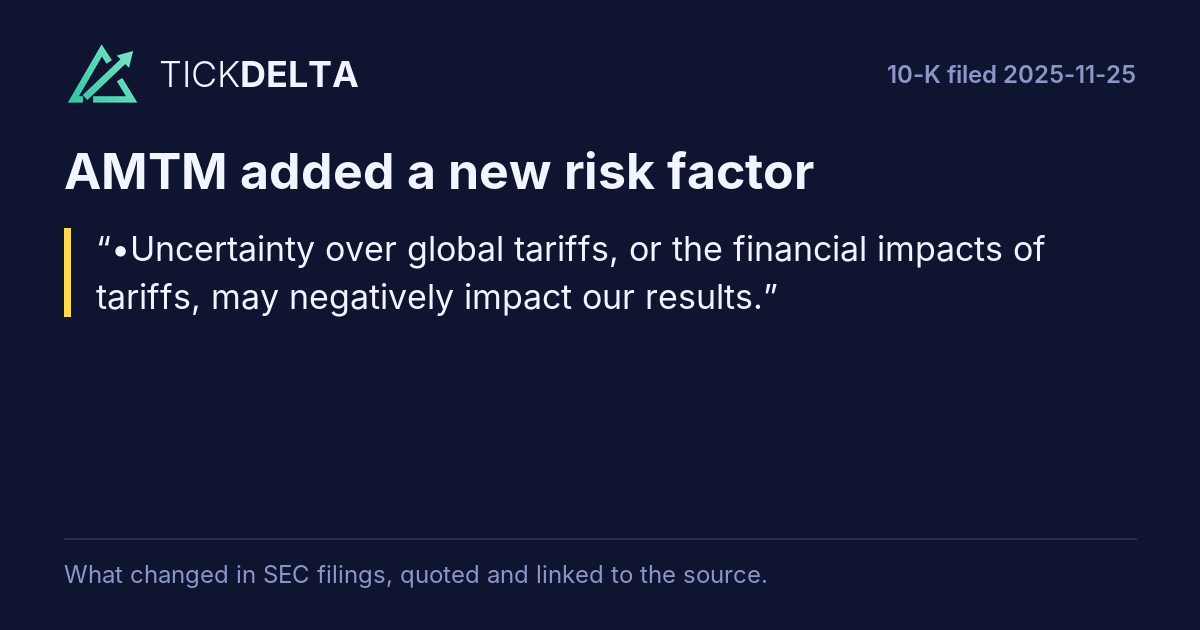
•Uncertainty over global tariffs, or the financial impacts of tariffs, may negatively impact our results.
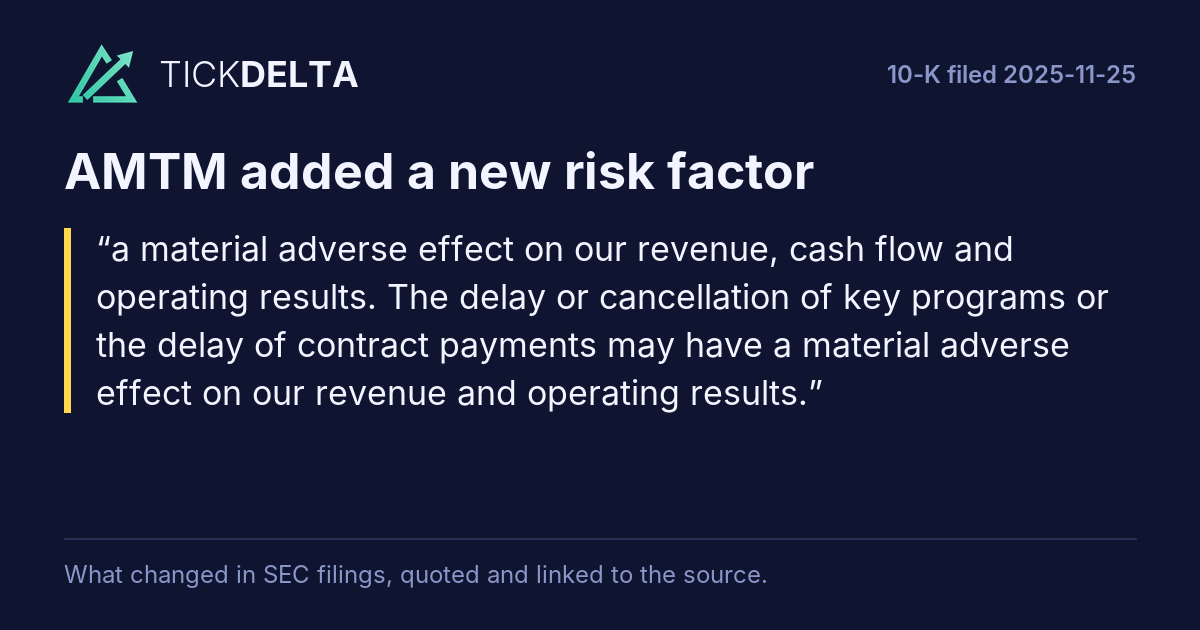
a material adverse effect on our revenue, cash flow and operating results. The delay or cancellation of key programs or the delay of contract payments may have a material adverse effect on our revenue and operating results.
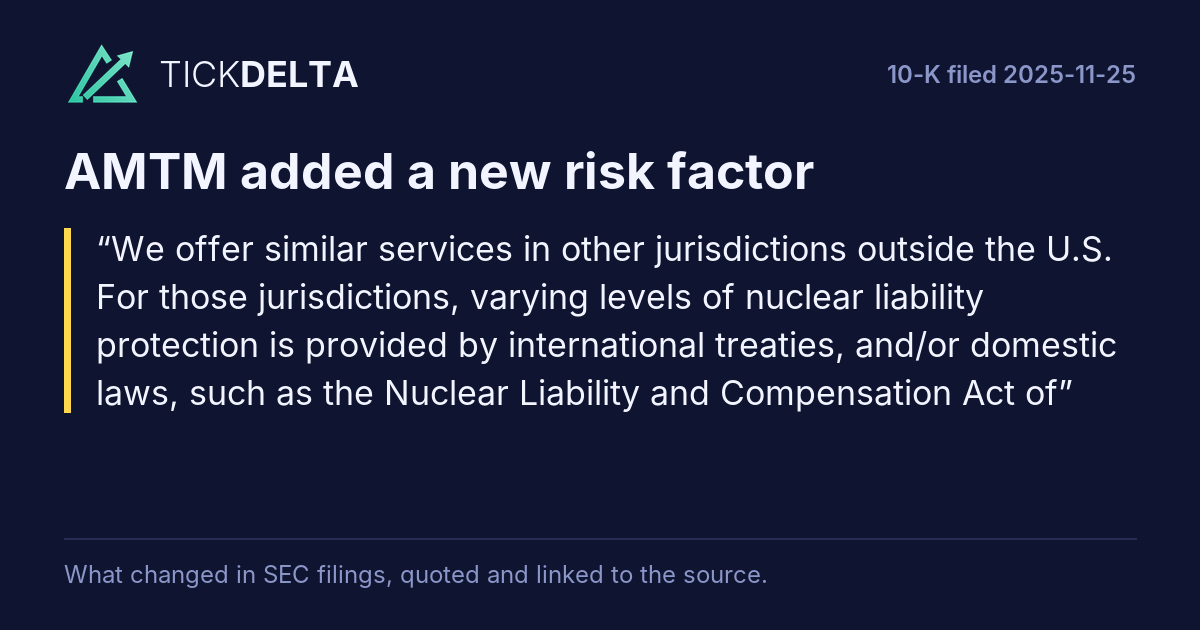
We offer similar services in other jurisdictions outside the U.S. For those jurisdictions, varying levels of nuclear liability protection is provided by international treaties, and/or domestic laws, such as the Nuclear Liability and Compensation Act of
In addition, certain of our contracts provide a wide range of nuclear services to the U.S. and U.K. governments. If the policies of those governments were to de-emphasize nuclear matters, it may have a material adverse impact on our business, financial condition and results of operations.
Uncertainty over global tariffs, or the financial impact of tariffs, may negatively impact our results.
Our business could be adversely impacted by changes in the U.S. Government’s approach to tariffs and other trade policies. As a result of major U.S. Government trade policy changes announced by President Trump, there is currently significant uncertainty with respect to tariffs that may impact our supply chain. New or increased tariffs for imports into the United States, as well as new or increased tariffs or trade bans imposed by other countries, could have an adverse effect on both our U.S. and international operations due to increased costs of materials, disruptions or delays in deliveries, and greater difficulty in planning and operating our business. While our business in the U.S. primarily provides labor services to our customers, some of our U.S. work involves providing goods that may be subject to tariffs. Our non-U.S. work could also be impacted by greater costs for goods sourced from the U.S. due to increased tariffs imposed by other countries. To date, the Company has not experienced a material negative impact from the recent changes in tariff policies. Although we plan to continue to monitor trade policy developments closely and to mitigate the adverse impacts of any changes where possible, we may not be able to fully mitigate such impacts in all situations.
•recent geopolitical tensions and conflict between the U.S. government and certain South and Central American countries;
Show the other 6
•risk that we are not able to complete strategic divestitures on satisfactory terms and conditions, including non-competition arrangements applicable to certain of our business lines, or within expected timeframes;
•risks that indemnification related to businesses divested or spun off that we may be required to provide or otherwise bear may be significant and could negatively impact our business; and
Our industry continues to experience significant changes to business practices as a result of an increased focus on affordability, efficiencies and recovery of costs, among other items. U.S. federal government agencies may face restrictions or pressure regarding the type and amount of services that they may obtain from private contractors. Legislation, regulations and initiatives dealing with procurement reform, including changes in the FAR, deterrence of fraud, and stricter environmental compliance or
There is increased scrutiny from governmental organizations, customers, and employees on companies’ sustainability practices and disclosures. If our sustainability practices do not meet evolving rules and regulations or stakeholder expectations and standards (or if we are viewed negatively based on positions we do or do not take or work we do or do not perform or cannot publicly disclose for certain customers and industries), then our reputation, our ability to attract or retain leading experts, employees and other professionals and our ability to attract new business and customers could be negatively impacted, as could
Our level of indebtedness could have important consequences, including, but not limited to:
Low trading volume for our stock could amplify the effect of the above factors on our stock price volatility.
We may experience a negative impact to our reputation as a result of socio-political opposition to U.S. government policies that are reflected in U.S. government contracts we bid, win and perform.
From time to time, we may bid, win and perform government contracts that are the result of U.S. government policies that may be opposed by certain stockholders, suppliers, customers or other stakeholders. Any resulting negative impact on our reputation may have a material adverse impact on our business, financial condition, results of operations and stock price.
Paragraphs in the 10-Q filed Aug 11, 2026 that were not in the one before
New in the latest 10-Q
8 paragraphs in the 10-Q filed Aug 11, 2026 with nothing like them in the 10-Q filed May 12, 2026 (at least half the words must differ; new numbers alone do not count). Quoted exactly, grouped by the item heading above them. This is text that changed, not a judgement of how serious it is.
Financial statements and notes
The carrying amount of goodwill for our reportable segments, DS and GES, was $ 2,260 million and $ 3,443 million, respectively, as of both July 3, 2026 and October 3, 2025.
Read in the 10-Q
On September 27, 2024, we entered into a senior secured credit facility (the “Credit Facility”) consisting of a $ 3,750 million term facility (“Term Loan”) maturing September 27, 2031 and an $ 850 million revolving facility (“Revolver”), including a $ 200 million letter of credit subfacility and a $ 100 million swingline subfacility, maturing September 27, 2029.
Read in the 10-Q
Quarterly principal amortization payments on Term Loan A are equal to (a) 0.625 % of the original principal amount of Term Loan A commencing September 30, 2026 through June 30, 2028, (b) 1.25 % of the original principal amount of Term Loan A from September 30, 2028 through June 30, 2030, and (c) 1.875 % of the original principal amount of Term Loan A thereafter with the remainder of the principal being due at maturity.
Read in the 10-Q
Quarterly principal amortization payments on Term Loan B are equal to 0.25 % of the original principal amount of Term Loan B commencing September 30, 2026, with the remainder of the principal being due at maturity. On June 30, 2026, we made a $ 125 million voluntary principal payment on Term Loan B.
Read in the 10-Q
As of July 3, 2026 and October 3, 2025, the available borrowing capacity under the Credit Facility was $ 917 million and $ 766 million, respectively, and included $ 83 million and $ 84 million, respectively, in issued letters of credit. As of July 3, 2026 and October 3, 2025, there were no amounts borrowed under the Revolver.
Read in the 10-Q
Show the other 3
Loss on extinguishment of debt - The loss on extinguishment of debt was due to the Amendment and a $125 million voluntary principal payment on the Term Loan B for the three months ended July 3, 2026 and a $191 million voluntary principal payment on the term facility for the three months ended June 27, 2025.
Read in the 10-Q
Loss on extinguishment of debt - The loss on extinguishment of debt was due to the Amendment and a $125 million voluntary principal payment on the Term Loan B for the nine months ended July 3, 2026 and a $191 million voluntary principal payment on the term facility for the nine months ended June 27, 2025.
Read in the 10-Q
Market risk
applicable interest rates, interest expense on our variable rate debt for the nine months ended July 3, 2026 would have fluctuated by approximately $23 million.
Read in the 10-Q
The 10-Q's risk factors against the 10-K
Item 1A of the 10-Q filed Aug 11, 2026 against Item 1A of the 10-K filed Nov 25, 2025.
A 10-Q repeats only the risks that changed, so a 10-K paragraph that is missing from it is not counted as removed.
Added is a paragraph with nothing like it in the 10-K, Reworded a sentence that is in both with several words changed,
Quiet changes a sentence in both where one to four words changed and one is a hedge or a modal
(cut words struck through, new words highlighted).
Text on the page, not a score; each links to the filing at sec.gov.
What the 10-Q itself says about its risk factors:There have been no material changes to our Risk Factors disclosed in the Company’s Form 10-K for the year ended October 3, 2025.
Read in the 10-Q
1 paragraph in the 10-Q's Item 1A, and none of them adds, rewords or quietly edits a paragraph of the 10-K's.
Phrases used for the first time
Two-word phrases in Risk Factors of the 10-K filed Nov 25, 2025 that are in none of the 1 earlier 10-Ks stored, back to Dec 17, 2024
Where each one is used
- cms subsidiaries: •Amentum will continue the active conduct of CMS’s trade or business and the trade or business of certain CMS subsidiaries;
- government shutdown: •A delay in the completion of the federal government’s budget process, a prolonged continuing resolution or government shutdown, a decline in the federal government budget, changes in spending or budgetary priorities or delays in contract award may materially adversely affect our business, financial condition and...
- nuclear technologies: •If we do not have adequate indemnification for our nuclear services, or business is slowed by the extensive regulatory processes for approval and licensing for new and existing nuclear technologies or socio-political opposition to nuclear-related technology and activities, it could adversely affect our business,...
- socio-political opposition: •If we do not have adequate indemnification for our nuclear services, or business is slowed by the extensive regulatory processes for approval and licensing for new and existing nuclear technologies or socio-political opposition to nuclear-related technology and activities, it could adversely affect our business,...
- increased tariffs: Our business could be adversely impacted by changes in the U.S. Government’s approach to tariffs and other trade policies. As a result of major U.S. Government trade policy changes announced by President Trump, there is currently significant uncertainty with respect to tariffs that may impact our supply chain. New...
- sustainability practices: Increasing scrutiny and changing and conflicting expectations from governmental organizations, customers, and our employees with respect to our sustainability practices may impose additional costs on us or expose us to new or additional risks.
- process prolonged: •A delay in the completion of the federal government’s budget process, a prolonged continuing resolution or government shutdown, a decline in the federal government budget, changes in spending or budgetary priorities or delays in contract award may materially adversely affect our business, financial condition and...
- prolonged continuing: •A delay in the completion of the federal government’s budget process, a prolonged continuing resolution or government shutdown, a decline in the federal government budget, changes in spending or budgetary priorities or delays in contract award may materially adversely affect our business, financial condition and...
Used at least twice, small words left out. Counted, not picked: a phrase can be new because the company renamed something.
What was taken out
43 paragraphs of last year's Risk Factors with nothing like them now. The longest are quoted.
Sources
Item 1A of each 10-K and 10-Q on EDGAR, quoted exactly. Each paragraph links to the filing at sec.gov.
Also
10-K change: what was reworded or cut, section by section.
Work with it
Excel workbook · CSV. Google Sheet that stays up to date: paste =IMPORTDATA("https://tickdelta.com/company/AMTM/export.csv") into a cell.