Form 10-K for the Fiscal Year Ended December 31, 2014
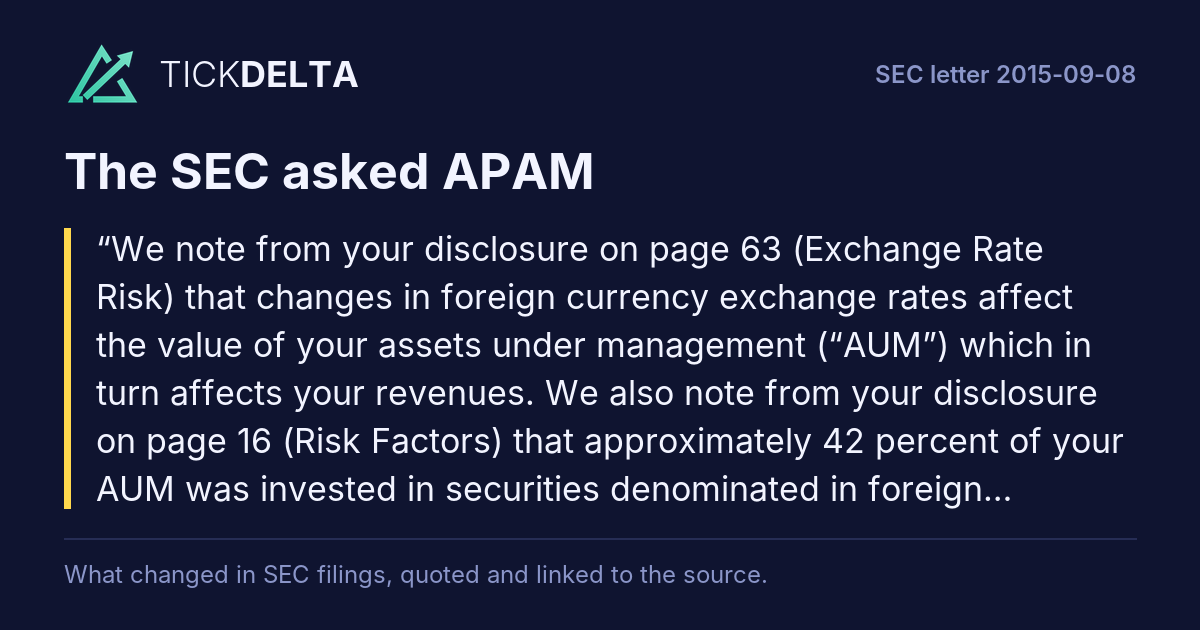
We note from your disclosure on page 63 (Exchange Rate Risk) that changes in foreign currency exchange rates affect the value of your assets under management (“AUM”) which in turn affects your revenues. We also note from your disclosure on page 16 (Risk Factors) that approximately 42 percent of your AUM was invested in securities denominated in foreign currencies.Rest of the question
Please revise your future filings to disaggregate the impact of foreign currencies within your AUM roll-forwards. Refer to Item 303(a)(3) of Regulation S-K.
If changes in foreign currency exchange rates have materially affected the value of our assets under management (“AUM”) as of a period end, we will revise the future filing to disclose information about the impact of foreign currency exchange rates on the value of our AUM.Read in the reply
First report after the company's reply of Sep 18, 2015: 10-Q filed Nov 2, 2015 ↗, against the 10-Q filed Aug 3, 2015 ↗.
Tickdelta does not hold the text of both reports, so they are not compared here.
We note from your disclosures on page 91 (Note 10 – Stockholders’ Equity) that the 2014 follow-on offering, H&F conversion, and Holdings common unit exchanges reduced your outstanding shares of Class B and Class C common stock.Rest of the question
We also note from your exchange agreement that certain Holdings common unit holders can exchange their Holdings common units together with an equal number of your Class B or Class C common stock for your Class A common stock. Please revise your future filings to expand your discussion and clarify the impact of these transactions (i.e. follow-on offerings, exchanges, etc.) on your Class B and Class C common stock such that an investor can reconcile your disclosure here to your consolidated statements of changes in stockholders’ equity (page 71) and the share amounts presented on page 91.
In future filings, we will expand our Consolidated Statements of Changes in Stockholders’ Equity to include a separate column for each class of common stock to allow investors to reconcile the share roll-forward included in the notes to the financial statements with the corresponding balance sheet impact. We will also revise future filings to expand our discussion of the impact of these transactions on our Class B and Class C common stock.Read in the reply
First report after the company's reply of Sep 18, 2015: 10-Q filed Nov 2, 2015 ↗, against the 10-Q filed Aug 3, 2015 ↗.
Tickdelta does not hold the text of both reports, so they are not compared here.
We note from your disclosure on page 107 (Compensation Discussion and Analysis) that career shares were issued for the first time in 2014 as component of your equity compensation program and one-half of the restricted shares awarded to your named executive officers were career shares.Rest of the question
We also note that these awards vest on a pro rata basis over five years and vesting will be consummated upon the qualifying retirement of the grantee. Please address the following: Tell us how you considered the “qualifying retirement” vesting provision when estimating the service period for these awards. Refer to ASC 718-10-35-5 and ASC 718-10-55-67 and 68. Revise your future filings to disclose the service period, compensation expense, unrecognized compensation expense, and weighted average recognition period for your career shares awards. Provide this information separately from other sharebased awards or explain to us why this information would not be meaningful. Refer to ASC 718-10-50-2(g). We note from pages 13 and 14 (Note 9 – Compensation and Benefits) in your June 30, 2015 Form 10-Q that you granted approximately 563 thousand restricted stock awards and 80 thousand restricted stock units (“RSUs”) in 2015. You also disclose on page 32 (Management’s Discussion and Analysis…) that career shares are included in this grant (i.e. you combine RSUs and restricted stock awards). Please revise your future filings to separately disaggregate this information, or explain to us why this information would not be meaningful. Refer to ASC 718-10-50-2(g).
Career shares generally are subject to two vesting conditions – pro-rata annual time vesting over five years and a “qualifying retirement” (as defined in the award agreements). A qualifying retirement requires that the participant has been employed by us for at least 10 years at retirement, has provided proper retirement notice, and remains at the company through the retirement notice period.Read in the replyRest of the answer
The career shares will vest if and when the participant retires from the company in accordance with the qualifying retirement conditions.
In accordance with ASC 718-10-55-73, the initial requisite service period for each career share recipient is the longest explicit, implicit or derived service period. The initial requisite service period is determined individually for each participant, depending on the amount of service already provided and whether the individual has provided a proper retirement notice. For each participant who has already attained 10 years of service at the time he is granted a career share award, the initial requisite service period for that award is the longer of:
(a) the five year vesting term, or
(b) the period through the date of anticipated qualifying retirement if the participant has provided a proper retirement notice.
If the participant does not have 10 years of service at the time he is granted a career share award, the initial requisite service period will be no shorter than the period through the date of attainment of 10 years of service, but could be longer based on:
the five year vesting term if the participant has not provided a proper retirement notice, or the period through the date of anticipated qualifying retirement if the participant has provided a proper retirement notice.
In accordance with ASC 718-10-35-7, we will reassess the requisite service period during the term of the award. If a participant has not provided his notice of retirement within one year of the conclusion of the initial requisite service period, the initial requisite service period would no longer be appropriate and we will extend the remaining requisite service period as necessary.
Revise your future filings to disclose the service period, compensation expense, unrecognized compensation expense, and weighted average recognition period for your career shares awards. Provide this information separately from other share-based awards or explain to us why this information would not be meaningful. Refer to ASC 718-10-50-2(g).
According to ASC 718-10-50-2(g), “An entity that grants equity or liability instruments under multiple share-based payment arrangements with employees shall provide the information specified in paragraph (a) through (f) separately for different types of awards to the extent that the differences in the characteristics of the awards make separate disclosure important to an understanding of the entity’s use of share-based compensation.”
As the majority of the career share awards have been granted to recipients that have already achieved 10 years of service, the difference in the service periods and remaining weighted average recognition periods between career share awards and our standard awards is not material, and therefore we concluded separate disclosure would not be meaningful. If in the future the requisite service period for career share awards is meaningfully different than that of our standard awards, we will add separate ASC 718-10-50-2 disclosure.
We note from pages 13 and 14 (Note 9 – Compensation and Benefits) in your June 30, 2015 Form 10-Q that you granted approximately 563 thousand restricted stock awards and 80 thousand restricted stock units (“RSUs”) in 2015. You also disclose on page 32 (Management’s Discussion and Analysis…) that career shares are included in this grant (i.e. you combine RSUs and restricted stock awards). Please revise your future filings to separately disaggregate this information, or explain to us why this information would not be meaningful. Refer to ASC 718-10-50-2(g).
Restricted stock units granted to employees in 2015 have the same vesting terms and requisite service period as our standard restricted stock awards. Additionally, as discussed above, the weighted average requisite service period for career shares granted to employees is not materially different than the requisite service period for standard restricted stock awards that have been granted. Accordingly, we do not believe separate disclosure of RSUs or career shares versus standard restricted stock awards would be meaningful. We will add separate ASC 718-10-50-2 disclosure in future filings if the requisite service period for RSU or career shares is meaningfully different than that of our standard restricted stock awards.
Artisan Partners Asset Management Inc. acknowledges that:
we are responsible for the adequacy of the disclosure in the filing;
staff comments or changes to disclosure in response to staff comments do not foreclose the Commission from taking any action with respect to the filing; and we may not assert staff comments as a defense in any proceeding initiated by the Commission or any person under the federal securities laws of the United States.
First report after the company's reply of Sep 18, 2015: 10-Q filed Nov 2, 2015 ↗, against the 10-Q filed Aug 3, 2015 ↗.
Tickdelta does not hold the text of both reports, so they are not compared here.
Also in this review: closing letter, 2015-09-30