Artisan Partners Asset Management Inc. APAM
New risk paragraphs, branching off last year
Each branch is a paragraph in Risk Factors with nothing like it in the 10-K filed Feb 25, 2025. A box jumps to the paragraph as filed, below.
Paragraphs with nothing like them in last year's 10-K
11 paragraphs in Risk Factors of the 10-K filed Feb 20, 2026 with nothing like them in the 10-K filed Feb 25, 2025. Quoted exactly. Paragraphs that were only edited are under 10-K change.
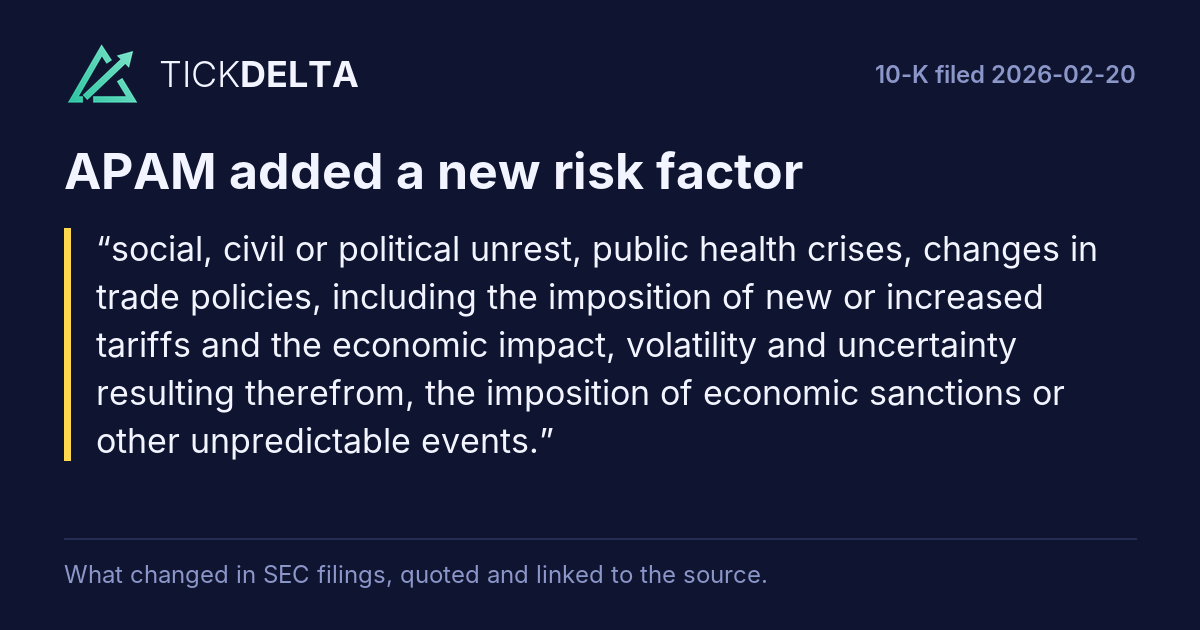
social, civil or political unrest, public health crises, changes in trade policies, including the imposition of new or increased tariffs and the economic impact, volatility and uncertainty resulting therefrom, the imposition of economic sanctions or other unpredictable events.
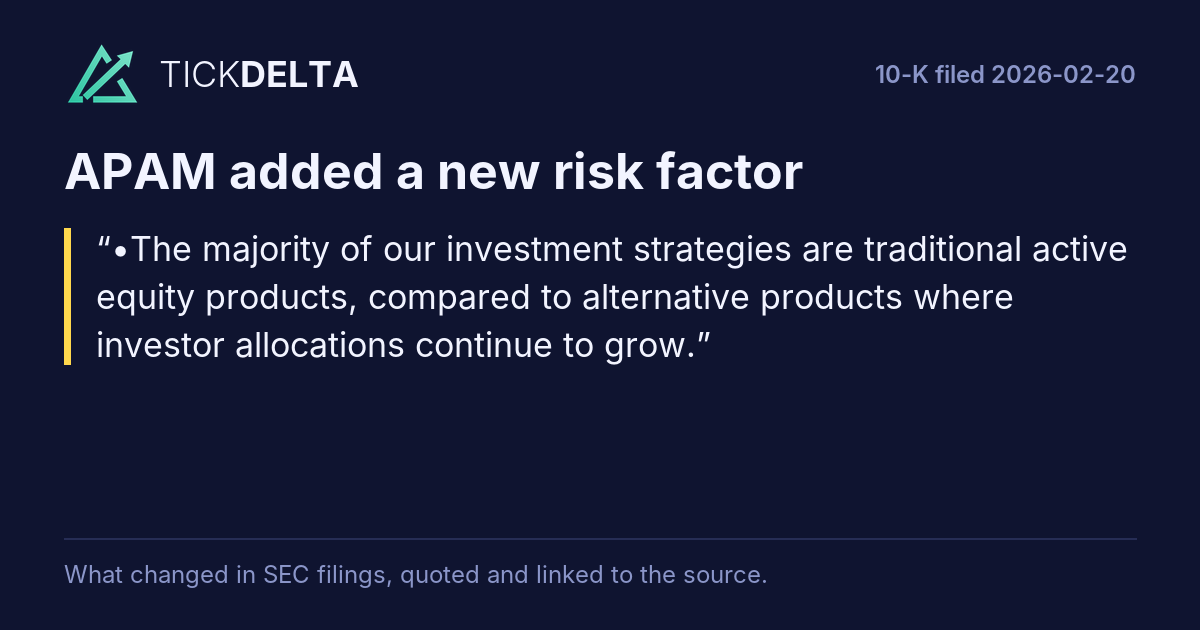
•The majority of our investment strategies are traditional active equity products, compared to alternative products where investor allocations continue to grow.
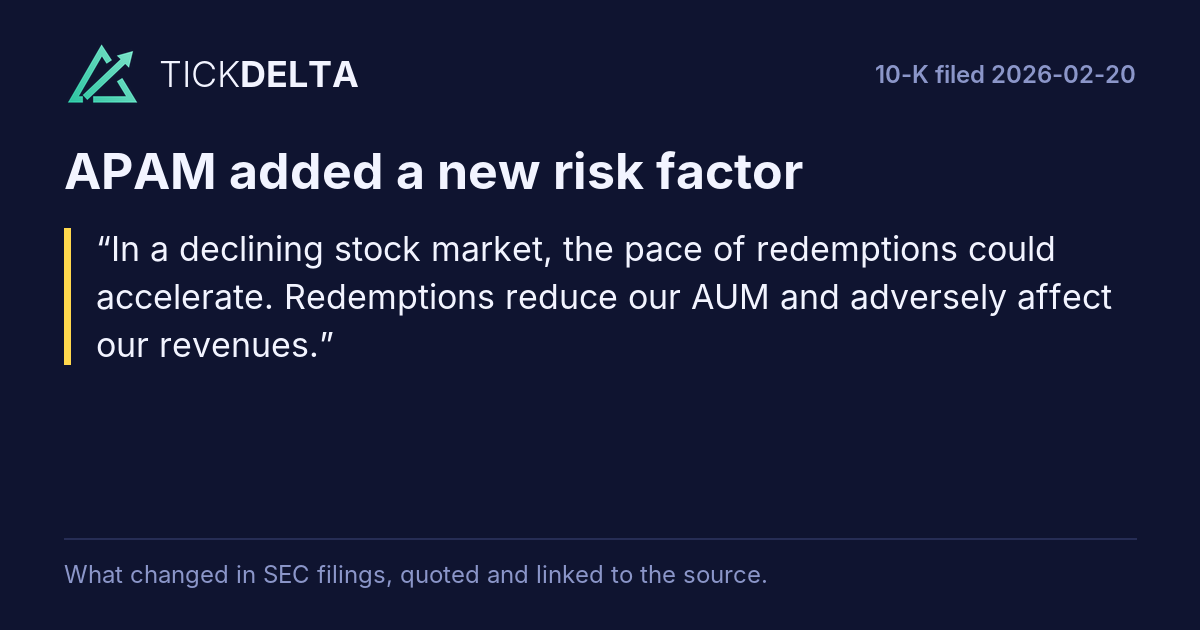
In a declining stock market, the pace of redemptions could accelerate. Redemptions reduce our AUM and adversely affect our revenues.
Our real estate funds are subject to the risks inherent in the ownership and operation of real estate and the construction and development of real estate.
Investments by our real estate funds will be subject to the risks inherent in the ownership and operation of real estate and real estate-related businesses and assets. Such investments are subject to the potential for deterioration of real estate fundamentals and the risk of adverse changes in local market and economic conditions, which may include changes in supply of and demand for competing properties in an area, increases in interest rates and borrowing costs, changes in demand for properties, changes in the financial resources of tenants, defaults by borrowers or tenants and the reduced availability of mortgage funds, which may render the sale or refinancing of properties difficult or impracticable. In addition, investments in real estate and real estate-related businesses and assets may be subject to the risk of environmental liabilities, contingent liabilities upon disposition of assets, casualty or condemnations losses, energy and supply shortages, natural disasters, climate change related risks, acts of god, terrorist attacks, war, pandemics or other severe public health events, and other events that are beyond our control, and various uninsured or uninsurable risks. Further, investments in real estate and real estate-related businesses and assets are subject to changes in law and regulation, including in respect of building, environmental and zoning laws and changes to tax laws and regulations.
The industry in which we operate is subject to extensive, complex and overlapping or conflicting laws, rules and regulations. There is uncertainty associated with the regulatory and compliance environments in which we operate and such environments are subject to frequently changing and often increasingly strict rules, regulations, policies, legal interpretations and enforcement
Show the other 2
intelligence (AI), and the use of AI by other market participants, may increase our exposure to operational, cybersecurity, privacy and reputational risks.
Our ability to manage and grow our business successfully can be impeded by systems and other technological limitations.
Our continued success in effectively managing and growing our business depends on our ability to integrate our varied financial, information, and operational systems on a global basis. Moreover, adapting or developing the existing systems we use to meet our internal needs, as well as client needs, industry demands and new regulatory requirements, is also critical for our business. On an ongoing basis, we need to upgrade and improve our technology, including the systems that support our core investment, trading and operational activities. Further, we also must be prepared to implement new technology when growth opportunities present themselves, whether in connection with the needs of a current or future investment team or rapidly increasing business activities in particular markets or regions. The integration of new or modified systems could present operational issues or require significant capital, and may require us to reevaluate the current value or expected useful lives of the technology we use or intend to use, which could negatively impact our results of operations. In addition, technology is subject to rapid advancements and changes and our competitors may, from time to time, implement newer technologies or more advanced platforms for their services and products, which could adversely affect our business if we are unable to remain competitive.
Developing regulatory treatment of AI, and failure to adequately address AI-related challenges, creates a risk of reputational harm and an impediment to growth.
AI is used within our business and we plan to further incorporate it where opportunity exists. The use of AI offers efficiencies, but also introduces significant challenges related to data security, privacy, intellectual property, regulatory compliance, accuracy and bias concerns, and reputational harm, among others. For example, AI technologies, including generative AI, may create content that appears correct but is factually inaccurate or flawed. AI technologies evolve at a rapid pace and their usage requires integration with other technology applications, data platforms and business processes. Globally, courts and regulatory agencies are developing approaches to dealing with AI-related issues, which creates uncertainty around the use of the technology. Use of AI technologies requires ongoing operational controls and procedures, and the development and implementation of appropriate protections and safeguards. Failure to successfully integrate AI technologies, respond to client or market demands, identify or address applicable legal or regulatory issues or effectively manage related risks could result in legal and regulatory liabilities and harm our reputation and growth.
Paragraphs in the 10-Q filed Oct 29, 2026 that were not in the one before
New in the latest 10-Q
18 paragraphs in the 10-Q filed Oct 29, 2026 with nothing like them in the 10-Q filed Jul 31, 2026 (at least half the words must differ; new numbers alone do not count). Quoted exactly, grouped by the item heading above them. This is text that changed, not a judgement of how serious it is.
Financial statements and notes
On September 23, 2026, Artisan Partners Holdings LP replaced its existing $ 100 million revolving credit facility with a new $ 150 million five-year revolving credit facility that matures in September 2031. The previous facility was scheduled to mature in August 2027. The Company incurred debt issuance costs related to the revolving credit facility of $ 1.4 million, which are recorded to other assets and are amortized as interest expense over the life of the instrument.
Read in the 10-Q
In addition, during the three months ended September 30, 2026, one series of Artisan Funds and one sub-fund of Artisan Global Funds were liquidated, resulting in the redemption of all fund assets at fair value. No gain or loss was recognized as a result of liquidation as the assets and liabilities of CIPs are carried at fair value. As a result, these funds were no longer consolidated as of September 30, 2026.
Read in the 10-Q
By December 2026, we expect the equity Artisan Funds to have completed their annual income and capital gain distributions. Based on our current estimates and assumptions, we expect fourth quarter distributions to result in approximately $2.5 billion of net client cash outflows from investors who choose not to reinvest their distributions. The fourth quarter 2026 distributions, estimates of which we expect Artisan Funds to disclose in advance of the record dates, may cause increased mutual fund redemptions.
Read in the 10-Q
Three Months Ended Growth Global Equity U.S. Value Int’l Value Group Global Value SEM Credit Developing World Antero Peak Group Int’l Small-Mid EMsights Capital Group Grandview Total
Read in the 10-Q
(1) Net client cash flows excludes Artisan Funds’ income and capital gain distributions that were not reinvested by fund shareholders, as well as realizations.
Read in the 10-Q
Show the other 13
(2) Represents assets acquired upon the closing of the Grandview Property Partners acquisition.
Read in the 10-Q
(3) Represents the distribution of realized proceeds from the disposition of assets.
Read in the 10-Q
(4) Artisan Funds’ distributions not reinvested represents the amount of income and capital gain distributions that were not reinvested in the Artisan Funds.
Read in the 10-Q
(5) Includes the impact of translating the value of AUM denominated in non-USD currencies into U.S. dollars. The impact was immaterial for the periods presented.
Read in the 10-Q
(6) Average AUM for the U.S. Value team reflects the period through the completion of the team's wind-down on August 30, 2026.
Read in the 10-Q
(1) Equity includes the following investment strategies: U.S. Mid-Cap Growth, U.S. Small-Cap Growth, U.S. Mid-Cap Value, Non-U.S. Growth, International Value, Global Opportunities, Global Equity, Value Equity, Global Value, Sustainable Emerging Markets, Global Discovery, Developing World, Non-U.S. Small-Mid Growth, International Explorer, Select Equity, Value Income and Franchise. Credit includes the following investment strategies: High Income, Floating Rate, Custom Credit Solutions, Eme...
Read in the 10-Q
(2) Net client cash flows excludes Artisan Funds’ income and capital gain distributions that were not reinvested by fund shareholders, as well as realizations.
Read in the 10-Q
(3) Realizations represents the distribution of realized proceeds from the disposition of assets.
Read in the 10-Q
(4) Artisan Funds’ distributions not reinvested represents the amount of income and capital gain distributions that were not reinvested in the Artisan Funds.
Read in the 10-Q
(5) Includes the impact of translating the value of AUM denominated in non-USD currencies into U.S. dollars. The impact was immaterial for the periods presented.
Read in the 10-Q
We estimate that our GAAP and adjusted effective tax rates could increase by approximately one percentage point beginning in 2027 as a result of the compensation deduction limitation rules within the OBBBA.
Read in the 10-Q
Nine months ended September 30, 2026, compared to nine months ended September 30, 2025
Read in the 10-Q
On September 23, 2026, Artisan Partners Holdings LP replaced its existing $100 million revolving credit facility with a new $150 million five-year revolving credit facility that matures in September 2031. The previous facility was scheduled to mature in August 2027. The Company incurred debt issuance costs related to the revolving credit facility of $1.4 million, which are recorded to other assets and are amortized as interest expense over the life of the instrument.
Read in the 10-Q
The 10-Q's risk factors against the 10-K
Item 1A of the 10-Q filed Oct 29, 2026 against Item 1A of the 10-K filed Feb 20, 2026.
A 10-Q repeats only the risks that changed, so a 10-K paragraph that is missing from it is not counted as removed.
Added is a paragraph with nothing like it in the 10-K, Reworded a sentence that is in both with several words changed,
Quiet changes a sentence in both where one to four words changed and one is a hedge or a modal
(cut words struck through, new words highlighted).
Text on the page, not a score; each links to the filing at sec.gov.
What the 10-Q itself says about its risk factors:For a discussion of related and other potential risks and uncertainties, see the information under the heading “Risk Factors” in our latest annual report on Form 10-K, which is accessible on the SEC’s website at www.sec.gov.
Read in the 10-Q
1 paragraph in the 10-Q's Item 1A, and none of them adds, rewords or quietly edits a paragraph of the 10-K's.
Phrases used for the first time
Two-word phrases in Risk Factors of the 10-K filed Feb 20, 2026 that are in none of the 1 earlier 10-Ks stored, back to Feb 25, 2025
Where each one is used
- real estate: Our real estate funds are subject to the risks inherent in the ownership and operation of real estate and the construction and development of real estate.
- cyber threats: We are heavily dependent on the capacity and reliability of the communications and information technology systems supporting our operations, whether developed, owned and operated by us or by third parties. We also rely on manual workflows and a variety of manual user controls. As our clients, physical locations and...
- real estate-related: Investments by our real estate funds will be subject to the risks inherent in the ownership and operation of real estate and real estate-related businesses and assets. Such investments are subject to the potential for deterioration of real estate fundamentals and the risk of adverse changes in local market and...
- increasingly complex: Attracting, developing and retaining talented investment professionals is an essential component of our business strategy. To do so, it is critical that we continue to foster an environment and provide opportunities, compensation and benefits that are attractive for existing and prospective investment professionals...
- public health: social, civil or political unrest, public health crises, changes in trade policies, including the imposition of new or increased tariffs and the economic impact, volatility and uncertainty resulting therefrom, the imposition of economic sanctions or other unpredictable events.
- face heightened: Several of our investment strategies invest principally in the securities of non-U.S. companies, which involve foreign currency exchange risks and may face heightened tax, political, social, economic and legal risks.
- heightened tax: Several of our investment strategies invest principally in the securities of non-U.S. companies, which involve foreign currency exchange risks and may face heightened tax, political, social, economic and legal risks.
- social economic: Several of our investment strategies invest principally in the securities of non-U.S. companies, which involve foreign currency exchange risks and may face heightened tax, political, social, economic and legal risks.
Used at least twice, small words left out. Counted, not picked: a phrase can be new because the company renamed something.
What was taken out
6 paragraphs of last year's Risk Factors with nothing like them now. The longest are quoted.
Sources
Item 1A of each 10-K and 10-Q on EDGAR, quoted exactly. Each paragraph links to the filing at sec.gov.
Also
10-K change: what was reworded or cut, section by section.
Work with it
Excel workbook · CSV. Google Sheet that stays up to date: paste =IMPORTDATA("https://tickdelta.com/company/APAM/export.csv") into a cell.