Paragraph 89 · 50% changed
Every version of it
Screener
/
SEC EDGAR
/CIK 0001433195
/10-K filed Feb 5, 2026, compared with Feb 6, 2025
/Numbers from the XBRL of the 10-Ks
Nasdaq
Technology · Software
Appfolio Inc APPF
The 10-K against last year's
142 changes: 33 added, 7 removed, 93 reworded, 9 quiet changes
10-K Feb 5, 2026 vs Feb 6, 2025
Risk Factors
13.5%
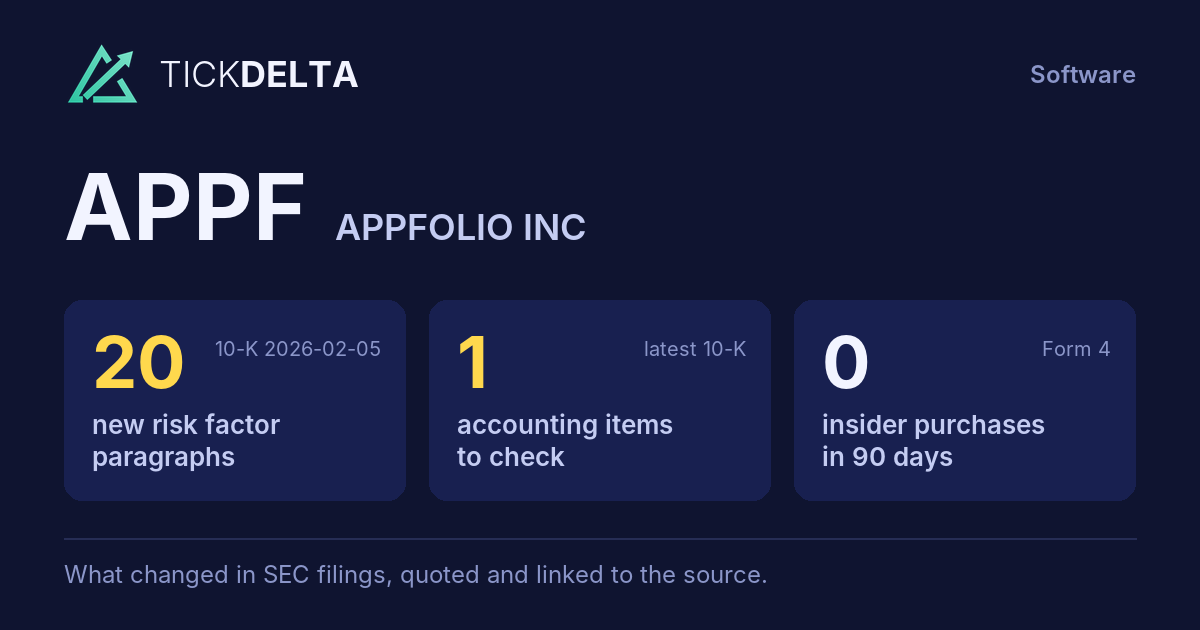
of the text changed · 12,714 words now · 20 new paragraphs, 2 gone
MD&A
24.6%
of the text changed · 5,114 words now · 13 new paragraphs, 5 gone
Legal Proceedings
41.5%
of the text changed · 791 words now
Accounting Policies
19.7%
of the text changed · 4,354 words now
10-K 0001433195-26-000011 (Feb 5, 2026) vs 10-K 0001433195-25-000013 (Feb 6, 2025)
Every paragraph, and how much of it changed
One bar per paragraph, in the order of the 10-K. Height and colour show the share of its words not in the closest paragraph a year earlier; the tallest bars are new paragraphs.
Risk Factors
129 paragraphs · 20 new · 60 reworded · 2 gone · 10-K Feb 5, 2026 against Feb 6, 2025
New paragraph
Reworded (5% of its words or more)
Same or nearly
Paragraph 64 · 43% changed
Every version of it
Paragraph 63 · 23% changed
Every version of it
Customer demands are constantly changing in response to new technology and other market factors. To compete effectively, we must identify and innovate in the right technologies, accurately predict our customers’ evolving needs, and continually improve our own technology platform. If we fail to execute against any of the foregoing, our business, financial condition and operating results may be harmed. In addition, the widespread adoption of quickly evolving disruptive technology products, such as generative AI, may significantly impact the real estate industry, even if such products are not specifically designed to apply directly to the real estate industry. The adoption of such new technologies could significantly reduce the number or demand of our customers, thereby reducing our revenue, which could materially impact our business, financial condition and operating results.
Paragraph 83 · 22% changed
Every version of it
Failure to protect our intellectual property rights rights, including our code, proprietary technology and brands, could impair our ability to protect our proprietary technology competitive position and our brands, which could harm our business.
Paragraph 4 · 22% changed
Every version of it
New and evolving regulatory requirements may also impact our customers and their ability or willingness to utilize our products and services. For instance, we are monitoring FCRA rulemaking efforts consistently monitor regulatory activity by the Federal Trade Commission (the "FTC"), by the Consumer Financial Protection Bureau ("CFPB") ("CFPB"), and by various recently enacted and proposed state regulations regulatory bodies applicable to tenant screening. These new New or uncertain regulatory requirements may impact our ability to offer or our customers' ability and willingness to utilize certain of our services, which may impact our operating results.
Paragraph 54 · 21% changed
Every version of it
We believe that our corporate culture has been and will continue to be a key contributor to our success. If we do not continue to preserve our corporate culture or maintain our core values as we grow and evolve, we may be unable to foster the passion, creativity, teamwork, focus and innovation we believe we need to support our growth. Any failure to preserve our culture could also negatively affect our ability to recruit and retain personnel and to effectively focus on and pursue our strategic objectives. As we grow, we may find it difficult to maintain our corporate culture.
Paragraph 44 · 18% changed
Every version of it
In addition, some of our third-party service providers also collect, store or process store, process, and transmit our sensitive information and our customers’ data on our behalf. These service providers have been, experienced cybersecurity incidents in the past involving such information and data, and we expect they will continue to be, be subject to similar threats of cyber attacks and other malicious Internet-based activities. internet-based activities in the future. Our contracts with these third parties may not provide us with adequate remedies in the event of such an incident incident, which could also expose us to risk of loss, litigation, fines, penalties, and potential liability as well as reputational damage.
Paragraph 48 · 18% changed
Every version of it
In addition to California, we are currently subject to comprehensive privacy laws across multiple states states, and in 2025 2026, will be subject to new comprehensive privacy laws in Delaware, Iowa, Maryland, Minnesota, Nebraska, New Hampshire, New Jersey, Indiana, Kentucky, and Tennessee. Rhode Island. These new and existing privacy laws and regulations have increased, impose increasingly complex operational requirements and will likely continue to increase, the complexity of our data collection and processing practices and policies and increase the cost of compliance to deliver support the delivery our services. Additionally, we We have incurred, and may incur in the future incur, substantial costs and expenses related to an increased exposure to regulatory enforcement and/or litigation. Despite our efforts, we cannot guarantee that we will be able to maintain full compliance with constantly evolving, and sometimes conflicting, data privacy laws in the jurisdictions in which we operate. If our privacy or data security measures fail to comply with current or future laws and regulations, we may be subject to claims, legal proceedings or other actions by individuals or governmental authorities based on privacy or data protection regulations and our privacy commitments to customers or others.
Paragraph 89 · 50% changed
Every version of it
10-K Feb 6, 2025Our solutions contain open source and third-party software, which may pose risks to our proprietary source code and/or introduce security vulnerabilities, and could have a material adverse impact on our business and operating results.
10-K Feb 5, 2026
software or open source software cease, significant engineering effort may be required to create an in-house solution. These risks could be difficult to eliminate or manage and have an adverse impact on our business and operating results.
Paragraph 64 · 43% changed
Every version of it
10-K Feb 6, 2025Customer demands are constantly changing in response to new technology and other market factors. To compete effectively, we must identify and innovate in the right technologies, accurately predict our customers’ evolving needs, and continually improve our own technology platform. If we fail to execute against any of the foregoing, our business, financial condition and operating results may be harmed. In addition, the widespread adoption of quickly evolving disruptive technology products, such as generative AI, may significantly impact the real estate industry, even if such products are not specifically designed to apply directly to the real estate industry. The adoption of such new technologies could significantly reduce the number or demand of our customers, thereby reducing our revenue, which could materially impact our business, financial condition and operating results.
10-K Feb 5, 2026
products, such as generative and agentic AI, may significantly impact the real estate industry, even if such products are not specifically designed to apply directly to the real estate industry. While we have introduced new generative and agentic AI products and are focused on enhancing the AI capabilities of our products and services and incorporating AI across existing products and services, there can be no assurance that our new or enhanced products and AI innovations will be successful, adopted or monetizable, or that we will innovate effectively to keep pace with the rapid evolution of AI across our offerings. The adoption of such new technologies could significantly reduce the number or demand of our customers, thereby reducing our revenue, which could adversely impact our business, financial condition and operating results.
Paragraph 63 · 23% changed
Every version of it
10-K Feb 6, 2025
Customer demands are constantly changing in response to new technology and other market factors. To compete effectively, we must identify and innovate in the right technologies, accurately predict our customers’ evolving needs, and continually improve our own technology platform. If we fail to execute against any of the foregoing, our business, financial condition and operating results may be harmed. In addition, the widespread adoption of quickly evolving disruptive technology products, such as generative AI, may significantly impact the real estate industry, even if such products are not specifically designed to apply directly to the real estate industry. The adoption of such new technologies could significantly reduce the number or demand of our customers, thereby reducing our revenue, which could materially impact our business, financial condition and operating results.
10-K Feb 5, 2026
Customer demands are constantly changing in response to new technology and other market factors. To compete effectively, we must identify and innovate in the right technologies, accurately predict our customers’ evolving needs, and continually improve our own technology platform. If we fail to execute against any of the foregoing, our business, financial condition and operating results may be harmed. In addition, the widespread adoption of quickly evolving disruptive technology
Paragraph 83 · 22% changed
Every version of it
10-K Feb 6, 2025
Failure to protect our intellectual property rights could impair our ability to protect our proprietary technology and our brands, which could harm our business.
10-K Feb 5, 2026
Failure to protect our intellectual property rights, including our code, proprietary technology and brands, could impair our competitive position and harm our business.
Paragraph 4 · 22% changed
Every version of it
10-K Feb 6, 2025
New and evolving regulatory requirements may also impact our customers and their ability or willingness to utilize our products and services. For instance, we are monitoring FCRA rulemaking efforts by the Consumer Financial Protection Bureau ("CFPB") and various recently enacted and proposed state regulations applicable to tenant screening. These new regulatory requirements may impact our ability to offer or our customers' ability and willingness to utilize certain of our services, which may impact our operating results.
10-K Feb 5, 2026
New and evolving regulatory requirements may also impact our customers and their ability or willingness to utilize our products and services. For instance, we consistently monitor regulatory activity by the Federal Trade Commission (the "FTC"), by the Consumer Financial Protection Bureau ("CFPB"), and by various state regulatory bodies applicable to tenant screening. New or uncertain regulatory requirements may impact our ability to offer or our customers' ability and willingness to utilize certain of our services, which may impact our operating results.
Paragraph 54 · 21% changed
Every version of it
10-K Feb 6, 2025
passion, creativity, teamwork, focus and innovation we believe we need to support our growth. Any failure to preserve our culture could also negatively affect our ability to recruit and retain personnel and to effectively focus on and pursue our strategic objectives. As we grow, we may find it difficult to maintain our corporate culture.
10-K Feb 5, 2026
We believe that our corporate culture has been and will continue to be a key contributor to our success. If we do not continue to preserve our corporate culture or maintain our core values as we grow and evolve, we may be unable to foster the passion, creativity, teamwork, focus and innovation we believe we need to support our growth. Any failure to preserve our culture could also negatively affect our ability to recruit and retain personnel and to effectively focus on and pursue our strategic objectives. As we grow, we may find it difficult to maintain our corporate culture.
Paragraph 44 · 18% changed
Every version of it
10-K Feb 6, 2025
In addition, some of our third-party service providers also collect, store or process our sensitive information and our customers’ data on our behalf. These service providers have been, and continue to be, subject to similar threats of cyber attacks and other malicious Internet-based activities. Our contracts with these third parties may not provide us with adequate remedies in the event of such an incident which could also expose us to risk of loss, litigation, fines, penalties, and potential liability as well as reputational damage.
10-K Feb 5, 2026
In addition, some of our third-party service providers also collect, store, process, and transmit our sensitive information and our customers’ data on our behalf. These service providers have experienced cybersecurity incidents in the past involving such information and data, and we expect they will continue to be subject to threats of cyber attacks and other malicious internet-based activities in the future. Our contracts with these third parties may not provide us with adequate remedies in the event of such an incident, which could also expose us to risk of loss, litigation, fines, penalties, and potential liability as well as reputational damage.
Paragraph 48 · 18% changed
Every version of it
10-K Feb 6, 2025
In addition to California, we are currently subject to comprehensive privacy laws across multiple states and in 2025 will be subject to new comprehensive privacy laws in Delaware, Iowa, Maryland, Minnesota, Nebraska, New Hampshire, New Jersey, and Tennessee. These laws and regulations have increased, and will likely continue to increase, the complexity of our data collection and processing practices and policies and the cost of compliance to deliver our services. Additionally, we may incur substantial costs and expenses related to an increased exposure to regulatory enforcement and/or litigation. Despite our efforts, we cannot guarantee that we will be able to maintain full compliance with constantly evolving, and sometimes conflicting, data privacy laws in the jurisdictions in which we operate. If our privacy or data security measures fail to comply with current or future laws and regulations, we may be subject to claims, legal proceedings or other actions by individuals or governmental authorities based on privacy or data protection regulations and our privacy commitments to customers or others.
10-K Feb 5, 2026
In addition to California, we are currently subject to comprehensive privacy laws across multiple states, and in 2026, will be subject to new comprehensive privacy laws in Indiana, Kentucky, and Rhode Island. These new and existing privacy laws and regulations impose increasingly complex operational requirements and will likely increase the cost of compliance to support the delivery our services. We have incurred, and may in the future incur, substantial costs and expenses related to an increased exposure to regulatory enforcement and/or litigation. Despite our efforts, we cannot guarantee that we will be able to maintain full compliance with constantly evolving, and sometimes conflicting, data privacy laws in the jurisdictions in which we operate. If our privacy or data security measures fail to comply with current or future laws and regulations, we may be subject to claims, legal proceedings or other actions by individuals or governmental authorities based on privacy or data protection regulations and our privacy commitments to customers or others.
MD&A
76 paragraphs · 13 new · 40 reworded · 5 gone · 10-K Feb 5, 2026 against Feb 6, 2025
New paragraph
Reworded (5% of its words or more)
Same or nearly
Paragraph 34 · 50% changed
Paragraph 31 · 48% changed
Research and product development expense for the year ended December 31, 2024 2025 increased compared to the prior year. The increase was mainly year primarily due to a $4.8 $22.8 million rise increase in personnel-related costs, including cash bonuses stock-based and stock-based compensation. These costs, performance-based compensation, net of capitalized software development costs, were costs driven by headcount growth and higher salaries as we continued to invest in innovation. Additionally, there was growth, combined with a $4.2 $2.3 million increase in allocated shared software spending to support our research and other costs, largely due to higher technology expense. The increase in personnel costs was partially offset by $3.4 million in severance and related expenses from a workforce reduction in development activities, for the third quarter of 2023. For additional information, see Note 17, Workforce Reduction, of the Notes to Consolidated Financial Statements included in Part II, Item 8 of this Annual Report. year ended December 31, 2025.
Paragraph 28 · 48% changed
Sales and marketing expense for the year ended December 31, 2024 2025 increased compared to the prior year, year primarily due to a $2.4 $20.0 million increase in personnel-related costs, including stock-based and performance-based compensation, to support growth in the business, combined with a $6.8 million increase in advertising and promotion expense and a $3.4 million increase related due to our FUTURE conference. These increases were partially offset by a $1.5 million reduction in personnel-related costs, including cash bonuses and stock-based compensation. The reduction in personnel-related costs included $3.8 million of severance and related personnel expenses from a workforce reduction in increased targeted go-to-market investment, for the third quarter of 2023. For additional information, see Note 17, Workforce Reduction, of the Notes to Consolidated Financial Statements included in Part II, Item 8 of this Annual Report. year ended December 31, 2025.
Paragraph 3 · 44% changed
The following discussion and analysis of our financial condition and results of operations includes 2025 and 2024 items and year-over-year comparisons between 2025 and 2024. For discussion of 2023 items and year-over-year comparisons between 2024 and 2023. For discussion of 2022 items and year-over-year comparisons between 2023 and 2022, 2023, refer to Part II. Item 7. “Management's Discussion and Analysis of Financial Condition and Results of Operations” of our Annual Report on Form 10-K for the year ended December 31, 2023. 2024. Our Consolidated Financial Statements are prepared and presented in accordance with accounting principles generally accepted in the United States ("GAAP"). This Annual Report also contains information regarding our non-GAAP income from operations ("Non-GAAP operating income") and non-GAAP operating margin ("Non-GAAP Operating Margin"), each of which constitutes a non-GAAP financial measure. We use these non-GAAP financial measures in addition to, and not as a substitute for, or superior to, financial measures calculated in accordance with GAAP. For more information regarding these non-GAAP financial measures, refer to "Management's Discussion and Analysis of Financial Condition and Results of Operations - Non-GAAP Financial Measures" below.
Paragraph 37 · 37% changed
Depreciation and amortization expense for the year ended December 31, 2024 decreased, 2025 increased, compared to the prior year, primarily due to decreased amortization expense associated with capitalized software development and of the intangible balances. assets recognized from the acquisition of Move EZ, Inc. in the fourth quarter of 2024.
Paragraph 25 · 36% changed
Cost of revenue (exclusive of depreciation and amortization) increased for the year ended December 31, 2024, increased 2025, compared to the prior year primarily driven by higher third-party service provider costs of $54.7 million, due to increases in expenditures to third-party service providers related to the delivery increased adoption and usage of our Value Added Services of $40.7 Services, combined with a $4.9 million compared increase in personnel-related costs, including stock-based and performance-based compensation, to support growth in the prior year. This increase was directly associated with the increased adoption and utilization of our Value Added Services. Allocated shared and other costs increased by $3.5 million business, for the year ended December 31, 2024, compared to the prior year, primarily related to investment in platform infrastructure in support of our overall growth. 2025.
Paragraph 45 · 36% changed
Paragraph 49 · 32% changed
Paragraph 34 · 50% changed
10-K Feb 6, 2025The net increase in cash provided by operating activities for the year ended December 31, 2024, compared to the prior year, was primarily due to a higher increase in cash collections from customers relative to the increase in operating expenditures during the year ended December 31, 2024.
10-K Feb 5, 2026
General and administrative expense for the year ended December 31, 2025 increased compared to the prior year primarily due to a $12.3 million increase in personnel-related costs, including stock-based and performance-based compensation, driven by headcount growth, for the year ended December 31, 2025.
Paragraph 31 · 48% changed
10-K Feb 6, 2025
Research and product development expense for the year ended December 31, 2024 increased compared to the prior year. The increase was mainly due to a $4.8 million rise in personnel-related costs, including cash bonuses and stock-based compensation. These costs, net of capitalized software development costs, were driven by headcount growth and higher salaries as we continued to invest in innovation. Additionally, there was a $4.2 million increase in allocated shared and other costs, largely due to higher technology expense. The increase in personnel costs was partially offset by $3.4 million in severance and related expenses from a workforce reduction in the third quarter of 2023. For additional information, see Note 17, Workforce Reduction, of the Notes to Consolidated Financial Statements included in Part II, Item 8 of this Annual Report.
10-K Feb 5, 2026
Research and product development expense for the year ended December 31, 2025 increased compared to the prior year primarily due to a $22.8 million increase in personnel-related costs, including stock-based and performance-based compensation, net of capitalized software development costs driven by headcount growth, combined with a $2.3 million increase in software spending to support our research and development activities, for the year ended December 31, 2025.
Paragraph 28 · 48% changed
10-K Feb 6, 2025
Sales and marketing expense for the year ended December 31, 2024 increased compared to the prior year, primarily due to a $2.4 million increase in advertising and promotion expense and a $3.4 million increase related to our FUTURE conference. These increases were partially offset by a $1.5 million reduction in personnel-related costs, including cash bonuses and stock-based compensation. The reduction in personnel-related costs included $3.8 million of severance and related personnel expenses from a workforce reduction in the third quarter of 2023. For additional information, see Note 17, Workforce Reduction, of the Notes to Consolidated Financial Statements included in Part II, Item 8 of this Annual Report.
10-K Feb 5, 2026
Sales and marketing expense for the year ended December 31, 2025 increased compared to the prior year primarily due to a $20.0 million increase in personnel-related costs, including stock-based and performance-based compensation, to support growth in the business, combined with a $6.8 million increase in advertising and promotion expense due to increased targeted go-to-market investment, for the year ended December 31, 2025.
Paragraph 3 · 44% changed
10-K Feb 6, 2025
The following discussion and analysis of our financial condition and results of operations includes 2024 and 2023 items and year-over-year comparisons between 2024 and 2023. For discussion of 2022 items and year-over-year comparisons between 2023 and 2022, refer to Part II. Item 7. “Management's Discussion and Analysis of Financial Condition and Results of Operations” of our Annual Report on Form 10-K for the year ended December 31, 2023.
10-K Feb 5, 2026
The following discussion and analysis of our financial condition and results of operations includes 2025 and 2024 items and year-over-year comparisons between 2025 and 2024. For discussion of 2023 items and year-over-year comparisons between 2024 and 2023, refer to Part II. Item 7. “Management's Discussion and Analysis of Financial Condition and Results of Operations” of our Annual Report on Form 10-K for the year ended December 31, 2024. Our Consolidated Financial Statements are prepared and presented in accordance with accounting principles generally accepted in the United States ("GAAP"). This Annual Report also contains information regarding our non-GAAP income from operations ("Non-GAAP operating income") and non-GAAP operating margin ("Non-GAAP Operating Margin"), each of which constitutes a non-GAAP financial measure. We use these non-GAAP financial measures in addition to, and not as a substitute for, or superior to, financial measures calculated in accordance with GAAP. For more information regarding these non-GAAP financial measures, refer to "Management's Discussion and Analysis of Financial Condition and Results of Operations - Non-GAAP Financial Measures" below.
Paragraph 37 · 37% changed
10-K Feb 6, 2025
Depreciation and amortization expense for the year ended December 31, 2024 decreased, compared to the prior year, primarily due to decreased amortization expense associated with capitalized software development and intangible balances.
10-K Feb 5, 2026
Depreciation and amortization expense for the year ended December 31, 2025 increased, compared to the prior year, primarily due to amortization of the intangible assets recognized from the acquisition of Move EZ, Inc. in the fourth quarter of 2024.
Paragraph 25 · 36% changed
10-K Feb 6, 2025
Cost of revenue (exclusive of depreciation and amortization) for the year ended December 31, 2024, increased primarily due to increases in expenditures to third-party service providers related to the delivery of our Value Added Services of $40.7 million compared to the prior year. This increase was directly associated with the increased adoption and utilization of our Value Added Services. Allocated shared and other costs increased by $3.5 million for the year ended December 31, 2024, compared to the prior year, primarily related to investment in platform infrastructure in support of our overall growth.
10-K Feb 5, 2026
Cost of revenue (exclusive of depreciation and amortization) increased for the year ended December 31, 2025, compared to the prior year primarily driven by higher third-party service provider costs of $54.7 million, due to increased adoption and usage of our Value Added Services, combined with a $4.9 million increase in personnel-related costs, including stock-based and performance-based compensation, to support growth in the business, for the year ended December 31, 2025.
Paragraph 45 · 36% changed
10-K Feb 6, 2025Our principal sources of liquidity continue to be cash, cash equivalents, and investment securities, as well as cash flows generated from our operations. As of December 31, 2024, our cash and cash equivalents and investment securities had an aggregate balance of $278.2 million. We have financed our operations primarily through cash generated from operations. We believe that our existing cash and cash equivalents, investment securities, and cash generated from operating activities will be sufficient to meet our working capital and capital expenditure requirements for at least the next twelve months.
10-K Feb 5, 2026
We believe that our existing cash and cash equivalents, investment securities, and cash generated from operating activities will be sufficient to meet our working capital and capital expenditure requirements for at least the next twelve months. The available borrowing capacity under the Credit Facility provides us additional liquidity and financial flexibility.
Paragraph 49 · 32% changed
10-K Feb 6, 2025Our Board of Directors has authorized the repurchase of up to $100.0 million of shares of our Class A common stock from time to time. To date, we have repurchased $4.2 million of our Class A common stock under the Share Repurchase Program. For additional information regarding our Share Repurchase Program, see Note 13, Stockholders' Equity, of the Notes to Consolidated Financial Statement included in Part II, Item 8 of this Annual Report.
10-K Feb 5, 2026
During the first quarter of 2025, we substantially exhausted the shares of Class A common stock remaining available for purchase under the $100 million share repurchase program authorized by our Board of Directors in 2019 (the "2019 Stock Repurchase Program"). On April 23, 2025, our Board authorized the repurchase of up to $300.0 million of shares of our Class A common stock from time to time pursuant to the 2025 Stock Repurchase Program. For more information regarding our repurchases under the 2019 Stock Repurchase Program and the 2025 Stock Repurchase Program, refer to Note 12, Stockholders' Equity, of our Consolidated Financial Statements of this Annual Report.
A paragraph is matched with the one last year that shares the most of its words; under half in common makes it new. The paragraphs shown are the 8 reworded the most in each section.
The paragraph that changed most in each section
The redline
Marked against last year's 10-K: cut words struck through, new words highlighted.
Risk Factors138 words changed in this paragraph; it is 82% similar to last year's version.
We employ machine learning and AI technologies, including generative and agentic AI, in our product and service offerings. Research into into, and continued development of of, such technologies remains ongoing. As AI represents a rapidly evolving field, it inherently carries a spectrum of risks typical to of emerging technologies. We anticipate the enactment of new laws and regulations pertaining to AI use, potentially placing us under increased regulatory oversight, escalating litigation risks, and augmenting our existing obligations regarding confidentiality and privacy. Such developments could negatively impact our business operations. Moreover, AI technologies introduce heightened cybersecurity risks and ethical considerations, potentially affecting our reputation and operational performance. Threat actors are increasingly using AI to develop sophisticated cyberattacks, including deepfakes and social engineering. Should we introduce solutions products or services that generate content that is misleading, inaccurate, biased, harmful or controversial due to perceived or actual societal impact, we may face potential harm to our brand and reputation, competitive disadvantages, or and legal liabilities. AI algorithms and training methodologies may be flawed. flawed, ineffective or inadequate. AI development or deployment practices by us or others could result in incidents that impair the acceptance of AI solutions or cause harm to individuals or society. Further, the legal landscape regarding intellectual property rights in AI technologies remains unsettled in the United States, both in legislation and judicial precedent. Consequently, our employment use of AI technologies and features might lead to allegations of infringement or misappropriation of third-party intellectual property rights. This risk is intensified by the current trend of entities swiftly seeking patents and other intellectual property protections in AI to gain a competitive edge. Additionally, generative and agentic AI has the capacity to yield inaccurate or misleading results, promote discriminatory outcomes, or perpetuate unintended biases, which risks are exacerbated by the speed and scale that of adoption and utilization of AI has the ability to operate at across our customer base. Despite our efforts to implement measures and develop our AI tools in a manner that enhances accuracy, security and fairness, these issues may arise due to the direct interaction of users with generative and agentic AI models and the inherent unpredictability and power of these technologies. Litigation or government regulation related to the use of AI may also adversely impact our ability to develop and offer products that use AI, as well as increase the cost and complexity of doing so. Potential government regulation related to AI use and ethics may also increase the burden and cost in this area. Failure to properly remediate AI usage or ethics issues may cause public confidence in AI to be undermined. Such outcomes could result in reputational damage and adverse effects on our operational results.
Source: Item 1A, 10-K 0001433195-26-000011 vs Item 1A, 10-K 0001433195-25-000013
MD&A130 words changed in this paragraph; it is 36% similar to last year's version.
Source: Item 7, 10-K 0001433195-26-000011 vs Item 7, 10-K 0001433195-25-000013
Accounting Policies80 words changed in this paragraph; it is 70% similar to last year's version.
We recognize deferred tax liabilities and assets for the expected future tax consequences of temporary differences between the carrying amounts and the tax basis of assets and liabilities. Deferred income tax assets and liabilities are measured using enacted tax rates expected to apply to taxable income in the years in which those temporary differences are expected to be recovered or settled. The effect of a change in tax rates on deferred tax assets and liabilities is recognized in the Consolidated Statements of Operations in the period that includes the enactment date. A valuation allowance is recorded when it is more likely than not that some of the deferred tax assets will not be realized. In evaluating the need for a valuation allowance at each reporting period, we consider the weighting of all available positive and negative evidence, which includes, among other things, the nature, frequency and severity of current and cumulative taxable income or losses, future projections of profitability, timing of the future reversal of existing temporary differences and the duration of statutory carryforward periods.
Source: Item 8, Note 2 – Summary of Significant Accounting Policies, 10-K 0001433195-26-000011 vs Item 8, Note 2 – Summary of Significant Accounting Policies, 10-K 0001433195-25-000013
Legal Proceedings5 words changed in this paragraph; it is 98% similar to last year's version.
Source: Item 3, via Note 11 – Commitments and Contingencies, 10-K 0001433195-26-000011 vs Item 3, via Note 12 – Commitments and Contingencies, 10-K 0001433195-25-000013
Sentences and paragraphs added, removed or reworded
Every change, by type
Sentences and paragraphs of APPF's Risk Factors and MD&A, 10-K Feb 5, 2026 against 10-K Feb 6, 2025. Each links to the text at sec.gov.
Quiet changes are sentences kept from last year with one to four words changed, at least one of them a hedge, a modal or a qualifier (may, could, will, not, significant, material…). A year or date rolling forward is not counted.
The full word list
adverse, adversely, all, although, anticipate, anticipates, any, approximately, believe, believes, can, cannot, certain, could, expect, expects, generally, however, if, intend, intends, largely, likely, many, material, materially, may, might, most, must, never, no, not, possible, primarily, probable, should, significant, significantly, some, substantial, substantially, unlikely, will, would
AddedRisk Factors
Our resident-focused offerings, such as Resident Onboarding and Resident Onboarding Lift, subject us and our customers to increased regulatory scrutiny and legal requirements.
Read it in 10-K Feb 5, 2026 at sec.gov
AddedRisk Factors
While our primary customers are property management companies, we offer (either directly or indirectly via third-party partnerships) various resident-focused products and services that are utilized by residents, including resident concierge services and resident benefit packages. These offerings subject us to additional regulatory risks and evolving legal requirements, particularly regarding fee transparency and disclosure. Federal and state regulatory agencies, including the FTC and the CFPB, have increasingly focused on the rental housing industry, specifically regarding the clarity of fees associated with residential tenancies. If our products are deemed to lack adequate transparency or disclosure, or if the mandatory nature of certain services is found to violate consumer protection laws, we or our customers could be subject to litigation or governmental investigation.
Read it in 10-K Feb 5, 2026 at sec.gov
AddedRisk Factors
Furthermore, regulatory requirements vary throughout the markets in which we operate, and new or updated state and local landlord-tenant laws may regulate the types of fees and services that property managers can require residents to purchase. Unfavorable administrative or judicial decisions interpreting these laws could impact our customers' ability or willingness to utilize these services, which may adversely impact our operating results. Our resident-focused concierge services also rely on third-party service providers to fulfill specific functionality, such as utility connections, internet connections, or moving services. We have significantly less control over the systems and processes of these providers, and any failure by these third parties to perform satisfactorily or to protect resident data could result in significant disruption to our operations, reputational harm, or potential liability. Because these services are ultimately utilized by residents, we may face an increased risk of class-based litigation or regulatory inquiries arising from resident disputes over service delivery, billing or alleged violations of consumer protection laws. There is no guarantee that we will not be required to adjust our business practices to accommodate future regulatory requirements, or that these offerings will not result in material financial loss.
Read it in 10-K Feb 5, 2026 at sec.gov
AddedRisk Factors
technologies. Litigation or government regulation related to the use of AI may also adversely impact our ability to develop and offer AI-based products, as well as increase the cost and complexity of doing so. Failure to properly remediate AI use or ethical issues may undermine public confidence in AI. Such outcomes could result in reputational damage and adverse effects on our operational results.
Read it in 10-K Feb 5, 2026 at sec.gov
AddedRisk Factors
manner, or implement adequate preventive measures, any of which may expose us to a risk of loss, harm to our reputation, litigation, fines, penalties, and potential liability.
Read it in 10-K Feb 5, 2026 at sec.gov
AddedRisk Factors
Further, we expect to face more competition as AI continues to advance and be integrated into the markets in which we compete. Our competitors or other third parties may incorporate AI into their offerings more successfully and efficiently, and achieve greater and faster adoption, which could impair our ability to compete effectively and adversely affect our business and financial results. Other companies may obtain proprietary rights that would prevent, limit or interfere with our ability to make, use or sell our AI offerings.
Read it in 10-K Feb 5, 2026 at sec.gov
AddedRisk Factors
We are subject to risks associated with our strategic investments, including partial or complete loss of invested capital. Changes in the fair value of our strategic investments could negatively impact our business, financial condition and results of operations.
Read it in 10-K Feb 5, 2026 at sec.gov
AddedRisk Factors
Our strategic investments consist of non-marketable equity investments in privately-held companies in which we do not have a controlling interest or significant influence. We make these investments to further our strategic objectives and support key business initiatives. However, these investments are inherently risky, and there can be no assurance that we will achieve the anticipated benefits of these investments or realize a return on them, or be able to dispose of them on favorable terms or at all. Consequently, we could lose all or part of our invested capital.
Read it in 10-K Feb 5, 2026 at sec.gov
Show the other 56
AddedRisk Factors
We record these strategic investments as long-term investments in our Consolidated Balance Sheets. We have elected to apply the measurement alternative for equity investments in privately-held companies that do not have readily determinable fair values, measuring them at cost, less any impairment, plus or minus adjustments resulting from observable price changes in orderly transactions for the identical or a similar investment of the same issuer. An impairment loss is recorded when an event or circumstance indicates a decline in value has occurred.
Read it in 10-K Feb 5, 2026 at sec.gov
AddedRisk Factors
In determining the estimated fair value of these strategic investments, we use the most recent and available data. Valuations of privately held securities are inherently complex due to the lack of readily available market data and require the use of judgment. The determination of whether an orderly transaction is for an identical or similar investment requires use of significant judgment. In our evaluation, we consider factors such as differences in the rights and preferences of the investments and the extent to which those differences would affect the fair values of those investments. Our impairment analysis encompasses an assessment of both qualitative and quantitative factors, including the investee’s financial metrics, market
Read it in 10-K Feb 5, 2026 at sec.gov
AddedRisk Factors
acceptance of the investee’s product or technology, general market conditions and liquidity considerations. We record all fair value adjustments of these strategic investments through our Consolidated Statement of Operations. As a result, we may experience additional volatility to our statement of operations due to the valuation and timing of observable price changes or impairments of our strategic investments.
Read it in 10-K Feb 5, 2026 at sec.gov
AddedRisk Factors
Changes in the fair value of these strategic investments or partial or complete loss of our invested capital could be material to our financial statements and negatively impact our business, financial condition and results of operations.
Read it in 10-K Feb 5, 2026 at sec.gov
RemovedRisk Factors
RemovedRisk Factors
RewordedRisk Factors
Among other things, these provisions authorize the issuance of preferred stock with powers, preferences and rights that may be senior to our common stock, provide for a staggered three-class Board of Directors, prohibit our stockholders from filling vacancies on our Board of Directors or calling special stockholder meetings, require the affirmative vote of (1) at least two-thirds 66 2/3% of the combined voting power of our outstanding capital stock to approve certain amendments to our Certificate, (2) at least 80% of the combined voting power of our outstanding capital stock to approve amendments by our stockholders to our Amended and Restated Certificate of Incorporation or Bylaws, and require the approval of the holders of (3) at least a majority of the outstanding shares of our Class B common stock voting as a separate class prior to consummating a change-in-control transaction.
Read it in 10-K Feb 5, 2026 at sec.gov
RewordedRisk Factors
These new and existing privacy laws and regulations have increased, impose increasingly complex operational requirements and will likely continue to increase, the complexity of our data collection and processing practices and policies and increase the cost of compliance to deliver support the delivery our services.
Read it in 10-K Feb 5, 2026 at sec.gov
RewordedRisk Factors
Our card payment processors require us to comply with payment card network operating rules, including special operating rules for electronic payment service providers to merchants, and we have agreed to reimburse our processors for any fines they are assessed by payment card networks as a result of any rule violations by us or our merchants.
Read it in 10-K Feb 5, 2026 at sec.gov
RewordedRisk Factors
RewordedRisk Factors
Therefore, despite our significant efforts to keep our systems, products and networks protected and up to date, we may be unable to anticipate new modes for cyber attacks, detect security incidents or react to them in a timely manner, or implement adequate preventive measures, any of which may expose us to a risk of loss, harm to our reputation, litigation, fines, penalties, and potential liability.
Read it in 10-K Feb 5, 2026 at sec.gov
RewordedRisk Factors
For instance, we are monitoring FCRA rulemaking efforts consistently monitor regulatory activity by the Federal Trade Commission (the "FTC"), by the Consumer Financial Protection Bureau ("CFPB") ("CFPB"), and by various recently enacted and proposed state regulations regulatory bodies applicable to tenant screening.
Read it in 10-K Feb 5, 2026 at sec.gov
RewordedRisk Factors
These service providers have been, experienced cybersecurity incidents in the past involving such information and data, and we expect they will continue to be, be subject to similar threats of cyber attacks and other malicious Internet-based activities. internet-based activities in the future.
Read it in 10-K Feb 5, 2026 at sec.gov
RewordedRisk Factors
RewordedRisk Factors
Failure to protect our intellectual property rights rights, including our code, proprietary technology and brands, could impair our ability to protect our proprietary technology competitive position and our brands, which could harm our business.
Read it in 10-K Feb 5, 2026 at sec.gov
RewordedRisk Factors
We also use use, and expect to continue to use, third-party commercial software in our solutions products and expect to continue to do so in the future. services.
Read it in 10-K Feb 5, 2026 at sec.gov
RewordedRisk Factors
Further, for us to achieve broader market acceptance of our products and solutions, services, grow our customer base, and pursue new markets consistent with our strategic plan, we will need to maintain and, over time, grow the current skill set and abilities of all of our employees, including but not limited to those in our research and product development, sales, marketing marketing, and customer service and support organizations.
Read it in 10-K Feb 5, 2026 at sec.gov
RewordedRisk Factors
Acceptance of our current and future solutions products and services in new markets will depend on numerous factors, including our ability to provide more sophisticated functionality and features, the pricing of our solutions products and services relative to competitive products, competitors, perceptions about the security, privacy and availability of our solutions offerings relative to competitive products, products and services, and the time-to-market of updates and enhancements to our solutions. offerings.
Read it in 10-K Feb 5, 2026 at sec.gov
Quiet changesRisk Factors
Accordingly, we must rely on banks or other card payment processors to process transactions and must pay fees for their services.
Read it in 10-K Feb 5, 2026 at sec.gov
Quiet changesRisk Factors
Our competitors may have or expend a greater amount of resources on improvement of technology, and our failure to maintain adequate development programs or compete effectively could materially and adversely affect our business.
Read it in 10-K Feb 5, 2026 at sec.gov
Quiet changesRisk Factors
If the perceived value of our equity awards declines, we are unable to offer equity awards in competitive amounts, or if the price of our Class A common stock experiences significant volatility, this may adversely affect our ability to retain and recruit highly skilled employees.
Read it in 10-K Feb 5, 2026 at sec.gov
Quiet changesRisk Factors
The adoption of such new technologies could significantly reduce the number or demand of our customers, thereby reducing our revenue, which could materially adversely impact our business, financial condition and operating results.
Read it in 10-K Feb 5, 2026 at sec.gov
Quiet changesRisk Factors
Our established competitors may have greater name recognition, longer operating histories, and significantly greater resources, which allows may allow them to respond more quickly and effectively to new or changing opportunities or challenges, technologies, operational requirements and industry standards.
Read it in 10-K Feb 5, 2026 at sec.gov
Quiet changesRisk Factors
Our competitors who are new entrants to the market, and generally smaller, may have more nimble operations due to having fewer products and less overhead and may be willing to take legal and operational risks, which allows may allow them to launch products and meet customer demand more quickly and efficiently.
Read it in 10-K Feb 5, 2026 at sec.gov
Quiet changesRisk Factors
These claims could result in litigation, which could be costly for us to defend, and could require us to make our source code freely available, purchase a costly license or cease offering the implicated functionality unless and until we can re-engineer them to avoid infringement.
Read it in 10-K Feb 5, 2026 at sec.gov
Quiet changesRisk Factors
The dual class structure of our common stock concentrates voting control with a limited number of stockholders, including certain of our directors and principal stockholders, effectively limiting other stockholders' ability to influence corporate matters.
Read it in 10-K Feb 5, 2026 at sec.gov
Quiet changesRisk Factors
These enactments or amendments could adversely affect our sales activity due to the inherent cost increase such taxes would represent and could ultimately result in a negative impact on our operating results.
Read it in 10-K Feb 5, 2026 at sec.gov
AddedMD&A
•Total property management units under management grew 8% year-over-year to 9.4 million.
Read it in 10-K Feb 5, 2026 at sec.gov
AddedMD&A
•GAAP operating income was $152.9 million, or 16.1% of revenue, compared to GAAP operating income of $135.6 million, or 17.1% of revenue in 2024.
Read it in 10-K Feb 5, 2026 at sec.gov
AddedMD&A
•Non-GAAP operating income was $234.9 million, or 24.7% of revenue, compared to non-GAAP operating income of $199.8 million, or 25.2% of revenue, in 2024.
Read it in 10-K Feb 5, 2026 at sec.gov
AddedMD&A
•Net cash provided by operating activities was $242.1 million, or 25.5% of revenue, compared to $188.2 million, or 23.7% of revenue, in 2024.
Read it in 10-K Feb 5, 2026 at sec.gov
AddedMD&A
In addition, to optimize our capital structure, on September 30, 2025, we entered into the Credit Facility, which provides for a $150.0 million senior secured revolving credit facility, including sublimits of $25.0 million for letters of credit and $25.0 million for swingline loans, and is scheduled to mature on September 30, 2030. We did not draw on the Credit Facility in the fourth quarter of 2025, and as of December 31, 2025, we had no outstanding borrowings under the Credit Facility, and were in compliance with the covenants under the Credit Facility. For more information regarding the Credit Facility, refer to "Credit Facility" in Note 11, Commitments and Contingencies, of our Consolidated Financial Statements of this Annual Report.
Read it in 10-K Feb 5, 2026 at sec.gov
AddedMD&A
To supplement our Consolidated Financial Statements, which are prepared and presented in accordance with accounting principles generally accepted in the United States ("GAAP"), this Annual Report contains information regarding our non-GAAP income from operations ("Non-GAAP Operating Income") and non-GAAP operating margin ("Non-GAAP Operating Margin"), each of which constitutes a non-GAAP financial measure. We use these non-GAAP financial measures in addition to, and not as a substitute for, or superior to, financial measures calculated in accordance with GAAP.
Read it in 10-K Feb 5, 2026 at sec.gov
AddedMD&A
•Non-GAAP Operating Income excludes certain non-cash or non-recurring items, including stock-based compensation expense, amortization of stock-based compensation capitalized in software development costs, and amortization of purchased intangibles, as described below. Non-GAAP Operating Margin is calculated as Non-GAAP Operating Income as a percentage of revenue.
Read it in 10-K Feb 5, 2026 at sec.gov
AddedMD&A
We use each of these non-GAAP financial measures internally to assess and compare operating results across reporting periods, for internal budgeting and forecasting purposes, and to evaluate our financial performance. We believe these non-GAAP financial measures also provide useful supplemental information to investors and facilitate the analysis of our operating results and comparison of operating results across reporting periods.
Read it in 10-K Feb 5, 2026 at sec.gov
AddedMD&A
In particular, we believe these non-GAAP financial measures are useful to investors and others in assessing our operating performance due to the following factors:
Read it in 10-K Feb 5, 2026 at sec.gov
AddedMD&A
•Stock-based compensation expense and amortization of stock-based compensation capitalized in software development costs. We utilize stock-based compensation to attract and retain employees. It is principally aimed at aligning their interests with those of our stockholders while ensuring long-term retention, rather than to address operational performance for any particular period. As a result, stock-based compensation expenses vary for reasons that are generally unrelated to financial and operational performance in any particular period.
Read it in 10-K Feb 5, 2026 at sec.gov
AddedMD&A
•Amortization of purchased intangibles. We view amortization of purchased intangible assets as items arising from pre-acquisition activities determined at the time of an acquisition. While these intangible assets are evaluated for impairment regularly, amortization of the cost of purchased intangibles is an expense that is not typically affected by operations during any particular period.
Read it in 10-K Feb 5, 2026 at sec.gov
AddedMD&A
Our non-GAAP financial measures may not provide information that is directly comparable to that provided by other companies in our industry, as other companies may calculate non-GAAP financial results differently. In addition, there are limitations in using non-GAAP financial measures because non-GAAP financial measures are not prepared in accordance with GAAP and can exclude expenses that may have a material impact on our reported financial results. As such, non-GAAP financial measures should not be considered in isolation from, or as a substitute for, financial information prepared in accordance with GAAP. A reconciliation of income from operations, the most comparable GAAP measure, to Non-GAAP Operating Income, and operating margin, the most comparable GAAP measure, to Non-GAAP Operating Margin is provided in the table below. We encourage investors to review the reconciliation of these historical non-GAAP financial measures to their most directly comparable GAAP financial measures.
Read it in 10-K Feb 5, 2026 at sec.gov
RemovedMD&A
RemovedMD&A
RemovedMD&A
RemovedMD&A
RemovedMD&A
RewordedMD&A
Sales and marketing expense for the year ended December 31, 2024 2025 increased compared to the prior year, year primarily due to a $2.4 $20.0 million increase in personnel-related costs, including stock-based and performance-based compensation, to support growth in the business, combined with a $6.8 million increase in advertising and promotion expense and a $3.4 million increase related due to our FUTURE conference. increased targeted go-to-market investment, for the year ended December 31, 2025.
Read it in 10-K Feb 5, 2026 at sec.gov
RewordedMD&A
The decrease increase in our effective tax rate for the year ended December 31, 2024, 2025, as compared to the prior year, is primarily due to the tax benefits recognized in the prior year related to the valuation allowance release against our federal and state deferred tax assets, which was partially offset by higher as well as lower excess tax expense due to a significant increase in our pre-tax income. benefits from stock-based compensation and research and development tax credits.
Read it in 10-K Feb 5, 2026 at sec.gov
RewordedMD&A
For additional more information regarding our Share repurchases under the 2019 Stock Repurchase Program and the 2025 Stock Repurchase Program, see refer to Note 13, 12, Stockholders' Equity, of the Notes to our Consolidated Financial Statement included in Part II, Item 8 Statements of this Annual Report.
Read it in 10-K Feb 5, 2026 at sec.gov
RewordedMD&A
Depreciation and amortization expense for the year ended December 31, 2024 decreased, 2025 increased, compared to the prior year, primarily due to decreased amortization expense associated with capitalized software development and of the intangible balances. assets recognized from the acquisition of Move EZ, Inc. in the fourth quarter of 2024.
Read it in 10-K Feb 5, 2026 at sec.gov
RewordedMD&A
Year Ended December 31, Change 2025 2024 2023 Amount % (dollars in thousands) Income (loss) before provision for income taxes $ 161,112 $ 150,322 $7,997 $ 142,325 1780 % (Benefit $10,790 7% Provision for (benefit from) provision for income taxes $ 20,189 $ (53,746) $5,295 $ (59,041) (1,115)% $73,935 (138)% Effective tax rate 12.5 % (35.8) % 66.2%
Read it in 10-K Feb 5, 2026 at sec.gov
RewordedMD&A
General and AdministrativeYear Ended December 31, Change 2025 2024 2023 Amount % (dollars in thousands) General and administrative $ 95,590 $ 85,974 $ 93,452 $ (7,478) (8)% $9,616 11% Percentage of revenue 10.1 % 10.8 % 15.1 % Stock-based compensation, included above $ 22,633 $ 22,361 $ 21,704 $ 657 3% $272 1% Percentage of revenue 2.4 % 2.8 % 3.5 %
Read it in 10-K Feb 5, 2026 at sec.gov
RewordedMD&A
For additional information regarding the business combination, acquisition and long-term investment, see Note 7 4, Investment Securities and Fair Value Measurements, and Note 7, Business Combination, of the Notes to our Consolidated Financial Statements included in Part II, Item 8 of this Annual Report.
Read it in 10-K Feb 5, 2026 at sec.gov
RewordedMD&A
During the measurement period of up to one year from the acquisition date, we may record adjustments to the preliminary fair value of the assets acquired and liabilities assumed with a corresponding offset to goodwill for these business combinations.
Read it in 10-K Feb 5, 2026 at sec.gov
RewordedMD&A
The net increase in cash used in provided by investing activities for the year ended December 31, 2024, 2025, compared to the prior year, was primarily due to higher purchases sales and maturities of available-for-sale investment securities and the cash paid in business acquisition, net lower purchases of cash acquired. available-for-sale investment securities.
Read it in 10-K Feb 5, 2026 at sec.gov
RewordedMD&A
The net increase in cash used in financing activities for the year ended December 31, 2024, 2025, compared to the prior year, was primarily due to an increase in net share settlements for employee tax withholdings associated with the vesting repurchases of equity awards. our Class A common stock.
Read it in 10-K Feb 5, 2026 at sec.gov
RewordedMD&A
As of December 31, 2024, our 2025, we had $251.2 million in cash, cash and cash equivalents equivalents, and investment securities had an aggregate balance of $278.2 million. securities.
Read it in 10-K Feb 5, 2026 at sec.gov
RewordedMD&A
Year Ended December 31, 2025 2024 2023 Net cash provided by operating activities $ 242,105 $ 188,159 $ 60,283 Net cash used in provided by (used in) investing activities 10,244 (151,761) (55,582) Net cash used in financing activities (187,886) (43,403) (25,961) Net increase (decrease) in cash and cash equivalents $ 64,463 $ (7,005) $ (21,260)
Read it in 10-K Feb 5, 2026 at sec.gov
Sources
The two latest 10-Ks on EDGAR, section by section. Each change links to the text at sec.gov.
Also
New risk factors: paragraphs with nothing like them last year, quoted in full.
Work with it
Excel workbook · CSV. Google Sheet that stays up to date: paste =IMPORTDATA("https://tickdelta.com/company/APPF/export.csv") into a cell.