New risk paragraphs, branching off last year
Each branch is a paragraph in Risk Factors with nothing like it in the 10-K filed Feb 5, 2025. A box jumps to the paragraph as filed, below.
Paragraphs with nothing like them in last year's 10-K
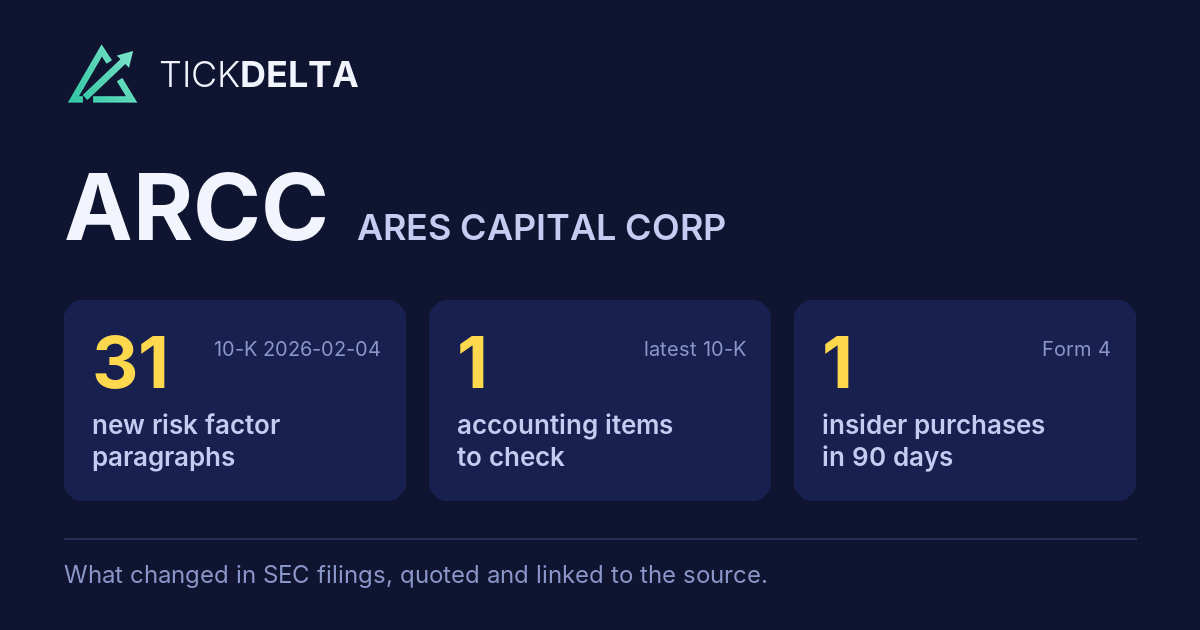
31 paragraphs in Risk Factors of the 10-K filed Feb 4, 2026 with nothing like them in the 10-K filed Feb 5, 2025. Quoted exactly. Paragraphs that were only edited are under 10-K change.
•Developments in artificial intelligence could disrupt markets in which we operate and subject us to increased competition, legal and regulatory risks and compliance costs.
See “Item 7. Management’s Discussion and Analysis of Financial Condition and Result of Operations—Recent Developments,” as well as Note 16 to our consolidated financial statements for the year ended December 31, 2025 for subsequent events relating to the January 2026 Notes and an additional issuance of unsecured notes.
that are on less favorable terms than what we may have originally anticipated, which may impact our return on these investments.
diversification requirements. In addition, because the relevant provisions of the Code may change, compliance with one or more of the RIC requirements may be impossible or impracticable.
expectations across varied stakeholder interests, it could erode stakeholder trust, impact our reputation and constrain our investment opportunities. Such scrutiny of both ESG and DEI related practices could expose our investment adviser to the risk of litigation, investigations or challenges by federal or state authorities or result in reputational harm.
New and evolving and sometimes conflicting sustainability/ESG regulations and disclosure expectations could increase our compliance costs and expose us to enforcement, litigation, or fundraising constraints.
Show the other 8
Compliance with any new laws or regulations increases our regulatory burden and could result in increased legal, accounting and compliance costs, make some activities more difficult, time-consuming and costly, affect the manner in which we or our portfolio companies conduct our businesses and adversely affect our profitability.
Climate change and related transition and physical risks could adversely affect our operations and those of our portfolio companies and increase costs (including insurance costs).
In recent periods, there has been increased activity by certain activist and other organized groups in opposition to certain investments made by and activities of private funds. Such groups may contact or otherwise seek to engage with government and regulatory bodies and fund investors, including public pension funds, to criticize or challenge certain investments, which could lead to negative publicity that could harm our or our investment adviser's reputation. In addition, partially as a result of certain high profile defaults and bankruptcies, there has also been increased negative publicity with respect to the private credit industry. Although neither we nor our investment adviser have been involved in those particular defaults and bankruptcies, the negative publicity and concerns surrounding the private credit industry generally could in the future harm our or our investment adviser's reputation, adversely affect our borrower or investor relationships and fundraising efforts and create pressure on the trading price of our common stock.
Regulators are also increasing scrutiny and implementing and considering regulation of the use of artificial intelligence technologies, including with respect to uses of artificial intelligence by investment advisers. While comprehensive U.S. regulation has not been enacted to date, various U.S. governmental agencies and departments, including the SEC and Department of the Treasury, have recently released reports or otherwise indicated interest in assessing risks relating to uses of artificial intelligence by businesses such as ours. Some specific laws governing artificial intelligence have already been passed in certain U.S. states and in the EU. We cannot predict what, if any, effects this may have on our business or the nature of future regulations.
•an increase in negative global media coverage relating to the private credit industry.
We are materially affected by conditions in the global financial markets and economic and political conditions throughout the world that are outside our control. These conditions may affect the level and volatility of securities prices and the liquidity and value of our investments, and we may not be able to or may choose not to manage our exposure to these conditions. This could in turn have a significant adverse effect on our business, financial condition and results of operations.
Global financial markets have experienced heightened volatility in recent periods, including as a result of economic and political events in or affecting the world’s major economies, such as the ongoing war between Russia and Ukraine, conflicts in the Middle East and recent U.S. military action in Venezuela. Sanctions imposed by the U.S. and other countries, including in connection with hostilities between Russia and Ukraine and the tensions between China and Taiwan, have caused
additional financial market volatility and affected the global economy. Concerns over future increases in inflation, economic recession, as well as interest rate volatility and fluctuations in oil and gas prices resulting from global production and demand levels, as well as geopolitical tension, have exacerbated market volatility. Market volatility has been further exacerbated by social unrest, changes regarding immigration and work permit policies and other political and security concerns both in the United States and across various international regions. Because of interrelationships within the global financial markets, if these issues do not abate, or they worsen or spread, our and our portfolio companies, businesses may be adversely affected both within and outside of the directly affected regions.
Changes in trade policies, including the imposition of new tariffs or increases in existing tariffs between the United States, Mexico, Canada, China or other countries, or reactionary measures in response thereto, including retaliatory tariffs, legal challenges, or currency manipulation, could adversely affect the market conditions in which we and our portfolio companies operate. These factors may affect the level and volatility of credit and securities prices and the liquidity and value of our investments, and we and our portfolio companies may not be able to successfully manage our exposure to these conditions.
In addition, numerous structural dynamics and persistent market trends have exacerbated volatility and market uncertainty. Concerns over significant volatility in the commodities markets, sluggish economic expansion in foreign economies, including continued concerns over growth prospects in China and emerging markets, growing debt loads for certain countries, uncertainty about the consequences of the U.S. and other governments withdrawing monetary stimulus measures, government agency closures, prolonged government shutdowns and speculation about a possible recession all highlight the fact that economic conditions remain unpredictable and volatile. U.S. debt ceiling and budget deficit concerns have increased the possibility of additional credit-rating downgrades and economic slowdowns or a recession in the U.S. In recent periods, geopolitical tensions, including between the U.S. and China, have escalated. Further escalation of such tensions and the related imposition of sanctions or other trade barriers may negatively impact the rate of global growth, particularly in China, where growth has slowed. Moreover, there is a risk of both sector-specific and broad-based volatility, corrections and/or downturns in the equity and credit markets. Any of the foregoing could have a significant impact on the markets in which we and our portfolio companies operate and have a significant adverse effect on our business, financial condition and results of operations.
A number of factors have had and may continue to have an adverse impact on credit markets in particular. In 2025, the weakness and the uncertainty regarding the stability of the oil and gas markets resulted in a tightening of credit across multiple sectors. In addition, the Federal Reserve decreased the federal funds rate three times in 2025. Changes in and uncertainty surrounding interest rates may have a material effect on our business, particularly with respect to the cost and availability of financing, which could have a material adverse impact on our business prospects and financial condition. Additionally, the Republican Party currently controls both the executive and legislative branches of the U.S. federal government, which increases the likelihood that legislation may be adopted that could significantly affect the regulation of U.S. financial markets. Regulatory changes could result in greater competition from banks and other lenders with which we compete for lending and other investment opportunities.
These and other conditions in the global financial markets and the global economy may result in adverse consequences for us and our portfolio companies, each of which could adversely affect the businesses of us or such portfolio companies, restrict our investment activities, impede our ability to effectively achieve our investment objectives and result in lower returns than we anticipated at the time certain of our investments were made. More specifically, these economic conditions could adversely affect our operating results by causing:
•decreases in the market value of securities, debt instruments or investments held by us;
•illiquidity in the market, which could adversely affect transaction volumes and the pace of realization of our investments or otherwise restrict our ability to realize value from our investments, thereby adversely affecting our ability to generate performance or other income; and
•increases in costs or reduced availability of financial instruments that finance our funds.
During periods of difficult market conditions or slowdowns (which may be across one or more industries, sectors or geographies), companies in which we invest may experience decreased revenues, financial losses, credit rating downgrades, difficulty in obtaining access to financing and increased funding costs. During such periods, these companies may also have difficulty in expanding their businesses and operations and be unable to meet their debt service obligations or other expenses as they become due, including expenses payable to us. Negative financial results in our portfolio companies may reduce the value of our portfolio companies, our net asset value and our investment returns, which could have a material adverse effect on our operating results and cash flow. In addition, such conditions would increase the risk of default with respect to our investments. We may be adversely affected by reduced opportunities to exit and realize value from our investments, by lower than expected
returns on investments made prior to the deterioration of the credit markets and by our inability to find suitable investments to effectively deploy capital. This could in turn materially reduce our net asset value and dividends and adversely affect our financial prospects and condition.
our services. Ares’ and our ability to monitor these third parties’ information security practices is limited, and they may not have adequate information security measures in place. The costs related to cyber-attacks or other security threats or disruptions may not be fully insured or indemnified by others, including by our third-party providers.
Technological developments in artificial intelligence could disrupt the markets in which we operate and subject us to increased competition, legal and regulatory risks and compliance costs.
Artificial intelligence, including machine learning technology and generative artificial intelligence, is rapidly evolving. While the full extent of current or future risks related thereto is not possible to predict, artificial intelligence could significantly disrupt the business models and markets in which we operate and subject us to increased competition, legal and regulatory risks and compliance costs, any of which could have a material adverse effect on our or our portfolio companies’ business, financial condition and results of operations.
We, our investment adviser and our administrator use and plan to expand our use of artificial intelligence tools and technologies in the operation of our business. In addition, certain of our portfolio companies use and may plan to expand their use of artificial intelligence tools and technologies in the operation of their businesses. These uses come with potential risks, including, but not limited to, generation of inaccurate results, misuse or disclosures of confidential information, infringement of third-party intellectual property rights, potential cybersecurity vulnerabilities, reputational risk, and regulatory burdens. Artificial intelligence models may create outputs that are flawed, inaccurate, biased, or that infringe or misappropriate intellectual property of third parties. The models may also be subject to new or different modes of cyber attacks, including prompt injection attacks, and such attacks may be able to circumvent our cybersecurity tools and processes. To the extent we, our investment adviser, our administrator, or any of our portfolio companies rely on such technologies, these risks could
negatively impact us or our portfolio companies. There is also a risk that artificial intelligence tools or applications may be misused by employees and/or third parties engaged by us, our adviser or administrator, or by our portfolio companies. For example, an employee of our adviser may input confidential information, including material non-public information, trade secrets, or personal information, into artificial intelligence technologies in a manner that results in such information becoming part of a dataset that is accessible by third-party artificial intelligence applications and users, including our competitors. Further, we, our adviser or administrator or our portfolio companies may not be able to control how third-party artificial intelligence technologies that we or they choose to use are developed or maintained, or how data we or they input is used or disclosed, even where contractual protections with respect to these matters have been sought. The misuse or misappropriation of our data could have an adverse impact on our reputation and could subject us to legal and regulatory investigations and/or actions. The misuse or misappropriation of data of any of our portfolio companies could have an adverse impact on such businesses reputation and could subject such portfolio company to legal and regulatory investigations and/or actions.
We or our portfolio companies may also be exposed to competitive risks related to the adoption of artificial intelligence or other new technologies by others within our respective industries. If our or our portfolio companies’ competitors are more successful than us or our portfolio companies in the use of artificial intelligence or development of services or products based on artificial intelligence, or we or our portfolio companies do so at a slower pace than others, we or our portfolio companies may be at a competitive disadvantage. In addition, our or our portfolio companies’ investments in technology systems and artificial intelligence may not deliver the benefits we or they expect, which could be costly for our or their respective businesses.
Finally, regulations related to artificial intelligence may also impose on us or our portfolio companies certain obligations and costs related to monitoring and compliance, and we or they could be subject to regulatory actions if we or they are deemed not to have complied.
represents a serious risk to our business, and compliance may be complicated by conflicting or inconsistent laws and regulations.
Paragraphs in the 10-Q filed Oct 27, 2026 that were not in the one before
New in the latest 10-Q
60 paragraphs in the 10-Q filed Oct 27, 2026 with nothing like them in the 10-Q filed Jul 29, 2026 (at least half the words must differ; new numbers alone do not count). Quoted exactly, grouped by the item heading above them. This is text that changed, not a judgement of how serious it is.
Financial statements and notes
(a) Approximates the aggregate gross appreciation (depreciation) of each interest rate swap.
Read in the 10-Q
(a) Approximates the aggregate gross appreciation (depreciation) of each interest rate swap.
Read in the 10-Q
In July 2026, ADL CLO 1 completed a CLO reset transaction pursuant to which its previously existing $ 702 term debt securitization was refinanced through the issuance of $ 709 of new term debt under the ADL CLO 1 Debt Securitization. The transaction resulted in a realized loss on extinguishment of debt of approximately $ 2 related to unamortized debt issuance costs.
Read in the 10-Q
On October 26, 2026, the Company entered into a definitive agreement (the “Merger Agreement”) to acquire MidCap Financial Investment Corporation (“MFIC”), a Maryland corporation, in a cash and stock transaction (the “MFIC Transaction”). Ares Capital Management is also a party to the Merger Agreement for certain limited purposes, including to fund the Cash Consideration (as defined below).
Read in the 10-Q
Under the Merger Agreement, Union Acquisition Sub Inc., a wholly owned subsidiary of the Company, will merge with and into MFIC, with MFIC as the surviving corporation (the “First Merger”). Immediately afterward, MFIC will merge with and into Union Acquisition Sub LLC, another wholly owned subsidiary of the Company, with Union Acquisition Sub LLC as the surviving company (together with the First Merger, the “Mergers”). As of October 26, 2026, the last full trading day prior to the announcement of the MFIC Transaction, the transaction had an implied value of approximately $ 2.6 billion, or $ 10.88 per share of MFIC common stock, based on $ 1.21 in Cash Consideration and $ 9.67 in implied value of the Share Consideration (as defined below) and 82,372,628 MFIC shares of common stock outstanding.
Read in the 10-Q
Show the other 55
Subject to the terms of the Merger Agreement, upon the consummation of the First Merger, each share of MFIC common stock issued and outstanding immediately before the effective time of the First Merger (other than certain canceled shares) will be converted into the right to receive (i) $ 1.21 per share in cash, without interest, payable by Ares Capital Management, acting solely on its own behalf (the “Cash Consideration”), and (ii) a number of shares of the Company’s common stock, par value $ 0.001 per share, determined by the Exchange Ratio described below (the “Share Consideration”), plus cash in lieu of fractional shares, payable by the Company. The Exchange Ratio will be determined shortly before closing, based on the Company’s net asset value per share of the Company’s common stock (the “Closing NAV”) and on the closing price of the Company’s common stock on the date that net asset value is determined (the “Closing Price”).
Read in the 10-Q
• If the Closing Price is at or below 100 % of the Closing NAV, the Exchange Ratio is $ 9.67 (less the per share amount of any post-signing tax dividends declared by MFIC) (the “Dividend Adjusted Price”) divided by the Company’s net asset value per share.
Read in the 10-Q
• If the Closing Price is above 100 % but no more than 104.5 % of the Closing NAV, the Dividend Adjusted Price is first multiplied by 1.00 plus 50 % of the premium of the Closing Price over the Closing NAV, and the result is divided by the Closing Price.
Read in the 10-Q
• If the Closing Price is above 104.5 % of the Closing NAV, the Dividend Adjusted Price is first multiplied by 102.25 %, and the result is divided by the Closing Price.
Read in the 10-Q
Because the Exchange Ratio depends on the Company’s net asset value per share and stock price near closing and is adjusted by the per share amount of any tax dividends declared by MFIC, the number of shares of the Company’s common stock to be issued will not be known until shortly before the MFIC Transaction closes. The Cash Consideration and the Share Consideration are subject to adjustment for certain changes in capitalization, such as stock splits, reclassifications and stock dividends. As of October 26, 2026, 82,372,628 shares of MFIC common stock were outstanding.
Read in the 10-Q
Completion of the MFIC Transaction is subject to certain conditions, including, among others:
Read in the 10-Q
• approval of the MFIC Transaction by MFIC stockholders holding a majority of the outstanding shares of MFIC common stock;
Read in the 10-Q
• approval for listing on NASDAQ of the shares of the Company’s common stock to be issued;
Read in the 10-Q
• effectiveness of the Company’s registration statement on Form N-14 to be filed in connection with such issuance;
Read in the 10-Q
• receipt of certain third-party consents relating to MFIC’s collateralized loan obligation vehicles;
Read in the 10-Q
While there can be no assurances as to the exact timing, or that the MFIC Transaction will be completed at all, the Company expects to complete the MFIC Transaction in the first half of 2027. The Merger Agreement may be terminated by either party if the First Merger has not been completed within nine months after the date of the Merger Agreement, which deadline is automatically extended by three months if, on that date, all closing conditions other than those relating to antitrust approvals have been satisfied or waived. In certain circumstances, including termination by MFIC to enter into a superior proposal or termination by the Company following a change in the MFIC board’s recommendation, MFIC will be required to pay the Company a termination fee of $ 31.36 million.
Read in the 10-Q
In connection with the MFIC Transaction, the Company has agreed to repay at closing the outstanding obligations under MFIC’s senior secured revolving credit agreement. MFIC has also agreed, if the Company requests, to redeem MFIC’s outstanding notes issued under its indenture at closing.
Read in the 10-Q
Wells Fargo Bank, National Association has also agreed, subject to customary conditions, to provide $ 750 million of additional secured financing that can be used to support the MFIC Transaction under the Loan and Servicing Agreement, dated as of January 22, 2010, among Ares Capital CP Funding LLC, as borrower, and the Company, as servicer and transferor, as amended.
Read in the 10-Q
• the outcome and impact of any litigation relating to the MFIC Transaction (as defined below);
Read in the 10-Q
• the likelihood that the MFIC Transaction is completed and the anticipated timing of its completion;
Read in the 10-Q
• the ability of our business and MFIC’s business to successfully integrate if the MFIC Transaction is completed; and
Read in the 10-Q
During the third quarter of 2026, economic activity remained generally stable and labor market conditions were relatively balanced, despite continued uncertainty related to geopolitical developments and their impact on inflation, particularly with respect to energy prices. As a result of elevated inflation, the Federal Reserve raised the target range for the federal funds rate by 25 basis points and signaled the potential for additional tightening, with the aim to deliver price stability and support a timelier return to its 2% inflation target. Against this backdrop, performance across U.S. leveraged corporate credit markets was mixed, with floating-rate credit outperforming fixed-rate credit given expectations for higher market interest
Read in the 10-Q
rates. Looking ahead, while risks remain, underlying fundamentals are supportive of continued stability and healthy overall economic activity.
Read in the 10-Q
As of September 30, 2026, our total equity market capitalization was $13.8 billion.
Read in the 10-Q
repurchased under the stock repurchase program. As of September 30, 2026, the expiration date of the stock repurchase program was February 15, 2027. The program may be suspended, extended, modified or discontinued at any time. As of September 30, 2026, there was $1.0 billion available for additional repurchases under the program.
Read in the 10-Q
In July 2026, ADL CLO 1 completed a CLO reset transaction pursuant to which its previously existing $702 million term debt securitization was refinanced through the issuance of $709 of new term debt under the ADL CLO 1 Debt Securitization. The transaction resulted in a realized loss on extinguishment of debt of approximately $2 million related to unamortized debt issuance costs.
Read in the 10-Q
On October 26, 2026, we entered into a definitive agreement (the “Merger Agreement”) to acquire MFIC, a Maryland corporation, in a cash and stock transaction (the “MFIC Transaction”). Our investment adviser is also a party to the Merger Agreement for certain limited purposes, including to fund the Cash Consideration (as defined below).
Read in the 10-Q
Under the Merger Agreement, Union Acquisition Sub Inc., our wholly owned subsidiary, will merge with and into MFIC, with MFIC as the surviving corporation (the “First Merger”). Immediately afterward, MFIC will merge with and into Union Acquisition Sub LLC, our wholly owned subsidiary, with Union Acquisition Sub LLC as the surviving company (together with the First Merger, the “Mergers”). As of October 26, 2026, the last full trading day prior to the announcement of the MFIC Transaction, the transaction had an implied value of approximately $2.6 billion, or $10.88 per share of MFIC
Read in the 10-Q
common stock, based on $1.21 in Cash Consideration and $9.67 in implied value of the Share Consideration (as defined below) and 82,372,628 MFIC shares of common stock outstanding.
Read in the 10-Q
Subject to the terms of the Merger Agreement, upon the consummation of the First Merger, each share of MFIC common stock issued and outstanding immediately before the effective time of the First Merger (other than certain canceled shares) will be converted into the right to receive (i) $1.21 per share in cash, without interest, payable by Ares Capital Management, acting solely on its own behalf (the “Cash Consideration”), and (ii) a number of our shares of common stock, par value $0.001 per share, determined by the Exchange Ratio described below (the “Share Consideration”), plus cash in lieu of fractional shares, payable by us. The Exchange Ratio will be determined shortly before closing, based on our net asset value per share (the “Closing NAV”) and on the closing price of our common stock on the date that net asset value is determined (the “Closing Price”).
Read in the 10-Q
• If the Closing Price is at or below 100% of the Closing NAV, the Exchange Ratio is $9.67 (less the per share amount of any post-signing tax dividends declared by MFIC) (the “Dividend Adjusted Price”) divided by our net asset value per share.
Read in the 10-Q
• If the Closing Price is above 100% but no more than 104.5% of the Closing NAV, the Dividend Adjusted Price is first multiplied by 1.00 plus 50% of the premium of the Closing Price over the Closing NAV, and the result is divided by the Closing Price.
Read in the 10-Q
• If the Closing Price is above 104.5% of the Closing NAV, the Dividend Adjusted Price is first multiplied by 102.25%, and the result is divided by the Closing Price.
Read in the 10-Q
Because the Exchange Ratio depends on our net asset value per share and stock price near closing and is adjusted by the per share amount of any tax dividends declared by MFIC, the number of shares of our common stock to be issued will not be known until shortly before the MFIC Transaction closes. The Cash Consideration and the Share Consideration are subject to adjustment for certain changes in capitalization, such as stock splits, reclassifications and stock dividends. As of October 26, 2026, 82,372,628 shares of MFIC common stock were outstanding.
Read in the 10-Q
Completion of the MFIC Transaction is subject to certain conditions, including, among others:
Read in the 10-Q
• approval of the MFIC Transaction by MFIC stockholders holding a majority of the outstanding shares of MFIC common stock;
Read in the 10-Q
• approval for listing on NASDAQ of the shares of our common stock to be issued;
Read in the 10-Q
• effectiveness of our registration statement on Form N-14 to be filed in connection with such issuance;
Read in the 10-Q
• receipt of certain third-party consents relating to MFIC’s collateralized loan obligation vehicles;
Read in the 10-Q
While there can be no assurances as to the exact timing, or that the MFIC Transaction will be completed at all, we expect to complete the MFIC Transaction in the first half of 2027. The Merger Agreement may be terminated by either party if the First Merger has not been completed within nine months after the date of the Merger Agreement, which deadline is automatically extended by three months if, on that date, all closing conditions other than those relating to antitrust approvals have been satisfied or waived. In certain circumstances, including termination by MFIC to enter into a superior proposal or termination by us following a change in the MFIC board’s recommendation, MFIC will be required to pay us a termination fee of $31.36 million.
Read in the 10-Q
In connection with the MFIC Transaction, we have agreed to repay at closing the outstanding obligations under MFIC’s senior secured revolving credit agreement. MFIC has also agreed, if we request, to redeem MFIC’s outstanding notes issued under its indenture at closing.
Read in the 10-Q
Wells Fargo Bank, National Association has also agreed, subject to customary conditions, to provide $750 million of additional secured financing that can be used to support the MFIC Transaction under the Loan and Servicing Agreement, dated as of January 22, 2010, among Ares Capital CP Funding LLC, as borrower, and us, as servicer and transferor, as amended.
Read in the 10-Q
The foregoing summary description of the Merger Agreement and the transactions contemplated thereby is subject to and qualified in its entirety by reference to the Merger Agreement, a copy of which has been filed as Exhibit 2.1 to our Current Report on Form 8-K, dated October 27, 2026, the terms of which are incorporated herein by reference.
Read in the 10-Q
Risk Factors
The consummation of the MFIC Transaction is subject to the satisfaction or waiver of certain conditions, including conditions that are not under our control. If the MFIC Transaction does not close, we will not benefit from the expenses incurred in its pursuit.
Read in the 10-Q
While we expect to complete the MFIC Transaction in the first half of 2027, there can be no assurances as to the exact timing, or that the MFIC Transaction will be completed at all. The completion of the MFIC Transaction is subject to certain conditions, including approval by MFIC stockholders holding a majority of the outstanding shares of MFIC common stock. See Part I, “Item 2. Management’s Discussion and Analysis of Financial Condition and Results of Operations - Recent Developments” for more information on the MFIC Transaction. We intend to complete the MFIC Transaction as soon as possible but we cannot assure stockholders that the conditions required to complete the MFIC Transaction will be satisfied or waived on the anticipated schedule, or at all.
Read in the 10-Q
If the MFIC Transaction is not completed, we will have incurred substantial expenses for which no ultimate benefit will have been received. We have incurred out-of-pocket expenses in connection with the MFIC Transaction, including for investment banking, legal and accounting fees and other related charges. Many of such charges will be incurred even if the MFIC Transaction is not completed. In certain circumstances, MFIC will be required to pay a termination fee to us in connection with the termination of the Merger Agreement, but there is no guarantee such termination fee will be payable or, if payable, will actually be paid us. If the MFIC Transaction does not close, we will not benefit from the substantial expenses incurred in its pursuit.
Read in the 10-Q
We may be unable to realize the benefits anticipated from the MFIC Transaction, or it may take longer than anticipated to achieve such benefits.
Read in the 10-Q
The realization of certain benefits anticipated as a result of the MFIC Transaction will depend in part on the integration of MFIC’s investment portfolio with our investment portfolio and the integration of MFIC’s business with our business. There
Read in the 10-Q
can be no assurance that MFIC’s investment portfolio or business can be operated profitably or integrated successfully into our investment portfolio or business in a timely fashion or at all. The dedication of management resources to such integration may detract attention from the management of our day-to-day business and there can be no assurance that there will not be substantial costs associated with the transition process or there will not be other material adverse effects as a result of these integration efforts. Such effects, including but not limited to, incurring unexpected costs or delays in connection with such integration and failure of MFIC’s investment portfolio to perform as expected, could have a material adverse effect on the financial results of the combined company.
Read in the 10-Q
Our stockholders will experience dilution and a reduction in percentage ownership and voting power as a result of the issuance of shares of our common stock as Share Consideration if the MFIC Transaction is consummated, and the value of the consideration paid to MFIC stockholders will not be impacted by certain changes in MFIC’s net asset value.
Read in the 10-Q
If the MFIC Transaction is completed, we will issue shares of our common stock to MFIC stockholders as Share Consideration. As a result, our existing stockholders will experience a reduction in their percentage ownership interests and effective voting power relative to their percentage ownership interests in us prior to the MFIC Transaction. Consequently, our existing stockholders should expect to exercise less influence over the management and policies of the combined company following the completion of the MFIC Transaction than they currently exercise over our management and policies.
Read in the 10-Q
Because the number of shares to be issued as Share Consideration depends on the Exchange Ratio, the extent of this dilution will not be known until shortly before the effective time of the First Merger. The Exchange Ratio depends on several variables that are not fixed and cannot be known at this time, including the Closing NAV, the Closing Price, the relationship between the Closing Price and the Closing NAV, and the per share amount of any tax dividends declared by MFIC after the date of the Merger Agreement. The Exchange Ratio will not be reduced, however, for liabilities of MFIC that were not known or anticipated, or due to reductions in the fair value of the investments in MFIC’s portfolio. We estimate that following completion of the MFIC Transaction, our existing stockholders are expected to own approximately 95% and existing MFIC stockholders are expected to own approximately 5% of the combined company, but the level of dilution could be greater than we currently anticipate.
Read in the 10-Q
Other information
Departure of Directors or Principal Officers; Election of Directors; Appointment of Principal Officers
Read in the 10-Q
On October 22, 2026, Paul Cho informed our board of directors of his intention to step down from his position as our Chief Accounting Officer and Principal Accounting Officer, effective October 31, 2026. Paul Cho will continue to serve within the finance and accounting function of Ares Management. Paul Cho’s decision to step down was not based on the result of any disagreement regarding our operations, policies or practices.
Read in the 10-Q
Effective October 31, 2026, Scott Lem, our Chief Financial Officer and Treasurer, will also resume his previous role as our Principal Accounting Officer for purposes of our filings with the SEC.
Read in the 10-Q
Item 6
31.1 Certification by Chief Executive Officer pursuant to Exchange Act Rule 13a-14(a), as adopted pursuant to Section 302 of the Sarbanes-Oxley Act of 2002*
Read in the 10-Q
31.2 Certification by Chief Financial Officer pursuant to Exchange Act Rule 13a-14(a), as adopted pursuant to Section 302 of the Sarbanes-Oxley Act of 2002*
Read in the 10-Q
32.1 Certification by Chief Executive Officer and Chief Financial Officer pursuant to 18 U.S.C. Section 1350, as adopted pursuant to Section 906 of the Sarbanes-Oxley Act of 2002**
Read in the 10-Q
99.1 Supplemental Financial Information of Senior Direct Lending Program, LLC as of September 30, 2026 (unaudited) and December 31, 2025*
Read in the 10-Q
101. INS Inline XBRL Instance Document - the instance document does not appear in the Interactive Data File because XBRL tags are embedded within the Inline XBRL document.
Read in the 10-Q
The 10-Q's risk factors against the 10-K
Item 1A of the 10-Q filed Oct 27, 2026 against Item 1A of the 10-K filed Feb 4, 2026.
A 10-Q repeats only the risks that changed, so a 10-K paragraph that is missing from it is not counted as removed.
Added is a paragraph with nothing like it in the 10-K, Reworded a sentence that is in both with several words changed,
Quiet changes a sentence in both where one to four words changed and one is a hedge or a modal
(cut words struck through, new words highlighted).
Text on the page, not a score; each links to the filing at sec.gov.
Show the other 4
Phrases used for the first time
Two-word phrases in Risk Factors of the 10-K filed Feb 4, 2026 that are in none of the 1 earlier 10-Ks stored, back to Feb 5, 2025
Where each one is used
- item management’s: As of December 31, 2025, we had approximately $4.5 billion of outstanding borrowings under the Credit Facilities, our wholly owned consolidated subsidiary, Ares Direct Lending CLO 1 LLC (“ADL CLO 1”) had approximately $476 million in aggregate principal amount outstanding of the notes offered in the ADL CLO 1 debt...
- january clo: As of December 31, 2025, we had approximately $4.5 billion of outstanding borrowings under the Credit Facilities, our wholly owned consolidated subsidiary, Ares Direct Lending CLO 1 LLC (“ADL CLO 1”) had approximately $476 million in aggregate principal amount outstanding of the notes offered in the ADL CLO 1 debt...
- intelligence tools: The efficient operation of our business is dependent on information systems and technology, including computer hardware and software systems, as well as data processing systems and the secure processing, storage and transmission of information, all of which are potentially vulnerable to security incidents and...
- increased competition: •Developments in artificial intelligence could disrupt markets in which we operate and subject us to increased competition, legal and regulatory risks and compliance costs.
- competition legal: •Developments in artificial intelligence could disrupt markets in which we operate and subject us to increased competition, legal and regulatory risks and compliance costs.
- regulatory risks: •Developments in artificial intelligence could disrupt markets in which we operate and subject us to increased competition, legal and regulatory risks and compliance costs.
- difficult market: From time to time, capital markets may experience periods of disruption and instability. Such disruptions may result in, amongst other things, write-offs, the re-pricing of credit risk, the failure of financial institutions or worsening general economic conditions, any of which could materially and adversely impact...
- political conditions: From time to time, capital markets may experience periods of disruption and instability. Such disruptions may result in, amongst other things, write-offs, the re-pricing of credit risk, the failure of financial institutions or worsening general economic conditions, any of which could materially and adversely impact...
Used at least twice, small words left out. Counted, not picked: a phrase can be new because the company renamed something.
What was taken out
14 paragraphs of last year's Risk Factors with nothing like them now. The longest are quoted.
Sources
Item 1A of each 10-K and 10-Q on EDGAR, quoted exactly. Each paragraph links to the filing at sec.gov.
Also
10-K change: what was reworded or cut, section by section.
Work with it
Excel workbook · CSV. Google Sheet that stays up to date: paste =IMPORTDATA("https://tickdelta.com/company/ARCC/export.csv") into a cell.