Form 10-K for the Fiscal Year ended December 31, 2024
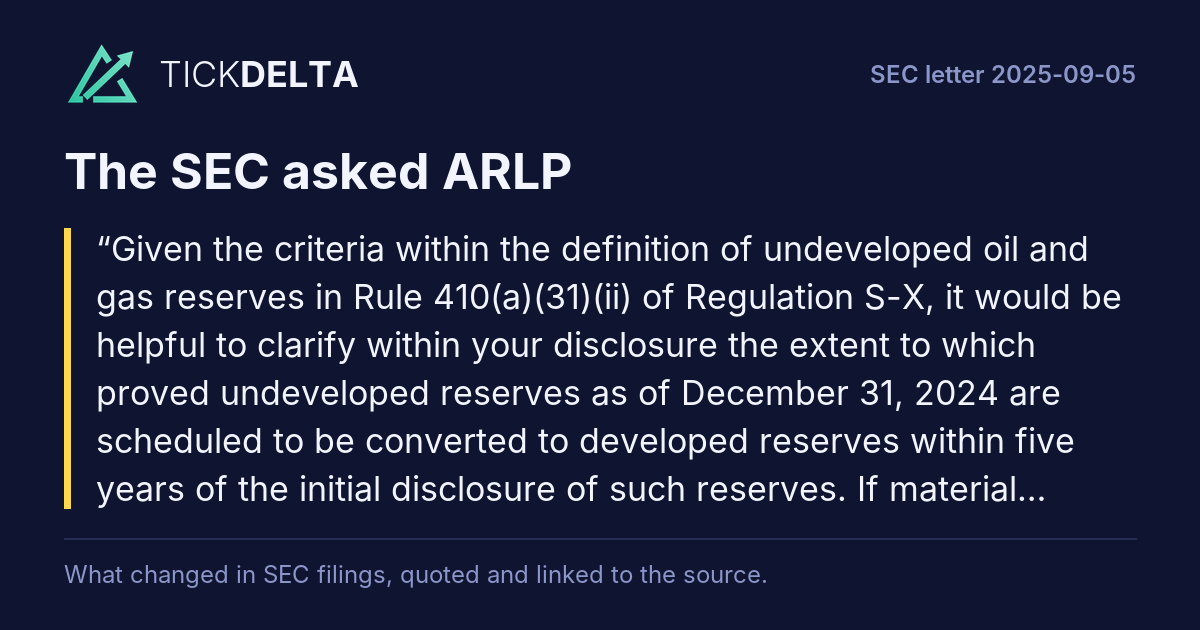
Given the criteria within the definition of undeveloped oil and gas reserves in Rule 410(a)(31)(ii) of Regulation S-X, it would be helpful to clarify within your disclosure the extent to which proved undeveloped reserves as of December 31, 2024 are scheduled to be converted to developed reserves within five years of the initial disclosure of such reserves.Rest of the question
If material amounts of your proved undeveloped reserves will not be converted to proved developed status within five years of initial disclosure as proved reserves, please also expand your disclosure to explain the reasons for the delay. You may refer to Item 1203(d) of Regulation S-K and Question 131.03 in the Compliance and Disclosure Interpretations (C&DIs) regarding Oil and Gas Rules if you require further clarification or guidance.
We acknowledge the Staff’s comment and in response propose clarifying our disclosures in future filings to include the language illustrated below in bold.Read in the reply
As a mineral interest owner we have no transparency into or control over the operators’ investments and operational progress to convert PUDs to proved developed producing reserves nor do we have insight into the operators’ drilling plans.Rest of the answer
Since we do not have insight into the operators’ drilling plans, we use active drilling permits as evidence of economic viability and intention to expend capital to develop reserves within five years as there is generally a statutory two-year timeframe associated with permits. We do not incur any capital expenditures or lease operating expenses in connection with the development of our PUDs, which costs are borne entirely by the operators. As a result, during the year ended December 31, 2024, we did not have any expenditures to convert PUDs to proved developed producing reserves. PUDs that have not been developed within two years of permitting are reviewed and removed from proved reserves as necessary. Because we remove PUDs from proved reserves that have not been developed within two years of initial classification as proved reserves, we have no material PUDs that will not be developed within five years of initial classification as proved reserves. Since January 1, 2022, our average permit to first sales timeframe is 383 days. For our 2024 reserve reporting we had scheduled all PUD locations to be drilled within a year and a half using the average historical development pacing on our acreage in the individual basins in which we own mineral interests. As of December 31, 2024, approximately 10.87% of our total proved reserves were classified as PUDs.
Please expand the discussion of the methods used by the Company in estimating the quantities of proved reserves to include an explanation of the criteria used to assign proved undeveloped locations similar to the discussion provided in Exhibit 99.1.
We acknowledge the Staff’s comment and in response propose to include the following expanded discussion in future filings as illustrated below.Read in the reply
Non-producing reserve estimates, for both developed and undeveloped properties, are based on regional type curve methodologies by reservoir or productive bench.Rest of the answer
These methods provide a relatively high degree of accuracy for predicting proved developed non-producing and undeveloped reserves for our properties, due to the mature nature of properties targeted for development and an abundance of historical production data on which we base statistical average type forecasts.
New drills on our acreage include planned drills, wells currently drilling, and/or permitted wells. For each new drill, a reserve category of proved developed non-producing or PUD is assigned based on whether the location has been spud or permitted. Generally, we book a location as a PUD when it has been permitted by the operator and a PUD becomes a proved developed non-producing reserve when the operator has spud that well to begin drilling operations.
Drill scheduling is determined by historical development pacing on our acreage in each basin and it is assumed that future pacing will mirror that of the historical pace. This projection is then adjusted to take into account anticipated commodity prices and other industry economic factors which tend to either reduce or increase future development pacing. First, known completed locations are developed in chronological order based on state filings or publicly sourced completion data. The development schedule for these locations estimates the turn-in-line rate of these locations due to production data lag. Second, spud locations with unknown completion status are scheduled based on the historical spud to completion time within each basin. Third, permitted locations, without development timing, are scheduled in chronological order by filing date.
First report after the company's reply of Oct 3, 2025: 10-Q filed Nov 7, 2025 ↗, against the 10-Q filed Aug 7, 2025 ↗.
Tickdelta does not hold the text of both reports, so they are not compared here.
Please expand the discussion of CGA’s conclusions regarding the reserves estimates as of December 31, 2024 to additionally clarify that the reserves audit (referenced in Exhibit 99.1) did not extend to your share of reserves attributable to the equity interest in AllDale III.Rest of the question
As part of the expanded discussion, specify the proportion of your total reserves (including the consolidated and equity interests), that are covered by the audit. The reserves report may alternatively be revised as it should ordinarily provide this information to comply with Item 1202(a)(8)(iii) of Regulation S-K. Acreage Concentrations, page 77 Please expand the disclosure of your gross, net mineral and net royalty acreage to clarify the difference between the net mineral and net royalty acres and to corelate your explanation to the figures mentioned in the discussion on pages 74 and 75, regarding the 50,755 developed and undeveloped net mineral acres, and the 69,363 net royalty acres standardized to a 1/8th royalty. 5. 6. Please expand your disclosure to clarify the reasons that no material amounts of your undeveloped acreage are expiring in the near term if this is the case, or to specify the minimum remaining terms of leases and concessions to comply with Item 1208(b) of Regulation S-K. Oil & Gas Production, Prices and Production Costs, page 77 7. Please expand your disclosure to include the production volumes by final product sold for each field or common operational area that contains 15% or more of your total proved reserves expressed on an oil-equivalent-barrels basis for each of the last three fiscal years. You may refer to the disclosure requirements in Item 1204(a) of Regulation S-K and the definition of a field in Rule 4-10(a)(15) of Regulation S-X if you require further clarification or guidance. Productive Wells, page 77 8. We note your separate disclosure of the number of gross productive horizontal gas wells (1,079) and the number of gross productive horizontal oil wells (10,651) in the second-to-last paragraph on page 77, although you indicate the sum of these would be17,502 total gross productive horizontal wells. Please revise your disclosure to either resolve or to clarify the the reasons for the apparent inconsistency. 9. Please expand your disclosure of 5,772 total gross vertical wells to separately disclose the number of natural gas wells and the number of oil wells to comply with Item 1208(a) of Regulation S-K. 10. We note disclosure clarifying that you do not own any material working interests in any wells and accordingly, that you do not own any net wells. As a result, it appears that you have not disclosed the number of net productive wells or net wells drilled. For the purposes of disclosing “net” productive wells and “net” wells drilled during each of the last three fiscal years pursuant to Items 1208(a) and 1205 of Regulation S- K, the net revenue interest may be utilized as a substitute for these disclosures, consistent with your disclosure of the “net” developed and undeveloped mineral acreage pursuant to Item 1208 of Regulation S-K. Supplemental Oil & Gas Reserve Information (Unaudited) Oil & Gas Reserves, page 148 We note that you report proved developed and proved undeveloped reserves on a total combined basis (including the consolidated interests and the equity method investee interests) as of the end of each of the last three fiscal years on page 149. 11. However, as FASB ASC 932-235-50-8c pertains to the disclosures prescribed by FASB ASC 932-235-50-4, you should additionally disclose this information separately for your consolidated interests and equity method investee interests. For additional guidance regarding the disclosure of reserve quantity information, please refer to the illustration and accompanying notes in FASB ASC 932-235-55-2. Also expand your disclosure to include the net quantities of proved developed and proved undeveloped reserves at the beginning of the initial year shown in the reserves reconciliation, i.e. as of January 1, 2022 (for the year ended December 31, 2022) to comply with FASB ASC 932-235-50-4.
We acknowledge the Staff’s comment and in response propose clarifying our disclosures in future filings to include the language illustrated below in bold.Read in the reply
Excluding our share of proved reserves held by AllDale III, our 2024 year-end estimate of proved reserves were prepared by our internal engineering team. Our engineering team works to ensure the integrity, accuracy, and timeliness of the data used to calculate our estimated proved reserves. Our proved reserve estimates, with the exception of AllDale III, which comprise 4.2% of our total proved reserves, were audited by CGA.Rest of the answer
Our engineering team met with CGA periodically during the period covered by the above referenced reserve report to discuss the assumptions and methods used in the reserve estimation process. Our engineering team provided historical information to CGA for our properties, such as oil & gas production, well test data, and realized commodity prices. Our engineering team also provided ownership interest information with respect to our properties. Our internal petroleum engineer, primarily responsible for overseeing the petroleum reserves preparation, has over 20 years of engineering and operations experience in the oil & gas sector and a Bachelor of Science in Petroleum Engineering.
First report after the company's reply of Oct 3, 2025: 10-Q filed Nov 7, 2025 ↗, against the 10-Q filed Aug 7, 2025 ↗.
Tickdelta does not hold the text of both reports, so they are not compared here.
Also in this review: request for more time, Sep 8, 2025, closing letter, 2025-11-21