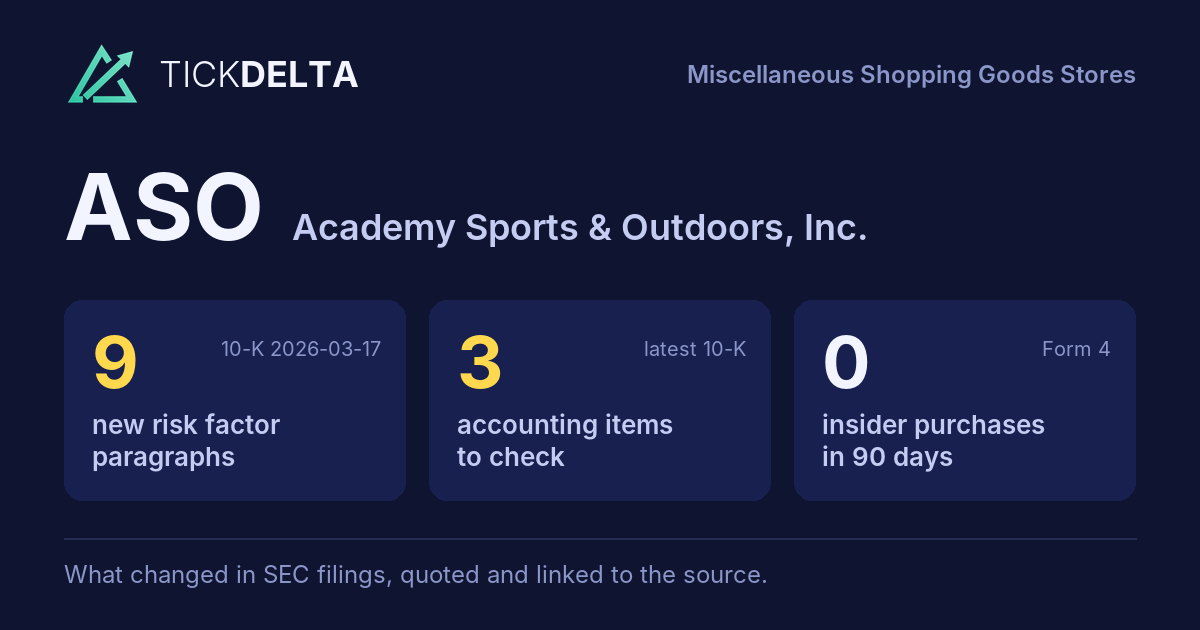
Screener / SEC EDGAR /CIK 0001817358 /10-K filed Mar 17, 2026, compared with Mar 20, 2025 /Numbers from the XBRL of the 10-Ks
Nasdaq Consumer discretionary · Miscellaneous Shopping Goods Stores

Academy Sports & Outdoors, Inc. ASO

Compare with peers Embed
The 10-K against last year's

102 changes: 14 added, 15 removed, 71 reworded, 2 quiet changes

10-K Mar 17, 2026 vs Mar 20, 2025

10-K 0001817358-26-000031 (Mar 17, 2026) vs 10-K 0001817358-25-000027 (Mar 20, 2025)

Every paragraph, and how much of it changed

One bar per paragraph, in the order of the 10-K. Height and colour show the share of its words not in the closest paragraph a year earlier; the tallest bars are new paragraphs.

Risk Factors

229 paragraphs · 9 new · 48 reworded · 5 gone · 10-K Mar 17, 2026 against Mar 20, 2025
New paragraph Reworded (5% of its words or more) Same or nearly
Paragraph 13 · 45% changed Every version of it
The political, health, safety, security, and economic environments of the countries in which we or our vendors obtain merchandise or raw materials have the potential to materially affect our operations. In the event of disruptions or delays in supply due to economic, political, health, safety or security conditions in foreign countries or their relations with the United States, such disruptions or delays could adversely affect our results of operations unless and until alternative supply arrangements could be made. For example, during the COVID-19 pandemic we have experienced, and may continue to experience, disruptions resulting from public health events, significant changes in China, we experienced a temporary closure trade policy, labor shortages, geopolitical tensions, and constraints within global transportation and logistics networks, any of third party manufacturer facilities, interruptions which may result in labor and product supply, and restrictions on the export increased costs, delays, or shipment reduced availability of our products, which resulted in disruptions in our supply chain in China. Also, for example on February 10, 2025 the Trump Administration has imposed 25% duties on all imports of steel, aluminum, and their derivative products, effective March 12, 2025. merchandise. The imposition of trade tariffs, sanctions or other regulations against merchandise imported by us, or the loss of “normal trade relations” status with the countries in which we or our vendors obtain merchandise or raw materials, could significantly increase our cost of products imported into the United States and harm our business. Additionally, the prices charged for the merchandise that we purchase by foreign manufacturers may be affected by the fluctuation of their local currency against the U.S. dollar.
Paragraph 35 · 43% changed Every version of it
The level of success we achieve is dependent on, among other factors, the frequency of merchandise and service innovations, how accurately and timely we predict consumer tastes and preferences regarding sporting goods and outdoor recreation merchandise, the level of consumer demand, the availability of merchandise, the related impact on the demand for existing merchandise, and the competitive environment. Our products must appeal to a broad range of customers whose preferences cannot be predicted with certainty and are subject to change. We must identify and obtain access to a broad assortment of brands and styles, to enable us to offer to our customers, attractive, innovative and high-quality merchandise on a continuous basis. It is difficult to predict consistently and successfully the products and services our customers will demand as we often purchase products from our vendors several months in advance of the proposed delivery. Our failure to timely identify or effectively respond to changing consumer tastes, preferences and spending patterns could negatively affect our relationship with our customers, the demand for our merchandise and services and our market share, which could have a material adverse effect on our net sales and results of operations.
Paragraph 96 · 43% changed Every version of it
We operate three distribution centers located in Katy, Texas; Twiggs County, Georgia; and Cookeville, Tennessee, to manage the receipt, storage, sorting, packing and distribution of our merchandise to the appropriate stores or to the customer directly. We depend in large part on the orderly operation of our receiving and distribution process, which depends, in turn, on adherence to shipping schedules, proper functioning of our information technology and inventory control systems and overall effective management of our distribution centers. A disruption or a prolonged interruption in the operations at any of these distribution centers or third-party transportation providers due to a work stoppage, labor shortage, operations significantly below historical efficiency levels, supply chain disruption, public health events (such as pandemics), severe weather (such as tornadoes) or natural or man-made disasters (including events that may be caused or exacerbated by climate change), system failures or cyber incidents, slowdowns or strikes, acts of terror or other unforeseen events in the areas or regions of these facilities could impair our ability to adequately stock our stores, process returns of products to vendors and ship products to our e-commerce customers, thereby adversely affecting our sales and profitability. In addition, we could incur significantly higher costs and longer lead times associated with distributing our products to our stores and customers during the time it takes for us to reopen or replace these distribution centers.
Paragraph 14 · 43% changed Every version of it
The political, health, safety, security, and economic environments of the countries in which we or our vendors obtain merchandise or raw materials have the potential to materially affect our operations. In the event of disruptions or delays in supply due to economic, political, health, safety or security conditions in foreign countries or their relations with the United States, such disruptions or delays could adversely affect our results of operations unless and until alternative supply arrangements could be made. For example, during the COVID-19 pandemic in China, we experienced a temporary closure of third party manufacturer facilities, interruptions in labor and product supply, and restrictions on the export or shipment of our products, which resulted in disruptions in our supply chain in China. Also, for example on February 10, 2025 the Trump Administration has imposed 25% duties on all imports of steel, aluminum, and their derivative products, effective March 12, 2025. The imposition of trade tariffs, sanctions or other regulations against merchandise imported by us, or the loss of “normal trade relations” status with the countries in which we or our vendors obtain merchandise or raw materials, could significantly increase our cost of products imported into the United States and harm our business. The continuation or escalation of global trade tensions could have further adverse effects on our sales and profitability, results of operations and financial condition. Additionally, the prices charged for the merchandise that we purchase by foreign manufacturers may be affected by the fluctuation of their local currency against the U.S. dollar.
Paragraph 80 · 35% changed Every version of it
The success of our business depends significantly on our ability to hire and retain quality team members, including store managers, Enthusiasts and other store team members, distribution center team members and corporate directors, managers and other personnel. We plan to expand our team member base to manage our anticipated growth. Competition for non-entry-level personnel, particularly for team members with retail experience, is highly competitive. Additionally, our ability to maintain consistency in the quality of customer service in our stores is critical to our success. Many of our store team members are in entry-level or part-time positions that historically have high rates of turnover, which can lead to increased training and retention costs, particularly if employment opportunities increase. We are also dependent on the team members who staff our distribution centers, many of whom are skilled. We may be unable to meet our labor needs and control our costs due to external factors such as the availability of a sufficient number of qualified persons in the work force of the markets in which we operate, competition, unemployment levels, changes in immigration laws, demand for certain labor expertise, prevailing wage rates, wage inflation, changing demographics, health and other insurance costs, adoption of new or revised employment and labor laws and regulations, and the impacts of man-made or natural disasters, such as tornadoes, hurricanes, and public health events. We have experienced, and expect to continue to experience, a shortage of labor for certain functions, which has increased our labor costs and negatively impacted our profitability. The extent and duration of the effect of these labor market challenges are subject to numerous factors, including availability of qualified persons in the markets where we and our contracted service providers operate and unemployment levels within these markets, behavioral changes, prevailing wage rates and other benefits, inflation, adoption of new or revised employment and labor laws and regulations (including immigration/visa processing) or government programs, safety levels of our operations, and our reputation within the labor market.
Paragraph 162 · 32% changed Every version of it
We require many of our vendors to carry their own insurance, and we have indemnity agreements with many of our vendors, but we cannot be assured that (1) any specific claim or lawsuit will be subject to a vendor’s insurance or indemnity agreement, (2) our vendors will carry or maintain such insurance coverage or meet their indemnity obligations or (3) we will be able to collect payments from our vendors sufficient to offset liability losses or, in the case of our private label brand products, where almost all of the manufacturing occurs outside the United States, that we will be able to collect anything at all.
Paragraph 116 · 29% changed Every version of it
Negative publicity or perceptions involving us or our brands, products, team members, operations, vendors, spokespersons, or marketing and other partners may negatively impact our reputation and adversely impact our ability to attract and retain customers, team members, vendors and/or other partners. Failure to detect, prevent or mitigate issues that might give rise to reputational risk or failure to adequately address negative publicity or perceptions could adversely impact our reputation, business, results of operations, and financial condition. Issues that might pose a reputational risk include failure of our cybersecurity measures to protect against cybersecurity incidents, product liability and product recalls, our social media activity, our handling of issues relating to corporate responsibility matters, including our response to such matters, failure to comply with applicable laws and regulations or enforce our own policies, our policies related to the sale of firearms, ammunition and accessories, our policies relating to public health, public stances on controversial social or political issues, concerns surrounding labor, environmental, workplace safety and other practices that may vary from U.S. standards in any of our foreign manufacturers, whether directly or indirectly, and any of the other risks enumerated in these risk factors. As part of our marketing efforts, we rely on social media platforms and other digital marketing to attract and retain customers. A variety of risks are associated with our social media activity and digital marketing, including the improper disclosure of proprietary information, negative comments about or negative incidents regarding us, exposure of personally identifiable information, fraud or out-of-date information. The inappropriate use of social media and digital marketing vehicles by us, our customers, team members or others could increase our costs, lead to litigation or result in negative publicity that could damage our reputation. Many social media platforms immediately publish the content, videos and/or photographs created or uploaded by their subscribers and participants, often without filters or checks on accuracy of the content posted. Information posted on such platforms at any time may be adverse to our interests and/or may be inaccurate. The dissemination of negative information related to us or our brands, products, team members, operations, vendors, spokespersons or partners could harm our business, results of operations and financial condition, regardless of the information’s accuracy, and the harm may be immediate without affording us an opportunity for redress or correction. It may be difficult to address negative publicity across media channels, regardless of its accuracy or the reputability of its source, and this challenge could be further exacerbated by fictitious media content, such as content produced by generative artificial intelligence or bad actors. Furthermore, the prevalence of news coverage, the internet, and social media may accelerate and increase the potential scope of any negative publicity we might receive and could increase the negative impact of these issues on our reputation, business, results of operations, and financial condition.
Paragraph 217 · 29% changed Every version of it
Additionally, our operations are conducted through our wholly owned subsidiaries and our ability to generate cash to meet our debt service obligations or to make future dividend payments or conduct share repurchases, if any, is highly dependent on the earnings of, and the receipt of funds from, our subsidiaries via dividends or intercompany loans. In addition, Delaware law may impose requirements that may restrict our ability to pay dividends to holders of our common stock or our ability to repurchase our common stock.

MD&A

116 paragraphs · 5 new · 56 reworded · 10 gone · 10-K Mar 17, 2026 against Mar 20, 2025
New paragraph Reworded (5% of its words or more) Same or nearly
Paragraph 95 · 49% changed
•$14.2 •$13.1 million increase in cash inflows from proceeds from a sale-leaseback transaction capital expenditures related to our retail store in Cypress, TX properties purchased and subsequently sold as part of sale-leaseback transactions (see Note 11).
Paragraph 94 · 48% changed
•$12.3 •$27.2 million decrease in additional proceeds from the exercise of stock options; sale-leaseback transactions in 2025 compared to 2024 (see Note 11); partially offset by
Paragraph 41 · 47% changed
Other (Income), Income, net. Other (Income), income, net, increased $4.0 decreased $26.8 million in 2025 when compared to 2024, primarily driven by the settlement of a legal matter with a non-trade vendor that resulted in a net gain of approximately $15.0 million in 2024 when compared to 2023, primarily driven by increased money market investments (see Note 2) as well as lower interest rates in the current year.
Paragraph 97 · 39% changed
•$162.1 •$165.9 million increase decrease in cash outflows primarily caused by an increase in for repurchases and simultaneous retirement of common stock in the current year; 2025; and
Paragraph 30 · 39% changed
Interest Expense. Interest expense includes regular interest payable related to our Term Loan, Notes and ABL Facility (see Note 4 to the accompanying financial statements) 4) and the amortization of our deferred loan costs and original issuance discounts associated with the acquisition of the debt. In 2022 and 2023, we utilized cash on hand to voluntarily prepay $100 million of outstanding borrowings on our Term Loan. However, this prepayment in principal on our Term Loan was largely offset by increases made by the Federal Reserve to the federal funds benchmark rate during 2022 and 2023, resulting in a decrease in interest expense in 2024 compared to 2023.
Paragraph 37 · 39% changed
Gross Margin. Gross margin decreased $98.8 increased $94.2 million, or 4.7%. 4.7%, to $2,105.6 million for fiscal year 2025 from $2,011.5 million for fiscal year 2024. As a percentage of net sales, gross margin decreased 40 increased 90 basis points from 34.3% in 2023 to 33.9% in 2024. 2024 to 34.8% in 2025. The decrease increase of 40 90 basis points in gross margin was primarily attributable to: to favorability in merchandise margin due to promotions and managing prices in response to increased tariff costs, while maintaining alignment with our value pricing strategy.
Paragraph 91 · 37% changed
•$22.9 •$20.6 million decrease in cash flows from income taxes payables, accounts receivable due to timing of payments relative to the prior year period received; partially offset by
Paragraph 92 · 37% changed
•$38.7 •$37.0 million increase in cash flows from accrued prepaid expenses and other current liabilities, partially offset assets, largely driven by timing of construction reimbursement payments received.

A paragraph is matched with the one last year that shares the most of its words; under half in common makes it new. The paragraphs shown are the 8 reworded the most in each section.

The paragraph that changed most in each section

The redline

Marked against last year's 10-K: cut words struck through, new words highlighted.

Risk Factors349 words changed in this paragraph; it is 40% similar to last year's version.
We and our partners rely on commercially available information security technology and industry standard operational practices for collecting, storing, maintaining, transmitting, protecting, and processing data. Despite our security measures, we may not be able to anticipate, prevent, and stop future cybersecurity incidents, including attacks to our information systems and data and those of our partners. Threat actors may have the ability to defeat our security measures and may obtain access to data (including personal data or personally identifiable information) that we hold relating to us and our customers, team members, and vendors, or may cause operational harm. For example, ransomware events could cause key systems to be unavailable for use, or credential stuffing attacks of customer accounts on our website could cause customer privacy breaches and unauthorized charges to payment or gift cards, or phishing/smishing attacks, in which attackers masquerade as a trustworthy entity in an electronic communication (including email or text message), could gain control of a user's device and/or credentials. The techniques used by threat actors to attack or access information systems and data evolve and may not be recognized until or after being launched against a target. We may not have the resources or technical sophistication to anticipate, prevent or stop new or evolving cybersecurity incidents, including attacks to our information systems and data and those of our partners. We may also be vulnerable to breaches due to human error or other disruptions, including data privacy breaches by employees, insiders or others with authorized access, or other cybersecurity incidents. As new and improved technologies and methodologies become available to threat actors (for example, artificial intelligence), increased risks and currently unknown vulnerabilities could result in significant future expenditures related to our information systems, technology infrastructure and operations. A future cybersecurity incident could also (1) result in unauthorized access, disclosure, loss, or misuse of our intellectual property, proprietary information, or team member, customer or supplier data, (2) attract substantial media attention, (3) damage our relationships with our customers, team members, and partners, (4) cause a loss of confidence in us or cause us to violate applicable privacy laws and obligations, (5) expose us to costly government enforcement actions or private litigation and financial liability (possibly beyond our insurance coverage), (6) increase the costs we incur to protect against or remediate cybersecurity incidents and vulnerabilities, (7) result in additional costs and operational activities to comply with consumer protection and data privacy laws and obligations, and/or (8) disrupt our operations and distract our management and other key personnel from performing their primary operational duties, any of which could adversely affect our reputation, competitiveness, business, results of operations, and financial condition. Any of the foregoing can be exacerbated by a delay or failure to detect a cybersecurity incident or the full extent of such incident.

Source: Item 1A, 10-K 0001817358-26-000031 vs Item 1A, 10-K 0001817358-25-000027

Accounting Policies116 words changed in this paragraph; it is 38% similar to last year's version.
Within the reconciliation merchandise division sales table of the statutory U.S. federal income tax rate to our effective income tax rate presented in Note 10, 3, certain tax effects products and categories were allocated among recategorized in the effect current fiscal year amongst various categories and divisions, respectively, to better align with our current merchandising strategy and view of tax credits and the effect of other permanent items on the effective tax rate during 2023 due to the Company’s purchase of energy credits under the new Inflation Reduction Act related to tax years ending February 3, 2024 and February 1, 2025. business. As a result, we have reclassified the effect of other permanent items sales between divisions for fiscal year 2024 and 2023 for comparability purposes (there was no impact to fiscal year 2022). purposes. This reclassification is in divisional presentation only and did not impact the overall net sales balances previously disclosed.

Source: 10-K text, Note 2 – Summary of Significant Accounting Policies, 10-K 0001817358-26-000031 vs 10-K text, Note 2 – Summary of Significant Accounting Policies, 10-K 0001817358-25-000027

MD&A106 words changed in this paragraph; it is 33% similar to last year's version.
Comparable Net Sales. Net sales decreased 5.1% driven by lower sales across all merchandise divisions as a result of a 6.3% decrease increased $120.0 million, or 2.0%, in comparable transactions, partially offset by an increase in average ticket of 1.2%. The decrease of 3.7% in net sales fiscal year 2025 compared to fiscal year 2024, which was driven by decreased increased sales of 6.5% 3.6% in the sports and recreation merchandise division, 5.8% 2.4% in the apparel division and 3.9% merchandise division, 1.2% in the footwear division, partially offset by an increase of 0.7% merchandise division and 1.2% in the outdoor merchandise division. Fiscal year 2024 was a 52 week year compared to fiscal year 2023, which was a 53 week year. Merchandise net sales for the 53rd week in 2023 were $73.3 million.

Source: Item 7, 10-K 0001817358-26-000031 vs Item 7, 10-K 0001817358-25-000027

Legal Proceedings2 words changed in this paragraph; it is 97% similar to last year's version.
As of February 1, 2025, January 31, 2026, we have obligations under technology-related, construction and other contractual commitments in the amount of $ 81.3 183.3 million. Of such commitments, approximately $ 42.1 72.5 million is payable in the next 12 months.

Source: Item 3, via Note 12 – Commitments and Contingencies, 10-K 0001817358-26-000031 vs Item 3, via Note 12 – Commitments and Contingencies, 10-K 0001817358-25-000027

Sentences and paragraphs added, removed or reworded

Every change, by type

Sentences and paragraphs of ASO's Risk Factors and MD&A, 10-K Mar 17, 2026 against 10-K Mar 20, 2025. Each links to the text at sec.gov.

Quiet changes are sentences kept from last year with one to four words changed, at least one of them a hedge, a modal or a qualifier (may, could, will, not, significant, material…). A year or date rolling forward is not counted.

The full word list

adverse, adversely, all, although, anticipate, anticipates, any, approximately, believe, believes, can, cannot, certain, could, expect, expects, generally, however, if, intend, intends, largely, likely, many, material, materially, may, might, most, must, never, no, not, possible, primarily, probable, should, significant, significantly, some, substantial, substantially, unlikely, will, would

AddedRisk Factors
These trade-related risks are heightened by the evolving, frequent, and unpredictable nature of global trade policies, including the use of executive authority to impose, modify, suspend or expand tariffs and other trade restrictions. Such actions may be implemented with limited advance notice and may apply to a broad range of countries, materials, and products, including steel, aluminum, and other derivative products, and may be subject to retaliation by affected countries. As a result, we may be unable to timely adjust our sourcing, pricing, or operational strategies to mitigate the impacts of such changes, which could materially increase our costs and adversely affect our margins, results of operations, and financial condition.
Read it in 10-K Mar 17, 2026 at sec.gov
AddedRisk Factors
We use and expect to continue to use machine learning and other types of artificial intelligence in our business, and challenges with properly managing its use could adversely affect our business.
Read it in 10-K Mar 17, 2026 at sec.gov
AddedRisk Factors
We use and expect to continue to use artificial intelligence and machine learning technology that is rapidly evolving and gaining capabilities. Advancements in technology may allow us to expand the use of artificial intelligence, including generative artificial intelligence, into key operational and/or administrative aspects of our business over time. Our business, financial condition, and results of operations may be adversely affected if the output of our use of artificial intelligence is or is alleged to be deficient, inaccurate, or biased. As with other emerging technology, new providers may arise from time to time, regulatory and legal limitations on its use may evolve, costs may not be predictable, and the successful use of such technology may require changes to business processes, data systems and processes, and the delivery of products and services provided to customers. We may be required to expend additional resources in order to use artificial intelligence responsibly and effectively in compliance with applicable laws and standards. Our competitors may incorporate artificial intelligence into their business more quickly or more successfully than us, which could impair our ability to compete effectively and adversely affect our results of operations.
Read it in 10-K Mar 17, 2026 at sec.gov
AddedRisk Factors
Changes in consumer preferences and spending patterns may be long-lasting or structural rather than temporary and could be amplified by pricing actions taken in response to higher costs or tariffs, which may cause consumers to reduce discretionary spending or shift purchases to alternative products or channels.
Read it in 10-K Mar 17, 2026 at sec.gov
AddedRisk Factors
We and our partners rely on commercially available information security technology and industry standard operational practices for collecting, storing, maintaining, transmitting, protecting, and processing data. Despite our security measures, we may not be able to anticipate, prevent, and stop future cybersecurity incidents, including attacks to our information systems and data and those of our partners. Threat actors may have the ability to defeat our security measures and may obtain access to data (including personal data or personally identifiable information) that we hold relating to us and our customers, team members, and vendors, or may cause operational harm. For example, ransomware events could cause key systems to be unavailable for use, or credential stuffing attacks
Read it in 10-K Mar 17, 2026 at sec.gov
AddedRisk Factors
We may require significant capital in the future to sustain or grow our business, including our store and e-commerce activities, due to increased competition and market entry by new or disruptive retailers. There is no assurance that cash flow from operations will be sufficient to meet those needs or that additional sources of capital will be available on acceptable terms or at all.
Read it in 10-K Mar 17, 2026 at sec.gov
Show the other 47
RemovedRisk Factors
General trade tensions between the United States and China began escalating in 2018, with the Trump administration ultimately imposing multiple rounds of tariffs on imports from China, where we and many of our vendors source commodities. As a result, we have experienced rising inventory costs on private label brand products we directly source from China, as well as national brand products from China that we source through our vendors. These higher inventory costs have resulted in higher prices and/or lower margins, thus resulting in a negative impact to sales and/or gross margin. These tariffs have had an adverse effect on our business, financial condition and results of operations. In response to the tariffs, we have sought alternative suppliers or vendors, raised prices, and made changes to our operations. On February 1, 2025, and again on March 4, 2025, President Trump issued executive orders increasing the tariff on products from China to 20% on top of any preexisting tariffs. As a result, China has imposed retaliatory tariffs on the United States. The continuation or escalation of the U.S.-China trade tensions could have further adverse effects on our sales and profitability, results of operations and financial condition.
Read it in 10-K Mar 20, 2025 at sec.gov
RemovedRisk Factors
Climate change resulting from increased concentrations of carbon dioxide and other greenhouse gases in the atmosphere, including increases in global temperatures, changes in weather patterns and increasingly frequent and/or prolonged extreme weather and climate related events, could present risks to our operations. The potential impacts of climate change present a variety of risks. The physical effects of climate change, such as extreme weather conditions, drought, and rising sea levels, could adversely affect our results of operations, including by increasing our energy costs, disrupting our supply chain, negatively impacting our workforce, damaging our stores, distribution centers, and inventory, and threatening the habitability of the locations in which we operate.
Read it in 10-K Mar 20, 2025 at sec.gov
RemovedRisk Factors
We have significant operations in certain states where natural disasters are more prevalent. Natural disasters in those states or in other areas where we operate could result in significant physical damage to or closure of one or more of our stores, distribution centers, facilities, or key vendors. In addition, weather conditions, natural disasters, and other catastrophic events in areas where we or our vendors operate, or depend upon for continued operations, could adversely affect the availability and cost of certain products within our supply chain, affect consumer purchasing power, and reduce consumer demand. Any of these events could adversely affect our results of operations. For additional information, see also our risk factor related to the impact of severe weather under “Risks Related to Our Business and Industry” above.
Read it in 10-K Mar 20, 2025 at sec.gov
RemovedRisk Factors
Climate change could exacerbate challenges relating to the availability and quality of water and raw materials, including those used in the production of the private label and other merchandise that we sell, may lead to increased energy usage and costs, and may result in changes in regulations or consumer preferences that could have a material adverse effect on our business, results of operations and financial condition. Uncharacteristic or significant weather conditions, including the physical impacts of climate change, can affect consumer shopping patterns, particularly in apparel and seasonal items, which could lead to lower sales or greater than expected markdowns and adversely affect our results of operations. There has been an increased focus by governmental and non-governmental organizations, customers, team members and other stakeholders on products that are sustainably made and other sustainability matters, including responsible sourcing, the use of plastic, conservation, energy and water, the recyclability of packaging and materials transparency, all of which may require us to incur increased costs for additional transparency, due diligence, and reporting. Additionally, recent proposed legislative and regulatory changes related to climate change and reporting at both the federal and state levels could increase the complexity of, and compliance costs associated with, such regulations, which could have a material adverse effect on our business, results of operations and financial condition.
Read it in 10-K Mar 20, 2025 at sec.gov
RewordedRisk Factors
A disruption or a prolonged interruption in the operations at any of these distribution centers or third-party transportation providers due to a work stoppage, labor shortage, operations significantly below historical efficiency levels, supply chain disruption, public health events (such as pandemics), severe weather (such as tornadoes) or natural or man-made disasters (including events that may be caused or exacerbated by climate change), system or power grid failures or cyber incidents, slowdowns or strikes, acts of terror or other unforeseen events in the areas or regions of these facilities could impair our ability to adequately stock our stores, process returns of products to vendors and ship products to our e-commerce customers, thereby adversely affecting our sales and profitability.
Read it in 10-K Mar 17, 2026 at sec.gov
RewordedRisk Factors
We require many of our vendors to carry their own insurance, and we have indemnity agreements with many of our vendors, but we cannot be assured that (1) any specific claim or lawsuit will be subject to a vendor’s insurance or indemnity agreement, (2) our vendors will carry or maintain such insurance coverage or meet their indemnity obligations or (3) we will be able to collect payments from our vendors sufficient to offset liability losses or, in the case of our private label brand products, where almost all of the manufacturing occurs outside the United States, that we will be able to collect anything at all.
Read it in 10-K Mar 17, 2026 at sec.gov
RewordedRisk Factors
Compliance with UFLPA As a result, we may experience shipment delays, seizures, supply disruptions, increased compliance and documentation costs, or the need to source alternative suppliers, any of which could have a material adverse effect on our business, financial condition condition, and results of operations.
Read it in 10-K Mar 17, 2026 at sec.gov
RewordedRisk Factors
Merchandise or raw materials purchased from alternative sources may be of lesser quality or more expensive than the merchandise or raw materials we currently were to cause a disruption of trade from the countries in which our suppliers are located, our inventory levels may be reduced or the costs of our merchandise may increase. purchase.
Read it in 10-K Mar 17, 2026 at sec.gov
RewordedRisk Factors
Natural disasters in those states could result in significant physical damage to or closure of one or more of our stores, distribution centers, facilities, or key vendors Socio-political factors, such as foreign wars, civil unrest or other economic or political uncertainties that contribute to consumer unease or harm to our supply chain or store base, may also result in decreased discretionary spending, property damage and/or business interruption losses.
Read it in 10-K Mar 17, 2026 at sec.gov
RewordedRisk Factors
Increased competition in markets in which we have stores or the The adoption by competitors of innovative store formats, aggressive pricing, promotion or delivery strategies and alternative retail sale methods, models, such as the Internet, mobile-first commerce, social commerce, and third-party marketplaces, could cause us to lose market share and could have a material adverse effect on our business, financial condition, results of operations and cash flows.
Read it in 10-K Mar 17, 2026 at sec.gov
RewordedRisk Factors
For example, we may face losses related to the civil unrest in the United States, such as that which occurred in late May 2020 in response to reported incidents of police violence. States.
Read it in 10-K Mar 17, 2026 at sec.gov
RewordedRisk Factors
In June 2021, the DOJ announced a new policy to underscore zero tolerance emphasizing “zero tolerance” for willful violations of the law by federally licensed firearms dealers dealers; in 2025 that put public safety at risk. policy was repealed.
Read it in 10-K Mar 17, 2026 at sec.gov
RewordedRisk Factors
We must successfully choose our store sites, execute favorable real estate transactions on terms that are acceptable to us, construct and equip the stores with furnishings and appropriate merchandise, hire and train competent personnel and effectively open and operate these new stores and integrate the stores into our operations, and we may need to expand our distribution infrastructure, including the addition of new distribution centers. operations.
Read it in 10-K Mar 17, 2026 at sec.gov
RewordedRisk Factors
We are, and may in the future, be subject to claims, demands and lawsuits, and our Our insurance or indemnities may not be sufficient to cover damages related to those claims and lawsuits.
Read it in 10-K Mar 17, 2026 at sec.gov
RewordedRisk Factors
Any common stock that we issue, including under our 2011 Equity Plan, 2020 Equity Plan, ESPP or other equity incentive plans that we may adopt in the future, would will dilute the percentage ownership held by the investors who purchase common stock in this offering. of our existing stockholders.
Read it in 10-K Mar 17, 2026 at sec.gov
RewordedRisk Factors
Additionally, the The ability of consumers to compare prices on a real-time basis through the use of smartphones smartphones, apps, and digital technology puts additional pressure on us to maintain competitive prices vis-à-vis our competitors. prices, inventory availability, and fulfillment capabilities.
Read it in 10-K Mar 17, 2026 at sec.gov
AddedMD&A
We continue to monitor global macroeconomic trends and uncertainties such as inflation, existing and potential tariffs, and other shifting trade policies, which have impacted consumer spending and could adversely affect our ability to grow sales and merchandise margin. The impact of the evolving macroeconomic environment on our financial results is uncertain. We have worked diligently to mitigate the impact of tariffs on our business. We are closely monitoring the evolving environment with respect to tariffs and other trade policy developments and will continue to adjust plans as needed, including, but not limited to, inventory purchase quantities and timing, strategic pricing and promotional adjustments to maintain value for our customers, diversifying sourcing to shift country of origin, and vendor negotiations.
Read it in 10-K Mar 17, 2026 at sec.gov
AddedMD&A
The expansion and enhancement of our omnichannel capabilities have contributed to increased sales in recent years. We continue to invest in initiatives designed to drive traffic to our stores and e-commerce platforms, including our website and mobile application, improve conversion, and support our long-term objective of continuing to increase our e-commerce penetration of sales. These initiatives include investments in our customer data ecosystem (data lake and Customer Data Platform), enabling customer-level attributes and models that power personalization and deepen engagement.
Read it in 10-K Mar 17, 2026 at sec.gov
AddedMD&A
We are implementing enhancements to the online shopping experience, including a redesigned homepage, expanded BOPIS functionality, enhanced shipping notifications, and ongoing improvements in product discovery and site experience. Our e-commerce platform supports store operations by driving customer demand, providing real-time product discovery and inventory visibility, and enabling store-fulfilled transactions such as BOPIS, ship-to-store, and ship-from-store. During 2025, stores facilitated approximately 95% of our total sales, including ship-from-store, BOPIS, and in-store retail sales. We expect to continue investing in the expansion and enhancement of our omnichannel capabilities, including our mobile application, website experience optimization, fulfillment improvements, and emerging digital commerce capabilities such as artificial intelligence-enabled shopping experiences and social and marketplace commerce integrations. These initiatives are intended to support long-term growth and improve customer experience, and will require ongoing investment.
Read it in 10-K Mar 17, 2026 at sec.gov
RemovedMD&A
The comparable sales metric for 2024 (52 week fiscal year) compares the fiscal year ending February 1, 2025 to the final 52 weeks of the fiscal year 2023 ended February 3, 2024. Fiscal year 2023 was a 53 week year. Merchandise net sales for the 2023 53rd week were $73.3 million.
Read it in 10-K Mar 20, 2025 at sec.gov
RemovedMD&A
The expansion and enhancement of our omnichannel capabilities has resulted in increased sales in recent years. We continue to invest in initiatives that will increase traffic to our stores and e-commerce platform, which includes our website and mobile app, and drive increased sales conversion. These initiatives include investments in our new customer data platform and the development of strategies, which focus on customer segmentation with the intention of improving customer identification and increasing customer engagement. Additionally, we continue to implement several innovative website features to enhance the customer online shopping experience, including a redesigned home page, additional BOPIS features, and enhanced shipping notifications. Our improved e-commerce platform supports our stores with digital marketing and our BOPIS and ship-to-store programs. These platforms allow us to connect further with our customers for marketing and product education and assists us in introducing customers to the Academy brand by reaching customers outside of our current store footprint. During 2024, stores facilitated approximately 95% of our total sales, including ship-from-store, BOPIS and in-store retail sales. We expect to continue to invest in expanding and enhancing our omnichannel capabilities, including our mobile app, optimizing the web site experience and upgrading our fulfillment capabilities, which will continue to require further investments by us.
Read it in 10-K Mar 20, 2025 at sec.gov
RemovedMD&A
During the fourth quarter of 2024, we closed on a sale-leaseback agreement involving a store property in Cypress, Texas. We determined that the sale-leaseback transaction qualifies as a sale in accordance with ASC 842 (See Note 11). In connection with the sale-leaseback transaction, we recognized a net gain of approximately $7.1 million in Selling, General, and Administrative expenses on the Consolidated Statements of Income.
Read it in 10-K Mar 20, 2025 at sec.gov
RemovedMD&A
•30 basis points of unfavorability due to increased supply chain costs associated with our transition to a new warehouse management system at our Georgia distribution center and increased freight costs; and
Read it in 10-K Mar 20, 2025 at sec.gov
RemovedMD&A
Loss on early retirement of debt. We utilized cash on hand to voluntarily prepay $100 million of outstanding borrowings under the Term Loan in February of 2024, which resulted in a loss on early retirement of debt of $1.5 million for 2023.
Read it in 10-K Mar 20, 2025 at sec.gov
RemovedMD&A
On November 29, 2023, the Board of Directors authorized a new share repurchase program (the “2023 Share Repurchase Program”) under which the Company may purchase up to $600 million of its outstanding shares during the three-year period ending November 29, 2026.
Read it in 10-K Mar 20, 2025 at sec.gov
RemovedMD&A
•$28.0 million net increase in non-cash charges offset by a $7.1 million gain, net of fees, on a sale-leaseback transaction in the fourth quarter of fiscal year 2024 (see Note 11); and
Read it in 10-K Mar 20, 2025 at sec.gov
RemovedMD&A
•$8.2 million decrease in capital expenditures, primarily driven by decreased spending related to Corporate, e-commerce, and information technology programs in the year-to-date 2024 compared to the year-to-date 2023; and
Read it in 10-K Mar 20, 2025 at sec.gov
RewordedMD&A
Dividends Paid per Share Total Dividends Paid Stockholder Date of Record First Quarter (February 4, 2024 2, 2025 to May 4, 2024) $0.11 3, 2025) $0.13 $ 8,182 8,716 March 26, 2024 25, 2025 Second Quarter (May 5, 2024 4, 2025 to August 3, 2024) $0.11 7,921 2, 2025) $0.13 8,649 June 20, 2024 19, 2025 Third Quarter (August 4, 2024 3, 2025 to November 2, 2024) $0.11 7,739 1, 2025) $0.13 8,663 September 19, 2024 11, 2025 Fourth Quarter (November 3, 2024 2, 2025 to February 1, 2025) $0.11 7,621 January 31, 2026) $0.13 8,629 December 18, 2024 2025 Total Dividends Paid $ 31,463 34,657
Read it in 10-K Mar 17, 2026 at sec.gov
RewordedMD&A
The decrease of 3.7% Net sales increased $120.0 million, or 2.0%, in net sales fiscal year 2025 compared to fiscal year 2024, which was driven by decreased increased sales of 6.5% 3.6% in the sports and recreation merchandise division, 5.8% 2.4% in the apparel division and 3.9% merchandise division, 1.2% in the footwear division, partially offset by an increase of 0.7% merchandise division and 1.2% in the outdoor merchandise division.
Read it in 10-K Mar 17, 2026 at sec.gov
RewordedMD&A
SG&A expenses increased $40.5 $120.6 million, or 2.8%, 8.2%, to $1,593.4 million in 2025 from $1,472.8 million in 2024 from $1,432.4 million in 2023, 2024, primarily as a result of our increased strategic investments of $66.4 $109.0 million, including $84.8 million in new stores and technology and deleverage from decreased sales. $13.1 million in technology.
Read it in 10-K Mar 17, 2026 at sec.gov
RewordedMD&A
Our cost Cost of goods sold includes the direct cost of merchandise and costs related to procurement, warehousing and distribution, which consist primarily of payroll and benefits, distribution center occupancy costs and freight and are generally variable in nature relative to our sales volume. distribution.
Read it in 10-K Mar 17, 2026 at sec.gov
RewordedMD&A
Our cost of goods sold includes the direct cost of merchandise and These costs related to procurement, warehousing and distribution, which consist primarily of tariffs, payroll and benefits, distribution center occupancy costs costs, depreciation and freight freight, and are generally variable in nature relative to our inventory receipts and sales volume.
Read it in 10-K Mar 17, 2026 at sec.gov
RewordedMD&A
The following table provides reconciliations of net income to Adjusted EBITDA and to Adjusted EBIT for the periods presented (amounts in thousands):Fiscal Year Ended January 31, 2026 February 1, 2025 February 3, 2024 January 28, 2023 Net income (a) $ 376,768 $ 418,447 $ 519,190 $ 628,001 Interest expense, net 36,214 36,873 46,051 46,441 Income tax expense 109,289 119,778 143,966 190,319 Depreciation and amortization 122,866 118,070 110,936 106,762 Equity compensation (b) 21,176 26,629 24,377 21,175 Loss on early retirement of debt — — 1,525 1,963 Write off Write-off of deferred loan costs — 449 — — Adjusted EBITDA $ 666,313 $ 720,246 $ 846,045 $ 994,661 Less:
Read it in 10-K Mar 17, 2026 at sec.gov
RewordedMD&A
Fiscal Year Ended January 31, 2026 February 1, 2025 February 3, 2024 January 28, 2023 New stores and relocations $ 119,902 $ 107,703 $ 100,419 $ 42,735 Corporate, e-commerce, and information technology programs 41,291 70,474 81,992 50,019 Updates for existing stores and Existing stores, distribution centers and other 51,475 21,412 25,359 15,550 Total capital expenditures $ 212,668 $ 199,589 $ 207,770 $ 108,304
Read it in 10-K Mar 17, 2026 at sec.gov
RewordedMD&A
Write off Write-off of Deferred Loan Costs increased deferred loan costs decreased by $0.4 million for the year-to-date 2024 fiscal year 2025 when compared with the year-to-date 2023, fiscal year 2024, in connection with the amendment in the 2024 first quarter that led to the write off write-off of deferred loan costs on the ABL Facility.
Read it in 10-K Mar 17, 2026 at sec.gov
RewordedMD&A
Fiscal Year Ended January 31, 2026 February 1, 2025 February 3, 2024 January 28, 2023 Net income (a) $ 376,768 $ 418,447 $ 519,190 $ 628,001 Equity compensation (b) 21,176 26,629 24,377 21,175 Loss on early retirement of debt — — 1,525 1,963 Write off Write-off of deferred loan costs — 449 — — Tax effects of these adjustments (c) (4,761) (6,038) (5,621) (5,382) Adjusted Net Income $ 393,183 $ 439,487 $ 539,471 $ 645,757 Earnings per common share:
Read it in 10-K Mar 17, 2026 at sec.gov
RewordedMD&A
The following discussion and analysis of our financial condition and results of operations for the year ended February 1, 2025 (“2024”) January 31, 2026 (“2025”) and the year ended February 3, 2024 (“2023”) 1, 2025 (“2024”) should be read together with our consolidated financial statements and related notes included elsewhere in this Annual Report for the fiscal year ended February 1, 2025 January 31, 2026 (this “Annual Report”).
Read it in 10-K Mar 17, 2026 at sec.gov
RewordedMD&A
On March 6, 2025, 5, 2026, the Company announced that the Board of Directors declared a quarterly cash dividend with respect to the quarter ended February 1, 2025 January 31, 2026 of $0.13 $0.15 per share of common stock, payable on April 17, 2025, 10, 2026, to stockholders of record as of the close of business on March 25, 2025. 20, 2026.
Read it in 10-K Mar 17, 2026 at sec.gov
RewordedMD&A
Fiscal Year Ended January 31, 2026 February 1, 2025 February 3, 2024 January 28, 2023 Beginning stores 298 282 268 259 Q1 new stores 5 2 1 1 Q2 new stores 1 3 1 1 Q3 new stores 11 8 5 4 Q4 new stores 5 5 7 3 Closed — — — Ending stores 322 298 282 268 Relocated stores — — —
Read it in 10-K Mar 17, 2026 at sec.gov
Quiet changesMD&A
We expect our existing cash balances, internally generated cash flows and available borrowings under our ABL Facility will be to fulfill anticipated obligations such as capital expenditures, dividends, stock repurchases, working capital needs and scheduled debt maturities for the foreseeable future.
Read it in 10-K Mar 17, 2026 at sec.gov

Sources

The two latest 10-Ks on EDGAR, section by section. Each change links to the text at sec.gov.

Also

New risk factors: paragraphs with nothing like them last year, quoted in full.

Work with it

Excel workbook · CSV. Google Sheet that stays up to date: paste =IMPORTDATA("https://tickdelta.com/company/ASO/export.csv") into a cell.

Next:Related parties
Esc

Type a ticker such as AAPL, a name, an investor such as Buffett, or a topic such as tariffs. ↑ ↓ to move, Enter to open.