Paragraphs with nothing like them in last year's 10-K
Quoted exactly
9 paragraphs in Risk Factors of the 10-K filed Mar 17, 2026
with nothing like them in the 10-K filed Mar 20, 2025. Quoted exactly.
Paragraphs that were only edited are under 10-K change.
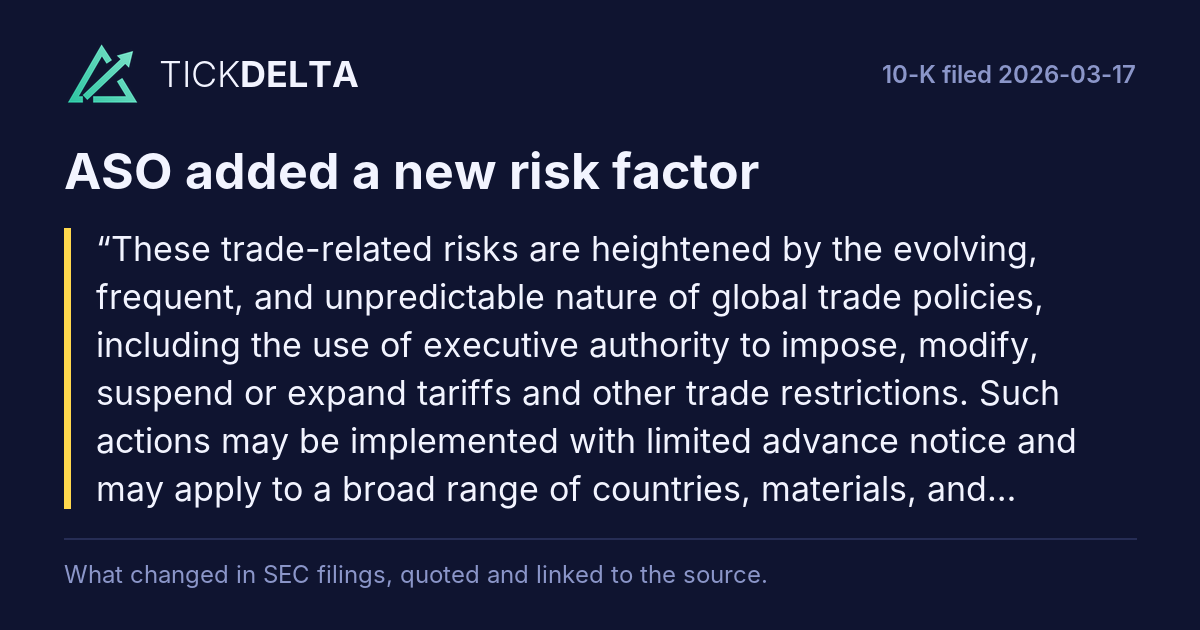
These trade-related risks are heightened by the evolving, frequent, and unpredictable nature of global trade policies, including the use of executive authority to impose, modify, suspend or expand tariffs and other trade restrictions. Such actions may be implemented with limited advance notice and may apply to a broad range of countries, materials, and products, including steel, aluminum, and other derivative products, and may be subject to retaliation by affected countries. As a result, we may be unable to timely adjust our sourcing, pricing, or operational strategies to mitigate the impacts of such changes, which could materially increase our costs and adversely affect our margins, results of operations, and financial condition.
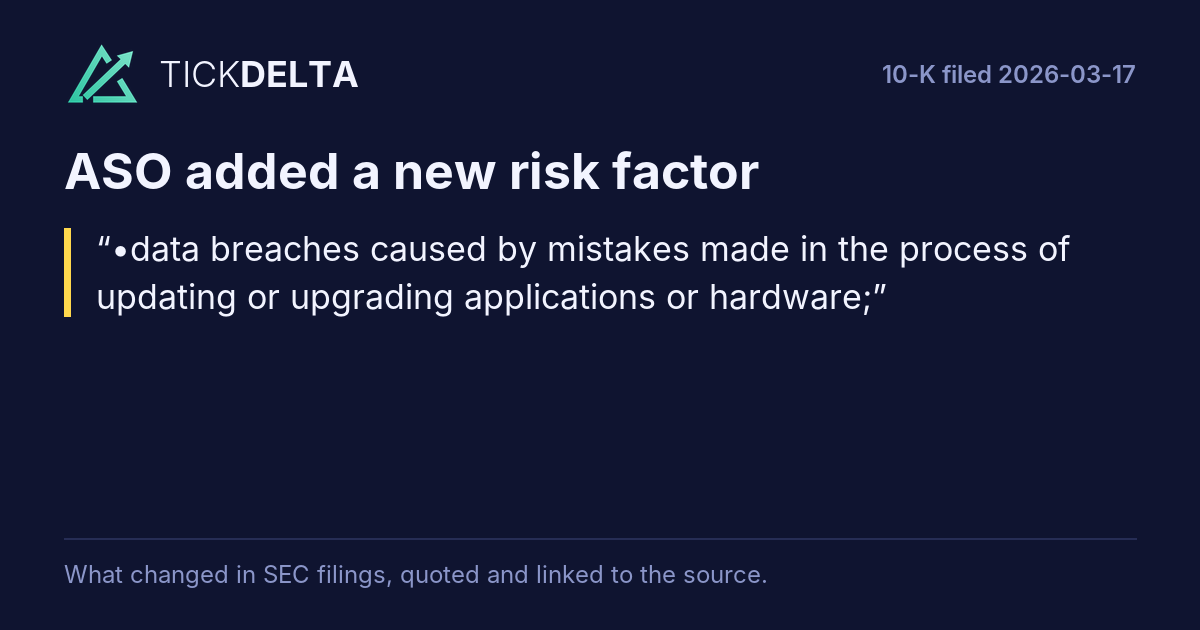
•data breaches caused by mistakes made in the process of updating or upgrading applications or hardware;
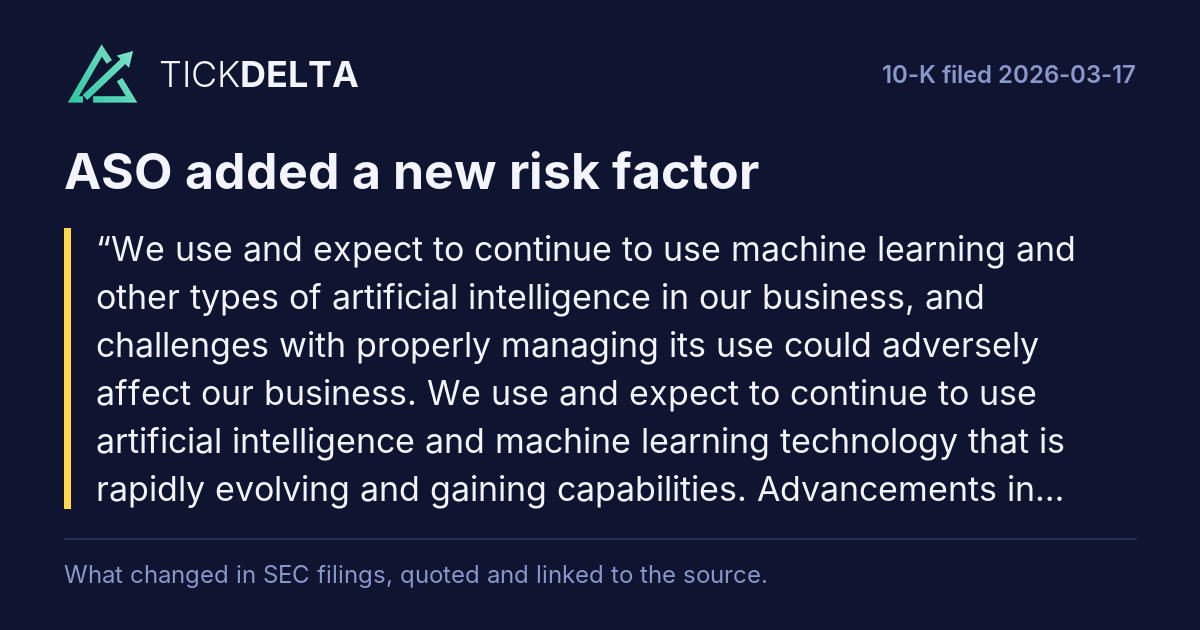
We use and expect to continue to use machine learning and other types of artificial intelligence in our business, and challenges with properly managing its use could adversely affect our business.
We use and expect to continue to use artificial intelligence and machine learning technology that is rapidly evolving and gaining capabilities. Advancements in technology may allow us to expand the use of artificial intelligence, including generative artificial intelligence, into key operational and/or administrative aspects of our business over time. Our business, financial condition, and results of operations may be adversely affected if the output of our use of artificial intelligence is or is alleged to be deficient, inaccurate, or biased. As with other emerging technology, new providers may arise from time to time, regulatory and legal limitations on its use may evolve, costs may not be predictable, and the successful use of such technology may require changes to business processes, data systems and processes, and the delivery of products and services provided to customers. We may be required to expend additional resources in order to use artificial intelligence responsibly and effectively in compliance with applicable laws and standards. Our competitors may incorporate artificial intelligence into their business more quickly or more successfully than us, which could impair our ability to compete effectively and adversely affect our results of operations.
Changes in consumer preferences and spending patterns may be long-lasting or structural rather than temporary and could be amplified by pricing actions taken in response to higher costs or tariffs, which may cause consumers to reduce discretionary spending or shift purchases to alternative products or channels.
We and our partners rely on commercially available information security technology and industry standard operational practices for collecting, storing, maintaining, transmitting, protecting, and processing data. Despite our security measures, we may not be able to anticipate, prevent, and stop future cybersecurity incidents, including attacks to our information systems and data and those of our partners. Threat actors may have the ability to defeat our security measures and may obtain access to data (including personal data or personally identifiable information) that we hold relating to us and our customers, team members, and vendors, or may cause operational harm. For example, ransomware events could cause key systems to be unavailable for use, or credential stuffing attacks
Show the other 3
•emerging or non-traditional retail formats, including digitally native brands and marketplace platforms.
We may require significant capital in the future to sustain or grow our business, including our store and e-commerce activities, due to increased competition and market entry by new or disruptive retailers. There is no assurance that cash flow from operations will be sufficient to meet those needs or that additional sources of capital will be available on acceptable terms or at all.
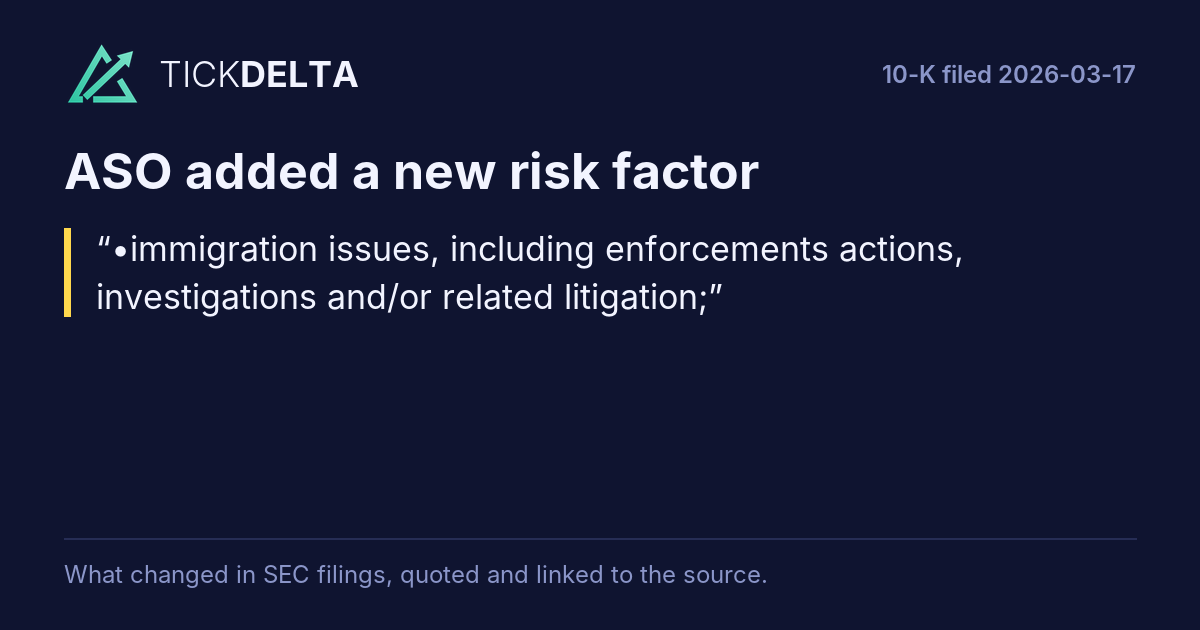
•immigration issues, including enforcements actions, investigations and/or related litigation;
Paragraphs in the 10-Q filed Sep 9, 2026 that were not in the one before
New in the latest 10-Q
16 paragraphs in the 10-Q filed Sep 9, 2026 with nothing like
them in the 10-Q filed Jun 10, 2026 (at least half the words must differ; new numbers alone do not count).
Quoted exactly, grouped by the item heading above them. This is text that changed, not a judgement of how serious it is.
Financial statements and notes
In connection with the refinancing activities in the 2026 second quarter, the Company recognized a non-cash loss on early retirement of debt of $1.9 million from the write-off of deferred loan costs and expense related to the original issuance discount associated with the Term Loan.
Read in the 10-Qopen_in_new
The $10.5 million proceeds from the sale of a portion of the rights to potential IEEPA tariff relief claims were recorded within Other Long-Term Liabilities on the Condensed Consolidated Balance Sheets in 2025 and the fair value option was elected (see Note 10). In the second quarter of 2026, the change in the fair value of the liability and the remittance of tariff refund claims were $61.8 million, net and $72.2 million, respectively.
Read in the 10-Qopen_in_new
Thirteen Weeks Ended August 1, 2026 Compared to Thirteen Weeks Ended August 2, 2025
Read in the 10-Qopen_in_new
Interest Expense. Interest expense decreased $1.0 million, or 10.8%, in the 2026 second quarter when compared with the 2025 second quarter, primarily due to lower interest rates and debt refinancing activities in the 2026 second quarter which resulted in lower interest rates on our long-term debt (see Note 4).
Read in the 10-Qopen_in_new
Loss on Early Retirement of Debt. Loss on early retirement of debt increased by $1.9 million in the 2026 second quarter as compared to the 2025 second quarter. During the second quarter of 2026, we completed refinancing transactions and used the net proceeds from the issuance of the Notes to fully redeem the 2020 Notes and repay our Term Loan in full (as defined in Note 4), which resulted in a $1.9 million loss on early retirement of debt.
Read in the 10-Qopen_in_new
Show the other 11
Other Expense (Income), net. Other expense (income), net, changed by $59.5 million in the 2026 second quarter as compared to the 2025 second quarter, primarily driven by $72.2 million of payments made related to the Participation Agreement for tariff relief claims, partially offset by the $10.5 million in proceeds recognized related to the Participation Agreement (see Note 10).
Read in the 10-Qopen_in_new
Twenty-Six Weeks Ended August 1, 2026 Compared to Twenty-Six Weeks Ended August 2, 2025
Read in the 10-Qopen_in_new
Interest Expense. Interest expense decreased $1.0 million, or 5.7%, for the year-to-date 2026 when compared with the year-to-date 2025, primarily due to lower interest rates and debt refinancing activities in the 2026 second quarter which resulted in lower interest rates on our long-term debt (see Note 4).
Read in the 10-Qopen_in_new
Loss on Early Retirement of Debt. Loss on early retirement of debt increased $1.9 million for the year-to-date 2026 when compared with the year-to-date 2025. During the second quarter of 2026, we completed refinancing transactions and used the net proceeds from the issuance of the Notes to fully redeem the 2020 Notes and repay our Term Loan in full (as defined in Note 4), which resulted in a $1.9 million loss on early retirement of debt.
Read in the 10-Qopen_in_new
Other Expense (Income), net. Other expense (income), net, changed by $59.1 million in year-to-date 2026 when compared to year-to-date 2025, primarily driven by $72.2 million of payments made related to the Participation Agreement for tariff relief claims, partially offset by the $10.5 million in proceeds recognized related to the Participation Agreement (see Note 10).
Read in the 10-Qopen_in_new
As of August 1, 2026, the Company’s long-term debt and interest rates consist of:
Read in the 10-Qopen_in_new
• $25.3 million net increase in non-cash charges primarily due to $61.8 million related to the loss on the IEEPA tariff refund monetization in the 2026 second quarter (see Note 5 and Note 10), partially offset by a $28.8 million decrease in deferred income taxes.
Read in the 10-Qopen_in_new
• $39.5 million increase in income taxes payable primarily due to deductions in the prior year period resulting from the One Big Beautiful Bill Act, timing of payments, and a tax refund received in the prior year period; partially offset by
Read in the 10-Qopen_in_new
• $484.3 million increase in cash outflows related to the redemption of the 2020 Notes and repayment of the Term Loan as part of the refinancing activities in the 2026 second quarter (see Note 4);
Read in the 10-Qopen_in_new
• $81.5 million increase in cash outflows for repurchases of common stock in 2026; and
Read in the 10-Qopen_in_new
• $493.9 million in net proceeds resulting from the issuance of the Notes as part of the refinancing activities in the 2026 second quarter (see Note 4).
Read in the 10-Qopen_in_new
The 10-Q's risk factors against the 10-K
Item 1A of the 10-Q filed Sep 9, 2026 against Item 1A of the 10-K filed Mar 17, 2026.
A 10-Q repeats only the risks that changed, so a 10-K paragraph that is missing from it is not counted as removed.
Added is a paragraph with nothing like it in the 10-K, Reworded a sentence that is in both with several words changed,
Quiet changes a sentence in both where one to four words changed and one is a hedge or a modal
(cut words struck through, new words highlighted).
Text on the page, not a score; each links to the filing at sec.gov.
Added10-Q Sep 9, 2026 vs 10-K Mar 17, 2026
You should carefully consider the risk factors discussed in the section of the Annual Report entitled “Part 1A. Risk Factors”, which could materially affect our business, financial condition or future results. The risks described in the Annual Report are not the only risks facing the Company. Additional risks and uncertainties not currently known to us or that we currently deem to be immaterial also may materially adversely affect our business, financial condition or future results. There have been no material changes to the risk factors discussed in the section of the Annual Report entitled “Part 1A. Risk Factors”.
Read it in the 10-Q at sec.govopen_in_new
Climate change could exacerbate challenges relating to the availability and quality of water and raw materials, including those used in the production of the private label and other merchandise that we sell, may lead to increased energy usage and costs, and may result in changes in regulations or consumer preferences that could have a material adverse effect on our business, results of operations and financial condition. Uncharacteristic or significant weather conditions, including the physical impacts of climate change, can affect consumer shopping patterns, particularly in apparel and...
In the 10-K filed Mar 20, 2025open_in_new
General trade tensions between the United States and China began escalating in 2018, with the Trump administration ultimately imposing multiple rounds of tariffs on imports from China, where we and many of our vendors source commodities. As a result, we have experienced rising inventory costs on private label brand products we directly source from China, as well as national brand products from China that we source through our vendors. These higher inventory costs have resulted in higher prices and/or lower margins, thus resulting in a negative impact to sales and/or gross margin. These...
In the 10-K filed Mar 20, 2025open_in_new
We have significant operations in certain states where natural disasters are more prevalent. Natural disasters in those states or in other areas where we operate could result in significant physical damage to or closure of one or more of our stores, distribution centers, facilities, or key vendors. In addition, weather conditions, natural disasters, and other catastrophic events in areas where we or our vendors operate, or depend upon for continued operations, could adversely affect the availability and cost of certain products within our supply chain, affect consumer purchasing power, and...
In the 10-K filed Mar 20, 2025open_in_new
Climate change resulting from increased concentrations of carbon dioxide and other greenhouse gases in the atmosphere, including increases in global temperatures, changes in weather patterns and increasingly frequent and/or prolonged extreme weather and climate related events, could present risks to our operations. The potential impacts of climate change present a variety of risks. The physical effects of climate change, such as extreme weather conditions, drought, and rising sea levels, could adversely affect our results of operations, including by increasing our energy costs, disrupting...
In the 10-K filed Mar 20, 2025open_in_new
Sources
Item 1A of each 10-K and 10-Q on EDGAR, quoted exactly. Each paragraph links to the filing at sec.gov.
Also
10-K change: what was reworded or cut, section by section.
Work with it
Excel workbook · CSV. Google Sheet that stays up to date: paste =IMPORTDATA("https://tickdelta.com/company/ASO/export.csv") into a cell.