Screener / SEC EDGAR /CIK 0001780312 /10-K filed Mar 2, 2026, compared with Mar 3, 2025 /Numbers from the XBRL of the 10-Ks
Nasdaq Communication · Communications Services

AST SpaceMobile, Inc. ASTS

Compare with peers Embed
SEC comment letters, last 20 years

3 reviews of ASTS's filings by SEC staff

UPLOAD and CORRESP
Reviews 3 latest letter Jun 26, 2024
Questions asked 24 each answered in the company's own letter
No closing letter 2 reviews without a letter saying the staff completed it

When the SEC's staff reviews a filing, it writes to the company with numbered questions, and the company answers each one in a letter. SEC publishes the exchange once the review is over, at least 20 business days later. A question is not an accusation; most reviews end with the company adding detail to its next filing.

How the reviews went

Every review on EDGAR, from the first staff letter to the letter that closes it

  1. 1. Staff letters 5 UPLOAD
  2. 2. Questions in them 24 numbered comments
  3. 3. Company replies 7 CORRESP
  4. 4. Reviews closed 1 of 3 closing letter

Half the closed reviews took 51 days or less from the first letter to the closing letter.

Form S-3

2024-06-26 to 2024-07-18 · 1 question · 1 letter from the SEC, 2 from the company
No closing letter
SEC asked
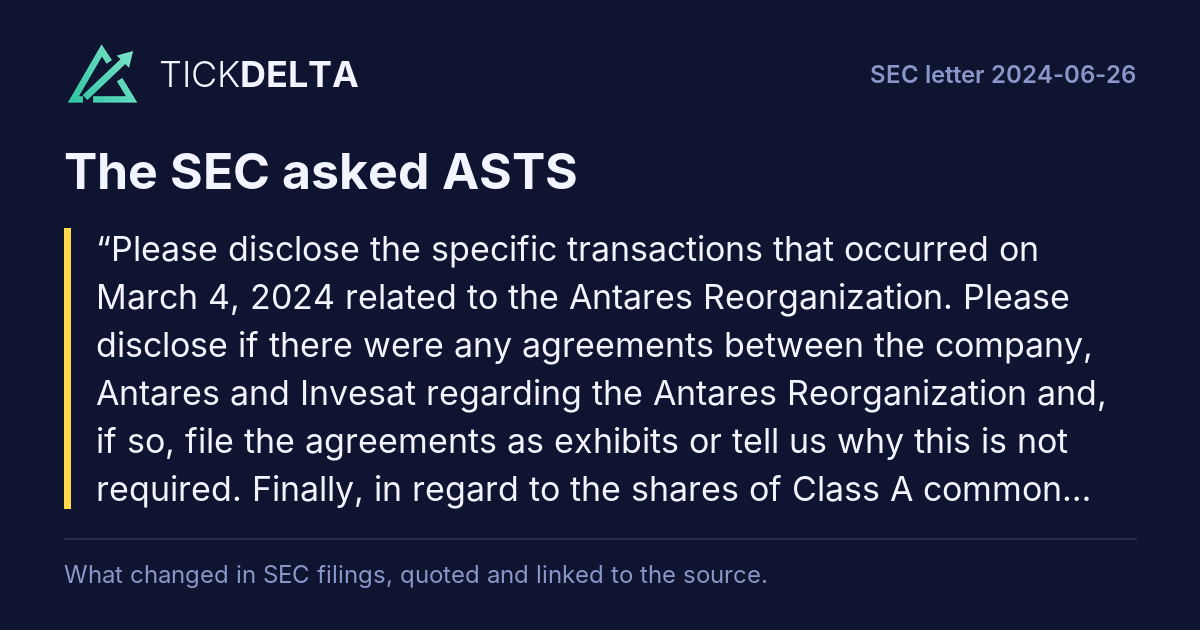
Please disclose the specific transactions that occurred on March 4, 2024 related to the Antares Reorganization. Please disclose if there were any agreements between the company, Antares and Invesat regarding the Antares Reorganization and, if so, file the agreements as exhibits or tell us why this is not required.
Rest of the question

Finally, in regard to the shares of Class A common stock issued to Antares, disclose the section of the Securities Act or rule under which an exemption from registration was claimed and state briefly the facts relied upon to make the exemption available.

ASTS answered
The Company acknowledges the Staff’s comment and in response thereto has amended the disclosure on page 12 to clarify that the

Antares Reorganization was done pursuant to Section 11.8 of the Fifth Amended and Restated Limited Liability Company Operating Agreement of AST& Science, LLC, dated as of April 6, 2021 (the “Operating

Agreement”). The Company respectfully advises the Staff that the Operating Agreement was previously filed as Exhibit 10.5 to the Company’s Current Report on Form 8-K filed with the SEC on April 12, 2021.
Rest of the answer

Under Section

11.8 of the Operating Agreement, the Company was required to work together in good faith with the requesting member, Invesat LLC, to structure a Blocker Merger Transaction (as defined in the Operating Agreement). In connection with the Antares Reorganization, AST SpaceMobile

Holdings II, LLC and AST SpaceMobile Holdings, LLC, each a Delaware limited liability company that is treated as a disregarded entity of the Company, entered into an Agreement and Plan of Merger with Invesat LLC, Antares Technologies LLC and Hackney Capital Ventures

LTD (the “Merger Agreement”). The Company determined that the Merger Agreement is not material and need not be filed under Item 601(b)(10) of Regulation S-K. However, the Company respectfully advises the Staff that the Merger Agreement was previously filed as Exhibit 99.8 to the Schedule 13D/A filed by Invesat LLC on March 6, 2024.

With respect to the shares of Class A common stock issued to Antares in connection with the Antares Reorganization, the Company respectfully advises the Staff that it relied upon the exemption from registration provided by Section 4(a)(2) of the Securities Act because the Company determined that the issuance did not involve a public offering.

Read in the reply

Also in this review: company letter, Jul 18, 2024

Schedule 14A

2021-01-19 to 2021-03-11 · 19 questions · 3 letters from the SEC, 4 from the company
Review closed 2021-03-11
AcquisitionsRevenueExecutive pay
Questions and Answers About the Business Combination · How will SpaceMobile be managed following the Business Combination...?, page 14
SEC asked (1)
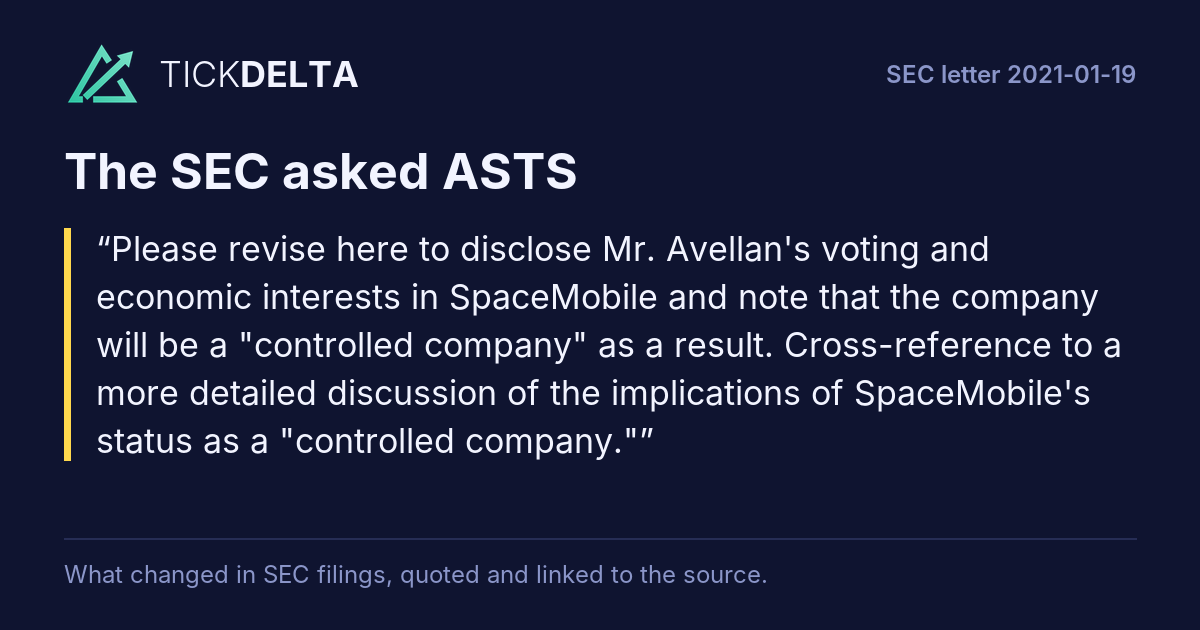
Please revise here to disclose Mr. Avellan's voting and economic interests in SpaceMobile and note that the company will be a "controlled company" as a result. Cross-reference to a more detailed discussion of the implications of SpaceMobile's status as a "controlled company."
ASTS answered
Pursuant to the Staff’s request, we have revised the disclosure on pages 14 and 15 to reflect the Staff’s comment.
Read in the reply
What is an "Up-C" Structure?, page 17
SEC asked (2)
Please revise to further describe the practical effects and implications of the Up-C structure. For example, disclose your voting and economic interests in AST, describe your role as managing member of AST and note that this will give you control over the affairs and decision-making of AST. Finally, explain that you will consolidate the financial results of AST.
ASTS answered
request, we have revised the disclosure on page 17 to reflect the Staff’s comment.
Read in the reply
What vote is required to approve the Proposals?, page 18
SEC asked (3)
In light of the vote requirement, please revise to discuss how the voting requirement and the letter agreement make it more likely the business combination will be approved. For example, discuss the percentage of shares not subject to the letter agreement that would be required to approve the business combination proposal if only a quorum of NPA shares are present.
ASTS answered
request, we have revised the disclosure on page 19 to reflect the Staff’s comment.
Read in the reply
Summary of the Proxy Statement · Organizational Structure, page 30
SEC asked (4)
Please revise the post-closing diagram to clarify the economic and voting interests of SpaceMobile and the Existing Equityholders over AST.
ASTS answered
request, we have revised the diagram on page 32 accordingly. See percentage corrections to diagram.
Read in the reply
Unaudited Pro Forma Condensed Combined Financial Information · Description of the Business Combination, page 84
SEC asked (5)
Please clarify whether Class B and Class C shares of common stock will remain outstanding if the AST common units are exchanged for Class A common stock or redeemed for cash. Provide an example that illustrates the effect of exchanging AST common units into Class A common stock on the voting and economic rights of all parties.
ASTS answered
request, we have revised the disclosure on pages 85 through 87 to reflect the Staff’s comment and provide illustrative examples of the effect of exchanges on the voting and economic rights of all parties.
Read in the reply
Unaudited Pro Forma Condensed Combined Financial Information · Description of the Business Combination, page 84
SEC asked (6)
Revise to add a table that presents the voting rights of each class of common stock outstanding in addition to current table that presents ownership percentages.
ASTS answered
request, we have provided a table on page 86 that presents the voting rights of each class of common stock outstanding.
Read in the reply
Adjustments to the Unaudited Pro Forma Condensed Combined Financial Information, page 93
SEC asked (7)
Please revise adjustment (K) to describe the redemption terms of AST common units. This disclosure should clearly indicate why these units are classified as temporary equity and describe how the redemption amount was determined. Explain why the redeemable non-controlling interest amount changes under the two scenarios.
Rest of the question

Please provide how you determined the value of redeemable non-controlling interest, including disclosing the number of AST common units outstanding. You disclose that Class B common stock and Class C common stock are intended to correspond with AST common units held by investors. Tell us how the fair value of the shares of Class A common stock factored into this valuation.

ASTS answered
We understand that whether an equity investment is redeemable at the option of the holder or upon the occurrence of an event that is solely within the control of the issuer can be complex and that all of the individual facts and circumstances surrounding events that could trigger redemption should be evaluated separately and that the possibility that any triggering event that is not solely within the control of the issuer could occur – without regard to probability – would require the instrument to be classified in temporary equity.

As noted in the Proxy Statement, in connection with the
Rest of the answer

consummation of the business combination with AST, we will amend and restate the AST operating agreement in its entirety. The current form of A&R Operating Agreement provides that the AST

Common Units not held by NPA provide each member with the right to cause NPA to redeem its AST Common Units in whole or in part at any time and from time to time following the waiver or expiration of the lock-up period pursuant to the

Stockholders’ Agreement. NPA, as the Managing Member of AST, shall have the option to elect to have the redeemed AST

Common Units redeemed for either shares of Class A Common Stock or cash as set forth in the A&R Operating Agreement (the

“Cash Settlement”). However, because the noncontrolling interests holders collectively appoint the majority of NPA’s directors (specifically, Mr. Avellan, as the holder of a majority of the voting rights and director appointments), the settlement method for any redemption or exchange of AST Common Units arguably would not be fully in NPA’s control. Therefore, because there is a scenario outside of NPA’s control that may result in settlement of the noncontrolling interests in cash, we previously classified the noncontrolling interest as temporary equity in the pro forma balance sheet.

After further consideration, we have elected to make it clear that NPA will fully control the settlement method for all redemptions or exchanges of AST Common

Units. To accomplish this, we have updated the form of A&R Operating Agreement to become effective at the closing of the business combination to provide that NPA will establish a committee to exercise full control over all decisions on settlement for noncontrolling interest redemptions. The committee, which will be named the Redemption Election Committee, will have the fiduciary duties to act in the best interests of all of the Company’s stockholders, will be delegated the full power of the board of directors in respect of redemption settlement decisions, and will consist solely of directors that are neither nominated by, or affiliated with, any noncontrolling interest holders. Further, the settlement decisions made by the Redemption Election Committee will be solely in the Company’s control and cannot be overridden or vetoed by other board members, including Mr. Avellan. In addition, we have updated the form of Stockholders’ Agreement to become effective at the closing of the business combination to provide that until such date as the Stockholder Parties collectively control less than 50% of the total voting power of the Company, the

Stockholder Parties will take all necessary action to cause the Company and the Company’s board of directors to maintain the Redemption Election Committee and its delegated powers.

In making our accounting conclusion, we considered ASC 480-10-S99-3A which requires preferred securities (and other redeemable equity securities by analogy) that are redeemable for cash or other assets to be classified outside of permanent equity if they are redeemable (1) at a fixed or determinable price on a fixed or determinable date, (2) at the option of the holder or (3) upon the occurrence of an event that is not solely within the control of the issuer. Additionally, we considered the Staff’s views regarding the application of Accounting Series Release No. 268, Presentation in Financial Statements of “Redeemable Preferred

Stocks” (“ASR 268”). In particular, we considered the following example provided by the Staff:

Example 2. A preferred security that is not required to be classified as a liability under other applicable GAAP may have a redemption provision that states it may be called by the issuer upon an affirmative vote by a majority of its board of directors. While some might view the decision to call the security as an event that is within the control of the Company because the governance structure of the company is vested with the power to avoid redemption, if the preferred security holders control a majority of the votes of the board of directors through direct representation on the board of directors or through other rights, the preferred security is redeemable at the option of the holder and classification in temporary equity is required. In other words, any provision that requires approval by the board of directors cannot be assumed to be within the control of the issuer. All of the relevant facts and circumstances should be considered.

The Company respectfully advises the Staff that after evaluating the guidance set forth above and based on the specific facts and circumstances applicable to the

Company, including the revisions of the A&R Operating Agreement to be entered into at the closing of the business combination, the Company concludes that the noncontrolling interest should be presented within permanent equity in the pro forma balance sheet.

request, adjustment (K) has been revised to describe the redemption terms of the AST common units, how the noncontrolling interest was determined including how amounts change under the two scenarios, and the reasons that the units are classified as permanent equity. Please see pages 97 and 98 for the revised adjustment (K) description. Additionally, we have revised our proxy to clarify that any noncontrolling interest settlement decision will be subject to the approval of our committee. Please see pages 30, 124, and 222 .

Read in the reply
Proposal No. 1 - The Business Combination Proposal · The Board's Reasons for Approving the Business Combination, page 131
SEC asked (8)
We note the disclosed prospective financial information that AST provided NPA. Tell us whether any other information was provided to NPA to support the projections. If so, disclose the material estimates and hypothetical assumptions upon which they are based.
ASTS answered
AST & Science LLC (“AST”) provided NPA with 10-year models on a monthly basis. Two of the models, the revenue model and operating expenses model, provide the basis for the financial statement model disclosed in the Amended Proxy Statement on pages 138 and 139. We believe the disclosure in the Proxy Statement contained all material information with respect to the projections; however, in response to the Staff’s request, we have revised the disclosure on pages 139 and 140 to include supplemental disclosure of the material estimates and assumptions upon which the financial statement model was
Rest of the answer

based.

Read in the reply
Other Information About AST · Overview, page 167
SEC asked (9)
We note your disclosure on page 180 that AST has not generated significant revenues and does not expect to begin generating revenues from its SpaceMobile Service until 2023. Please revise here and elsewhere to more prominently disclose that AST has not generated revenue from its SpaceMobile Service to date and does not expect to do so until 2023.
Rest of the question

This disclosure should explain the basis for determining the number of subscribers, including the basis for the rapid adoption of your products and the impacts of entry of competitors. In addition, explain how you estimated the operating expenses and why you believe those estimates are reasonable. Describe how you factored the cost of building and placing satellites into this model and the underlying valuation. That is, the model should reflect the estimated depreciation and amortization expense. Further, the model should explain how you plan to fund the capital expenditures as well.

ASTS answered
request, we have revised the disclosure on pages 138 through 140, and 186, to reflect the Staff’s comment.
Read in the reply
Other Information About AST · Overview, page 167
SEC asked (10)
You disclose that AST believes that the SpaceMobile Service would be the first global direct mobile broadband network to provide connectivity to any standard, unmodified, offthe-shelf mobile phone. We also note that you are partnering with mobile network operators to provide this service and will share revenues with these MNOs.
Rest of the question

Please revise to clarify whether you will also need to enter into agreements with mobile phone or other device manufacturers to offer this service on their devices and whether there is a material risk that device manufacturers could unilaterally prohibit your service from being offered on their devices.

ASTS answered
SpaceMobile does not anticipate entering into agreements with mobile phone or device manufactures. The SpaceMobile Service is designed to work with the MNO’s network as an extension of the terrestrial coverage assets and will use the MNO’s standard cellular spectrum. The SpaceMobile

Service will work with any cell phone, regardless of make or model. Commonly available standard mobile phones of any make or model will not distinguish between the terrestrial network or SpaceMobile satellite.
Rest of the answer

Standard mobile phones will not require an operating system update, special app, internal modifications or external hardware. In the unlikely event a phone manufacturer or device manufacturer was able to block the SpaceMobile service from certain devices, Management believes consumers would be less likely to purchase such devices. As such, we have revised the disclosure on pages 173 and 174 to reflect the Staff’s comment.

Read in the reply
Executive and Director Compensation of AST, page 202
SEC asked (11)
You provide AST executive compensation disclosure for 2019 here and for NPA on page 193. Please revise to also provide executive compensation disclosure for the fiscal year ended December 31, 2020 for both AST and NPA.
ASTS answered
request, we have revised the disclosure on pages 199 and 212 through 218 to reflect the Staff’s comment.
Read in the reply
Description of SpaceMobile Securities · Common Stock, page 231
SEC asked (12)
You disclose that each share of Class C Common Stock will, (i) prior to the Sunset Date, entitle the holder thereof to cast a number of votes on all matters on which stockholders generally are entitled to vote equal to the lesser of (x) 10 votes and (y) the Class C Share Voting Amount and (ii) from and after the Sunset Date, entitle the holder thereof to cast one vote.
Rest of the question

Please provide us with detailed examples of how the voting rights of SpaceMobile's Class C common stock will be calculated and discuss the practical effects of this formula. Additionally, you state that the above formula "generally" applies to the calculation of Class C voting rights. Please clarify any exceptions. General

ASTS answered
The Staff’s comment is noted. Upon further review, the word “generally” is not needed and we have revised the disclosure on pages 2, 42,

76, 77, 87, 209 and 243 to remove the word “generally” when describing the applicability of the Class C Share

Voting Amount and clarify that there are no exceptions.

The practical effect of the formula used to calculate the Class C Share Voting Amount is to cap the aggregate voting power of the Class C Common Stock so that, in most scenarios, the voting power of the Class C Common Stock does not increase, or increases more slowly than it would otherwise
Rest of the answer

in the event the Class C holders acquire additional voting stock in SpaceMobile.

Example 1:

To illustrate, please refer to

Table 1 below which presents the simplified anticipated ownership of SpaceMobile at Closing.

AST Units

Class A Shares

Class B Shares

Class C Shares

Total Shares

Total Votes

Voting

%

Economic

Class C Holders

78,163,078

-

781,630,780

88.3 %

43.1 %

Class B Holders

51,636,922

5.8 %

28.4 %

Class A Holders

51,750,000

5.9 %

28.5 %

Total

129,800,000

181,550,000

885,017,702

100.0 %

At Closing, Class C Share Voting Amount at

Closing will equal 10 votes per share, calculated as follows. The Class C Voting Amount is equal to the Class C Aggregate

Voting Amount divided by the number of shares of Class C Common Stock then outstanding. The Class C Aggregate Voting Amount is equal to (x) the Closing Class C Percentage, which we anticipate to be 88% at Closing, multiplied by the total voting power (“TVP”) of the outstanding voting stock of SpaceMobile (assuming 10 votes per share for the Class C

Common Stock, but excluding from TVP any shares of Class A Common Stock held by a Class C Holder that are attributable to the exchange of AST Common Units (“Exchanged Votes”)) minus (y) the total voting power of the outstanding stock of SpaceMobile (other than Class C Common Stock) owned or controlled by the Key Holders (the “Non-C

Votes”).

The TVP is equal to 885,017,702 (per the above table, calculating 1 vote for each share of Class A and Class B stock, and 10 votes per share of Class C stock and less

Exchanged Votes, which are 0) and 88% of the TVP is approximately 781,630,780. From this product is subtracted any votes of

Class C stockholders that are not attributable to shares of Class C Common Stock (Non-C Votes)–as of Closing this is 0 votes.

Class C Aggregate Voting Amount

= ((88% * (TVP - Exchanged Votes)) - Non-C Votes

= ((88% * 885,017,702) – 0)

= (781,630,780 – 0)

= 781,630,780

Class C Share Voting Amount

= 781,630,780 / Shares of Class C Outstanding

= 781,630,780 / 78,163,070

= 10 Votes

Because the number of votes per Class C Share is equal to the lesser of 10 and the Class C Share Voting Amount, the votes per Class C share at Closing will be 10.

Example 2

To illustrate how the Class C voting power is calculated after Closing and when there have been changes in the ownership and capitalization of SpaceMobile, please refer to the following table, which shows the voting and economic interest of the classes of shareholders if the Class C holders were to purchase 50 million additional shares of Class A Common Stock (not through an exchange of AST Common Units).

Class A

Shares

Class B

Class C

Total Raw

Votes*

(Adj.)**

50,000,000

128,163,078

831,630,780

825,789,828

88.9 %

55.4 %

5.5 %

22.3 %

5.6 %

100,750,000

231,550,000

935,017,702

929,176,750

* Calculated using 10 votes per Class C Share

** Calculated with votes per Class C Share equal to the

Class C Voting Amount at this capitalization (approx. 9.9253).

In this scenario, the TVP is increased by 50 million votes, but these are also subtracted from the calculation of “Class C Aggregate Voting Amount” because they are owned by the Class C holders and not attributable to Class C Common Stock. The calculations are as follows:

= ((88% * 935,017,702) –

50,000,000)

= (825,789,827 – 50,000,000)

= 775,789,827

= 775,789,827 / Shares of Class C Outstanding

= 775,789,827 / 78,163,070

= 9.9253 Votes per share

The shares of Class C Common Stock bear the number of votes equal to the lesser of 10 and the Class C Share Voting Amount. Here, the Class C Share Voting Amount is less than ten, so each share of Class C Common Stock would bear 9.9253 votes per share. Without the capping effect of the Class C

Share Voting Amount, the holders of Class C Common Stock would be entitled to vote a total of 831,630,780 votes (that is

78,163,078 Class C shares multiplied by 10 votes, plus 50,000,000 Class A shares multiplied by 1 vote), however, the because the Class C Voting Amount is less than 10, the total number of votes that the holders of Class C Common Stock have is reduced to 825,789,827 (that is 78,163,078 Class C shares multiplied by 9.9253 votes, plus 50,000,000 Class A shares multiplied by 1 vote). The effect in this scenario is that, although the Class C holders purchased an additional 50 million

Class A shares, the overall voting power of the Class C Holders is collared by reducing the number of votes each share of

Class C Common Stock bears from 10 votes to 9.9253 votes per share. In this example, the Class C holders directly purchased the additional 50 million Class A shares. However, if the Class C holders had instead received these Class A Shares in exchange for AST Common Units, those Class A shares would be excluded from the calculation of TVP as “Exchanged

Votes” and the Class C voting power would not be increased.

Read in the reply
Description of SpaceMobile Securities · Common Stock, page 231
SEC asked (13)
Please include a form of proxy with your next amendment.
ASTS answered
request, the form of proxy has been included and filed with the Amended Proxy Statement.

If any additional supplemental information is required by the Staff or if you have any questions regarding the foregoing, please direct any such requests or questions to

Julian Seiguer of Kirkland & Ellis LLP at (713) 836-3334.
Read in the reply
Revised Preliminary Proxy Statement filed January 27, 2021 · Cover Page
SEC asked (1)
Your response to prior comment 12 indicates that the practical effect of the Class C voting rights formula is to "cap the aggregate voting power of the Class C Common Stock so that, in most scenarios, the voting power of the Class C Common Stock does not increase, or increases more slowly than it would otherwise in the event the Class C holders acquire additional voting stock in SpaceMobile." Please revise your
Rest of the question

cover page and elsewhere to describe the practical effect of your Class C voting rights formula.

ASTS answered
Pursuant to the Staff’s request, we have revised the disclosure on the Cover Page and pages 14, 15, 42, 77, 78, 87 and 210.

Cautionary Note Regarding Forward-Looking Statements,
Read in the reply
Cautionary Note Regarding Forward-Looking Statements, page 5
SEC asked (2)
You disclose that the proxy statement includes forward-looking statements within the meaning of Section 27A of the Securities Act of 1933. Section 27A(b)(1)(B) of the Securities Act expressly states that the safe harbor for forward-looking statements is not available in connection with an offering of securities by a blank check company.
Rest of the question

Please delete your reference to this safe harbor provision or clarify that it does not apply to your company.

ASTS answered
request, we have revised the disclosure on page 5 to reflect the Staff’s comment.
Read in the reply
Questions and Answers About the Business Combination · How will SpaceMobile be managed following the Business Combination... ?, page 14
SEC asked (3)
Revisions made in response to prior comment 1 disclose the voting power controlled by Key Holders. Please revise here to define Key Holders and disclose Mr. Avellan's economic interest in the company following the offering.
ASTS answered
request, we have revised the disclosure pages 14 and 15 reflect the Staff’s comment.
Read in the reply
Unaudited Pro Forma Condensed Combined Financial Information · Adjustments to the Unaudited Pro Forma Condensed Combined Financial Information, page 96
SEC asked (4)
We note your response to prior comment 7. Please explain why the non-controlling interest should now be presented as a part of stockholders' equity instead of temporary equity when the issuer does not control the redemption feature. That is, the redemption of the AST Common Units for cash or other assets is not solely within the issuer's control. We refer you to ASC 480-10-S99-3A(2), (4) and (5).
Rest of the question

It appears that the redemption provision is in the control of the Redemption Election Committee not the issuer. Please advise.

ASTS answered
We advise the Staff that, pursuant to §141(a) of the Delaware General Corporation Law (the “DGCL”) and Article V, Section 5.1 of the Company’s certificate of incorporation, the business and affairs of the Company shall be managed by the Company’s board of directors

(the “Board”). As a Delaware corporation, the Company is not, as a matter of state corporate law, empowered to take any action that is not approved or authorized by the Board, or that has been approved or authorized by any properly constituted committee of the board or any authorized individual to whom the Board has properly
Rest of the answer

delegated its authority – the Company has no separate or autonomous decision making ability. §141(c)(2) of the DGCL vests authority in the Board to form and delegate authority to one or more committees of the Board that has as its members one or more directors of the Company. Any such committee, to the extent provided in a resolution of the Board or the bylaws of the Company, may exercise all of the powers and authority of the Board. The only power or authority that the Board may not delegate under the DGCL are such powers as are required to be submitted to stockholders of the Company by the DGCL or the ability to adopt, repeal or amend any bylaw of the Company. In this case, the Board has properly delegated its authority to control the redemption feature to the Redemption Election Committee and the Redemption Election Committee will direct the Company in the exercise of the redemption feature. As a result, the redemption provision is within the control of the issuer.

Read in the reply
Proposal No. 1 - The Business Combination Proposal · The Board's Reasons for Approving the Business Combination, page 135
SEC asked (5)
We note the expanded disclosure about your assumptions in response to prior comment 8. Please explain how you have a reasonable basis to support these assumptions in light of your limited operating history and the fact that you project subscriber adoption ten years into the future.
Rest of the question

Please address the following: • Please describe the basis used to estimate the potential subscribers who will become customers and the type of plan that they will subscribe to. In your speed of adoption bullet point, consider disclosing your projected subscribers by the three categories you list. For example, tell us your estimate of how many of the 700 million people who have no mobile coverage will subscribe to your services. It appears that this potential pool of customers will have the added cost to obtain mobile phones and may have greater uncertainty in becoming subscribers. Further, it would seem that the lack of visibility into the future limits your ability to project ten years of subscriber adoption of your products on a reasonable and supportable basis and that a shorter timeframe may be warranted. • You state that there are high barriers for entry for competitors. Explain how your assumption takes into account new technology that might emerge that would allow entry to competitors who would want to participate in your profitable marketplace. This assumption seems to become increasingly unreliable and more subjective over a longer period of time. Also, terrestrial cellular coverage area might improve during this period of time as well. • You state that agreements and relationships with telecommunications companies insulate against direct competition. Indicate how your revenue projections take into account revenue sharing agreements. Disclose the relevant terms of revenue sharing agreements. • Explain whether any comparable companies have similar cost and profitability experiences that you have projected. If not, explain why you will achieve success while these companies have failed.

ASTS answered
As previously noted, AST

& Science LLC (“AST”) provided NPA with 10-year models on a monthly basis. Two of the models, the revenue model and operating expenses model, provide the basis for the financial statement model disclosed in the Amended Proxy

Statement on pages 140 and 141 (the “Projections”). In response to the specific questions raised by the Staff, the Company respectfully advises the Staff of the following:

● Risks and uncertainties inherent in the Projections.
Rest of the answer

NPA and AST acknowledge that a number of the Staff’s comments focus on the risks and uncertainties inherent in the Projections generally. We acknowledge that AST is a pre-revenue company facing significant business and operational risks that make forecasting particularly difficult, especially in the latter years covered by the 10-year Projections. The NPA Board of Directors (the “NPA Board”) understood these risks when considering the

Projections in connection with its review and analysis of the business combination transaction with AST. Although NPA’s proxy disclosures advise investors of these risks and other limitations of the Projections, in view of the Staff’s comments NPA has revised disclosures on pages 139 and 140 in the risk factors on pages 53, 54 and 70 to highlight the difficulty of forecasting financial performance for a pre-revenue company over a 10-year period and caution investors accordingly.

● Assumptions regarding potential subscribers. In reviewing the Projections, the NPA Board and AST considered a variety of factors when estimating the potential subscribers to AST’s SpaceMobile Service and the type of plan those subscribers may adopt, including the following:

o AST’s business model. NPA and AST believe that AST’s business model will facilitate rapid adoption of the Space Mobile Service. AST intends to employ a wholesale, business-to-business-to-consumer model, pursuant to which, AST will enter into commercial agreements with MNOs, who will then provide the SpaceMobile Service to their subscribers. As disclosed on pages 140, 174 and 178 of the Amended Proxy, AST has entered into agreements and understandings with MNOs which collectively cover over 1.3 billion mobile subscribers and of which approximately 790 million mobile subscribers are covered by binding and mutually exclusive agreements with MNOs. As described on page 178 of the Amended Proxy, AST anticipates that the MNOs will market the enhanced coverage of the SpaceMobile Service to their customers and offer the service at a differentiated price to the current terrestrial coverage using service offerings, including an ad-hoc day pass, a monthly add-on subscription and a standalone plan, through automatic prompts that are made via text message directly to the end-user customer’s mobile phone when they leave the terrestrial coverage area and at the point in time when they likely want to access the SpaceMobile Service or are subscribed for as part of a monthly add-on to the end-user customer’s existing wireless plan.

o Total addressable market. The Projections rely on comprehensive market data compiled by the GSMA, an industry organization that represents the interests of mobile network operators worldwide. GSMA produced market data provides information regarding population, subscribers and ARPU on a country-by-country basis, and AST used this data as the foundation to project its revenues. AST priced its 2024 EBITDA projections based on 44 million subscribers, or 0.6% of the world’s total population or 0.8% of the 5.2 billion mobile subscribers worldwide, according to GSMA market data. In addition, GSMA market data shows that approximately 4.0 billion people currently do not have a mobile broadband subscription, and of those, approximately 700 million have no terrestrial tower coverage. Given the ubiquity of cell phones, AST and the

NPA Board believe that many of the 700 million who currently do not have terrestrial tower coverage will choose to add the

SpaceMobile Service when it becomes available. In particular, the model assumes that in 2024, 19 million subscribers, or 0.5% of the 4.0 billion people currently without cellular broadband (this number inclusive of the approximate 700 million people that do not have terrestrial tower coverage), would subscribe to the SpaceMobile Service through an MNO, and that this percentage would increase over time. In response to the Staff’s comments, the Company has revised its disclosure on pages 140 and 141 of the Amended Proxy Statement to include additional disclosure regarding the assumptions underlying subscriber adoption.

o Speed of adoption by service type – projected subscribers by category. The NPA Board did not consider disaggregated projected subscriber data to be of material importance when reviewing the Projections. However, AST believes that the SpaceMobile

Service will be adopted relatively rapidly due to the ease with which AST anticipates end-user customers will be able to subscribe for the SpaceMobile Service. It is anticipated that the MNOs will market the enhanced coverage of the SpaceMobile Service to their customers and offer the service as a differentiated price to the current terrestrial coverage through automatic prompts that are made via text message directly to the end-user customer’s mobile phone when they leave the terrestrial coverage area and at the point in time when they likely want to access the SpaceMobile Service or are subscribed for as part of a monthly add-on to the end-user customer’s existing wireless plan. While AST believes this sales tactic will be effective, given that similar technology has proven effective in other contexts, such as selling roaming or international cellular coverage to MNO end-user customers, it has not been tested in this context and may prove to be less effective than anticipated. In response to the Staff’s comments, the Company has revised its disclosure on page 139 of the Amended Proxy Statement to include additional disclosure regarding the assumptions underlying the speed of adoption.

o Scalable cost of service. AST believes that its wholesale, business-to-business-to-consumer model will permit MNOs to index the cost of the SpaceMobile Service to the customer’s ability to pay on a market-by-market basis. MNOs already employ scalable rates on a market-by-market basis and continue to drive to provide service in new markets.

o Long-term projections. The Projections have been included in the Amended Proxy because NPA believes that, in order to appropriately discharge the NPA Board’s fiduciary disclosure obligations, investors should be given the opportunity to understand the material information actually considered and reviewed by the NPA Board in determining to undertake the business combination transaction with AST. Accordingly, NPA does not believe it would benefit investors to create a truncated set of projections, different than those actually reviewed by the NPA Board, and disclose those in the proxy in lieu of the existing disclosures. However, as noted above, NPA acknowledges the concerns expressed by the Staff regarding the risks and uncertainties inherent in the Projections, and therefore NPA has revised disclosures on pages 140 and 141 to highlight the difficulty of forecasting financial performance for a pre-revenue company over a 10-year period and caution investors accordingly.

● Barriers to entry. AST and NPA are not aware of any competitors offering space-based cellular broadband services to mobile phones over spectrum allocated for terrestrial mobile use. AST expects that it would become aware of any competitors through the various required regulatory filings, including with the U.S. Patent and Trademark Office, the

International Telecommunication Union and the Federal Communications Commission, as well as publicly disclosed agreements with MNOs. While NPA and AST expect that the SpaceMobile Service will have competition in the future, NPA and AST believe that the nature, timing and impact of that competition are too speculative to include in any projections at this time.

However, in light of the Staff’s comment, the Company has revised the disclosure on pages 140 and 141 to note that

NPA’s and AST’s judgments regarding high barriers to entry for competitors are based on technology currently available, and that new or disruptive technologies could significantly alter AST’s competitive landscape in the future.

● Revenue sharing agreements. While various terms of AST’s revenue sharing arrangements with other MNOs are confidential at this time, as disclosed on pages 140, 141, 174 and 178 of the Amended Proxy, AST has entered into agreements and understandings with MNOs which collectively cover over 1.3 billion mobile subscribers and of which approximately 790 million mobile subscribers are covered by binding and mutually exclusive agreements with MNOs that provide for revenue-sharing with AST. Of these, Vodafone represents the largest number of mobile subscribers, and as disclosed on pages

183, 184, 195 and F-69 of the Amended Proxy, AST has entered into an agreement with Vodafone that provides for 50/50 revenue sharing. AST expects that its future agreements with MNOs will contain similar revenue sharing terms.

● Comparable companies. AST believes it will be the first company providing spaced-based cellular broadband services to ordinary cell phones, without the need for any specialized hardware, using a business-to-business-to-consumer model. To date, other satellite communications companies have employed a direct-to-consumer business model, which requires the use of a sales force to sell their product directly to consumers, as well as installation services to install their specialized hardware. Because of AST’s wholesale, business-to-business-to-consumer model, AST is projected to have much lower operating costs and customer acquisition costs, and, accordingly, much higher EBITDA margins, than the typical satellite communications companies. AST is not aware of any other satellite communications companies employing, or planning to employ, a similar wholesale business model for space-based cellular broadband services directly to mobile phones over spectrum allocated for terrestrial mobile use, and, accordingly, AST and NPA do not believe there are any comparable companies. In light of the Staff’s comments, NPA has revised the disclosure on pages 140 and 141 to provide additional detail regarding how the foregoing impact the profit margins used in the Projections.

Except as noted above with respect to some clarifying disclosure on pages 139-141 of the Amended Proxy, the Company respectfully advises the Staff that it believes the disclosure in the Proxy Statement contains all material information, including all material assumptions that were discussed with the NPA Board of Directors, with respect to the Projections.

If any additional supplemental information is required by the Staff or if you have any questions regarding the foregoing, please direct any such requests or questions to

Julian Seiguer of Kirkland & Ellis LLP at (713) 836-3334.

Read in the reply
Unaudited Pro Forma Condensed Combined Financial Information · Adjustments to the Unaudited Pro Forma Condensed Combined Financial Information, page 96
SEC asked
We note your response to prior comment 4 where you describe your basis for presenting the non-controlling interest as part of stockholders’ equity instead of temporary equity. We also note your disclosure throughout regarding the planned establishment of a committee to exercise full control over all decisions on settlement for non-controlling interest redemptions, which will be called the Redemption Election
Rest of the question

Committee. Please respond to the following: • Your response indicates that Redemption Election Committee will consist solely of directors that are neither nominated by, nor affiliated with, any noncontrolling interest holders. Please tell us how many directors are expected to qualify to potentially be a part of the Redemption Election Committee. Additionally, please tell us how many directors are expected to be included on the Redemption Election Committee, and whether the number of directors on the Committee is subject to change. • To the extent that there is not a majority conclusion among the members of the Redemption Election Committee, how would a conclusion be reached? • Describe any potential scenarios where a director could be removed from the Redemption Election Committee. To the extent that a director is removed from the Committee, would the director have to be replaced on the Committee before the Committee could take further action? • We note your disclosure on page 27 that until such date as the Stockholder Parties collectively control less than 50% of the total voting power of SpaceMobile, the Stockholder Parties will take all necessary action to cause SpaceMobile and the SpaceMobile Board to maintain the Redemption Election Committee of the SpaceMobile Board and its delegated powers. Please clarify what is meant by all necessary action. Are there any potential scenarios where the Redemption Election Committee would not be maintained while the stockholder parties control more than 50% of the voting power? • We note your disclosure on page 212 that the Redemption Election Committee will initially consist solely of Mr. Coleman. Please clarify whether additional members are expected to be added to the Redemption Election Committee, and when. To the extent there is a time period when there is only one member of the Redemption Election Committee, please tell us how you concluded this qualified as a Committee of directors that is expected to have the fiduciary duties to act in the best interests of all of the Company’s stockholders.

ASTS answered
The Company expects that at the closing of the transactions contemplated by the Proxy Statement there will be a sole qualifying director on the Redemption Election Committee. None of the Company’s organizational documents, the Stockholders’ Agreement, committee charters or corporate governance policies provide any limit on the number of directors that may serve on the Redemption

Election Committee, only that any director that is a member shall meet the qualifications as specified in the Stockholders’

Agreement.
Rest of the answer

The Stockholders’ Agreement obligates each party thereto to take all action necessary to establish and maintain the Redemption Election Committee and to ensure that each director appointed thereto is qualified to serve on the committee.

The number of directors that will be included on the Redemption Election Committee will be determined by the Company’s nominating and corporate governance committee and is subject to expansion provided that any director so appointed is qualified to serve.

The nominating and corporate governance committee’s charter will provide that, when making recommendations to the full board with respect to the filling of any vacancies on the board that may occur in the future, the committee shall be required to consider the need to have at least one director on the board that would be qualified to serve on the Redemption Election Committee.

● To the extent that there is not a majority conclusion among the members of the Redemption Election Committee, how would a conclusion be reached?

Response:

The nominating and corporate governance committee’s charter, as well as the charter of the Redemption Election Committee, will provide that there must always be an odd number of directors that serve on the Redemption Election Committee. Accordingly, as a practical matter we do not believe there will be a scenario where there is an impasse or deadlock on the Redemption Election

Committee. Nevertheless, in light of the Staff’s inquiry and to ensure that there is no ambiguity, the Company will revise

Section 11.1.2 of the OpCo limited liability company operating agreement (“Operating Agreement”) to provide that,

“…if the Redemption Election Committee for any reason is unable to or does not take action within such three (3)

Business Day period, then the Managing Member shall be deemed to have elected the Share Settlement method.” As a result, in the unlikely event that an impasse or any other issue (e.g., temporary director incapacity, or death of a director on the committee) would prevent the Redemption Election Committee from acting within the prescribed election period, redemptions would be required to be settled by the issuance of PubCo Class A shares.

● Describe any potential scenarios where a director could be removed from the Redemption Election Committee. To the extent that a director is removed from the Committee, would the director have to be replaced on the Committee before the Committee could take further action?

Response:

The board delegation of authority to the Redemption Election Committee will provide that while new members of the Redemption Election

Committee will be selected by the nominating and corporate governance committee, a director that serves on the Redemption Election

Committee can only be removed from that committee by a vote of the members of that committee. In the event a director is removed from the Redemption Election Committee, or resigns from the committee, to the extent there was a fully functioning committee – i.e. each member was qualified to serve on the committee and there was an odd number of directors serving on the committee – then the Redemption Election Committee could take further action. Additionally, as noted above, revised Section 11.1.2 of the

Operating Agreement will provide that if the Redemption Election Committee for any reason is unable to or does not take action within the prescribed election period, redemptions would be required to be settled by the issuance of PubCo Class A shares.

We note further that the charter and bylaws of the Company and the limited liability company operating agreement of OpCo all are expressly subject to the terms of the Stockholders’ Agreement as permitted under Delaware law (specifically, Section 102(d) of the Delaware General Corporation Law (the “DGCL”)) – and the amendment provisions of all such documents provide that the same cannot be amended other than in compliance with the Stockholders’ Agreement. The Stockholders’ Agreement amendment provisions require each stockholder party thereto to consent to an amendment of its terms. As a result, no one stockholder has the ability to amend the Stockholders’ Agreement, or any of the Company’s other organizational documents, to alter the provisions with respect to the Redemption Election Committee.

● We note your disclosure on page 27 that until such date as the Stockholder Parties collectively control less than 50% of the total voting power of SpaceMobile, the Stockholder Parties will take all necessary action to cause SpaceMobile and the SpaceMobile Board to maintain the Redemption Election Committee of the SpaceMobile Board and its delegated powers. Please clarify what is meant by all necessary action. Are there any potential scenarios where the Redemption Election Committee would not be maintained while the stockholder parties control more than 50% of the voting power?

Response:

“Necessary Action” is defined in the Stockholders’ Agreement, and includes, among other actions, obligating a stockholder that has designated a director for nomination to the board to request that such designee act in a certain manner, which we believe would include acting consistent with the obligation in the Stockholders’ Agreement to establish and maintain the Redemption Election Committee.

As set forth in the immediately preceding response, the charter and bylaws of the Company and the OpCo limited liability company agreement are governed by and subject to the terms of the Shareholders’ Agreement which provides significant protection to the committee’s existence and structure. The only scenario we could envision where the Redemption Election Committee would not be maintained or would no longer be solely responsible for redemption decisions would be if all of the stockholders party to the Stockholders’ Agreement amended the agreement to remove the requirement to establish and maintain the committee.

If this occurred, we would expect that the accounting treatment of the non-controlling interest may need to be re-evaluated at that time to determine the proper treatment.

note your disclosure on page 212 that the Redemption Election Committee will initially consist solely of Mr. Coleman. Please clarify whether additional members are expected to be added to the Redemption Election Committee, and when. To the extent there is a time period when there is only one member of the Redemption Election Committee, please tell us how you concluded this qualified as a Committee of directors that is expected to have the fiduciary duties to act in the best interests of all of the Company’s stockholders.

Response:

As described above, the Company’s nominating and corporate governance committee will be charged with the determination as to whether additional members shall be added to the Redemption Election Committee. Currently, there are no plans to add additional members to the Redemption Election Committee, as the determination to do so will be solely in the purview of the nominating and corporate governance committee.

note that Section 141(c)(2) of the DGCL provides that “The board of directors may designate 1 or more committees, each committee to consist of 1 or more of the directors of the corporation.” This is consistent with Section 4.1 of the Company’s bylaws. Section 141(c)(2) of the DGCL goes on to state: “Any such committee, to the extent provided in the resolution of the board of directors, or in the bylaws of the corporation, shall have and may exercise all the powers and authority of the board of directors in the management of the business and affairs of the corporation,”. Fiduciary duties are a matter of state corporate law, and the DGCL clearly contemplates that a committee with only one member is able to discharge its fiduciary duties, just like a board of directors under the DGCL with one sole member would be able to discharge such duties.

summary, the provisions of the Company’s core governing documents - the charter, bylaws, Operating Agreement, Stockholders’

Agreement and the charters of the Redemption Election Committee and the Nominating and Corporate Governance Committee, have been purposefully designed to ensure that none of the holders of OpCo LLC interests, including our founder and controlling stockholder,

Mr. Avellan, has the power to control whether redemptions are settled in equity or cash. These decisions must be made by the Redemption

Election Committee, and if for any reason that committee does not or cannot act timely, redemptions must be settled by the issuance of PubCo Class A shares. In combination, we believe that these provisions ensure that the redemption of OpCo LLC interests for cash or equity is solely within the issuer’s control within the meaning of ASC 480-10-S99-3A.

light of the Staff’s additional inquiries in respect of the Company’s proposed governance provisions, and to help ensure that the Company is able to treat non-controlling interests as permanent equity, the Company has decided to further modify the Operating Agreement. Specifically, the Company will add the following to Section 11.1.2 of the Operating Agreement:

“Notwithstanding anything to the contrary in this Agreement, the Managing Member (acting through the Redemption Election Committee) may only elect a Cash Settlement if such Cash Settlement is limited to the net proceeds from any issuance of shares of Class A Common Stock issued for the purpose of satisfying such Cash Settlement.”

Put more simply, the Company will only be permitted to settle redemptions in cash with the proceeds of a new permanent equity offering.

Staff has previously stated that permanent equity classification is acceptable in circumstances where the issuer has an unconditional right, coupled with the present intent and ability, to satisfy the redemption by exchanging the redeemable security for a permanent equity security (considering the requirements in ASC 815-40-25 to ensure that the issuer has the ability to settle in shares) or limiting the redemption to the cash proceeds to be received from a new permanent equity offering, with appropriate disclosure.

this case, even if the Company, acting through the Redemption Election Committee, were inclined to settle a redemption request in cash, it may only elect to do so if the cash delivered in the exchange is limited to the cash proceeds to be received from a new permanent equity offering through issuance of Class A Common Stock in accordance with revised Section 11.1.2 of the Operating

Agreement quoted above.

Therefore, because there is no scenario outside of the Company’s control that may result in settlement of the noncontrolling interest in cash in excess of cash proceeds to be received from a new permanent equity offering, the Company believes that the noncontrolling interest should be classified as permanent equity, as a cash settlement would in no circumstances result in the use or delivery of existing cash or other assets of the Company.

We note that a number of recent issuers organized as Up-Cs have utilized this “cash limitation” approach, either alone or in combination with provisions of their organizational documents ensuring that independent and disinterested directors control redemption election decisions, to conclude that non-controlling interests should be classified as permanent equity. See, e.g., GCM Grosvenor, Inc., UWM Holdings Corporation, Rocket Companies,

Inc. and GoHealth, Inc. Like the Company, each of these issuers have pre-IPO or pre-business combination investors who hold operating company units and have majority or otherwise significant voting.

Further, and for the avoidance of doubt, management considered whether the criteria of paragraph ASC 815-40-25-10 are met such that the

Company could always control whether a redemption is settled in cash or equity, and management determined that the criteria outlined in ASC 815-40-25-10 are met, and that, accordingly, the noncontrolling interest should be classified in permanent equity.

Company will supplement the proxy statement to include the various revisions discussed above as soon as possible.

If any additional supplemental information is required by the Staff or if you have any questions regarding the foregoing, please direct any such requests or questions to Julian Seiguer of Kirkland & Ellis LLP at (713) 836-3334.
Read in the reply

Also in this review: company letter, Mar 5, 2021, closing letter, 2021-03-11

Form S-1

2019-07-24 to 2019-08-23 · 4 questions · 1 letter from the SEC, 1 from the company
No closing letter
AcquisitionsRisk factors
Draft Registration Statement on Form S-1 Submitted on June 27, 2019 · Cover Page
SEC asked (1)
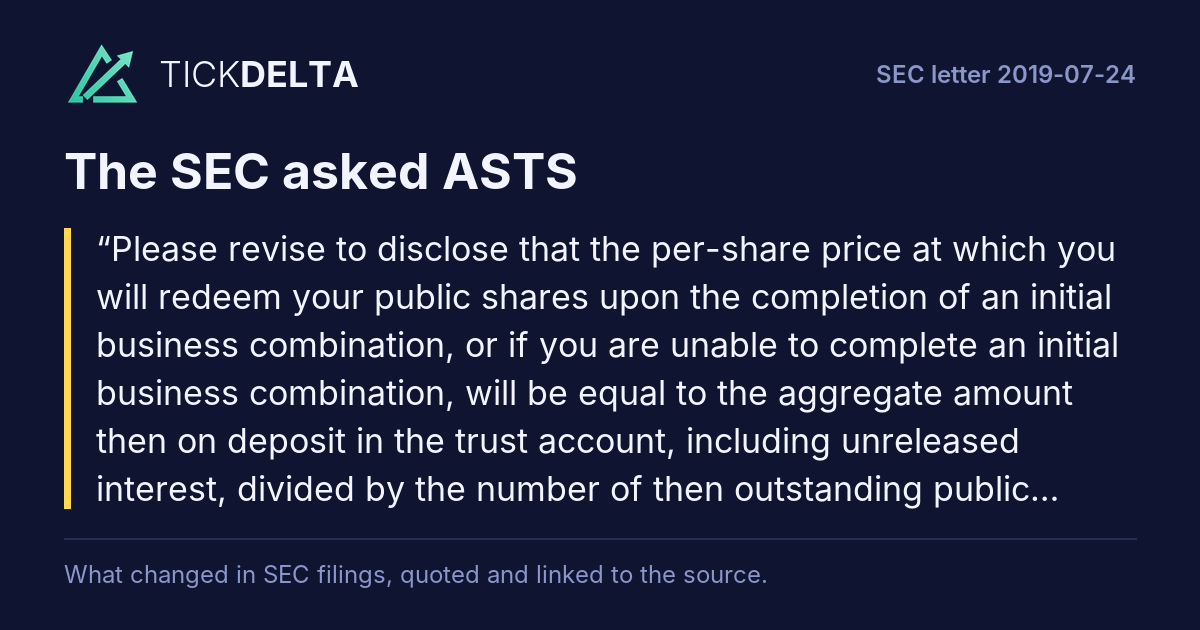
Please revise to disclose that the per-share price at which you will redeem your public shares upon the completion of an initial business combination, or if you are unable to complete an initial business combination, will be equal to the aggregate amount then on deposit in the trust account, including unreleased interest, divided by the number of then outstanding public shares.
Rest of the question

In this regard we note your disclosure on page 81 under the heading Proposed Business—Redemption Rights for Public Stockholders upon Completion of our Initial Business Combination.

ASTS answered
The Company acknowledges the

Staff’s comment and has revised the cover page of the prospectus accordingly.
Read in the reply
Our Business Combination Process, page 4
SEC asked (2)
Disclosure on pages 5 and 73 indicates that if you engage in a business combination with a company that is affiliated with your sponsor, officers or directors, you will obtain an opinion that the transaction is fair to your company from a financial point of view.
Rest of the question

Please clarify here, and wherever similar disclosure appears, whether you would seek an opinion that the transaction in these circumstances is fair to your stockholders from a financial point of view, as suggested in the risk factor "We may engage in an initial business combination with one or more target businesses . . ." beginning on page 42.

ASTS answered
The Company acknowledges the

Staff’s comment and has revised the disclosure throughout the Registration Statement consistent with the Staff’s request.
Read in the reply
Index to Financial Statements · Report of Independent Registered Public Accounting Firm, page F-2
SEC asked (3)
The independent accountant disclosed that they conducted their audit in accordance with the standards of the PCAOB and in accordance with the auditing standards generally accepted in the United States of America. Please delete the reference to the auditing standards generally accepted in the United States of America. Please refer to AS 3101. General
ASTS answered
The Company acknowledges the

Staff’s comment and advises the Staff that the report of Marcum LLP has been revised accordingly in the Registration Statement.
Read in the reply
Index to Financial Statements · Report of Independent Registered Public Accounting Firm, page F-2
SEC asked (4)
Please supplementally provide us with copies of all written communications, as defined in Rule 405 under the Securities Act, that you, or anyone authorized to do so on your behalf, present to potential investors in reliance on Section 5(d) of the Securities Act, whether or not they retain copies of the communications.
ASTS answered
The Company respectfully advises the Staff that no written communications have been presented in reliance on Section 5(d) of the Securities Act to potential investors to date. The Company acknowledges the Staff’s comment and will provide copies of such communication to the extent they are used prior to the offering.

We hope that the foregoing has been responsive to the Staff’s comments. If you have any questions related to this letter, please contact Christian O. Nagler of Kirkland & Ellis LLP at (212) 446-4660.
Read in the reply

Letters without questions

Other letters

UPLOAD and CORRESP
14 other letters: notices that a filing will not be reviewed, requests to declare a registration effective, and the like

From the SEC's correspondence on EDGAR: staff letters (form UPLOAD) and company letters (form CORRESP), 27 letters filed since 2019-07-25. Questions and answers are matched by their numbers; topics come from words in each question. The reports are compared word for word (same form, before the first SEC letter against the first report after the company's reply). No AI.

Sources

The SEC's correspondence on EDGAR: staff letters (form UPLOAD) and company letters (form CORRESP), matched question by question. No AI.

Also

Filings: the letters in the filing list.

Work with it

Excel workbook · CSV. Google Sheet that stays up to date: paste =IMPORTDATA("https://tickdelta.com/company/ASTS/export.csv") into a cell.

Next in Owners and insiders:Insider trades
Esc

Type a ticker such as AAPL, a name, an investor such as Buffett, or a topic such as tariffs. ↑ ↓ to move, Enter to open.